Brandnav vs Oceanio: Which B2B Data Tool Wins in 2026?
Brandnav vs Oceanio: a hands-on 2026 breakdown of accuracy, pricing, coverage, and where each tool wins — plus a faster, cheaper third option.
Choosing between Brandnav and Oceanio usually comes down to one question: do you need clean, verified contact emails to fuel outbound, or do you need a full account-intelligence layer to decide who to target in the first place? They sound similar on a landing page, but they solve different halves of the prospecting problem — and paying for the wrong half is how teams burn budget without booking meetings.
This is a neutral, hands-on comparison. We'll break down accuracy, pricing, data coverage, and ideal use cases, then show where a leaner third option fits if your real bottleneck is finding and verifying email addresses at scale.
TL;DR — Brandnav vs Oceanio at a glance#
- Brandnav leans toward email finding and contact-level data — useful when you already know your target accounts and just need reachable inboxes.
- Oceanio (Ocean.io) is an account-intelligence and lookalike-prospecting platform — strong at building a target list from firmographic and technographic signals, lighter on guaranteed-deliverable emails.
- Accuracy is the deciding factor for cold outbound: a great account list still bounces if the underlying emails aren't verified.
- Pricing for both skews toward mid-market and up; neither has a generous free tier for solo founders or small teams.
- If your core need is verified emails at a predictable price, a dedicated email finder like Tomba often does the contact-data job for less.
What is Brandnav?#
Brandnav positions itself as a B2B data and email-finding tool: you feed it a company or a person, and it returns contact details — primarily work emails, sometimes enriched with role and company metadata. The pitch is straightforward outbound enablement. You've already decided who to contact; Brandnav helps you reach them.
In practice, tools in this category live or die on two things: match rate (what percentage of your inputs return any email) and accuracy (what percentage of those emails are actually valid and deliverable). A high match rate with low accuracy is a trap — you'll feel productive while quietly torching your sender reputation with bounces.
)
Brandnav's strength is contact-level focus. It isn't trying to be your whole go-to-market brain; it's trying to get you an email. For teams with a defined account list, that narrow focus can be a feature, not a limitation.
What is Oceanio?#
Oceanio — branded as Ocean.io — is a different animal. It's an account-based prospecting and company-data platform built around lookalike search: point it at your best customers, and it surfaces similar companies using firmographics (size, industry, geography) and technographics (the tools a company runs).
Where Brandnav answers "what's this person's email?", Oceanio answers "which 500 companies should we even be talking to?" That makes it a list-building and territory-planning tool more than a pure contact-data engine. It shines early in the funnel, when you're defining your ideal customer profile and need a defensible target universe rather than a pile of addresses.
The trade-off: account intelligence and verified, send-ready emails are not the same product. Many Oceanio users still run contacts through a separate email verifier before launching a campaign, because deliverability is its own discipline.
Brandnav vs Oceanio: how do they compare?#
Here's the head-to-head on the attributes that actually change your results.
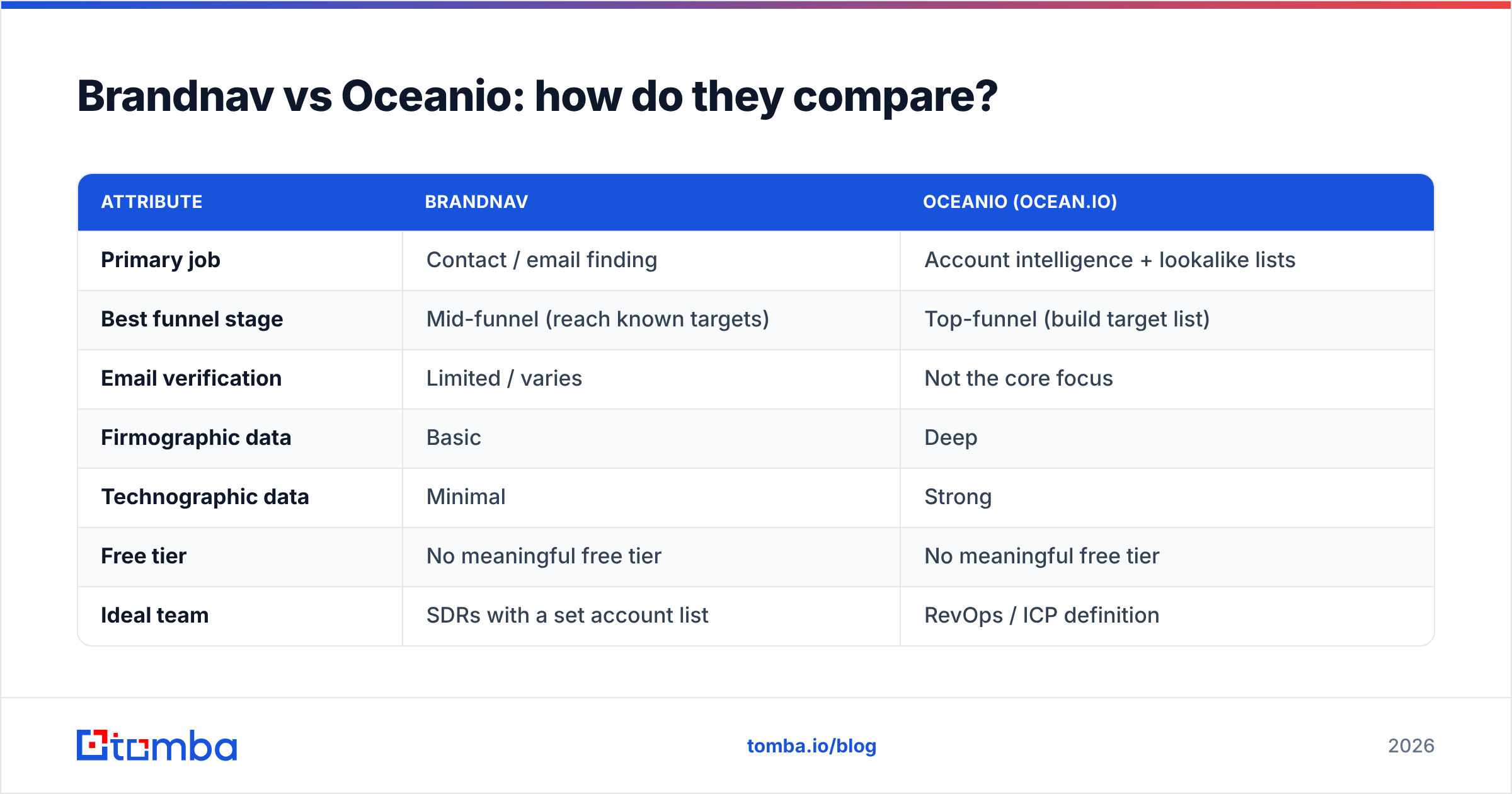
| Attribute | Brandnav | Oceanio (Ocean.io) |
|---|---|---|
| Primary job | Contact / email finding | Account intelligence + lookalike lists |
| Best funnel stage | Mid-funnel (reach known targets) | Top-funnel (build target list) |
| Email verification | Limited / varies | Not the core focus |
| Firmographic data | Basic | Deep |
| Technographic data | Minimal | Strong |
| Free tier | No meaningful free tier | No meaningful free tier |
| Ideal team | SDRs with a set account list | RevOps / ICP definition |
| Biggest weakness | List-building depth | Send-ready email accuracy |
The pattern is clear: these tools are complements as often as they are competitors. A RevOps team might use Oceanio to define the target universe, then hand it to SDRs who need verified emails to execute. The gap in the middle — turning an account list into deliverable contacts — is exactly where deliverability problems creep in.
Which tool is more accurate for cold outreach?#
Accuracy is where the comparison gets real, because a bounced email costs you twice: the wasted send and the damage to your sender reputation. Mailbox providers treat high bounce rates as a spam signal, so one sloppy list can drag down deliverability for every campaign that follows.

Neither Brandnav nor Oceanio was built primarily as a verification engine. Oceanio is optimized for finding the right accounts; Brandnav is optimized for returning a contact. Verification — the SMTP-level check that an inbox actually exists and accepts mail — is a separate competency that dedicated providers obsess over.
That's why a common stack looks like this:
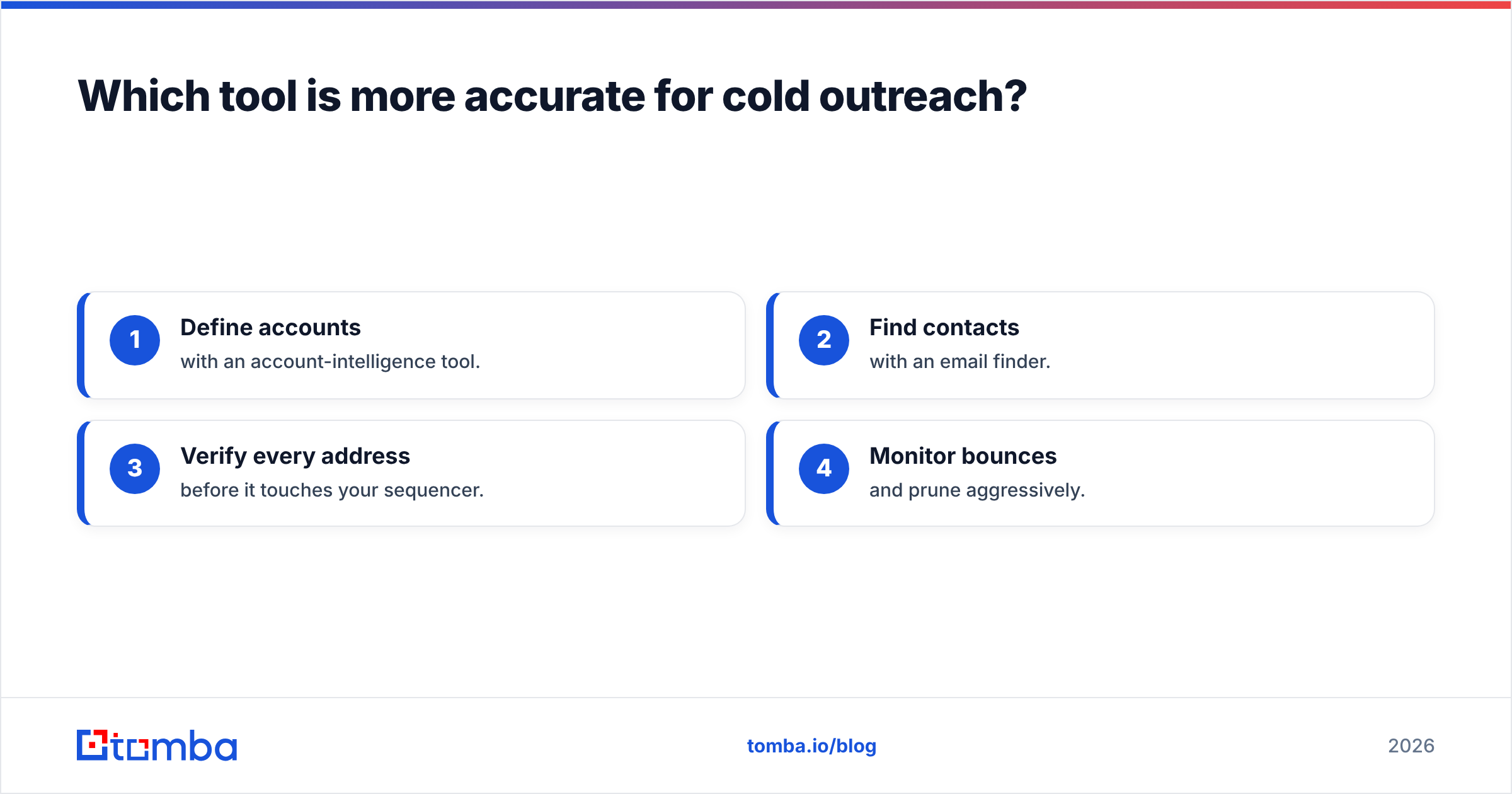
- Define accounts with an account-intelligence tool.
- Find contacts with an email finder.
- Verify every address before it touches your sequencer.
- Monitor bounces and prune aggressively.
Skip step three and your match rate becomes a vanity metric. The teams with the best reply rates aren't the ones with the biggest lists — they're the ones with the cleanest ones.
How much do Brandnav and Oceanio cost?#
Both platforms target mid-market and enterprise buyers, and pricing reflects that. Public, self-serve pricing is limited for both — Oceanio in particular tends to route serious buyers through a sales conversation, with plans scaling by data volume, seats, and export limits. Brandnav's contact-data pricing similarly scales with lookup volume.
The practical takeaways:
- Neither is a great fit for a solo founder or a 2-person sales team testing the waters. The entry points assume a funded motion.
- Credits and export caps matter more than the sticker price. A "cheap" plan that throttles exports can cost more per usable contact than a higher tier elsewhere.
- Bundled vs. unbundled. Oceanio bundles account data you may not need if you already have a defined ICP. You can end up paying for intelligence you won't use.
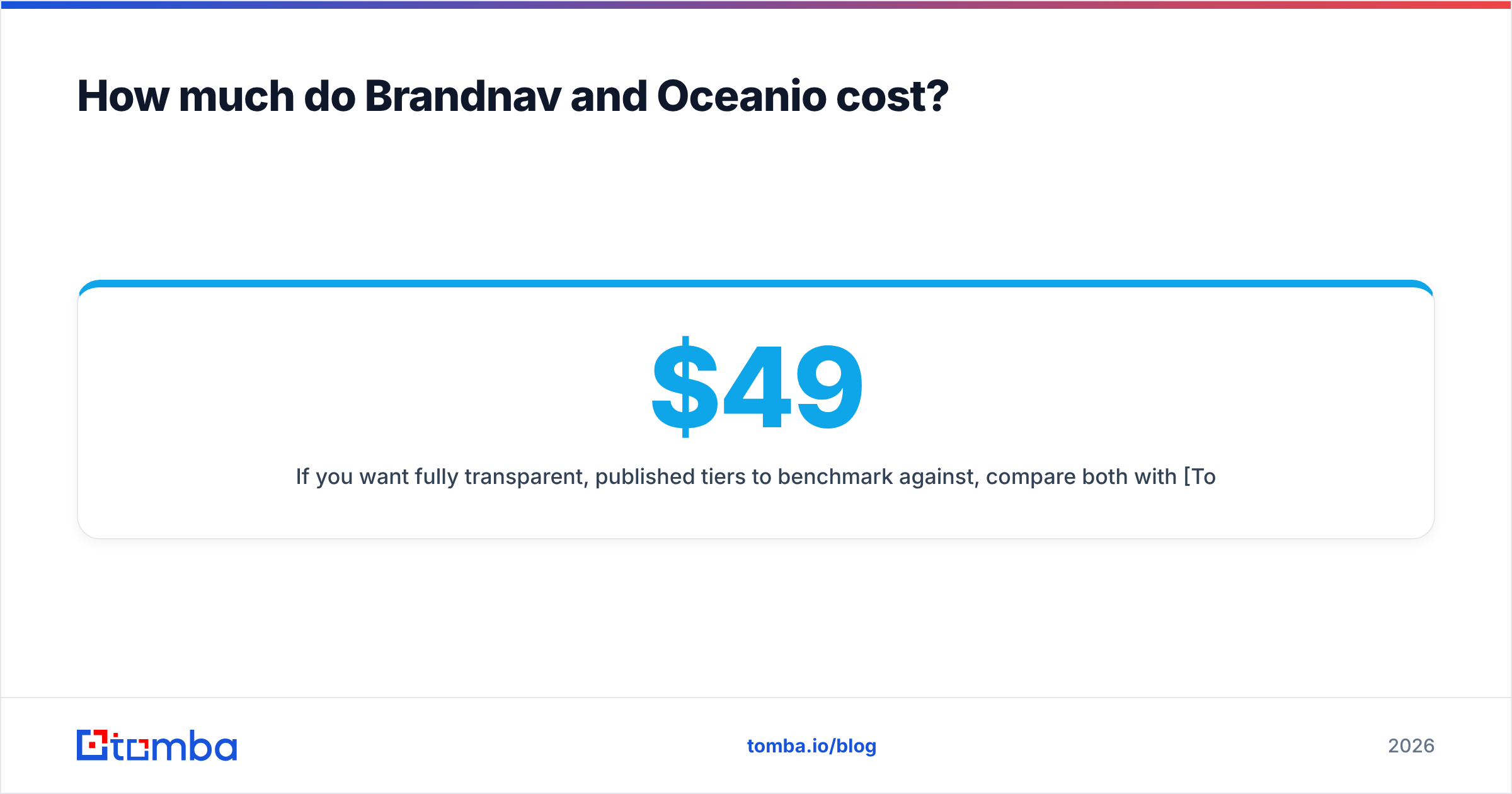
If you want fully transparent, published tiers to benchmark against, compare both with Tomba pricing: a Free tier (25 searches/mo), Starter at $49/mo, Growth at $99/mo, and Pro at $249/mo. The point isn't that cheaper is automatically better — it's that predictable, public pricing makes it far easier to model cost-per-verified-contact before you commit.
When should you pick Brandnav over Oceanio?#
Pick Brandnav when:
- You already know your target accounts and just need reachable contacts.
- Your workflow is contact-first: a rep finds a person, then needs their email.
- You don't need deep technographic or lookalike data to plan territories.
Pick Oceanio when:
- You're still defining or expanding your ideal customer profile.
- Lookalike modeling — "find companies like our best customers" — is the core job.
- Your RevOps team owns list-building and hands curated accounts to SDRs.
The honest answer for many teams is "both, for different stages." The mistake is buying one and expecting it to do the other's job well.
)
Is there a better-value alternative for finding emails?#
If your actual bottleneck is getting verified, send-ready emails — not deciding which accounts to chase — a dedicated email-finding and verification platform usually wins on both accuracy and cost-per-contact.

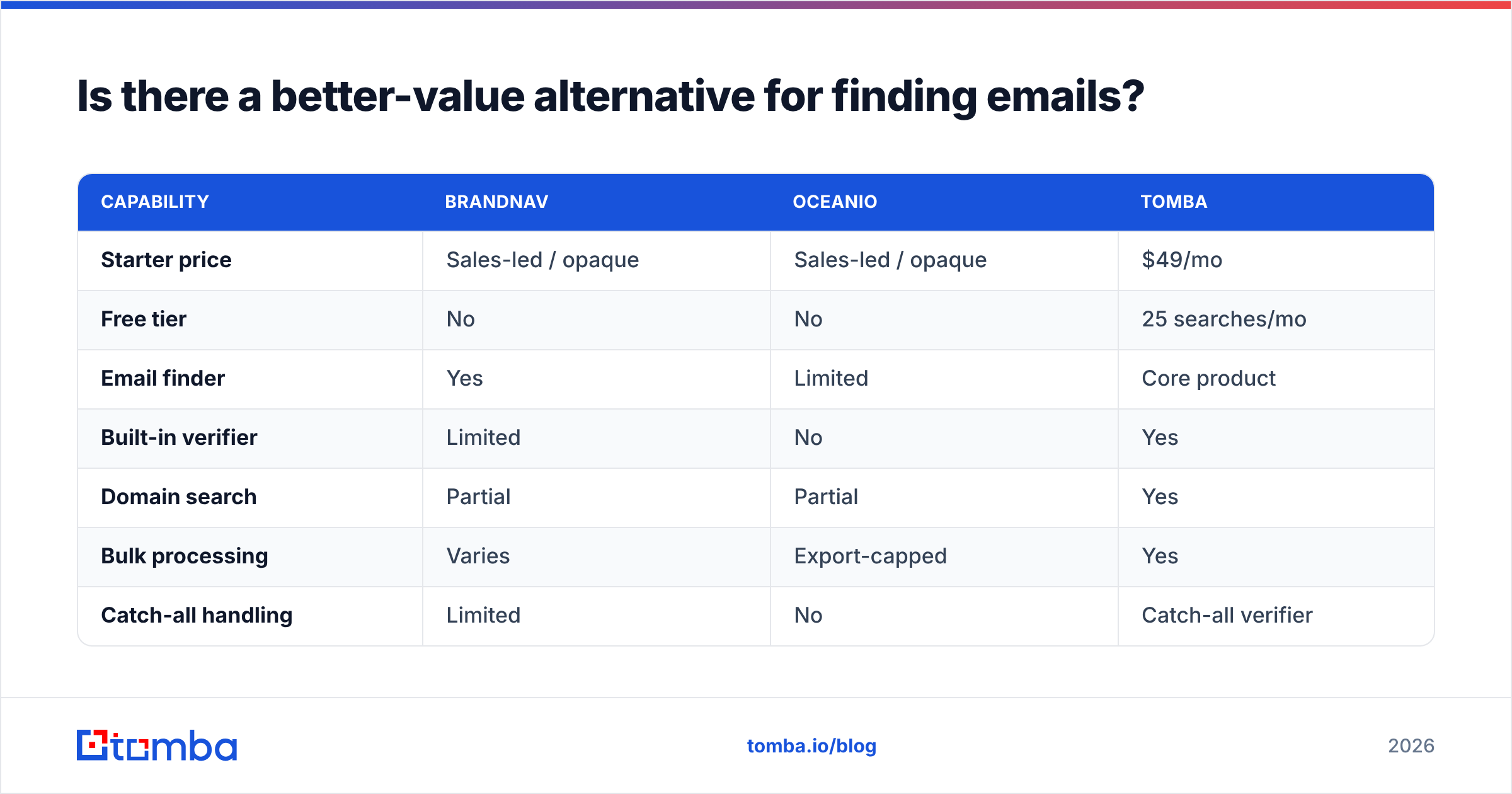
Here's how a focused email-data tool like Tomba stacks up against the two platforms on the contact-data dimension specifically:
| Capability | Brandnav | Oceanio | Tomba |
|---|---|---|---|
| Starter price | Sales-led / opaque | Sales-led / opaque | $49/mo |
| Free tier | No | No | 25 searches/mo |
| Email finder | Yes | Limited | Core product |
| Built-in verifier | Limited | No | Yes |
| Domain search | Partial | Partial | Yes |
| Bulk processing | Varies | Export-capped | Yes |
| Catch-all handling | Limited | No | Catch-all verifier |
| API access | Varies | Yes | Full REST API |
A few practical advantages worth calling out:
- Verification is built in. Instead of bolting on a separate verifier, Tomba's email verification runs in the same workflow, so addresses are checked before export.
- Domain search for whole-company sweeps. Need every reachable contact at a target account? Domain search returns the patterns and people for a company in one call.
- Catch-all handling. Catch-all domains accept everything at the SMTP layer, which fools naive verifiers. A dedicated catch-all verifier reduces the false-positive trap that inflates bounce rates.
- Transparent, public pricing makes cost-per-verified-contact easy to model — no sales call required to know what you'll pay.
This isn't an argument that Oceanio's account intelligence is worthless — for ICP work, it's genuinely useful. It's an argument that you shouldn't overpay for a bundled data platform when your specific gap is verified emails. Match the tool to the bottleneck.
What does the ideal stack look like?#
For most outbound teams in 2026, the winning setup is layered, not monolithic:
- Targeting layer — an account-intelligence tool (Oceanio-style) to define and expand your ICP, if list-building is a real constraint for you.
- Contact layer — a precise email finder to turn accounts and names into addresses.
- Hygiene layer — verification and catch-all checks before anything reaches your sequencer.
- Execution layer — your sequencer or CRM, protected by good email deliverability hygiene.
The expensive mistake is collapsing all four into one vendor and assuming the bundle does each job well. It rarely does. Buy the targeting tool for targeting, and buy the contact-data tool for contacts.
Brandnav vs Oceanio: the verdict#
Neither tool is a knockout winner because they're built for different jobs. Oceanio wins top-funnel account intelligence and lookalike list-building. Brandnav wins as a more contact-focused finder when you already know who you're chasing. If you're forced to pick one and your motion is account-based, Oceanio's data depth justifies its price; if your reps just need emails, Brandnav's narrower focus is closer to what you actually use.
But if you zoom out and ask "where does my pipeline actually leak?", the answer for most teams is deliverable contact data — and that's a problem a dedicated email-finding-and-verification platform solves more cheaply and more accurately than either bundled tool.
If verified emails are your bottleneck, start with the Tomba Email Finder. Find professional addresses by domain, name, or company, verify them in the same workflow, and export a clean list — with a free tier to test accuracy on your own data before you pay a cent. Compare the results against your current stack and let cost-per-verified-contact, not the marketing page, decide the winner.
// get started
Find, verify and enrich your first contacts today
Start on the free plan with 25 searches a month, then scale when your team is ready.
Free plan · No credit card required · GDPR & CCPA
// about the author