Brandnav vs Outboundview: B2B Lead Data Compared (2026)
Choosing between Brandnav and Outboundview for B2B lead data? Here's an honest 2026 breakdown of accuracy, pricing, and fit — plus a faster alternative.
Picking a B2B data source is really a bet on two things: how accurate the contacts are, and how much control you keep over the process. Brandnav and Outboundview sit on opposite ends of that spectrum — one sells you data and tooling, the other sells you a done-for-you outbound motion. This breakdown shows where each one earns its price in 2026, and where a self-serve email finder beats both.
TL;DR — Brandnav vs Outboundview at a glance#
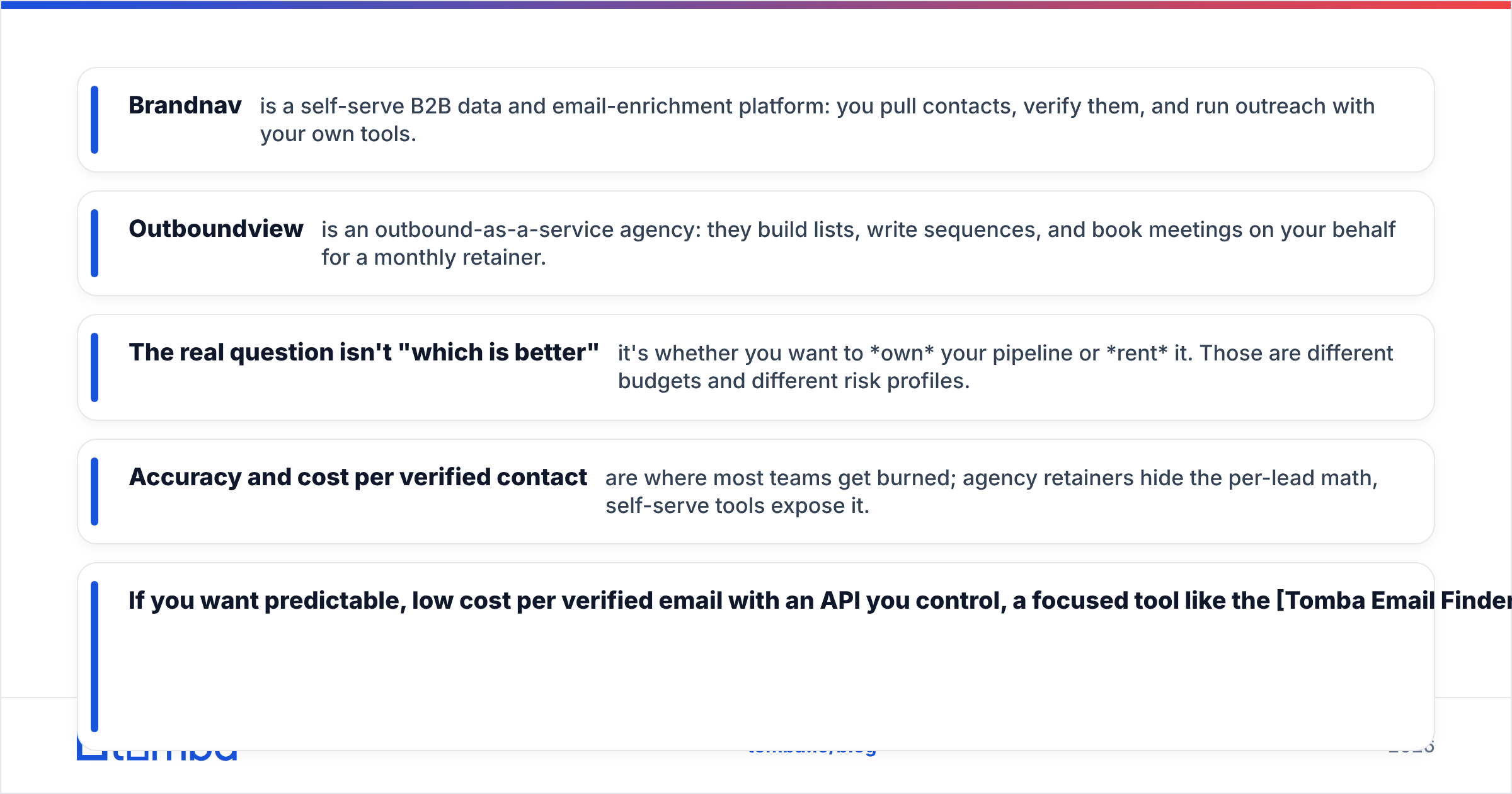
- Brandnav is a self-serve B2B data and email-enrichment platform: you pull contacts, verify them, and run outreach with your own tools.
- Outboundview is an outbound-as-a-service agency: they build lists, write sequences, and book meetings on your behalf for a monthly retainer.
- The real question isn't "which is better" — it's whether you want to own your pipeline or rent it. Those are different budgets and different risk profiles.
- Accuracy and cost per verified contact are where most teams get burned; agency retainers hide the per-lead math, self-serve tools expose it.
- If you want predictable, low cost per verified email with an API you control, a focused tool like the Tomba Email Finder usually beats both on price and flexibility.
What is Brandnav?#
Brandnav is a software product. You log in, search for companies or people, and it returns business contact data — emails, sometimes phone numbers and firmographics — that you export or push into your CRM. The model is pay-for-access: you buy credits or a seat, and the volume of data you pull is yours to use across whatever outreach stack you already run.
That makes Brandnav a tooling decision. You're responsible for the strategy: who to target, what to say, how to follow up. The platform's job is to hand you contacts that are accurate enough to email without torching your sender reputation. When a data tool gets that wrong, the damage shows up later as bounces, spam complaints, and a domain that quietly stops landing in inboxes.
Because you keep the workflow, Brandnav fits teams that already have an SDR or a founder doing outbound and just need a reliable contact source plumbed into their process. You can pair it with data enrichment and verification steps to keep list quality high before anything sends.
What is Outboundview?#
Outboundview is a service, not a login. It's an outbound and appointment-setting agency: you pay a monthly retainer, and a team handles list building, copywriting, sending, and (often) early reply handling, then routes booked meetings to your closers. You can read their positioning on the Outboundview website.
The pitch is speed and offloaded effort. You don't hire and train SDRs, you don't manage sequencing software, and you don't babysit deliverability — the agency owns the machine and you get calendar invites. For a founder-led team with no outbound function, that can compress months of hiring into a two-week onboarding.
The trade-off is ownership and unit economics. You're renting a pipeline. When the contract ends, the lists, the learnings, and the sending infrastructure usually leave with the agency. And because the cost is a flat retainer, your real cost-per-meeting swings wildly with how well the campaign performs — good months feel cheap, slow months feel brutal.
Brandnav vs Outboundview: how do they actually compare?#
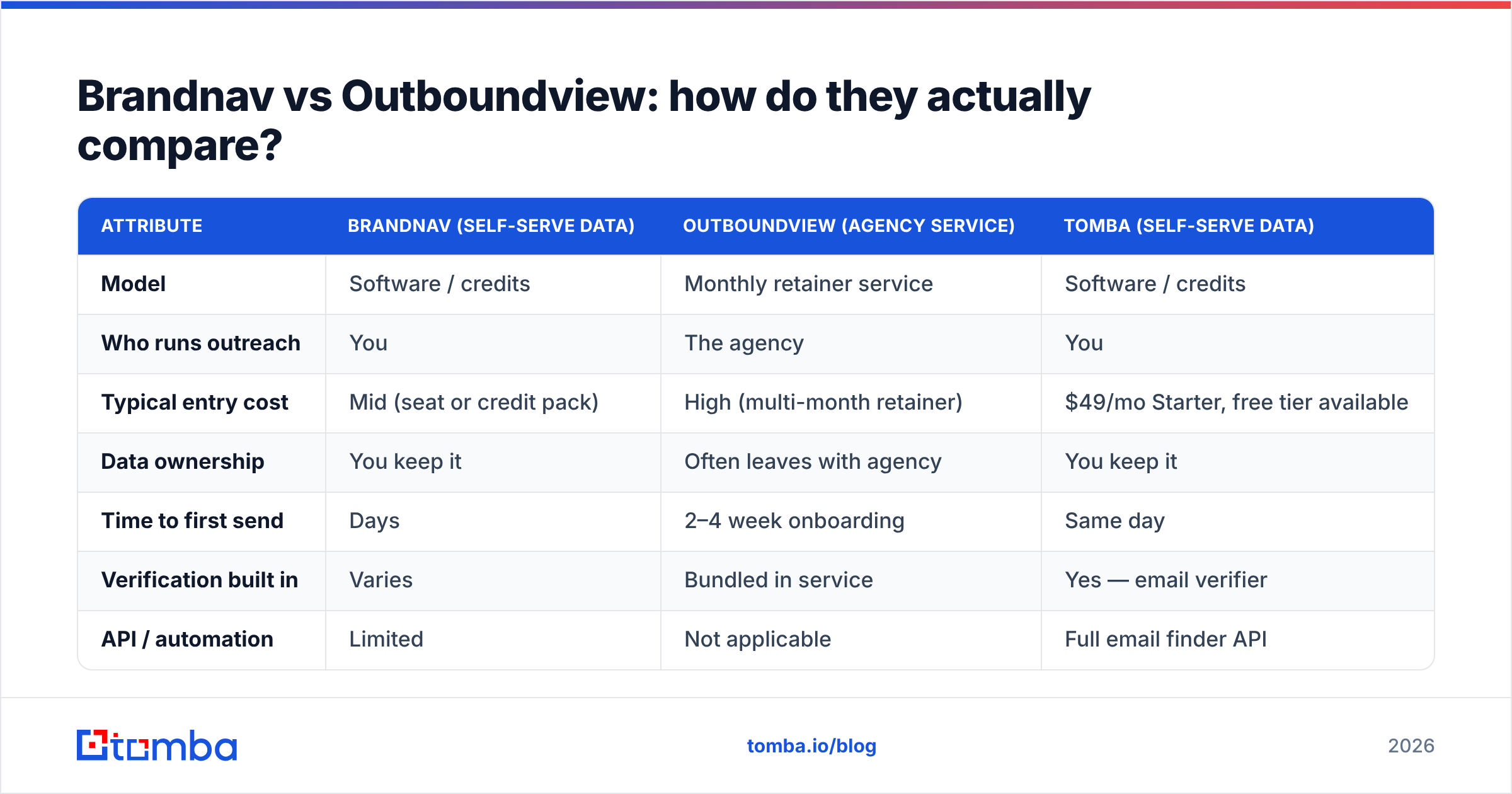
The honest comparison isn't feature-by-feature, because they're not the same kind of thing. One is a data product you operate; the other is a service that operates for you. Here's the practical breakdown most buyers actually care about.
| Attribute | Brandnav (self-serve data) | Outboundview (agency service) | Tomba (self-serve data) |
|---|---|---|---|
| Model | Software / credits | Monthly retainer service | Software / credits |
| Who runs outreach | You | The agency | You |
| Typical entry cost | Mid (seat or credit pack) | High (multi-month retainer) | $49/mo Starter, free tier available |
| Data ownership | You keep it | Often leaves with agency | You keep it |
| Time to first send | Days | 2–4 week onboarding | Same day |
| Verification built in | Varies | Bundled in service | Yes — email verifier |
| API / automation | Limited | Not applicable | Full email finder API |
| Best for | Teams with an outreach motion | Teams with budget, no SDRs | Teams scaling cost-efficient outbound |
Read that table as three columns of trade-offs. Brandnav and Tomba compete directly — both are data tools you control. Outboundview competes for a different budget line entirely: it's closer to hiring than to buying software.
Which delivers better data accuracy?#
Accuracy is the metric that decides everything downstream, and it's measured the same way regardless of vendor: what percentage of the emails you send actually reach a real, monitored inbox. A list that looks big but bounces 15% of the time will quietly damage your sender reputation and drag down every campaign that follows.

With an agency like Outboundview, accuracy is the agency's problem — until it isn't. You don't see the bounce rate directly; you see the meeting count. If the underlying data is weak, you feel it as underperformance, not as a number you can audit. That opacity is fine when results are strong and frustrating when they're not, because you can't tell whether the copy, the targeting, or the list is the weak link.
With a self-serve tool, accuracy is visible and yours to control. You can run every address through a catch-all verifier before sending, sample-test a list, and cut the dead weight yourself. The discipline takes effort, but it means you always know your real cost per verified contact — not your cost per claimed contact. For high-volume work, a bulk email finder plus verification keeps that number honest at scale.
The general rule: a tool that exposes verification puts accuracy in your hands, while a service that hides it asks you to trust the outcome. Neither is wrong — they suit different temperaments and different reporting needs.
What does Brandnav vs Outboundview cost in practice?#
This is where the comparison gets concrete, and where buyers most often miscalculate. The two pricing models aren't comparable on their face.
- Agency retainers bundle labor + data + tools. Outboundview's price covers people writing and managing campaigns, not just contacts. That's why it sits well above any software subscription — you're paying for a team.
- Self-serve data prices the contacts only. Brandnav and similar tools charge for access and volume; the labor of running outreach is your cost, paid in your team's time.
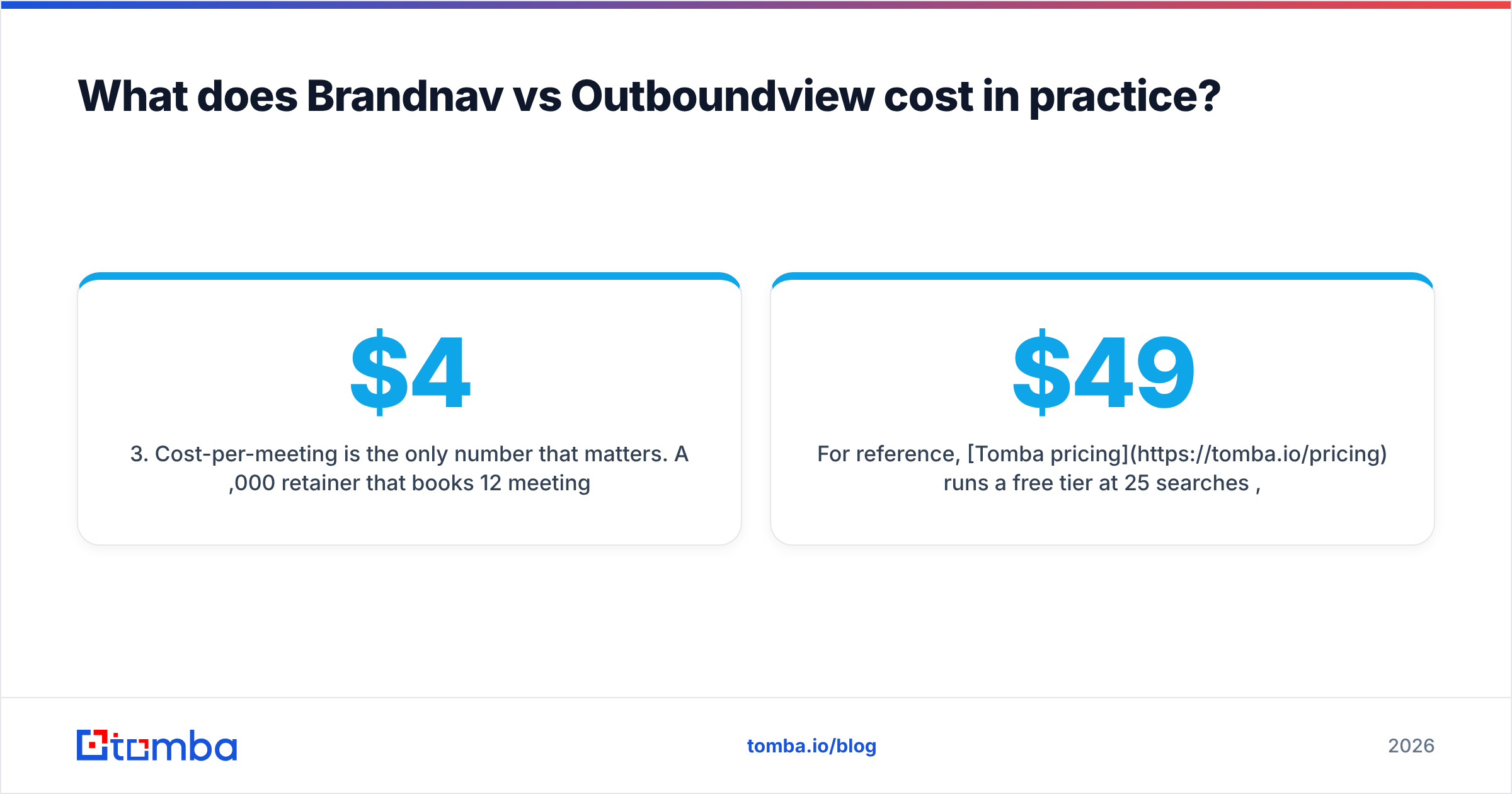
- Cost-per-meeting is the only number that matters. A $4,000/mo retainer that books 12 meetings costs ~$333 per meeting. A $99/mo tool that books 12 meetings costs ~$8 per meeting in software — but you spent SDR hours to get there.
- Hidden cost #1: ramp. Agencies need weeks to warm up; tools start today but need your time to operate well.
- Hidden cost #2: deliverability. Bad data inflates every downstream cost. Verifying up front with an email verifier is cheaper than rebuilding a burned domain.
For reference, Tomba pricing runs a free tier at 25 searches/mo, Starter at $49/mo, Growth at $99/mo, and Pro at $249/mo — an entire year of which often costs less than a single month of agency retainer. That doesn't make the agency wrong; it makes the math explicit. You're choosing between paying for outcomes and paying for capacity.
When should you choose an agency like Outboundview?#
Pick the agency model when your constraint is people and time, not money. Specifically:
- You have budget but no outbound function and no appetite to build one this quarter.
- You need meetings booked now and can't wait to hire and ramp SDRs.
- Your founders are the bottleneck and their hours are worth more elsewhere.
- You want to test whether outbound works for your offer before investing in headcount.
In those situations, renting a working machine is rational. Just go in clear-eyed: you're trading ownership and unit-cost transparency for speed and offloaded effort. Negotiate for data portability up front — ask what happens to the lists and learnings when the contract ends, because the default answer is "they stay with us."
When should you run it yourself with a data tool?#
Choose self-serve when you want to own the pipeline and control the unit economics. This fits most teams that plan to do outbound for more than a quarter:
- You already have an SDR, a founder, or a growth hire who can run sequences.
- You want predictable, low cost per verified contact you can audit.
- You need an email finder API or integrations to wire data into an existing stack.
- You're scaling and want the data, the lists, and the learnings to stay in-house.
The catch is that you own the work too: targeting, copy, deliverability, follow-up. But you also keep every asset you build, and your cost structure stays flat as you scale instead of climbing with every retainer renewal. You can compare options on independent review sites like G2 and Capterra before committing — both list verified user reviews for data and outreach tools.
Is there a better alternative to both?#
For most teams reading a "Brandnav vs Outboundview" comparison, the real answer is a focused, self-serve email finder that gives you agency-grade data without the retainer. That's the lane Tomba sits in.
The reason it wins on this specific comparison is fit-to-job. You don't need a full outbound team's overhead to get accurate contacts — you need a reliable finder, built-in verification, and an API that drops into whatever you already run. Tomba's core is the email finder, with an email verifier, domain search, catch-all checks, and data enrichment alongside it — the same building blocks an agency uses, priced as software you control.

Concretely, that means you can start free, verify before you send, keep every contact you pull, and scale on a flat subscription instead of a climbing retainer. If outbound is a function you intend to keep, owning the data layer almost always beats renting the whole motion.
How to decide in five minutes#
Run this quick test against your own situation:
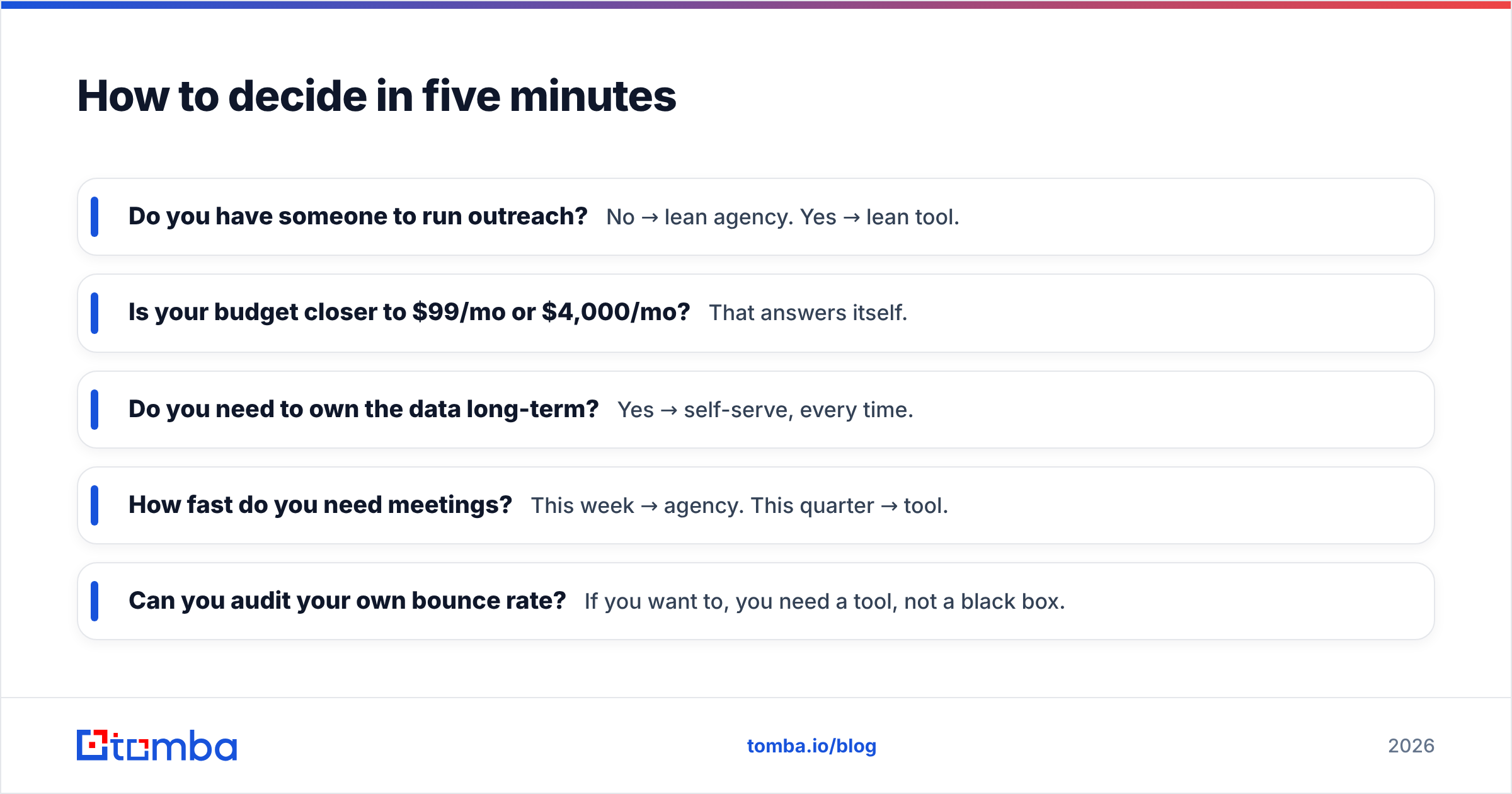
- Do you have someone to run outreach? No → lean agency. Yes → lean tool.
- Is your budget closer to $99/mo or $4,000/mo? That answers itself.
- Do you need to own the data long-term? Yes → self-serve, every time.
- How fast do you need meetings? This week → agency. This quarter → tool.
- Can you audit your own bounce rate? If you want to, you need a tool, not a black box.
Most teams that ask "Brandnav vs Outboundview" already have outbound ambitions and a tight budget — which points to self-serve data with verification baked in.
The bottom line#
Brandnav and Outboundview solve different problems. Brandnav (and self-serve data generally) gives you accurate contacts to run with; Outboundview gives you an outsourced team that runs them for you. The agency wins on speed and offloaded effort; the tool wins on ownership, transparency, and cost per verified contact over time.
If you want the data quality without the retainer — start free, verify every address before it sends, and keep what you build — try the Tomba Email Finder. Pull your first contacts on the free tier today, check the numbers against your own bounce rate, and scale on a plan that stays flat as your pipeline grows.
// get started
Find, verify and enrich your first contacts today
Start on the free plan with 25 searches a month, then scale when your team is ready.
Free plan · No credit card required · GDPR & CCPA
// about the author