Brandnav vs Prosperfleet Valgen: 2026 B2B Tool Comparison
A neutral, side-by-side breakdown of Brandnav vs Prosperfleet Valgen — features, pricing logic, data quality, and team fit — so you can pick the right B2B platform in 2026.
Choosing between two niche B2B platforms is rarely about which one has the longer feature list. It comes down to which one fits how your team actually sells, what your data hygiene looks like, and what you'll pay as you scale. This guide compares Brandnav vs Prosperfleet Valgen on the dimensions that move pipeline — and shows where a dedicated data layer fits regardless of which platform you land on.
TL;DR#
- Brandnav tends to appeal to teams that want an opinionated, workflow-first interface with fast onboarding and lighter configuration.
- Prosperfleet Valgen leans toward teams that need deeper customization, granular permissions, and heavier reporting — at the cost of a steeper setup.
- Neither tool replaces a verified contact-data source: both are only as good as the emails and phone numbers you feed them.
- Pricing for both scales with seats and usage, so model your real team size before committing — not the entry tier.
- Pair either platform with a dedicated email finder and email verifier to keep bounce rates low and deliverability healthy.
What are Brandnav and Prosperfleet Valgen?#
Both Brandnav and Prosperfleet Valgen sit in the broader B2B sales-tooling category: software that helps revenue teams organize prospects, run outreach, and track activity toward closed deals. They overlap enough that buyers routinely shortlist them together, which is exactly why the "vs" question keeps coming up.
The honest framing: these are emerging, lower-profile tools rather than household names like Salesforce or HubSpot. That has trade-offs. You often get more responsive support and sharper pricing from a challenger product, but you also inherit a smaller integration ecosystem and a thinner public track record. When you evaluate either one, weight your decision on your own test data, not on marketing pages.
A useful way to think about it: the platform is the kitchen, but your contact data is the ingredients. A beautiful kitchen with stale ingredients still produces a bad meal. That distinction matters for everything below.

How do Brandnav and Prosperfleet Valgen compare?#
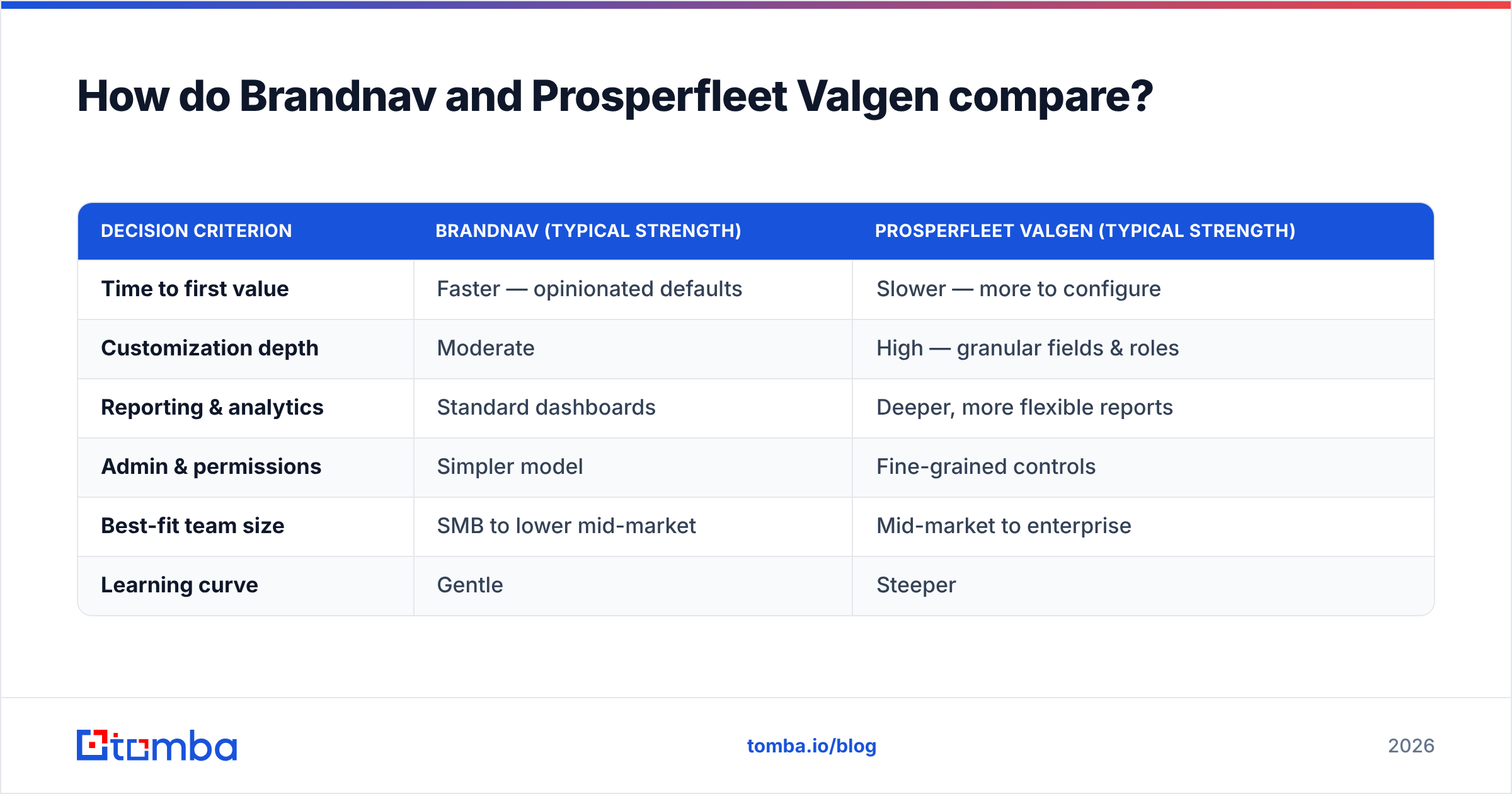
Because both vendors iterate quickly, treat any spec sheet as a snapshot. The most durable way to compare them is by decision criteria rather than by today's exact feature toggles. Here's the framework we'd use for any brandnav vs prosperfleet valgen evaluation:
| Decision criterion | Brandnav (typical strength) | Prosperfleet Valgen (typical strength) |
|---|---|---|
| Time to first value | Faster — opinionated defaults | Slower — more to configure |
| Customization depth | Moderate | High — granular fields & roles |
| Reporting & analytics | Standard dashboards | Deeper, more flexible reports |
| Admin & permissions | Simpler model | Fine-grained controls |
| Best-fit team size | SMB to lower mid-market | Mid-market to enterprise |
| Learning curve | Gentle | Steeper |
This table is a starting hypothesis, not gospel — confirm each row against a live trial. The pattern it captures is common in challenger-vs-challenger comparisons: one tool optimizes for speed and simplicity, the other for control and depth.
Which criteria actually decide the deal?#
When you run the comparison, score these in order of impact:
- Data portability — Can you export your records cleanly if you leave? Lock-in is the most expensive hidden cost.
- Integration coverage — Does it connect to your CRM, calendar, and enrichment stack without brittle workarounds?
- Per-seat economics — What's the real cost at your actual headcount, not the advertised entry price?
- Permission granularity — Can managers see what they need without exposing everything to everyone?
- Support responsiveness — For smaller vendors, support quality is part of the product.
- Roadmap transparency — Is the vendor public about what's shipping next?
If two tools tie on features, these six usually break the tie.
Is Brandnav better than Prosperfleet Valgen?#
There's no universal winner — there's only a better fit for your situation. Use these profiles:
- Pick the simpler, faster tool (Brandnav-style) if you're a small or growing team that values quick onboarding, you don't need deep custom fields, and you'd rather your reps spend time selling than configuring.
- Pick the deeper, more configurable tool (Prosperfleet Valgen-style) if you're mid-market or larger, you have RevOps capacity to maintain the system, and your reporting and permission requirements are genuinely complex.
Cross-check both against independent reviews on G2 and Capterra before you trust any vendor's own claims, and look at how recent the reviews are — an active review stream signals an actively maintained product. For category context and definitions, Gartner is a reasonable neutral reference on how sales-tech segments are defined.
What about the data layer both tools depend on?#
Here's the part most comparisons skip: neither Brandnav nor Prosperfleet Valgen is a contact-data provider. They help you act on contacts. The accuracy of those contacts is a separate problem — and it's the one that most directly determines whether your outreach lands or bounces.
If you push unverified addresses into either platform, you'll inflate bounce rates, hurt sender reputation, and slowly degrade email deliverability across the whole domain. That damage follows you no matter which sales tool you chose.
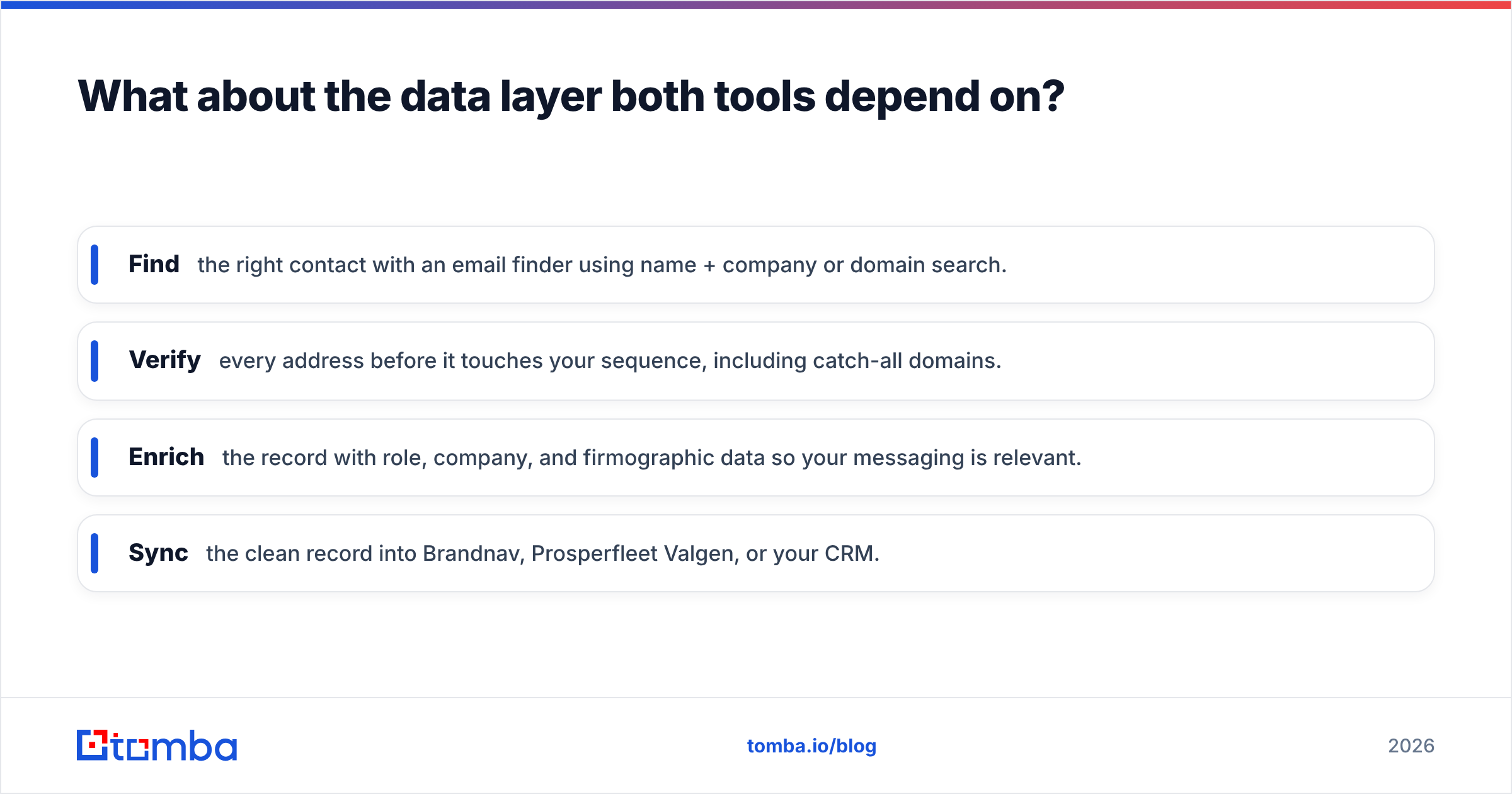
This is where a dedicated data stack earns its place. A typical healthy workflow looks like:
- Find the right contact with an email finder using name + company or domain search.
- Verify every address before it touches your sequence, including catch-all domains.
- Enrich the record with role, company, and firmographic data so your messaging is relevant.
- Sync the clean record into Brandnav, Prosperfleet Valgen, or your CRM.
Doing this before import keeps your chosen platform clean from day one, instead of letting it fill with dead records you pay to store.
How does pricing compare, and where does Tomba fit?#
Both Brandnav and Prosperfleet Valgen price on a mix of seats and usage, and both tend to reserve their best features for higher tiers — so always model the plan you'll be on in 12 months, not the trial. Because their public pricing shifts, confirm current numbers directly with each vendor rather than trusting any third-party figure.
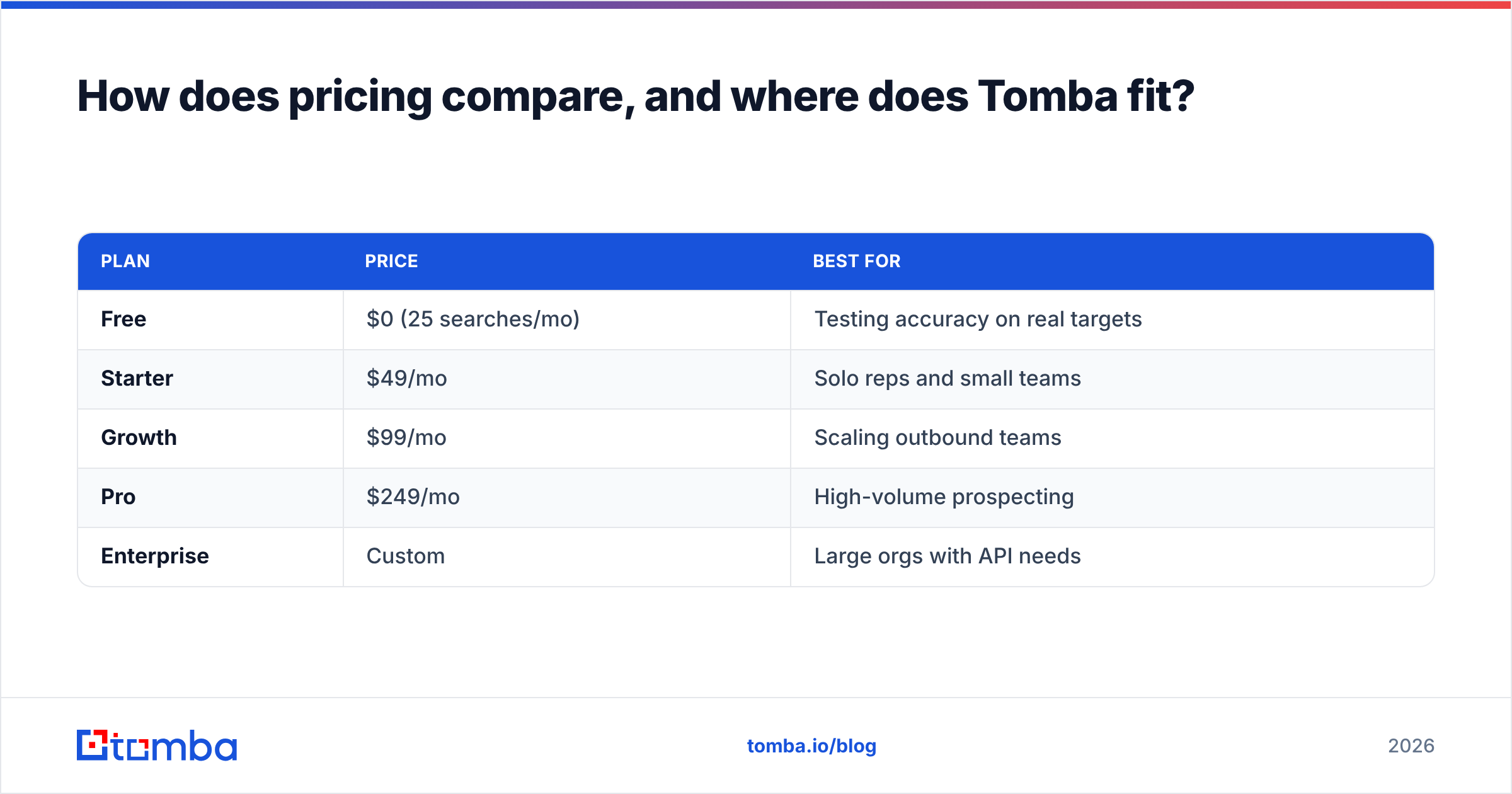
What you can anchor on is the cost of the data layer. Tomba's pricing is transparent and predictable, which makes it easy to budget alongside whichever sales platform you choose:
| Plan | Price | Best for |
|---|---|---|
| Free | $0 (25 searches/mo) | Testing accuracy on real targets |
| Starter | $49/mo | Solo reps and small teams |
| Growth | $99/mo | Scaling outbound teams |
| Pro | $249/mo | High-volume prospecting |
| Enterprise | Custom | Large orgs with API needs |
See full Tomba pricing for current credit allowances and add-ons. The point isn't that Tomba replaces Brandnav or Prosperfleet Valgen — it's that it sits underneath either one, supplying the verified contacts that make the platform worth paying for.
A quick total-cost reminder#
When you budget, add three line items, not one:
- Platform seats (Brandnav or Prosperfleet Valgen).
- Data + verification (your email finder and verifier).
- Integration/ops time (the hours someone spends keeping it all in sync).
Teams that only budget for #1 are the ones who feel blindsided in month three.
What does a real evaluation process look like?#
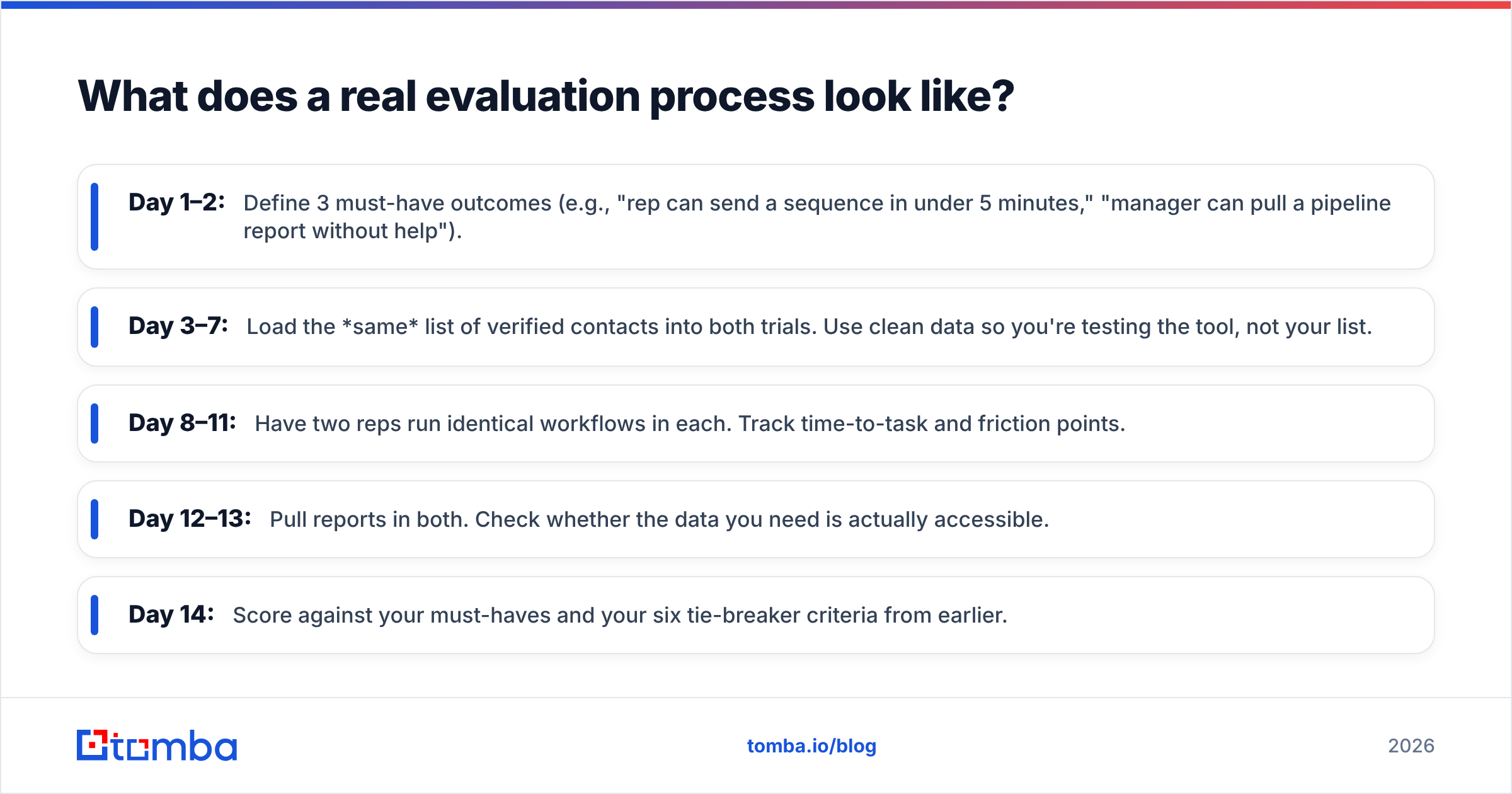
Skip the feature-checklist trap. Run a structured 14-day bake-off instead:
- Day 1–2: Define 3 must-have outcomes (e.g., "rep can send a sequence in under 5 minutes," "manager can pull a pipeline report without help").
- Day 3–7: Load the same list of verified contacts into both trials. Use clean data so you're testing the tool, not your list.
- Day 8–11: Have two reps run identical workflows in each. Track time-to-task and friction points.
- Day 12–13: Pull reports in both. Check whether the data you need is actually accessible.
- Day 14: Score against your must-haves and your six tie-breaker criteria from earlier.
Using identical, verified input data in both trials is what makes the comparison fair. If one tool gets a clean list and the other gets a messy one, you're measuring your data hygiene, not the software. Run your test list through data enrichment and verification first so both platforms compete on equal footing.
Common mistakes when comparing the two#
- Comparing entry tiers. The cheapest plan rarely reflects what you'll actually use. Compare the realistic tier.
- Ignoring export. If you can't get your data out cleanly, you don't own it.
- Trusting demo data. Vendor demos use perfect, staged records. Your reality is messier — test with your own contacts.
- Skipping verification. Importing unverified emails into either tool guarantees bounces and reputation damage.
- Overweighting features you won't use. A long feature list is not value; adoption is.
Avoiding these five keeps your brandnav vs prosperfleet valgen decision grounded in how you'll actually operate.
Frequently asked questions#
Is Brandnav or Prosperfleet Valgen better for small teams? Smaller teams usually favor the faster-to-onboard, less-configurable option, since they lack dedicated RevOps capacity to maintain a complex system. Larger teams with reporting and permission needs lean the other way.
Do either of these tools find or verify emails? They're sales-workflow platforms, not data providers. You'll still want a dedicated email verifier and finder to source and validate contacts before importing them.
How do I avoid vendor lock-in? Confirm clean data export and API access before you sign. Keep your master contact records in a system you control, and treat the sales platform as an interchangeable layer on top.
Can I use Tomba with either platform? Yes. Tomba supplies verified contacts that you sync into whichever platform you choose, through CSV, integrations, or the Tomba API.
The bottom line#
Brandnav and Prosperfleet Valgen solve the same broad problem from opposite ends: one optimizes for speed and simplicity, the other for depth and control. Match the tool to your team's size and operational maturity, run a fair side-by-side test on identical data, and budget for the data layer — not just the seats.
Whichever platform wins your bake-off, the contacts you feed it decide your results. Start by sourcing accurate, verified professional emails with the Tomba Email Finder — find prospects by name, company, or domain, verify them before they hit your sequence, and import a clean list into Brandnav or Prosperfleet Valgen from day one. Try it free with 25 searches a month and see the difference verified data makes before you commit a cent to either platform.
// get started
Find, verify and enrich your first contacts today
Start on the free plan with 25 searches a month, then scale when your team is ready.
Free plan · No credit card required · GDPR & CCPA
// about the author