Brandnav vs Pubrio: Which B2B Data Tool Wins in 2026?
Brandnav vs Pubrio compared on accuracy, pricing, coverage, and verification — plus where a dedicated email finder like Tomba beats both on cost per valid lead.
You're choosing between two B2B data platforms, and the marketing pages both promise the same thing: accurate contacts, fresh emails, instant enrichment. The problem is that "accurate" is doing a lot of unverified work in both pitches. This breakdown puts Brandnav vs Pubrio side by side on the things that actually drain your budget — match rates, bounce rates, credit math, and verification depth — and shows where a focused tool like Tomba changes the cost-per-valid-lead equation entirely.
TL;DR#
- Brandnav leans toward broad brand/company data and enrichment; Pubrio positions as an all-in-one prospecting database with intent signals. Both bundle email finding into a wider suite.
- The number that matters isn't headline database size — it's valid emails per credit spent. Bundled suites often inflate matches with unverified or catch-all addresses.
- For pure email finding and verification, a dedicated tool typically delivers a lower bounce rate and clearer pricing than a do-everything platform.
- Tomba starts free (25 searches/mo), with Starter at $49/mo, and separates finding from verification so you don't pay credits for guesses.
- Pick by job: enrichment-heavy GTM → suite; clean, deliverable outbound lists → dedicated finder + verifier.
What are Brandnav and Pubrio?#
Both are B2B data platforms, but they aim at slightly different buyers.
Brandnav markets itself around company and brand intelligence with contact enrichment layered on top. The pitch is breadth: pull a company, get firmographics, then attach contacts and emails. It appeals to teams that start from an account list and work down to people.
Pubrio positions as an all-in-one prospecting engine — a searchable contact and company database with filters, list building, and intent-style signals meant to feed cold outreach and sales sequences. The pitch is volume and discovery: search by criteria, build a list, export.
The thing to understand before comparing prices: when a platform bundles finding, enrichment, and signals, the email you get at the end is often a byproduct, not the core engineering focus. That's exactly where bounce rates creep up. A dedicated email finder treats the deliverable address as the product, not a checkbox.
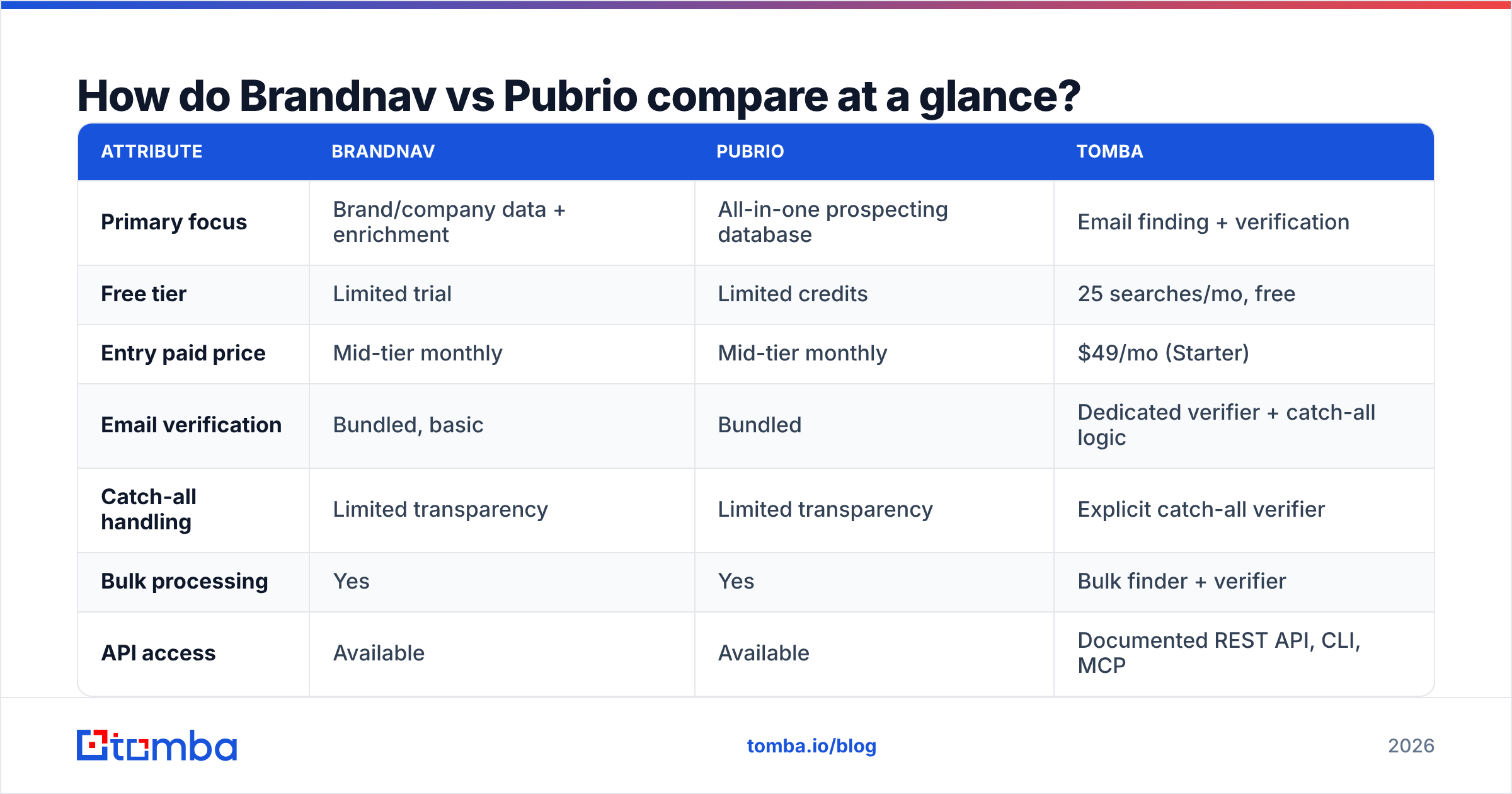
How do Brandnav vs Pubrio compare at a glance?#
Here's the head-to-head on the attributes that move the needle for an outbound or RevOps team. Treat vendor-stated coverage as directional — always validate on your own ICP with a trial before committing budget.
| Attribute | Brandnav | Pubrio | Tomba |
|---|---|---|---|
| Primary focus | Brand/company data + enrichment | All-in-one prospecting database | Email finding + verification |
| Free tier | Limited trial | Limited credits | 25 searches/mo, free |
| Entry paid price | Mid-tier monthly | Mid-tier monthly | $49/mo (Starter) |
| Email verification | Bundled, basic | Bundled | Dedicated verifier + catch-all logic |
| Catch-all handling | Limited transparency | Limited transparency | Explicit catch-all verifier |
| Bulk processing | Yes | Yes | Bulk finder + verifier |
| API access | Available | Available | Documented REST API, CLI, MCP |
| Best for | Account-first enrichment | Discovery + list building | Deliverable outbound lists |
The pattern: the suites win on breadth of fields, while a focused tool wins on the deliverability of the one field most outbound teams actually need. If your sequences die on bounce, breadth doesn't save you.
Which has better data accuracy?#
Accuracy is the whole game, so be specific about what you're measuring. There are three different numbers vendors blur together:
- Match rate — of the contacts you searched, how many returned any email. Easy to inflate; a guessed pattern counts as a match.
- Verified rate — of those matches, how many passed real SMTP verification. This is the number that predicts your bounce rate.
- Catch-all rate — how many sit on domains that accept everything, so you can't confirm the box exists without sending. High catch-all share quietly degrades list quality.
Bundled platforms like Brandnav and Pubrio tend to report match rate prominently and verified rate quietly. When you run a sample, you often find the gap: a 90% "match" that becomes a 60% genuinely-deliverable list once you strip unverified and catch-all addresses. Independent reviews on G2 and Capterra are worth scanning for exactly these complaints before you trust a headline stat.
This is where verification depth matters. Tomba's email verifier and dedicated catch-all verifier exist precisely to close that match-to-deliverable gap, and you can read how Tomba sources and refreshes data on its data page. If you want to sanity-check any provider's output, run the verification step yourself rather than trusting the bundled "verified" flag.

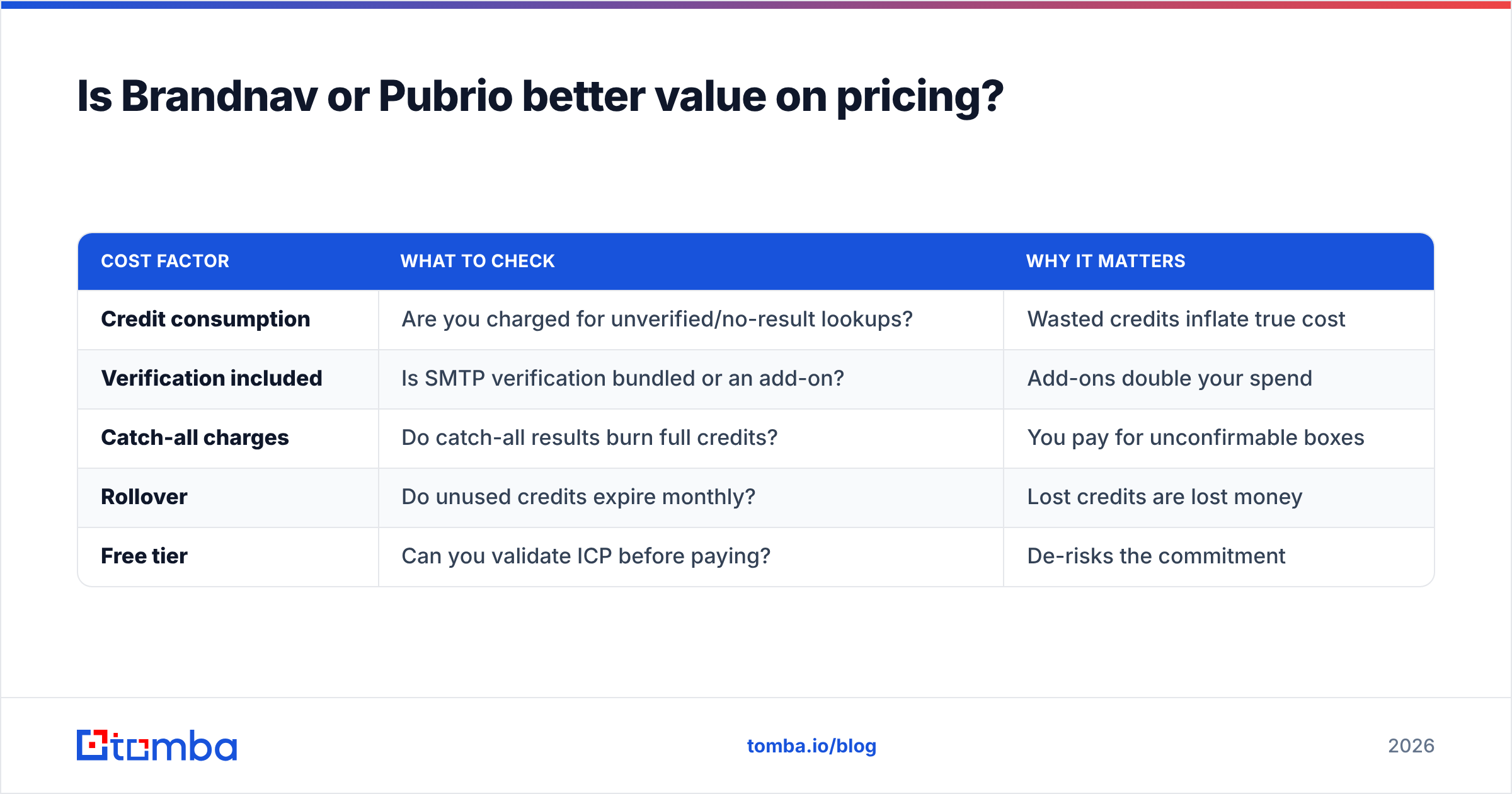
Is Brandnav or Pubrio better value on pricing?#
Value isn't the sticker price — it's cost per valid, deliverable email. Two platforms at the same monthly fee can differ 2x on real cost once you account for wasted credits on unverified or catch-all hits.
Run this simple math before buying any of them:
- Effective cost = monthly price ÷ (credits × verified-deliverable rate)
If a $99 plan gives 5,000 credits but only 60% resolve to deliverable emails, you're paying for 3,000 usable contacts — your real cost per lead is 67% higher than the brochure implies. A plan that returns fewer raw matches but a higher verified rate can be cheaper per usable lead.
| Cost factor | What to check | Why it matters |
|---|---|---|
| Credit consumption | Are you charged for unverified/no-result lookups? | Wasted credits inflate true cost |
| Verification included | Is SMTP verification bundled or an add-on? | Add-ons double your spend |
| Catch-all charges | Do catch-all results burn full credits? | You pay for unconfirmable boxes |
| Rollover | Do unused credits expire monthly? | Lost credits are lost money |
| Free tier | Can you validate ICP before paying? | De-risks the commitment |
Tomba's pricing is deliberately legible against that checklist: a Free tier (25 searches/mo), Starter at $49/mo, Growth at $99/mo, Pro at $249/mo, and Enterprise custom — with finding and verification as distinct steps so you aren't paying search credits to confirm a guess. Whatever you choose, demand that same line-item clarity from Brandnav and Pubrio before you commit.

When should you pick the all-in-one suite?#
Suites earn their keep when the email is genuinely secondary to the workflow. Choose Brandnav or Pubrio when:
- You're account-first. You start from a target company list and need firmographics, technographics, and org structure before you ever touch a person. Brandnav's company-data orientation fits here.
- Discovery is the bottleneck. You don't know who to contact yet and need to search a database by role, industry, and size to build lists from scratch. Pubrio's prospecting filters fit here.
- You want one login. A smaller team that values fewer tools over best-in-class output may accept a higher bounce rate for consolidation.
- Intent signals drive your motion. If timing data shapes who you reach this week, a suite that bundles signals can be worth the trade-off.
If that's you, shortlist the suite — but still pipe the final list through a standalone verifier before sending. The consolidation benefit evaporates the moment your domain reputation takes a hit from bounces. Keep an eye on your sender reputation as the real scoreboard.
When is a dedicated email finder the smarter buy?#
Pick a focused tool when deliverability is the job and everything else is noise. That's the case for most cold-outbound and demand-gen teams. A dedicated finder wins when:
- Bounce rate is a KPI. You're protecting domain reputation and need the cleanest possible list, not the biggest.
- You already have an ICP and accounts. You don't need discovery — you need the right person's confirmed address fast, via domain search or name-based lookup.
- You run at volume. A bulk email finder plus bulk verification beats clicking through a database UI for thousands of contacts.
- You build your own pipeline. A documented Tomba API, CLI, and integrations let you wire finding and verification into your own enrichment flow instead of living in someone else's dashboard.
In practice, many teams run a hybrid: a suite for discovery and account intelligence, then a dedicated finder/verifier as the quality gate before anything reaches a sequence. That combination usually beats trusting any single bundled "verified" flag.

What about verification and catch-all domains?#
This is the detail that separates a 2% bounce list from a 12% one, and it's where bundled suites are typically weakest.
Catch-all (accept-all) domains accept mail for any address, so a standard SMTP check returns "valid" even for a box that doesn't exist. If a platform counts catch-all hits as verified — as many do silently — your list looks clean and bounces anyway. The fix is a finder that flags catch-all status explicitly and a verifier that applies extra logic instead of waving it through.
A disciplined verification flow looks like this:
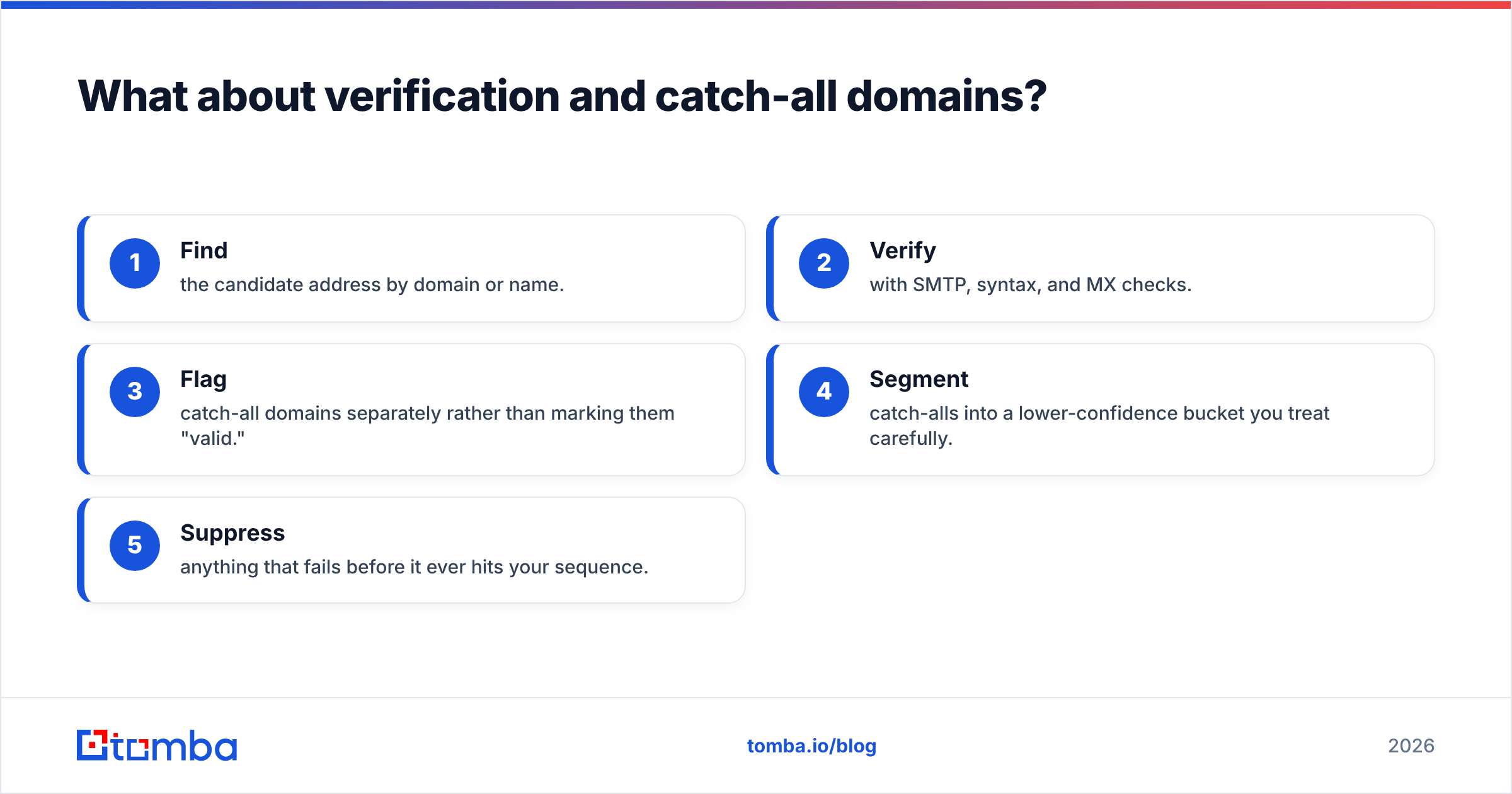
- Find the candidate address by domain or name.
- Verify with SMTP, syntax, and MX checks.
- Flag catch-all domains separately rather than marking them "valid."
- Segment catch-alls into a lower-confidence bucket you treat carefully.
- Suppress anything that fails before it ever hits your sequence.
When you evaluate Brandnav vs Pubrio, ask each vendor directly how they label catch-all results. If the answer is vague, assume those addresses are inflating the "verified" number you're paying for. Strong email deliverability is downstream of honest verification, not big database claims.
Brandnav vs Pubrio vs Tomba: the verdict#
There's no universal winner — there's a winner for your motion:
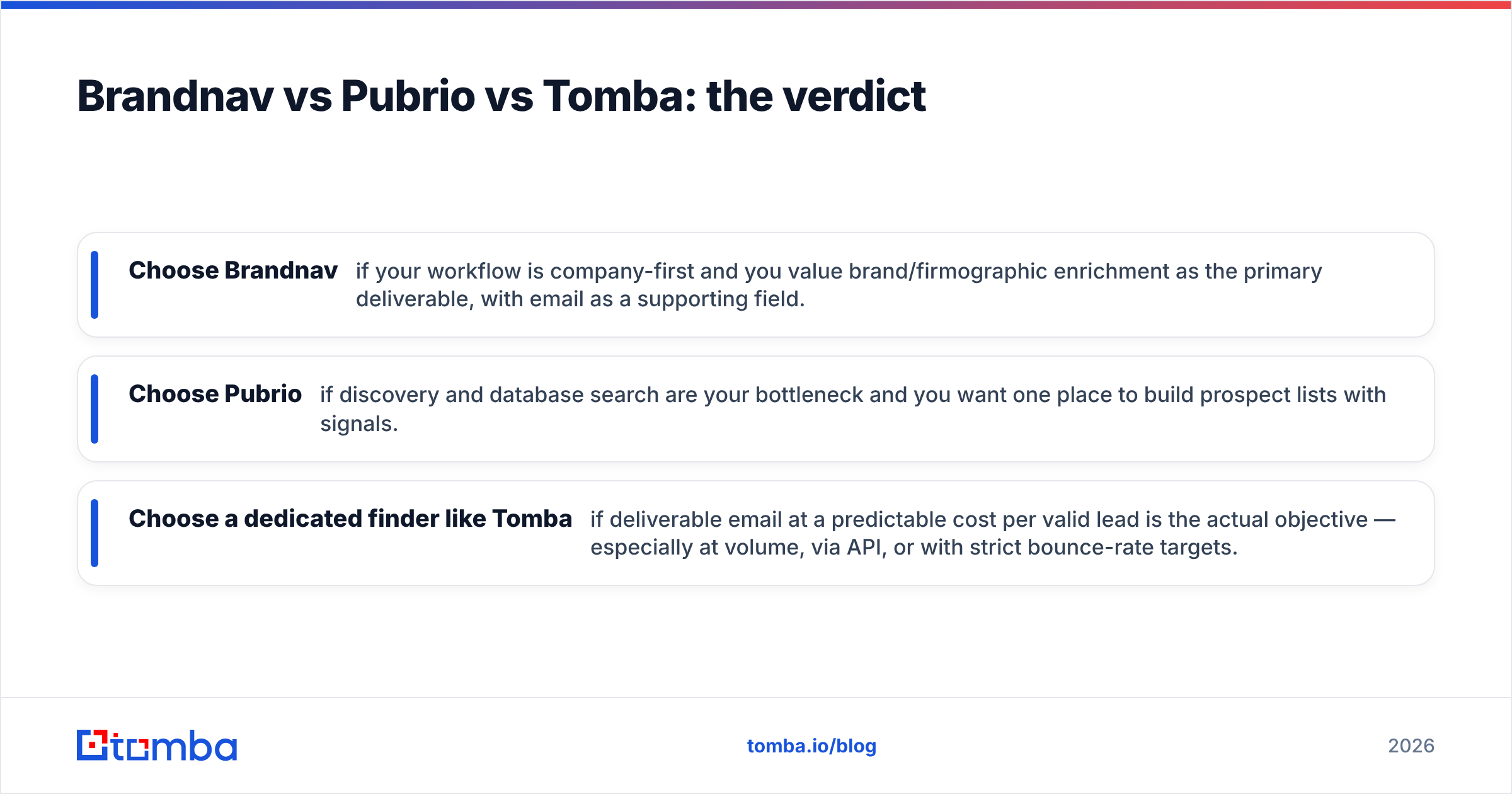
- Choose Brandnav if your workflow is company-first and you value brand/firmographic enrichment as the primary deliverable, with email as a supporting field.
- Choose Pubrio if discovery and database search are your bottleneck and you want one place to build prospect lists with signals.
- Choose a dedicated finder like Tomba if deliverable email at a predictable cost per valid lead is the actual objective — especially at volume, via API, or with strict bounce-rate targets.
The honest framing: suites optimize for breadth of data; a focused tool optimizes for the quality of the one field your campaigns live or die on. Most outbound teams need the second thing more than they admit, which is why pairing a suite's discovery with a dedicated verification gate is the pattern that wins.
Before you commit budget to either Brandnav or Pubrio, run the same 100-contact sample through each and through Tomba's email finder, then verify all three outputs and compare true deliverable rates. Start on the Free tier (25 searches/mo) — no credit card to find out whether breadth or deliverability is what's actually costing you pipeline. The cheapest data is the data that doesn't bounce.
// get started
Find, verify and enrich your first contacts today
Start on the free plan with 25 searches a month, then scale when your team is ready.
Free plan · No credit card required · GDPR & CCPA
// about the author