Brandnav vs Salesintel 2026: Which B2B Data Tool Wins?
Brandnav vs Salesintel compared on data accuracy, coverage, pricing, and compliance — plus where a leaner email-finder beats both for outbound teams.
Choosing between Brandnav and Salesintel comes down to one question: do you need a research-grade, human-verified contact database, or do you need accurate emails fast without an annual contract? Both promise clean B2B data. They get there in very different ways, and they charge very differently for it.
This breakdown compares the two on accuracy, coverage, compliance, integrations, and real cost — then shows where a focused email-finder undercuts both for teams that just need verified addresses.
TL;DR#
- Salesintel leans on human-verified contacts and a "research on demand" model. Strong U.S. coverage, deep firmographics, and intent data — but priced for mid-market and enterprise with annual commitments.
- Brandnav positions as a more affordable B2B data and email-enrichment layer, with bulk lookups and API access aimed at growth teams and agencies.
- Accuracy is the real battleground. Human-verified records (Salesintel) win on hard-to-find direct dials; algorithmic + verified email finders win on speed and price-per-record.
- Pricing transparency favors neither — both gate numbers behind demos. That alone pushes many teams toward self-serve tools.
- If your core need is verified work emails by name or domain, a dedicated email finder like Tomba starts at $49/mo with no annual lock-in and a free tier to test first.
What are Brandnav and Salesintel?#
Salesintel is a U.S.-focused B2B contact and company intelligence platform. Its signature is human-verified data: a research team re-confirms contacts on a rolling cycle, and a "Research on Demand" service hunts down records that aren't already in the database. It bundles firmographics, technographics, and buyer intent (via partners) for go-to-market teams. You can read their positioning on the official Salesintel site.
Brandnav is a B2B data and enrichment platform aimed at lead generation, email outreach, and list-building. It markets accurate contact data, bulk enrichment, and API access at a lower entry point than the enterprise incumbents, which makes it popular with agencies and lean sales teams.
Think of it like buying produce. Salesintel is the specialty grocer where a person inspects each item — premium, reliable, priced accordingly. Brandnav is the well-run supermarket: broad shelves, good-enough quality checks, friendlier prices. Neither is "wrong"; they serve different budgets and different definitions of "good enough."
How do Brandnav and Salesintel compare at a glance?#
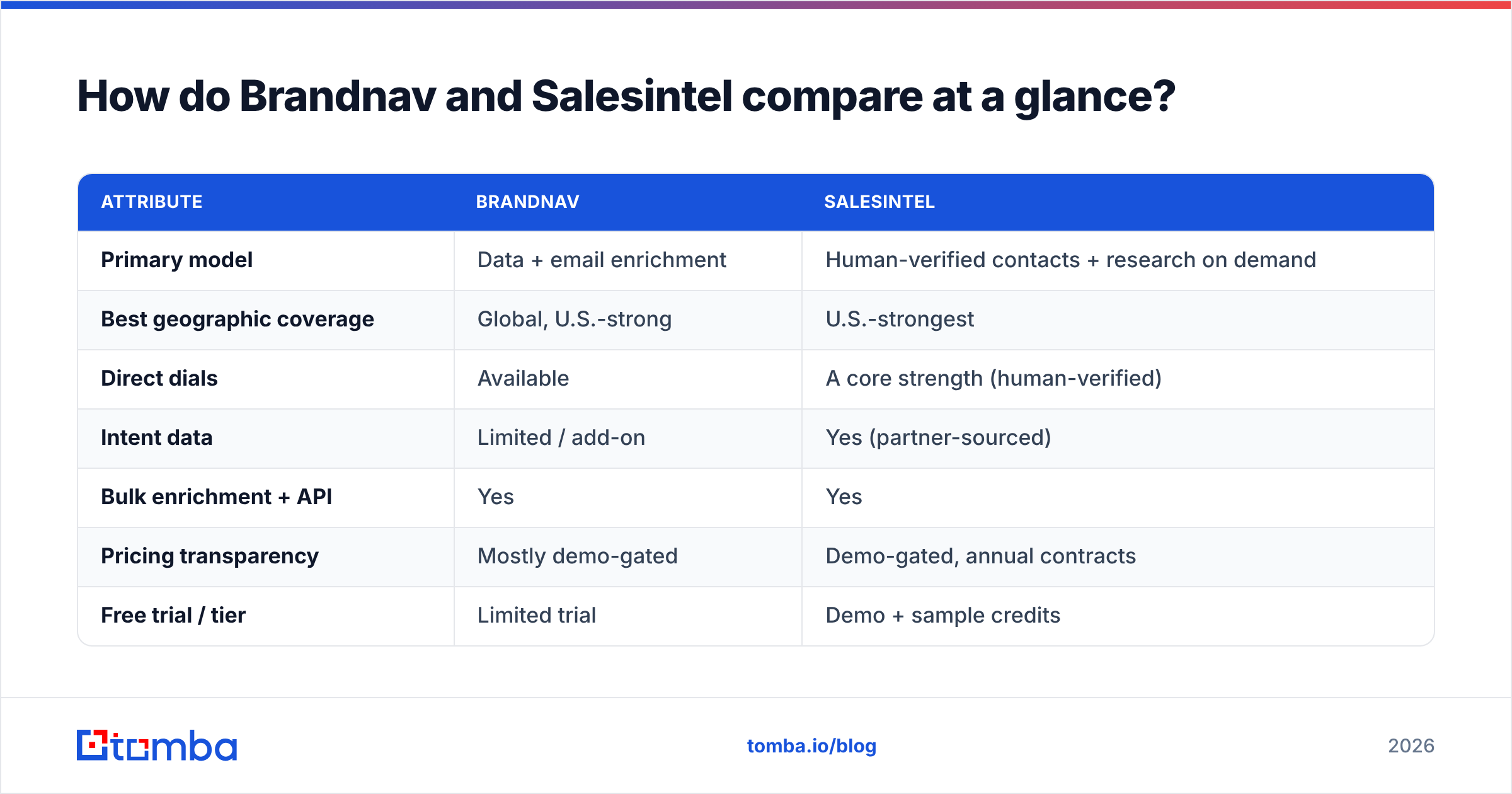
The fastest way to see the trade-offs is side by side. Numbers marked "demo-gated" mean the vendor does not publish them publicly as of 2026.
| Attribute | Brandnav | Salesintel |
|---|---|---|
| Primary model | Data + email enrichment | Human-verified contacts + research on demand |
| Best geographic coverage | Global, U.S.-strong | U.S.-strongest |
| Direct dials | Available | A core strength (human-verified) |
| Intent data | Limited / add-on | Yes (partner-sourced) |
| Bulk enrichment + API | Yes | Yes |
| Pricing transparency | Mostly demo-gated | Demo-gated, annual contracts |
| Free trial / tier | Limited trial | Demo + sample credits |
| Best fit | Agencies, growth teams | Mid-market, enterprise SDR teams |
The pattern is clear: Salesintel is the heavier, higher-touch platform; Brandnav is the leaner, more budget-conscious option. Where you land depends on whether you'll actually use intent data and research-on-demand, or whether you're mostly paying for features you'll never touch.
Which one has more accurate data?#
Accuracy is the only metric that matters once a record hits your sequencer — a bounced email or a dead number costs you sender reputation and rep time, not just a wasted credit.
Salesintel's pitch is human verification: real researchers re-check records, which historically produces high accuracy on direct dials and senior-contact data that algorithms struggle with. The cost is freshness at scale — human cycles are slower and more expensive than automated re-verification, which is why the price reflects it.
Brandnav relies more on automated sourcing and verification. That keeps cost-per-record down and lookups fast, with accuracy that's strong on standard work emails and weaker on hard-to-reach mobile numbers.

Two practical rules regardless of vendor:
- Always re-verify before send. Even 95%-accurate data drifts as people change jobs. Run lists through an email verifier at send time, not at purchase time.
- Treat catch-all domains separately. Catch-all servers accept everything, so "valid" is meaningless without deeper checks. A catch-all verifier tells you whether a mailbox actually exists behind the wildcard.
No provider — Brandnav, Salesintel, or anyone else — should be trusted as a permanent source of truth. Verification is a step in your workflow, not a one-time purchase.
How does pricing compare?#
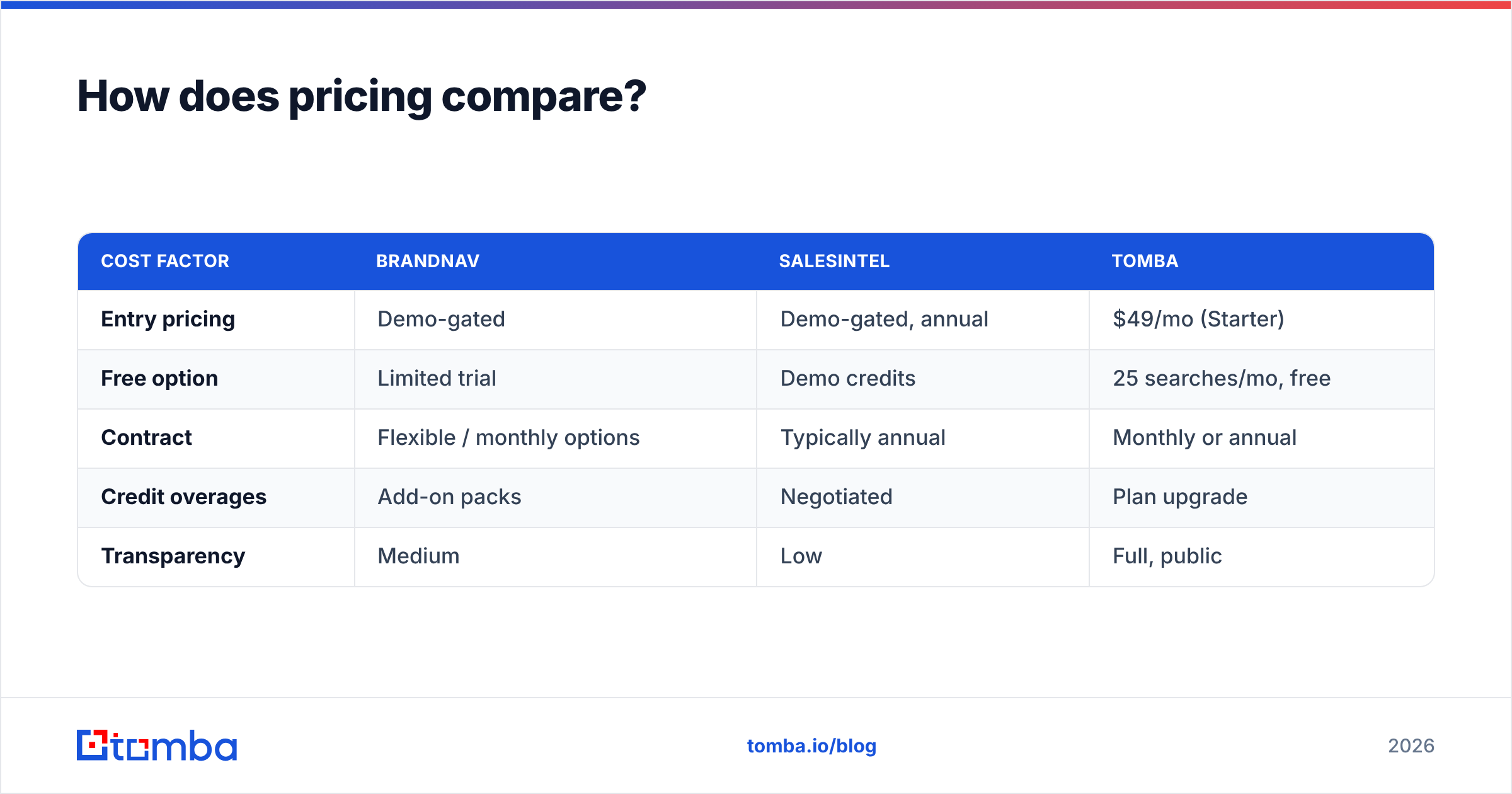
Here's the friction point for most buyers: neither Brandnav nor Salesintel publishes clear, self-serve pricing. You book a demo, get qualified, and receive a quote — usually annual.
| Cost factor | Brandnav | Salesintel | Tomba |
|---|---|---|---|
| Entry pricing | Demo-gated | Demo-gated, annual | $49/mo (Starter) |
| Free option | Limited trial | Demo credits | 25 searches/mo, free |
| Contract | Flexible / monthly options | Typically annual | Monthly or annual |
| Credit overages | Add-on packs | Negotiated | Plan upgrade |
| Transparency | Medium | Low | Full, public |
For teams that want to test data quality before committing budget, demo-gating is a real barrier. You can't compare bounce rates on your own list until after sales conversations. That's precisely why self-serve tools with published Tomba pricing and a free tier have eaten share at the SMB end — you validate accuracy on your accounts first, then scale.
Which integrates better with your stack?#
Both tools cover the basics: CRM sync, CSV export, and an API. The differences are in depth and friction.
- Salesintel offers native connectors into major CRMs (Salesforce, HubSpot) and a Chrome extension for prospecting on LinkedIn and company sites. Enterprise plans get richer admin controls.
- Brandnav emphasizes API and bulk workflows, which suits agencies running enrichment at volume across many client lists.
If your workflow lives in spreadsheets or a CRM, integration depth decides how much manual export-import you'll do. For reference, a modern data tool should let you enrich without leaving your CRM — see how a HubSpot integration or Salesforce integration removes the CSV round-trip entirely, and how a bulk email finder handles large lists in one pass.
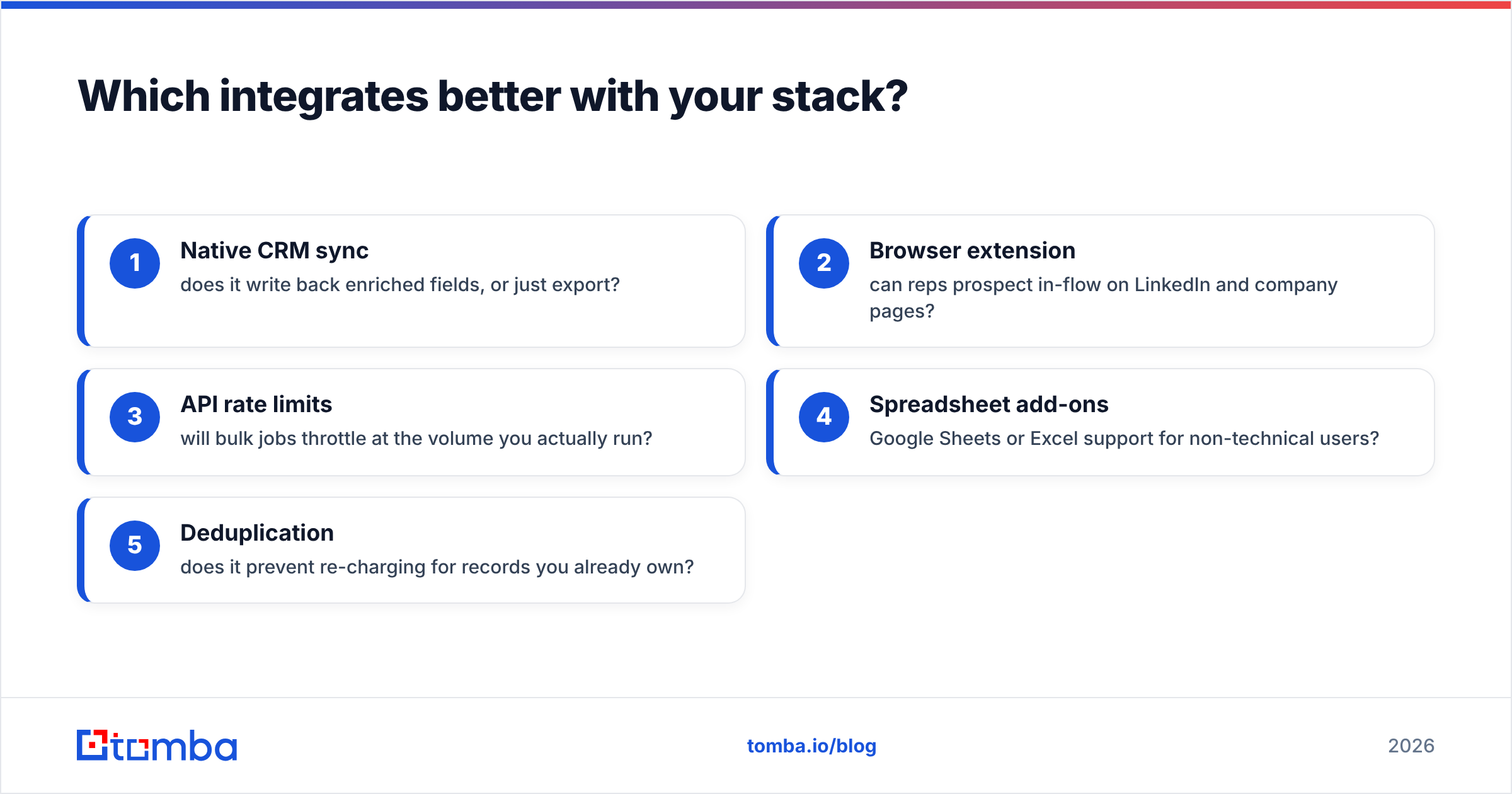
A quick checklist for evaluating integration fit:
- Native CRM sync — does it write back enriched fields, or just export?
- Browser extension — can reps prospect in-flow on LinkedIn and company pages?
- API rate limits — will bulk jobs throttle at the volume you actually run?
- Spreadsheet add-ons — Google Sheets or Excel support for non-technical users?
- Deduplication — does it prevent re-charging for records you already own?
What about compliance and data sourcing?#
Compliance is non-negotiable for B2B data in 2026. Both vendors operate under GDPR and CCPA frameworks, but how data is sourced matters for your own risk posture.
Salesintel emphasizes verified, consented business data and publishes compliance documentation — useful when your legal team needs answers. Brandnav, like most enrichment platforms, aggregates from multiple sources; ask specifically how records are sourced and how opt-out requests propagate.
Whatever you choose, confirm three things in writing: lawful basis for processing, a working data-subject opt-out path, and documented sourcing. For background on how reputable providers describe sourcing, Tomba publishes its own data sources page — a good template for the transparency to demand from any vendor. For deeper definitions, vendor-neutral references like G2's category pages and Gartner's market guides help you benchmark claims against peers.
When should you pick Brandnav vs Salesintel?#
Choose Salesintel if:
- You sell into U.S. mid-market and enterprise and need verified direct dials.
- Buyer intent data is part of your GTM motion and you'll actually action it.
- You have budget for an annual contract and value research-on-demand for hard accounts.
Choose Brandnav if:
- You're an agency or growth team running high-volume enrichment on a tighter budget.
- API and bulk workflows matter more than a polished enterprise UI.
- You want lower cost-per-record and don't need heavy intent tooling.
Choose a focused email finder instead if:
- Your real need is verified work emails by name, domain, or company — not a full intelligence suite.
- You want to test accuracy on your own list before paying, with no annual lock-in.
- You'd rather pay $49/mo for exactly what you use than negotiate an enterprise quote.

That last category is bigger than most buyers admit. A large share of teams shopping for "B2B data" actually just need clean, deliverable emails for outbound — and they overpay for intent dashboards and firmographic depth they never open.
How do these compare to a dedicated email finder?#
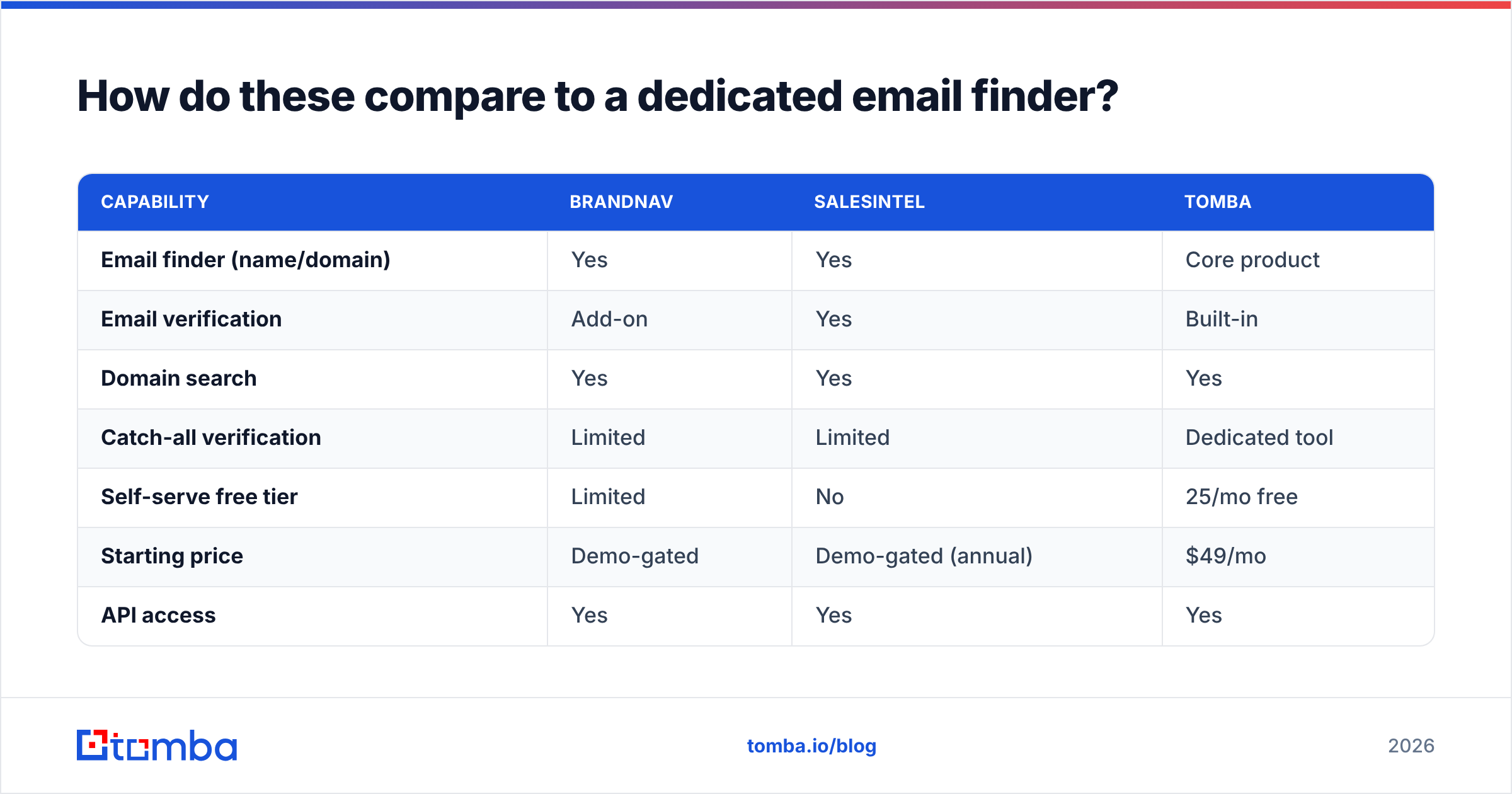
This is where the framing shifts. Brandnav and Salesintel are intelligence platforms; an email finder is a precision tool. If your outbound depends on reaching real inboxes, a focused tool often delivers better cost-per-verified-email than either full platform.
| Capability | Brandnav | Salesintel | Tomba |
|---|---|---|---|
| Email finder (name/domain) | Yes | Yes | Core product |
| Email verification | Add-on | Yes | Built-in |
| Domain search | Yes | Yes | Yes |
| Catch-all verification | Limited | Limited | Dedicated tool |
| Self-serve free tier | Limited | No | 25/mo free |
| Starting price | Demo-gated | Demo-gated (annual) | $49/mo |
| API access | Yes | Yes | Yes |
Tomba isn't trying to replace an enterprise intent platform. But if the job is "find and verify the email for this person at this company," it does that one job cheaply, transparently, and at scale — and you can prove the accuracy on your own list during the free tier before spending a cent. Pair the email finder with data enrichment and you cover most of what mid-market SDR teams actually use from the bigger suites, minus the annual contract.
The bottom line#
Brandnav and Salesintel are both legitimate B2B data platforms, and the right pick depends on budget and how much of the suite you'll use. Salesintel earns its premium on human-verified U.S. data and intent; Brandnav wins on price and bulk flexibility. The shared weakness is demo-gated pricing that makes it hard to validate quality before you commit.
If your outbound lives or dies on deliverable emails, start with the precise tool. Try the Tomba Email Finder free — 25 searches a month, no contract, full verification built in — and benchmark its accuracy against any quote Brandnav or Salesintel sends you. Let the bounce rate on your own list decide, not a sales call.
// get started
Find, verify and enrich your first contacts today
Start on the free plan with 25 searches a month, then scale when your team is ready.
Free plan · No credit card required · GDPR & CCPA
// about the author