Brandnav vs Sparklane 2026: Which B2B Data Tool Wins?
Brandnav and Sparklane both promise better B2B contact data, but they solve different problems. Here's an honest 2026 breakdown of pricing, accuracy, coverage, and fit.
Choosing between Brandnav and Sparklane usually means you've already hit a wall: your prospecting list is full of bounces, or your reps are spending more time hunting for contacts than talking to them. Both tools claim to fix that. They go about it in very different ways, and the right pick depends on whether you need raw contact discovery or account-level sales intelligence.
This is a neutral, hands-on comparison for 2026 — pricing, data accuracy, coverage, workflow fit, and where each tool quietly falls short.
TL;DR#
- Brandnav is a contact-discovery and email-finding tool built for volume prospecting and list-building. Strong if you need emails and phone numbers fast.
- Sparklane is a predictive lead-generation and sales-intelligence platform focused on buying signals and account scoring, with a European data footprint.
- They don't really compete head-to-head — Brandnav is bottom-of-funnel contact data; Sparklane is top-of-funnel account targeting.
- Pricing models differ sharply: Brandnav leans credit/seat-based and affordable; Sparklane is enterprise quote-based and pricier.
- If accuracy and cost-per-valid-email matter most, a focused email finder like Tomba often beats both on unit economics — more on that below.
What is Brandnav?#
Brandnav is a B2B data tool centered on finding business email addresses and phone numbers at scale. You feed it a name and company (or a domain), and it returns contact details you can push into outreach. It positions itself around list-building, bulk enrichment, and quick lookups for SDRs and growth teams.
In practice, Brandnav is a find-the-contact tool. Its job ends roughly where your sequencing tool begins. That makes it easy to slot into a stack, but it also means it doesn't try to tell you who to target — only how to reach the people you already picked.
Think of Brandnav like a phone book that's been digitized and searchable: fast at turning a name into a number, but it won't tell you which name is worth calling.
What is Sparklane?#
Sparklane is a predictive lead-generation platform with deep roots in the European market. Instead of starting with a name, it starts with signals — hiring activity, funding rounds, leadership changes, technology adoption, and other triggers — then scores accounts so your team focuses on the ones most likely to buy.
Sparklane's core value is account selection, not raw contact volume. It answers "which 200 companies should we prospect this quarter?" far better than "what's the CFO's direct dial?" It's an intelligence layer that sits above your prospecting motion.
If Brandnav is a phone book, Sparklane is a scout who watches the market and taps you on the shoulder when a company starts showing buying behavior.
Brandnav vs Sparklane: the core difference#
The single most important thing to understand: these tools live at opposite ends of the funnel.
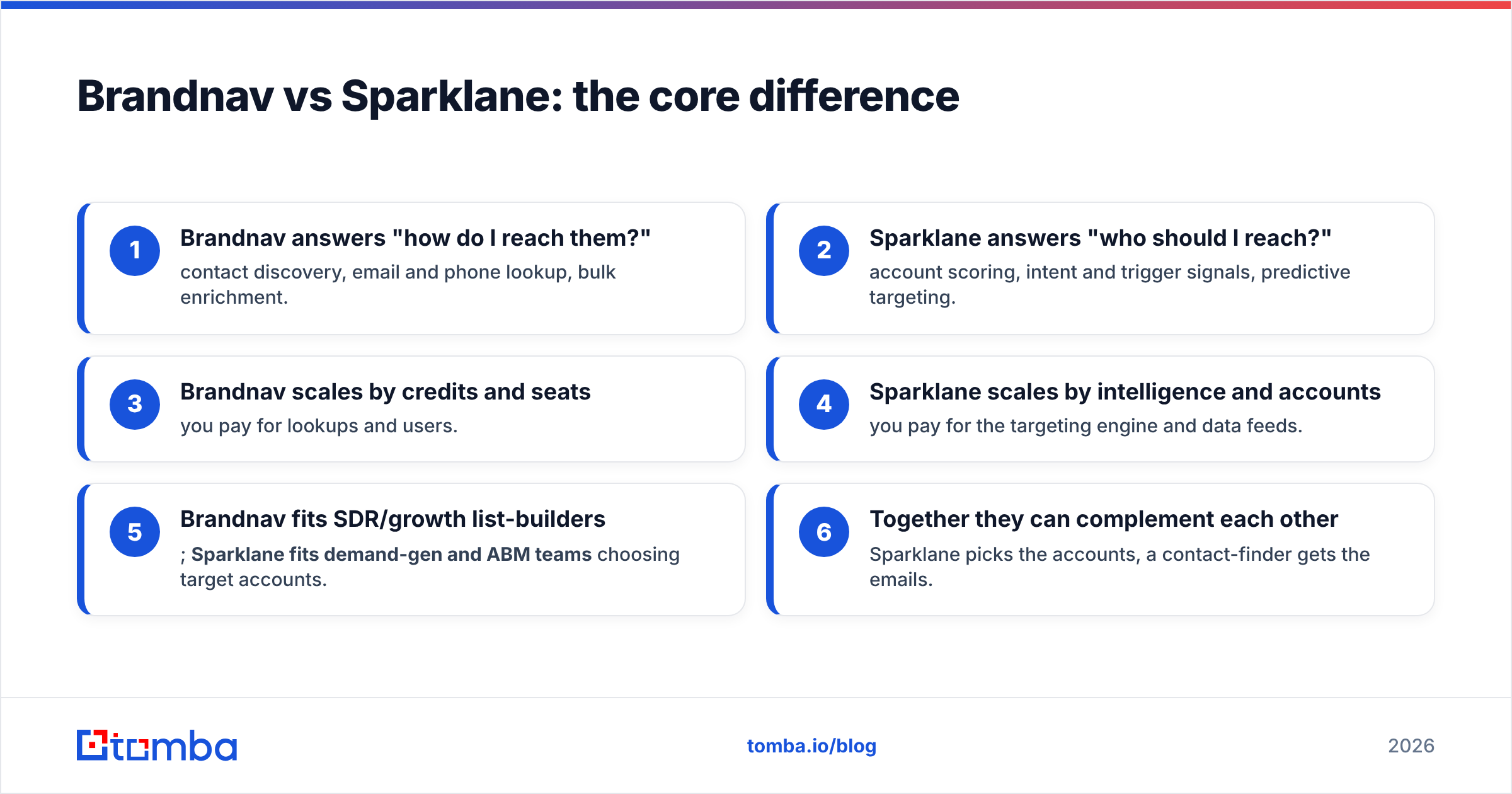
- Brandnav answers "how do I reach them?" — contact discovery, email and phone lookup, bulk enrichment.
- Sparklane answers "who should I reach?" — account scoring, intent and trigger signals, predictive targeting.
- Brandnav scales by credits and seats — you pay for lookups and users.
- Sparklane scales by intelligence and accounts — you pay for the targeting engine and data feeds.
- Brandnav fits SDR/growth list-builders; Sparklane fits demand-gen and ABM teams choosing target accounts.
- Together they can complement each other — Sparklane picks the accounts, a contact-finder gets the emails.
That last point matters: many teams don't choose between them — they realize they need one of each function, and then ask whether one vendor or a cheaper specialist covers it.
How do Brandnav and Sparklane compare on features and pricing?#
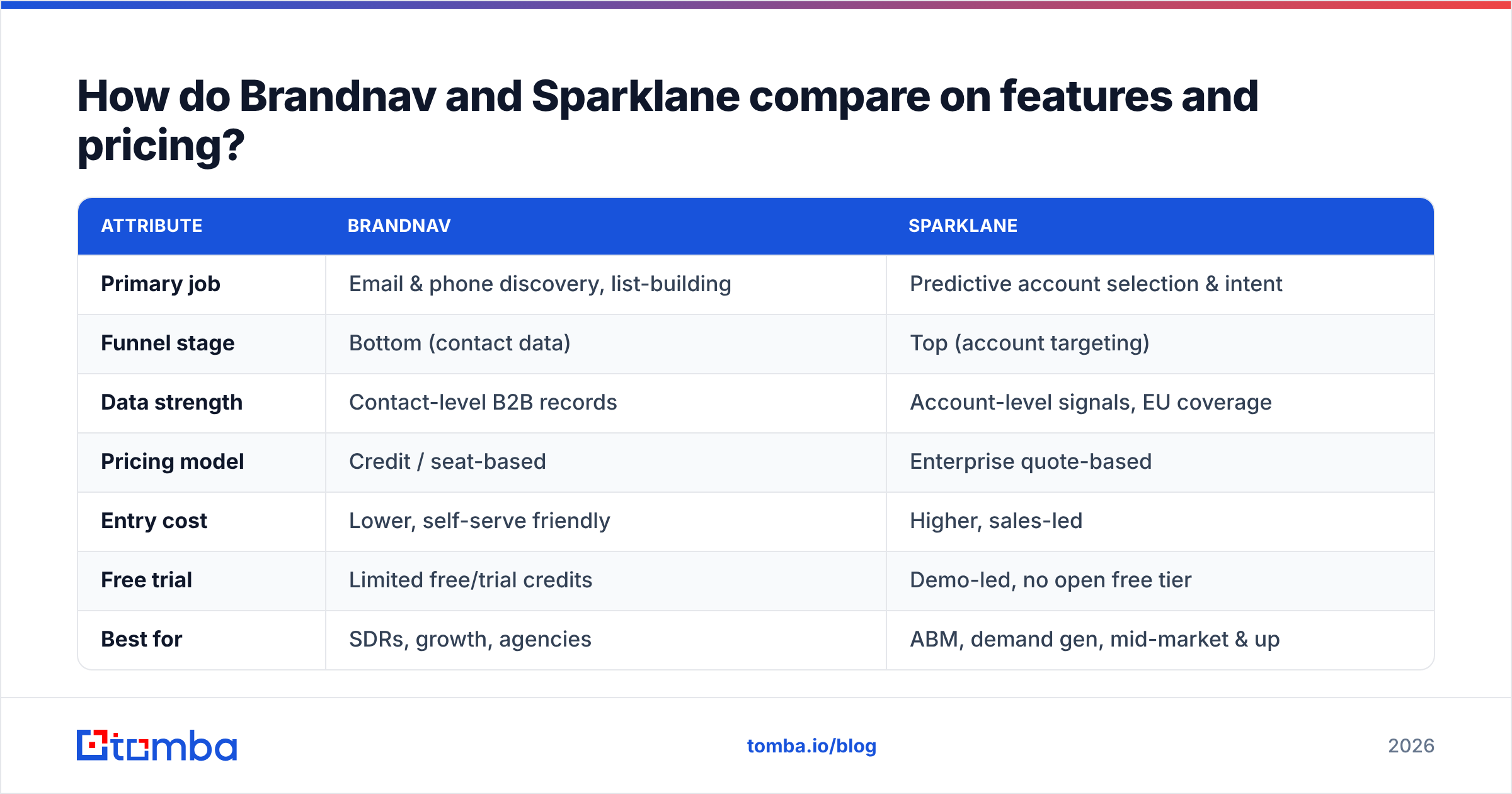
Here's the side-by-side. Pricing for both fluctuates and Sparklane is quote-only, so treat figures as directional and confirm with each vendor.
| Attribute | Brandnav | Sparklane |
|---|---|---|
| Primary job | Email & phone discovery, list-building | Predictive account selection & intent |
| Funnel stage | Bottom (contact data) | Top (account targeting) |
| Data strength | Contact-level B2B records | Account-level signals, EU coverage |
| Pricing model | Credit / seat-based | Enterprise quote-based |
| Entry cost | Lower, self-serve friendly | Higher, sales-led |
| Free trial | Limited free/trial credits | Demo-led, no open free tier |
| Best for | SDRs, growth, agencies | ABM, demand gen, mid-market & up |
| Email verification | Basic | Not the core focus |
| Ideal team size | 1–50 reps | 10+ with a defined ICP |
The takeaway: if your bottleneck is targeting, Sparklane's premium is justified. If your bottleneck is reaching people you've already identified, you're paying enterprise prices at Sparklane for a job a contact tool does cheaper — and Brandnav is closer to the right category, but not always the most accurate or cost-efficient option in it.
Which one is more accurate?#
Accuracy means different things here, which is exactly why a flat "who's better" answer misleads people.
Sparklane's accuracy is about predictive relevance — did it surface accounts that actually entered a buying cycle? That's hard to benchmark and varies by your ICP and region. In its European stronghold, its signal data is genuinely strong.
Brandnav's accuracy is about deliverability — what percentage of the emails it returns actually land without bouncing. This is measurable, and it's where contact-discovery tools live or die. A list that's 80% deliverable versus 95% deliverable is the difference between a healthy domain and a spam-foldered one.

If you're evaluating on the contact-data axis, don't take any vendor's self-reported accuracy at face value. Run the same 100 known contacts through each tool and measure: match rate, bounce rate after sending, and how many results came back "catch-all" (unverifiable). Pair whatever you choose with a dedicated email verifier so a bad address never reaches your sequencer. Independent reviews on G2 are a useful sanity check before you commit to a contract.
When should you choose Sparklane?#
Pick Sparklane when account selection is your real constraint:
- You sell into the European market and need GDPR-conscious, locally strong account data.
- You run account-based marketing and need scored target lists, not just contacts.
- You have a defined ICP and a team large enough to work a curated account list.
- Buying signals and triggers (funding, hiring, tech changes) drive your outreach timing.
Sparklane is overkill if you're a small team that just needs emails. You'd be buying a targeting engine to do a lookup tool's job — and paying enterprise rates for it.
When should you choose Brandnav?#
Pick Brandnav when reaching identified prospects is the bottleneck:
- You already know your target companies and need contacts at them, fast.
- You're an SDR team or agency building lists at volume.
- You want self-serve, credit-based pricing without a sales call.
- You need phone numbers alongside emails for multi-channel outreach.
Brandnav stumbles if you expected it to choose your accounts — it won't — or if you assumed every returned email is verified. Always layer verification on top.

Is there a better alternative for contact data?#
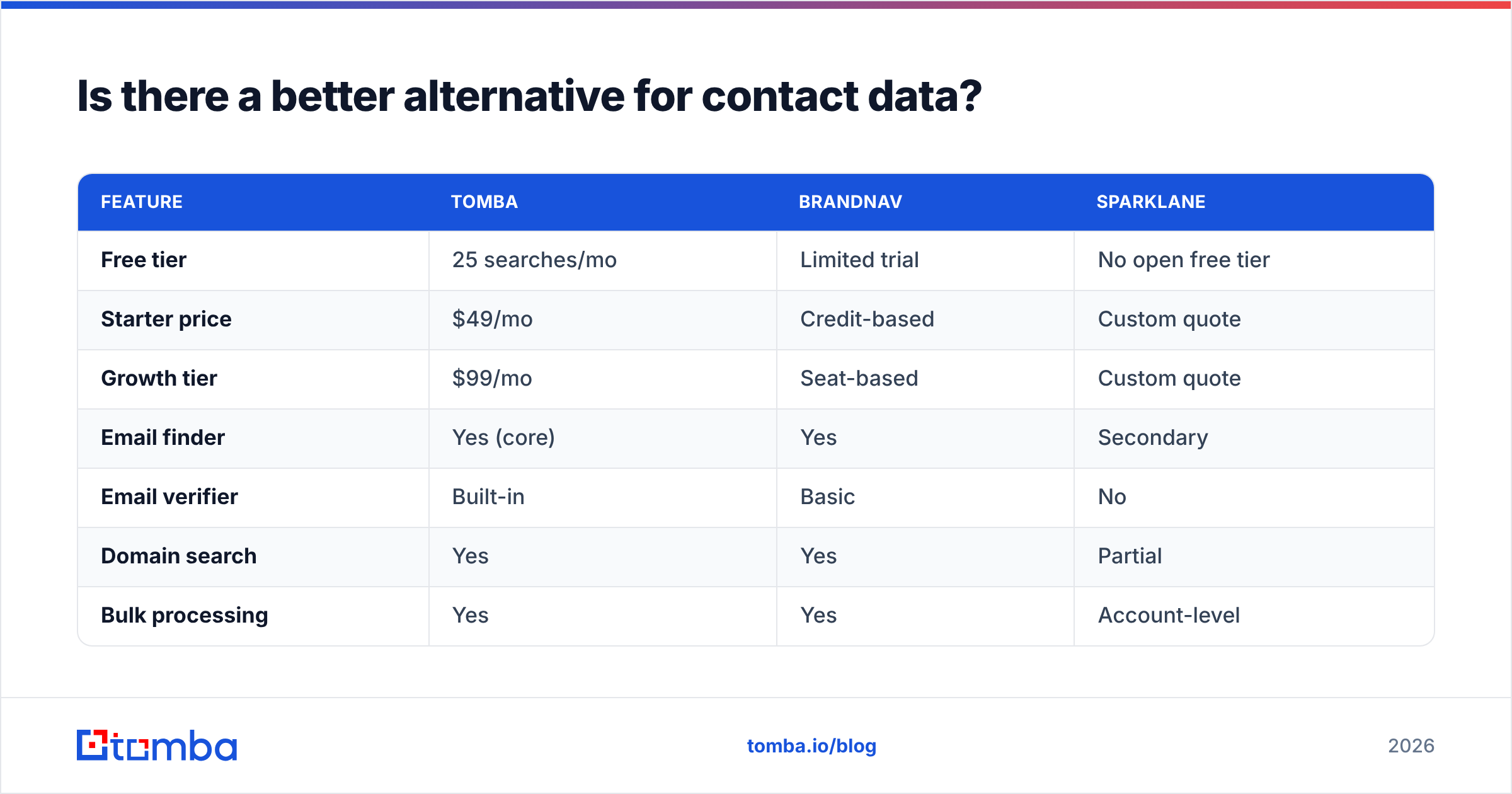
For the specific job of turning names and domains into verified, deliverable emails, a focused email-finding tool usually beats both on cost-per-valid-contact. That's the lane Tomba sits in.
Where Brandnav bundles discovery and Sparklane sells intelligence, Tomba concentrates on accuracy and unit economics for the contact-data step — backed by transparent Tomba pricing instead of a quote-only model.
| Feature | Tomba | Brandnav | Sparklane |
|---|---|---|---|
| Free tier | 25 searches/mo | Limited trial | No open free tier |
| Starter price | $49/mo | Credit-based | Custom quote |
| Growth tier | $99/mo | Seat-based | Custom quote |
| Email finder | Yes (core) | Yes | Secondary |
| Email verifier | Built-in | Basic | No |
| Domain search | Yes | Yes | Partial |
| Bulk processing | Yes | Yes | Account-level |
| Predictive signals | No | No | Yes (core) |
| Best fit | Accurate contact data | Volume lookups | Account targeting |
Tomba's stack covers the contact-data workflow end to end: find emails by name or domain, verify them before sending, run bulk email finder jobs for whole lists, and push everything into your CRM via data enrichment. Free tier is 25 searches a month, Starter is $49/mo, Growth $99/mo, and Pro $249/mo — no sales call required to start.
To be fair: Tomba is not a Sparklane replacement. It won't score accounts or surface buying signals. If predictive targeting is your real need, Sparklane (or a dedicated intent platform) is the right tool, and you'd pair it with a contact-finder for the reach step. Pricing benchmarks across these categories are easy to verify on Capterra and Sparklane's own site.
What does a smart 2026 stack look like?#
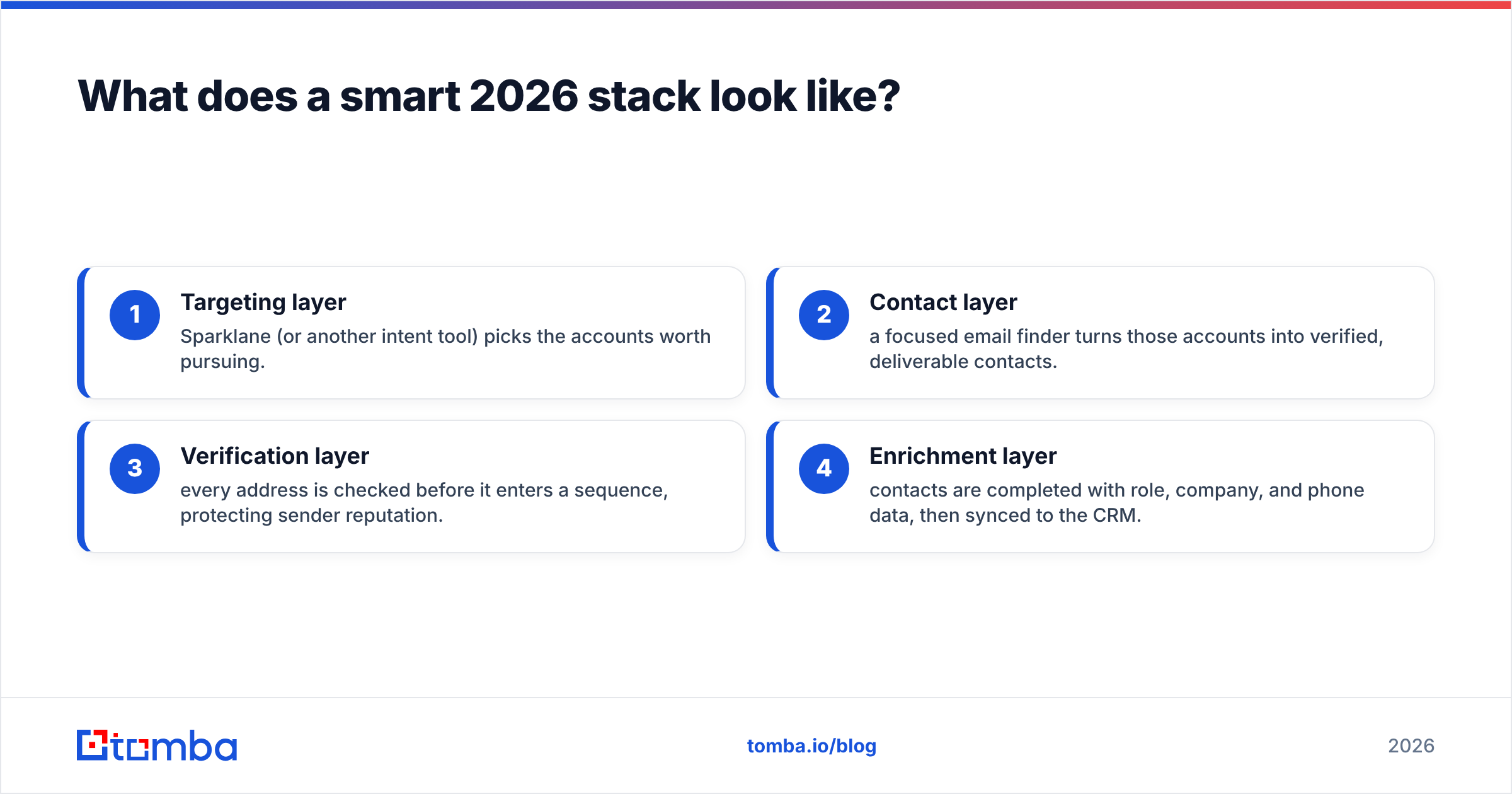
The teams getting the most out of these tools rarely run just one. A common, efficient setup:
- Targeting layer — Sparklane (or another intent tool) picks the accounts worth pursuing.
- Contact layer — a focused email finder turns those accounts into verified, deliverable contacts.
- Verification layer — every address is checked before it enters a sequence, protecting sender reputation.
- Enrichment layer — contacts are completed with role, company, and phone data, then synced to the CRM.
The expensive mistake is using a premium intelligence platform for the cheap-to-solve contact step, or using a bulk lookup tool to make targeting decisions it was never built for. Match the tool to the job and your cost-per-meeting drops.
Brandnav vs Sparklane: the verdict#
There's no universal winner because they're not really the same product. Choose Sparklane if your problem is who to target and you have the ICP, team, and budget to work scored account lists — especially in Europe. Choose Brandnav if your problem is getting contacts at companies you've already picked and you want affordable, self-serve lookups.
But if you map your actual bottleneck, most teams discover the painful, measurable part is contact accuracy and deliverability — and that's a job a specialist tool does better and cheaper than either generalist.
Start with the Tomba Email Finder to find and verify professional emails by name, domain, or company — with a free tier to test accuracy on your own list before you ever pay. Run your 100 known contacts through it, check the bounce rate, and let the numbers, not the marketing, pick your winner.
// get started
Find, verify and enrich your first contacts today
Start on the free plan with 25 searches a month, then scale when your team is ready.
Free plan · No credit card required · GDPR & CCPA
// about the author