Brandnav vs ZoomInfo 2026: Which B2B Data Tool Wins?
Brandnav vs ZoomInfo compared on data accuracy, coverage, pricing, and contract terms — plus where a leaner email finder beats both for outbound teams in 2026.
Choosing between Brandnav and ZoomInfo usually comes down to one trade-off: do you want a lightweight, pay-as-you-grow data tool, or an enterprise sales-intelligence platform with a price tag (and a contract) to match? This guide breaks down accuracy, coverage, pricing, and the real-world friction of each — and where a focused email finder beats both for most outbound teams.
TL;DR#
- ZoomInfo is the enterprise heavyweight: deep firmographics, intent data, and org charts, but it's expensive, locked behind annual contracts, and overkill for small teams.
- Brandnav is the leaner, cheaper option aimed at startups and SMBs — faster to adopt, but with thinner coverage outside its core regions and fewer enrichment layers.
- Accuracy is the deciding factor: ZoomInfo wins on raw database size, but both still need a verification step before you send.
- Pricing gap is huge — ZoomInfo deals routinely run $15k+/year, while Brandnav and most email finders start under $100/month.
- If your real need is finding and verifying contact emails rather than buying a full intelligence suite, a tool like Tomba Email Finder covers the job at a fraction of the cost.
What is Brandnav?#
Brandnav is a B2B contact and lead-data tool positioned at startups, agencies, and small sales teams. Its pitch is simple: get verified business emails and basic company data without signing an enterprise contract or learning a sprawling platform. You search by company or domain, pull contacts, and export them into your CRM or outreach tool.
The appeal is speed and price. There's no six-week onboarding, no seat minimums, and no procurement cycle. For a founder doing their own prospecting or a small agency building lists, that low friction matters more than having every data field under the sun.
The trade-off is depth. Brandnav's database is smaller than the enterprise incumbents, and coverage thins out once you move past common regions and mid-market companies. Intent signals, detailed org charts, and technographic layers — the things ZoomInfo sells hard — are either light or absent.
)
What is ZoomInfo?#
ZoomInfo is the category-defining B2B sales-intelligence platform. It combines a massive contact and company database with intent data, org charts, technographics, news triggers, and workflow tooling that plugs into Salesforce, HubSpot, and Outreach. It's built for revenue teams that run structured, account-based motions at scale.
When people talk about ZoomInfo's strength, they mean breadth: hundreds of millions of contacts, layered firmographic and intent signals, and the ability to build highly targeted lists with dozens of filters. For a 50-rep sales org with a revenue operations team to manage it, that's genuine leverage.
The catch is cost and commitment. ZoomInfo sells annual contracts, often with steep minimums, credit caps, and add-on fees for the better data layers. You can read more on their official site at zoominfo.com. For smaller teams, the platform's power becomes overhead you pay for but never fully use.
How do Brandnav and ZoomInfo compare?#
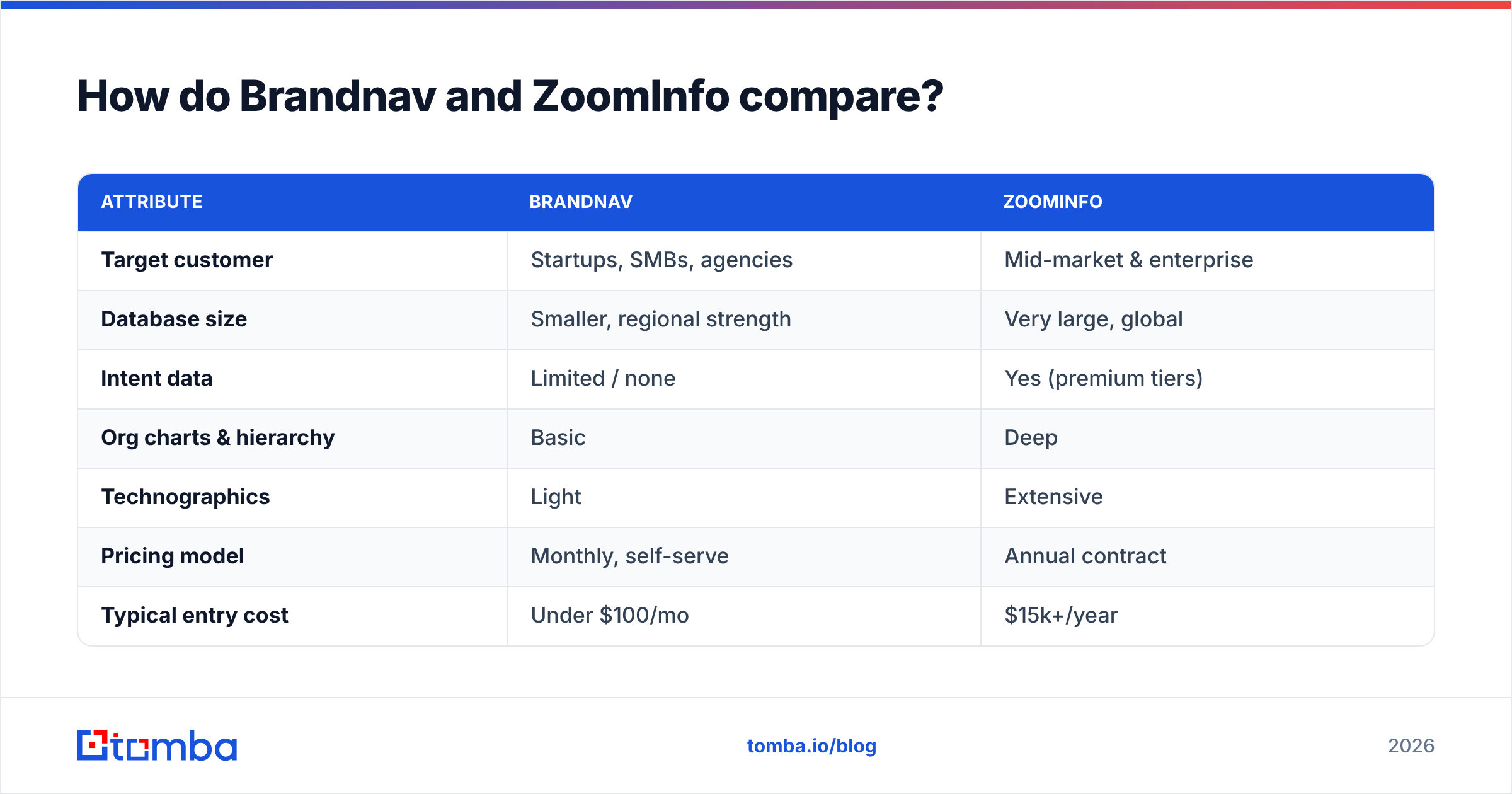
Here's the side-by-side on the attributes that actually drive a buying decision.
| Attribute | Brandnav | ZoomInfo |
|---|---|---|
| Target customer | Startups, SMBs, agencies | Mid-market & enterprise |
| Database size | Smaller, regional strength | Very large, global |
| Intent data | Limited / none | Yes (premium tiers) |
| Org charts & hierarchy | Basic | Deep |
| Technographics | Light | Extensive |
| Pricing model | Monthly, self-serve | Annual contract |
| Typical entry cost | Under $100/mo | $15k+/year |
| Contract lock-in | Low | High (annual) |
| Onboarding time | Minutes | Weeks |
| Best for | Lean outbound, fast lists | ABM at scale |
The pattern is consistent: ZoomInfo wins where scale, depth, and integration matter; Brandnav wins where speed, simplicity, and budget matter. Neither is "better" in the abstract — it depends entirely on the size and maturity of your motion.
Is ZoomInfo's data more accurate than Brandnav's?#
On raw coverage, ZoomInfo leads — but "more records" is not the same as "more correct records." ZoomInfo's larger database means you'll find someone for almost any target account, especially in North America. Brandnav's narrower database can leave gaps, particularly for smaller companies and non-core regions.
That said, both platforms suffer from the same industry-wide problem: B2B data decays fast. People change jobs, companies rebrand, and email formats shift. Studies across the data industry put annual B2B contact decay at roughly 25–30%, which means a chunk of any vendor's database is stale at any given moment.

The practical takeaway: treat every exported list — from either tool — as a starting point, not a finished asset. Run it through an email verifier before you send. A verification pass catches bounces, flags risky catch-all domains, and protects your sender reputation, which is the single biggest lever on whether your cold email lands in the inbox at all.
How does pricing compare for Brandnav vs ZoomInfo?#
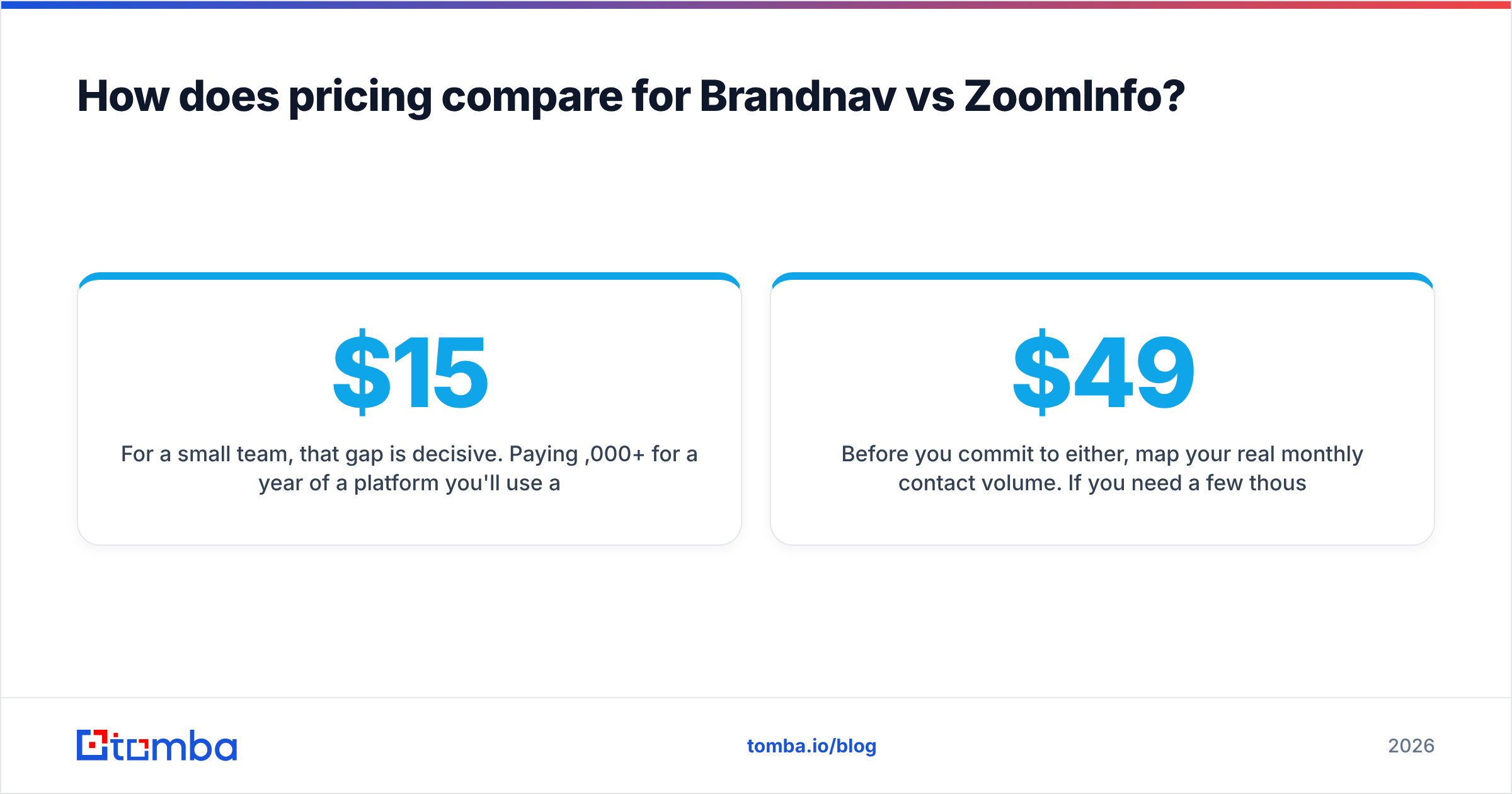
This is where the two diverge most sharply. Brandnav follows a transparent, self-serve monthly model — you can sign up, pay, and start the same day. ZoomInfo uses sales-led annual contracts, and published pricing is rare; most reported deals start in the five figures per year and climb with seats, credits, and premium data add-ons.
For a small team, that gap is decisive. Paying $15,000+ for a year of a platform you'll use at 20% capacity is hard to justify when a monthly tool covers your actual workflow. Reviews on G2 repeatedly cite ZoomInfo's cost and contract rigidity as the top frustration, even among customers who praise the data.
)
Before you commit to either, map your real monthly contact volume. If you need a few thousand verified contacts a month, an email finder priced per search will almost always beat an enterprise license. You can see how transparent, usage-based Tomba pricing compares — the Free tier includes 25 searches/month, Starter is $49/mo, Growth is $99/mo, and Pro is $249/mo, with no annual lock-in.
When should you choose ZoomInfo?#
Pick ZoomInfo when the platform's depth matches your motion. Specifically:
- You run account-based marketing at scale. Dozens of filters, intent data, and org charts pay off when you're orchestrating multi-threaded plays across hundreds of accounts.
- You have a RevOps function. Someone needs to own the integration, manage credits, and keep the data flowing into your CRM — otherwise the spend leaks.
- Your deals are large. When one closed deal covers the annual license, the ROI math works easily.
- You need intent and technographic signals. If your targeting depends on knowing who's in-market or what stack a company runs, Brandnav can't match it.
- Integration is non-negotiable. Native, deep connections into Salesforce and Outreach are part of what you're paying for.
If three or more of those describe you, ZoomInfo's price is probably defensible.
When should you choose Brandnav (or a leaner alternative)?#
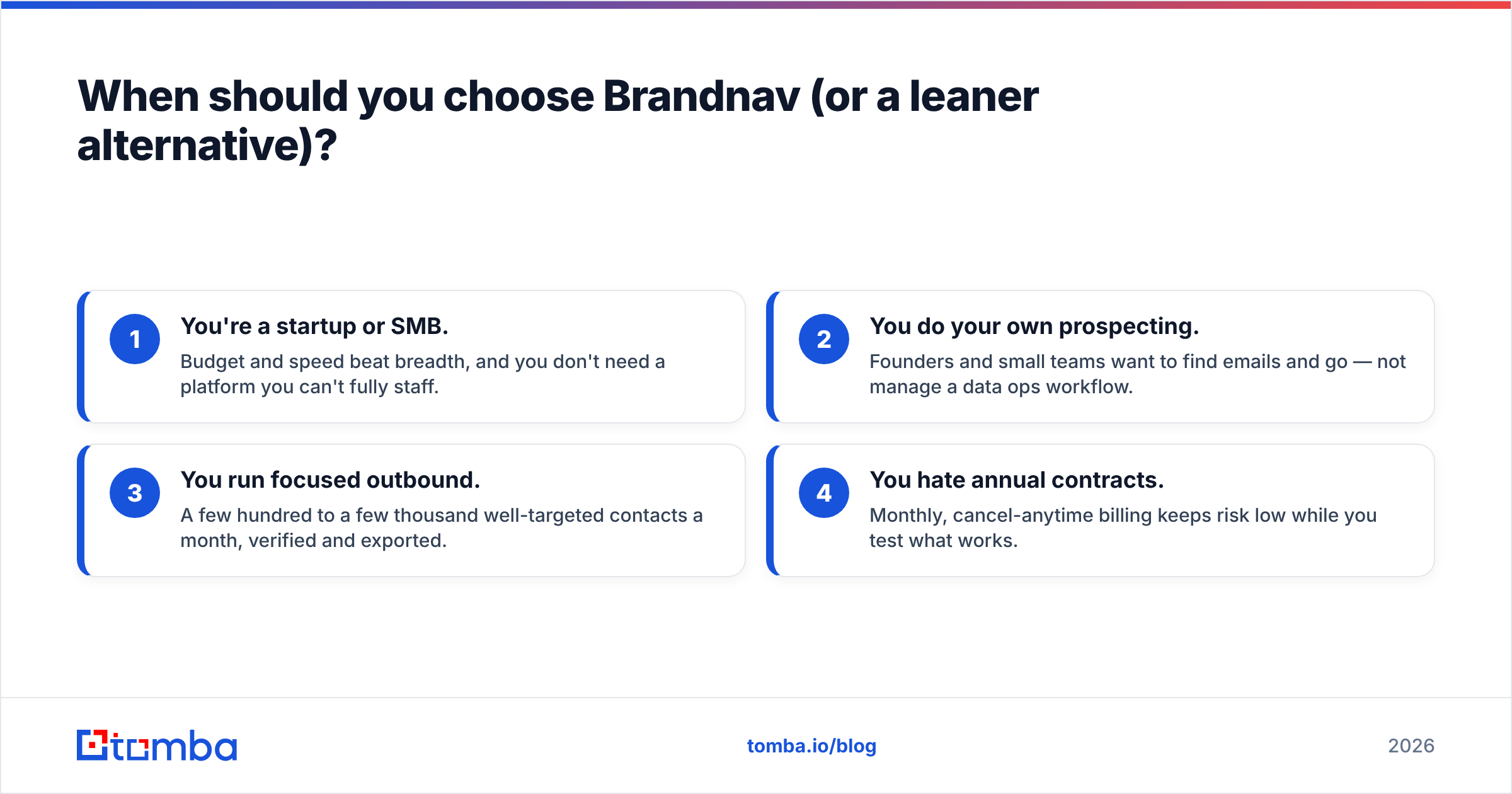
Choose the lightweight path when your need is contacts, not a full intelligence suite:
- You're a startup or SMB. Budget and speed beat breadth, and you don't need a platform you can't fully staff.
- You do your own prospecting. Founders and small teams want to find emails and go — not manage a data ops workflow.
- You run focused outbound. A few hundred to a few thousand well-targeted contacts a month, verified and exported.
- You hate annual contracts. Monthly, cancel-anytime billing keeps risk low while you test what works.
Here's the nuance, though: Brandnav isn't the only lean option. If your core job is finding and verifying professional emails, a dedicated email finder often delivers better accuracy per dollar than a generalist data tool. Tools like Tomba's domain search let you pull every public email pattern for a target company, while bulk email finder workflows handle list-building at volume.
Brandnav vs ZoomInfo vs a dedicated email finder#
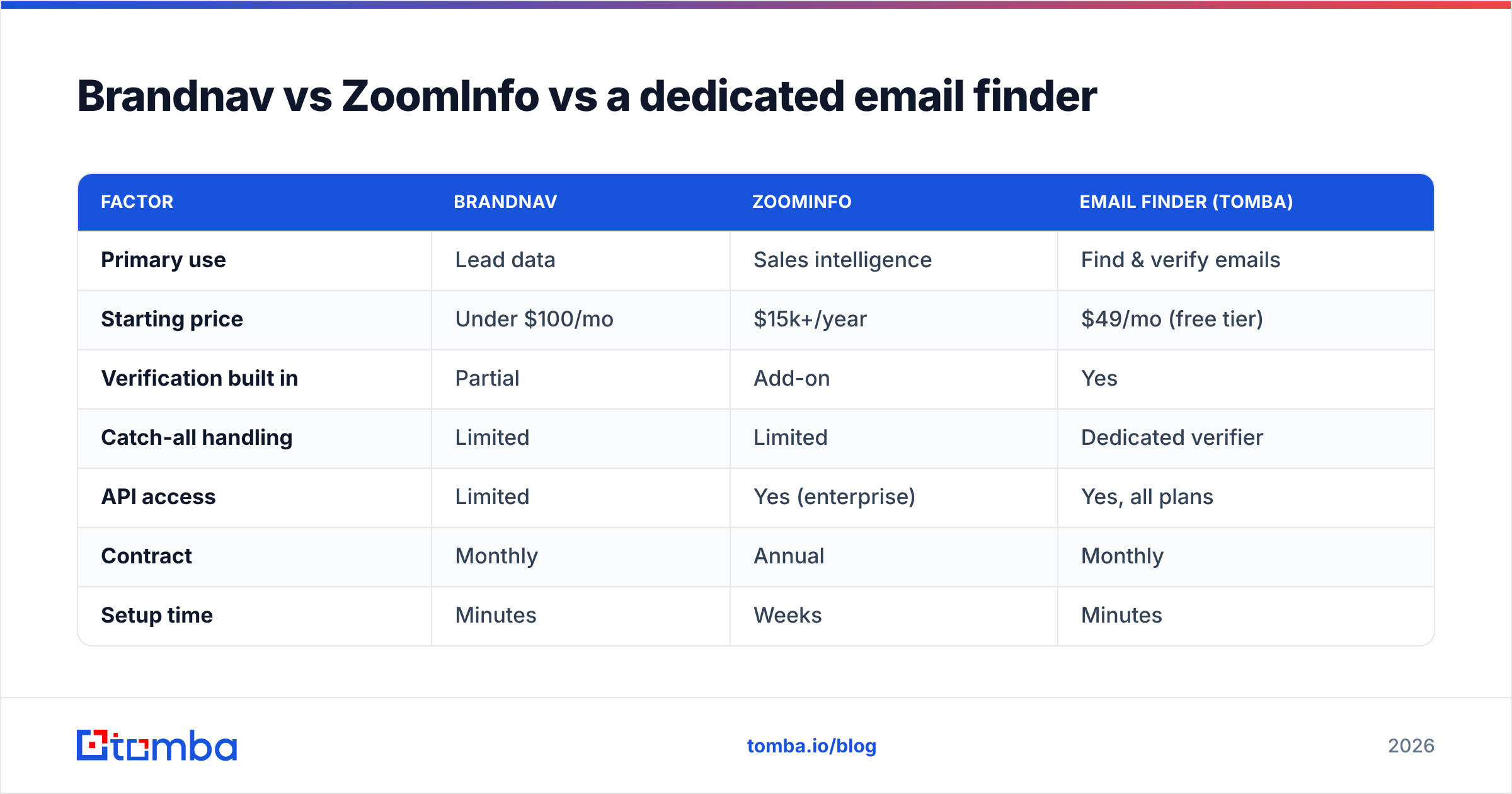
Most "Brandnav vs ZoomInfo" comparisons miss a third option that fits more teams than either: a purpose-built email finder. Here's how the three stack up for a typical outbound team.

| Factor | Brandnav | ZoomInfo | Email Finder (Tomba) |
|---|---|---|---|
| Primary use | Lead data | Sales intelligence | Find & verify emails |
| Starting price | Under $100/mo | $15k+/year | $49/mo (free tier) |
| Verification built in | Partial | Add-on | Yes |
| Catch-all handling | Limited | Limited | Dedicated verifier |
| API access | Limited | Yes (enterprise) | Yes, all plans |
| Contract | Monthly | Annual | Monthly |
| Setup time | Minutes | Weeks | Minutes |
The email-finder route wins when your bottleneck is simply getting a correct, verified address for the people you already know you want to reach. You skip the enterprise overhead and the SMB coverage gaps, and you get verification and catch-all verification as part of the same workflow instead of bolting it on later.
How do you actually decide?#
Run this quick decision sequence:
- Map your volume. How many verified contacts do you need per month? Under a few thousand favors monthly tools.
- Check your motion. ABM at scale leans ZoomInfo. Founder-led or focused outbound leans lean tools.
- Price the contract risk. Can you absorb an annual commitment if the data underperforms? If not, stay monthly.
- Test before you sign. Use free tiers and trials to compare your target accounts, not vendor demos. Pull the same 50 companies in each tool and check hit rate and accuracy.
- Always verify. Whatever you pick, add a verification step so bounce rates stay low and your domain reputation stays clean.
That last point is where teams quietly lose money. A pretty database means nothing if 20% of it bounces and tanks your email deliverability. Build verification into the pipeline from day one.
The bottom line#
ZoomInfo is the right call for enterprise teams that need depth, intent signals, and tight CRM integration — and can fund a five-figure annual contract. Brandnav is the sensible budget pick for startups and SMBs that want contacts fast without the lock-in. But for the large middle of the market whose actual job is finding and verifying business emails, a dedicated email finder beats both on cost, speed, and accuracy-per-dollar.
If that's you, start with the Tomba Email Finder. You get verified professional emails by name, company, or domain, built-in verification and catch-all checks, full API access on every plan, and transparent monthly pricing that starts free — no annual contract, no procurement cycle, no paying for data layers you'll never touch. Test it against your real target accounts and compare the hit rate yourself before you ever commit a dollar to an enterprise platform.
// get started
Find, verify and enrich your first contacts today
Start on the free plan with 25 searches a month, then scale when your team is ready.
Free plan · No credit card required · GDPR & CCPA
// about the author