Break Up Email Subject Lines: 25 Examples That Win Replies (2026)
The break-up email is your last shot at a cold prospect. These 25+ break up email subject lines, with open-rate data and templates, turn silence into replies.
The break-up email is the most counterintuitive message in your sequence: you tell a silent prospect you're giving up, and they suddenly reply. The lever that decides whether it works is the subject line — the eight to ten words that get the email opened in the first place. Get them right and your "last" email becomes your best-performing one.
TL;DR#
- Break up email subject lines are the final-touch subject lines you send when a prospect has gone silent — they trade urgency and loss aversion for a reply.
- The best ones are short (3–6 words), curiosity-driven, and signal closure ("Should I close your file?") rather than another desperate follow-up.
- Break-up emails routinely see higher reply rates than mid-sequence touches because they trigger loss aversion and remove the pressure of a pitch.
- Use them once, late in a sequence (touch 5–8), and pair them with clean data so you aren't "breaking up" with bounced or wrong addresses.
- Below: 25+ tested subject lines sorted by style, a comparison table, and templates you can paste today.
What is a break up email, and why does the subject line matter?#
A break-up email is the polite "I'll stop reaching out" message you send after several ignored follow-ups. It works on a simple psychological trick: people value things more when they're about to lose them. When you signal that the conversation is ending, the prospect who never replied to "just checking in" suddenly feels the cost of saying nothing.
But none of that psychology fires if the email is never opened. The subject line is the gate. In a crowded inbox, "Following up again" reads as noise, while "Permission to close your file?" reads as a decision the recipient has to make. The body closes the deal; the subject line buys you the open.
Think of it like a store about to close for the night. A sign reading "We're open" gets ignored. A sign reading "Last call — closing in 10 minutes" pulls people to the register. Your break-up subject line is that last-call sign.
What makes a break up email subject line work?#
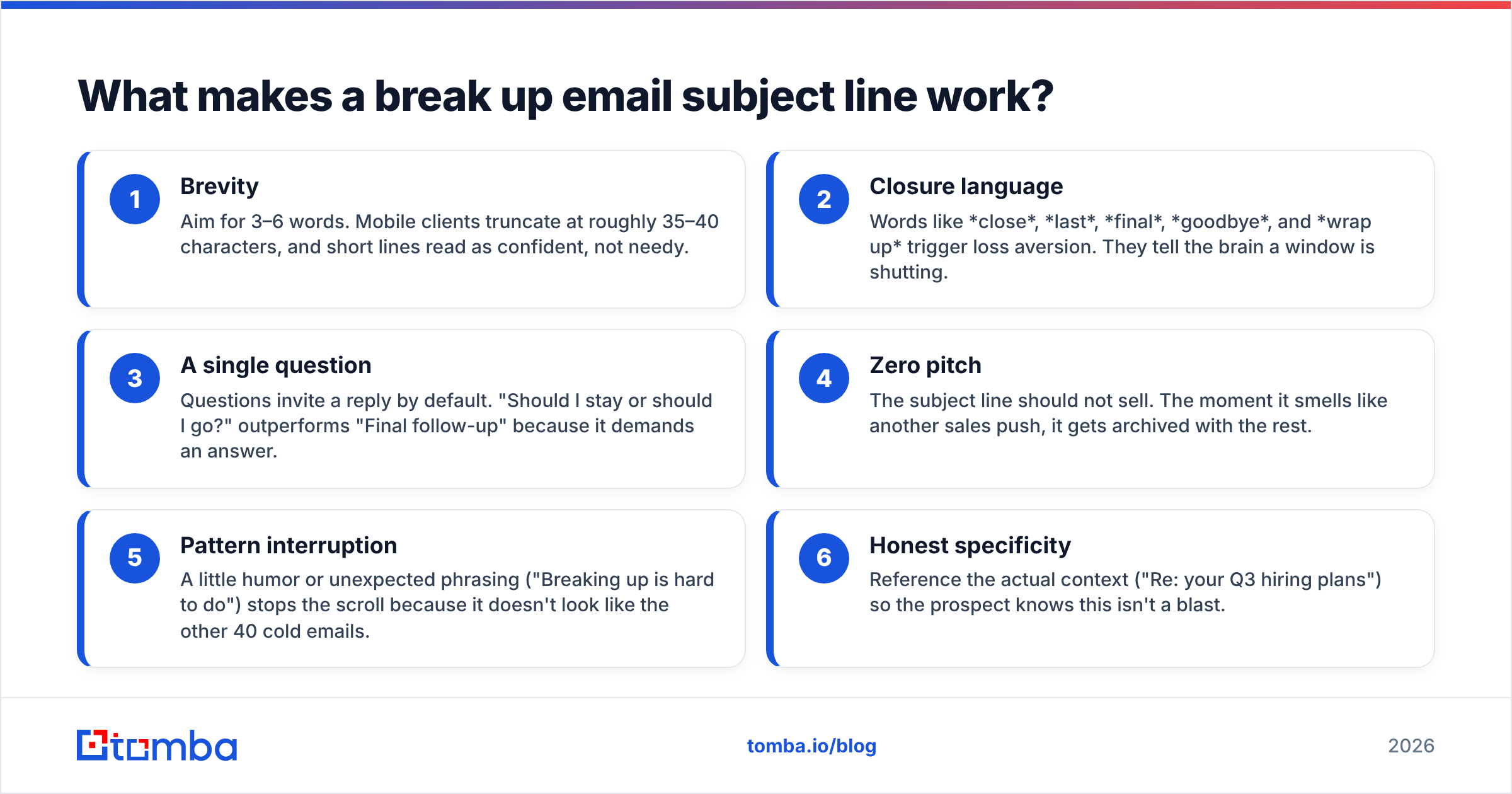
The strongest break-up subject lines share a small set of traits. Treat these as a checklist before you hit send:
- Brevity — Aim for 3–6 words. Mobile clients truncate at roughly 35–40 characters, and short lines read as confident, not needy.
- Closure language — Words like close, last, final, goodbye, and wrap up trigger loss aversion. They tell the brain a window is shutting.
- A single question — Questions invite a reply by default. "Should I stay or should I go?" outperforms "Final follow-up" because it demands an answer.
- Zero pitch — The subject line should not sell. The moment it smells like another sales push, it gets archived with the rest.
- Pattern interruption — A little humor or unexpected phrasing ("Breaking up is hard to do") stops the scroll because it doesn't look like the other 40 cold emails.
- Honest specificity — Reference the actual context ("Re: your Q3 hiring plans") so the prospect knows this isn't a blast.
If a subject line fails more than one of these, rewrite it. And if you want machine help generating variants, a subject line generator can spin up dozens of options to A/B test, while a test subject lines tool scores them before you commit.
Which break up email subject line style fits your prospect?#
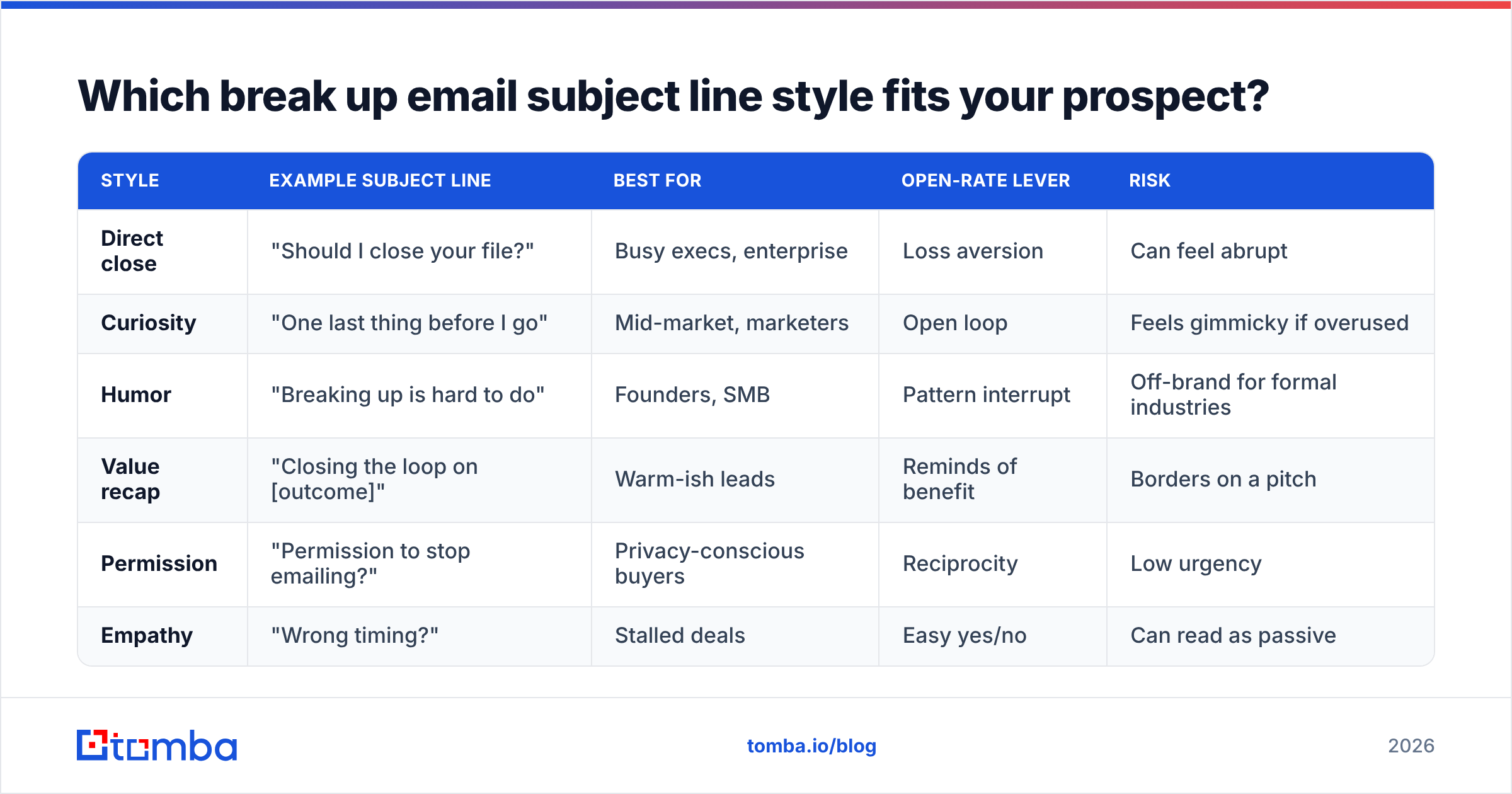
Not every prospect responds to the same trigger. A VP at an enterprise reacts to a calm, professional close; a founder at a 10-person startup may respond to humor. Here's how the main styles compare so you can match tone to audience.
| Style | Example subject line | Best for | Open-rate lever | Risk |
|---|---|---|---|---|
| Direct close | "Should I close your file?" | Busy execs, enterprise | Loss aversion | Can feel abrupt |
| Curiosity | "One last thing before I go" | Mid-market, marketers | Open loop | Feels gimmicky if overused |
| Humor | "Breaking up is hard to do" | Founders, SMB | Pattern interrupt | Off-brand for formal industries |
| Value recap | "Closing the loop on [outcome]" | Warm-ish leads | Reminds of benefit | Borders on a pitch |
| Permission | "Permission to stop emailing?" | Privacy-conscious buyers | Reciprocity | Low urgency |
| Empathy | "Wrong timing?" | Stalled deals | Easy yes/no | Can read as passive |
The takeaway: pick the style based on who you're emailing, not on which line you personally like best. Then test two styles head-to-head to see which earns the better response rate for your list.
What are the best break up email subject lines for 2026?#
Here are 25+ field-tested options, grouped by style. Swap the brackets for real specifics.
Direct / closure
- Should I close your file?
- Closing your account
- Last email from me
- Time to say goodbye?
- Final check on [Company]
Curiosity / open loop
- One last thing
- Before I go…
- Quick question, then I'll stop
- Did I lose you?
- Was it something I said?
Humor / pattern interrupt
- Breaking up is hard to do
- It's not you, it's your inbox
- Am I being ghosted?
- This is goodbye (for real this time)
- Returning you to the wild
Value recap
- Closing the loop on [outcome]
- Last chance for [specific result]
- Worth 10 minutes before I close out?
- [Competitor] is already doing this
Permission / empathy
- Permission to stop emailing you?
- Wrong time to chat?
- Should I check back in Q1?
- Want me to back off?
- Not a priority right now?
Use these as starting points, not gospel. The "best" line is the one your specific audience opens — which only A/B testing reveals.
How do you write the body behind the subject line?#
A great subject line earns the open; a sloppy body wastes it. Keep the break-up email to four sentences:
- Acknowledge the silence without guilt-tripping: "I've reached out a few times and haven't heard back, so I'll assume the timing isn't right."
- Restate one specific value, not your whole deck: "We helped [similar company] cut onboarding time by 30%."
- Make the reply effortless: "If I'm wrong, just reply with a 1, 2, or 3 — interested, not now, or never."
- Close cleanly: "Either way, I'll stop here. Wishing you a strong quarter."
The famous "1-2-3" close removes friction: replying takes one keystroke. According to HubSpot's sales research, lowering the cognitive cost of a reply is one of the most reliable ways to lift response rates on cold sequences. Pair that with a closure-driven subject line and you've stacked two triggers in the prospect's favor.
If you reuse this structure across campaigns, store the winners as reusable cold email templates so your team isn't rewriting the same break-up from scratch every week.
When should you send a break up email?#
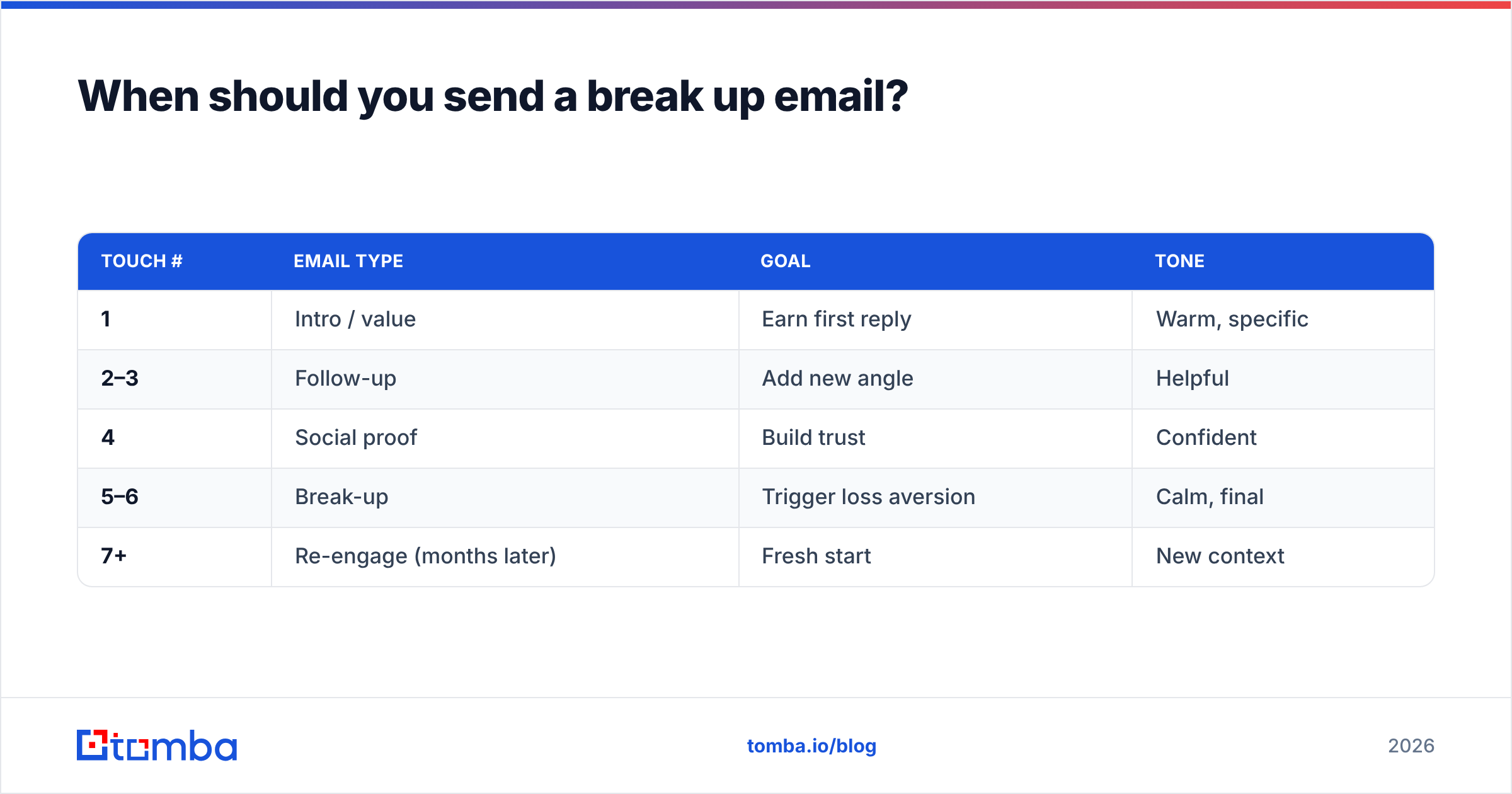
Timing matters as much as wording. Send it too early and you're quitting on a lead that wasn't ready; send it too late and you've burned goodwill with five "just checking in" emails.
| Touch # | Email type | Goal | Tone |
|---|---|---|---|
| 1 | Intro / value | Earn first reply | Warm, specific |
| 2–3 | Follow-up | Add new angle | Helpful |
| 4 | Social proof | Build trust | Confident |
| 5–6 | Break-up | Trigger loss aversion | Calm, final |
| 7+ | Re-engage (months later) | Fresh start | New context |
The break-up generally lands best at touch 5 or 6, after you've given genuine value and before you've become an irritation. Send it at a sensible local hour for the prospect, mid-week, and never the same day as your previous follow-up.
One non-negotiable: confirm the address is real before you spend your "last" email on it. Sending a break-up to a dead inbox or a typo'd address tells you nothing. Run your list through an email verifier first so a non-reply means they ignored you — not that the message bounced into the void. Bounces also damage your email deliverability, which quietly tanks every campaign that follows.
What mistakes kill break up email subject lines?#
Even good operators sabotage their last-chance email. Avoid these:
- Fake urgency. "FINAL NOTICE!!!" in caps reads as spam and trips filters. Closure should feel calm, not panicked.
- The empty threat. If your subject line says "last email" and you email again next week, you've taught the prospect to ignore you permanently.
- Guilt-tripping. "I guess you're not interested" is passive-aggressive and rarely converts. Stay gracious.
- Pitch-stuffing the subject line. "50% off our platform — last chance!" turns a relationship close into a discount blast.
- Personalization tokens that misfire. "Should I close your file, {{first_name}}?" is worse than no name at all. Validate your data before merge fields go out.
- Breaking up with bad contacts. If you guessed the email, you may be guessing wrong. Start from accurate contact data instead.
That last point is where most cold campaigns leak. You can write the perfect line and still get nothing because the address was never valid. Tools rated highly on G2 for verification exist precisely because guesswork is so costly at scale.
How does data quality change break-up performance?#
Your subject line controls the open; your data controls whether there's a human on the other end to open it. The cleanest sequence in the world fails on a list full of role accounts, catch-alls, and stale addresses.
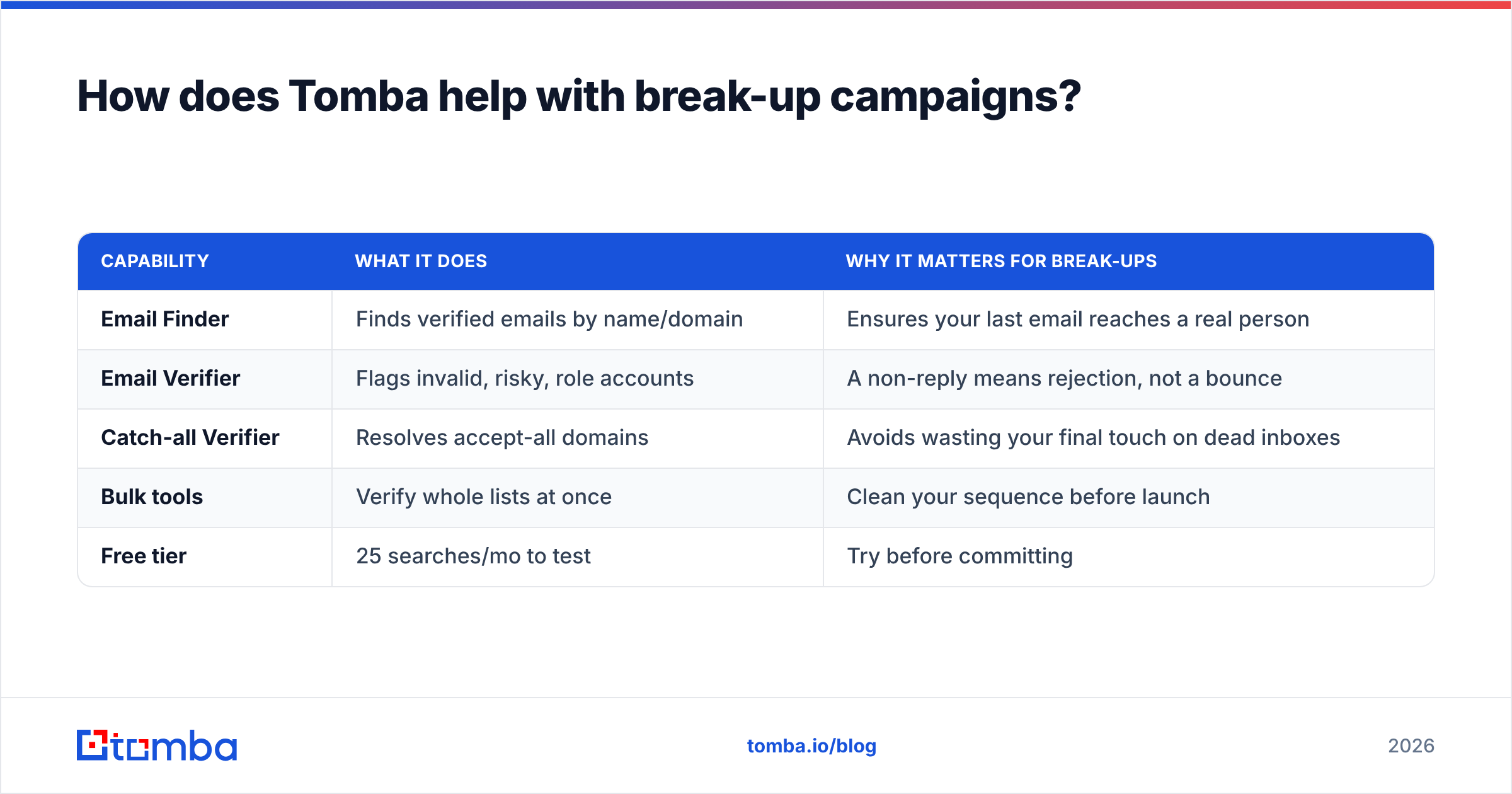
This is the unglamorous half of cold email. Before you obsess over whether "Should I close your file?" beats "One last thing," make sure you're emailing real, reachable people. Use an email finder to source verified addresses by name and company, a catch-all verifier to handle domains that accept everything, and bulk verification to scrub lists before a campaign. The math is simple: a 40% open rate on a clean list beats a 60% "open rate" on a list where a third of the sends never arrived.
How does Tomba help with break-up campaigns?#
| Capability | What it does | Why it matters for break-ups |
|---|---|---|
| Email Finder | Finds verified emails by name/domain | Ensures your last email reaches a real person |
| Email Verifier | Flags invalid, risky, role accounts | A non-reply means rejection, not a bounce |
| Catch-all Verifier | Resolves accept-all domains | Avoids wasting your final touch on dead inboxes |
| Bulk tools | Verify whole lists at once | Clean your sequence before launch |
| Free tier | 25 searches/mo to test | Try before committing |
Tomba's pricing scales with volume: a Free tier (25 searches/mo), Starter at $49/mo, Growth at $99/mo, Pro at $249/mo, and custom Enterprise plans. See full Tomba pricing for credit details. The point isn't to add another tool — it's to stop wasting your best subject lines on addresses that were never going to reply.
Frequently asked questions#
Do break up emails actually work? Yes, when used correctly. They consistently outperform generic mid-sequence follow-ups because they trigger loss aversion and remove sales pressure. The catch is they only work once per sequence — overuse kills the effect. The psychology behind it is well documented under loss aversion.
How long should a break up email subject line be? Three to six words, or roughly 35 characters, so it doesn't truncate on mobile. Short lines read as confident and get opened more often.
Should I use the prospect's name in the subject line? Only if your data is verified. A correct first name can lift opens; a wrong or missing token ("Should I close your file, {{first_name}}?") destroys credibility instantly.
What's the best break up email subject line overall? "Should I close your file?" is the most reliable across industries because it's short, closure-driven, and demands a yes/no answer. But always test it against a curiosity or humor variant for your specific audience.
How many follow-ups before the break-up email? Typically four to five value-driven touches, with the break-up landing at touch 5 or 6. Sending it earlier quits too soon; sending it later annoys.
Send your last email to a real inbox#
A break-up email is your highest-leverage message — don't waste it on a guess. Source and verify every address first with the Tomba Email Finder, so when a prospect doesn't reply to "Should I close your file?", you know it's a real no — and not a bounce. Start free with 25 searches, write a closure line worth opening, and turn silence into replies.
// get started
Find, verify and enrich your first contacts today
Start on the free plan with 25 searches a month, then scale when your team is ready.
Free plan · No credit card required · GDPR & CCPA
// about the author