Breakup Email Templates That Actually Get Replies (2026)
A breakup email is the last message in a sequence that often gets the most replies. Here are templates, timing rules, and mistakes to avoid in 2026.
Breakup Email Templates That Actually Get Replies (2026)
You chase a prospect for two weeks, send five thoughtful follow-ups, and hear nothing. Then you send one short note saying you're giving up — and they reply within an hour. That is the strange power of the breakup email, and most reps still get it wrong.
TL;DR#
- A breakup email is the final message in a cold outreach or sales sequence that signals you're closing the loop and moving on.
- It works because of loss aversion: people who ignored your value pitch suddenly respond when the offer is about to disappear.
- Reply rates on a well-timed breakup email often land between 8% and 33%, frequently beating earlier touches in the same sequence.
- Keep it short, specific, and free of guilt-tripping. One clear question beats a paragraph of passive-aggression.
- Pair good copy with good data: a breakup email sent to a verified, correctly-targeted inbox is the only version that matters.
What is a breakup email?#
A breakup email is the closing message in a follow-up sequence — the one where you tell a non-responsive prospect that you'll stop reaching out unless they say otherwise. Think of it like the last call at a bar: people who were happy to nurse their drink suddenly order another when they hear the lights are about to come up.
It is not a tantrum, and it is not a guilt trip. The best breakup emails are calm and respectful. They acknowledge reality ("I haven't heard back, so I'll assume the timing isn't right"), make leaving easy, and quietly leave the door open. The psychology underneath is well documented: loss aversion, the principle that people feel the pain of losing something roughly twice as strongly as the pleasure of gaining it. Your earlier emails offered a gain. The breakup email threatens a loss. That reframe is why it converts.

Breakup emails show up in three common contexts:
- Cold outreach — the last touch in a 5–7 step prospecting cadence to a lead who never replied.
- Active deals gone quiet — a prospect who engaged, took a call, then ghosted during evaluation.
- Renewals and re-engagement — a lapsed customer or trial user you want to reactivate before archiving.
The copy changes slightly for each, but the mechanics are identical: short, low-pressure, one decision to make.
Why does a breakup email get more replies than normal follow-ups?#
Because it removes the thing your prospect was avoiding: an open loop. A normal follow-up asks them to take on something new — a meeting, a demo, a decision. A breakup email asks them to either confirm they're out (easy) or raise their hand before you go (also easy). You've lowered the cost of replying to almost zero.
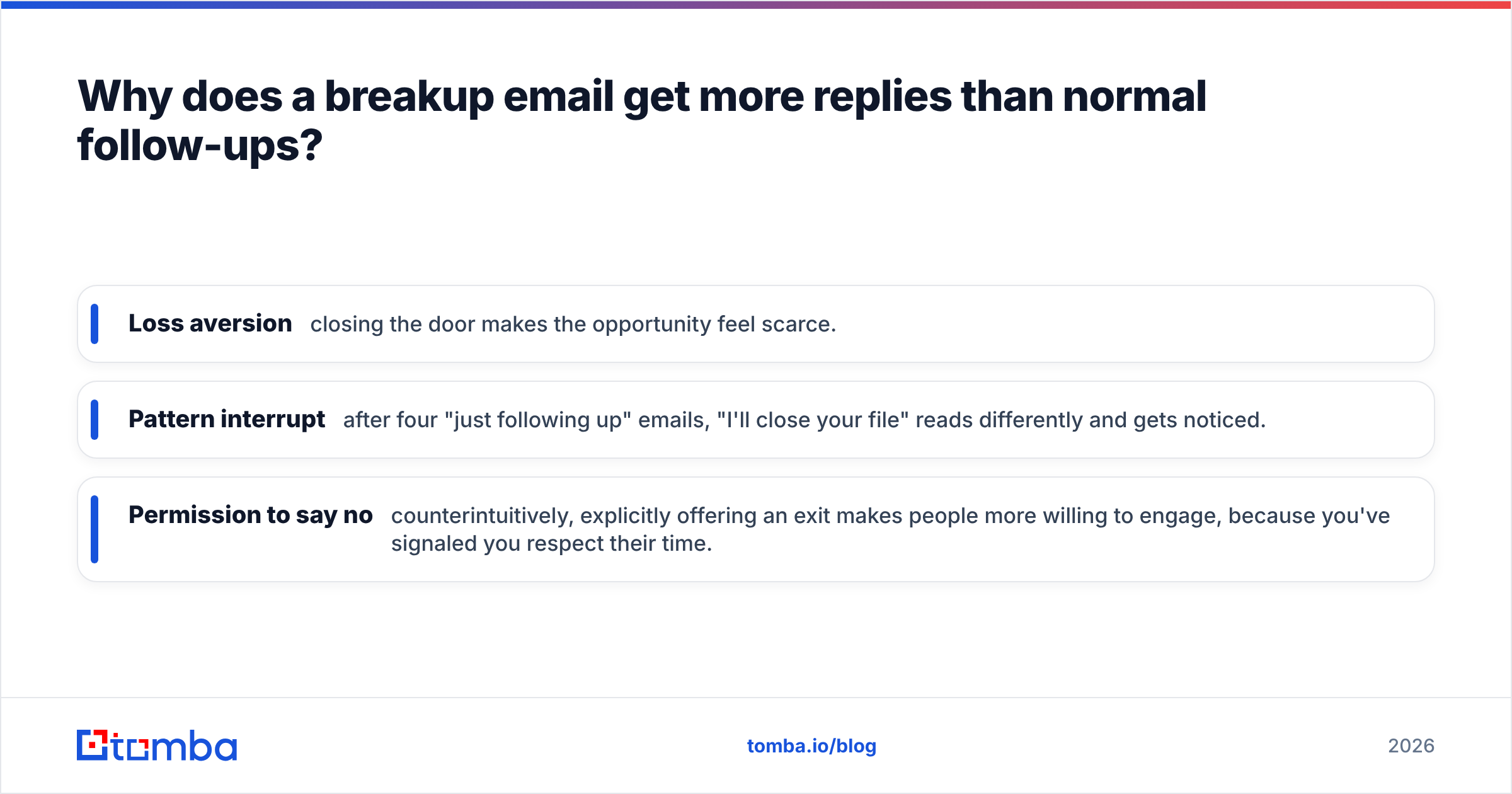
Three forces compound here:
- Loss aversion — closing the door makes the opportunity feel scarce.
- Pattern interrupt — after four "just following up" emails, "I'll close your file" reads differently and gets noticed.
- Permission to say no — counterintuitively, explicitly offering an exit makes people more willing to engage, because you've signaled you respect their time.
A quick word of caution on the famous statistics. You'll see claims that breakup emails get "the highest reply rate in any sequence." Sometimes true, sometimes survivorship bias — the breakup email only fires on people who ignored everything else, so its audience is pre-filtered. Treat published benchmarks from vendors like HubSpot and peer-review sites like G2 as directional, then measure your own reply rate per step. Your numbers are the only ones that pay your quota.
What are the elements of a high-performing breakup email?#
Strip a great breakup email down and you find the same skeleton every time. Here is the structure, with the job each part does.
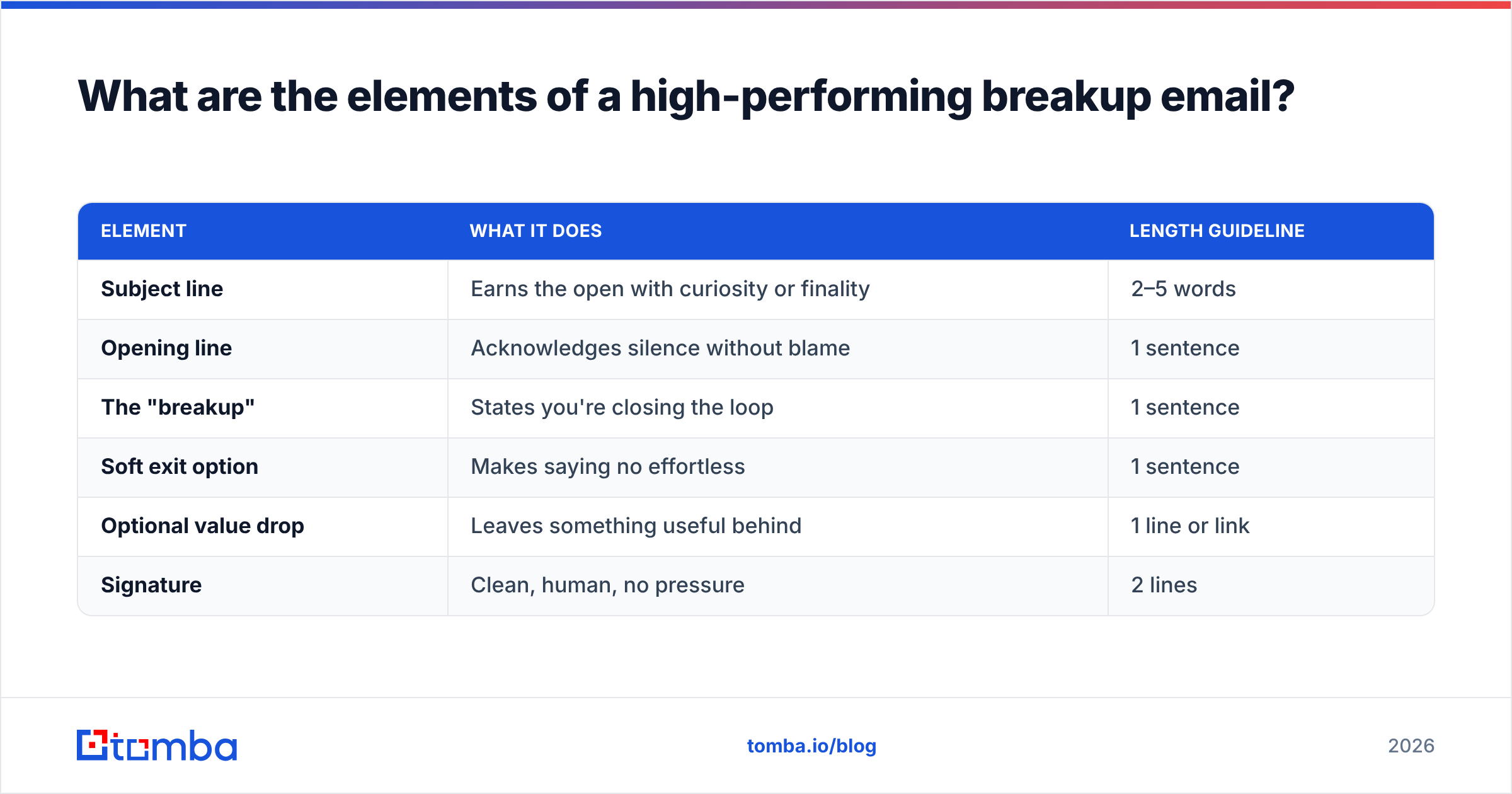
| Element | What it does | Length guideline |
|---|---|---|
| Subject line | Earns the open with curiosity or finality | 2–5 words |
| Opening line | Acknowledges silence without blame | 1 sentence |
| The "breakup" | States you're closing the loop | 1 sentence |
| Soft exit option | Makes saying no effortless | 1 sentence |
| Optional value drop | Leaves something useful behind | 1 line or link |
| Signature | Clean, human, no pressure | 2 lines |
Keep the whole thing under 90 words. The breakup email is the one message where brevity is non-negotiable — a long goodbye defeats the entire pattern-interrupt effect.
Subject lines that work#
- "Should I close your file?"
- "Permission to stop?"
- "Last one from me, [First name]"
- "Wrong time?"
- "Closing the loop on [Company]"
Avoid fake urgency ("FINAL NOTICE") and anything that reads like a system-generated dunning email. You want it to feel like a human deciding to move on, because that is exactly what it is.
What does a good breakup email look like? (Templates)#
Here are four templates you can adapt. Swap the brackets, match the tone to your buyer, and resist the urge to add a paragraph.
Template 1 — The classic close (cold outreach)
Subject: Should I close your file?
Hi [First name],
I've reached out a few times about [specific outcome], but the timing may not be right. I don't want to keep cluttering your inbox, so this is the last you'll hear from me.
If [problem] is still worth solving this quarter, just reply "yes" and I'll send one short plan. If not, no hard feelings.
Best,
[Your name]
Template 2 — The value parting gift
Subject: Last one from me
Hi [First name],
Looks like now isn't the moment — totally understand. Before I close things out, here's the [benchmark report / teardown] I mentioned. It's useful whether or not we ever talk.
If you want the walkthrough version, I'm one reply away.
[Your name]
Template 3 — The deal that went quiet
Subject: Wrong time?
Hi [First name],
We were moving toward [next step] and then things went quiet, which usually means priorities shifted or I dropped the ball. Either is fine.
Want me to pause this until [next quarter], or close it out for now? One word works.
[Your name]
Template 4 — The re-engagement / lapsed user
Subject: Closing your account?
Hi [First name],
Your [trial / account] has been quiet, so I'm about to archive it. If you were waiting on [feature / answer], tell me and I'll sort it before it goes.
Otherwise, thanks for giving us a look.
[Your name]
Notice what none of these do: beg, lecture, or fake disappointment. The tone is "I respect your time enough to stop," which is far more persuasive than "why are you ignoring me?"
When should you send a breakup email?#
Send it as the last step of the sequence, after you've delivered real value and given the prospect genuine reasons to reply. Timing matters in two dimensions: position and spacing.
- Position: the breakup email should be touch 5–7 in a cold cadence, never touch 2. If you "break up" too early, you've spent your scarcest card on someone you barely courted.
- Spacing: leave a slightly longer gap before the breakup — 4 to 6 business days after your previous touch — so it reads as a considered decision, not another reflexive follow-up.
A sane cold sequence with the breakup email in its proper place looks like this:
- Day 1 — Personalized opener tied to a trigger.
- Day 3 — Value follow-up (case study, relevant insight).
- Day 6 — Different angle or social proof.
- Day 10 — Short bump, one-line question.
- Day 16 — Breakup email.
If you run multichannel, fold in a LinkedIn outreach touch or a call between steps 3 and 4 so the breakup email isn't the prospect's only signal that you exist. For phone-friendly buyers, having a verified number from a phone finder lets you make the breakup a quick voicemail instead of one more email in a crowded inbox.
What mistakes kill a breakup email?#
Most failed breakup emails fail for predictable reasons. Here's the comparison between what works and what tanks your reply rate.
| Do this | Not this |
|---|---|
| "I'll close your file unless I hear otherwise." | "I guess you're not interested." |
| One clear yes/no question | Three asks crammed into a paragraph |
| Respectful, neutral tone | Guilt-tripping or sarcasm |
| Under 90 words | A four-paragraph farewell speech |
| Send to a verified, correct contact | Send to a guessed or stale address |
| Genuinely stop if they decline | "Breaking up" then emailing again in a week |
That last row is the silent killer. A breakup email only works if it's true. If you say "this is the last you'll hear from me" and then resurface seven days later, you've trained the prospect that your words don't mean anything — and you've torched your credibility for any future touch.

The second silent killer is data. A perfectly worded breakup email sent to john.smith@company.com when the prospect is actually j.smith@company.com doesn't get a low reply rate — it gets zero, and you never know why. Before you blame the copy, verify the plumbing.
How does data quality change breakup email results?#
Dramatically — because every reply-rate problem is either a copy problem or a delivery problem, and delivery problems hide. If a quarter of your sequence is bouncing or landing in spam, your breakup email's "low reply rate" is actually a deliverability failure wearing a copywriting costume.
Two data checks protect every breakup email you send:
- Right person, right address. Use an email finder to source the correct, current contact, and an email verifier to confirm the mailbox accepts mail before you ever hit send. Bouncing your final touch off a dead inbox is the cheapest mistake to avoid.
- Right targeting. When you're building the account list, domain search pulls the relevant roles at a company so your breakup email reaches a decision-maker, not a generic info@ alias that no human reads.
This is also why the breakup email is a terrible place to cut corners on list hygiene. It's your last impression. Clean, verified data means the only variable left is your message — which is exactly the variable you can control and improve. If you're running sequences at scale, a bulk email finder plus verification keeps the whole cadence — opener through breakup — pointed at addresses that actually exist.
For a sense of how the tooling lines up against your stack, the full Tomba pricing starts free at 25 searches a month, so you can validate a small list before committing to a paid sequence.
How do you measure if your breakup email is working?#
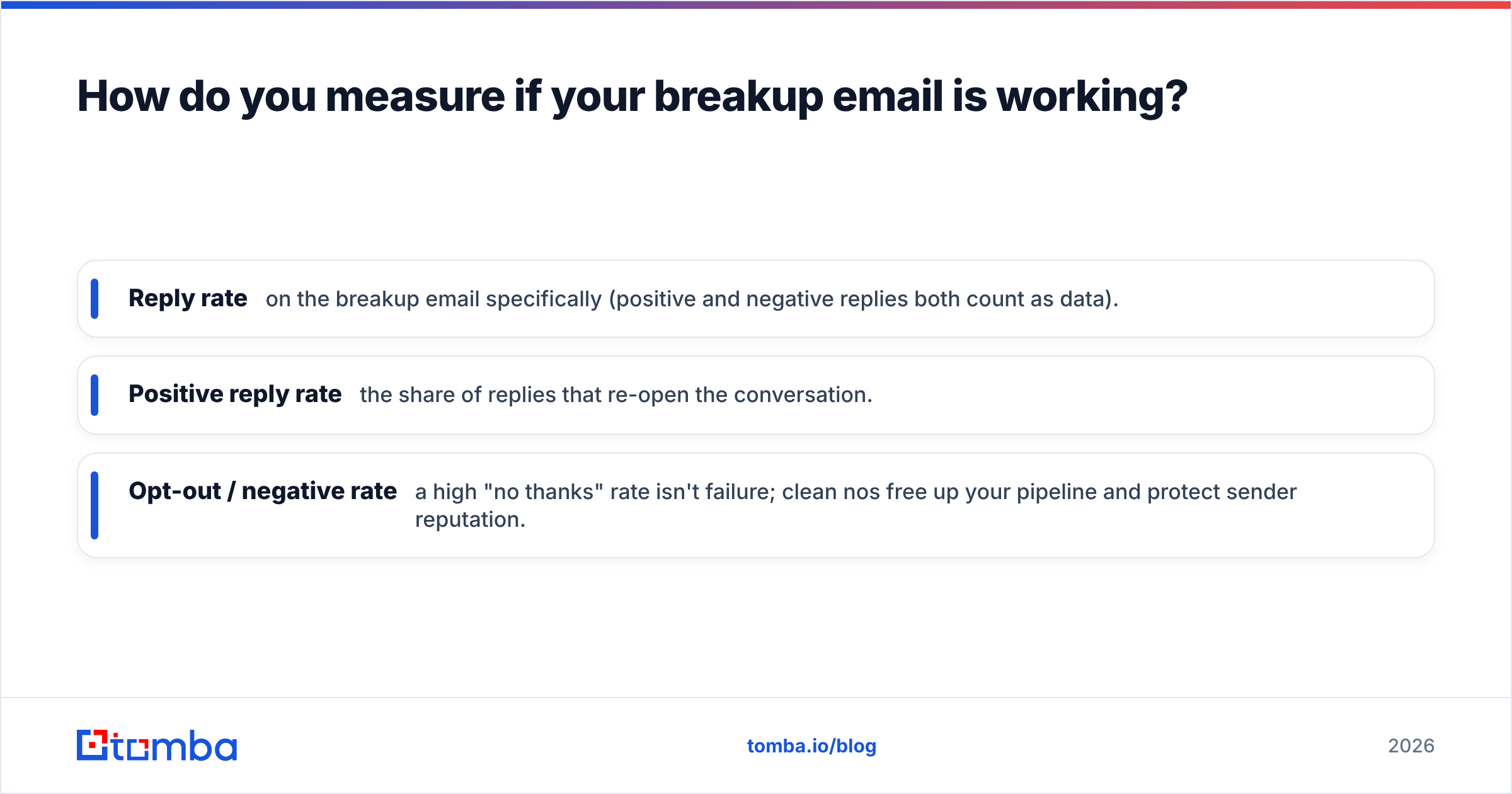
Track reply rate per step, not just sequence-wide. Tag the breakup email as its own touch in your CRM or sending tool and watch three numbers:
- Reply rate on the breakup email specifically (positive and negative replies both count as data).
- Positive reply rate — the share of replies that re-open the conversation.
- Opt-out / negative rate — a high "no thanks" rate isn't failure; clean nos free up your pipeline and protect sender reputation.
Run an A/B test on two variables at a time, max: subject line and the core ask. Resist rewriting everything at once — you'll learn nothing about what moved the number. Give each variant at least 100 sends before you trust the result, and re-check your bounce rate first so you're not optimizing copy on top of a delivery leak.
One healthy reframe: a breakup email that produces a wave of polite "not right now, circle back in Q3" replies is doing its job. You've converted dead silence into dated, actionable pipeline. That's worth more than a vanity open rate.
Frequently asked questions#
Is a breakup email the same as an unsubscribe? No. An unsubscribe ends the relationship at the prospect's request. A breakup email is your decision to pause outreach, framed in a way that invites them to stop you. One is compliance; the other is strategy.
Can a breakup email hurt my brand? Only if it's whiny or dishonest. A respectful, brief breakup email reads as professional. A guilt-trip reads as desperate. Tone is the whole game.
How many breakup emails should I send? One. The entire effect depends on it being final. If you "break up" repeatedly, it becomes just another ignored follow-up.
Should I include a calendar link in the breakup email? Optional. A single low-friction option (a one-word reply) usually beats a calendar link, which reintroduces the very commitment the prospect was avoiding.
The bottom line#
The breakup email is the highest-leverage message in your sequence and the easiest to ruin. Keep it short, make it honest, give a clean exit, and — most importantly — send it to a real, verified person. Great copy aimed at the wrong inbox is just a well-written bounce.
Before you write your next sequence, fix the foundation. Start with the Tomba Email Finder to source and verify the right contact for every account, so your opener lands, your follow-ups land, and your breakup email actually reaches the person who can say yes. The free tier gives you 25 searches a month to test it on a live list — enough to prove that better data, not louder copy, is what turns goodbyes into replies.
// get started
Find, verify and enrich your first contacts today
Start on the free plan with 25 searches a month, then scale when your team is ready.
Free plan · No credit card required · GDPR & CCPA
// about the author