Brevity Pricing & Reviews 2026: Pros, Cons & Alternatives
A neutral 2026 breakdown of Brevity's pricing, real-user reviews, and the honest pros and cons—plus where it fits in a B2B sales stack and when a data tool serves you better.
Brevity markets itself as an AI assistant that turns long, messy documents into short, skimmable briefs. If you write a lot of B2B content—proposals, call notes, research dumps, sales decks—the pitch is obvious: paste in the wall of text, get a tight summary back. But "does it summarize well" and "is it worth the subscription" are two different questions. This review answers the second one.
TL;DR#
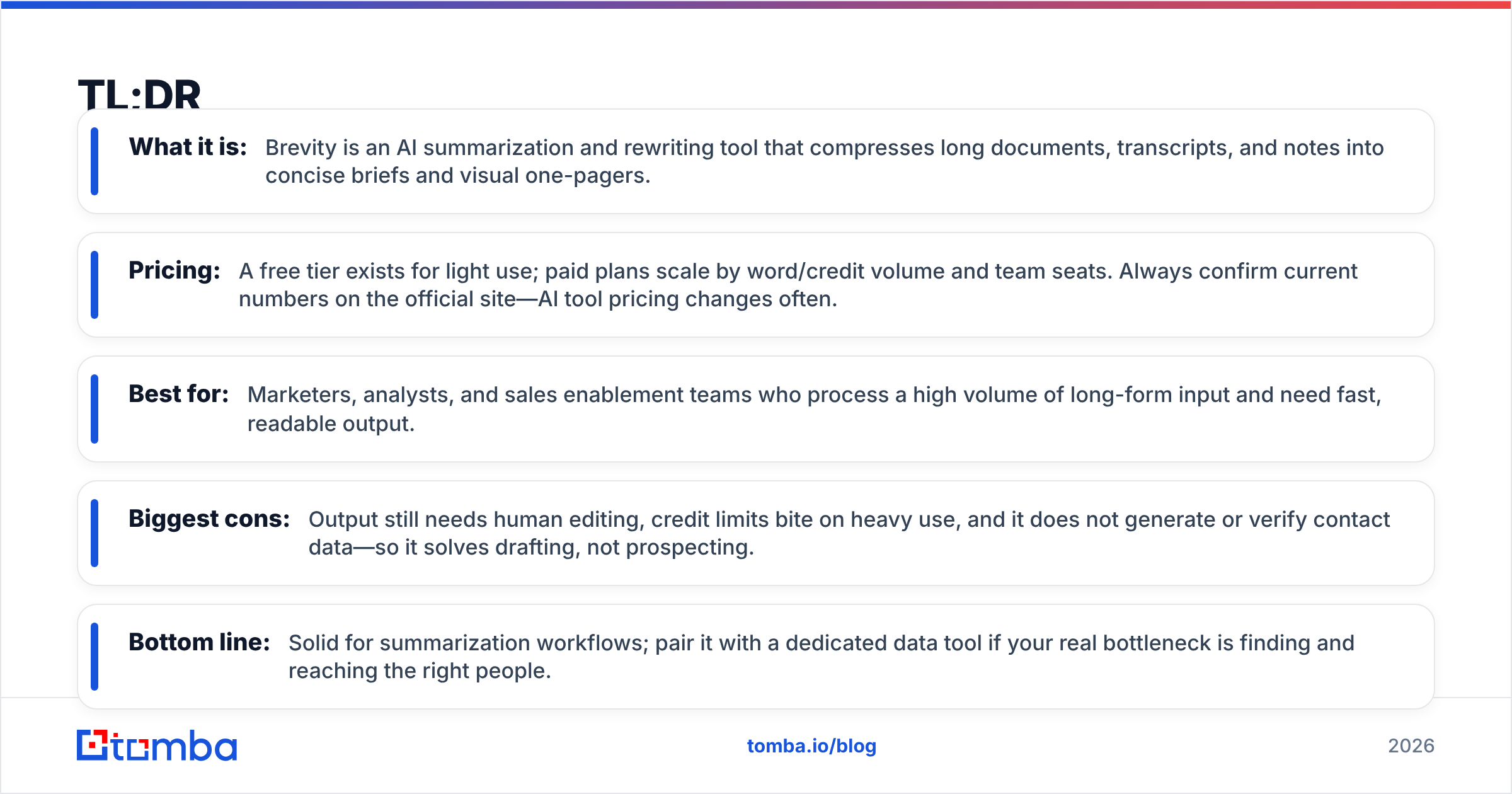
- What it is: Brevity is an AI summarization and rewriting tool that compresses long documents, transcripts, and notes into concise briefs and visual one-pagers.
- Pricing: A free tier exists for light use; paid plans scale by word/credit volume and team seats. Always confirm current numbers on the official site—AI tool pricing changes often.
- Best for: Marketers, analysts, and sales enablement teams who process a high volume of long-form input and need fast, readable output.
- Biggest cons: Output still needs human editing, credit limits bite on heavy use, and it does not generate or verify contact data—so it solves drafting, not prospecting.
- Bottom line: Solid for summarization workflows; pair it with a dedicated data tool if your real bottleneck is finding and reaching the right people.
What is Brevity and who is it for?#
Brevity sits in the "AI writing assistant" category, but with a narrower focus than general chat tools. Instead of open-ended generation, it specializes in compression: take something long, return something short and structured. Think meeting transcripts into action-item briefs, a 40-page report into an executive summary, or a rambling internal doc into a clean one-pager you can actually send to a client.
The typical user is someone drowning in input. Sales enablement leads turning call recordings into coaching notes. Content marketers repackaging webinars into blog outlines. RevOps analysts summarizing dashboards into stakeholder updates. If your day involves reading more than you'd like and re-writing it for someone else, that's the sweet spot.
What Brevity is not: a prospecting or data platform. It won't find a decision-maker's email, validate a list, or enrich a CRM record. That distinction matters when you compare its price against the value it actually creates in a sales motion—more on that below.

How does Brevity pricing work in 2026?#
Like most AI tools, Brevity uses a tiered model that scales on usage (words or credits processed) and seats (how many people on your team). A free tier lets you test the output quality on small documents; paid tiers raise volume caps, unlock longer inputs, and add collaboration features.
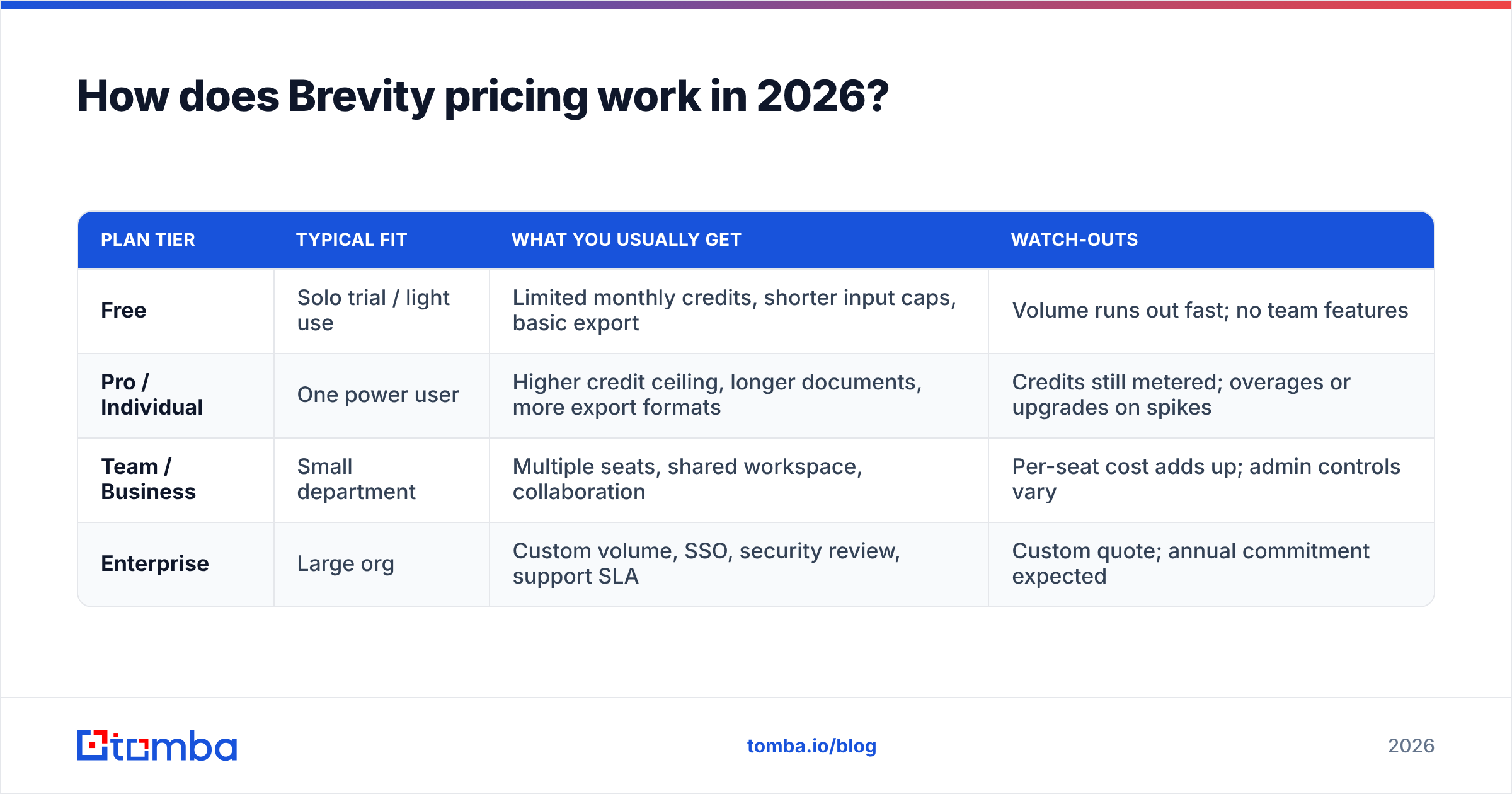
Because AI vendors adjust pricing frequently—often quarterly as model costs shift—treat the table below as a structural guide, not a quote. Verify live numbers before you buy.
| Plan tier | Typical fit | What you usually get | Watch-outs |
|---|---|---|---|
| Free | Solo trial / light use | Limited monthly credits, shorter input caps, basic export | Volume runs out fast; no team features |
| Pro / Individual | One power user | Higher credit ceiling, longer documents, more export formats | Credits still metered; overages or upgrades on spikes |
| Team / Business | Small department | Multiple seats, shared workspace, collaboration | Per-seat cost adds up; admin controls vary |
| Enterprise | Large org | Custom volume, SSO, security review, support SLA | Custom quote; annual commitment expected |
The honest read on value: if you genuinely process long documents every day, even a mid-tier plan pays for itself in saved reading time. If you summarize a few things a week, the free tier—or a general-purpose AI tool you already pay for—will likely cover you. The trap is buying a Team plan "for the future" and using 10% of the credits.
For context on how usage-based pricing should map to actual output, compare it against transparent, flat plans like Tomba pricing, where each tier states exactly how many searches you get. Predictable caps make budgeting far easier than fluctuating credit math.
What do Brevity reviews say—pros and cons?#
Pulling together the recurring themes from public review sites and user feedback, a clear pattern emerges. Check current ratings on G2 and Capterra before deciding, since scores move as products update.
The pros users repeat#
- Speed on long input. The single most praised feature: paste a transcript or report, get a usable summary in seconds. For anyone facing a backlog of reading, that's a real time win.
- Readable, structured output. Reviewers note the briefs are skimmable—bullets, headers, and short paragraphs rather than a single dense block. That's a step above raw "summarize this" prompts.
- Low learning curve. Most users are productive within minutes. There's little setup, no complex configuration, and the core action (paste, summarize) is obvious.
- Good for repurposing. Marketers like turning one long asset into several short ones—a webinar into social posts, a report into an email.
The cons users repeat#
- Output needs editing. As with every AI summarizer, the draft is a starting point, not a finished deliverable. Nuance gets flattened, and occasionally a key caveat is dropped. You still review everything before it goes out.
- Credit limits frustrate heavy users. People who summarize all day hit caps and face upgrade pressure. The metered model rewards light use and penalizes the exact power users who'd benefit most.
- Narrow scope. It summarizes; it doesn't research, fact-check, or pull live data. For workflows that need accurate external information, you're combining tools anyway.
- Accuracy on technical content. Highly specialized or jargon-heavy source material can produce summaries that read well but lose precision—dangerous if you forward them unchecked.
The fair conclusion: Brevity does its one job competently. Complaints cluster around scope and pricing friction, not core quality.
Is Brevity worth it for sales and marketing teams?#
It depends entirely on where your bottleneck actually is.
If your team's pain is information overload—too many calls, docs, and reports to digest—Brevity earns its keep. Summarization is a genuine, repeatable time saver, and the output quality is good enough to be useful with light editing.
But many B2B teams misdiagnose their bottleneck. The problem usually isn't "we can't summarize our notes." It's "we can't find enough qualified people to talk to," or "half our outreach bounces." No summarization tool fixes that. You can write the most concise, beautiful cold email in the world, and it does nothing if it lands in the wrong inbox—or no inbox at all.
That's why the smartest stacks separate the two jobs. Use an AI writer for drafting and compression; use a dedicated data platform for finding and verifying contacts. If your write-up game is strong but your list is weak, you're polishing the wrong end of the funnel.

How does Brevity compare to alternatives?#
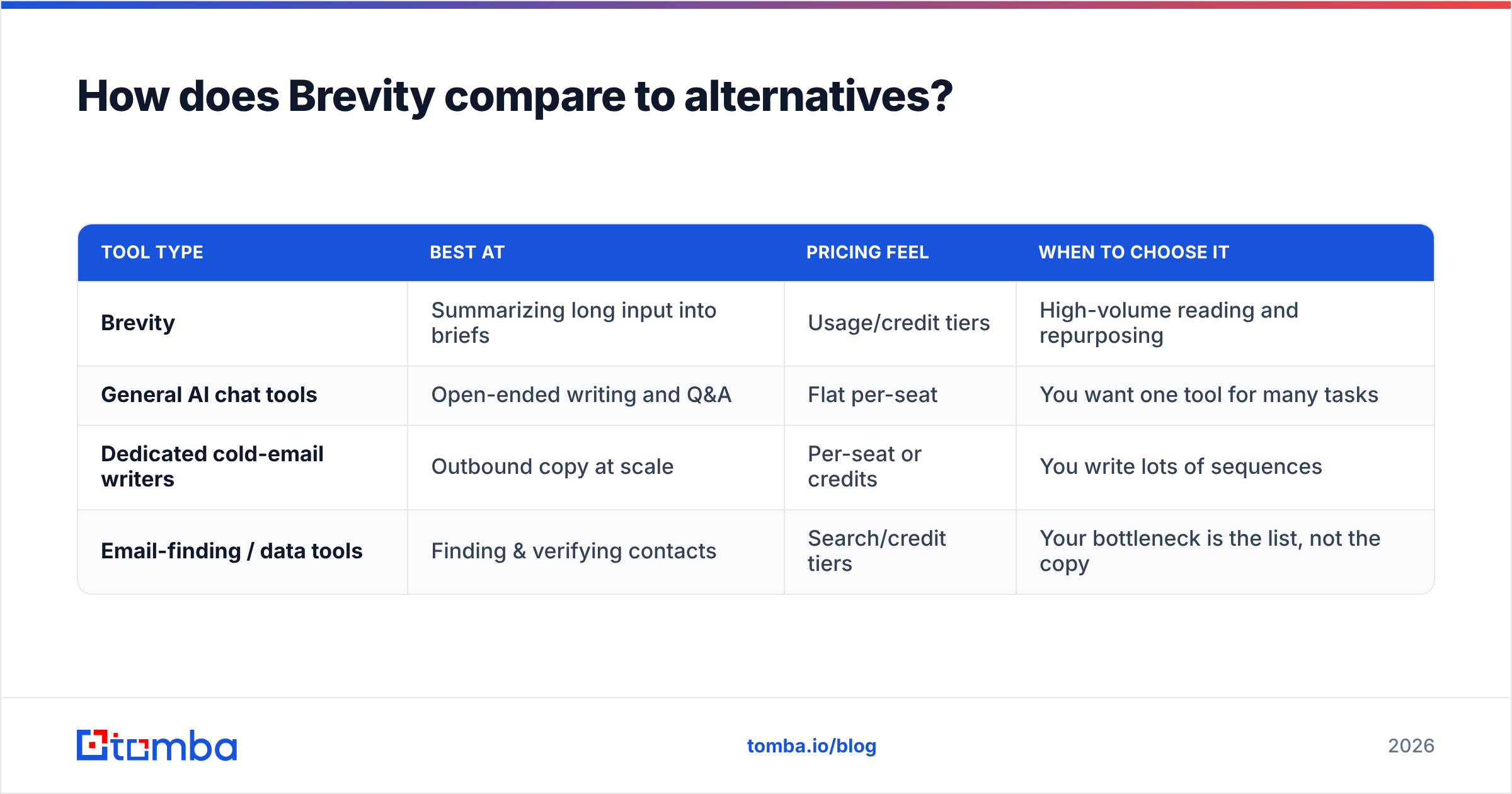
Brevity competes in a crowded AI-writing space, and the right comparison depends on your job. Here's how it stacks against the obvious categories.
| Tool type | Best at | Pricing feel | When to choose it |
|---|---|---|---|
| Brevity | Summarizing long input into briefs | Usage/credit tiers | High-volume reading and repurposing |
| General AI chat tools | Open-ended writing and Q&A | Flat per-seat | You want one tool for many tasks |
| Dedicated cold-email writers | Outbound copy at scale | Per-seat or credits | You write lots of sequences |
| Email-finding / data tools | Finding & verifying contacts | Search/credit tiers | Your bottleneck is the list, not the copy |
A few practical notes. General AI assistants can summarize too—often "good enough" if you already pay for one, which undercuts a standalone summarizer for casual users. Purpose-built outbound writers like a cold email AI tool focus specifically on persuasive sequences rather than compression. And if you keep landing on "great copy, wrong recipients," the missing piece is upstream: data.
For drafting support that doesn't require a new subscription, free utilities such as an email subject line generator or ready-made cold email templates handle a lot of what teams buy AI writers for—without the credit anxiety.
Where do email-finding tools fit alongside Brevity?#
They fill the gap Brevity can't touch: getting your polished message to a real, reachable person.
Here's the honest division of labor. Brevity (or any AI writer) shapes the what you say. A data platform handles the who you say it to and whether they'll receive it. Those are complementary, not competing—but only one of them moves a deal forward when your pipeline is empty.
A dedicated data tool typically covers:
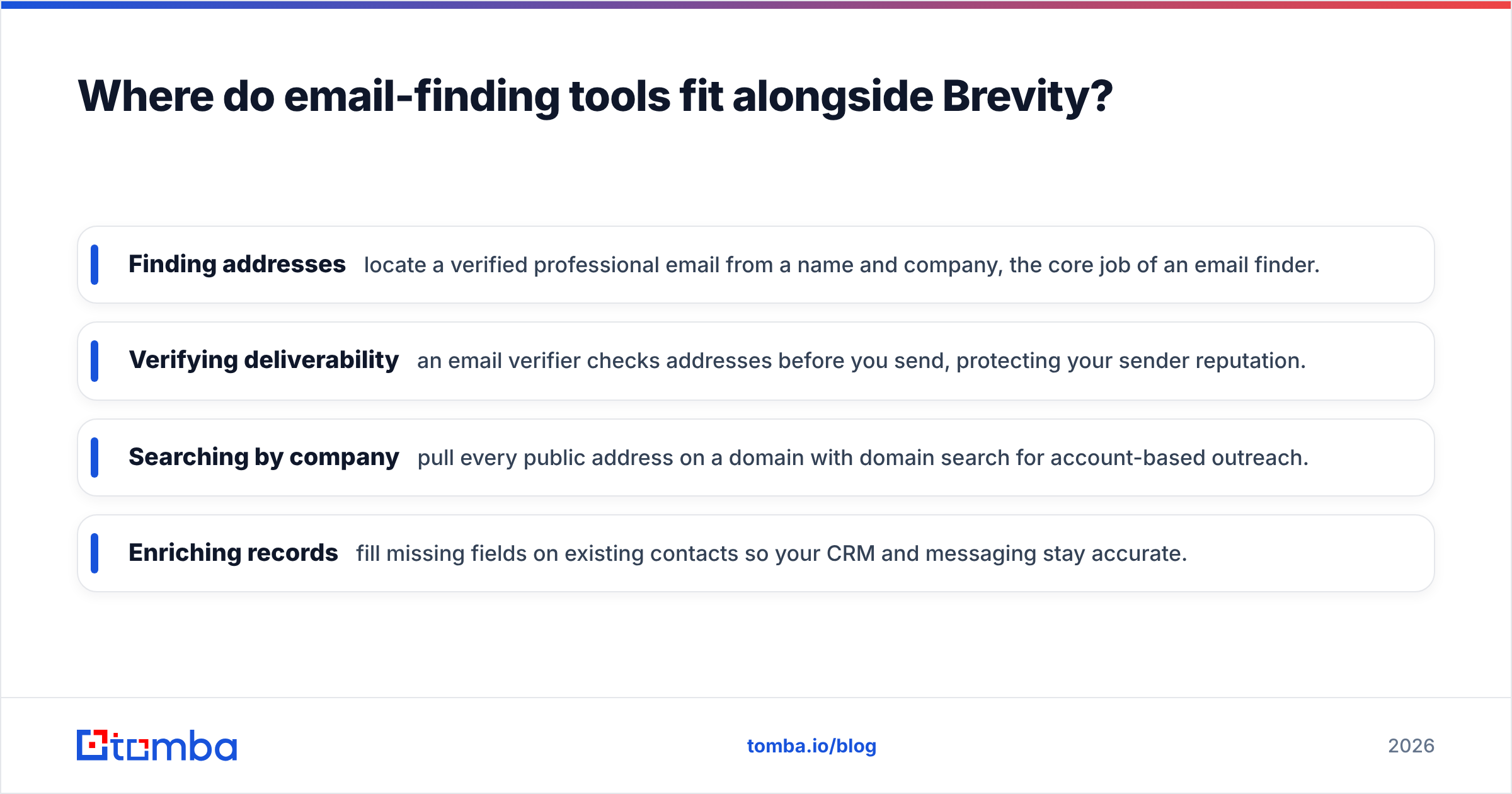
- Finding addresses — locate a verified professional email from a name and company, the core job of an email finder.
- Verifying deliverability — an email verifier checks addresses before you send, protecting your sender reputation.
- Searching by company — pull every public address on a domain with domain search for account-based outreach.
- Enriching records — fill missing fields on existing contacts so your CRM and messaging stay accurate.
This is where pricing comparison gets interesting. A summarizer saves you reading time; a data tool directly produces pipeline. When you weigh a $99/mo AI-writing subscription against a data plan at the same price, ask which one a rep would rather lose. For most outbound teams, the answer is the list.
What's the verdict on Brevity's pricing, pros, and cons?#
Brevity is a competent, focused tool that does one thing—turning long input into short, readable output—well. The pros are real: speed, structure, and a gentle learning curve. The cons are equally real: metered credits that frustrate heavy users, output that still needs editing, and a narrow scope that means it's rarely your only tool.
On price, the structure is fair but rewards honest self-assessment. If you summarize all day, a paid tier is justified. If you summarize occasionally, the free plan—or a general AI tool you already own—will do. Don't over-buy seats and credits against an imagined future workload.
The strategic takeaway: decide what your actual bottleneck is before you spend. If it's reading and repackaging information, Brevity is a reasonable buy. If it's finding and reaching qualified prospects—which is the more common B2B constraint—your money goes further on data.
Find and verify the contacts your message deserves#
Great copy is wasted on the wrong inbox. Before you invest in another AI-writing subscription, make sure your outreach is reaching real, verified decision-makers. The Tomba Email Finder locates professional email addresses by name, company, or domain—and pairs with built-in verification so your sequences land instead of bounce. Start free with 25 searches a month, scale up only when you need to, and put your polished messaging in front of people who can actually say yes. Summarize the meeting notes with Brevity; fill the pipeline with Tomba.
Ready to find emails that actually work?
Join 150,000+ professionals who stopped guessing and started sending. Free credits on signup — no credit card required.
Get the Tomba newsletter
Practical outbound tactics and product updates — once every two weeks.
About the author