Brevo vs HubSpot 2026: Which Marketing Platform Wins?
Brevo vs HubSpot, compared on pricing, CRM depth, email deliverability, and automation. See which platform fits your 2026 go-to-market stack before you commit.
Choosing between Brevo and HubSpot is really a choice about how much platform you want to pay for. Brevo wins on price-per-send and SMS; HubSpot wins on CRM depth and ecosystem. This guide breaks down where each one earns its keep in 2026 so you stop guessing and pick based on your actual workflow.
TL;DR#
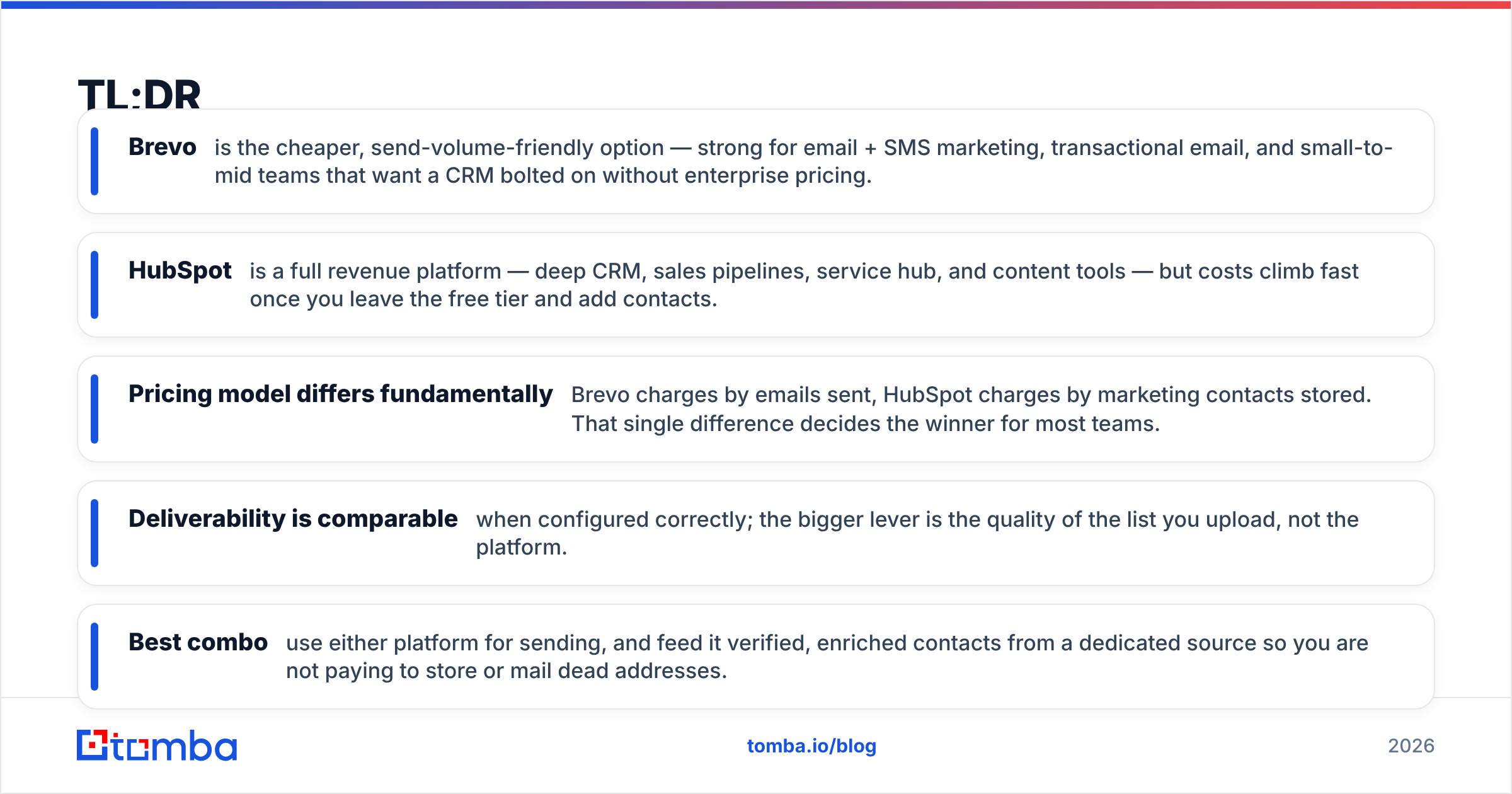
- Brevo is the cheaper, send-volume-friendly option — strong for email + SMS marketing, transactional email, and small-to-mid teams that want a CRM bolted on without enterprise pricing.
- HubSpot is a full revenue platform — deep CRM, sales pipelines, service hub, and content tools — but costs climb fast once you leave the free tier and add contacts.
- Pricing model differs fundamentally: Brevo charges by emails sent, HubSpot charges by marketing contacts stored. That single difference decides the winner for most teams.
- Deliverability is comparable when configured correctly; the bigger lever is the quality of the list you upload, not the platform.
- Best combo: use either platform for sending, and feed it verified, enriched contacts from a dedicated source so you are not paying to store or mail dead addresses.
What is the real difference between Brevo and HubSpot?#
The short answer: Brevo is a marketing-and-messaging tool with a light CRM; HubSpot is a CRM-first platform with marketing built on top.
Think of it like buying a vehicle. Brevo is a well-equipped van — it hauls your email and SMS campaigns efficiently and the price stays reasonable as you load it up. HubSpot is a fleet management system — it does far more than move packages, tracking every deal, ticket, and touchpoint across your whole company, but you pay for the command center whether or not you use all of it.
Brevo (formerly Sendinblue) built its reputation on affordable, high-volume email and transactional sending, then added SMS, WhatsApp, a sales pipeline, and automation. HubSpot started as inbound marketing software and grew into a five-hub suite — Marketing, Sales, Service, Content, and Operations — anchored by a genuinely good free CRM.
That origin story explains every meaningful difference you will hit in practice.
)
How do Brevo and HubSpot pricing models compare?#
This is where most buying decisions are won or lost, so read carefully.
- Brevo bills by emails sent. You can store unlimited contacts on most plans and pay for monthly send volume. If you have a big list but mail it infrequently, this is dramatically cheaper.
- HubSpot bills by marketing contacts. You pay for the number of contacts you actively market to, with tiers that step up quickly. Non-marketing contacts can be stored free, but the line items add up as your database grows.
- Free tiers exist on both, but they mean different things. Brevo's free plan caps daily sends; HubSpot's free CRM is genuinely generous for contact storage but gates the automation and reporting you will eventually want.
- Add-ons inflate HubSpot fast. Onboarding fees, extra seats, and hub upgrades mean the sticker price rarely matches the final invoice.
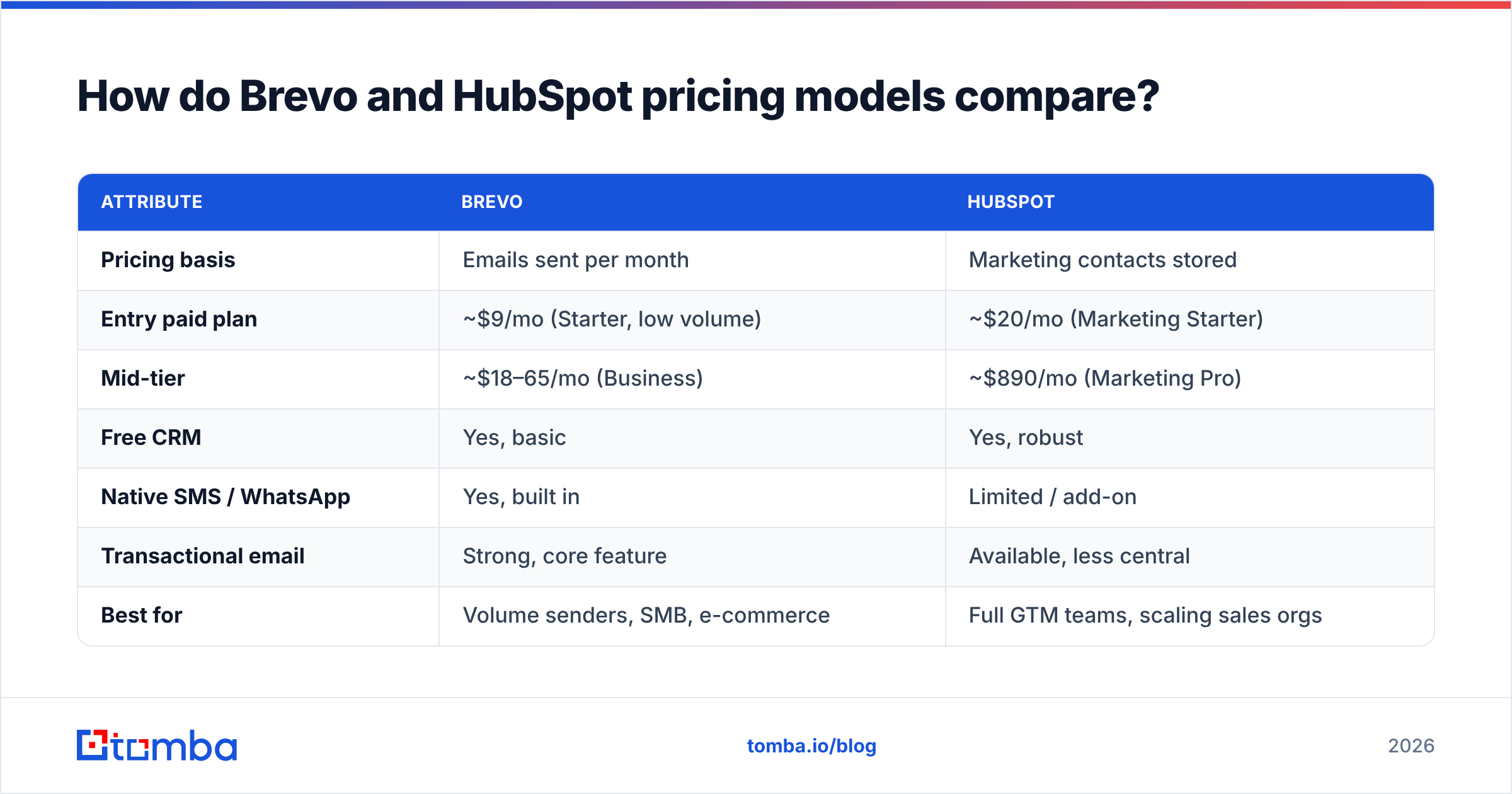
Here is a side-by-side of how the two stack up on the attributes that actually drive cost and fit:
| Attribute | Brevo | HubSpot |
|---|---|---|
| Pricing basis | Emails sent per month | Marketing contacts stored |
| Entry paid plan | ~$9/mo (Starter, low volume) | ~$20/mo (Marketing Starter) |
| Mid-tier | ~$18–65/mo (Business) | ~$890/mo (Marketing Pro) |
| Free CRM | Yes, basic | Yes, robust |
| Native SMS / WhatsApp | Yes, built in | Limited / add-on |
| Transactional email | Strong, core feature | Available, less central |
| Best for | Volume senders, SMB, e-commerce | Full GTM teams, scaling sales orgs |
| Learning curve | Low | Moderate to high |
The pattern is clear: Brevo wins on raw affordability and messaging breadth, HubSpot wins when you need one connected system for marketing, sales, and service and can justify the spend.
Which platform has the better CRM and sales tools?#
HubSpot, decisively — and it is not close.
HubSpot's CRM is the product the rest of the company is built around. You get deal pipelines, task automation, meeting scheduling, email sequences, conversation tracking, quotes, and forecasting that genuinely support a sales team's daily work. The free tier alone outclasses many paid CRMs.
Brevo's CRM is functional but lighter. It covers contacts, a basic pipeline, task management, and meeting booking — enough for a small team that wants to keep deals in the same place as their email marketing, but not a replacement for a dedicated sales platform once you scale headcount.
If your priority is revenue operations — pipeline visibility, multi-touch attribution, and tight sales-marketing alignment — HubSpot earns the premium. If your priority is sending great campaigns cheaply with a CRM as a convenience, Brevo is the pragmatic pick. For a deeper look at how data flows between these systems, see how data enrichment keeps either CRM populated with current, accurate fields.
Is Brevo or HubSpot better for email deliverability?#
Both can hit excellent inbox placement — the platform is rarely the bottleneck.
Deliverability comes down to three things, and only the first is partly the vendor's job:
- Sending infrastructure — both Brevo and HubSpot maintain reputable IP pools and authentication support (SPF, DKIM, DMARC). Brevo's transactional roots give it strong, granular sending controls; HubSpot's shared infrastructure is well-managed but less configurable.
- Authentication setup — you must configure your domain correctly on either platform. Review your SPF record and DKIM before your first send, regardless of vendor.
- List quality — this is the lever you control most and the one that wrecks the most campaigns. A clean list of real, reachable addresses protects your sender reputation; a list full of typos, role accounts, and dead mailboxes triggers bounces and spam complaints that no platform can save you from.
The uncomfortable truth: teams blame "bad deliverability" on Brevo or HubSpot when the real problem is the garbage they uploaded. Run every list through an email verifier before import and most "deliverability problems" disappear. HubSpot will even suppress contacts that repeatedly bounce — but you pay for those contacts up until that point.
)
What about automation, integrations, and ecosystem?#
HubSpot has the larger ecosystem; Brevo has the simpler one.
HubSpot's App Marketplace lists well over a thousand integrations, and its workflow automation is among the most powerful in the category — branching logic, lead scoring, multi-object triggers, and custom code actions. If your stack is sprawling and you need everything to talk to a central CRM, HubSpot's gravity is hard to beat. Connecting tools is straightforward; for example, you can pipe verified contacts straight in through the HubSpot integration.
Brevo's automation is approachable and covers the essentials — welcome series, abandoned-cart flows, SMS triggers, and scoring — without the complexity (or cost) of HubSpot's workflow engine. Its integration library is smaller but covers the major e-commerce platforms, CMSs, and Zapier, which bridges most gaps.
A quick way to decide:
- Pick HubSpot if you have multiple teams, a complex tech stack, and need one source of truth across the funnel.
- Pick Brevo if you are a lean marketing team or e-commerce store that wants powerful sending and good-enough automation without a platform tax.
Brevo vs HubSpot: which should you choose in 2026?#
Match the platform to your stage and your budget, not to the louder brand.
Choose Brevo if:
- Send volume is high but contact-marketing frequency is moderate.
- You need native SMS and WhatsApp alongside email.
- Transactional email is core to your product.
- You are an SMB or e-commerce team watching cost-per-send.
Choose HubSpot if:
- You need a true CRM as the backbone of sales and marketing.
- Multiple teams (sales, marketing, service) share one customer record.
- You will use reporting, attribution, and advanced automation enough to justify the price.
- Budget is available and you are scaling go-to-market headcount.
Read real buyer reviews on G2 before you commit — both platforms have thousands, and the recurring themes (Brevo's value, HubSpot's onboarding cost) hold up. And whichever you pick, audit the full Tomba pricing angle on the data side: the cheapest mistake is mailing a list you never verified.
Where do most teams actually lose money?#
On the contacts themselves — not the software.
Both Brevo and HubSpot are sending tools. They assume the contacts you load are real. They are not in the business of finding, verifying, or enriching your prospect data — that is on you, and it is where campaigns quietly bleed budget:
- HubSpot charges you to store and market to contacts. Every fake, duplicate, or dead contact is a line item you are paying for monthly.
- Brevo protects your sender reputation only as well as your list lets it. Bounces from bad addresses hurt placement for the good ones.
The fix is upstream. Before a single contact hits either platform, you want addresses that are found accurately, verified as deliverable, and enriched with current job titles and company data. That is a different job than sending email — and doing it well is what separates a profitable list from an expensive one.
The bottom line#
Brevo and HubSpot solve overlapping problems from opposite directions. Brevo is the cost-efficient messaging engine; HubSpot is the connected revenue platform. Neither is "better" in the abstract — the better one is the one that matches your budget, team structure, and how often you actually mail your list.
But both share the same blind spot: they are only as good as the contact data you feed them. Pay for a sophisticated sending platform and you still lose if half your list bounces.
That is where a dedicated data layer pays for itself. Use the Tomba Email Finder to source accurate, professional email addresses by domain, name, or company, then verify them before they ever reach Brevo or HubSpot. You stop paying to store dead contacts, you protect your sender reputation, and every campaign you send — on either platform — starts from clean, reachable data. Start free with 25 searches a month and feed your marketing engine the only fuel that actually converts: real people who exist.
// get started
Find, verify and enrich your first contacts today
Start on the free plan with 25 searches a month, then scale when your team is ready.
Free plan · No credit card required · GDPR & CCPA
// about the author