Brevo vs Salesforce in 2026: Which CRM Should You Pick?
Brevo vs Salesforce, compared on pricing, features, and fit. See which platform actually matches your team size, budget, and growth stage in 2026.
Choosing between Brevo and Salesforce is really a choice between two philosophies. One bundles email, SMS, and a light CRM into an affordable package built for marketers. The other is an enterprise sales platform that can model almost any business process — for a price, and with the complexity to match.
This guide breaks down where each one wins, what they actually cost, and how to decide without a 12-month implementation regret.
TL;DR#
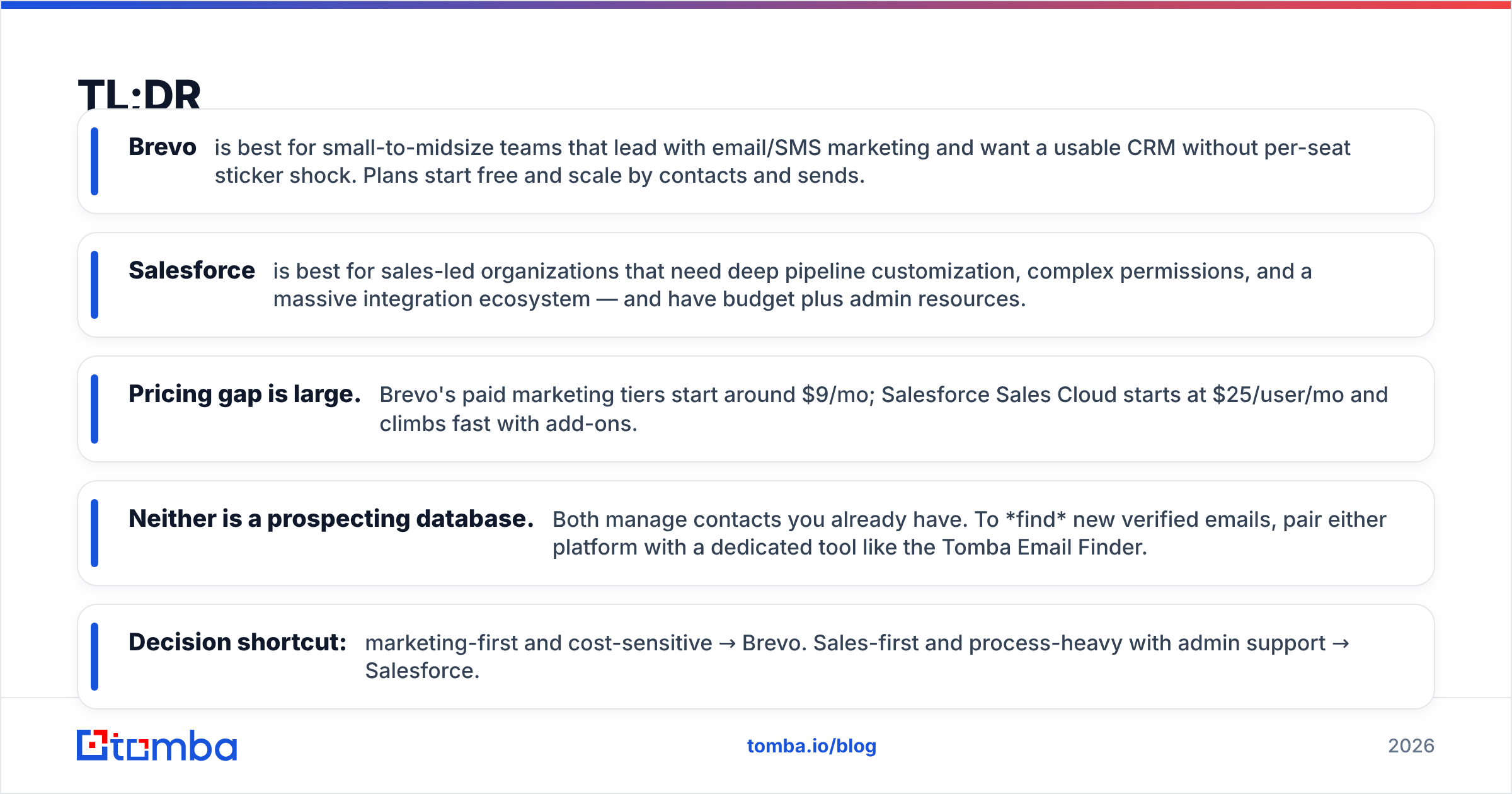
- Brevo is best for small-to-midsize teams that lead with email/SMS marketing and want a usable CRM without per-seat sticker shock. Plans start free and scale by contacts and sends.
- Salesforce is best for sales-led organizations that need deep pipeline customization, complex permissions, and a massive integration ecosystem — and have budget plus admin resources.
- Pricing gap is large. Brevo's paid marketing tiers start around $9/mo; Salesforce Sales Cloud starts at $25/user/mo and climbs fast with add-ons.
- Neither is a prospecting database. Both manage contacts you already have. To find new verified emails, pair either platform with a dedicated tool like the Tomba Email Finder.
- Decision shortcut: marketing-first and cost-sensitive → Brevo. Sales-first and process-heavy with admin support → Salesforce.
What is Brevo?#
Brevo (formerly Sendinblue) is an all-in-one marketing and CRM platform aimed at small and growing businesses. Think of it as a Swiss Army knife: email campaigns, SMS, WhatsApp, marketing automation, transactional email, landing pages, and a lightweight sales CRM all in one subscription.
Its defining trait is the pricing model. Instead of charging per user, Brevo charges based on the volume of emails you send and the contacts or features you unlock. That means a five-person team and a fifty-person team can pay the same for the marketing side, which is why budget-conscious teams gravitate to it.
The CRM in Brevo is functional but intentionally simple — deals, pipelines, tasks, and basic automation. It covers the 80% case for a small sales team without forcing you into a configuration project.
What is Salesforce?#
Salesforce is the category-defining cloud CRM, and the most powerful one on the market. Its Sales Cloud product is a sales operating system: leads, opportunities, forecasting, territory management, approval flows, and a customization layer (objects, fields, flows, Apex code) that can model nearly any business.
The trade-off is that this power assumes investment. Salesforce charges per user per month, and most real deployments add editions, Service Cloud, Marketing Cloud, AppExchange apps, and often a paid implementation partner. You're buying a platform, not an app — and platforms need administrators.
If Brevo is a Swiss Army knife, Salesforce is a fully equipped workshop. Incredible if you have the work and the staff to run it; overkill if you just need to cut some rope.

Brevo vs Salesforce: how do they compare at a glance?#
Here's the core comparison most teams care about before going deeper.
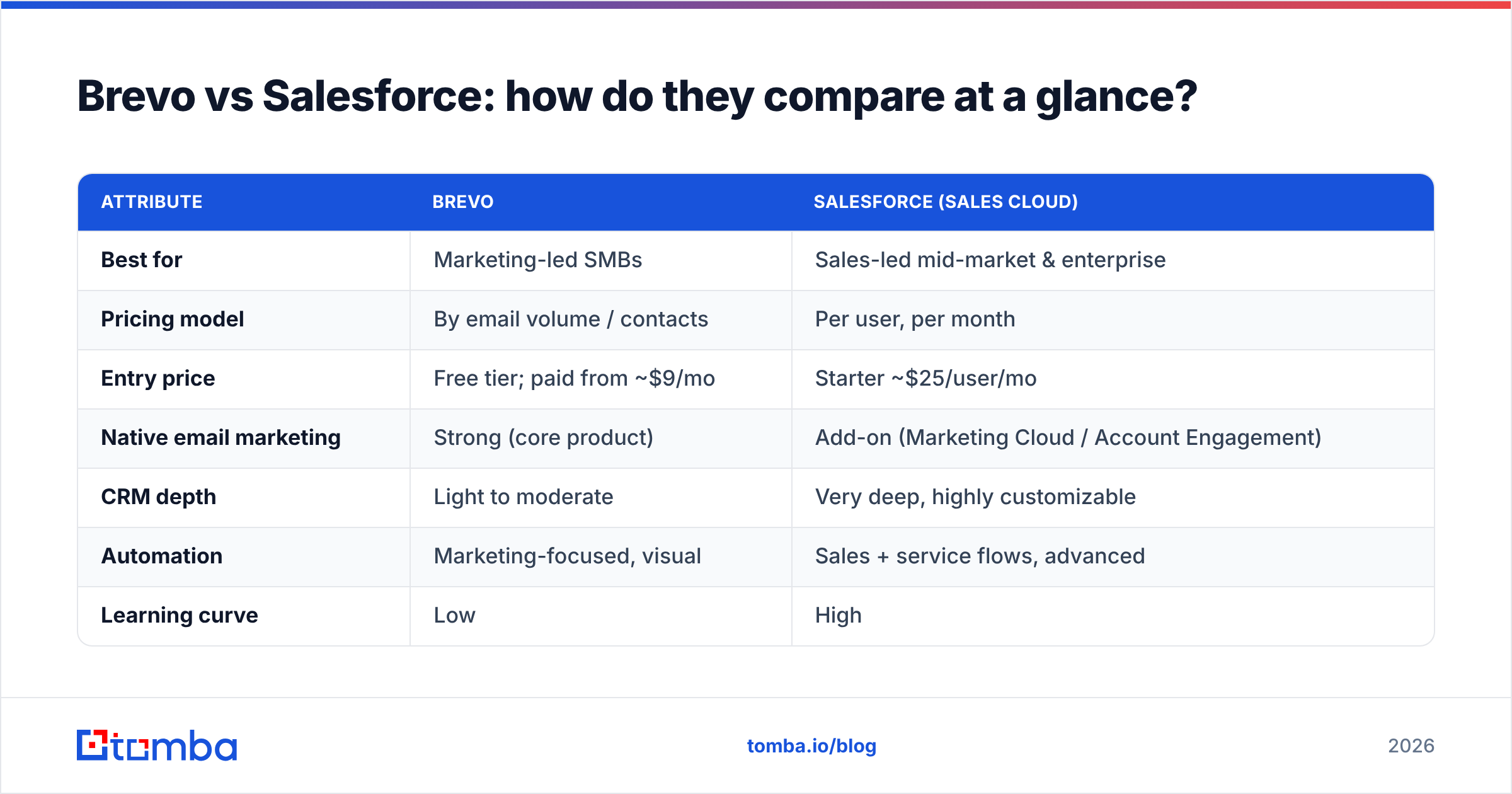
| Attribute | Brevo | Salesforce (Sales Cloud) |
|---|---|---|
| Best for | Marketing-led SMBs | Sales-led mid-market & enterprise |
| Pricing model | By email volume / contacts | Per user, per month |
| Entry price | Free tier; paid from ~$9/mo | Starter ~$25/user/mo |
| Native email marketing | Strong (core product) | Add-on (Marketing Cloud / Account Engagement) |
| CRM depth | Light to moderate | Very deep, highly customizable |
| Automation | Marketing-focused, visual | Sales + service flows, advanced |
| Learning curve | Low | High |
| Admin required | No | Usually yes |
| Ecosystem | Solid integrations | Largest in the industry (AppExchange) |
| SMS / WhatsApp | Built in | Via add-ons / partners |
The pattern is clear: Brevo concentrates value in marketing and ease of use, while Salesforce concentrates value in sales-process depth and extensibility.
How much do Brevo and Salesforce actually cost?#
Cost is where the two diverge most, and where buyers most often get surprised.
Brevo scales with sending volume and feature tiers:
- Free — limited daily email sends and unlimited contacts; good for testing.
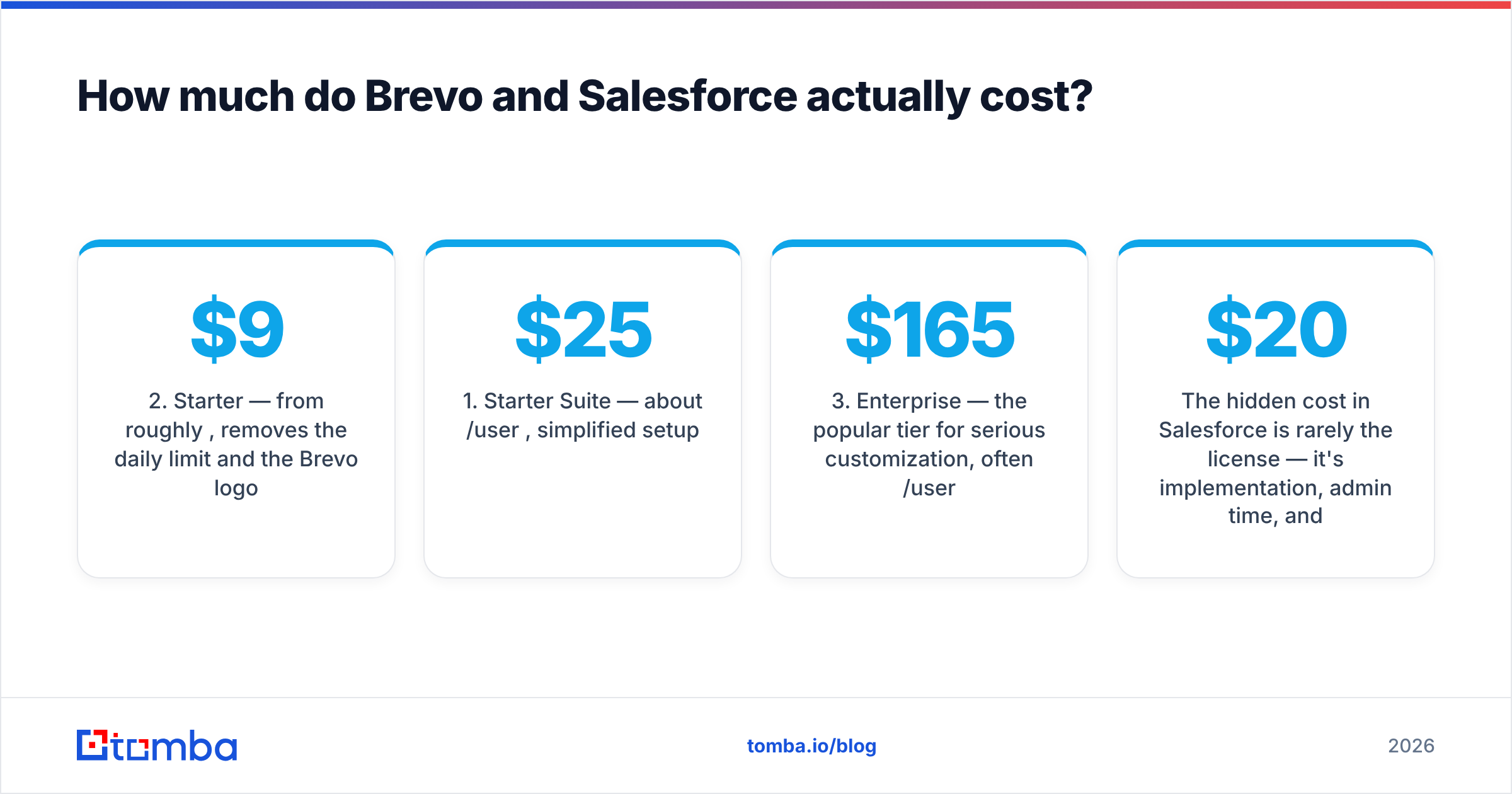
- Starter — from roughly $9/mo, removes the daily limit and the Brevo logo.
- Business — adds marketing automation, A/B testing, and multi-user access.
- Enterprise — custom pricing with advanced security and support.
Salesforce Sales Cloud scales with users and editions:
- Starter Suite — about $25/user/mo, simplified setup.
- Pro Suite — more customization and automation.
- Enterprise — the popular tier for serious customization, often $165/user/mo.
- Unlimited / Einstein — premium support and AI, climbing well beyond that.
The hidden cost in Salesforce is rarely the license — it's implementation, admin time, and add-ons. A 10-person sales team on Enterprise can easily clear $20,000/year before integrations. Brevo's marketing-first model keeps a similar-sized team in the hundreds-per-month range. Always check the current vendor pricing pages directly, since both change tiers regularly.
Is Brevo better than Salesforce for small businesses?#
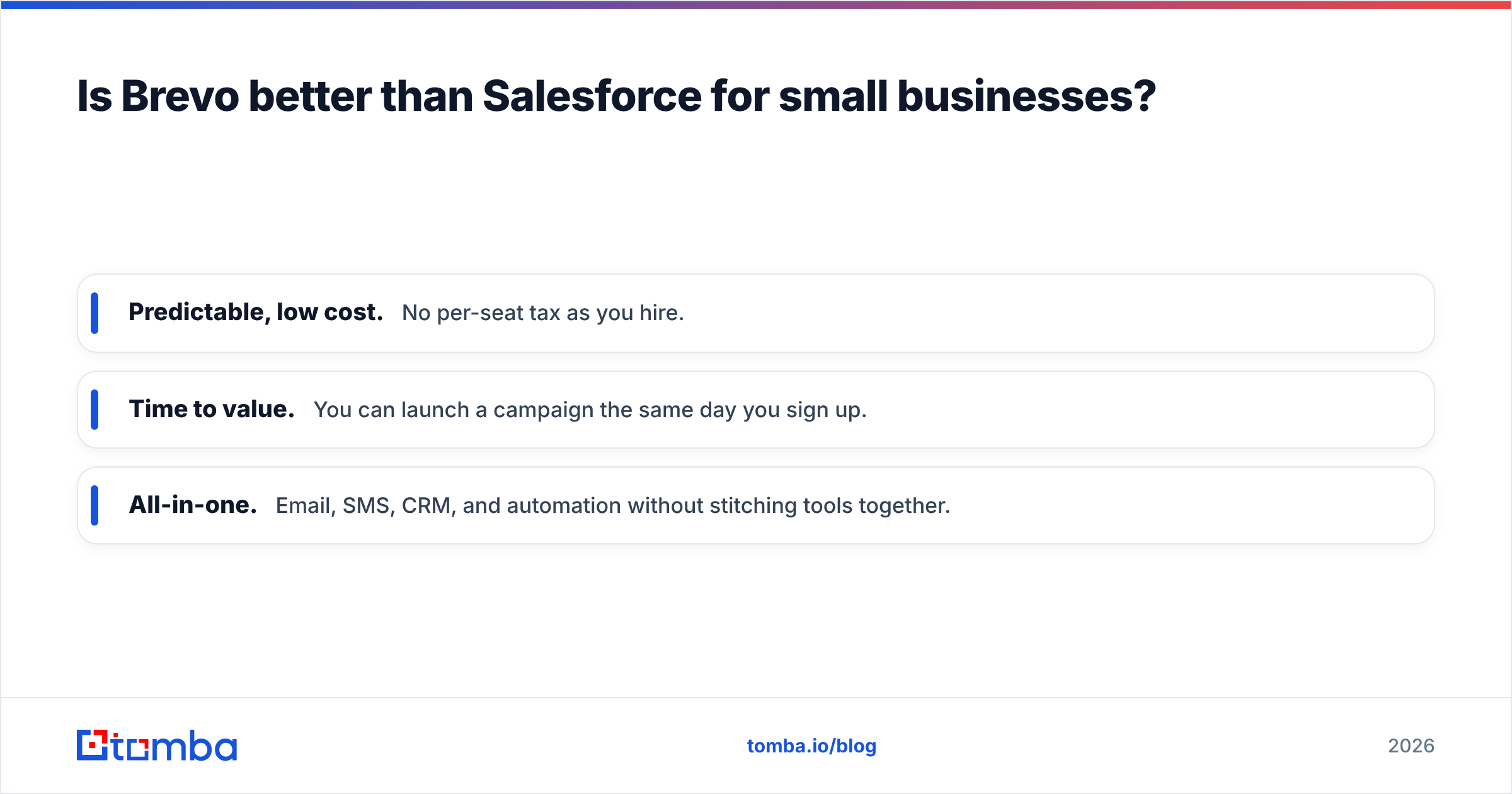
For most small businesses, yes — if your growth engine is email and marketing rather than a complex outbound sales motion.
Brevo wins on three fronts that matter to small teams:
- Predictable, low cost. No per-seat tax as you hire.
- Time to value. You can launch a campaign the same day you sign up.
- All-in-one. Email, SMS, CRM, and automation without stitching tools together.
Salesforce makes sense for a small business only when you already know you'll need heavy customization, have a dedicated ops person, or are deliberately building on a platform you'll grow into over years. Buying Salesforce "to look serious" is the classic way to pay for capacity you never use.
That said, Salesforce isn't worse — it's aimed at a different buyer. A 30-rep sales org with custom approval chains and forecasting needs would find Brevo's CRM far too thin.
Which one has better email and automation?#
This is closer than the price gap suggests, but the answer depends on your motion.
Brevo owns native email marketing. Newsletters, segmentation, send-time optimization, transactional email, and visual automation flows are the core product. For a marketing team running newsletters and drip campaigns, Brevo is more capable out of the box and far cheaper.
Salesforce owns sales process automation. Its Flow builder, validation rules, and assignment logic can automate genuinely complex sales operations. But true email marketing lives in separate paid products (Marketing Cloud or Account Engagement, formerly Pardot), which add significant cost and complexity.
So: if "automation" means nurturing subscribers, Brevo. If it means routing leads through a 7-stage approval and forecasting pipeline, Salesforce.
A quick reality check on deliverability — neither platform fixes a cold domain. Whatever you choose, protect your sender reputation with proper authentication and list hygiene before you scale volume. Sending to unverified addresses tanks results on both platforms.
What neither Brevo nor Salesforce does: find new contacts#
Here's the gap buyers miss. Brevo and Salesforce are both excellent at managing and messaging contacts you already have. Neither is built to discover new, verified business emails at scale. They assume the list already exists.
That's a problem if your pipeline depends on net-new outbound. Importing a list of guesses leads to bounces, which hurt deliverability in Brevo and pollute reporting in Salesforce. You need clean, verified contact data going in.
This is where a dedicated email-finding layer fits in front of either CRM:
- Use a domain search to pull every public email pattern at a target company.
- Run new contacts through an email verifier before they ever touch a campaign.
- Push enriched, validated records into Brevo or Salesforce via the Tomba API or native integrations.
In other words, the CRM debate is downstream of data quality. Picking Brevo or Salesforce without a sourcing-and-verification step is like buying a great oven with no ingredients.
How do I choose between Brevo and Salesforce?#
Use these decision triggers instead of feature checklists.
| Your situation | Lean toward |
|---|---|
| Marketing drives revenue (newsletters, ecommerce, content) | Brevo |
| Outbound sales drives revenue with complex stages | Salesforce |
| Under ~20 employees, no CRM admin | Brevo |
| Need custom objects, territories, forecasting | Salesforce |
| Tight, predictable budget | Brevo |
| Large integration/AppExchange requirements | Salesforce |
| You want SMS/WhatsApp built in | Brevo |
| You'll hire a RevOps/admin team anyway | Salesforce |
If you're split down the middle, start with Brevo. It's cheaper to adopt, faster to leave, and you'll learn what you actually need before committing to a Salesforce-scale investment. Migrating up to Salesforce later is common; migrating down from a sprawling Salesforce org is painful.
For a broader market view, independent reviews on G2 are useful for seeing how teams of your size rate each platform in practice.
Brevo vs Salesforce: pros and cons#
Brevo — pros: affordable, marketing-first, fast setup, built-in SMS/WhatsApp, no per-seat pricing, generous free tier. Brevo — cons: lighter CRM, less customization, fewer enterprise controls, fewer integrations than Salesforce.
Salesforce — pros: unmatched customization, deepest sales features, largest ecosystem, strong reporting and forecasting, enterprise-grade security. Salesforce — cons: expensive, steep learning curve, needs an admin, email marketing costs extra, slow time-to-value.
Both are legitimate choices. The mistake is matching the tool to your ambition instead of your actual workflow and headcount.
The bottom line#
Pick Brevo if you're a marketing-led SMB that wants email, SMS, and a clean CRM at a predictable price. Pick Salesforce if you're a sales-led organization that needs deep customization and has the budget and admin muscle to run it. Most teams under 20 people are happier — and richer — starting with Brevo.
But remember the part neither platform solves: getting verified contacts into the system in the first place. Before you load a single list, find and validate your prospects' real business emails with the Tomba Email Finder. Search by name, company, or domain, verify in bulk, and push clean records straight into Brevo or Salesforce — so whichever CRM you choose actually delivers. Start free with 25 searches a month and see the difference clean data makes.
// get started
Find, verify and enrich your first contacts today
Start on the free plan with 25 searches a month, then scale when your team is ready.
Free plan · No credit card required · GDPR & CCPA
// about the author