Bright Pattern Pricing and Reviews 2026: Pros and Cons
A no-spin 2026 breakdown of Bright Pattern pricing, real user reviews, and the honest pros and cons — plus where it fits and where it falls short.
Bright Pattern Pricing and Reviews 2026: Pros and Cons
TL;DR
- Bright Pattern is a cloud, omnichannel contact center platform priced per agent, per month — and like most enterprise CCaaS vendors, the real number comes from a sales quote, not a public page.
- Public references put list pricing roughly between $70 and $120 per agent/month depending on tier, contract length, and add-ons; expect implementation and integration fees on top.
- Reviewers on G2 and Capterra praise its omnichannel routing, AI quality management, and fast deployment; the most common complaints are reporting depth, documentation gaps, and opaque pricing.
- It is built for support and service teams, not outbound sales prospecting — so pairing it with a data tool that fills your pipeline matters.
- If your bottleneck is finding the right contacts to call in the first place, a dedicated email finder and phone finder will move the needle faster than any dialer feature.
What is Bright Pattern?#
Bright Pattern is a cloud-based contact center as a service (CCaaS) platform. Think of it as the switchboard, router, and quality-control room for a customer support operation — it takes inbound calls, chats, emails, SMS, and social messages, then routes each one to the right agent while recording everything for coaching and compliance.
Its headline pitch is true omnichannel: a customer can start on chat, move to a phone call, and the agent keeps the full context without the conversation resetting. Bright Pattern also leans hard into AI — automated quality management that scores 100% of interactions instead of a 2% sample, plus bots and agent-assist features. The platform is used across healthcare, BPOs, retail, and financial services, and it integrates with CRMs like Salesforce, ServiceNow, and Microsoft Dynamics.
What it is not is a prospecting or lead-generation tool. Bright Pattern helps you handle conversations once contact details and routing rules exist. Building the list of who to contact is a separate job — and one we'll come back to in the alternatives section.
How much does Bright Pattern cost in 2026?#
Bright Pattern uses per-agent, per-month pricing with no fully public price list — you request a quote. This is standard for enterprise CCaaS, but it makes apples-to-apples budgeting harder than with self-serve SaaS.
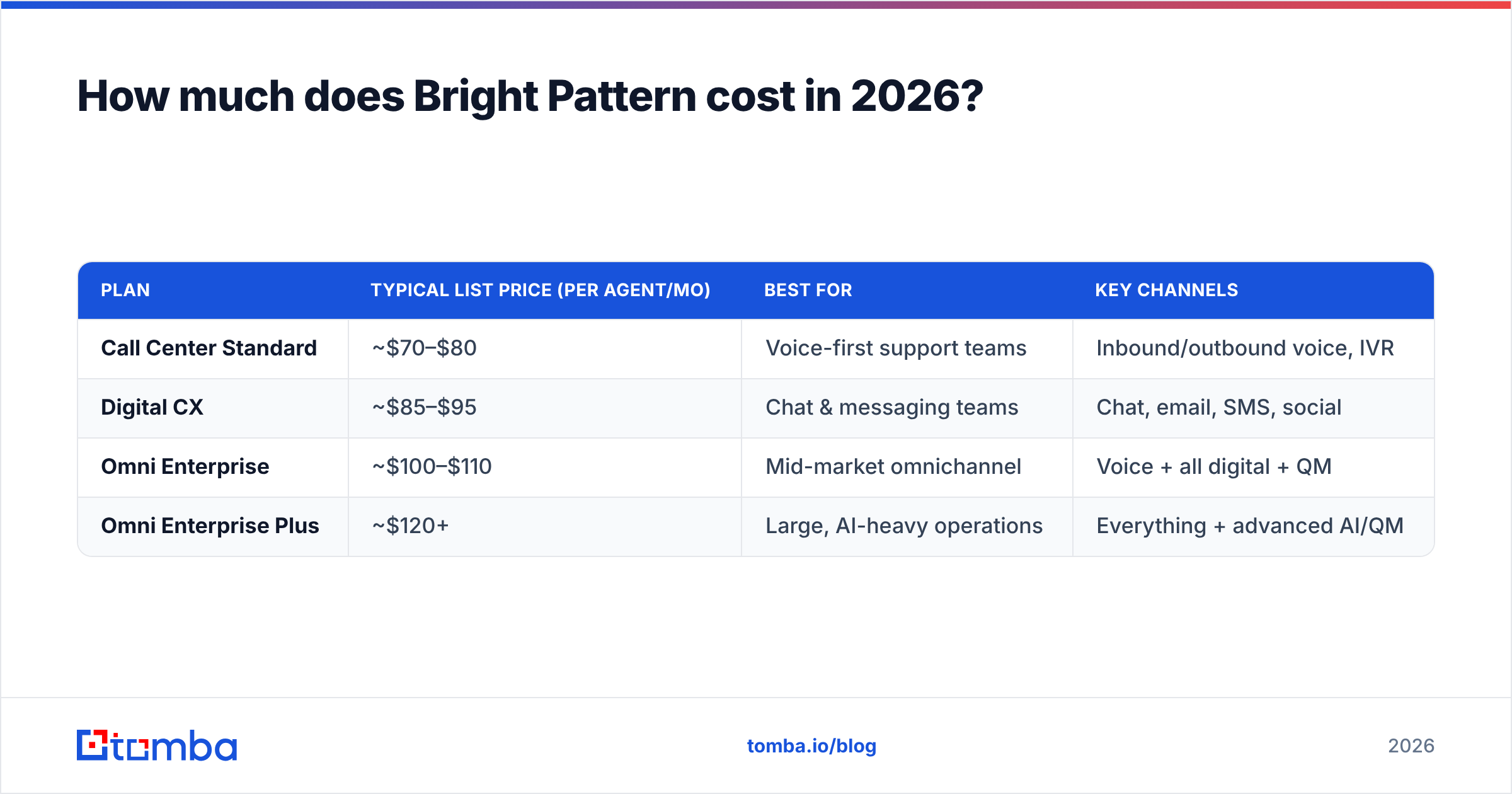
Based on third-party listings, reseller pages, and reviewer comments, here is the most realistic picture of the published tiers. Treat these as directional list prices, not guarantees — your quote will move with seat count, contract term, and channel mix.
| Plan | Typical list price (per agent/mo) | Best for | Key channels |
|---|---|---|---|
| Call Center Standard | ~$70–$80 | Voice-first support teams | Inbound/outbound voice, IVR |
| Digital CX | ~$85–$95 | Chat & messaging teams | Chat, email, SMS, social |
| Omni Enterprise | ~$100–$110 | Mid-market omnichannel | Voice + all digital + QM |
| Omni Enterprise Plus | ~$120+ | Large, AI-heavy operations | Everything + advanced AI/QM |
A few cost realities that don't show up on the headline number:
- Implementation and onboarding fees — one-time professional-services charges to configure routing, IVR, and integrations.
- Annual contracts — month-to-month is rare at this tier; most savings require a 12-month-plus commitment.
- Integration and telephony costs — carrier minutes, SMS, and some CRM connectors can be billed separately.
- Add-on AI modules — advanced quality management and bot capabilities may sit in the top tiers or as extras.
Because the public numbers are soft, the honest move is to get a written quote and compare it line by line. If you want a reference point for how transparent, published SaaS pricing reads by contrast, the Tomba pricing page lists every tier and credit count openly — a useful sanity check when a vendor only quotes "contact sales."
What do Bright Pattern reviews say — pros and cons?#
Bright Pattern scores well on omnichannel depth and ease of deployment, and weaker on reporting and pricing clarity. Across G2 and Capterra, the platform holds solid ratings, typically in the 4.5-star range, with consistent themes in both directions.
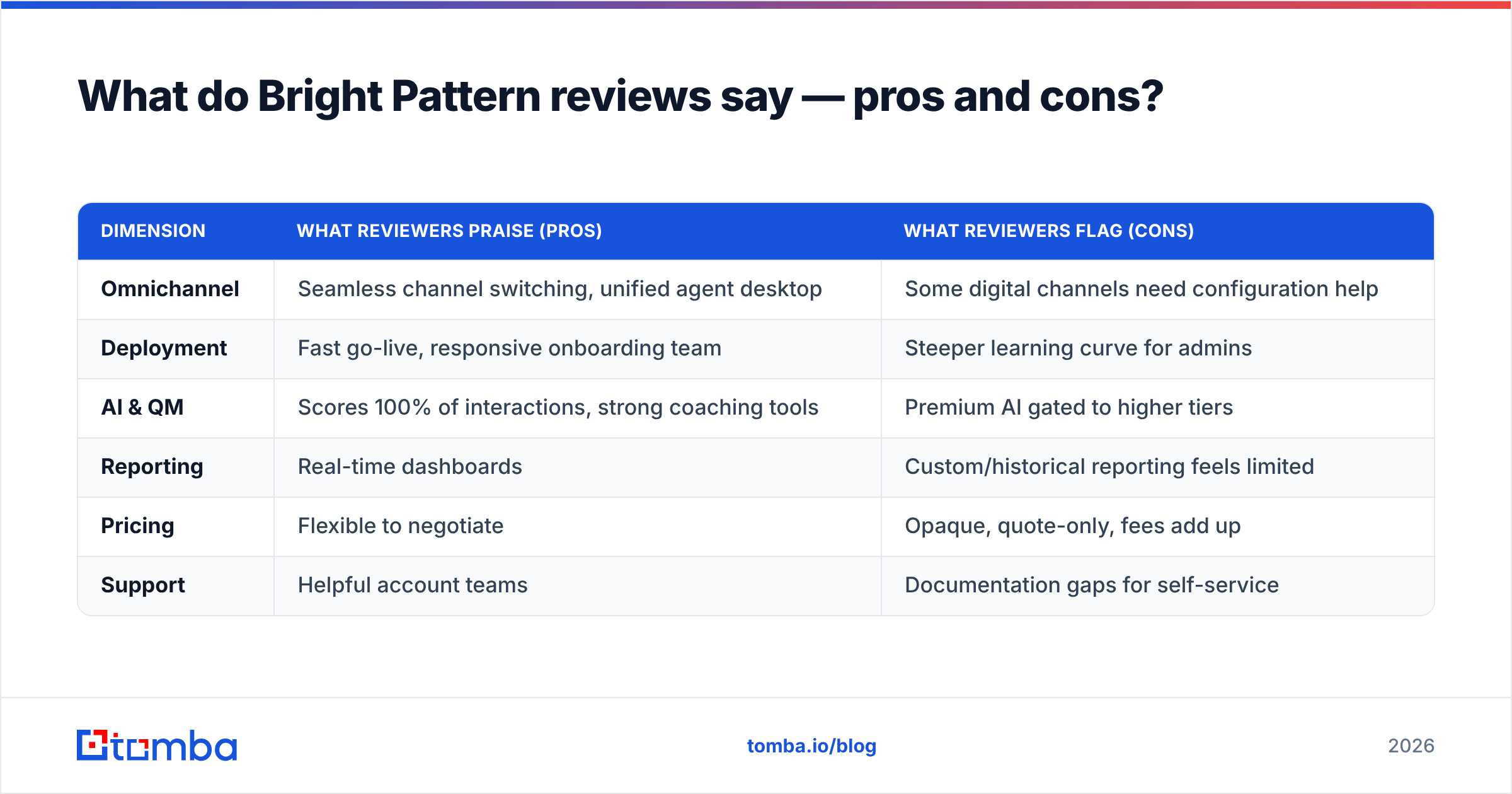
Here is how the recurring feedback breaks down:
| Dimension | What reviewers praise (Pros) | What reviewers flag (Cons) |
|---|---|---|
| Omnichannel | Seamless channel switching, unified agent desktop | Some digital channels need configuration help |
| Deployment | Fast go-live, responsive onboarding team | Steeper learning curve for admins |
| AI & QM | Scores 100% of interactions, strong coaching tools | Premium AI gated to higher tiers |
| Reporting | Real-time dashboards | Custom/historical reporting feels limited |
| Pricing | Flexible to negotiate | Opaque, quote-only, fees add up |
| Support | Helpful account teams | Documentation gaps for self-service |
The pros, in plain terms: teams that need to handle voice plus chat plus messaging in one place tend to be happy. The unified desktop reduces context-switching, the AI quality management is a genuine differentiator versus older on-prem systems, and implementation is faster than many enterprise rollouts.
The cons, in plain terms: if your team lives in reports, you may hit walls and lean on the vendor for custom builds. Admins describe a learning curve, and the most consistent gripe is simply not knowing the price without a sales cycle. None of these are dealbreakers for a service org — but they're worth pressure-testing in a trial.
Is Bright Pattern worth it for your team?#
It's worth it if you run a genuine omnichannel support operation and want AI-driven quality management — less so if you mainly need outbound calling or a light help desk. The value concentrates in three scenarios:
- BPOs and outsourcers that must spin up new client queues quickly and prove quality at scale.
- Regulated industries (healthcare, finance) where recording and scoring 100% of interactions has compliance value.
- Mid-market and enterprise teams consolidating several point tools into one omnichannel desktop.
If you're a small team that just needs a shared inbox or a simple outbound dialer, Bright Pattern is likely over-built and over-priced for the job. And if your real problem is pipeline, not call handling — you have agents ready but not enough qualified contacts to reach — then the contact center platform isn't your constraint at all. That's a data problem.
This is where the line between "talking to customers" and "finding prospects" matters. Bright Pattern optimizes the conversation; it assumes you already have the phone number and email. Sourcing accurate B2B contact data is a different discipline handled by tools like a phone finder, a verified email verifier, and data enrichment to fill the gaps in your CRM before a single call routes.

How does Bright Pattern compare to alternatives?#
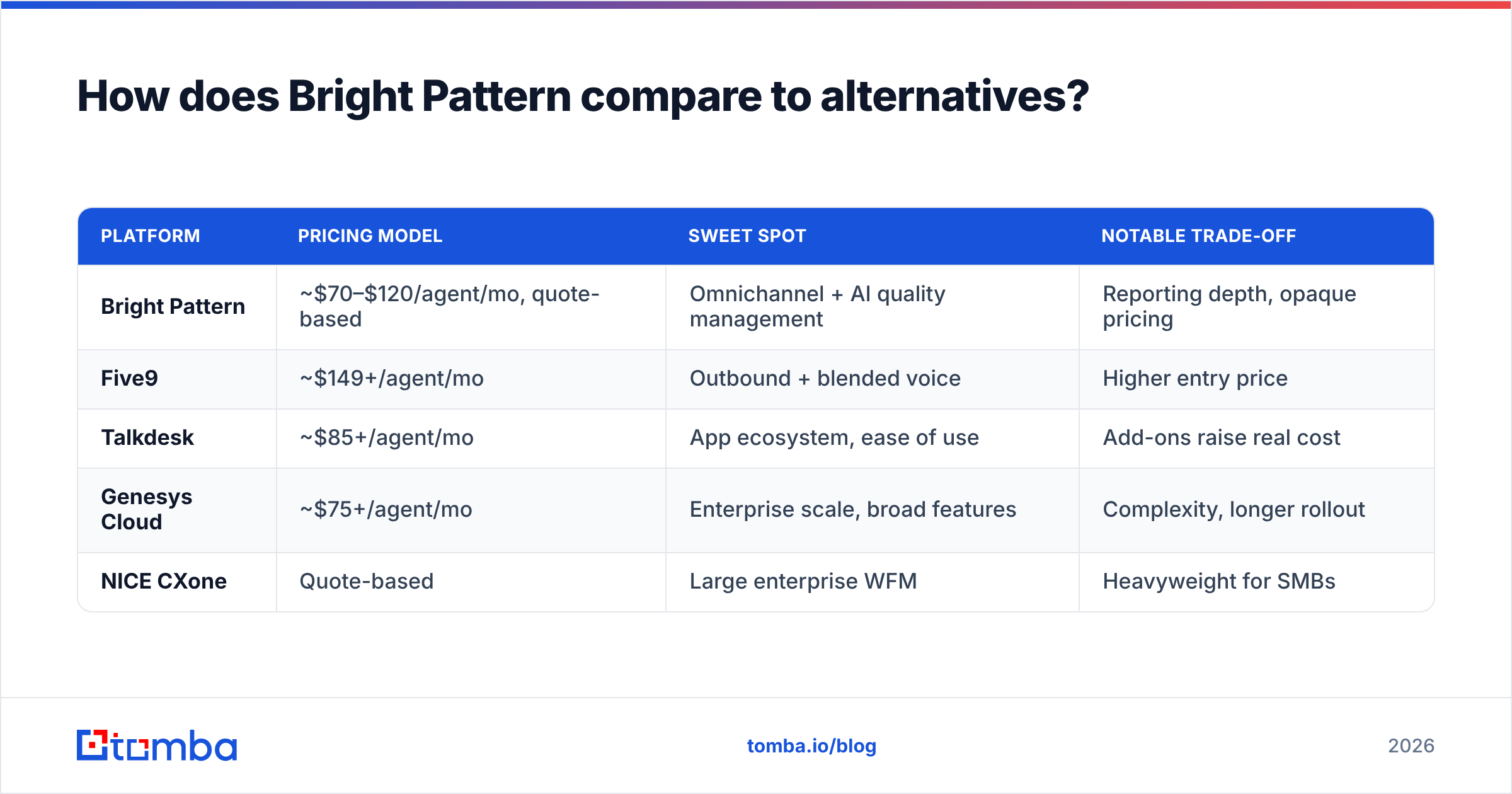
Bright Pattern competes with the big CCaaS players — Five9, Genesys, Talkdesk, NICE CXone — and the right pick depends on whether you optimize for AI quality, ecosystem breadth, or budget. Here's a simplified positioning view.
| Platform | Pricing model | Sweet spot | Notable trade-off |
|---|---|---|---|
| Bright Pattern | ~$70–$120/agent/mo, quote-based | Omnichannel + AI quality management | Reporting depth, opaque pricing |
| Five9 | ~$149+/agent/mo | Outbound + blended voice | Higher entry price |
| Talkdesk | ~$85+/agent/mo | App ecosystem, ease of use | Add-ons raise real cost |
| Genesys Cloud | ~$75+/agent/mo | Enterprise scale, broad features | Complexity, longer rollout |
| NICE CXone | Quote-based | Large enterprise WFM | Heavyweight for SMBs |
The takeaway: Bright Pattern lands in the middle on price and punches above its weight on AI-driven quality management. If your evaluation hinges on scoring every interaction rather than sampling, it's a strong shortlist candidate. If you need deep, self-serve custom reporting, weigh that gap carefully.
But notice what every option in that table assumes: you already know who to call. None of them generate your prospect list. For outbound and sales-led teams, the more impactful comparison isn't dialer-vs-dialer — it's whether your contact data is accurate before it ever reaches the routing engine. A bad number wastes an agent minute no matter how good the platform is.
That's why outbound teams pair a contact center with a sourcing layer. You can pull verified business emails with domain search, enrich those records, and push clean data into your CRM and dialer. Garbage-in still equals garbage-out, even on a premium CCaaS seat.
What should you ask before signing a Bright Pattern contract?#
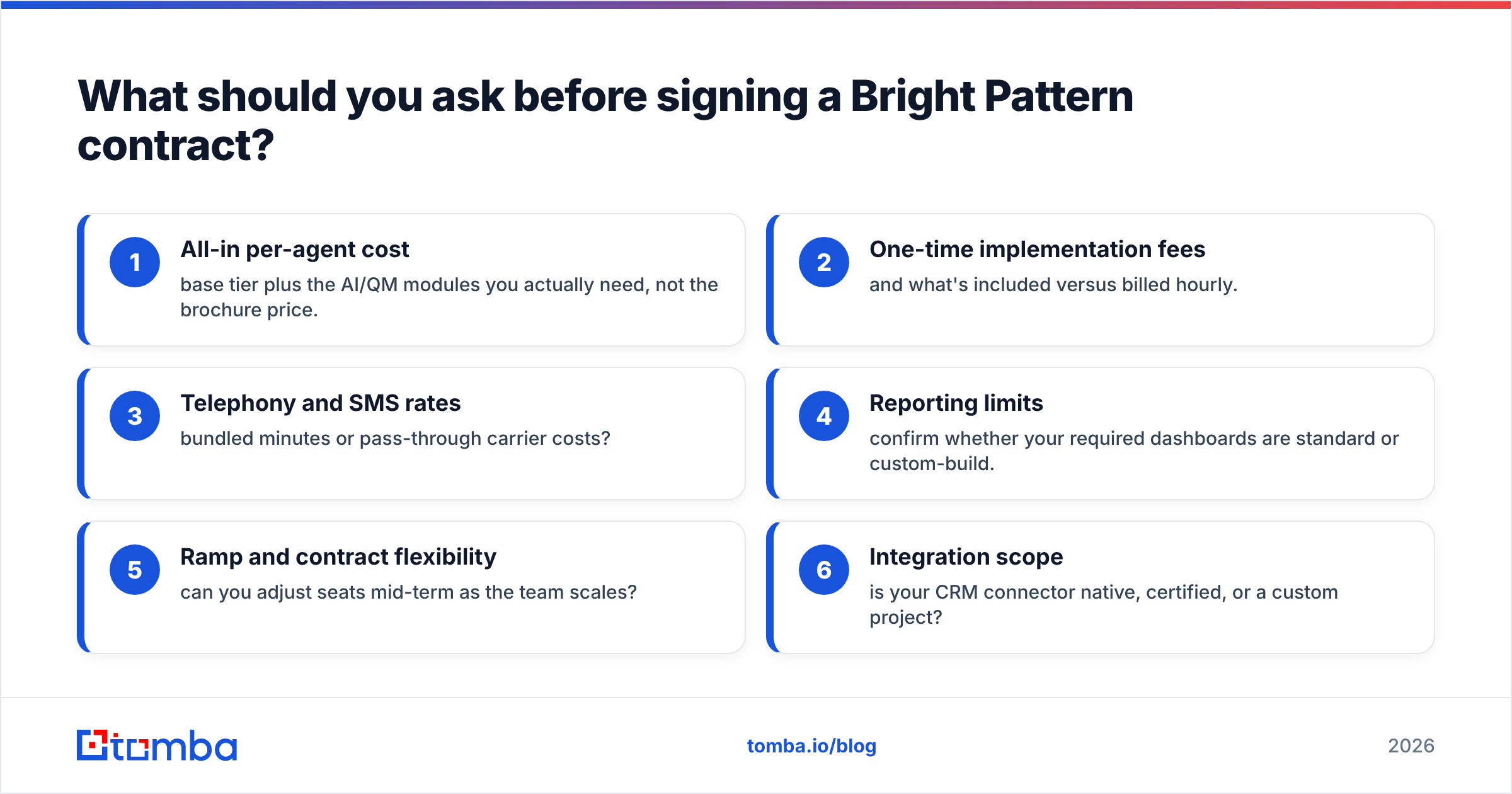
Before you commit to an annual seat count, get these in writing:
- All-in per-agent cost — base tier plus the AI/QM modules you actually need, not the brochure price.
- One-time implementation fees — and what's included versus billed hourly.
- Telephony and SMS rates — bundled minutes or pass-through carrier costs?
- Reporting limits — confirm whether your required dashboards are standard or custom-build.
- Ramp and contract flexibility — can you adjust seats mid-term as the team scales?
- Integration scope — is your CRM connector native, certified, or a custom project?
Run a real trial with your own call flows, not a canned demo. The pros and cons above are directional; your queue volume, channel mix, and reporting needs decide whether Bright Pattern is a fit.
The bottom line#
Bright Pattern is a credible, mid-priced omnichannel contact center with standout AI quality management — held back mainly by quote-only pricing and reporting limits. For service-heavy teams it earns its place on the shortlist. For sales and outbound teams, remember that the platform handles the conversation, not the prospecting.
If the gap in your funnel is finding and verifying the right contacts before your agents ever dial, start there. The Tomba Email Finder locates professional email addresses by name, domain, or company, with verification built in — so the contacts flowing into your contact center are real, reachable, and ready. Pair clean data with the right calling platform and every agent minute works harder. Try Tomba's free tier (25 searches/month) before you commit to a per-seat contract anywhere.
Ready to find emails that actually work?
Join 150,000+ professionals who stopped guessing and started sending. Free credits on signup — no credit card required.
Get the Tomba newsletter
Practical outbound tactics and product updates — once every two weeks.
About the author