BriteVerify Pricing, Reviews, Pros and Cons (2026 Guide)
A straight-talking breakdown of BriteVerify pricing, real user reviews, and the pros and cons that matter before you commit budget to email verification in 2026.
TL;DR
- BriteVerify uses a pay-per-email model (around $0.01 per verification at the entry tier, dropping with volume), plus a Validity-bundled subscription for heavier users — no permanent free tier, just a small trial credit.
- Reviewers praise its accuracy and simple drag-and-drop UI, but flag price creep at scale and weak handling of catch-all and role-based addresses.
- It verifies emails only — there is no email finder, no enrichment, and no phone data, so you still need separate tools to build lists.
- For B2B teams that want finding and verifying in one place, a flat-rate platform like Tomba is usually cheaper per usable contact.
- Read the pros and cons below before you load a 500k-row list and watch the meter run.
What is BriteVerify and who is it for?#
BriteVerify is a real-time email verification service owned by Validity, the same company behind Everest and DemandTools. Its single job is to tell you whether an email address is valid, invalid, accept-all, or unknown before you hit send. It plugs into form fields for real-time checks and accepts CSV uploads for batch list cleaning.
The typical buyer is an email marketer or RevOps lead who already has a list — from a CRM, a signup form, or a purchased database — and wants to scrub the dead weight before a campaign. That distinction matters: BriteVerify assumes you already have the addresses. If you still need to source them, it does nothing for you. Think of it as a car wash, not a dealership — it cleans what you drive in, but it won't sell you the car.
That single-purpose focus is both its strength and its biggest limitation, which is exactly what the pricing, reviews, and pros and cons below come down to.

How much does BriteVerify pricing actually cost?#
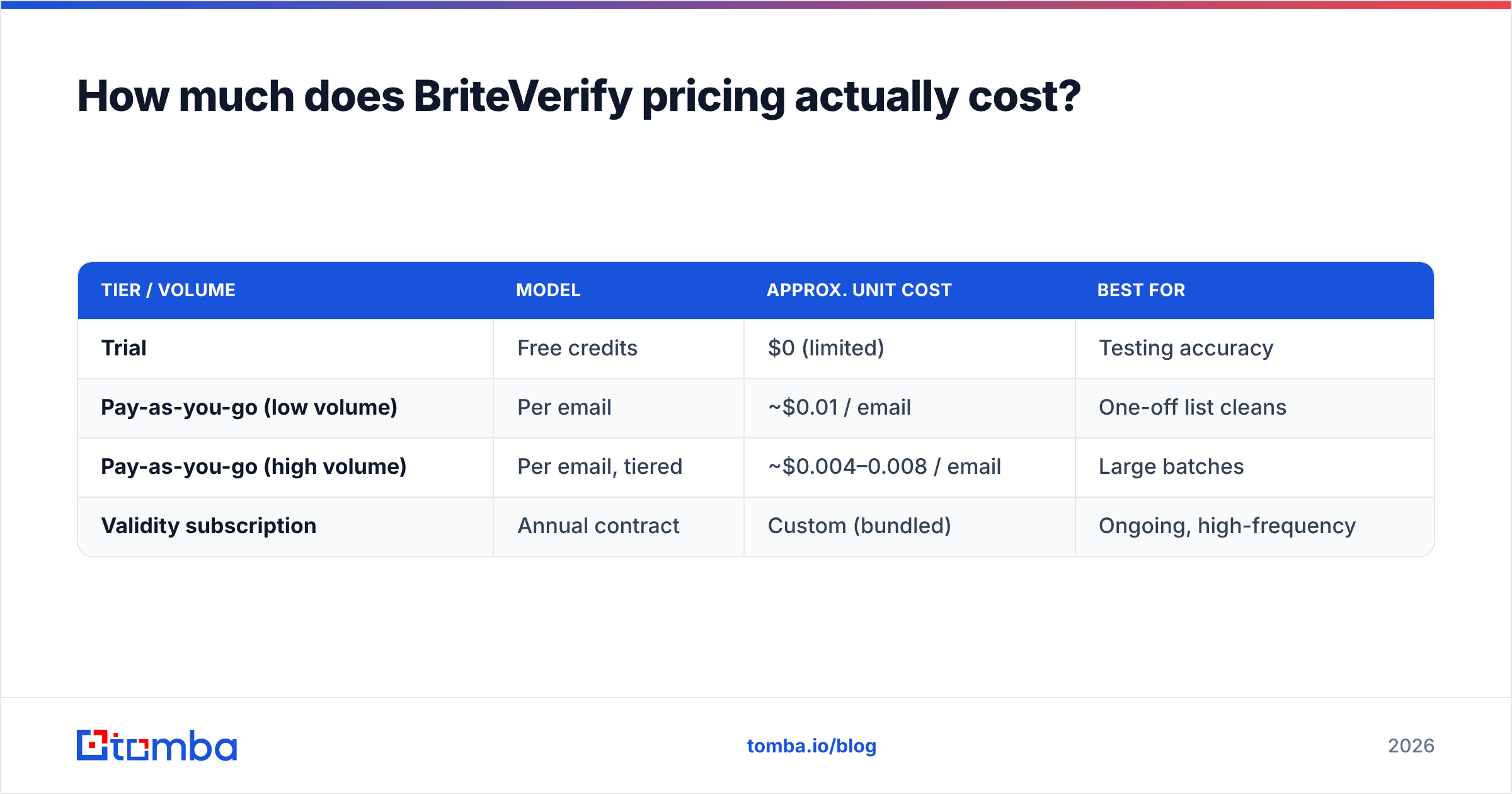
The headline conclusion: BriteVerify is pay-as-you-go by default, billed per email verified, with optional subscriptions for predictable volume. There is no $0 forever plan — just a small batch of trial credits to test the service.
Per-email pricing scales down as you buy more, but the entry rate is what stings on large one-off lists. Here is the shape of it (rates are indicative and shift with Validity promotions, so confirm before you buy):
| Tier / volume | Model | Approx. unit cost | Best for |
|---|---|---|---|
| Trial | Free credits | $0 (limited) | Testing accuracy |
| Pay-as-you-go (low volume) | Per email | ~$0.01 / email | One-off list cleans |
| Pay-as-you-go (high volume) | Per email, tiered | ~$0.004–0.008 / email | Large batches |
| Validity subscription | Annual contract | Custom (bundled) | Ongoing, high-frequency |
Run the math before you commit. A one-time clean of a 250,000-row list at roughly a penny each is about $2,500 — and you pay again next quarter when the list decays. That is the moment most teams start pricing alternatives. A flat-rate or credit-pooled tool changes the equation entirely; you can compare how that works on the Tomba pricing page, where verification sits alongside finding instead of being metered separately.
One more cost note reviewers raise: unknowns still burn credits. If BriteVerify can't reach a mail server and returns "unknown," you've paid for a result you can't act on. On catch-all-heavy B2B domains, that share is not trivial.
What do BriteVerify reviews say?#
Across G2 and Capterra, BriteVerify lands in solid-but-not-spotless territory — generally in the low 4-star range. The themes are remarkably consistent, so here's the honest split.
What reviewers consistently like:
- Accuracy on consumer domains — Gmail, Yahoo, and Outlook results are reliably correct, which is what most email marketers verify against.
- Dead-simple interface — drag a CSV in, get a categorized file out. No onboarding required.
- Real-time API for forms — stops bad addresses at the point of capture, which protects sender reputation long-term.
- Validity ecosystem — if you already run Everest for deliverability monitoring, the integration story is clean.
What reviewers repeatedly criticize:
- Cost at scale — the per-email model is the single most common complaint; teams describe being "nickel-and-dimed" on big lists.
- Catch-all ambiguity — accept-all domains get flagged "unknown," and you still pay, with no deeper resolution.
- No list-building — multiple reviewers wish it found emails too, instead of forcing a second subscription.
- Support and contracts — annual Validity agreements feel heavy for teams that just wanted a quick clean.
The pattern is clear: people who verify consumer lists occasionally are happy. People verifying large B2B lists frequently start looking for a better cost structure. If your world is the second one, a dedicated email verifier with predictable pricing tends to win on total cost — and a catch-all verifier closes the exact ambiguity gap reviewers complain about.
What are the pros and cons of BriteVerify?#
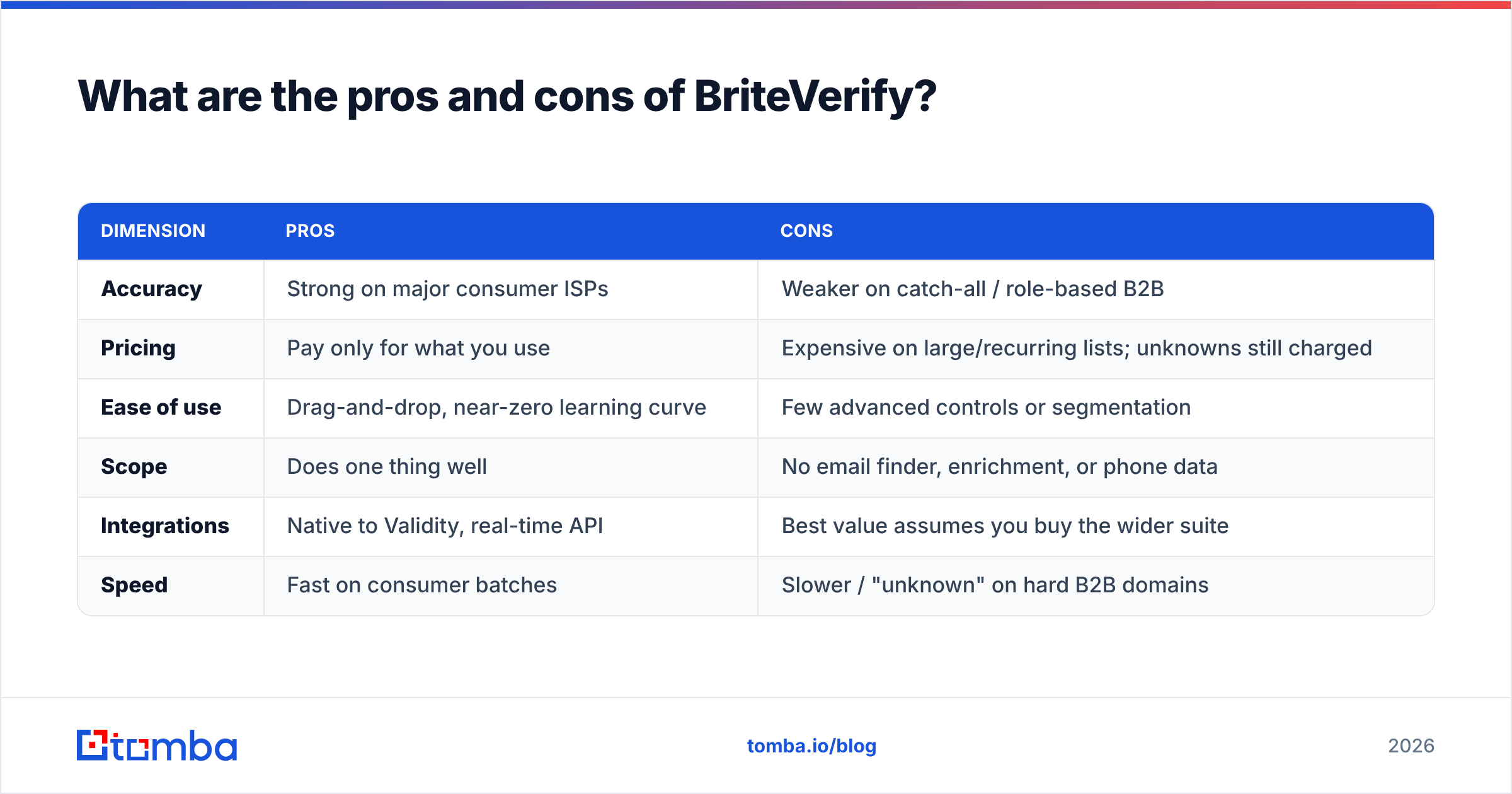
Here's the balanced scorecard, the part you came for. No tool is all upside, and BriteVerify's trade-offs are easy to predict once you know the per-email model drives everything.
| Dimension | Pros | Cons |
|---|---|---|
| Accuracy | Strong on major consumer ISPs | Weaker on catch-all / role-based B2B |
| Pricing | Pay only for what you use | Expensive on large/recurring lists; unknowns still charged |
| Ease of use | Drag-and-drop, near-zero learning curve | Few advanced controls or segmentation |
| Scope | Does one thing well | No email finder, enrichment, or phone data |
| Integrations | Native to Validity, real-time API | Best value assumes you buy the wider suite |
| Speed | Fast on consumer batches | Slower / "unknown" on hard B2B domains |
The pros, in plain terms#
If you need to clean a marketing list before a send, BriteVerify is dependable and frictionless. The real-time API is genuinely useful for protecting sender reputation at the form level, and the categorized output (valid / invalid / accept-all / unknown) is easy for a non-technical marketer to act on. For occasional, consumer-heavy verification, it earns its keep.
The cons, in plain terms#
The model fights you the moment volume grows or B2B complexity rises. You pay per email, including for ambiguous results, and you get only verification. That second point is the quiet killer: a verifier with no finder means your workflow is still split across multiple vendors and invoices. For outbound teams that need to discover contacts, that's a structural gap — not a setting you can change.

How does BriteVerify compare to an all-in-one alternative?#
Conclusion first: BriteVerify verifies; it doesn't find. If your job ends at cleaning an existing list, it's fine. If your job starts with building the list, you'll pay for two tools where one would do.
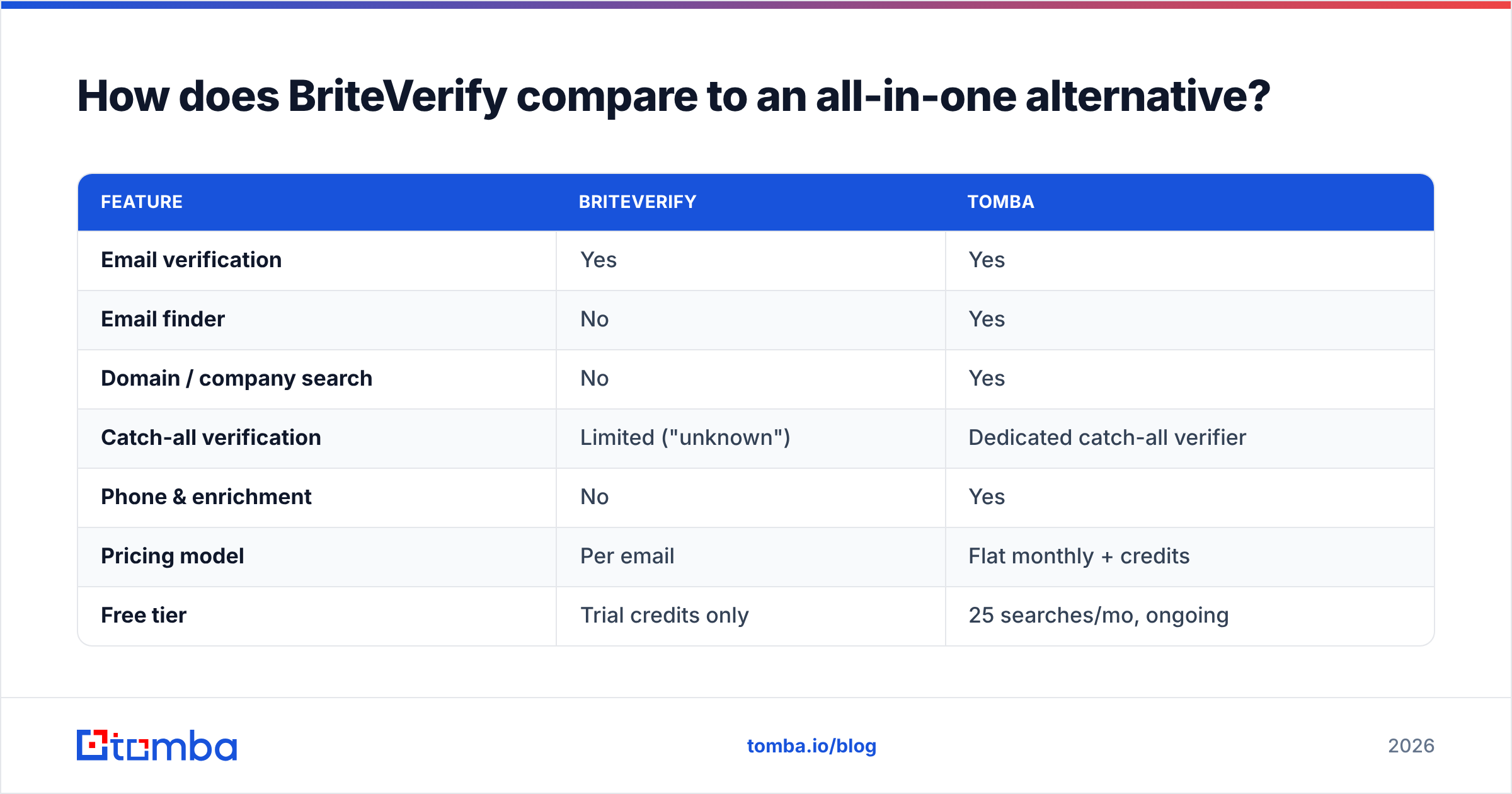
This is where the comparison gets concrete. A platform like Tomba combines an email finder, verification, domain search, and data enrichment under one credit pool, on flat monthly tiers instead of per-email metering.
| Feature | BriteVerify | Tomba |
|---|---|---|
| Email verification | Yes | Yes |
| Email finder | No | Yes |
| Domain / company search | No | Yes |
| Catch-all verification | Limited ("unknown") | Dedicated catch-all verifier |
| Phone & enrichment | No | Yes |
| Pricing model | Per email | Flat monthly + credits |
| Free tier | Trial credits only | 25 searches/mo, ongoing |
| Entry paid plan | Pay-as-you-go | $49/mo Starter |
The cost logic flips depending on your workflow. For a pure one-time scrub of a known-good consumer list, pay-as-you-go can be cheaper than any subscription. For continuous B2B prospecting — finding, verifying, re-verifying as lists decay — flat pricing wins because the same credits do double duty across finding and cleaning, and you're not penalized for "unknown" results.
If you're specifically shopping verifiers, it's also worth weighing dedicated competitors like ZeroBounce, Bouncer, and Clearout. We keep honest breakdowns of each — see the ZeroBounce alternative and Bouncer alternative pages for how the per-email versus credit-pool math plays out against those tools too.
Is BriteVerify worth it in 2026?#
Short answer: it depends entirely on whether you also need to find emails.
Buy BriteVerify if all three are true: you already own your lists, your audience is mostly consumer ISPs, and your verification volume is occasional rather than constant. In that lane it's accurate, simple, and you only pay for what you use. It's a clean, narrow tool that does its one job well.
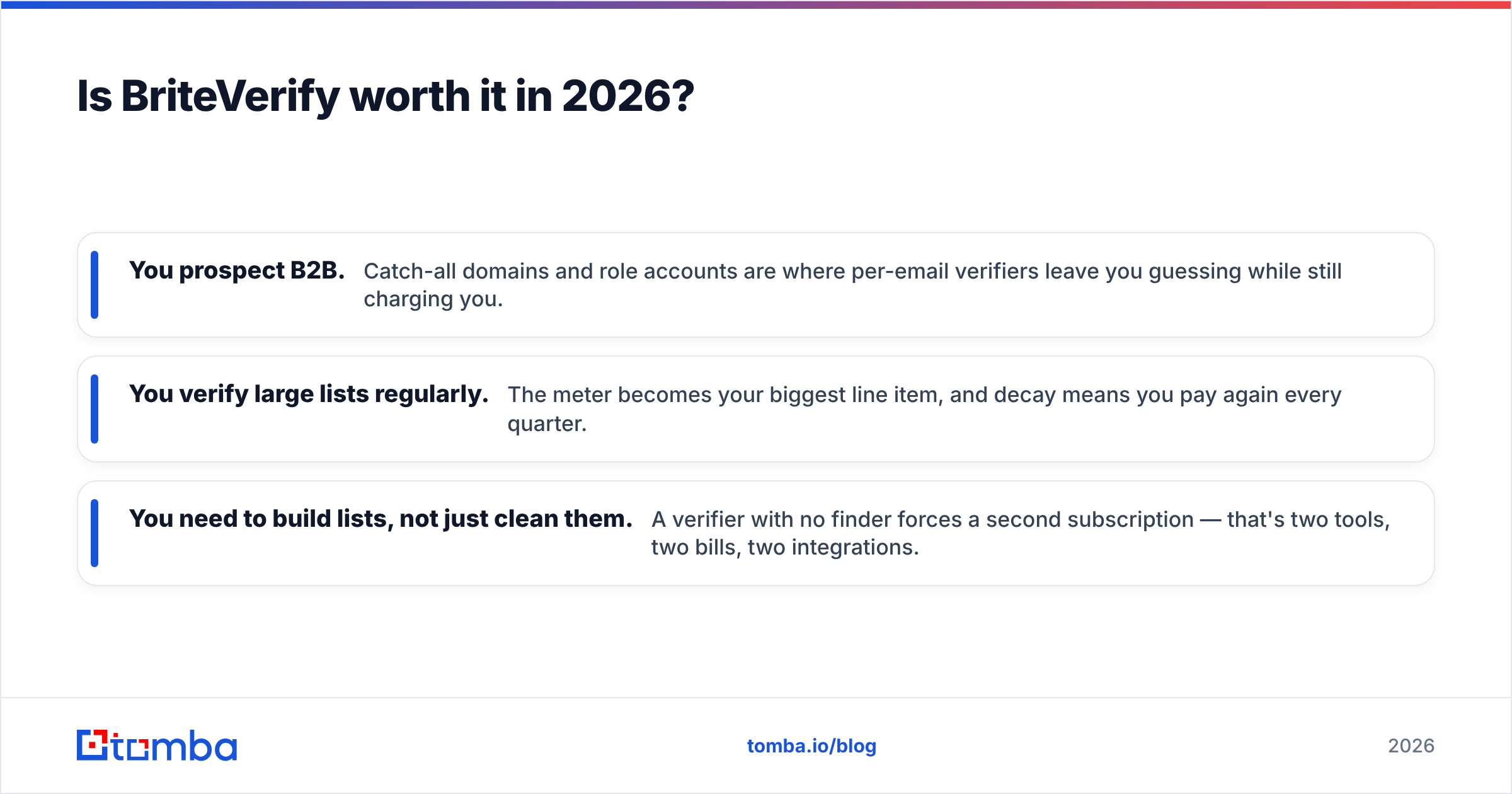
Look elsewhere if any of these apply:
- You prospect B2B. Catch-all domains and role accounts are where per-email verifiers leave you guessing while still charging you.
- You verify large lists regularly. The meter becomes your biggest line item, and decay means you pay again every quarter.
- You need to build lists, not just clean them. A verifier with no finder forces a second subscription — that's two tools, two bills, two integrations.
The deciding question isn't "is BriteVerify accurate?" — it usually is. It's "what does one usable, verified contact cost me end to end?" When you add the finder you'd otherwise buy separately, the all-in-one math often comes out ahead. You can sanity-check that against your own numbers using the transparent Tomba pricing tiers and a free email checker before spending a cent.
Frequently asked questions#
Does BriteVerify have a free plan? No permanent free tier — only a limited batch of trial credits to test accuracy. For ongoing free volume, Tomba's free tier includes 25 searches per month that combine finding and verifying.
How accurate is BriteVerify? Very accurate on major consumer domains (Gmail, Yahoo, Outlook). Accuracy and clarity drop on catch-all and role-based B2B addresses, which it tends to mark "unknown" while still charging a credit.
Can BriteVerify find email addresses? No. It only verifies addresses you already have. To discover new contacts you need a separate email finder or a platform that bundles both.
Is BriteVerify cheaper than the alternatives? For small, one-time consumer list cleans, pay-as-you-go can be the cheapest option. For recurring or high-volume B2B work, flat-rate credit pools usually cost less per usable contact.
The bottom line#
BriteVerify is a reliable, narrow tool: strong accuracy on consumer lists, a friendly interface, and a pay-per-email model that's fair for occasional cleans but punishing at scale. The pros and cons all trace back to one fact — it verifies and nothing else.
If your real workflow is find, verify, enrich, repeat, stop paying for half a pipeline. Tomba's email finder sources professional addresses by name, company, or domain, then verifies them in the same flow — on flat plans starting at $49/mo (Starter), with a free tier to test first. Build clean, send-ready B2B lists without watching a per-email meter tick. Start free with the Tomba Email Finder and keep your verification budget for the campaigns themselves.
Ready to find emails that actually work?
Join 150,000+ professionals who stopped guessing and started sending. Free credits on signup — no credit card required.
Get the Tomba newsletter
Practical outbound tactics and product updates — once every two weeks.
About the author