Briteverify vs Cognism 2026: Which B2B Data Tool Wins?
BriteVerify cleans the emails you already have; Cognism finds new contacts. Here's how the two stack up on data, pricing, and fit in 2026 — plus a cheaper third option.
TL;DR
- BriteVerify and Cognism solve different problems. BriteVerify is an email and contact verification tool — it cleans lists you already own. Cognism is a B2B data intelligence platform — it finds net-new contacts and phone numbers.
- BriteVerify wins on simplicity and pay-as-you-go pricing. Cognism wins on data depth, intent signals, and GDPR-friendly mobile coverage in EMEA.
- Neither is cheap. BriteVerify charges per verification; Cognism sells annual seats that routinely run into five figures.
- If your real goal is finding and verifying emails in one workflow, a focused email-finder plus verifier stack (like Tomba) covers most of both jobs at a fraction of the cost.
- Pick BriteVerify to clean, Cognism to prospect, and read on to see where a third option beats both on price.
What is BriteVerify and what is Cognism?#
Short answer: BriteVerify keeps your existing data clean; Cognism gives you new data to work with. They get lumped into the same "B2B data" bucket, but comparing them head-to-head is like comparing a dishwasher to a grocery store.
BriteVerify (a Validity product) is an email verification service. You upload a list, it pings each address, and it tells you which ones are valid, risky, or dead — plus optional phone and address validation. It's built to protect email deliverability by stopping you from mailing addresses that bounce and wreck your sender reputation.
Cognism is a sales intelligence platform. It sells access to a global B2B contact database with firmographics, technographics, intent data, and — its headline feature — verified mobile numbers marketed as "Diamond Data." It competes with ZoomInfo, Apollo, and Lusha, not with verification-only tools.
So the honest framing for BriteVerify vs Cognism is: do you have a list that needs cleaning, or do you need a list in the first place?
)
How do BriteVerify and Cognism compare at a glance?#
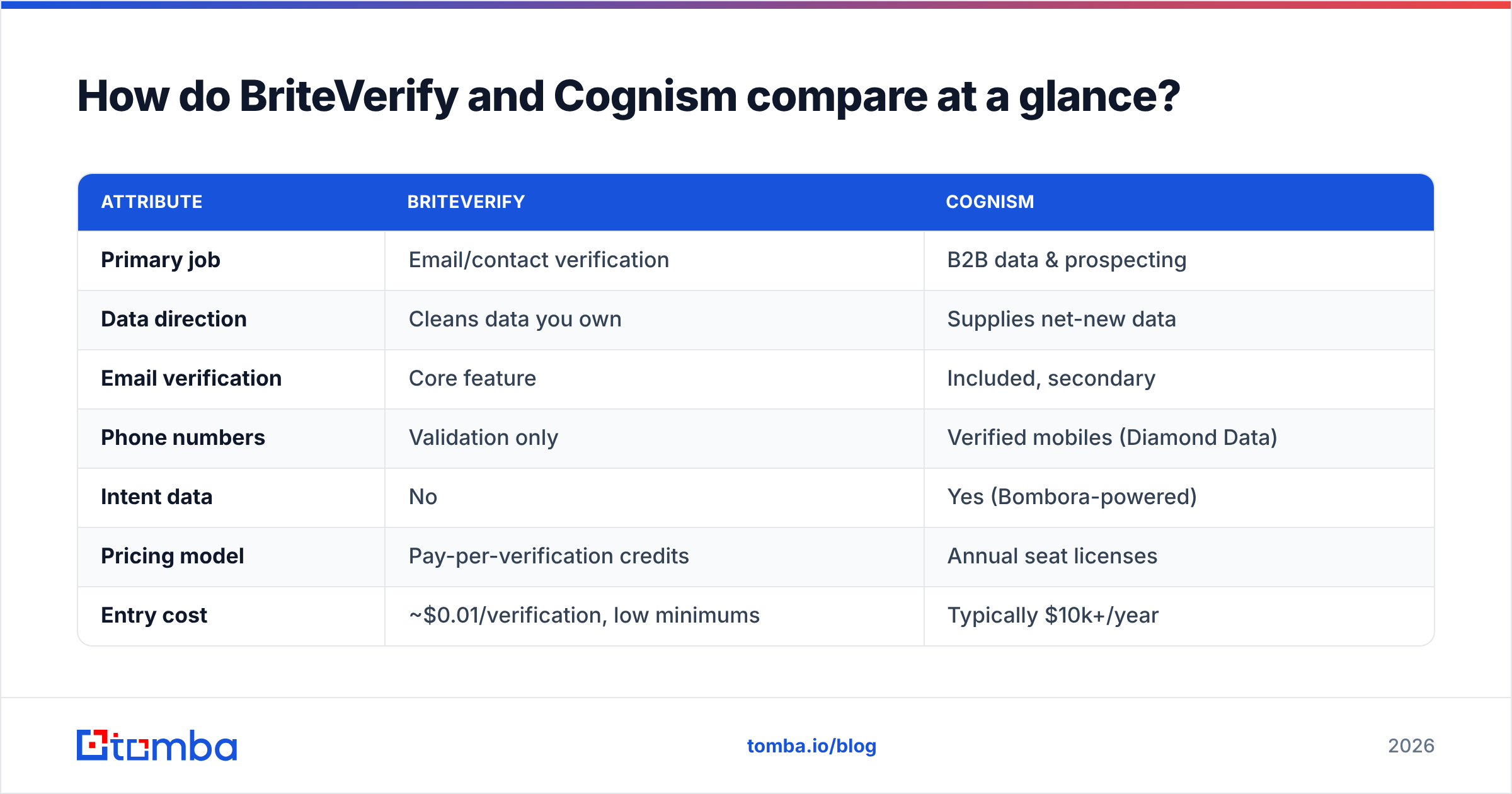
Here's the side-by-side on the attributes that actually drive a buying decision.
| Attribute | BriteVerify | Cognism |
|---|---|---|
| Primary job | Email/contact verification | B2B data & prospecting |
| Data direction | Cleans data you own | Supplies net-new data |
| Email verification | Core feature | Included, secondary |
| Phone numbers | Validation only | Verified mobiles (Diamond Data) |
| Intent data | No | Yes (Bombora-powered) |
| Pricing model | Pay-per-verification credits | Annual seat licenses |
| Entry cost | ~$0.01/verification, low minimums | Typically $10k+/year |
| Free tier | Limited free trial | Demo only, no self-serve free tier |
| Best for | List hygiene, deliverability | Outbound prospecting at scale |
| Compliance focus | Validation accuracy | GDPR/CCPA, phone-verified contacts |
The pattern is clear: BriteVerify is a precise, narrow tool you can adopt in an afternoon. Cognism is a platform commitment that reshapes how your sales team sources accounts — with a price tag and contract to match.
Which has better data accuracy?#
It depends on what you mean by accuracy, because they measure different things.
BriteVerify's accuracy is about verification precision — how reliably it labels an address valid or invalid. It runs syntax checks, domain and MX-record checks, and mailbox-level pings, and it's well regarded for catching hard bounces before you send. Where it gets fuzzy, like most verifiers, is on catch-all domains that accept every address at the server level. If that's a recurring headache, a dedicated catch-all verifier gives you a more confident verdict than a bounce-or-not label.
Cognism's accuracy is about database freshness and coverage — whether the contact it hands you is real, current, and reachable. Its Diamond Data phone numbers are human-verified, which is genuinely strong for cold-calling teams in Europe where mobile coverage from US-centric vendors falls off a cliff. The trade-off: any prospecting database goes stale, and you're trusting Cognism's refresh cadence rather than verifying at send time.
The takeaway: BriteVerify tells you if an email works. Cognism tells you the email exists and who it belongs to. Serious teams often want both — find the contact, then verify before the first send.
How do BriteVerify and Cognism price out?#
This is where most buyers feel the difference.
BriteVerify uses pay-as-you-go credits, roughly a cent per verification with volume discounts and no forced annual lock-in. You can validate 5,000 addresses, pay for 5,000, and walk away. That makes it easy to justify for a one-time list cleanup or an occasional pre-send check.
Cognism sells annual contracts with per-seat licensing, and public reporting and review sites consistently place entry deals in the low five figures, climbing with seats and data modules. There's no meaningful self-serve free tier — you go through a sales demo. For a funded team doing heavy outbound, the ROI can be there. For a small team or a side project, it's overkill.
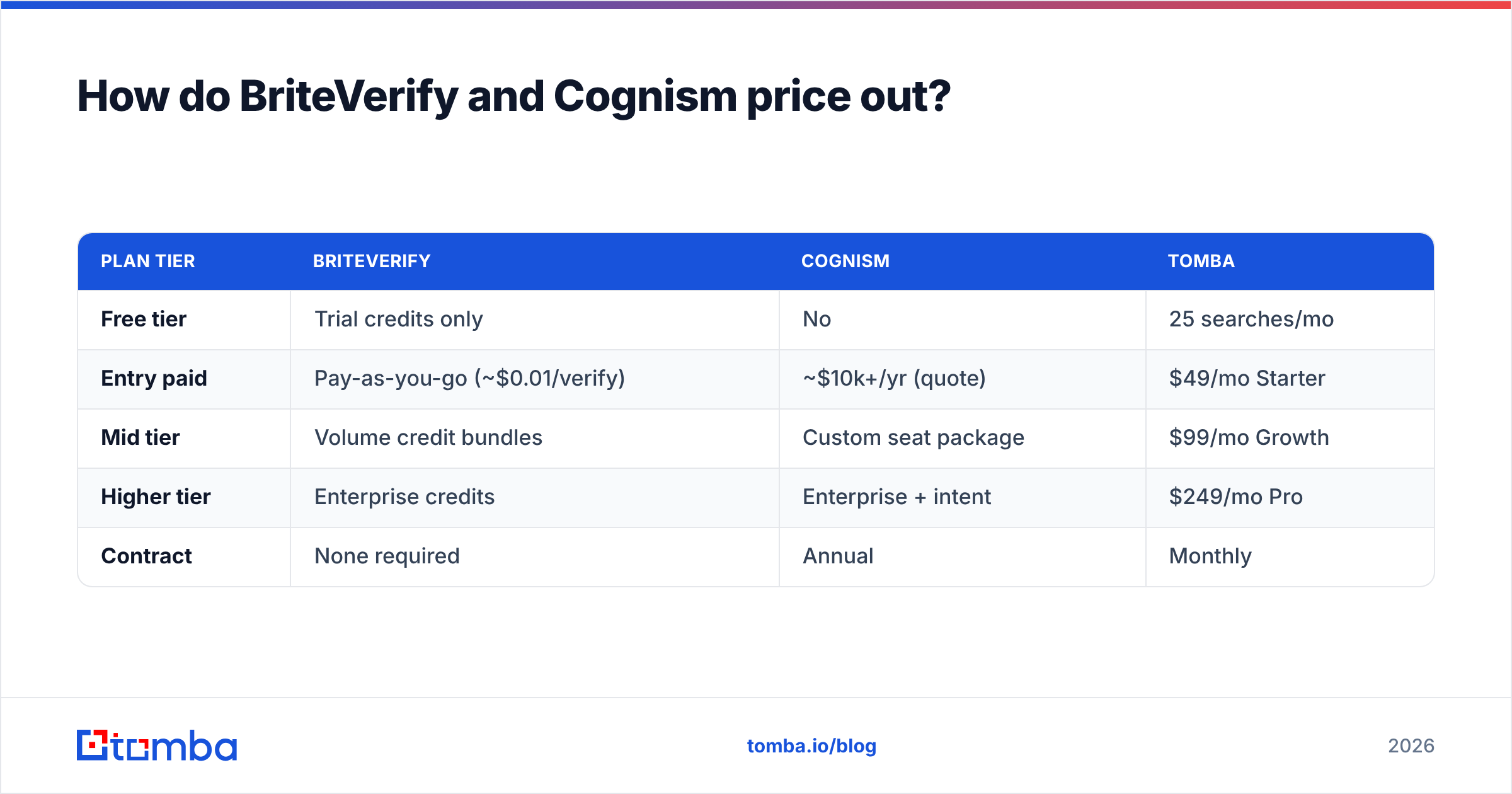
Here's how a leaner finder-plus-verifier stack compares on entry economics:
| Plan tier | BriteVerify | Cognism | Tomba |
|---|---|---|---|
| Free tier | Trial credits only | No | 25 searches/mo |
| Entry paid | Pay-as-you-go (~$0.01/verify) | ~$10k+/yr (quote) | $49/mo Starter |
| Mid tier | Volume credit bundles | Custom seat package | $99/mo Growth |
| Higher tier | Enterprise credits | Enterprise + intent | $249/mo Pro |
| Contract | None required | Annual | Monthly |
You can see full Tomba pricing for the credit breakdown, but the headline is that monthly, no-contract plans start at $49/mo — not a five-figure annual commitment.
When should you choose BriteVerify?#
Choose BriteVerify when the data already exists and you need it clean.
- You run high-volume email campaigns and bounce rates are threatening your domain reputation.
- You're migrating or merging CRMs and want to scrub dead contacts before import.
- You need occasional, on-demand verification without signing an annual contract.
- You want a single, focused tool that does one job well and integrates with ESPs and marketing platforms.
What BriteVerify won't do is find anyone. If your pipeline problem is "we don't have enough contacts," verification doesn't solve it — you're polishing an empty list. For the deliverability side of the equation specifically, BriteVerify is a defensible, narrow pick.
When should you choose Cognism?#
Choose Cognism when you need net-new contacts, especially phone numbers in EMEA.
- You're building outbound from scratch and need firmographic + contact data at scale.
- Cold calling is core to your motion and US-only databases leave you with dead European numbers.
- You want intent signals to prioritize accounts showing buying behavior.
- You have budget for an annual platform and seats for a full sales team.
Cognism's weakness is the inverse of BriteVerify's: it's a heavyweight commitment. If you just want to find a few hundred verified emails this quarter, you'll be paying for a Ferrari to drive to the corner store. Many teams evaluating it end up wanting something between "verify only" and "enterprise platform" — which is exactly the gap a focused email finder fills.
)
Is there a better-value alternative to both?#
Yes — if your actual job is finding professional emails and verifying them in one flow, you don't need an enterprise data contract or a verification-only silo.
Tomba combines the two jobs that BriteVerify and Cognism split between them. You can run a domain search to pull every public email pattern at a company, use the email finder to get a specific person's address by name and domain, then run the built-in email verifier before you send — all on a monthly plan with a free tier to test it.
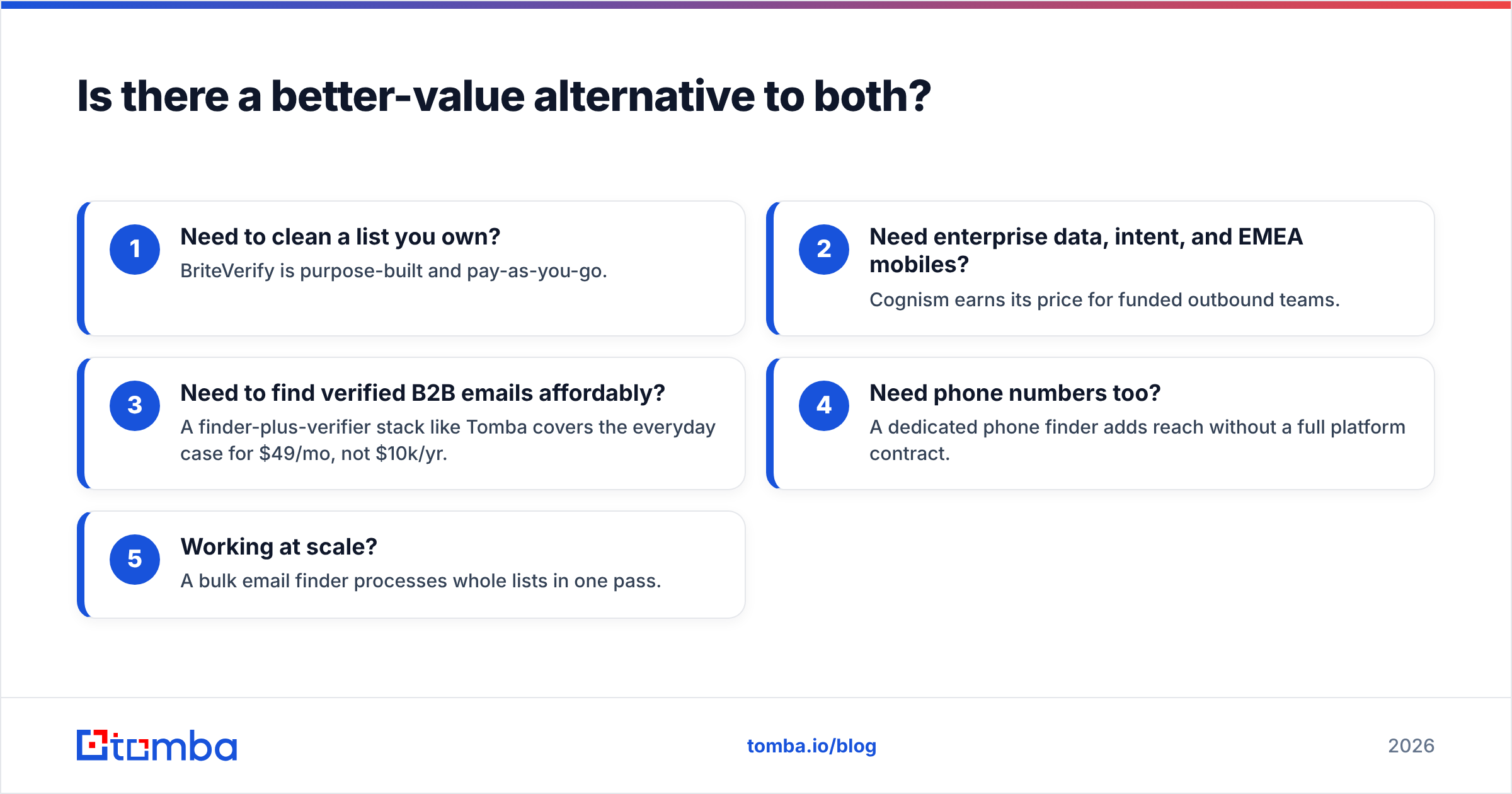
Here's where each tool lands:
- Need to clean a list you own? BriteVerify is purpose-built and pay-as-you-go.
- Need enterprise data, intent, and EMEA mobiles? Cognism earns its price for funded outbound teams.
- Need to find verified B2B emails affordably? A finder-plus-verifier stack like Tomba covers the everyday case for $49/mo, not $10k/yr.
- Need phone numbers too? A dedicated phone finder adds reach without a full platform contract.
- Working at scale? A bulk email finder processes whole lists in one pass.
None of this means BriteVerify or Cognism are bad tools — they're good at their respective jobs. It means most teams are paying for one specialty when they actually need a blend of both.
How do these tools fit into a real outreach workflow?#
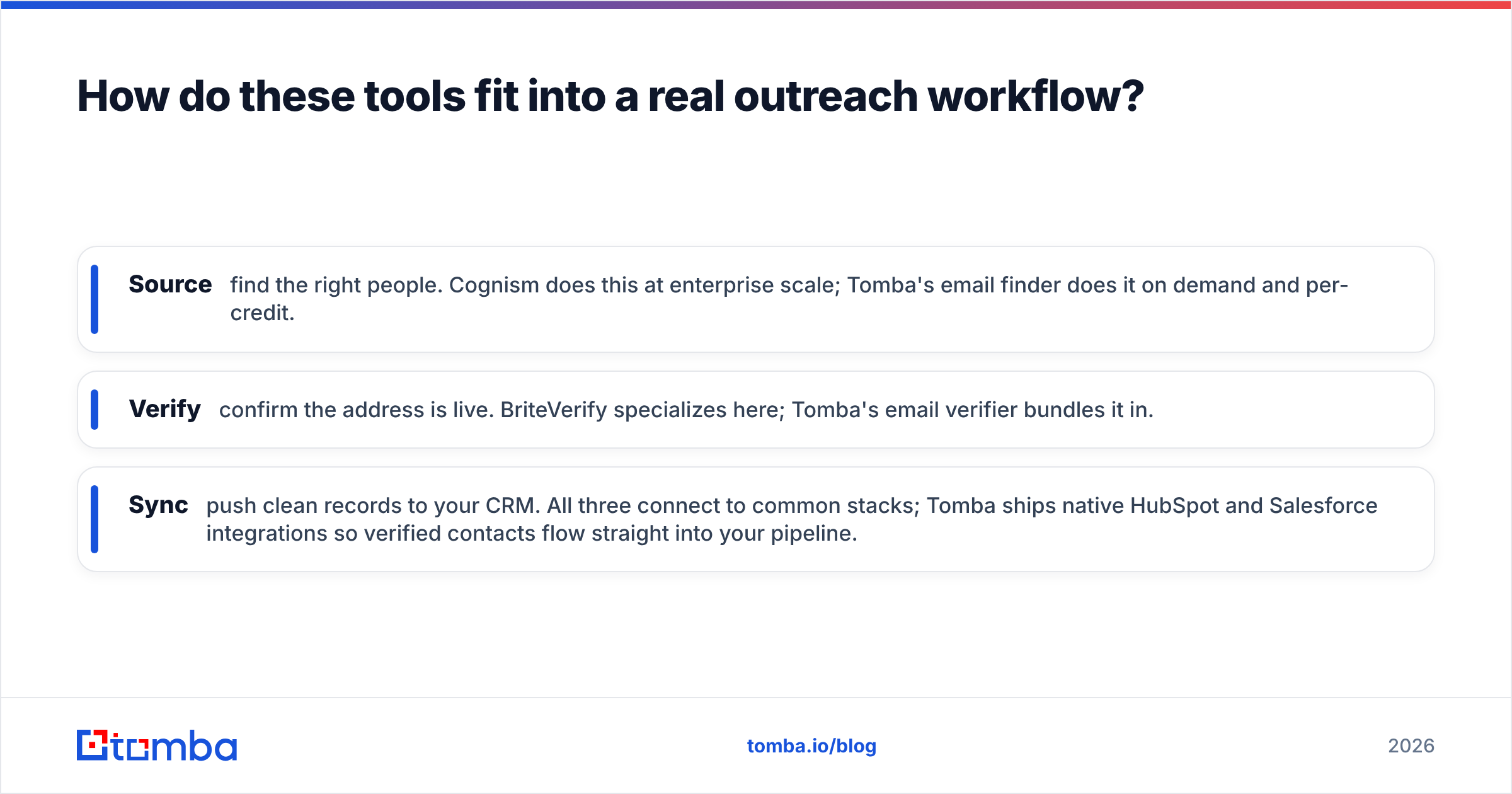
Map the tool to the stage, not the brand. A clean outbound motion has three data steps, and you can mix vendors:
- Source — find the right people. Cognism does this at enterprise scale; Tomba's email finder does it on demand and per-credit.
- Verify — confirm the address is live. BriteVerify specializes here; Tomba's email verifier bundles it in.
- Sync — push clean records to your CRM. All three connect to common stacks; Tomba ships native HubSpot and Salesforce integrations so verified contacts flow straight into your pipeline.
The mistake teams make is buying one heavyweight platform and assuming it covers every stage. In practice, a focused finder plus a verification step beats an over-bought platform on both cost and flexibility — and you keep control of data quality at send time instead of trusting a quarterly database refresh.
For deeper context on how vendors source and refresh records, both G2's category reviews and Cognism's own product documentation are worth reading before you commit to an annual contract.
The bottom line on BriteVerify vs Cognism#
BriteVerify and Cognism aren't really rivals — they're two halves of a data workflow. BriteVerify cleans what you have; Cognism supplies what you don't. Choose BriteVerify for deliverability-focused list hygiene with no contract. Choose Cognism for enterprise-grade prospecting data and EMEA phone coverage, if the budget supports it.
But if you came here because you need verified B2B emails without an enterprise price tag, the smarter move is a tool that finds and verifies in one place. Start free with the Tomba Email Finder — 25 searches a month at no cost, domain search and verification built in, and monthly plans from $49 instead of a five-figure annual lock-in. Find the contact, confirm it's real, and send with confidence — all before either of these platforms would finish onboarding you.
// get started
Find, verify and enrich your first contacts today
Start on the free plan with 25 searches a month, then scale when your team is ready.
Free plan · No credit card required · GDPR & CCPA
// about the author