BriteVerify vs LeadsForge 2026: Which Email Tool Wins?
BriteVerify verifies the lists you already have. LeadsForge tries to build them. Here is an honest 2026 breakdown of accuracy, pricing, and which one your team actually needs.
(title rendered separately)
TL;DR
- BriteVerify is a mature, pay-as-you-go email verification engine (owned by Validity) built to clean lists you already own and stop bounces at form-submit time.
- LeadsForge sits earlier in the funnel: it pitches AI-assisted lead sourcing and list building, not deep validation. The two tools overlap less than the "vs" suggests.
- If your problem is "my bounce rate is killing deliverability," BriteVerify is the closer fit. If it's "I have no list at all," LeadsForge is aimed at you.
- Per-verification pricing makes BriteVerify expensive at scale; subscription tools with bundled finding-and-verifying often win on cost per usable contact.
- A combined find + verify platform like Tomba usually beats running a sourcing tool and a separate verifier in parallel — one credit pool, one API, one bill.
What problem does each tool actually solve?#
Start here, because "BriteVerify vs LeadsForge" is a slightly unfair fight: the two products are optimized for different stages of the pipeline.
BriteVerify is a dedicated verifier. You hand it a list — uploaded CSV, CRM sync, or a real-time API call on your signup form — and it tells you whether each address is valid, invalid, accept-all (catch-all), or unknown. It does one job and has done it for over a decade. Validity, its parent company, also owns Everest and the Sender Score reputation data, so the brand leans hard on deliverability credibility.
LeadsForge markets itself further up the funnel: AI-driven prospecting and list generation. The promise is "describe your ideal customer, get a list of contacts." Verification, where it exists, is a finishing step rather than the core engine.
So the honest framing is:
- You already have contacts and want them clean → that's a verification job (BriteVerify's home turf).
- You have zero contacts and need to build a list → that's a sourcing job (LeadsForge's pitch).
- You need both, continuously → you want a platform that does finding and verifying without bolting two vendors together.
Most B2B teams are in bucket 3 and only realize it after paying for two tools.
)
How accurate is BriteVerify in 2026?#
Accuracy is BriteVerify's headline feature, and it's genuinely strong on role and syntax detection, hard-bounce prediction, and known-invalid domains. Where every SMTP-based verifier — BriteVerify included — gets fuzzy is catch-all (accept-all) domains. A catch-all server accepts mail for any address at the domain, so no verifier can confirm a specific mailbox exists by SMTP alone. BriteVerify returns these as "accept-all," which is honest, but it pushes the judgment call back to you.
That matters because a large share of corporate domains are catch-all. If 30% of your list lands in "unknown / accept-all," the cleaning value drops fast. This is exactly where dedicated catch-all verifier logic — using pattern intelligence and historical signals rather than SMTP alone — separates good verifiers from great ones.

LeadsForge's accuracy story is different and harder to pin down, because the risk isn't "did it verify correctly" — it's "where did this contact come from." AI list builders often assemble addresses from scraped or permutated sources. That can mean a healthy chunk of guessed-but-unverified emails, which is precisely the kind of input you then need a verifier to clean. If your sourcing tool feeds you unverified guesses, you've just recreated the two-tool problem.
The practical takeaway: judge a verifier by its catch-all handling, and judge a sourcing tool by how verified its output is at the point of export. Don't assume either.
BriteVerify vs LeadsForge: the side-by-side#
Here's the core comparison. Treat LeadsForge figures as positioning-level (pricing for AI lead tools shifts often, and you should confirm current numbers on their site before buying); BriteVerify's pay-as-you-go model is its long-standing structure.
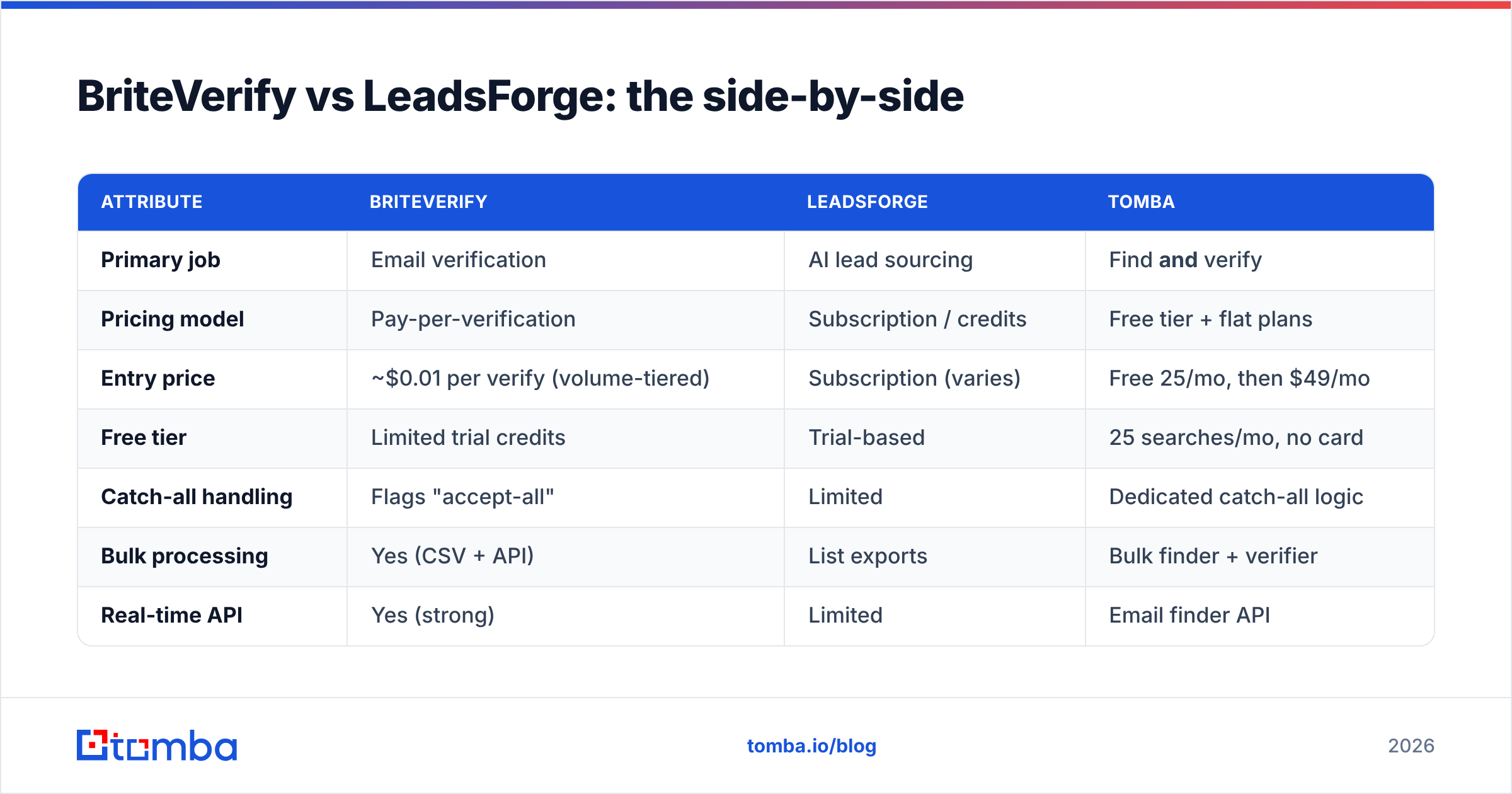
| Attribute | BriteVerify | LeadsForge | Tomba |
|---|---|---|---|
| Primary job | Email verification | AI lead sourcing | Find and verify |
| Pricing model | Pay-per-verification | Subscription / credits | Free tier + flat plans |
| Entry price | ~$0.01 per verify (volume-tiered) | Subscription (varies) | Free 25/mo, then $49/mo |
| Free tier | Limited trial credits | Trial-based | 25 searches/mo, no card |
| Catch-all handling | Flags "accept-all" | Limited | Dedicated catch-all logic |
| Bulk processing | Yes (CSV + API) | List exports | Bulk finder + verifier |
| Real-time API | Yes (strong) | Limited | Email finder API |
| Best for | Cleaning owned lists | Cold list building | Full prospecting workflow |
A few honest reads from that table:
- BriteVerify wins on real-time form protection. If you need an API that blocks junk at signup, it's battle-tested.
- LeadsForge wins if you literally have no list and want sourcing baked into one subscription.
- Neither alone covers the full loop. Sourcing without strong verification leaks bounces; verification without sourcing assumes you already did the hard part.
Which one is cheaper at scale?#
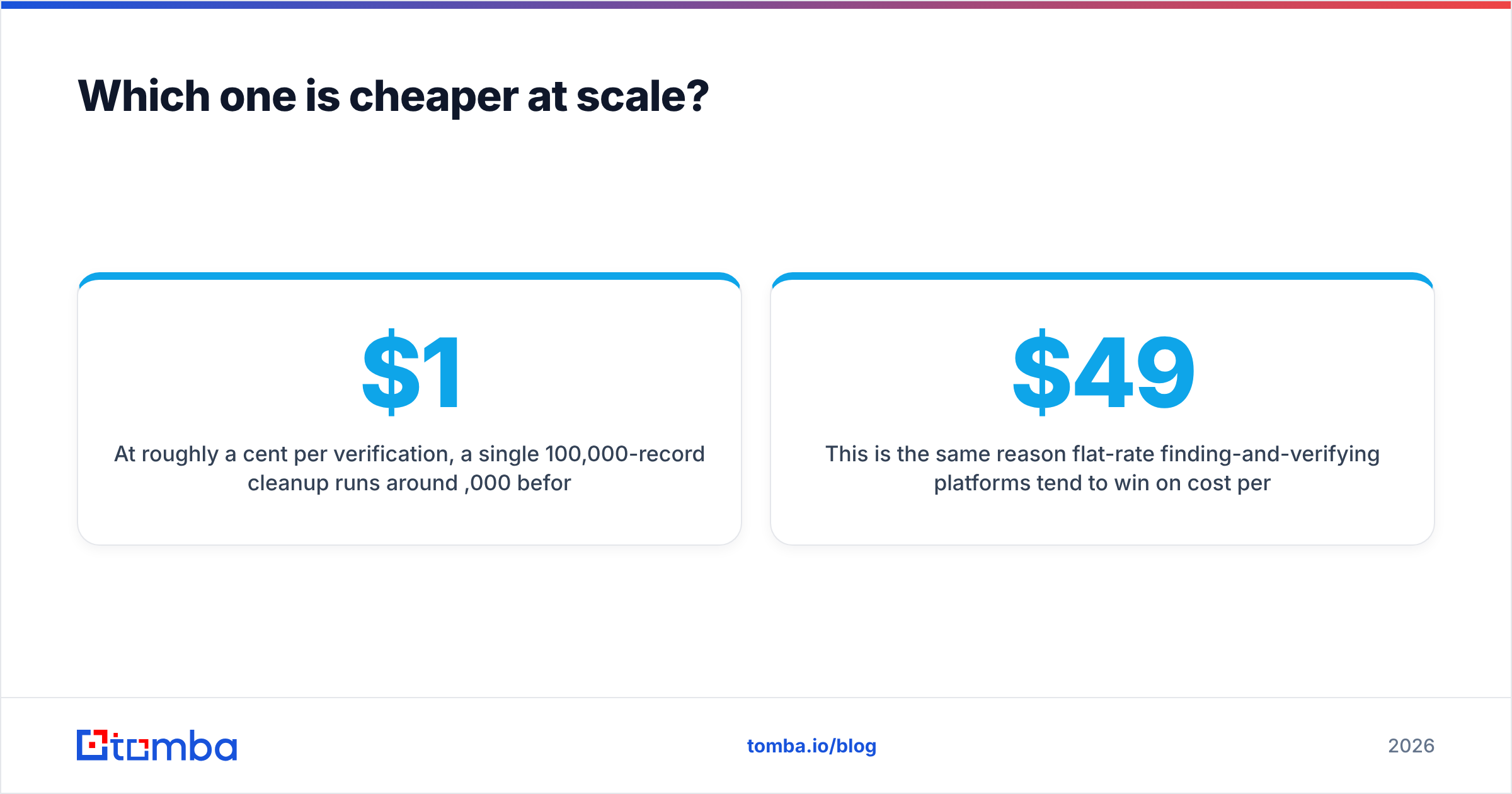
Conclusion first: pay-per-verification gets expensive fast, and that's BriteVerify's weak spot.
At roughly a cent per verification, a single 100,000-record cleanup runs around $1,000 before volume discounts. Do that monthly and the meter never stops. For teams that verify continuously — every form submit, every new import, every re-engagement campaign — usage-based pricing is unpredictable in the worst way: your bill scales with your growth.
Subscription tools flip that. LeadsForge's bundled model means a flat monthly cost, but read the fine print on credit limits and overage rates — "unlimited" rarely is.
This is the same reason flat-rate finding-and-verifying platforms tend to win on cost per usable contact. When one plan covers domain search, finding, and verification, you stop paying three middlemen for one outcome. You can see how a flat structure compares on the Tomba pricing page — Free (25 searches), Starter $49/mo, Growth $99/mo, Pro $249/mo — versus a per-hit meter that punishes volume.
)
What does a complete workflow actually need?#
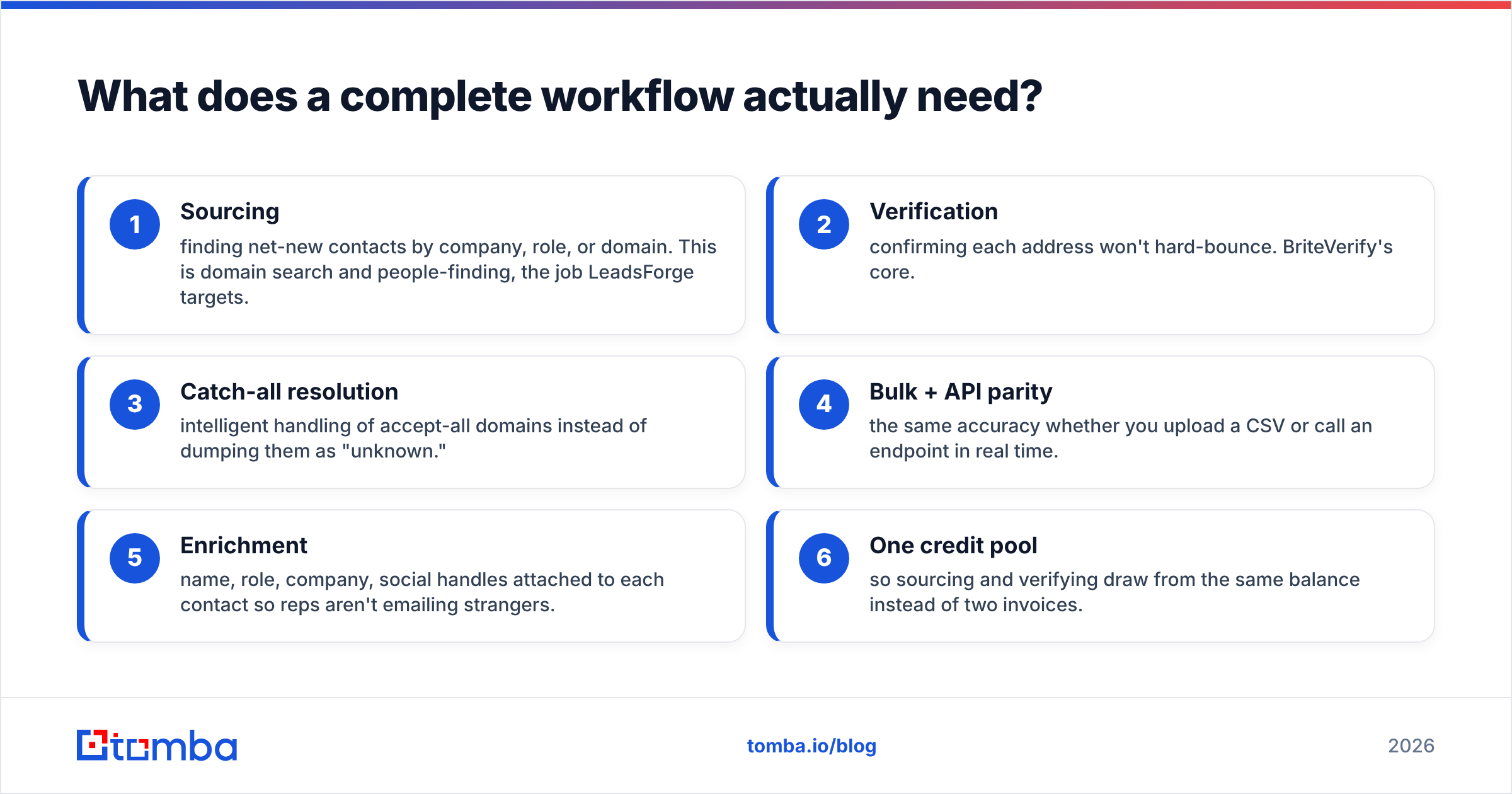
Here's the structured checklist most teams discover the hard way. A production-grade email workflow needs all six of these, not two:
- Sourcing — finding net-new contacts by company, role, or domain. This is domain search and people-finding, the job LeadsForge targets.
- Verification — confirming each address won't hard-bounce. BriteVerify's core.
- Catch-all resolution — intelligent handling of accept-all domains instead of dumping them as "unknown."
- Bulk + API parity — the same accuracy whether you upload a CSV or call an endpoint in real time.
- Enrichment — name, role, company, social handles attached to each contact so reps aren't emailing strangers.
- One credit pool — so sourcing and verifying draw from the same balance instead of two invoices.
BriteVerify nails #2 and #4. LeadsForge targets #1. Neither single tool delivers all six, which is why "BriteVerify vs LeadsForge" so often ends with teams buying both — and then a third tool for enrichment.
The alternative is a platform that treats find-and-verify as one motion. Tomba's email finder and email verifier share the same data backbone and credit pool, so a found address can be verified in the same call — no export, re-import, or second subscription.
Is BriteVerify better than LeadsForge?#
It depends on the job, and the honest answer is neither is "better" — they're solving different problems.
Choose BriteVerify if:
- Your lists already exist (CRM, signup forms, event imports) and bounces are the pain.
- You need a hardened real-time API to block bad addresses at form submit.
- You value the Validity deliverability brand and already use Everest or Sender Score.
- Per-verification cost is acceptable because your volume is steady and modest.
Choose LeadsForge if:
- You're starting from zero and want sourcing plus a workable list in one subscription.
- Your team prefers a "describe your ICP, get contacts" workflow over manual prospecting.
- You can tolerate verifying the output yourself or accept some guessed addresses.
Choose a combined platform (like Tomba) if:
- You do both jobs continuously and don't want two bills, two APIs, and two data models.
- Cost predictability matters — a flat plan beats a per-hit meter as you scale.
- You want catch-all intelligence, enrichment, and bulk processing under one roof.
You can sanity-check all three against real reviews on G2 and Capterra — and confirm BriteVerify's current model directly on the Validity site, since pay-as-you-go terms change.
How do they handle deliverability and compliance?#
BriteVerify's pedigree shows here. Because Validity also runs reputation products, BriteVerify is positioned as part of a deliverability stack: clean the list, protect the sender reputation, keep the bounce rate under the thresholds that trigger ISP throttling. If deliverability governance is a board-level concern at your company, that brand alignment carries weight.
LeadsForge, like most AI sourcing tools, puts the compliance burden more on you. Lists built from scraped or inferred data raise legitimate questions about consent and data provenance under GDPR and CAN-SPAM. That's not unique to LeadsForge — it's the structural risk of any "instant list" product. Always confirm where contacts originate and whether you have a lawful basis to email them.
A verifier reduces bounce-driven reputation damage; it does not make a non-consented list compliant. Keep those two ideas separate, because vendors love to blur them.
What's the smartest setup for a B2B team in 2026?#
Conclusion first: collapse the stack. The teams getting the best cost-per-meeting aren't running BriteVerify and a sourcing tool and an enrichment tool — they're running one platform that finds, verifies, and enriches from a single credit balance, then exporting clean contacts straight into the CRM.
The two-tool path (source with one vendor, verify with another) works, but it costs you in three ways: duplicate spend, integration glue, and the latency of moving lists between systems. Every export-reimport step is a chance for data to go stale or get mangled.
If you're evaluating this matchup specifically to fix bounces on lists you already own, BriteVerify is a defensible buy. If you're evaluating it because you have no pipeline yet, neither tool fully solves your problem — you need sourcing and trustworthy verification in the same motion.
That's the gap Tomba is built for. The Tomba Email Finder locates professional addresses by name, company, or domain, then verifies them against the same data sources — so the contact that lands in your sequence is already cleaned. Start on the free tier (25 searches a month, no card), and if it earns its place, the $49/mo Starter plan covers finding and verifying without a per-hit meter ticking against you. Skip the two-vendor tax: find it, verify it, send it — in one place.
// get started
Find, verify and enrich your first contacts today
Start on the free plan with 25 searches a month, then scale when your team is ready.
Free plan · No credit card required · GDPR & CCPA
// about the author