BriteVerify vs Leadzen.ai (2026): Verify or Find Leads?
BriteVerify verifies the emails you already have. Leadzen.ai finds new ones. Here's an honest 2026 breakdown of where each wins, what they cost, and the cheaper way to get both.
You are comparing two tools that barely do the same job. That is the first thing to get straight before you swipe a credit card.
BriteVerify (a Validity product) is an email verification engine: you feed it a list, it tells you which addresses are deliverable. Leadzen.ai is a lead intelligence platform: it helps you discover net-new prospects, their contact details, and firmographic context. One cleans data you already own. The other generates data you do not have yet.
This guide breaks down BriteVerify vs Leadzenai on accuracy, pricing, coverage, and real-world fit — and shows where a single combined stack quietly beats running both.
TL;DR: BriteVerify vs Leadzen.ai in 30 seconds#
- BriteVerify is a pure email/list verifier. Best when you already have lists and just need them scrubbed before a send. Pay-as-you-go pricing, strong deliverability accuracy, narrow scope.
- Leadzen.ai is a prospecting and lead-discovery platform aimed mostly at the Indian market and global B2B search. Best when you need to find people, not just validate them.
- They are complementary, not interchangeable — comparing them head-to-head is like comparing a car wash to a car dealership.
- If your real goal is "find verified contacts and keep my list clean," neither single tool covers the full loop. A finder-plus-verifier stack does.
- For most outbound teams, the cheaper, simpler path is one platform that finds and verifies — which is where Tomba's email verifier and finder come in later in this post.
What is BriteVerify and what does it actually do?#
BriteVerify is an email verification service owned by Validity. Its single job is to take an email list and sort each address into buckets: valid, invalid, accept-all (catch-all), unknown, and sometimes risky roles like info@ or sales@.
It does this through SMTP-level checks, syntax validation, domain/MX record lookups, and known-bounce databases. The output is a cleaner list and a lower bounce rate when you push that list into a sending platform.
What BriteVerify deliberately does not do:
- It will not find an email for a person whose address you do not have.
- It will not enrich a record with job title, company size, or phone.
- It will not build you a prospect list from a target market.
That focus is a feature. Teams that already have inbound forms, CRM exports, or purchased lists use BriteVerify as the last gate before a campaign so they protect sender reputation and stay out of spam folders.
Wait — ignore that placeholder; picture instead the BriteVerify list-upload screen where a CSV resolves into a green/red validity breakdown. That is 90% of the product surface. It is intentionally small.

What is Leadzen.ai and who is it for?#
Leadzen.ai sits on the opposite side of the funnel. It is a B2B data and lead-generation platform that helps you discover prospects, pull contact details, and run search-based prospecting. It leans heavily on business intelligence for the Indian market, with company search, decision-maker contacts, and real-time lead discovery as headline features.
Where BriteVerify answers "is this address safe to email?", Leadzen.ai answers "who should I be emailing in the first place?" It is closer in spirit to a prospecting database than to a verification engine.
Typical Leadzen.ai use cases:
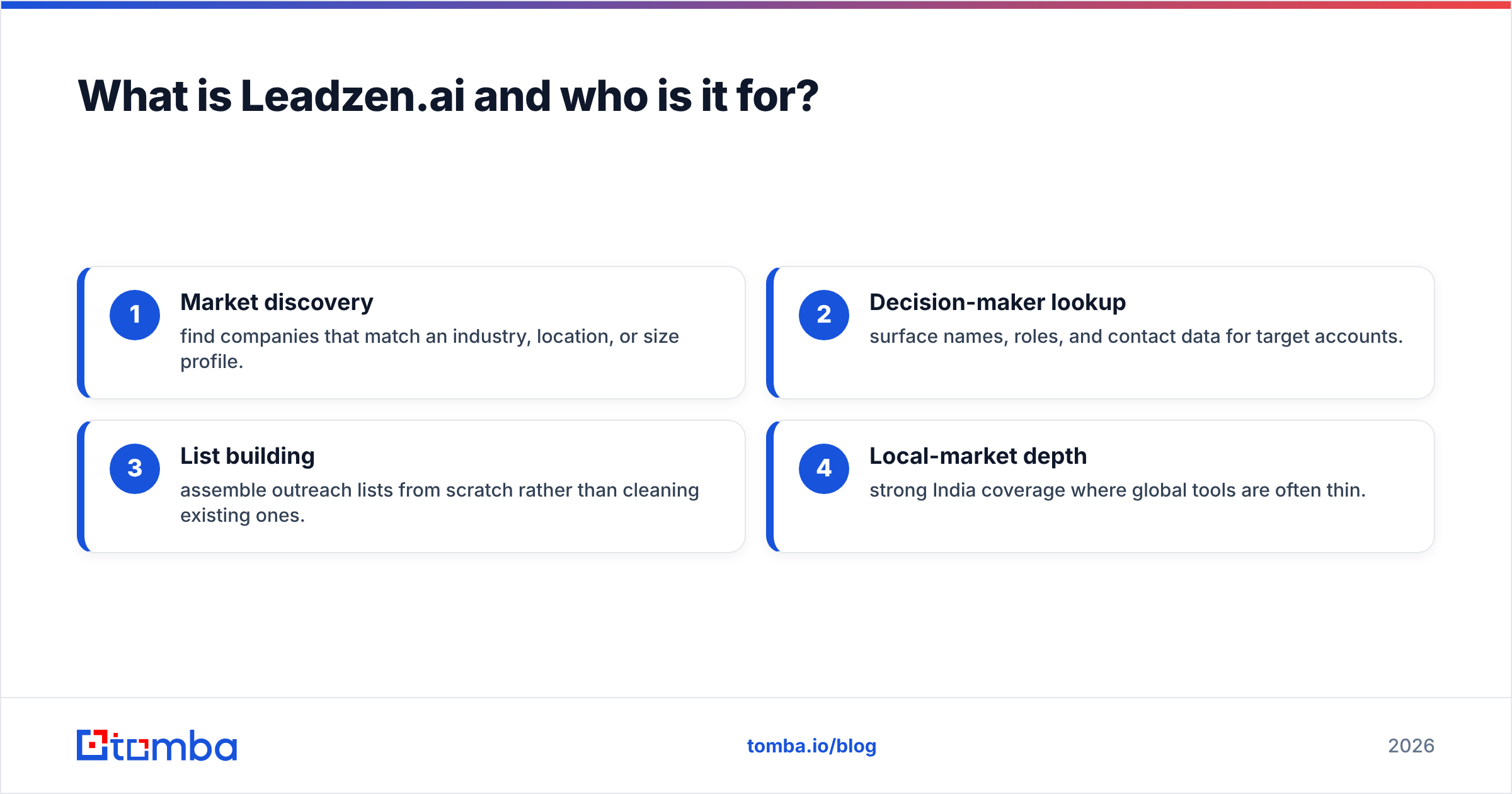
- Market discovery — find companies that match an industry, location, or size profile.
- Decision-maker lookup — surface names, roles, and contact data for target accounts.
- List building — assemble outreach lists from scratch rather than cleaning existing ones.
- Local-market depth — strong India coverage where global tools are often thin.
The catch: discovery platforms generate raw contact data, and raw contact data decays and bounces. That is exactly why a verification step still matters even after you use a finder. Discovery and verification are two halves of the same job.
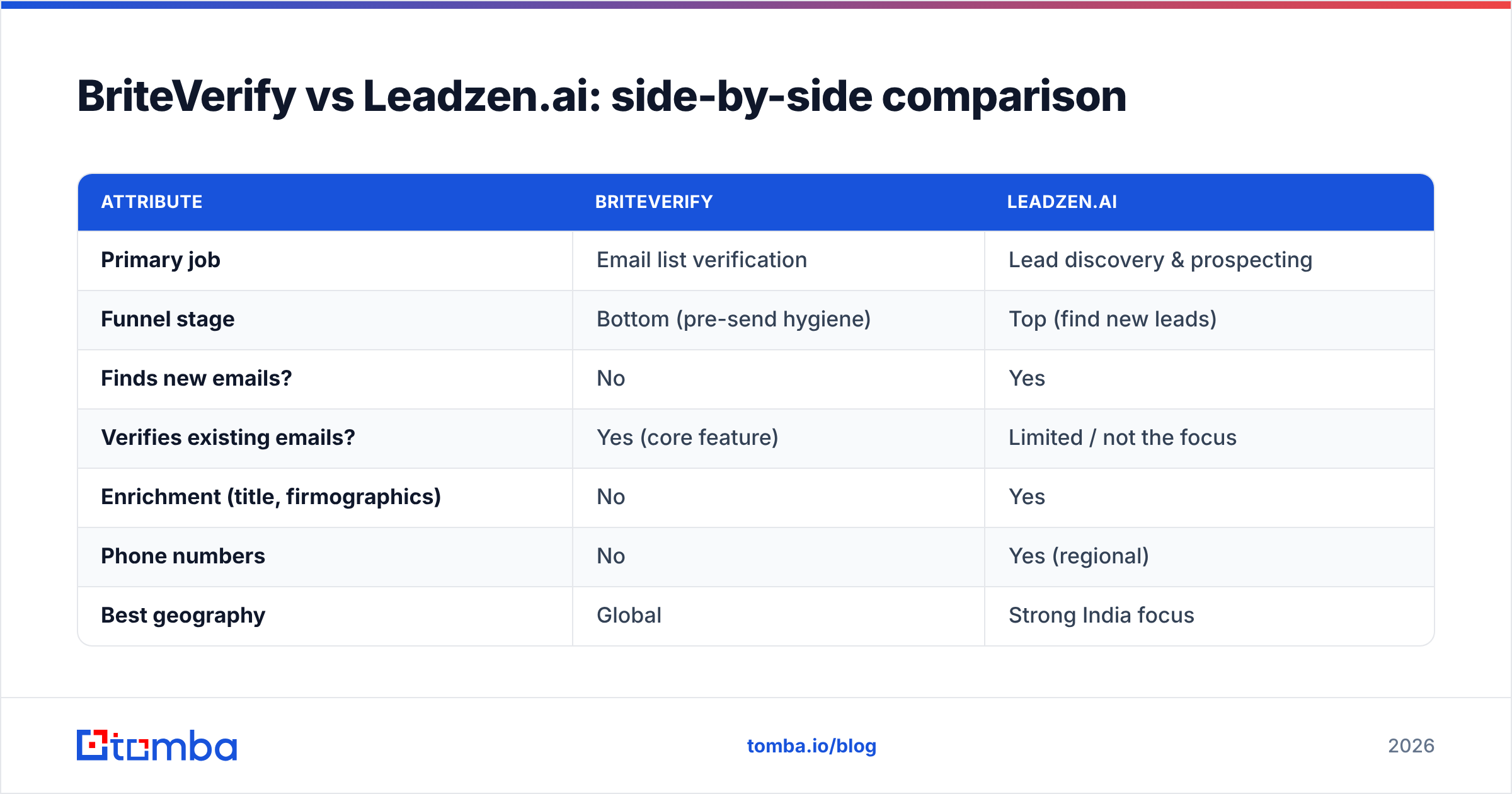
BriteVerify vs Leadzen.ai: side-by-side comparison#
Here is the honest head-to-head. Note how little overlap there actually is — that is the whole point.
| Attribute | BriteVerify | Leadzen.ai |
|---|---|---|
| Primary job | Email list verification | Lead discovery & prospecting |
| Funnel stage | Bottom (pre-send hygiene) | Top (find new leads) |
| Finds new emails? | No | Yes |
| Verifies existing emails? | Yes (core feature) | Limited / not the focus |
| Enrichment (title, firmographics) | No | Yes |
| Phone numbers | No | Yes (regional) |
| Best geography | Global | Strong India focus |
| Pricing model | Pay-as-you-go per email | Subscription / credit tiers |
| Free tier | Limited trial credits | Trial / demo based |
| Ideal user | Email marketers, RevOps cleaning lists | SDRs, prospectors building lists |
The takeaway from the table: you cannot pick a "winner" because they are not running the same race. If you only have one problem — dirty lists or empty pipeline — pick the tool that matches it. If you have both problems (most teams do), one of these alone leaves a gap.
Which is more accurate — and does that question even make sense?#
Accuracy means different things for each tool, so compare them on their own terms.
For BriteVerify, accuracy is bounce prevention: of the addresses it marks "valid," how many actually deliver? Validity reports strong deliverability outcomes, and in practice a good verifier should keep your hard-bounce rate under the ~2-3% threshold that mailbox providers punish. The weak spot for every verifier — BriteVerify included — is catch-all (accept-all) domains, where the server accepts everything and no tool can be 100% certain. That is why a dedicated catch-all verifier exists as a category at all.
For Leadzen.ai, accuracy is data freshness and match rate: when you search for a decision-maker, how often is the returned email and phone correct and current? Discovery data is harder to keep clean because people change jobs constantly. Match rates vary by region — strong where the database is deep (India), thinner elsewhere.
The practical conclusion: a finder's output should always be re-verified before you send. Discovery accuracy and deliverability accuracy are different metrics, and a contact that was "found correctly" last quarter can still bounce today.
How do BriteVerify and Leadzen.ai price compare?#
Pricing structures differ as much as the products.
BriteVerify uses pay-as-you-go pricing charged per email verified, which is friendly for occasional, bursty cleaning jobs — you pay only when you scrub a list. Costs scale linearly with volume, so very large or frequent verifications add up.
Leadzen.ai uses subscription and credit-based tiers built around lead lookups and exports, which suits ongoing prospecting where you pull leads every week. You commit to a plan rather than paying per address.
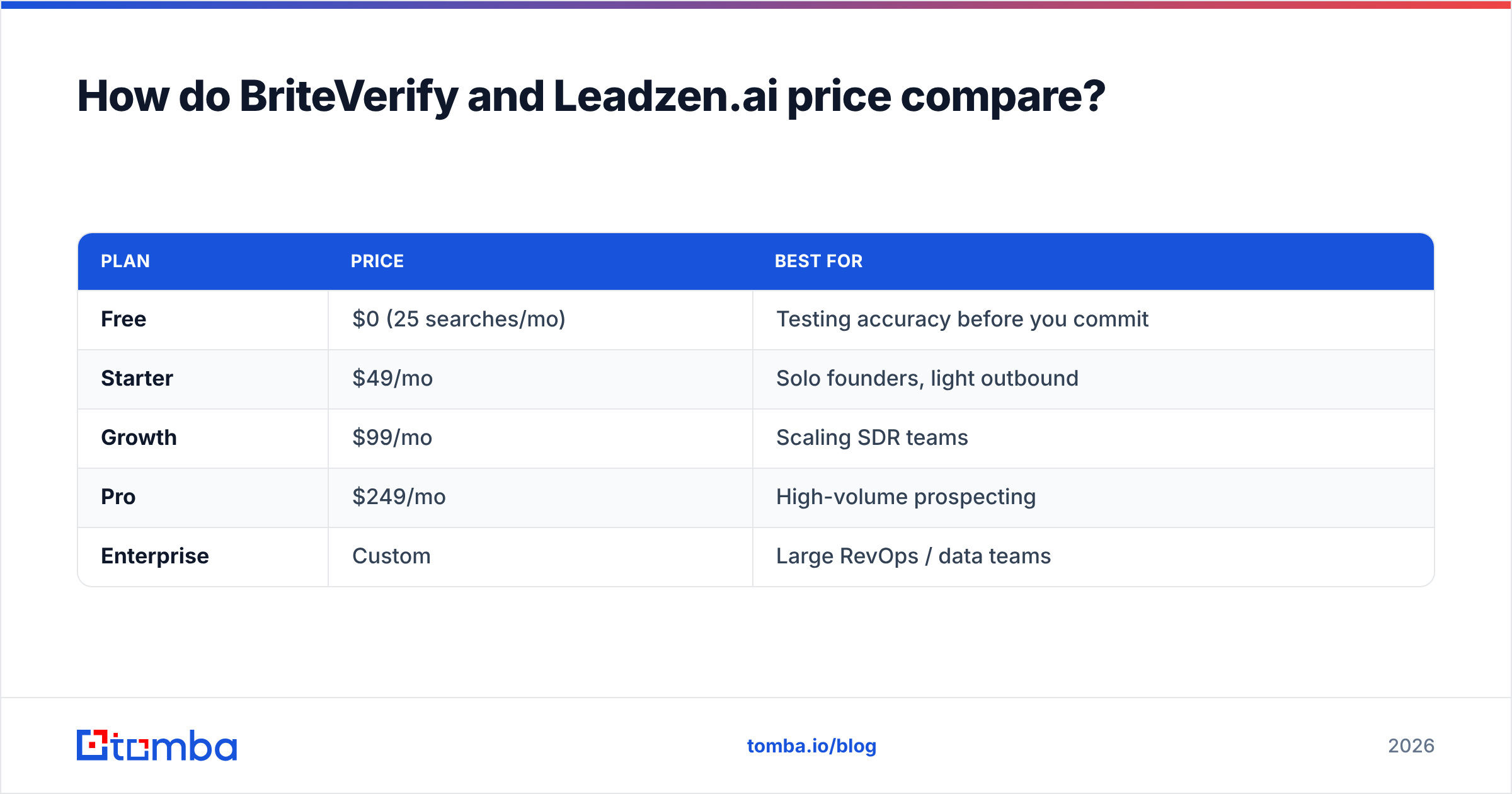
For reference, here is how a finder-plus-verifier platform prices when both jobs live under one roof. Predictable monthly tiers tend to beat juggling two separate per-use bills:
| Plan | Price | Best for |
|---|---|---|
| Free | $0 (25 searches/mo) | Testing accuracy before you commit |
| Starter | $49/mo | Solo founders, light outbound |
| Growth | $99/mo | Scaling SDR teams |
| Pro | $249/mo | High-volume prospecting |
| Enterprise | Custom | Large RevOps / data teams |
You can see the full Tomba pricing breakdown for current limits. The headline difference: with two separate tools you pay a verification bill and a discovery bill; with one platform you pay once and get find-plus-verify in the same workflow.
When should you choose BriteVerify?#
Choose BriteVerify if all of these are true:
- You already have lists — from forms, events, CRM, or imports — and your main pain is bounces.
- You do not need to discover new contacts; pipeline volume is not the problem.
- You want simple, pay-as-you-go billing and a tool that does one thing well.
- Deliverability and email deliverability hygiene are your priority before big sends.
BriteVerify is a clean, reliable choice for marketers and RevOps teams whose job is list hygiene, not list building. If your CRM is full and dirty, it solves your problem directly.
When should you choose Leadzen.ai?#
Choose Leadzen.ai if all of these are true:
- Your pipeline is empty or thin and you need to find new prospects.
- You sell into India or markets where Leadzen's database runs deep.
- You want firmographics and decision-maker context, not just a yes/no on an address.
- You are an SDR or prospector building lists from a target profile.
Leadzen.ai is the better fit when discovery is the bottleneck. Just remember the data you export still needs a verification pass before it hits your sequencer, or your carefully-built list will bounce.
What about a stack that does both — find and verify?#
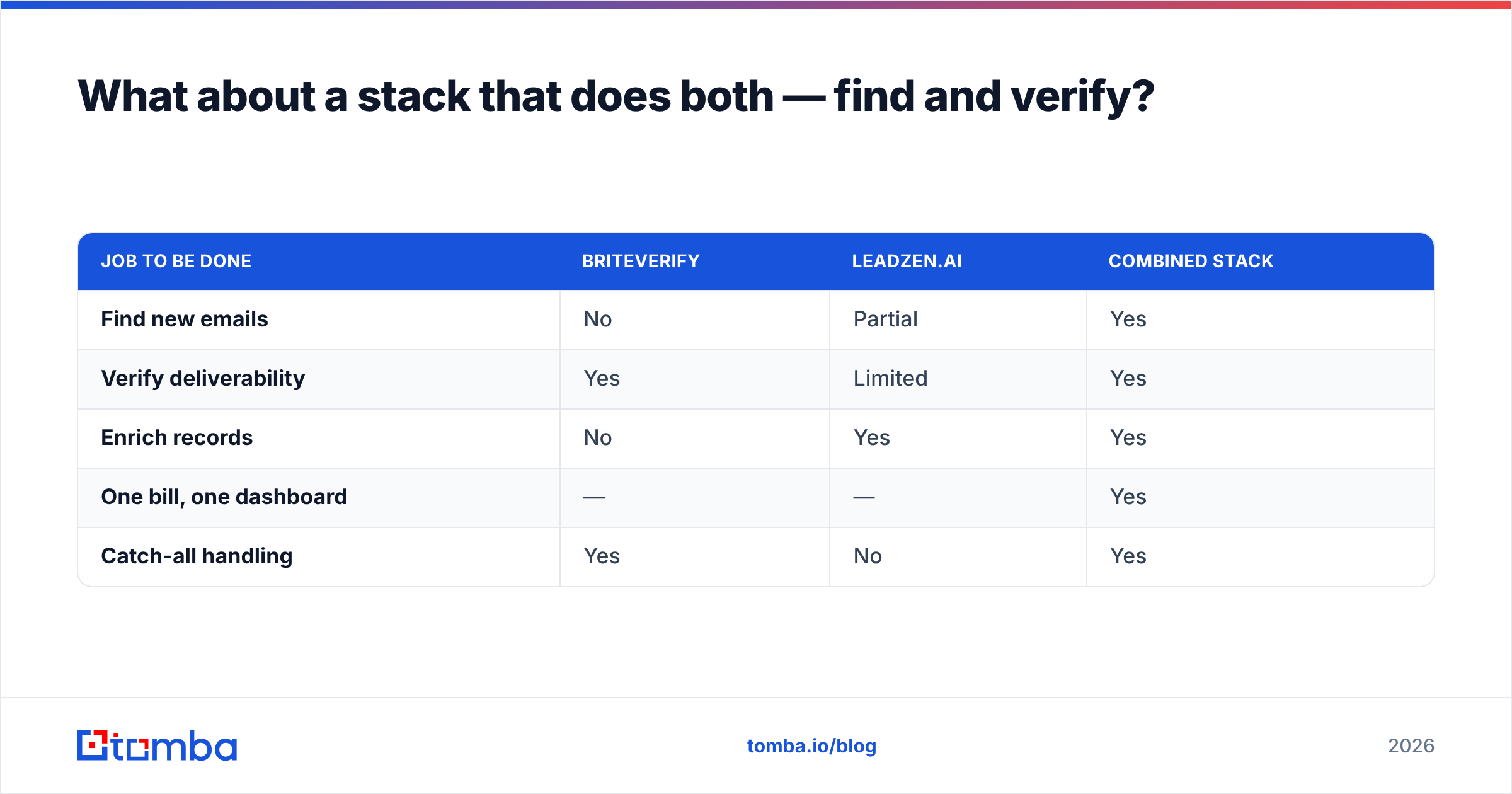
Here is the gap neither tool fully closes on its own: most outbound teams need to find verified contacts, then keep that list clean over time. BriteVerify handles the second half. Leadzen.ai handles part of the first. Neither covers the full loop end to end.
That is the case for a single combined platform. Instead of paying Leadzen.ai to find and BriteVerify to verify — two contracts, two dashboards, two billing cycles — you run one workflow:
- Find the email by name, company, or domain with an email finder.
- Verify deliverability in the same step with a built-in verify emails check.
- Enrich the record with title and firmographics via data enrichment.
- Bulk-process the whole list at once instead of exporting between tools.
| Job to be done | BriteVerify | Leadzen.ai | Combined stack |
|---|---|---|---|
| Find new emails | No | Partial | Yes |
| Verify deliverability | Yes | Limited | Yes |
| Enrich records | No | Yes | Yes |
| One bill, one dashboard | — | — | Yes |
| Catch-all handling | Yes | No | Yes |
A combined stack is not always the right call — if you only verify lists and never prospect, a dedicated verifier is leaner. But the moment you do both jobs, two vendors becomes friction you are paying for.
BriteVerify vs Leadzen.ai: the honest verdict#
There is no universal winner because these tools solve different problems:
- Pick BriteVerify when your lists exist and just need scrubbing. It is focused, accurate at bounce-prevention, and priced for occasional jobs.
- Pick Leadzen.ai when you need to discover prospects, especially in India, and want firmographic context with your contacts.
- Pick a combined find-plus-verify platform when you are doing both — which describes most modern outbound and revenue operations teams.
Run a quick test before committing to either: take 50 real target contacts, find their emails, verify them, and measure how many actually deliver. Whichever workflow gets you the most verified, sendable contacts per dollar is the right one — regardless of which logo is on the dashboard.
Compare your shortlist on G2 and check each vendor's own docs (BriteVerify, Leadzen.ai) before you buy, since features and pricing shift.
Find and verify in one place with Tomba#
If the comparison above made one thing clear, it is that finding and verifying are two halves of the same job — and paying two vendors to do them separately is the expensive path. Tomba's Email Finder finds professional email addresses by name, company, or domain, verifies deliverability in the same step, and enriches the record with firmographic context — so you skip the export-import shuffle between a discovery tool and a verifier. Start free with 25 searches a month, test the accuracy on your own target list, and scale to a single predictable plan only when it earns it. One dashboard, one bill, find-plus-verify in the same workflow.
// get started
Find, verify and enrich your first contacts today
Start on the free plan with 25 searches a month, then scale when your team is ready.
Free plan · No credit card required · GDPR & CCPA
// about the author