BriteVerify vs SalesIntel: Which B2B Data Tool Wins in 2026?
BriteVerify verifies emails; SalesIntel sources contact data. We compare accuracy, pricing, and use cases to show which one your 2026 stack actually needs.
You are comparing BriteVerify and SalesIntel because both promise cleaner data — but they solve opposite halves of the problem. One scrubs the list you already have. The other hands you a list you do not. Picking the wrong one means paying for a tool that cannot do the job you hired it for.
TL;DR#
- BriteVerify is an email verification tool. It checks whether addresses you already collected are valid, deliverable, and safe to send to. It does not find new contacts.
- SalesIntel is a B2B data provider. It supplies company and contact records — emails, phones, firmographics — with human-verified data as its headline feature. It is not built to scrub your existing list at scale.
- They are complementary, not interchangeable. Sourcing data and verifying data are different jobs; comparing them head-to-head only makes sense when you decide which gap is bigger for your team.
- Pricing models differ sharply. BriteVerify charges per verification (pay-as-you-go or volume tiers). SalesIntel sells annual seat-plus-credit contracts that run into five figures.
- If you want both jobs in one affordable tool, an all-in-one platform like Tomba finds and verifies from a single account starting at $49/mo — worth weighing before you sign two separate contracts.
What is BriteVerify?#
BriteVerify, now part of Validity, is a real-time email verification service. You feed it a list — or call its API as addresses get captured on a form — and it returns a status for each one: valid, invalid, accept-all (catch-all), unknown, or role-based. The goal is simple: stop you from sending to addresses that bounce, because high bounce rates wreck your sender reputation and land future campaigns in spam.
BriteVerify also validates phone numbers and postal addresses, but email is its core. Marketers use it at the point of capture (form fields), before big sends (list cleaning), and on a schedule (re-validating aging lists). It is fast, accurate on syntax and mailbox checks, and integrates with most ESPs.
What BriteVerify does not do: it will not tell you the email address of a VP of Sales at a company you have never contacted. It has no contact database. It cleans what you bring.
What is SalesIntel?#
SalesIntel is a B2B contact and company intelligence platform. Its pitch is "human-verified" data — a research team that re-verifies records on a rolling cycle so the phone numbers and direct-dial emails you pull are less stale than scraped databases. You search by company, title, industry, technographics, or intent signals, then export contacts into your CRM or sequencer.
SalesIntel competes with Apollo, ZoomInfo, and Lusha. It sells to sales and marketing teams that need to build prospect lists from scratch and want higher confidence in direct-dial accuracy than a purely automated provider offers.
What SalesIntel is not: a bulk hygiene tool for the 200,000-row newsletter list you have been collecting for five years. You can verify within its ecosystem, but it is priced and built for sourcing fresh contacts, not for scrubbing legacy data.

BriteVerify vs SalesIntel: how do they actually differ?#
The fastest way to see the split is by the job each one is hired for.
| Attribute | BriteVerify (Validity) | SalesIntel |
|---|---|---|
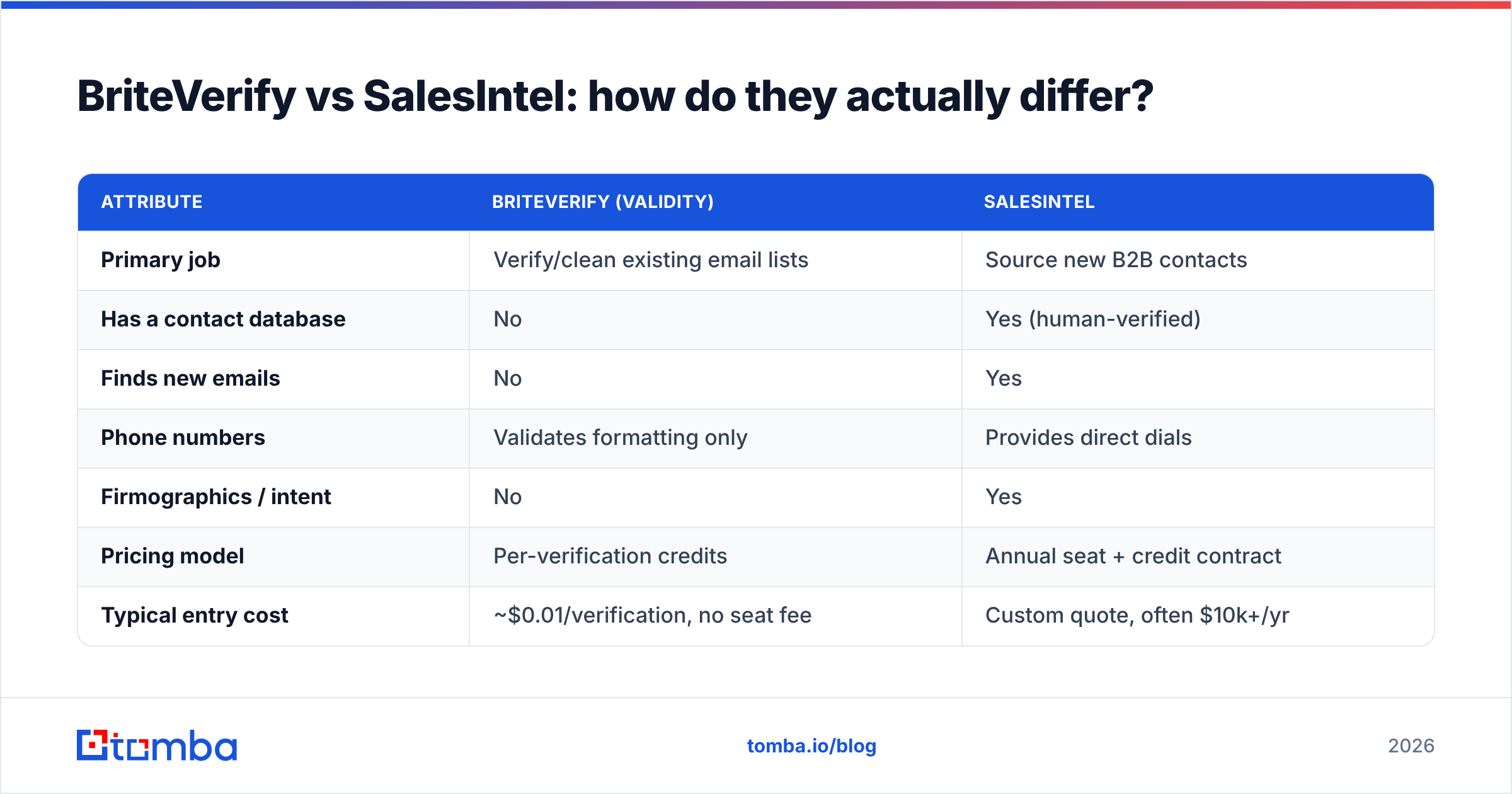
| Primary job | Verify/clean existing email lists | Source new B2B contacts |
| Has a contact database | No | Yes (human-verified) |
| Finds new emails | No | Yes |
| Phone numbers | Validates formatting only | Provides direct dials |
| Firmographics / intent | No | Yes |
| Pricing model | Per-verification credits | Annual seat + credit contract |
| Typical entry cost | ~$0.01/verification, no seat fee | Custom quote, often $10k+/yr |
| Best for | Email/marketing ops, deliverability | SDR/AE prospecting, demand gen |
| API | Yes (real-time verify) | Yes (data enrichment) |
The pattern is clear: BriteVerify is a deliverability tool, SalesIntel is a data acquisition tool. If your problem is "my emails bounce," you want the first. If your problem is "I have no one to email," you want the second.
Which problem are you actually solving?#
Before you compare features, name your gap. These are the four most common scenarios and the honest recommendation for each.
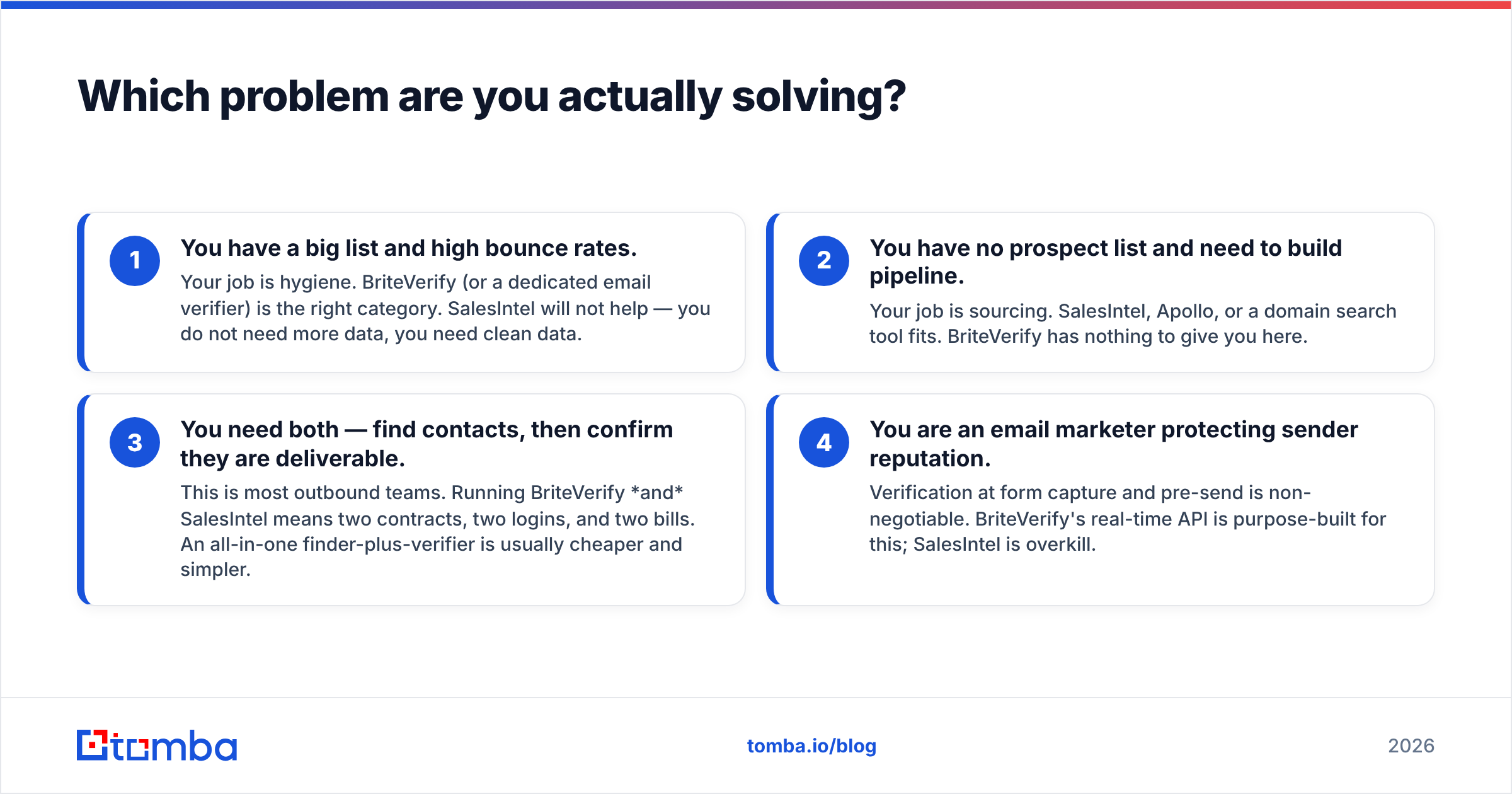
- You have a big list and high bounce rates. Your job is hygiene. BriteVerify (or a dedicated email verifier) is the right category. SalesIntel will not help — you do not need more data, you need clean data.
- You have no prospect list and need to build pipeline. Your job is sourcing. SalesIntel, Apollo, or a domain search tool fits. BriteVerify has nothing to give you here.
- You need both — find contacts, then confirm they are deliverable. This is most outbound teams. Running BriteVerify and SalesIntel means two contracts, two logins, and two bills. An all-in-one finder-plus-verifier is usually cheaper and simpler.
- You are an email marketer protecting sender reputation. Verification at form capture and pre-send is non-negotiable. BriteVerify's real-time API is purpose-built for this; SalesIntel is overkill.
Most teams that "compare BriteVerify vs SalesIntel" discover they were comparing a wrench to a screwdriver. The real question is which task is blocking revenue right now.
How accurate is each tool?#
Accuracy means different things for each product, so a single number is misleading.
For BriteVerify, accuracy is about verification correctness — when it says an address is valid, does it actually deliver? BriteVerify performs well on syntax, domain, and mailbox-level checks. Its known limitation, shared by every verifier, is catch-all domains: servers that accept any address at the SMTP layer return "accept-all," and no tool can fully confirm those without sending. A good catch-all verifier narrows the guess, but treat any "accept-all" result cautiously.
For SalesIntel, accuracy is about data freshness — when it gives you a direct dial, is the person still in that seat with that number? SalesIntel's human-verification cycle is its differentiator here, and it generally beats fully automated databases on direct-dial accuracy. The trade-off is coverage: human verification scales slower than scraping, so the database is deeper in some verticals than others.
The takeaway: BriteVerify accuracy protects your sender reputation; SalesIntel accuracy protects your rep's time. Both matter, but they are not the same metric, and a vendor scoring high on one tells you nothing about the other.
How does pricing compare?#
This is where the two diverge most, and where budget owners get surprised.
| Plan dimension | BriteVerify | SalesIntel | Tomba |
|---|---|---|---|
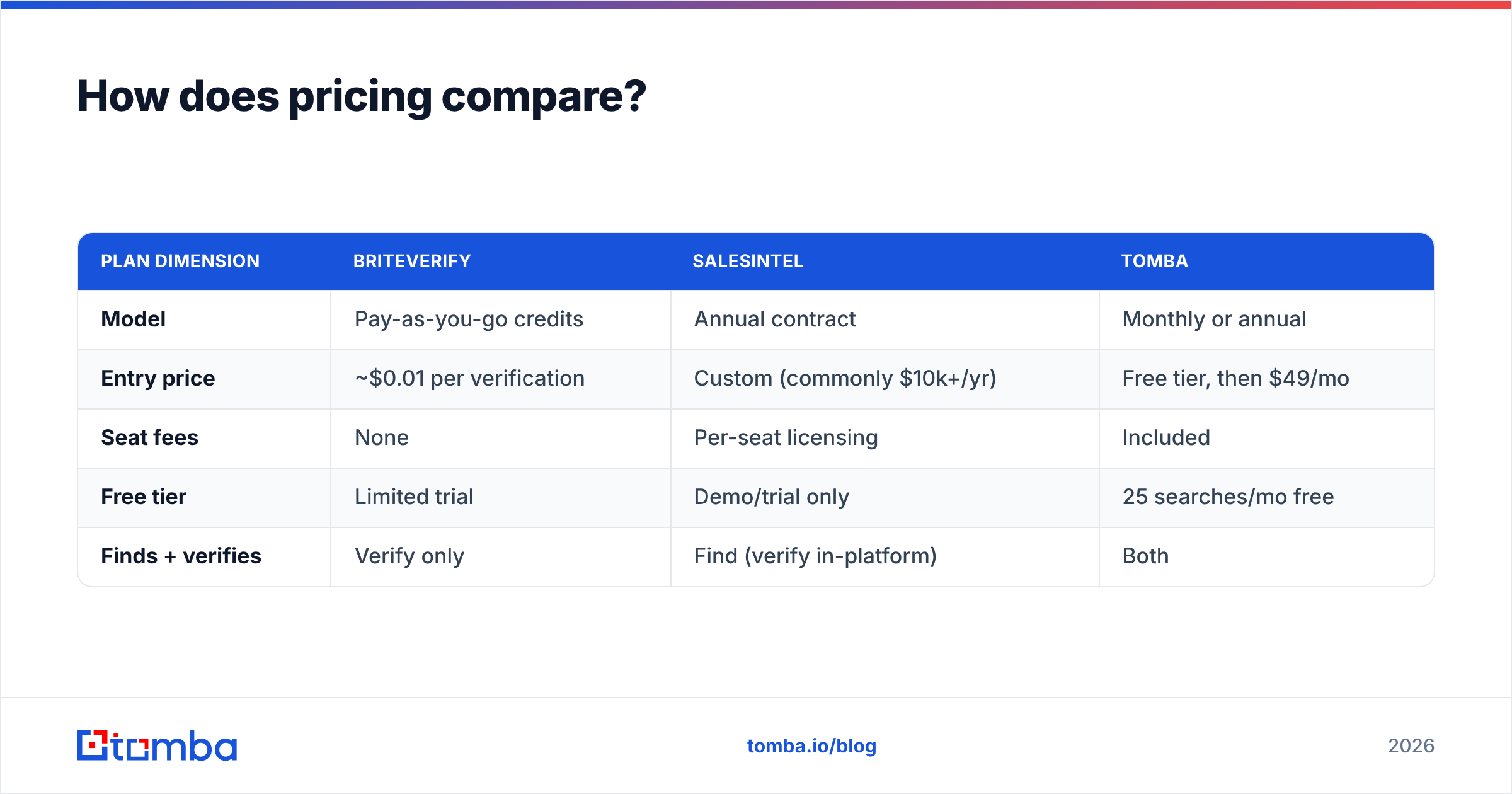
| Model | Pay-as-you-go credits | Annual contract | Monthly or annual |
| Entry price | ~$0.01 per verification | Custom (commonly $10k+/yr) | Free tier, then $49/mo |
| Seat fees | None | Per-seat licensing | Included |
| Free tier | Limited trial | Demo/trial only | 25 searches/mo free |
| Finds + verifies | Verify only | Find (verify in-platform) | Both |
BriteVerify's per-verification model is friendly for occasional list cleans but adds up at scale. SalesIntel's annual contracts deliver strong value if sourcing is your bottleneck and you will use the seats — but the commitment is real, and month-to-month flexibility is limited.
If you want predictable monthly pricing that covers both finding and verifying, compare the Tomba pricing tiers: Free (25 searches), Starter $49/mo, Growth $99/mo, Pro $249/mo. You are not signing a five-figure annual contract to start.

Can one tool do both jobs?#
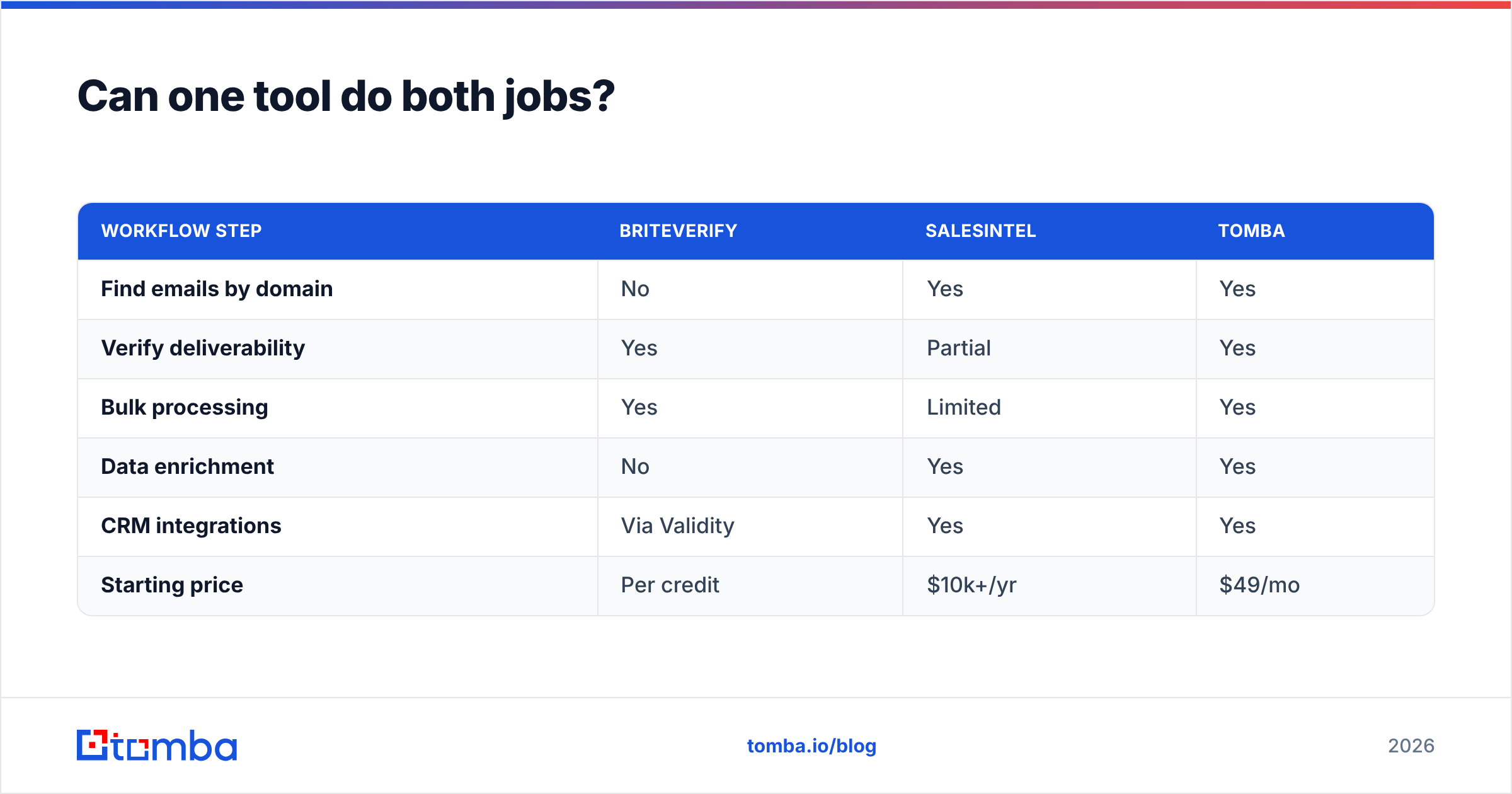
Yes — and that is the gap both BriteVerify and SalesIntel leave open. BriteVerify cleans but cannot source. SalesIntel sources but is not a bulk hygiene engine. Teams end up stitching them together, which means duplicate spend and data syncing headaches.
A unified platform handles the full motion in one place: search a company domain, pull verified professional emails, confirm deliverability, and push to your CRM. Tomba is built around exactly this loop. Its email finder locates addresses by name and domain, the built-in verifier scores deliverability before you export, and the bulk email finder handles list-scale jobs. For developers, the Tomba API exposes find and verify as a single integration instead of two.
Here is how the three stack up on the combined workflow:
| Workflow step | BriteVerify | SalesIntel | Tomba |
|---|---|---|---|
| Find emails by domain | No | Yes | Yes |
| Verify deliverability | Yes | Partial | Yes |
| Bulk processing | Yes | Limited | Yes |
| Data enrichment | No | Yes | Yes |
| CRM integrations | Via Validity | Yes | Yes |
| Starting price | Per credit | $10k+/yr | $49/mo |
This is not to say Tomba beats SalesIntel on database depth in every vertical — SalesIntel's human-verified direct dials are a genuine strength for heavy phone outbound. But for the common case of "find work emails and make sure they land," a single tool removes the seam.
Which should you choose?#
Decide by your bottleneck, not by feature lists.
- Choose BriteVerify if you are an email or marketing ops team whose only job is keeping an existing list clean and protecting email deliverability. You do not need to source new contacts.
- Choose SalesIntel if your bottleneck is finding the right people, you do heavy phone outbound, and you have budget for an annual data contract with human-verified direct dials.
- Choose an all-in-one (Tomba) if you need to both find and verify, want to start cheap, and would rather manage one tool than two. This covers most outbound and growth teams.
Check independent reviews on G2 before committing to any annual contract — pay attention to coverage complaints in your industry, since data depth is uneven across providers.
Frequently asked questions#
Is BriteVerify a competitor to SalesIntel? Not directly. BriteVerify verifies emails you already have; SalesIntel finds new contacts. They overlap only at the edges, which is why teams sometimes use both.
Does SalesIntel verify emails? It verifies records within its own platform as part of its human-verification process, but it is not designed as a standalone bulk verification engine the way BriteVerify is.
What is the cheapest way to get both finding and verifying? A combined platform. Tomba's Free tier gives you 25 searches a month, and the Starter plan is $49/mo with both the email finder and verifier included — far less than running two specialized contracts.
Can I just use free tools? For light, occasional work, free utilities like a free email checker help. But at any real volume you will want API access and bulk processing, which the paid tiers cover.
The bottom line#
BriteVerify vs SalesIntel is really a question about which half of the data problem you face. BriteVerify keeps your existing emails deliverable; SalesIntel fills your pipeline with new contacts. Neither does the other's job well, and buying both is expensive.
If your team needs to find verified business emails and confirm they land — without two vendors, two bills, and a sync problem — start with the Tomba Email Finder. Spin up the free tier, run a domain search, and verify the results in the same dashboard before you ever export a list. It is the simplest way to cover both jobs at once, and you can scale into Tomba's plans only when your volume actually demands it.
// get started
Find, verify and enrich your first contacts today
Start on the free plan with 25 searches a month, then scale when your team is ready.
Free plan · No credit card required · GDPR & CCPA
// about the author