Broadvoice Pricing 2026: Reviews, Pros, and Cons Guide
Thinking about Broadvoice for your business phone system? Here's an honest 2026 breakdown of plans, real costs, the pros, the cons, and who should pick an alternative.
TL;DR
- Broadvoice is a US cloud communications provider (UCaaS, contact center, and SIP trunking) aimed at small and mid-sized teams that want a phone system plus messaging in one place.
- As of 2026, b-hive plans generally land between roughly $10 and $25 per user per month, with contact center and SIP priced separately by quote. Always confirm the live number — published pricing shifts and most deals are negotiated.
- Pros: unlimited calling in North America, strong uptime track record, included team chat/video, and human support reviewers rate highly.
- Cons: thin public pricing, annual-contract pressure, occasional onboarding friction, and feature gaps versus heavyweights like RingCentral or 8x8.
- A phone system only matters if you can actually reach the right people — pair it with accurate contact data so your reps dial decision-makers, not dead numbers.
What is Broadvoice?#
Broadvoice is a cloud communications company that sells business phone service, a contact center platform, and SIP trunking. Think of it as the dial tone for a modern company: instead of a phone closet full of hardware, your calls, texts, voicemail, video meetings, and team chat run over the internet through one provider.
Its flagship product line is called b-hive — a unified communications (UCaaS) suite that bundles voice, messaging, and video. On top of that, Broadvoice offers a contact center (CCaaS) product for support and sales teams that handle high call volume, plus raw SIP trunking for businesses that already own phone hardware and just need carrier service.
The target customer is clear: small to mid-sized businesses (SMBs) that want enterprise-style features without enterprise complexity. If you're a 10–200 person company replacing an aging PBX or cobbled-together VoIP, Broadvoice is squarely in your consideration set alongside names like Nextiva, Dialpad, and 8x8.
How much does Broadvoice cost in 2026?#
Here's the honest answer first: Broadvoice does not publish a clean, fully transparent price list the way some competitors do, and the exact number you pay depends on seat count, contract length, and what you negotiate. That alone is the single most common complaint in Broadvoice pricing reviews — buyers want a sticker price and instead get a "talk to sales" funnel.
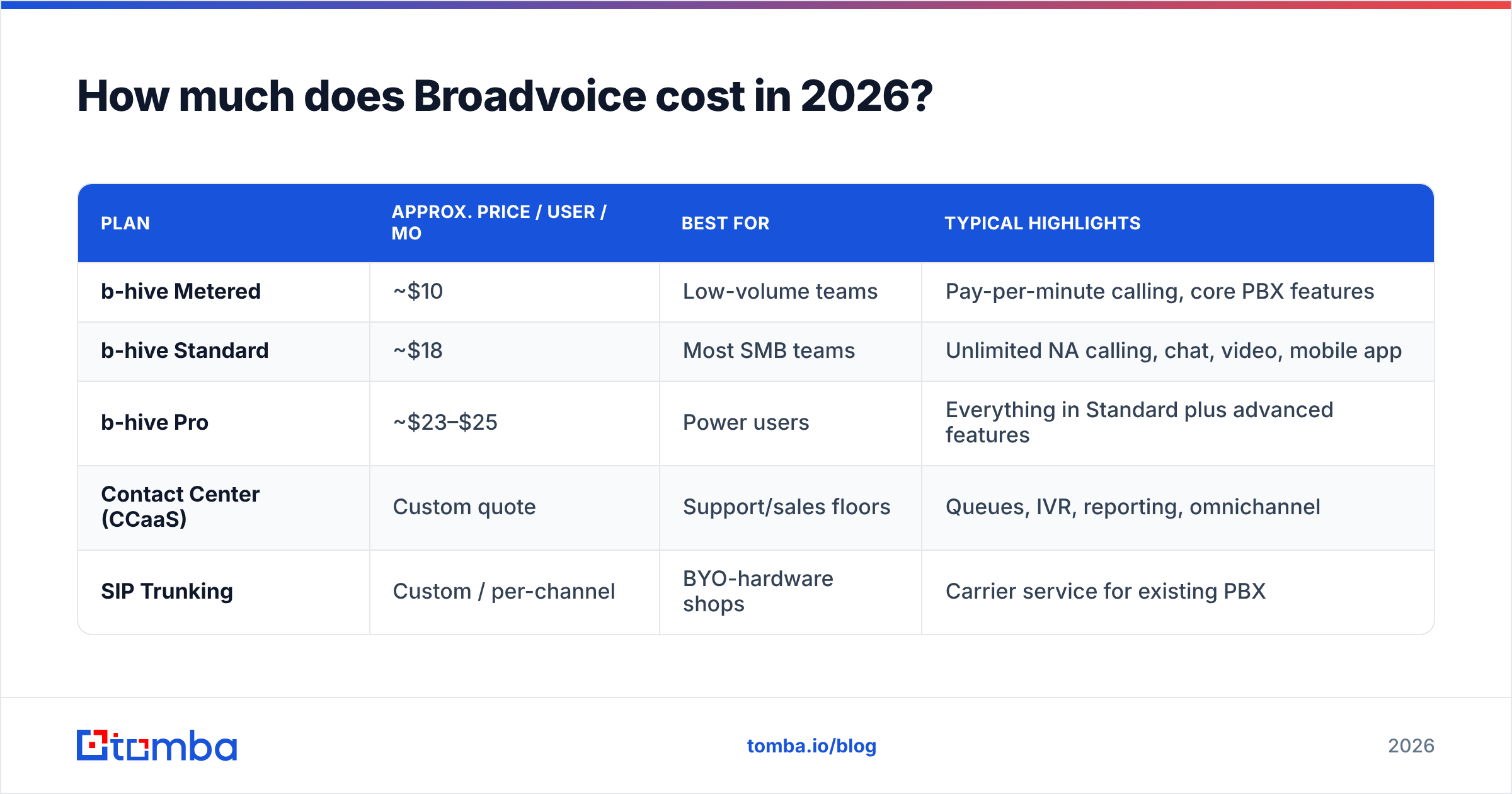
That said, based on public information and reviewer reports, b-hive seat pricing in 2026 generally falls into the ranges below. Treat these as planning estimates, not quotes.
| Plan | Approx. price / user / mo | Best for | Typical highlights |
|---|---|---|---|
| b-hive Metered | ~$10 | Low-volume teams | Pay-per-minute calling, core PBX features |
| b-hive Standard | ~$18 | Most SMB teams | Unlimited NA calling, chat, video, mobile app |
| b-hive Pro | ~$23–$25 | Power users | Everything in Standard plus advanced features |
| Contact Center (CCaaS) | Custom quote | Support/sales floors | Queues, IVR, reporting, omnichannel |
| SIP Trunking | Custom / per-channel | BYO-hardware shops | Carrier service for existing PBX |
A few things to budget for beyond the seat price:
- Contract length. Lower per-seat rates usually assume an annual or multi-year commitment. Month-to-month, if offered, costs more.
- Add-ons. Extra phone numbers, toll-free, international calling, and additional integrations can carry separate line items.
- Hardware. Desk phones are an optional purchase or rental — many teams skip them and use the softphone app.
- Onboarding/porting. Number porting is usually free, but complex migrations sometimes involve professional-services fees.
For comparison, mainstream UCaaS competitors publish entry tiers in a similar band — RingCentral, 8x8, and Nextiva all advertise starting seats in the ~$15–$30 range depending on promotions — so Broadvoice is price-competitive when you actually get the quote. You can sanity-check current market rates on a review aggregator like G2 before you negotiate.
What do Broadvoice reviews say? (Pros and cons)#
Across review platforms, Broadvoice lands in the "solid, well-liked, not flawless" zone — generally favorable ratings with a consistent set of praises and gripes. Here's the structured breakdown.
Pros reviewers consistently mention:
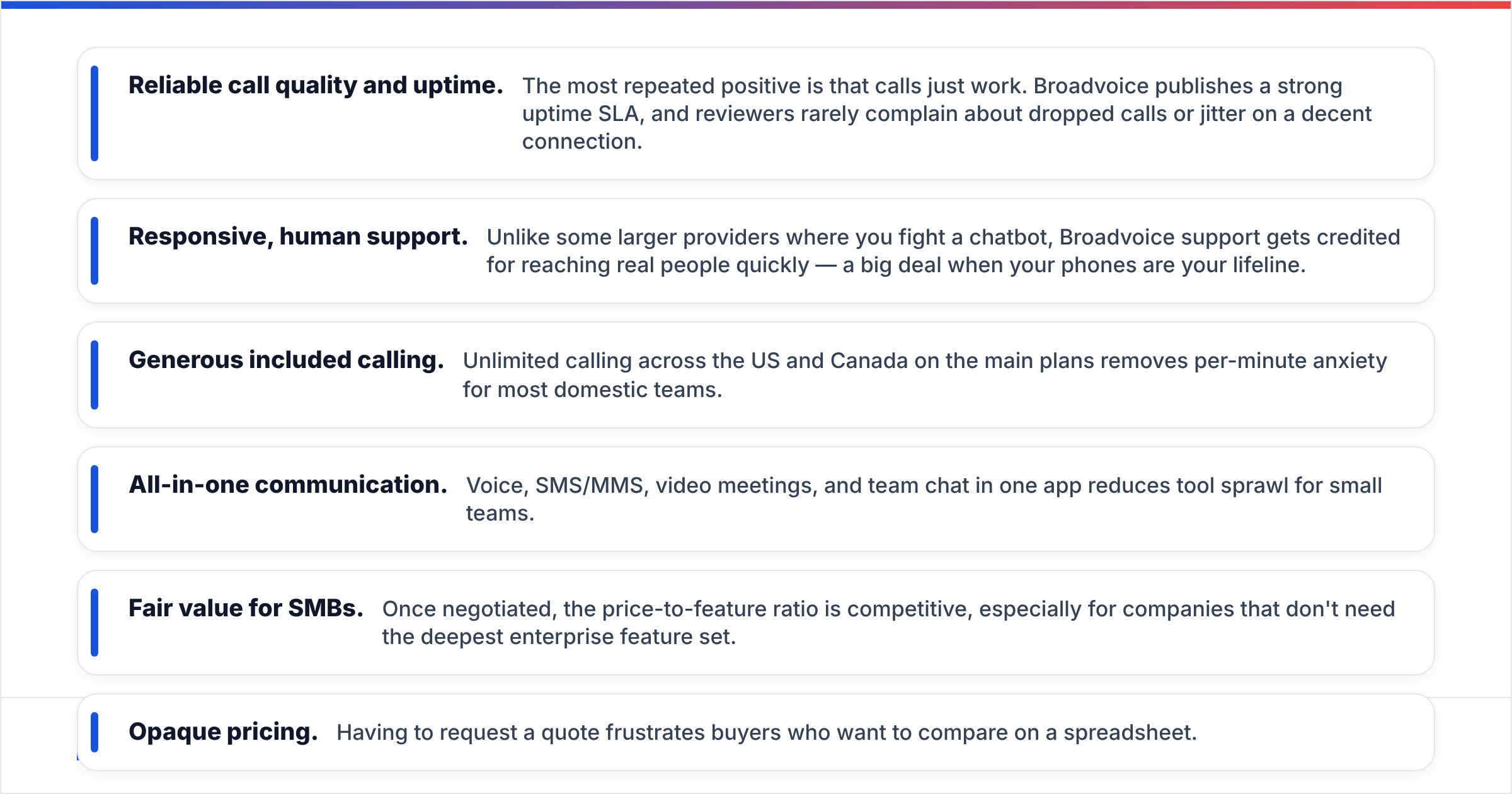
- Reliable call quality and uptime. The most repeated positive is that calls just work. Broadvoice publishes a strong uptime SLA, and reviewers rarely complain about dropped calls or jitter on a decent connection.
- Responsive, human support. Unlike some larger providers where you fight a chatbot, Broadvoice support gets credited for reaching real people quickly — a big deal when your phones are your lifeline.
- Generous included calling. Unlimited calling across the US and Canada on the main plans removes per-minute anxiety for most domestic teams.
- All-in-one communication. Voice, SMS/MMS, video meetings, and team chat in one app reduces tool sprawl for small teams.
- Fair value for SMBs. Once negotiated, the price-to-feature ratio is competitive, especially for companies that don't need the deepest enterprise feature set.
Cons reviewers consistently mention:
- Opaque pricing. Having to request a quote frustrates buyers who want to compare on a spreadsheet.
- Contract and renewal friction. Some reviews flag annual commitments and renewal terms that aren't obvious up front. Read the contract.
- Onboarding can be bumpy. While many setups go smoothly, a minority of reviews describe porting delays or configuration hiccups during migration.
- Feature depth vs. giants. For advanced analytics, deep CRM-native workflows, or sprawling international footprints, RingCentral, 8x8, and Dialpad sometimes pull ahead.
- Admin learning curve. The admin portal is capable but not the most intuitive for non-technical owners.
The pattern is typical for a mid-market UCaaS provider: great for the SMB sweet spot, less ideal if you need the absolute deepest feature catalog or rigid procurement transparency. Cross-reference current sentiment on Capterra and the vendor's own broadvoice.com site so you're comparing today's offering, not a two-year-old review.
Is Broadvoice better than RingCentral, Nextiva, or 8x8?#
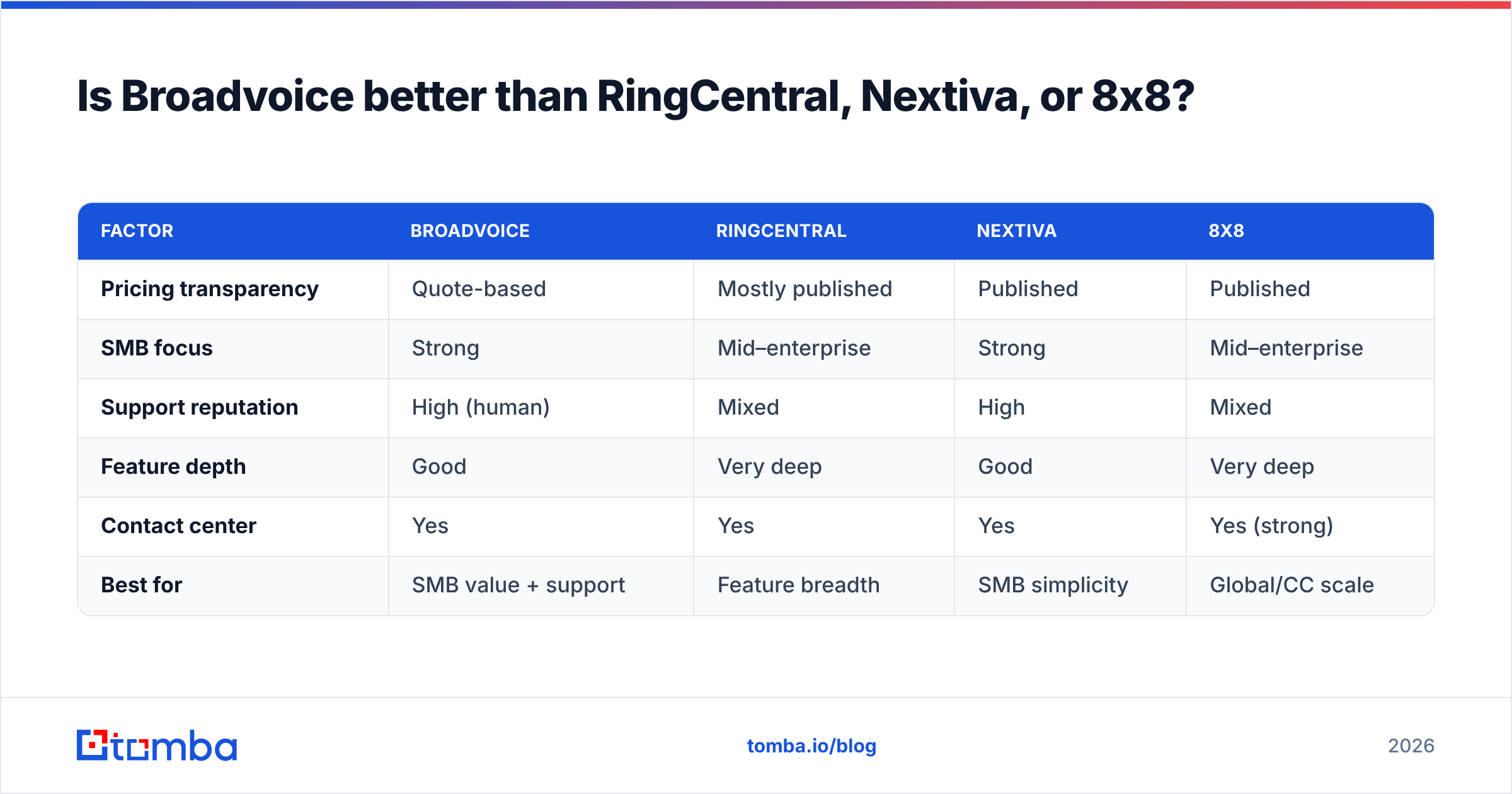
It depends on what you're optimizing for. Here's a quick head-to-head on the dimensions buyers care about most.
| Factor | Broadvoice | RingCentral | Nextiva | 8x8 |
|---|---|---|---|---|
| Pricing transparency | Quote-based | Mostly published | Published | Published |
| SMB focus | Strong | Mid–enterprise | Strong | Mid–enterprise |
| Support reputation | High (human) | Mixed | High | Mixed |
| Feature depth | Good | Very deep | Good | Very deep |
| Contact center | Yes | Yes | Yes | Yes (strong) |
| Best for | SMB value + support | Feature breadth | SMB simplicity | Global/CC scale |
Choose Broadvoice if you're an SMB that values responsive human support and a clean all-in-one app, and you don't mind a sales conversation to get pricing.
Choose a competitor if you need published pricing for procurement, the deepest analytics and integrations, or a heavy international/contact-center footprint where the larger platforms have more depth.
The reality most teams discover: the phone platform is rarely the bottleneck. The bottleneck is whether your reps are calling the right people. A perfect dialer pointed at a stale, unverified list still produces a bad quarter.

Does the phone system actually drive pipeline?#
Short answer: only if the data behind it is good. A UCaaS platform like Broadvoice is the delivery mechanism — it's the truck, not the cargo. What fills the pipeline is accurate, current contact information for the humans you're trying to reach.
This is where a lot of "our phone system isn't working" complaints are really data problems in disguise:
- Wrong numbers waste seats. If 20% of your dial list is disconnected or mismatched, you're paying for talk time that never connects. No phone platform fixes a bad list.
- No direct lines means gatekeepers. Reaching a company's main line is easy; reaching the actual decision-maker is the hard part. You need direct dials and verified mobile numbers.
- Stale CRM data decays fast. B2B contact data goes stale at roughly 2–3% per month as people change jobs. A list that was clean last year isn't clean now.
That's the gap a data layer closes. Before your reps ever pick up a Broadvoice handset, the contacts they're calling should be enriched and verified. Tools like a phone finder surface direct B2B numbers, a phone validator confirms a line is live before you dial, and data enrichment fills in the job title, company, and email so reps walk into the call with context.
In other words: budget for the phone system and the data that feeds it. The cost of a few enriched records is trivial against the cost of a rep burning a day on dead numbers.
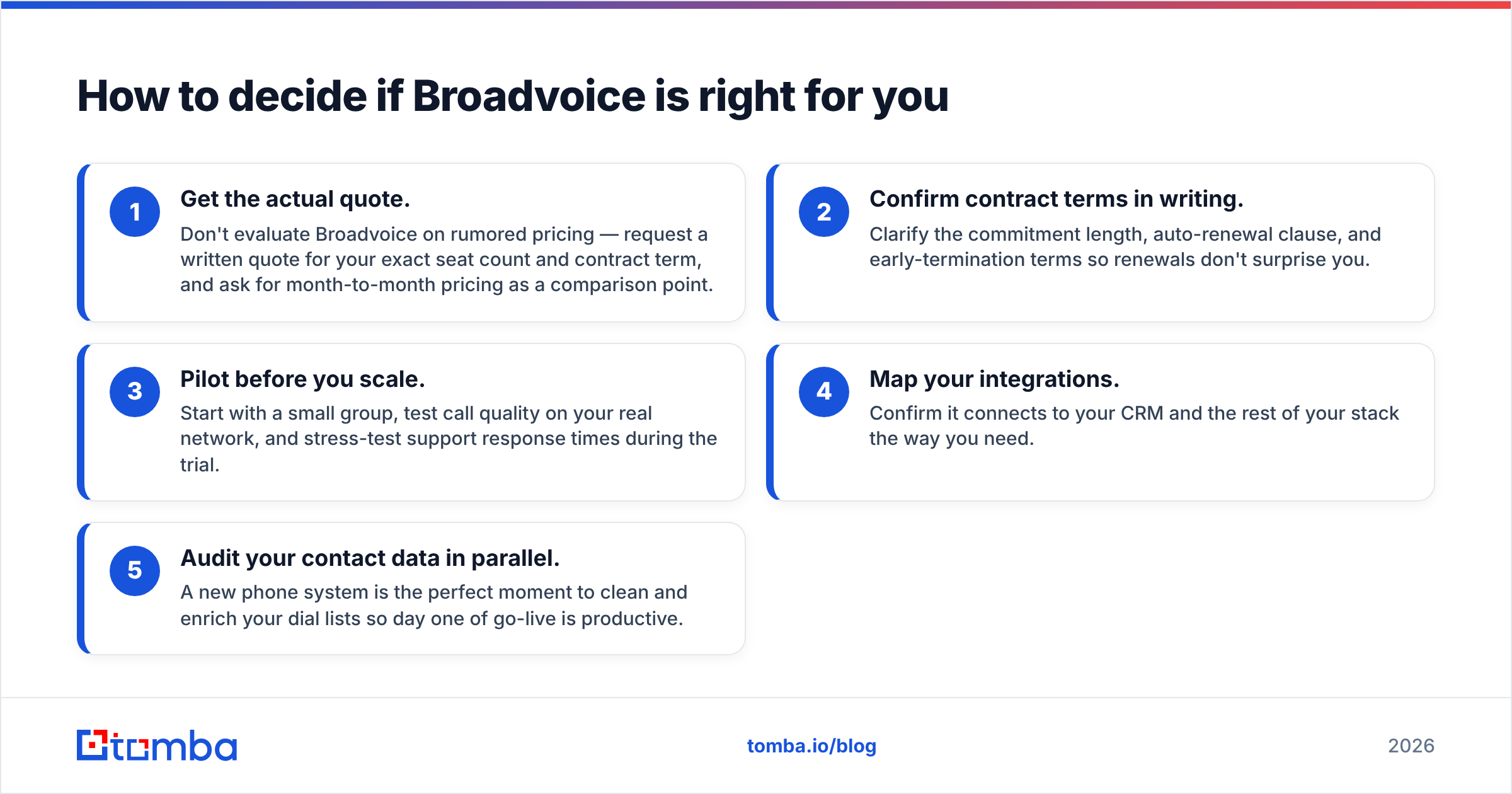
How to decide if Broadvoice is right for you#
Run this quick checklist before you sign anything:
- Get the actual quote. Don't evaluate Broadvoice on rumored pricing — request a written quote for your exact seat count and contract term, and ask for month-to-month pricing as a comparison point.
- Confirm contract terms in writing. Clarify the commitment length, auto-renewal clause, and early-termination terms so renewals don't surprise you.
- Pilot before you scale. Start with a small group, test call quality on your real network, and stress-test support response times during the trial.
- Map your integrations. Confirm it connects to your CRM and the rest of your stack the way you need.
- Audit your contact data in parallel. A new phone system is the perfect moment to clean and enrich your dial lists so day one of go-live is productive.
If you're an SMB that wants reliable calling, real support, and an all-in-one app at a fair negotiated price, Broadvoice deserves a spot on your shortlist. If procurement demands published pricing or you need enterprise-grade depth, weigh RingCentral, 8x8, or Nextiva alongside it.
Frequently asked questions#
Is Broadvoice expensive? Not unusually. Negotiated b-hive seats typically fall in the ~$10–$25/user/month range, which is competitive with mainstream UCaaS providers. The friction is transparency, not price.
Does Broadvoice require a contract? Most cost-effective plans assume an annual or multi-year commitment. Ask specifically about month-to-month options and renewal terms before signing.
Is Broadvoice good for sales teams? Yes for calling reliability and its contact-center add-on — but pair it with accurate contact data, or your reps will dial numbers that don't connect.
What are the best Broadvoice alternatives? RingCentral, 8x8, Nextiva, and Dialpad are the most common comparisons, each stronger on different axes (feature depth, transparency, or contact-center scale).
Make every dial count#
A great phone system is wasted on a bad list. Before you commit to Broadvoice — or any UCaaS provider — make sure the contacts your reps call are real, current, and reachable. Use the Tomba Email Finder to find verified professional email addresses by name or domain, then layer on the phone finder for direct B2B numbers and data enrichment to give every rep full context before the call connects. Start free with 25 searches a month, and check Tomba pricing when you're ready to scale — so the moment your new phones go live, they're pointed at the right people.
// get started
Find, verify and enrich your first contacts today
Start on the free plan with 25 searches a month, then scale when your team is ready.
Free plan · No credit card required · GDPR & CCPA
// about the author