Broadvoice vs Ooma 2026: Which Business Phone System Wins?
Broadvoice and Ooma both promise cheap, reliable VoIP for growing teams — but they win on very different things. Here's the honest 2026 breakdown on pricing, features, call quality, and which one your sales floor should actually buy.
Broadvoice vs Ooma: The 2026 Business Phone Showdown
Choosing a business phone system used to mean comparing handsets. In 2026 it means comparing platforms — call quality, contact-center features, integrations, and how much the bill creeps once your team grows. Broadvoice and Ooma both sell cloud VoIP to small and mid-sized businesses, and on the surface they look interchangeable. They aren't.
This is a neutral, side-by-side breakdown so you can pick the right one without sitting through three sales demos.
TL;DR — Broadvoice vs Ooma at a glance#
- Ooma Office wins on simplicity and price for very small teams: flat per-user pricing starting around $20/user/mo, near-zero setup, and a free mobile app. Great for offices that just need reliable phones.
- Broadvoice wins on scalability and contact-center muscle: unlimited-feature seats, deeper UCaaS/CCaaS tooling, and better fit for sales teams that live on the phone all day.
- Call quality is comparable when your network is solid; Broadvoice publishes stronger SLAs, Ooma leans on simplicity.
- Pick Ooma if you're under ~20 users and want plug-and-play. Pick Broadvoice if you run outbound sales, support queues, or expect to scale past 50 seats.
- A phone system only pays off if you're dialing the right numbers — clean contact data matters more than which dial tone you buy.
What are Broadvoice and Ooma?#
Both are cloud-based VoIP (Voice over IP) providers that replace traditional landlines and on-prem PBX hardware with software-driven calling over the internet.
Ooma built its reputation on dead-simple deployment. Ooma Office targets small businesses and home offices, while Ooma Enterprise extends into UCaaS for larger orgs. The pitch is "plug it in and it works" — minimal IT involvement, predictable flat pricing.
Broadvoice positions itself as a unified communications (UCaaS) and contact-center (CCaaS) platform for growing SMBs and mid-market teams. Its b-hive product bundles voice, video, messaging, and call-center features into per-seat plans with a heavier feature set out of the box.
Here's the simplest analogy: Ooma is the reliable compact car — affordable, easy to drive, gets you there. Broadvoice is the cargo van — more to configure, but it hauls a full sales-and-support operation without breaking a sweat.

How do Broadvoice and Ooma compare on pricing and features?#
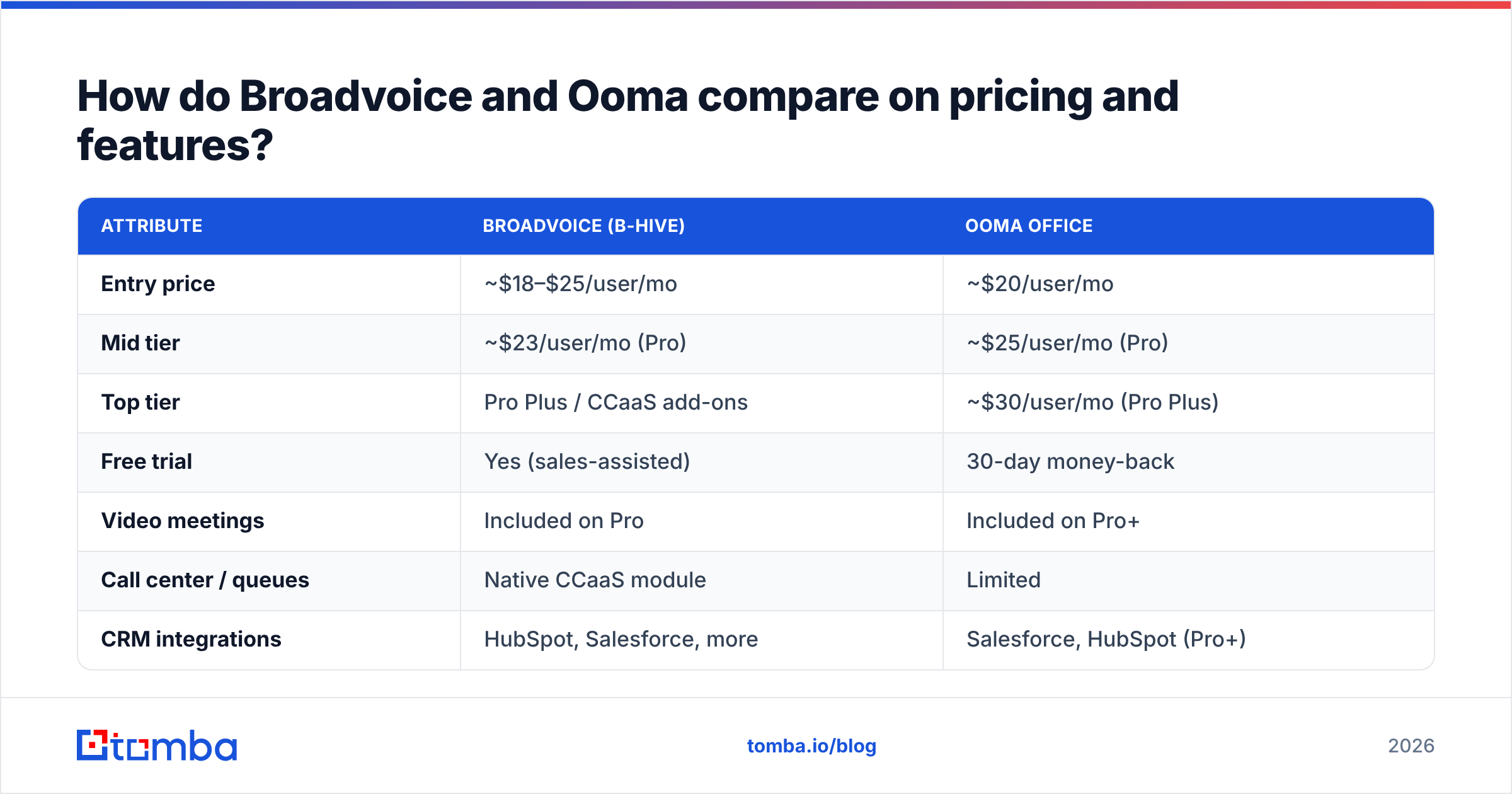
Pricing is where the two diverge most clearly. Ooma keeps tiers narrow and cheap; Broadvoice charges more per seat but front-loads features that Ooma reserves for upper tiers or add-ons.
| Attribute | Broadvoice (b-hive) | Ooma Office |
|---|---|---|
| Entry price | ~$18–$25/user/mo | ~$20/user/mo |
| Mid tier | ~$23/user/mo (Pro) | ~$25/user/mo (Pro) |
| Top tier | Pro Plus / CCaaS add-ons | ~$30/user/mo (Pro Plus) |
| Free trial | Yes (sales-assisted) | 30-day money-back |
| Video meetings | Included on Pro | Included on Pro+ |
| Call center / queues | Native CCaaS module | Limited |
| CRM integrations | HubSpot, Salesforce, more | Salesforce, HubSpot (Pro+) |
| Best for | 20–500+ seat sales/support | 1–20 seat offices |
A few things stand out. Ooma's headline price looks lower, but the features sales teams need — call recording, advanced analytics, CRM sync — sit in its top tier or as paid add-ons. Broadvoice bundles more at the mid tier, so the effective per-seat cost for a feature-hungry team often lands close to or below Ooma once you match capabilities.
If you're evaluating total cost, build a feature checklist first, then price each vendor against that exact list. Comparing advertised entry prices alone is how teams end up over-buying add-ons three months in.
Which has better call quality and reliability?#
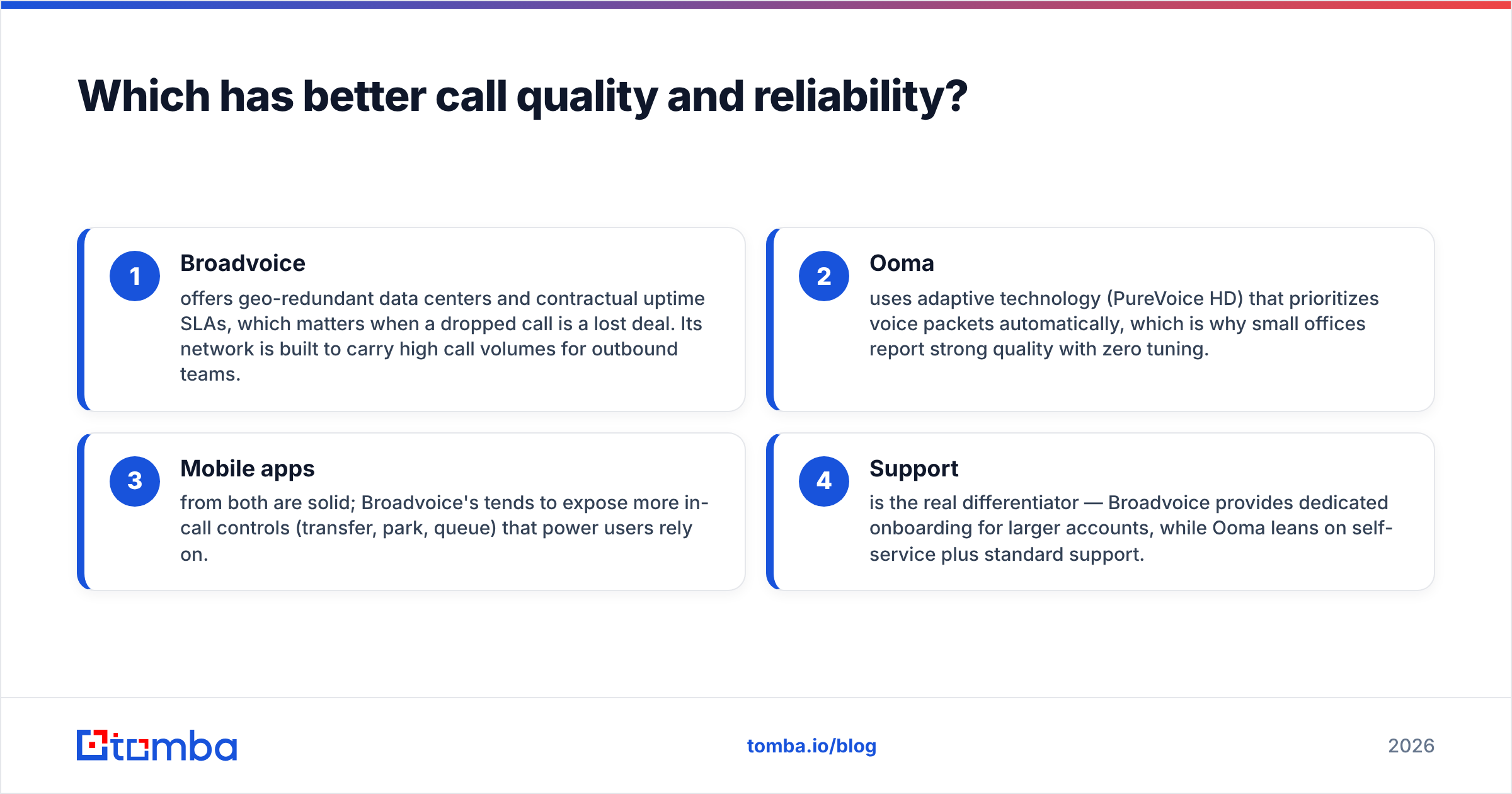
Conclusion first: both deliver clean HD voice when your network is healthy — Broadvoice publishes stronger uptime SLAs, while Ooma's edge is requiring almost no configuration to get there.
Call quality on any VoIP platform is mostly a function of three things you control: bandwidth, jitter, and QoS (Quality of Service) settings on your router. Neither vendor can fix a saturated office connection.
That said:
- Broadvoice offers geo-redundant data centers and contractual uptime SLAs, which matters when a dropped call is a lost deal. Its network is built to carry high call volumes for outbound teams.
- Ooma uses adaptive technology (PureVoice HD) that prioritizes voice packets automatically, which is why small offices report strong quality with zero tuning.
- Mobile apps from both are solid; Broadvoice's tends to expose more in-call controls (transfer, park, queue) that power users rely on.
- Support is the real differentiator — Broadvoice provides dedicated onboarding for larger accounts, while Ooma leans on self-service plus standard support.
Check third-party reviews on G2 before committing — patterns in recent reviews tell you more about real-world reliability than any vendor uptime page.
Is Broadvoice better than Ooma for sales teams?#
For a dedicated outbound or inbound sales floor, Broadvoice is usually the stronger fit. Its native call-center features — queues, IVR, live monitoring, whisper/barge, and analytics — are built for teams that treat the phone as the primary revenue channel.
Ooma can absolutely run a small sales team, especially one that mixes calling with other channels. But once you need supervisor dashboards, skills-based routing, and granular call analytics, you're pushing Ooma Office past its design intent and toward Ooma Enterprise (a different, more involved product).
The hard truth most phone-system comparisons skip: the dialer is only half the equation. A best-in-class contact center calling stale or wrong numbers will underperform a basic system calling verified, well-researched prospects. Connect rates collapse when your list is full of disconnected lines and gatekeeper numbers.
That's why high-performing teams pair their VoIP platform with a reliable data layer. Before a rep ever dials, you want a verified direct line and the context to personalize the opener. Tools like a phone finder surface accurate B2B phone numbers, and a phone validator screens out dead lines so your dialer isn't burning hours on numbers that ring nowhere. If you're working from a company name, a quick find company phone lookup gets you started without manual research.
What do Broadvoice and Ooma each do best?#
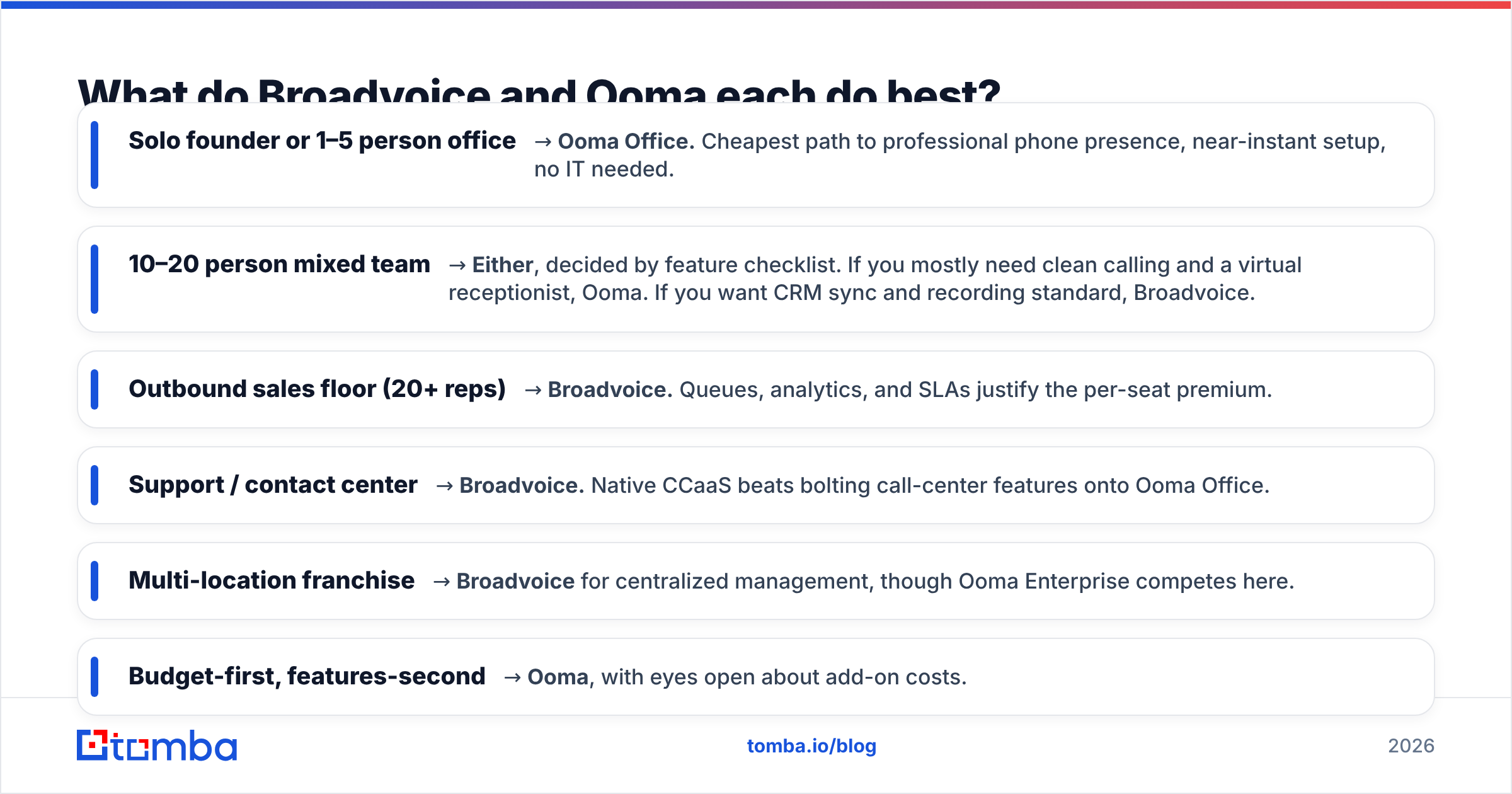
Rather than crown one universal winner, match the tool to the job. Here's how they sort out by scenario:
- Solo founder or 1–5 person office → Ooma Office. Cheapest path to professional phone presence, near-instant setup, no IT needed.
- 10–20 person mixed team → Either, decided by feature checklist. If you mostly need clean calling and a virtual receptionist, Ooma. If you want CRM sync and recording standard, Broadvoice.
- Outbound sales floor (20+ reps) → Broadvoice. Queues, analytics, and SLAs justify the per-seat premium.
- Support / contact center → Broadvoice. Native CCaaS beats bolting call-center features onto Ooma Office.
- Multi-location franchise → Broadvoice for centralized management, though Ooma Enterprise competes here.
- Budget-first, features-second → Ooma, with eyes open about add-on costs.
How do the integrations and admin experience compare?#
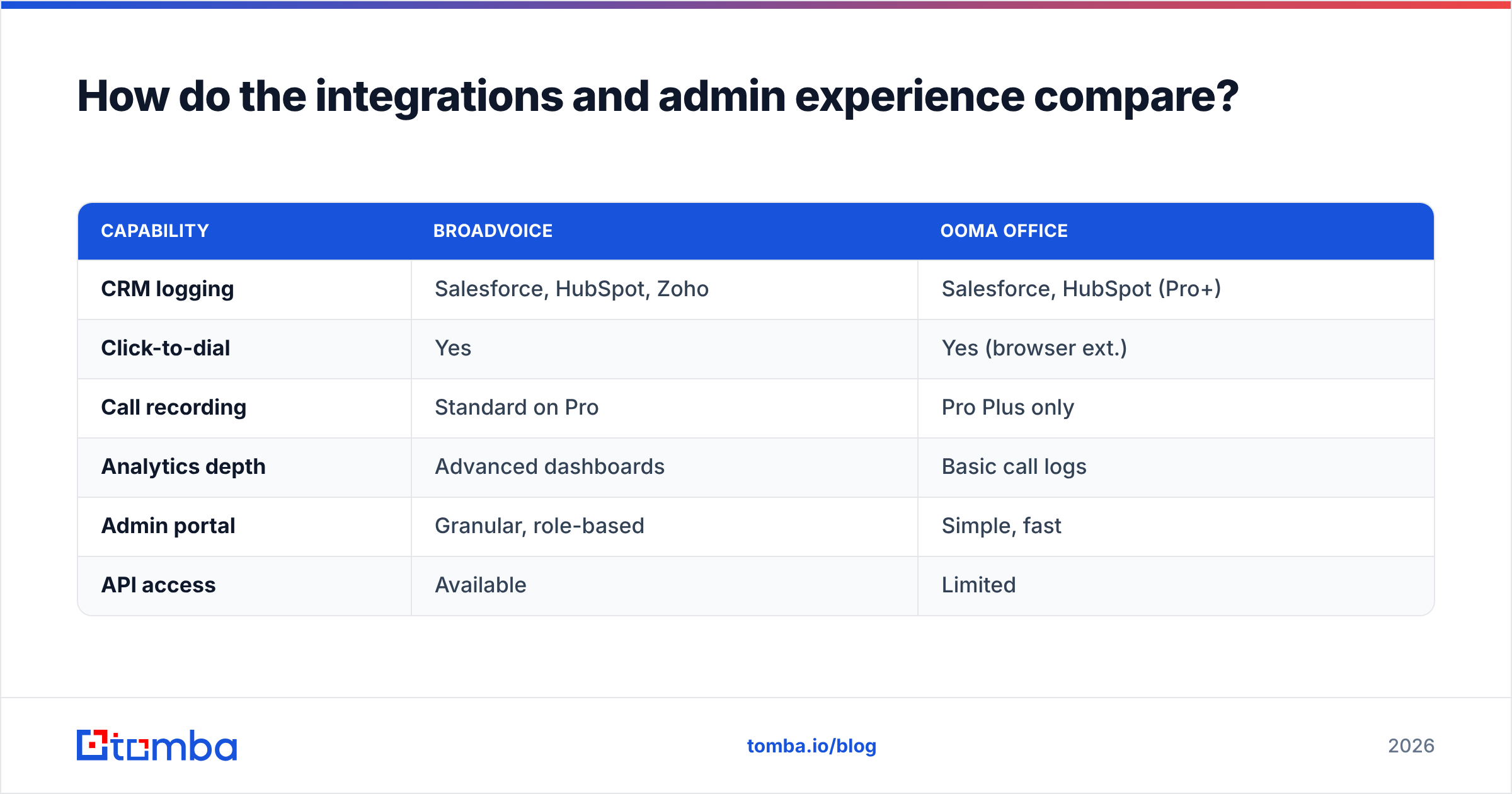
Integrations decide how much your phone system actually shows up in daily workflows. A call that doesn't log to your CRM is a call that didn't happen, as far as your pipeline reporting is concerned.
| Capability | Broadvoice | Ooma Office |
|---|---|---|
| CRM logging | Salesforce, HubSpot, Zoho | Salesforce, HubSpot (Pro+) |
| Click-to-dial | Yes | Yes (browser ext.) |
| Call recording | Standard on Pro | Pro Plus only |
| Analytics depth | Advanced dashboards | Basic call logs |
| Admin portal | Granular, role-based | Simple, fast |
| API access | Available | Limited |
Ooma's admin portal is genuinely easier — non-technical office managers can add users and set up routing in minutes. Broadvoice's portal is more powerful but has a steeper learning curve, which is the usual trade-off between simplicity and control.
Whichever you choose, your CRM is the system of record. If calls and contacts aren't flowing in clean, you'll spend more time fixing data than selling. Enriching every new lead with firmographic and contact detail — through something like data enrichment — keeps your dialer fed with complete records instead of half-blank rows. And remember that connect rate is downstream of data quality: a strong response rate starts with reaching a real human on the first try.
What are the downsides of each?#
No honest comparison skips the weak spots.
Broadvoice cons:
- Higher per-seat cost than Ooma's entry plan.
- More configuration and onboarding required; overkill for tiny teams.
- The breadth of features can overwhelm offices that just want phones.
Ooma cons:
- Sales- and contact-center features are thin without moving to Enterprise.
- Key capabilities (recording, advanced analytics) gated behind the top tier.
- Limited API and integration depth for teams that automate heavily.
The pattern: Broadvoice over-serves the small office, and Ooma Office under-serves the scaling sales team. Buy for where you'll be in 18 months, not just where you are today — migrating phone systems mid-growth is painful.
Broadvoice vs Ooma: which should you choose in 2026?#
Choose Ooma if you're a small business that wants reliable, affordable phones with the least possible setup and you don't need a contact center. It's the lower-risk, lower-cost default for under ~20 users.
Choose Broadvoice if you run outbound sales or support at scale, want CRM integration and analytics standard, and expect to grow past 50 seats. The per-seat premium buys you room to scale without re-platforming.
But here's the strategic takeaway that outlasts either vendor: the phone system is the pipe, not the water. Reps don't hit quota because of better hold music — they hit quota because they reach the right decision-maker with the right context. The biggest lever on your call performance isn't Broadvoice versus Ooma; it's whether your team is dialing verified, well-enriched contacts or guessing.
That's the gap Tomba closes. Before your reps ever pick up a headset, Tomba's Email Finder and its phone-finding and enrichment tools build accurate, verified B2B contact lists — direct dials, work emails, and the firmographic context that makes a cold opener land. Pair a solid VoIP platform with clean data and your connect rates climb regardless of which dial tone you bought. Start free with 25 searches a month, and see what dialing the right numbers does to your pipeline.
Bottom line: pick Ooma for simple, cheap, reliable calling; pick Broadvoice for scalable sales and support. Then feed whichever you choose with verified contact data — that's what actually moves the number.
// get started
Find, verify and enrich your first contacts today
Start on the free plan with 25 searches a month, then scale when your team is ready.
Free plan · No credit card required · GDPR & CCPA
// about the author