How to Fix a Broken Sales Funnel: 2026 Diagnostic Guide
A broken sales funnel quietly bleeds revenue at every stage. Here's how to find the leak, measure it, and fix it before next quarter.
A broken sales funnel is rarely one dramatic failure. It's a slow leak — a few percent lost at the top, a few more in the middle, and a closing rate that quietly drifts below target until someone asks why the number missed. By the time it shows up in the board deck, the damage is three quarters old.
This guide is a diagnostic, not a pep talk. You'll learn how to locate the exact stage where deals leak, how to measure the size of the hole, and which of the three usual culprits — bad data, weak messaging, or broken process — is actually to blame.
TL;DR#
- A broken sales funnel leaks at a specific stage; your first job is to find which one, not to "fix everything."
- Measure stage-to-stage conversion rates first. A funnel that loses 80% between MQL and SQL has a data or qualification problem, not a closing problem.
- The three root causes are almost always bad data, weak messaging, or broken process — and they each leave a different fingerprint.
- Bad contact data is the most common and most fixable cause: bounced emails and wrong numbers kill outreach before a rep ever gets a chance.
- Fix one stage, measure for two weeks, then move to the next. Sequential beats simultaneous every time.
What is a broken sales funnel?#
A broken sales funnel is a pipeline where prospects drop out at a rate that exceeds your benchmarks at one or more stages, in a pattern you can measure and reproduce. The word "broken" matters: every funnel loses people, because not everyone buys. A funnel is only broken when the drop-off at a stage is abnormal compared to your own history or industry norms.
Think of your funnel like a municipal water system. Clean water enters the reservoir (leads), travels through pipes (stages), and reaches homes (closed deals). You always lose a little to evaporation and normal use. But when the water bill triples and pressure drops, you don't re-dig the whole system — you find the one cracked pipe. A broken funnel is the same: there's a specific joint where the pressure drops.
Technically, your funnel is a series of conversion gates. Each gate has an input count, an output count, and a conversion rate between them. The "break" is the gate whose conversion rate is furthest below where it should be.
The five gates most B2B funnels share#
- Lead captured — a contact enters your system from a form, list, scrape, or import.
- Marketing qualified (MQL) — the lead matches your ICP and shows minimal intent. See what counts as a marketing qualified lead if your definition is fuzzy.
- Sales accepted / contacted (SQL) — a rep can actually reach the person and confirms fit.
- Opportunity — a real deal with a defined next step and budget signal.
- Closed won — signed, paid, in the bank.
If you can't produce input and output counts for all five gates, that's your first finding: you don't have a broken funnel, you have an invisible one. You can't fix what you can't measure.
How do you find the stage where your funnel is leaking?#
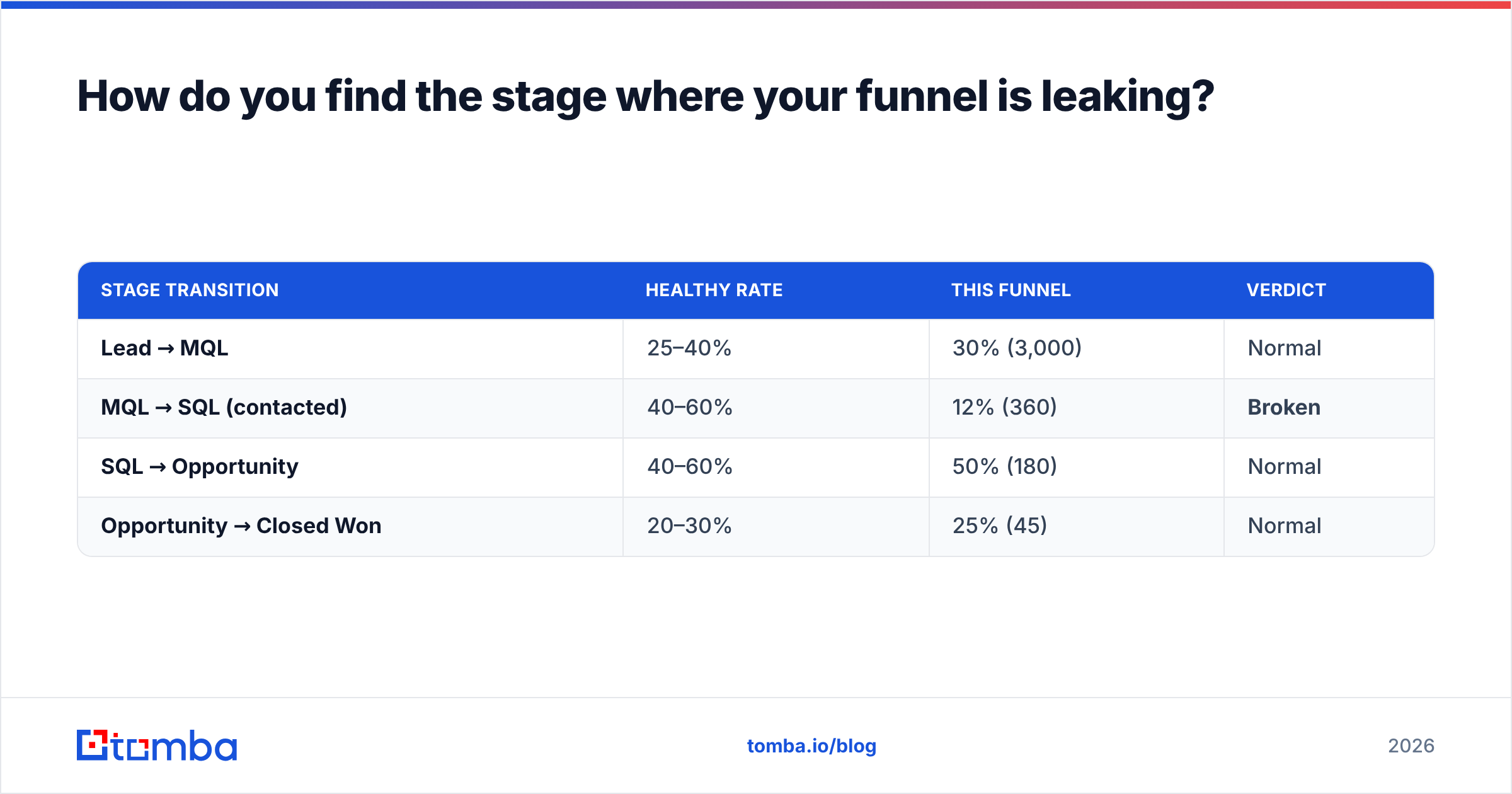
Pull the count of records that entered each gate over the last 90 days, then calculate the conversion rate between adjacent gates. The stage with the conversion rate furthest below benchmark is your leak. Everything else is a distraction until that one is fixed.
Here's a worked example. Imagine 10,000 leads enter the top over a quarter:
| Stage transition | Healthy rate | This funnel | Verdict |
|---|---|---|---|
| Lead → MQL | 25–40% | 30% (3,000) | Normal |
| MQL → SQL (contacted) | 40–60% | 12% (360) | Broken |
| SQL → Opportunity | 40–60% | 50% (180) | Normal |
| Opportunity → Closed Won | 20–30% | 25% (45) | Normal |
Every stage here is healthy except MQL → SQL, which is running at 12% against a 40–60% benchmark. The team's instinct will be to blame closing skills or pricing — but the close rate is fine. The deals that reach a rep convert normally. The problem is that reps can't reach most MQLs at all. That is a classic signature of bad contact data: emails bounce, phone numbers are dead, and the "contact attempted" stage silently swallows thousands of leads.
This is why you measure before you act. Without the table, this team would have rewritten their pitch deck and discounted their pricing — fixing two stages that weren't broken while ignoring the one that was.
What actually breaks a sales funnel?#
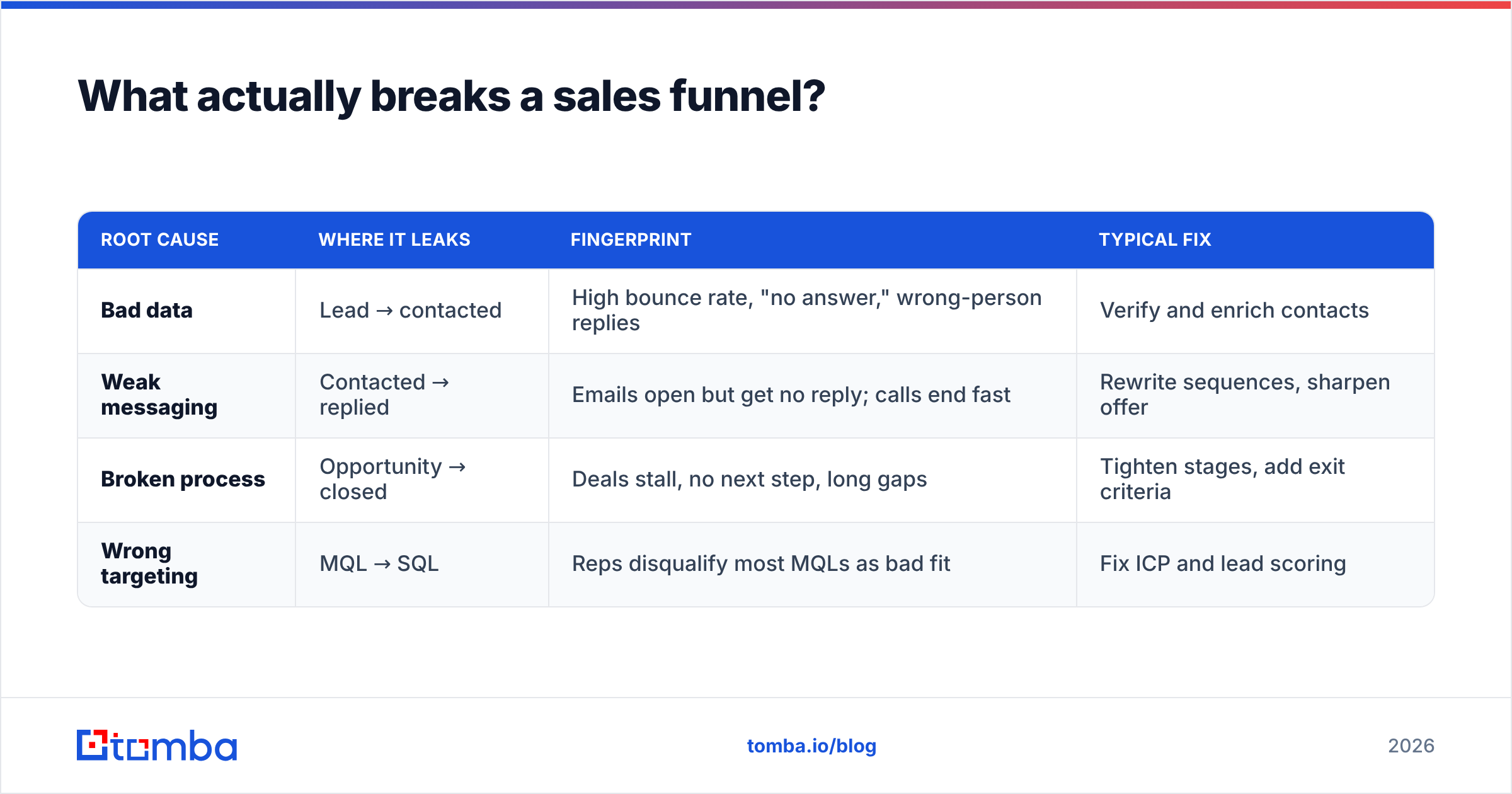
Three root causes account for the overwhelming majority of broken funnels. Each one leaves a distinct fingerprint in your stage data, so you can usually identify the culprit from the numbers alone.
| Root cause | Where it leaks | Fingerprint | Typical fix |
|---|---|---|---|
| Bad data | Lead → contacted | High bounce rate, "no answer," wrong-person replies | Verify and enrich contacts |
| Weak messaging | Contacted → replied | Emails open but get no reply; calls end fast | Rewrite sequences, sharpen offer |
| Broken process | Opportunity → closed | Deals stall, no next step, long gaps | Tighten stages, add exit criteria |
| Wrong targeting | MQL → SQL | Reps disqualify most MQLs as bad fit | Fix ICP and lead scoring |
Notice that the leak location tells you the cause. A leak right after "contacted" but before "replied" is a messaging problem — your data is fine because the messages are landing, but nothing about them earns a response. A leak between "opportunity" and "closed" is a sales process problem — deals are real but they stall because no one owns the next step.
The most common single cause, by a wide margin, is bad data at the top. According to industry research compiled by HubSpot, B2B data decays at roughly 22–30% per year as people change jobs, companies rebrand, and email formats shift. If you bought a list 18 months ago and never re-verified it, close to half of it is now wrong — and every one of those dead records is a lead that leaks before a rep can even try.
How do you fix a funnel that leaks at the top?#
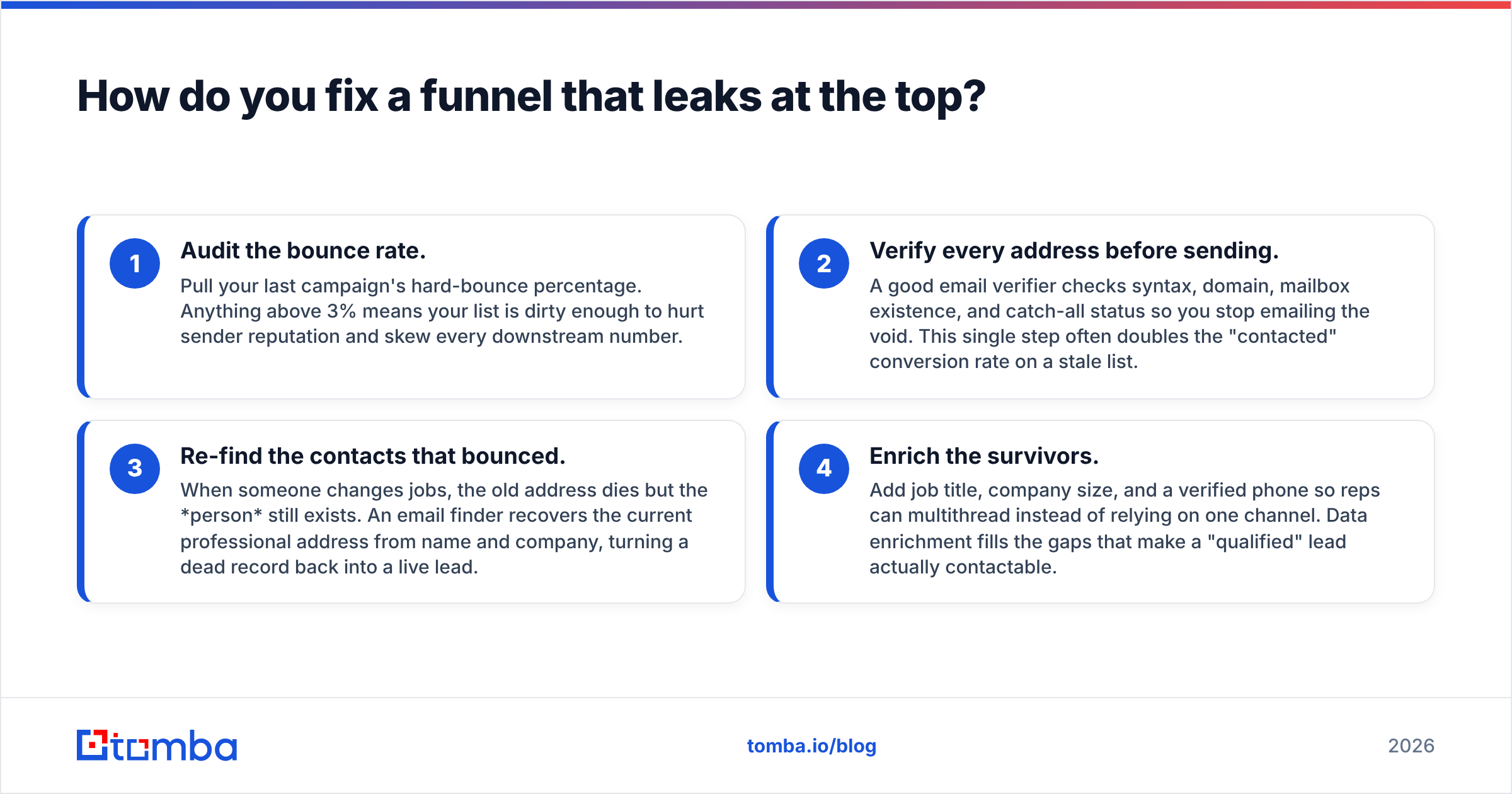
Verify and enrich your contact data before it ever reaches a rep, then re-measure the contacted rate. A top-of-funnel leak is almost always a data leak, and data leaks are the cheapest and fastest to close because they don't require changing a single human behavior.
Run this sequence:
- Audit the bounce rate. Pull your last campaign's hard-bounce percentage. Anything above 3% means your list is dirty enough to hurt sender reputation and skew every downstream number.
- Verify every address before sending. A good email verifier checks syntax, domain, mailbox existence, and catch-all status so you stop emailing the void. This single step often doubles the "contacted" conversion rate on a stale list.
- Re-find the contacts that bounced. When someone changes jobs, the old address dies but the person still exists. An email finder recovers the current professional address from name and company, turning a dead record back into a live lead.
- Enrich the survivors. Add job title, company size, and a verified phone so reps can multithread instead of relying on one channel. Data enrichment fills the gaps that make a "qualified" lead actually contactable.

The reason this works is leverage. Fixing data is a batch operation — you verify 10,000 records once and every rep benefits on every deal forever. Fixing messaging or process requires changing what dozens of people do every day, which is slower and decays without constant reinforcement. Always close the data leak first.
If you're operating at scale, a bulk email finder lets you re-verify and re-find an entire list in one pass instead of record by record. Compare what that costs against the revenue you're losing to dead leads — for most teams the math is not close, and you can review the Tomba pricing tiers to size it.
How do you fix a leak in the middle of the funnel?#
A mid-funnel leak — contacted but no reply, or replied but no meeting — is a messaging problem, and you fix it by rewriting the sequence around the prospect's problem instead of your product. The data is fine; the words are not.
Diagnose it with a simple test. Pull your open rate and reply rate separately:
- High open, low reply → your subject lines work but your body and offer don't. Rewrite the ask. Make the next step small and specific ("worth a 15-minute look Thursday?" beats "let me know if you're interested").
- Low open everywhere → either deliverability or subject lines. Check email deliverability first; a great message in the spam folder converts at zero.
- Good reply, no meetings → your qualification or calendar friction is the issue, not the copy.
The biggest mid-funnel mistake is volume thinking — blasting more emails through a sequence that already doesn't work. If your reply rate is 1%, sending twice as many emails gets you twice as many non-replies and a faster route to a spam complaint. Fix the message, then scale it. Tools like a subject line tester and proper sequence segmentation move the number far more than raw volume does.
How do you fix a leak at the bottom of the funnel?#
A bottom-of-funnel leak — opportunities that stall before closing — is a process problem, and you fix it by enforcing exit criteria and a defined next step on every open deal. Deals don't die at the bottom because the prospect vanished; they die because nobody made the next move happen.
The tell is "ghosted" deals that sit in "opportunity" for weeks with no activity. Audit your CRM for any deal without a scheduled next step and a documented exit criterion. Then enforce a rule: no deal stays in a stage without a defined action and a date. Vendors like Salesforce and most modern pipeline tools let you flag stale opportunities automatically — turn that on. Process leaks respond to discipline, not to more leads.
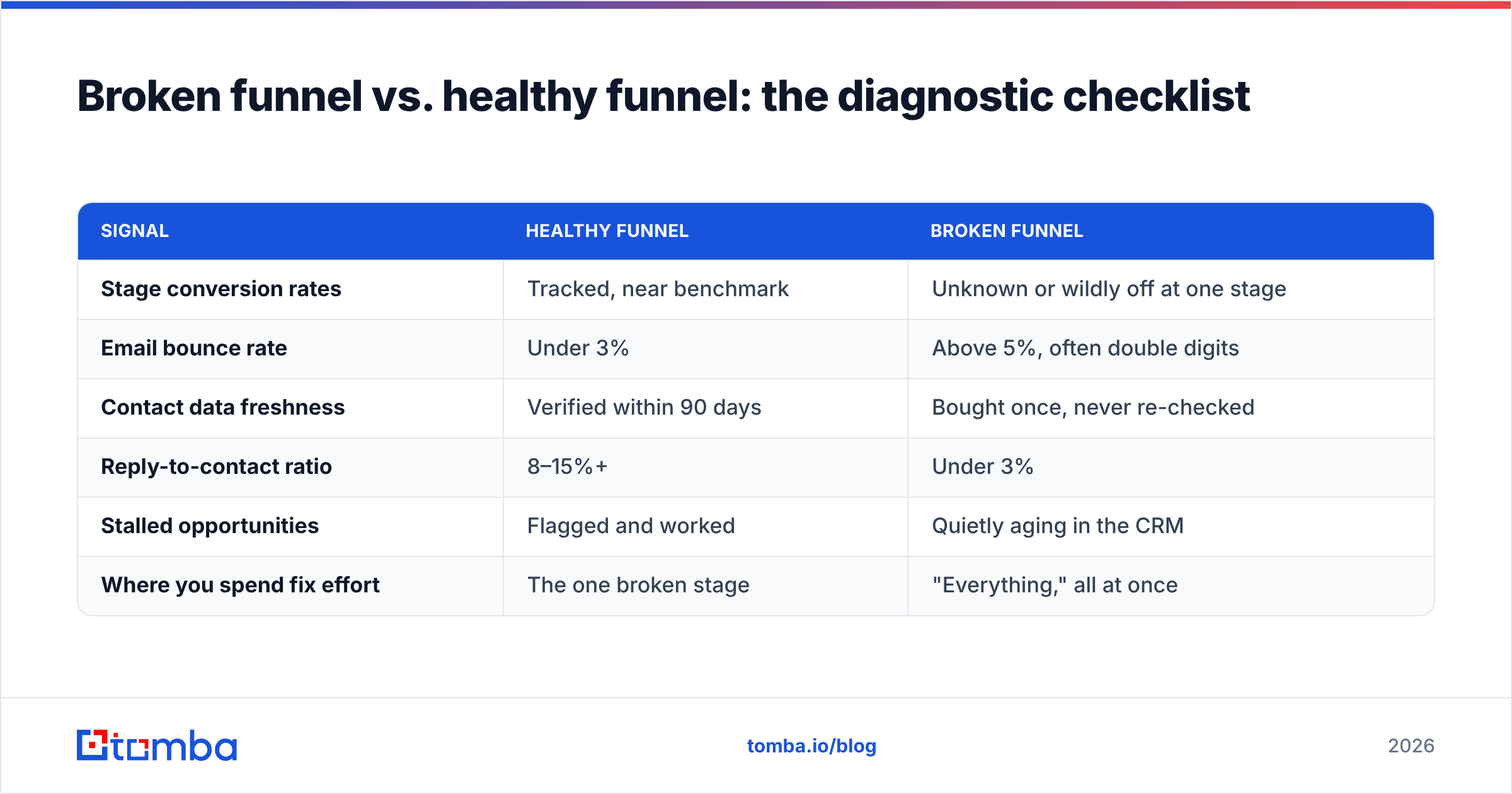
Broken funnel vs. healthy funnel: the diagnostic checklist#
Use this side-by-side to score your own funnel in five minutes.
| Signal | Healthy funnel | Broken funnel |
|---|---|---|
| Stage conversion rates | Tracked, near benchmark | Unknown or wildly off at one stage |
| Email bounce rate | Under 3% | Above 5%, often double digits |
| Contact data freshness | Verified within 90 days | Bought once, never re-checked |
| Reply-to-contact ratio | 8–15%+ | Under 3% |
| Stalled opportunities | Flagged and worked | Quietly aging in the CRM |
| Where you spend fix effort | The one broken stage | "Everything," all at once |
If three or more rows land in the right-hand column, you don't have a soft quarter — you have a structurally broken funnel, and guessing won't fix it.
How long does it take to fix a broken sales funnel?#
Plan on two to six weeks per stage, because the only honest way to confirm a fix is to change one thing and measure the result before touching the next. A data fix shows up fastest — re-verify a list and your contacted rate moves within days. Messaging takes a sequence cycle or two to read. Process changes take longest because they depend on rep behavior changing and holding.
The discipline that separates teams who fix funnels from teams who relaunch them every quarter is sequential repair. Fix the top-of-funnel data leak. Measure for two weeks. Only then move to messaging. Changing three things at once means you'll never know which one worked — and when the number moves, you won't be able to reproduce it.
Fix the leak that's easiest to close first#
Most broken funnels are bleeding hardest at the top, where dead and outdated contact data quietly kills outreach before your reps ever get a fair shot. That's also the leak you can close this week without changing how a single person sells.
Start there. Run your list through the Tomba Email Finder to recover current, verified professional emails for the contacts your old data lost, then enrich what survives so every lead that reaches a rep is actually reachable. Verify before you send, re-find what bounces, and watch your "contacted" conversion rate climb — then move down the funnel one stage at a time. The fastest revenue you'll find this quarter isn't in new leads; it's in the ones you already paid for and can no longer reach.
// get started
Find, verify and enrich your first contacts today
Start on the free plan with 25 searches a month, then scale when your team is ready.
Free plan · No credit card required · GDPR & CCPA
// about the author