How to Build an Email List for Marketing in 2026 (Field Guide)
Buying lists tanks deliverability. Here is how to build an email list for marketing in 2026 that actually converts — opt-in tactics, tools, and a 90-day plan.
You don't have a marketing problem if your list is small. You have a marketing problem if your list is the wrong list — bought, scraped without consent, or stuffed with addresses that bounce. This guide is about building the right one.
TL;DR#
- Never buy lists. Purchased lists wreck your sender reputation, violate GDPR/CAN-SPAM, and convert at a fraction of opt-in lists. Build, don't buy.
- Opt-in is the foundation. Lead magnets, gated content, exit-intent forms, and webinars are the highest-quality acquisition channels in 2026.
- B2B is different from B2C. For B2B, role-based prospecting plus verified business email sourcing fills your list faster than waiting on inbound alone.
- Verify everything before you send. A 3% bounce rate is the line between the inbox and the spam folder. Clean on entry, clean quarterly.
- A realistic 90-day plan can take you from zero to a few thousand engaged subscribers without a single risky shortcut.
Why should you build an email list for marketing at all?#
Because you own it. Social platforms rent you an audience and change the rules whenever they want — one algorithm tweak and your reach drops 60% overnight. Email is the one channel where the relationship is direct: your subscriber, your data, your send schedule.
The economics still hold up in 2026. Email marketing routinely returns more per dollar spent than paid social or display, largely because the audience already raised a hand. According to HubSpot's marketing research, email continues to outperform most channels on ROI for exactly this reason — intent. Someone who typed their address into your form wants to hear from you. Someone you scraped did not.
Think of your list like a garden versus a billboard. A billboard (paid ads) stops working the second you stop paying. A garden (an email list) compounds — you plant subscribers once, and they keep producing as long as you tend the soil.
What's the difference between building and buying a list?#
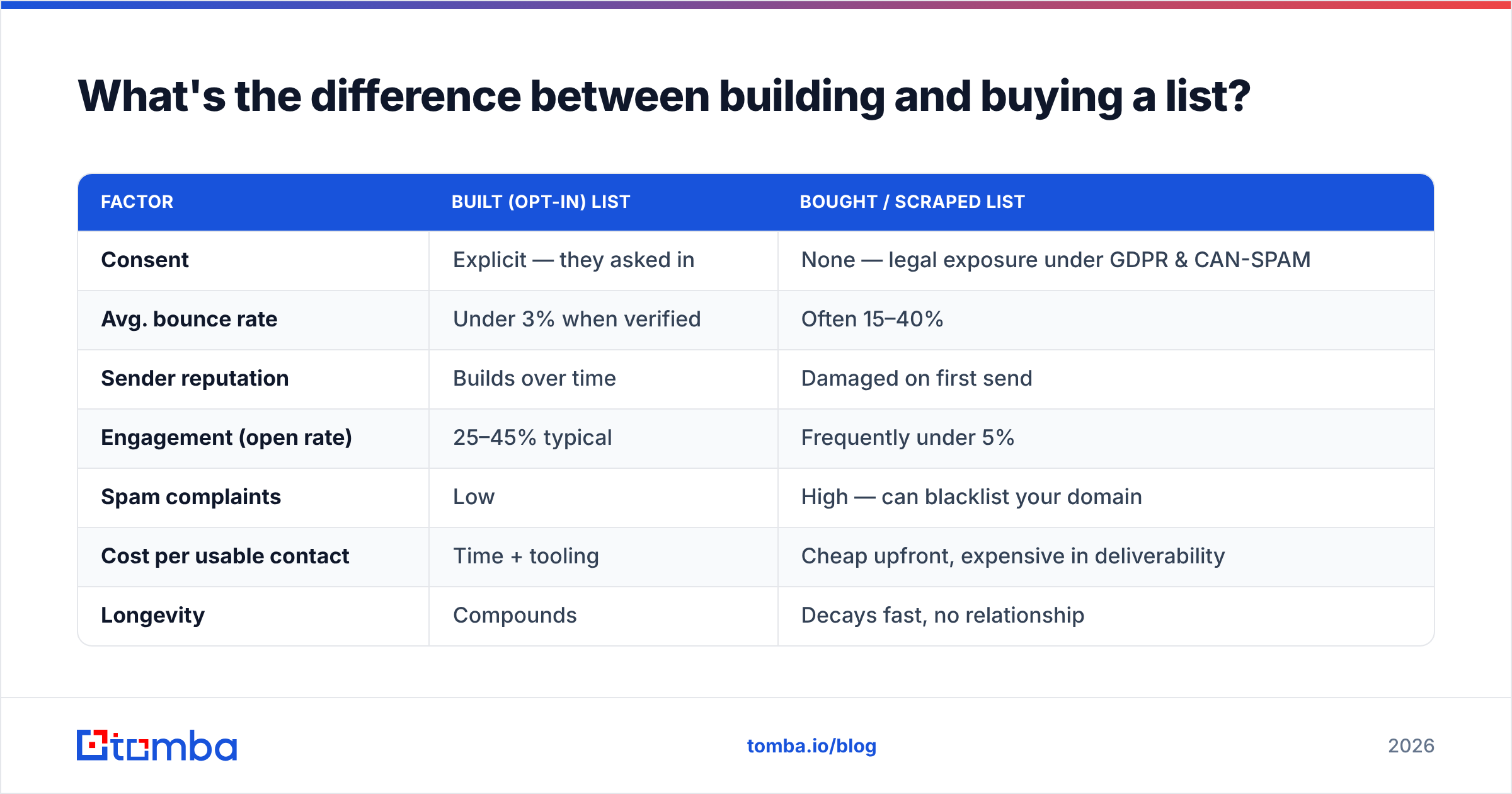
This is the fork in the road, and most deliverability disasters start with the wrong turn. Here's the honest comparison.
| Factor | Built (opt-in) list | Bought / scraped list |
|---|---|---|
| Consent | Explicit — they asked in | None — legal exposure under GDPR & CAN-SPAM |
| Avg. bounce rate | Under 3% when verified | Often 15–40% |
| Sender reputation | Builds over time | Damaged on first send |
| Engagement (open rate) | 25–45% typical | Frequently under 5% |
| Spam complaints | Low | High — can blacklist your domain |
| Cost per usable contact | Time + tooling | Cheap upfront, expensive in deliverability |
| Longevity | Compounds | Decays fast, no relationship |
Buying a list feels like a shortcut because you get 50,000 rows in a CSV for $200. But those rows poison the well: high bounces and spam complaints tell inbox providers you're a spammer, and then even your good emails to opt-in subscribers land in spam. You can read more on how this plays out in our breakdown of email deliverability and sender reputation. The short version: a bought list doesn't just fail — it takes your legitimate list down with it.
How do you build an email list for marketing the right way?#
There are two engines, and most teams need both: inbound opt-in (people come to you) and outbound B2B sourcing (you find and qualify the right people, then earn permission). Let's break down each.
The five highest-ROI opt-in tactics#
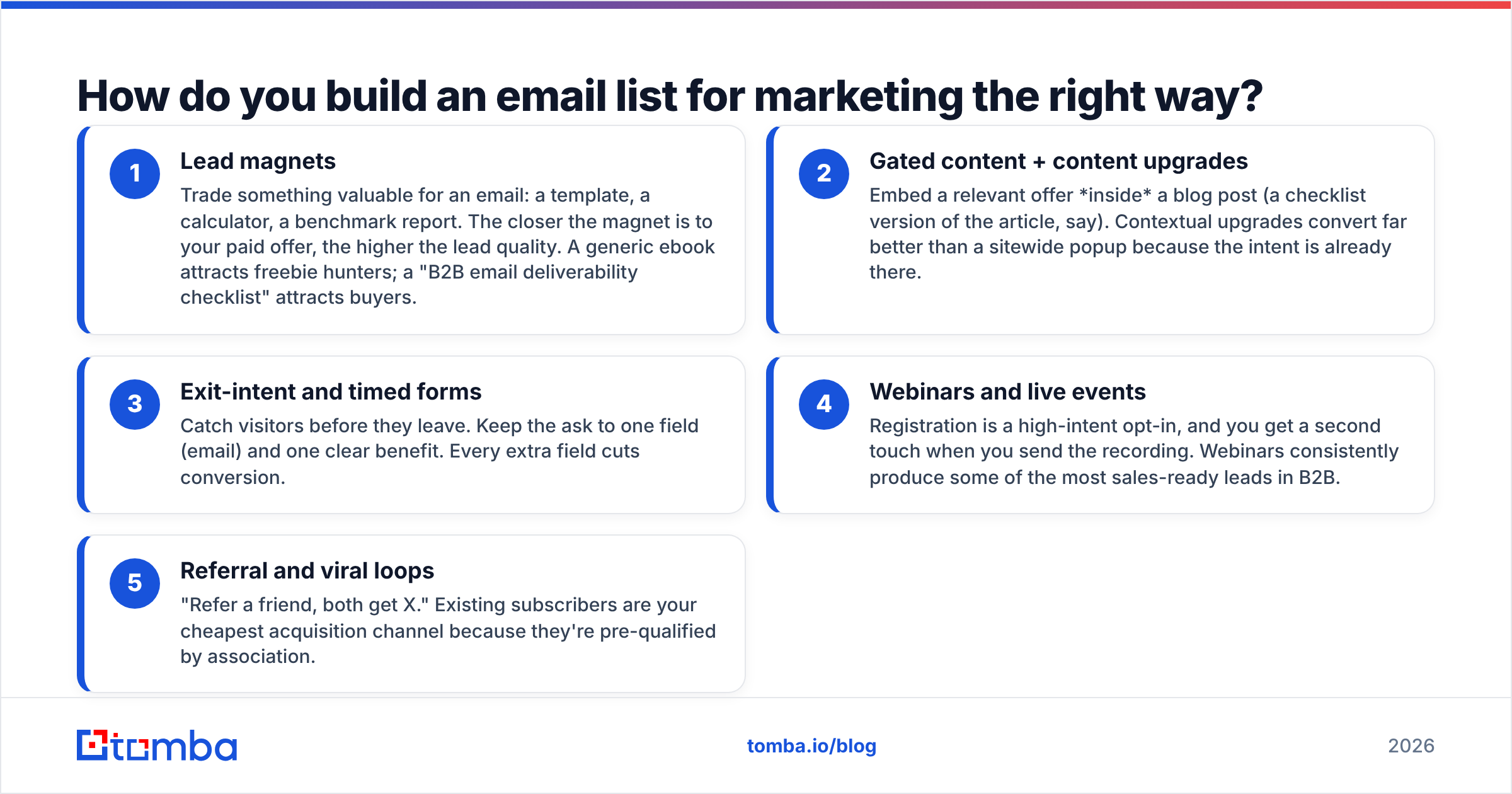
- Lead magnets — Trade something valuable for an email: a template, a calculator, a benchmark report. The closer the magnet is to your paid offer, the higher the lead quality. A generic ebook attracts freebie hunters; a "B2B email deliverability checklist" attracts buyers.
- Gated content + content upgrades — Embed a relevant offer inside a blog post (a checklist version of the article, say). Contextual upgrades convert far better than a sitewide popup because the intent is already there.
- Exit-intent and timed forms — Catch visitors before they leave. Keep the ask to one field (email) and one clear benefit. Every extra field cuts conversion.
- Webinars and live events — Registration is a high-intent opt-in, and you get a second touch when you send the recording. Webinars consistently produce some of the most sales-ready leads in B2B.
- Referral and viral loops — "Refer a friend, both get X." Existing subscribers are your cheapest acquisition channel because they're pre-qualified by association.
Whatever you collect, send a confirmation (double opt-in) for marketing lists in regulated regions. It shrinks raw signups slightly but dramatically improves engagement and legal standing.
The outbound engine for B2B#
Waiting on inbound alone is slow when you're targeting a defined market — say, "VP of Marketing at Series B SaaS companies." For that, you build the list by finding the right people and verifying their business emails, then running compliant outreach that earns the opt-in.
This is where a dedicated email finder replaces the temptation to buy a stale list. Instead of a generic CSV, you source verified, role-targeted business addresses on demand. A few practical moves:
- Use domain search to pull every public-facing email pattern at a target company, then filter to the roles you actually want.
- Run a bulk email finder when you have a list of companies and need the right contact at each.
- Pull verified contacts straight into your stack with the HubSpot integration or Salesforce integration so nothing gets re-keyed by hand.
The distinction matters: you're not buying a static list someone else scraped years ago. You're generating fresh, verified contacts that match your ICP, the day you need them.
What tools do you actually need?#
You can over-tool this. Here's the minimal stack that covers the full lifecycle — capture, source, verify, send — without redundancy.
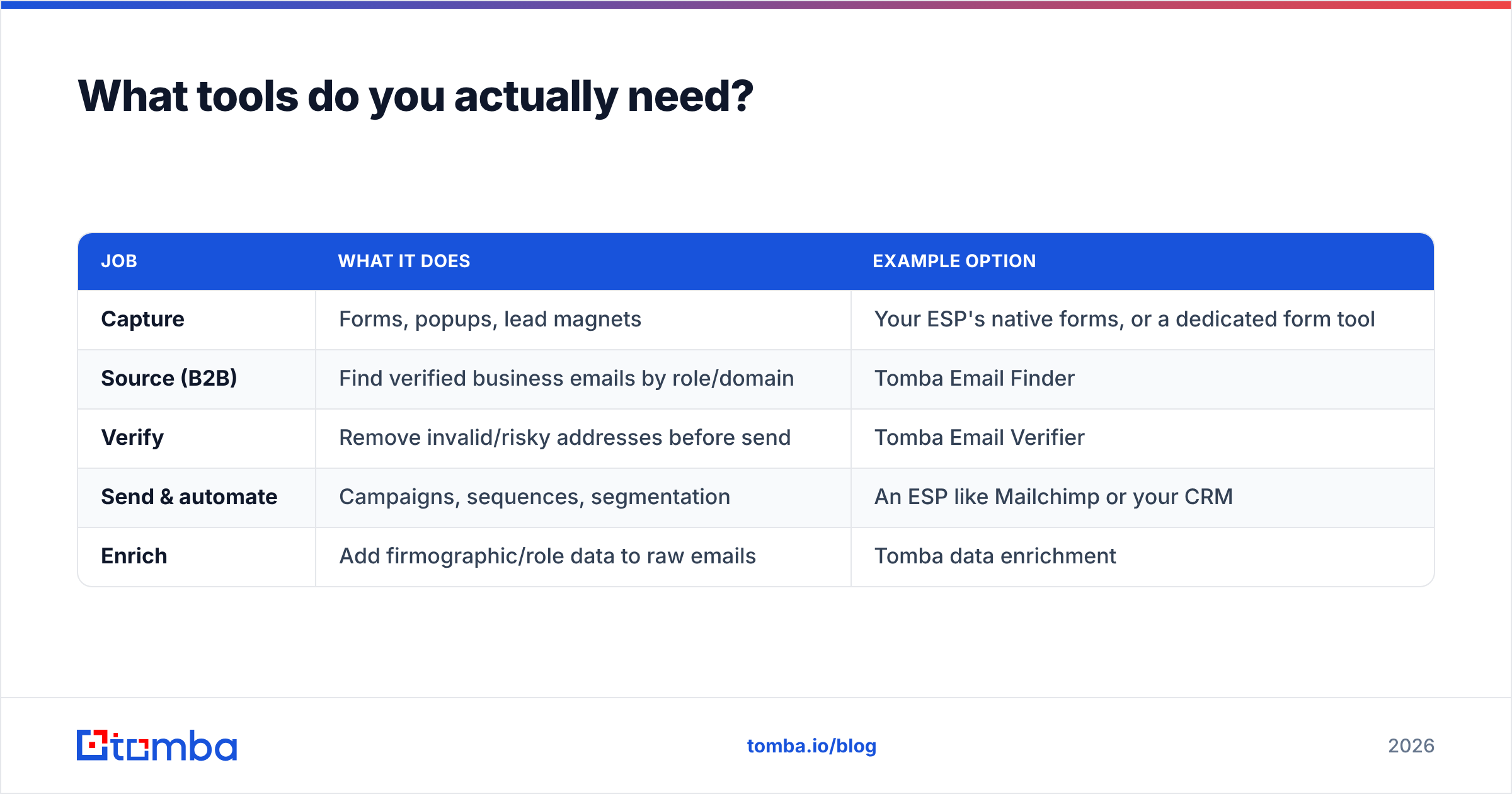
| Job | What it does | Example option |
|---|---|---|
| Capture | Forms, popups, lead magnets | Your ESP's native forms, or a dedicated form tool |
| Source (B2B) | Find verified business emails by role/domain | Tomba Email Finder |
| Verify | Remove invalid/risky addresses before send | Tomba Email Verifier |
| Send & automate | Campaigns, sequences, segmentation | An ESP like Mailchimp or your CRM |
| Enrich | Add firmographic/role data to raw emails | Tomba data enrichment |
For sourcing, compare options honestly on accuracy and pricing — G2's email-finder category is a reasonable starting point for third-party reviews. On the Tomba side, plans scale with volume: a Free tier (25 searches/mo) to test, Starter at $49/mo, Growth at $99/mo, and Pro at $249/mo. Full Tomba pricing is public so you can match a plan to your list-building pace rather than overpaying for unused credits.
How do you keep the list clean so it actually delivers?#
A list is a depreciating asset. Roughly 20–30% of B2B email addresses go stale every year as people change jobs. If you never clean, your deliverability quietly erodes until one campaign tips you into the spam folder.
Three habits keep you in the inbox:
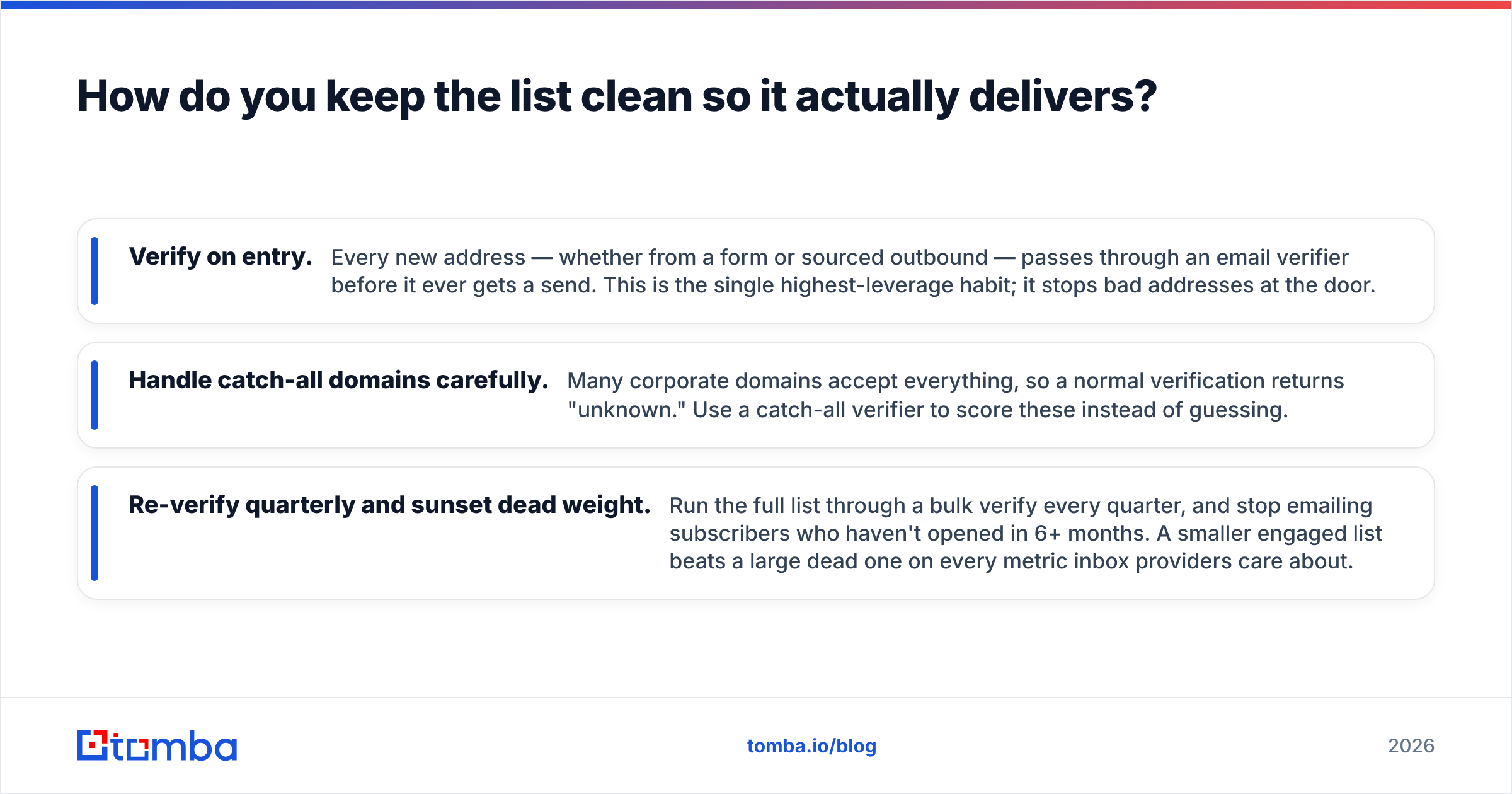
- Verify on entry. Every new address — whether from a form or sourced outbound — passes through an email verifier before it ever gets a send. This is the single highest-leverage habit; it stops bad addresses at the door.
- Handle catch-all domains carefully. Many corporate domains accept everything, so a normal verification returns "unknown." Use a catch-all verifier to score these instead of guessing.
- Re-verify quarterly and sunset dead weight. Run the full list through a bulk verify every quarter, and stop emailing subscribers who haven't opened in 6+ months. A smaller engaged list beats a large dead one on every metric inbox providers care about.
Pair this with the technical basics — a valid SPF record, DKIM, and DMARC — and a gradual warmup if you're on a new domain. Clean data plus correct authentication is 90% of deliverability.
What does a realistic 90-day list-building plan look like?#
Skip the "explode your list overnight" promises. Here's a grounded sequence for a small team starting from near zero.
Days 1–30: Foundation.
- Set up SPF, DKIM, DMARC and pick your ESP.
- Build one strong lead magnet tied to your core offer.
- Add a content upgrade to your three best-performing blog posts.
- Define your ICP precisely (industry, company size, role).
Days 31–60: Both engines on.
- Launch exit-intent capture sitewide.
- Start outbound sourcing: use domain search and the bulk email finder to build a verified target list of 500–1,000 ICP contacts.
- Verify 100% of contacts before any send.
- Run your first compliant outreach sequence with a clear opt-in/opt-out.
Days 61–90: Compound.
- Add a referral loop for existing subscribers.
- Host one webinar; turn registrants into a nurtured segment.
- Re-verify the whole list and segment by engagement.
- Review what converted and double down — kill the lead magnets that attract tire-kickers.
Done honestly, this gets most B2B teams to a few thousand genuinely engaged, deliverable subscribers — worth far more than 50,000 bought rows that bounce.
Common mistakes that quietly kill your list#
- One giant unsegmented blast. Relevance drives engagement; engagement drives deliverability. Segment from day one.
- Front-loading every form field. Ask for the email first, enrich the rest later with data enrichment.
- Ignoring the unsubscribe. A visible unsubscribe link lowers spam complaints, which protects your reputation. Hiding it backfires.
- Treating sourced contacts as opt-ins. Outbound-sourced emails still need permission-based, compliant outreach — not a marketing newsletter blast on day one.
- Never cleaning. Covered above, but it's the most common cause of "my open rates are dropping for no reason."
The bottom line#
Building an email list for marketing in 2026 is about quality compounding over time, not volume bought in bulk. Capture opt-ins with magnets that match your offer, source B2B contacts with a verified finder instead of a stale CSV, verify relentlessly, and clean on a schedule. That's the whole game.
When you're ready to fill the outbound side of your list with accurate, role-targeted business emails — without risking your sender reputation on a bought list — start with the Tomba Email Finder. Test it free with 25 searches a month, then scale on a plan that matches how fast you're growing. Build the garden, don't rent the billboard.
// get started
Find, verify and enrich your first contacts today
Start on the free plan with 25 searches a month, then scale when your team is ready.
Free plan · No credit card required · GDPR & CCPA
// about the author