Building Radar Alternatives: 7 Best Sales Intelligence Tools for 2026
Building Radar is strong on construction project signals, but it is not the only option. Compare 7 Building Radar alternatives on data, pricing, and contact accuracy for 2026.
Building Radar is a capable construction-focused sales intelligence platform, but it is not the right fit for every revenue team. If you sell outside early-stage construction projects, need broader contact data, or want predictable pricing, you have better-matched options. This guide compares seven Building Radar alternatives so you can choose on evidence, not on a sales demo.
TL;DR#
- Building Radar excels at early construction project signals, but coverage narrows fast once you leave AEC (architecture, engineering, construction) use cases.
- The best building radar alternatives depend on your job: project intelligence (Dodge, ConstructConnect), general B2B intent (ZoomInfo, Cognism), or contact-data accuracy (Tomba, Apollo).
- Most teams need two layers: a signal source that says "this account is in market" and a contact source that says "here is the verified email and phone."
- Pricing ranges from free tiers to five-figure annual contracts. Match the spend to the volume you actually work, not the volume you are sold.
- For verified emails and phone numbers behind any account list, Tomba's email finder is the lowest-friction layer to bolt onto whichever signal tool you keep.
What is Building Radar and who is it for?#
Building Radar is a sales intelligence product built around construction project data. It scans public sources, tenders, planning portals, and news to flag new building projects early in their lifecycle, then routes those leads to sales reps so they can reach decision-makers before competitors do. Think of it as a smoke detector for construction demand: it goes off when a project is still smoldering, long before the building is on fire with RFPs.
That early-signal angle is genuinely useful if you sell materials, equipment, software, or services into the AEC world. The catch is the same as any niche tool: the moment your ideal customer profile drifts away from "new construction project," the signal value drops and you are paying for coverage you cannot use. You can see the product scope on the Building Radar homepage, and real-world tradeoffs in user reviews on G2.
Why look for a Building Radar alternative?#
Three reasons come up repeatedly when teams evaluate a switch:
- Industry fit. Building Radar is construction-first. If you sell into SaaS, finance, healthcare, or general B2B, a horizontal data platform covers more of your market.
- Contact depth. Project intelligence tells you that an opportunity exists. It is often thinner on who to email and whether that address still works. You frequently need a dedicated email verifier and finder on top.
- Pricing and commitment. Niche intelligence tools tend toward annual contracts and per-seat pricing. Teams testing a new motion want a free tier or a low monthly entry point first.
If any of those describe you, the alternatives below are worth a serious look.
What are the best Building Radar alternatives in 2026?#
The right alternative depends on which layer you are replacing. Use this breakdown:
- Construction project intelligence: Dodge Construction Network, ConstructConnect, BCI Central — direct replacements for the project-signal job Building Radar does.
- General B2B sales intelligence: ZoomInfo, Cognism — broad company and contact databases with intent data, for teams that sell beyond construction.
- Contact-data accuracy layer: Tomba, Apollo — verified emails and phone numbers that attach to any account list, whether the leads came from a project tool or a CRM export.
- Hybrid stack: keep one signal source and pair it with a precise contact tool. This is what most efficient teams actually run.
The mistake is treating these as interchangeable. A project-intelligence tool and an email-finding tool solve different halves of the same problem.
How do the top Building Radar alternatives compare?#
| Tool | Primary job | Best for | Free tier | Entry price | Contact data depth |
|---|---|---|---|---|---|
| Building Radar | Construction project signals | AEC sales teams | No | Custom / annual | Moderate |
| Dodge Construction Network | Construction project + bid data | US construction firms | No | Custom / annual | Moderate |
| ConstructConnect | Project leads + takeoffs | Contractors, suppliers | Limited trial | Custom | Moderate |
| ZoomInfo | B2B database + intent | Mid-market & enterprise | No | ~$15k+/yr | High |
| Cognism | B2B data + EU phone | Outbound teams (EU/US) | No | Custom / annual | High |
| Apollo | Database + sequencing | SMB outbound | Yes (limited) | $49/user/mo | High |
| Tomba | Email & phone finding + verify | Any list, any industry | Yes (25 searches) | $49/mo | Very high (verified) |
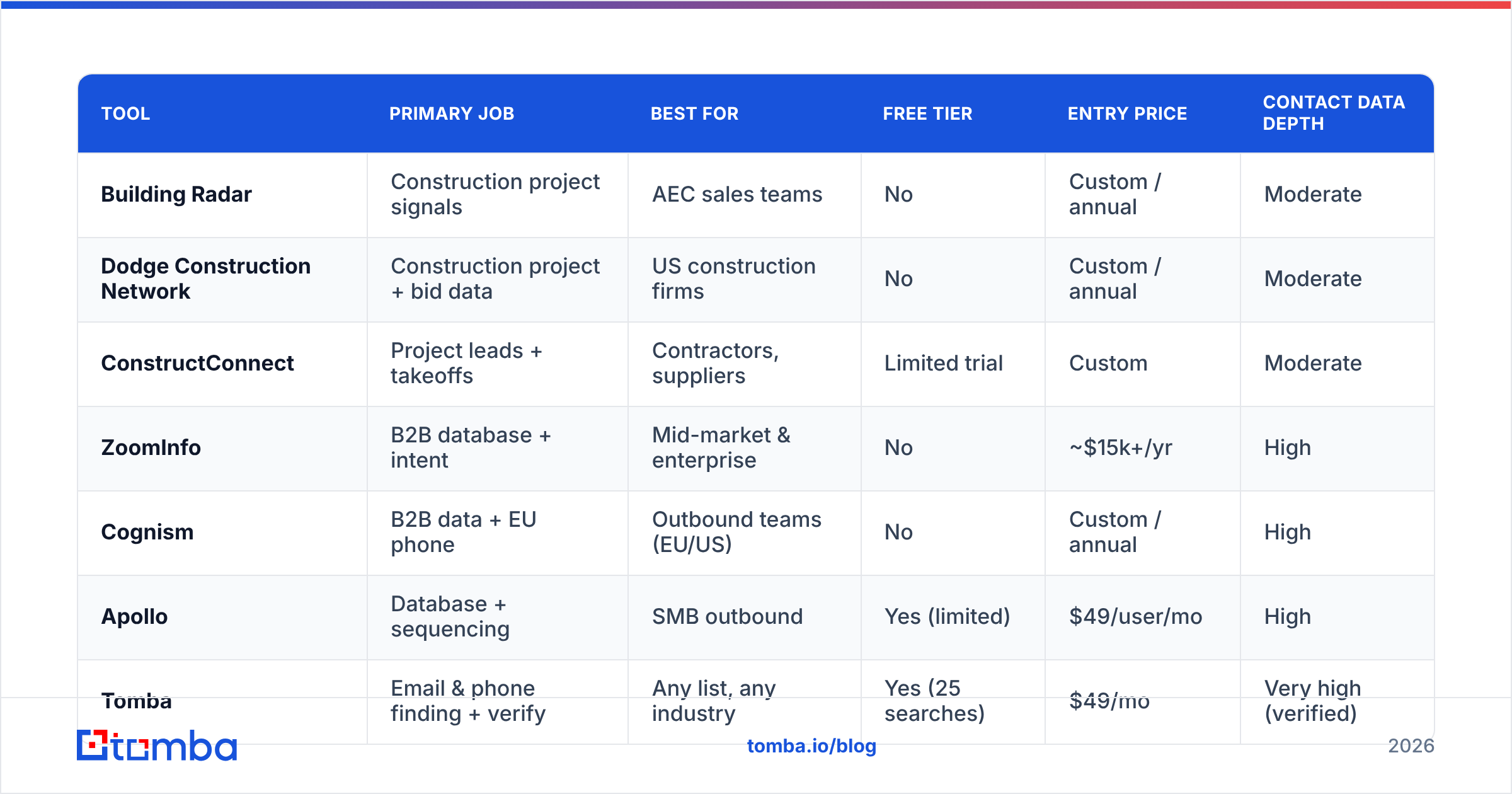
Two things stand out. First, the construction-specific tools cluster around custom, annual pricing — fine at scale, heavy for a pilot. Second, the contact-data layer (Tomba, Apollo) is where the verified email and phone accuracy lives, and it is dramatically cheaper to start. You can see the full Tomba pricing tiers, which begin with a free plan and a $49/mo Starter, no annual lock-in.
Which alternative fits your use case?#
You sell into construction and want a direct swap#
Look at Dodge Construction Network and ConstructConnect. Both are mature US-centric project databases with bid information and plan rooms. They overlap most directly with Building Radar's core job. Expect custom, annual pricing and a sales-led buying process. If your market is European, BCI Central and regional planning-data providers may have better local coverage than any single global tool.
You sell broadly across B2B#
Drop the construction lens entirely and go horizontal. ZoomInfo is the heavyweight: enormous company and contact coverage, intent signals, and deep integrations, at enterprise pricing. Cognism is the strongest challenger, especially for teams that need phone-verified mobile numbers and stronger EU/GDPR-aligned coverage. Both are signal-and-contact in one, which is why their price tags are high.
You want accuracy and a price you can pilot#
This is where a focused contact-data tool wins. Apollo bundles a database with email sequencing and is popular with SMB outbound teams. Tomba specializes in the part everyone actually struggles with: turning a name and a company into a verified, deliverable email and phone number. Pair it with data enrichment to fill in titles, social profiles, and company fields on lists you already own.
Is Tomba a good Building Radar alternative?#
Tomba is not a construction-project tool, and pretending otherwise would be dishonest. What Tomba replaces is the contact-data half of Building Radar — and it does that better and cheaper than a niche platform's bolt-on contact features.
Here is the realistic workflow. You identify in-market accounts (from Building Radar, a construction project feed, a conference list, or a CRM export). Then you need to reach the right people. That is the job Tomba is built for:
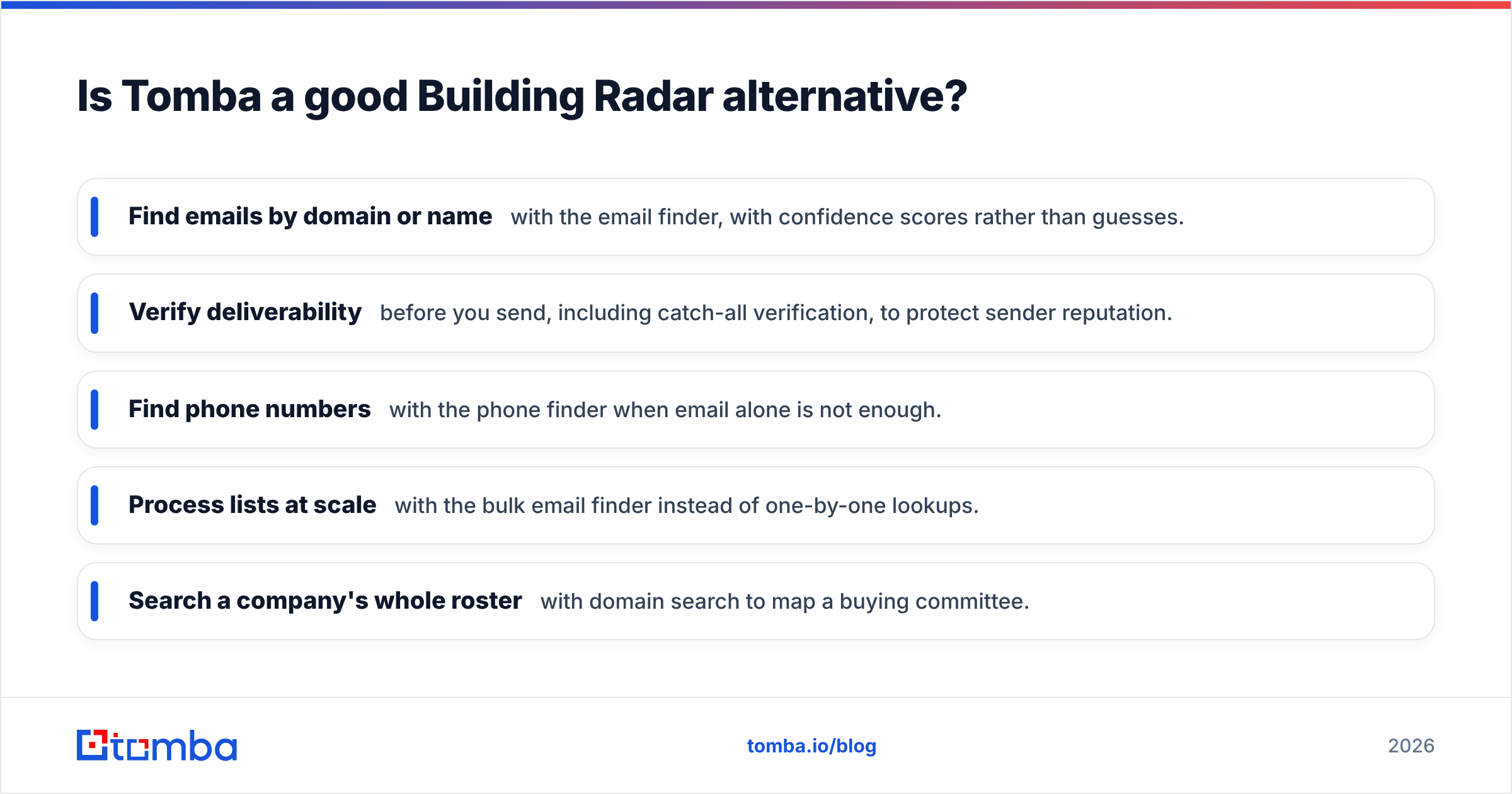
- Find emails by domain or name with the email finder, with confidence scores rather than guesses.
- Verify deliverability before you send, including catch-all verification, to protect sender reputation.
- Find phone numbers with the phone finder when email alone is not enough.
- Process lists at scale with the bulk email finder instead of one-by-one lookups.
- Search a company's whole roster with domain search to map a buying committee.
Where Tomba's data comes from and how accuracy is measured is documented openly, which matters when deliverability is on the line. The honest positioning: if you only need construction project alerts, keep a project tool. If you need verified ways to contact people, Tomba is a stronger, cheaper layer than most all-in-one platforms.
Tomba vs Building Radar: a focused comparison#
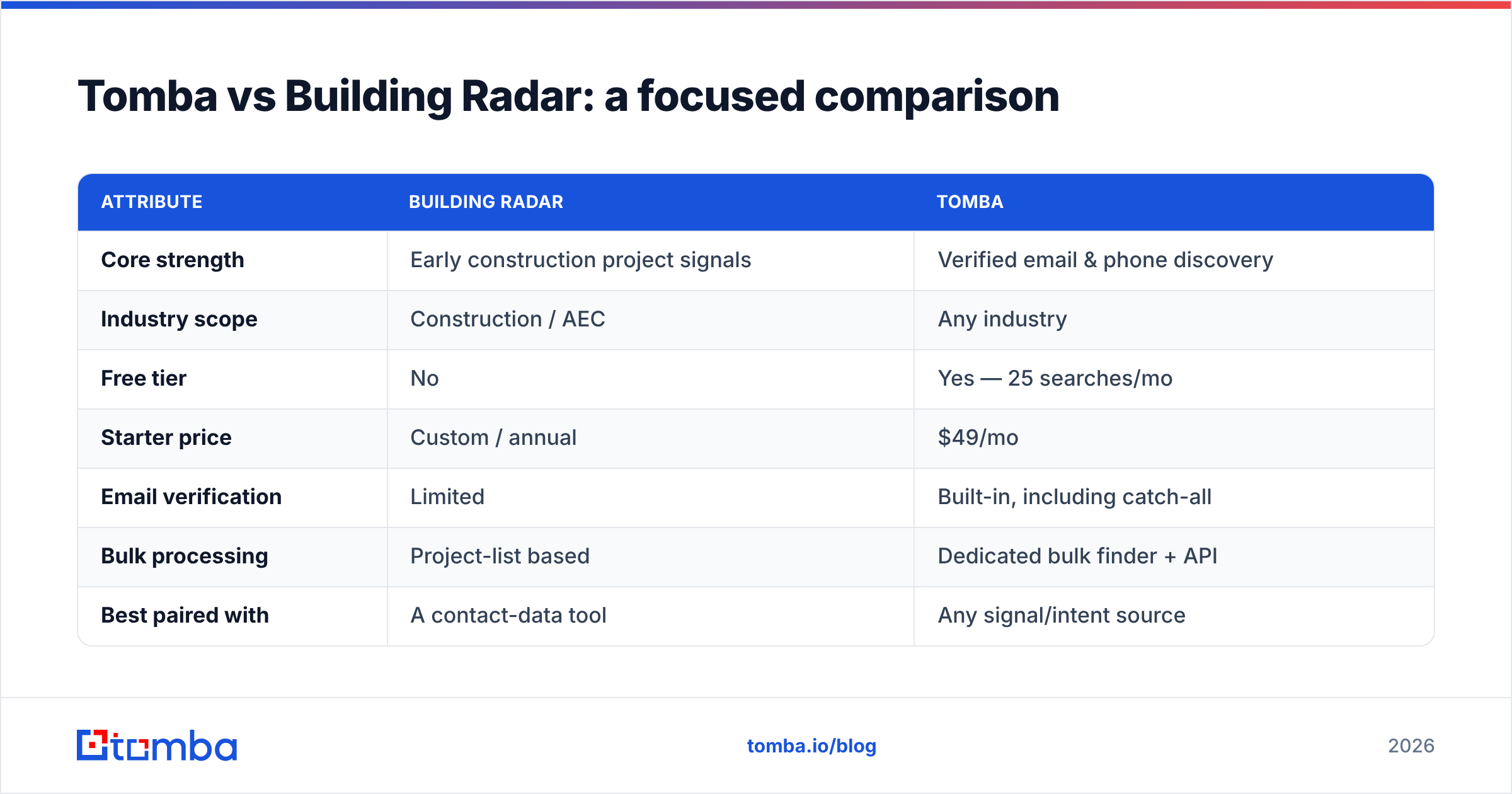
| Attribute | Building Radar | Tomba |
|---|---|---|
| Core strength | Early construction project signals | Verified email & phone discovery |
| Industry scope | Construction / AEC | Any industry |
| Free tier | No | Yes — 25 searches/mo |
| Starter price | Custom / annual | $49/mo |
| Email verification | Limited | Built-in, including catch-all |
| Bulk processing | Project-list based | Dedicated bulk finder + API |
| Best paired with | A contact-data tool | Any signal/intent source |
The takeaway is not "Tomba beats Building Radar at everything." It is that these tools live at different layers, and most teams over-buy a single expensive platform when a signal source plus a precise contact tool covers the same ground for less.
How should you build your stack?#
Run a simple two-layer model:
- Signal layer — what tells you an account is in market. For construction, that is Building Radar, Dodge, or ConstructConnect. For general B2B, that is ZoomInfo, Cognism, or your own intent data.
- Contact layer — what gives you a verified, deliverable way to reach the buyer. That is Tomba (or Apollo if you also want native sequencing).
The reason to separate them is cost control and flexibility. Signal tools are expensive and lock you into a vertical. Contact tools are cheap, horizontal, and portable across every list you build. When your ICP shifts, you swap the signal layer and keep the contact layer running. You can connect the contact layer to your CRM through Tomba's integrations, so verified data flows where reps already work.
A practical test before you commit to any annual contract: export 100 of your real target accounts, run them through each tool's free tier or trial, and measure two numbers — coverage (how many contacts you got) and accuracy (how many emails actually delivered). The tool that wins on delivered contacts, not raw count, is the one to keep.
What about pricing and total cost?#
Sticker price hides the real number. A construction intelligence platform at a five-figure annual contract is reasonable if construction is your entire market and your average deal justifies it. It is wasteful if you also sell to three other verticals that the tool does not cover.
A leaner 2026 stack often looks like this:
- One signal source matched to your largest segment.
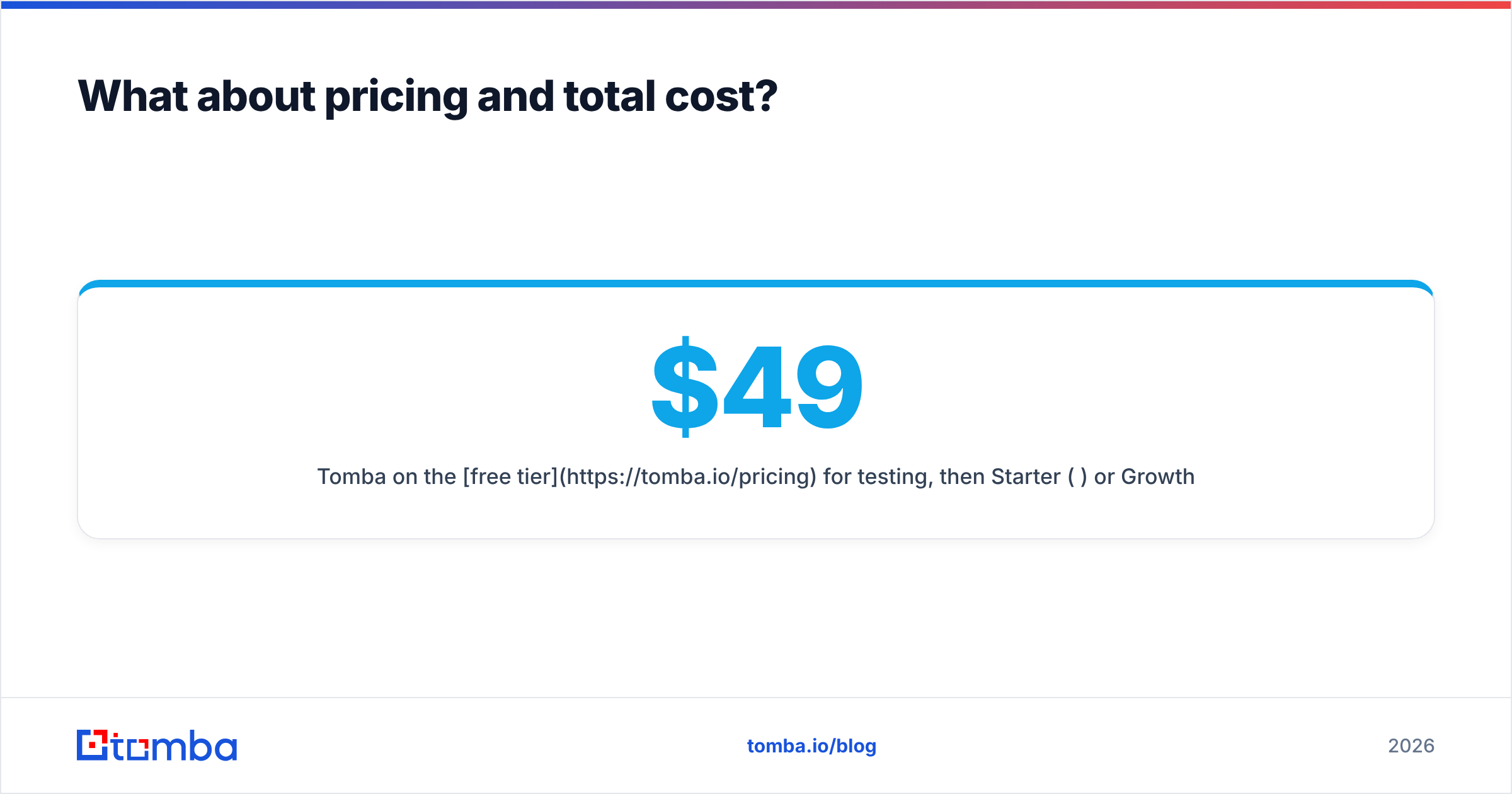
- Tomba on the free tier for testing, then Starter ($49/mo) or Growth ($99/mo) as volume grows, scaling to Pro ($249/mo) for high-volume teams.
- Your existing CRM and sequencing tool.
That combination keeps the expensive, vertical-locked spend to exactly one line item, while the verified contact data — the part that actually determines whether your emails land — stays cheap and flexible. Compare options yourself on independent review sites like Capterra before signing anything.
Final recommendation#
Choose by the job you are replacing. If you need construction project signals and nothing else, evaluate Dodge or ConstructConnect alongside Building Radar. If you sell broadly, look at ZoomInfo or Cognism. But almost every team in this comparison shares one weak point: turning known accounts into verified, deliverable contacts.
That is the gap Tomba was built to close. Start free with 25 searches a month, find and verify emails and phone numbers behind any account list, and only pay more when your pipeline justifies it. Spin up the Tomba Email Finder, run your real target list through it, and let delivered replies — not a vendor demo — decide your stack.
Ready to find emails that actually work?
Join 150,000+ professionals who stopped guessing and started sending. Free credits on signup — no credit card required.
Get the Tomba newsletter
Practical outbound tactics and product updates — once every two weeks.
About the author