Building Rapport in Sales: A 2026 Playbook That Closes
Rapport is not small talk. Here is how top reps build trust fast, the science behind it, and a repeatable framework that lifts win rates in 2026.
Building Rapport in Sales: The 2026 Trust Playbook
TL;DR
- Rapport is engineered trust, not luck or charm. It comes from preparation, relevance, and disciplined listening — all of which you can systematize.
- The fastest rapport-killers in 2026 are generic outreach and getting basic facts wrong. Accurate contact data fixes both before the conversation starts.
- Use a repeatable framework: research the person, lead with their context, mirror their pace, and earn the right to ask harder questions.
- Rapport without qualification is just being liked. Pair warmth with a clear path to value or you stall in "nice chat" purgatory.
- Reps who personalize at scale (good data + a tight process) consistently out-convert reps who wing it on personality alone.
What does building rapport in sales actually mean?#
Rapport is the felt sense that you understand the buyer and have their interests in mind. That's it. It is not joking about the weather, and it is not faking a shared love of their favorite team.
Think of rapport like the foundation of a house. You never see it once the building is up, but every floor above it depends on it holding. In sales, the "floors" are discovery, demo, negotiation, and close. Skip the foundation and the whole deal wobbles at the first objection.
The mistake most reps make is treating rapport as a phase — five minutes of pleasantries before "the real call." Top performers treat it as a property of the entire interaction. Every relevant question, every accurate detail, every moment you prove you did your homework adds another brick.
And here is the uncomfortable truth for 2026: buyers have less patience than ever. The average B2B buyer talks to fewer salespeople and spends most of the journey self-educating. By the time you reach them, generic warmth reads as a stall. Relevance is the new rapport.

Wait — ignore that placeholder instinct. The image above does not belong on a rapport post, so picture instead a rep's screen split between a templated blast and a researched one-to-one note. That contrast is the whole game.
Why does rapport matter more than your pitch?#
Because people buy from people they trust, and trust is transferred long before logic is. A buyer who likes and believes you will forgive a clunky demo. A buyer who doesn't will nitpick a perfect one.
Three things rapport buys you that no feature list can:
- Honest discovery. People only tell you their real problems, budget, and politics when they feel safe. Weak rapport produces polite, useless answers.
- The benefit of the doubt. When you mis-step — and you will — rapport is the buffer that keeps a small mistake from ending the deal.
- Internal advocacy. Your champion sells for you in rooms you'll never enter. They only do that if they trust you personally.
Decades of research back this up. Influence researcher Robert Cialdini lists "liking" and "authority" among his core principles of persuasion precisely because trust short-circuits resistance. You can read the primer on his work on Wikipedia's overview of his influence principles. The lesson: rapport isn't soft. It's the mechanism that makes everything else work.
How do you build rapport before the first conversation?#
You build it in the research, not the call. Ninety percent of rapport is decided before you say hello, because the quality of your opener is decided by what you know.
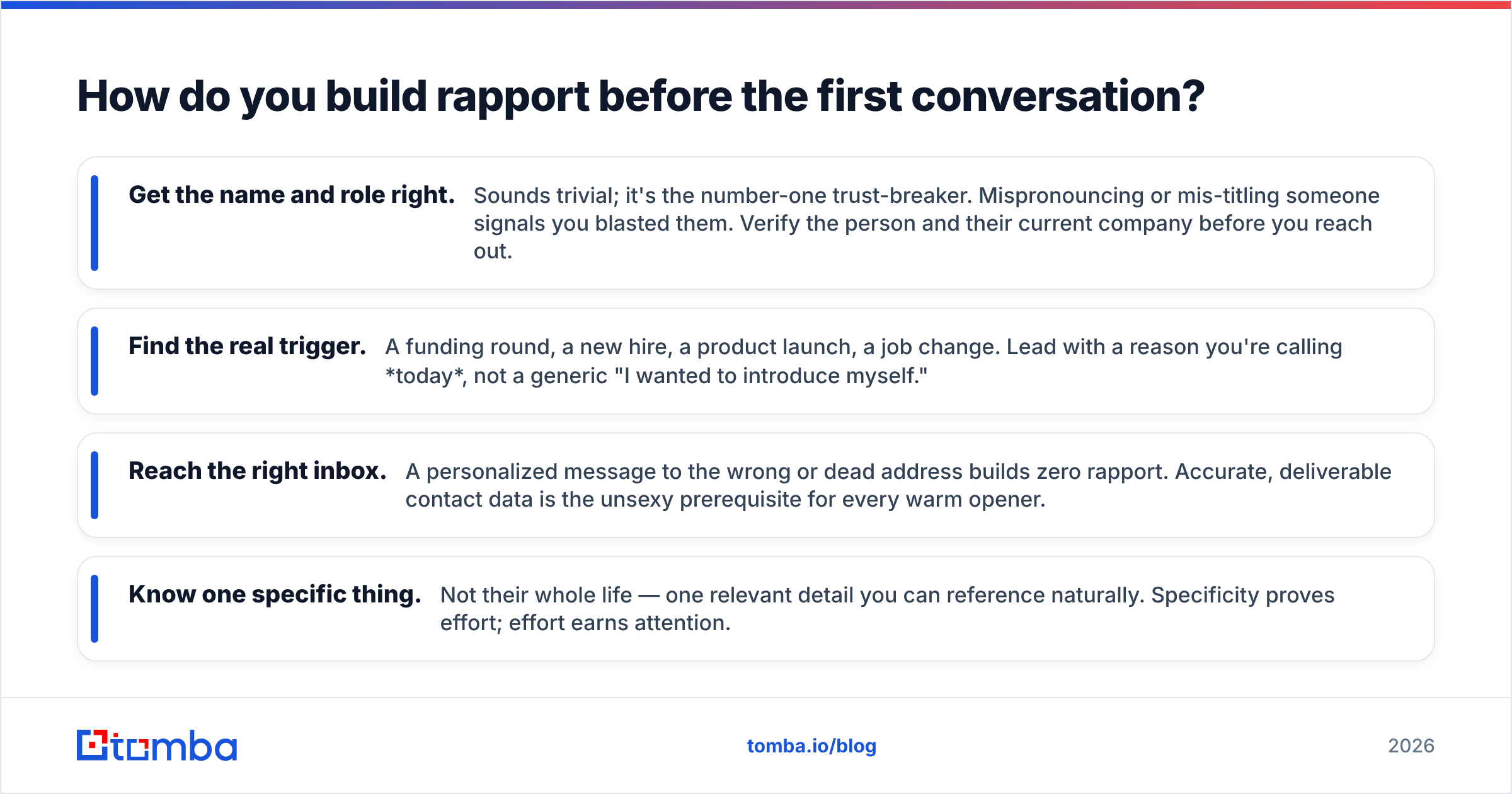
Here's the pre-call rapport stack:
- Get the name and role right. Sounds trivial; it's the number-one trust-breaker. Mispronouncing or mis-titling someone signals you blasted them. Verify the person and their current company before you reach out.
- Find the real trigger. A funding round, a new hire, a product launch, a job change. Lead with a reason you're calling today, not a generic "I wanted to introduce myself."
- Reach the right inbox. A personalized message to the wrong or dead address builds zero rapport. Accurate, deliverable contact data is the unsexy prerequisite for every warm opener.
- Know one specific thing. Not their whole life — one relevant detail you can reference naturally. Specificity proves effort; effort earns attention.
This is where good tooling quietly does the heavy lifting. Using an email finder to confirm you're contacting the actual decision-maker — and an email verifier to confirm the address is live — means your thoughtful note actually lands. Personalization that bounces is just wasted research. If you're working accounts in bulk, a domain search maps the right contacts at each company so you personalize the person, not just the logo.

Same note as before — that benchmark chart is off-topic here, so mentally swap it for an enrichment dashboard showing a verified contact card. The point stands: data quality decides whether your rapport attempt ever gets read.
What are the core rapport-building techniques that work?#
The fundamentals haven't changed, but the discipline to apply them is rare. Here are the techniques that move the needle, ranked by impact.
- Active listening. Talk less than 45% of the time on a discovery call. Reflect back what you heard ("So the real issue is renewal forecasting, not reporting?") before you respond. Buyers feel understood when you summarize, not when you agree.
- Mirroring pace and tone. Match their energy and speed. A fast, blunt operator finds slow throat-clearing exhausting; a deliberate analyst finds rapid-fire pitching aggressive. Adapt to them.
- Genuine, specific curiosity. Ask questions you actually want answered. "How did you end up owning this problem?" beats "What keeps you up at night?" by a mile.
- Strategic vulnerability. Admit what your product doesn't do. Saying "we're not the right fit if you need X" builds more trust in ten seconds than an hour of feature claims.
- Consistency and follow-through. Do the small thing you promised — send the case study, make the intro — exactly when you said you would. Reliability is rapport compounded over time.
Notice none of these require charisma. They require attention and discipline, which means any rep can learn them.
Rapport on the phone vs. email vs. video: what changes?#
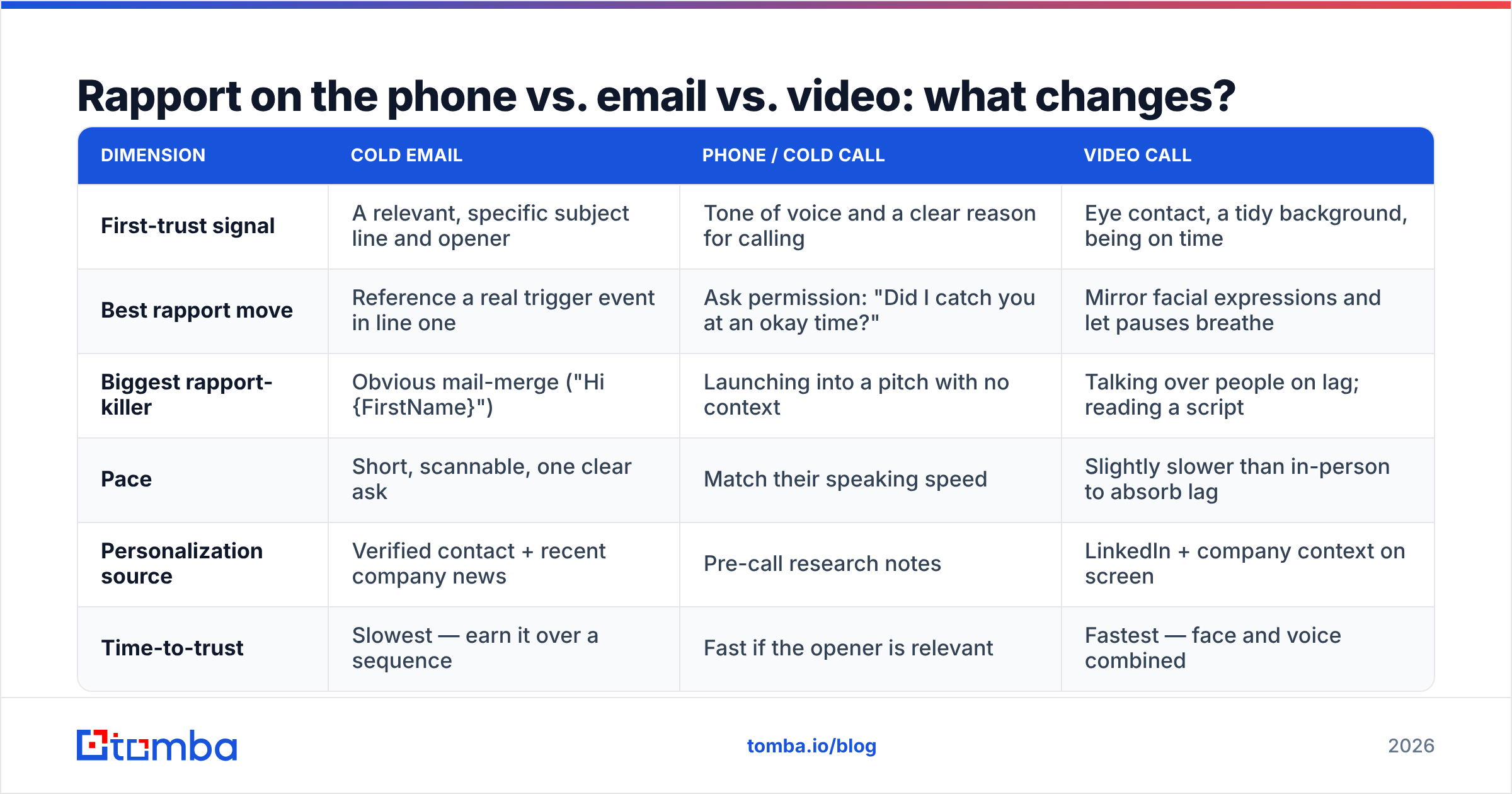
The principles are constant; the execution shifts by channel. Use the table below to match technique to medium.
| Dimension | Cold Email | Phone / Cold Call | Video Call |
|---|---|---|---|
| First-trust signal | A relevant, specific subject line and opener | Tone of voice and a clear reason for calling | Eye contact, a tidy background, being on time |
| Best rapport move | Reference a real trigger event in line one | Ask permission: "Did I catch you at an okay time?" | Mirror facial expressions and let pauses breathe |
| Biggest rapport-killer | Obvious mail-merge ("Hi {FirstName}") | Launching into a pitch with no context | Talking over people on lag; reading a script |
| Pace | Short, scannable, one clear ask | Match their speaking speed | Slightly slower than in-person to absorb lag |
| Personalization source | Verified contact + recent company news | Pre-call research notes | LinkedIn + company context on screen |
| Time-to-trust | Slowest — earn it over a sequence | Fast if the opener is relevant | Fastest — face and voice combined |
The strategic takeaway: email rapport is won in preparation, phone rapport is won in the first ten seconds, and video rapport is won by simply being present and human. Pick the channel that fits the buyer, not the one that fits your comfort zone. When you need to switch to a call, having a verified B2B phone number ready means you reach them instead of a dead extension — another small reliability signal that quietly builds trust.
How do you build rapport at scale without sounding like a robot?#
You separate what must be personal from what can be systematic. Rapport at scale is not about personalizing everything — it's about personalizing the right things and automating the rest.
Here's the operating model that works:
- Systematize the research. Use data tools and enrichment to gather the trigger, role, and verified contact automatically. Your time goes to interpreting the data, not hunting for it.
- Template the structure, personalize the substance. Your framework (problem → relevance → soft ask) can repeat. The specific problem and the specific relevance must be unique to each prospect.
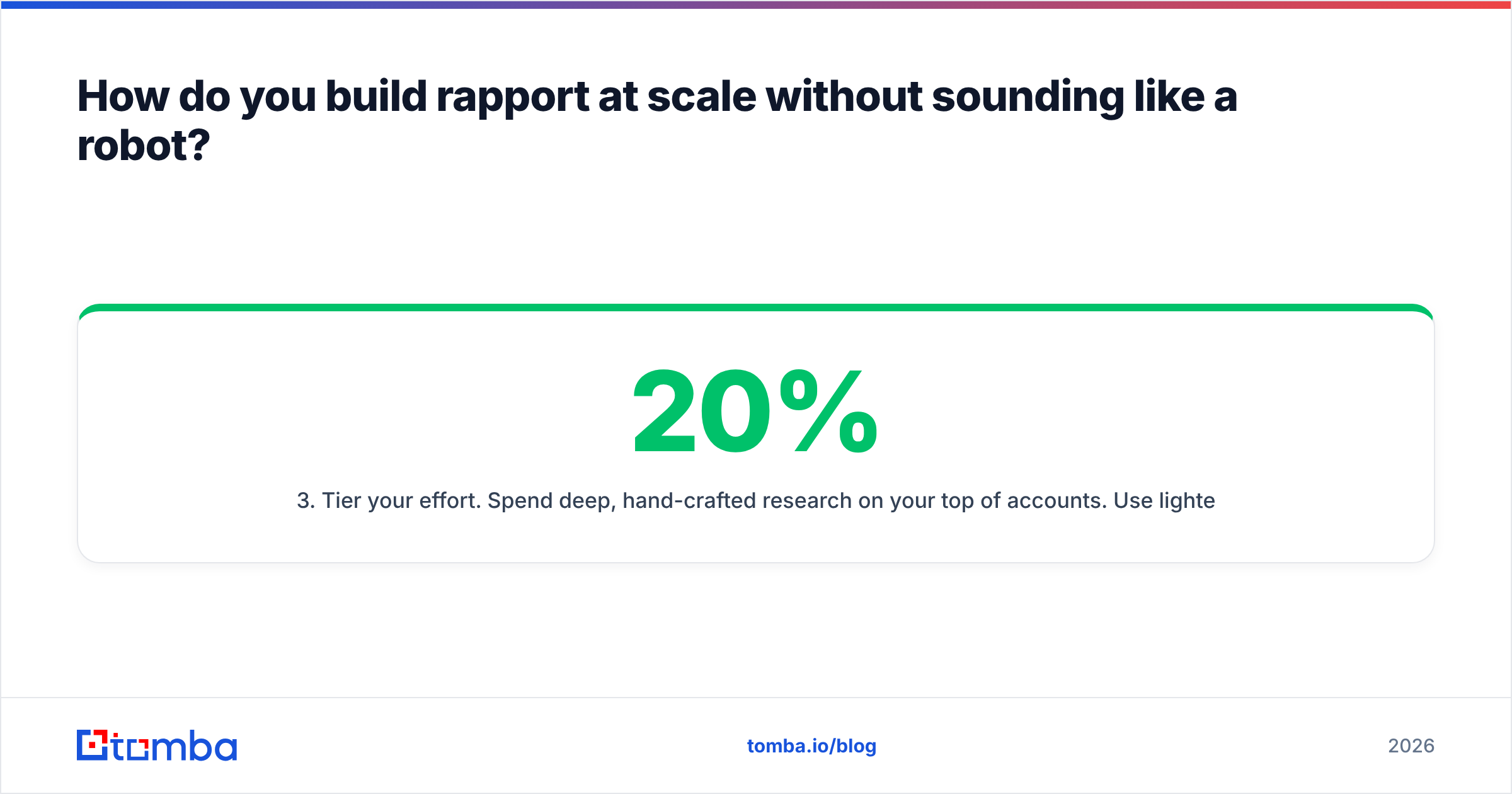
- Tier your effort. Spend deep, hand-crafted research on your top 20% of accounts. Use lighter, signal-based personalization on the rest. Don't give a $2k deal the same hours as a $200k one.
- Measure what builds trust. Track reply quality and meeting-hold rate, not just send volume. High activity with low rapport is just noise that burns your domain.
This is exactly where most teams break: they confuse volume with progress. Pairing a clean process with reliable data — verified emails, accurate roles, real triggers — lets you keep the human warmth while covering more ground. A platform like Tomba exists to handle that data layer so your reps spend their energy on the conversation, not the spreadsheet. Compare what fits your stack and budget on the Tomba pricing page; the free tier (25 searches/month) is enough to test the workflow before you commit.
For a broader playbook on cold outreach mechanics, HubSpot's sales blog is a solid, vendor-neutral reference, and G2's sales software category is useful for seeing how buyers themselves rate trust and accuracy across tools.
How do you measure whether your rapport is actually working?#
Stop guessing from "vibes" and watch behavioral signals. Rapport is invisible, but its effects are measurable.
Leading indicators that rapport is landing:
- Response depth. Do buyers reply with real information, or one-word brush-offs? Detailed replies mean trust.
- Meeting-hold rate. Booked meetings that actually happen (and aren't rescheduled three times) reflect genuine interest, not politeness.
- Volunteered information. When a prospect tells you about internal politics, budget timing, or a competing vendor unprompted, you've earned real rapport.
- Speed of access. How fast do they introduce you to other stakeholders? Quick intros mean they trust you in front of their peers.
Lagging indicators show up in your numbers: higher reply rates, shorter sales cycles, and a better win rate. If your rapport is strong, deals move faster because trust removes friction at every stage. If your meetings are pleasant but never advance, you have likability without rapport — warmth that isn't attached to value.
What are the biggest rapport mistakes to avoid?#
The fastest way to improve is to stop doing the obvious damage. Avoid these:
- Fake personalization. "I loved your recent post!" with no specifics is worse than saying nothing. Buyers smell it instantly.
- Rapport as a tax. Treating small talk as a box to check before the "real" pitch. Buyers can tell when you're performing interest.
- Over-mirroring. Copying someone's body language so obviously it becomes creepy. Subtlety only.
- Talking too much. The single most common error. If you finish a discovery call having talked more than the buyer, you didn't build rapport — you delivered a monologue.
- Bad data. Reaching the wrong person, the wrong company, or a dead inbox. No amount of charm survives a factual error in the first sentence.
That last point is why so many "rapport problems" are really data problems. You can run a flawless framework into the ground if the foundation — who you're talking to and how to reach them — is wrong.
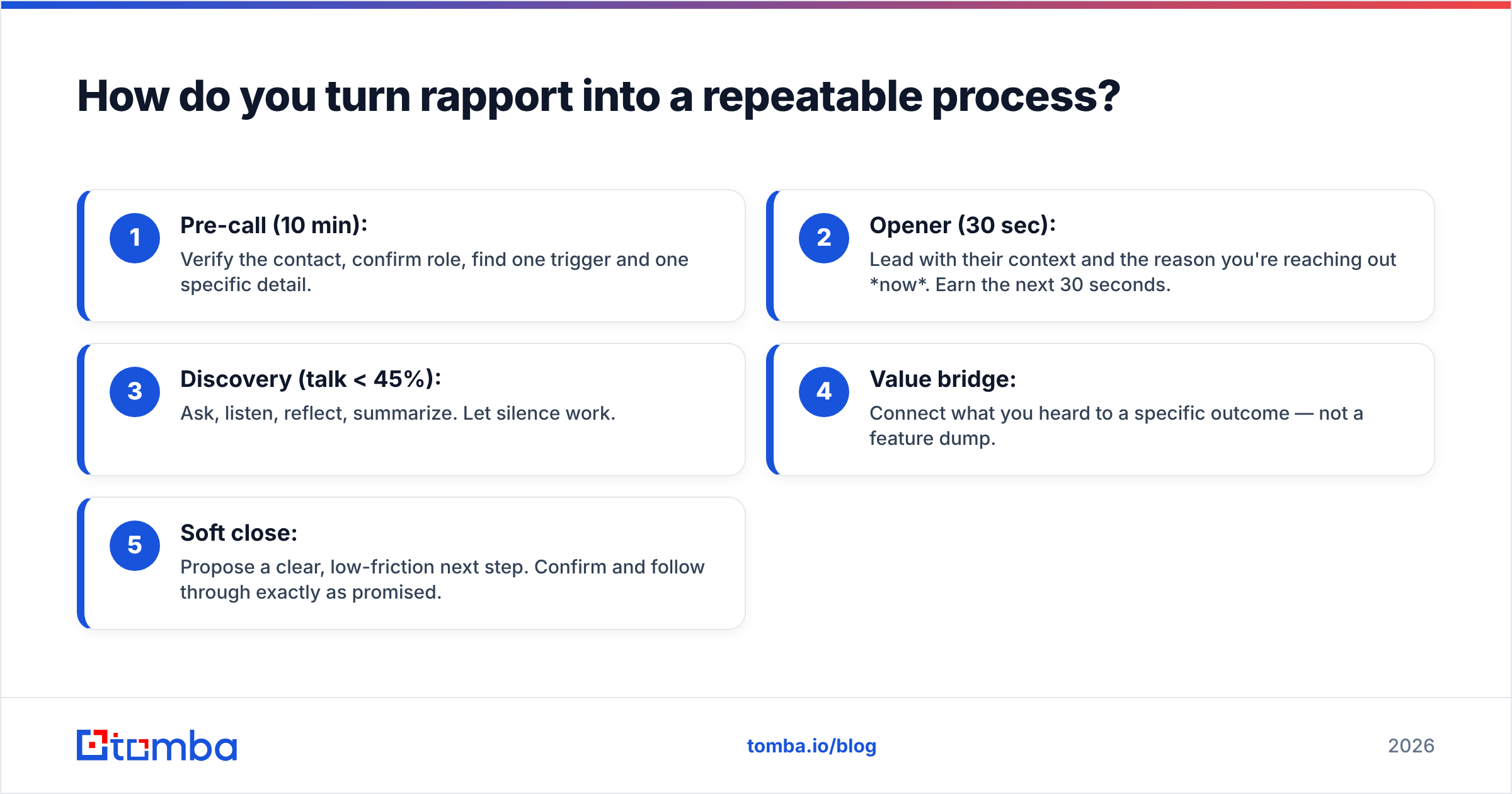
How do you turn rapport into a repeatable process?#
Codify it so every rep on your team does it the same way, every time. Charm doesn't scale; process does.
A simple, durable rapport playbook:
- Pre-call (10 min): Verify the contact, confirm role, find one trigger and one specific detail.
- Opener (30 sec): Lead with their context and the reason you're reaching out now. Earn the next 30 seconds.
- Discovery (talk < 45%): Ask, listen, reflect, summarize. Let silence work.
- Value bridge: Connect what you heard to a specific outcome — not a feature dump.
- Soft close: Propose a clear, low-friction next step. Confirm and follow through exactly as promised.
Drop that into your CRM as a checklist and you've turned a "soft skill" into an operational standard. The reps who win in 2026 aren't the most charismatic — they're the most prepared, the most relevant, and the most reliable. All three are learnable, and all three start with knowing exactly who you're talking to.
Where Tomba fits#
Rapport is human work, but it runs on accurate data. Before you craft the perfect opener, you need to know you're reaching the right decision-maker at the right company — with an address that actually delivers. That's the foundation everything else stands on.
Tomba's Email Finder gives you verified, decision-maker contacts by domain, name, or company, so every thoughtful, personalized message you send lands in a real inbox instead of bouncing into the void. Start free with 25 searches a month, build your prospect list on solid ground, and spend your energy where it counts — on the conversation, not the contact hunt. Trust is built one accurate, relevant touch at a time. Give yourself the data to earn it.
// get started
Find, verify and enrich your first contacts today
Start on the free plan with 25 searches a month, then scale when your team is ready.
Free plan · No credit card required · GDPR & CCPA
// about the author