Building Sales Relationships in 2026: A Practical Playbook
Quotas reward closing, but pipeline is built on trust. Here is a concrete, repeatable system for building sales relationships that survive the next budget cut.
TL;DR
- Building sales relationships is a system, not a personality trait. Reps who treat trust as a repeatable process out-renew the "natural" closers every time.
- The order matters: research, relevance, and reciprocity come before any ask. Pitching on the first touch is the fastest way to kill a relationship.
- Bad data quietly poisons rapport. A wrong name or a bounced email signals "you don't know me," so accurate contact data is a relationship asset, not a back-office detail.
- Multi-threading — building three to five relationships per account — is the single biggest predictor of deals that survive a champion leaving.
- The metrics that predict revenue are leading ones: response rate, meeting-held rate, and multi-thread count, not just closed-won.
What does "building sales relationships" actually mean?#
Building sales relationships means earning enough trust that a buyer chooses to keep talking to you when they have no obligation to. That is the whole game. Everything else — discovery calls, demos, proposals — only happens because someone decided you were worth their time twice.
Think of it like a bank account. Every relevant insight, every kept promise, every time you make the buyer look smart to their boss is a deposit. Every generic pitch, every "just checking in" email, every missed follow-up is a withdrawal. Reps who overdraw the account wonder why nobody returns their calls. Reps who keep a positive balance get the inbound reply six months later that turns into a six-figure deal.
The mistake most teams make is treating relationships as the soft, unmeasurable part of selling. It is not soft. It is the most measurable thing you do, because trust shows up as response rates, meeting-held rates, and renewal numbers. If those are weak, your relationships are weak — no matter how friendly the calls feel.
Why do most sales relationships fail before they start?#
Most relationships die on the first touch because the rep made it about themselves. The opening message is a product paragraph, the name is misspelled, and the "personalization" is a merge tag that didn't fire. The buyer's takeaway is simple: this person doesn't know me, and they want something.
Three failure patterns show up again and again:
- Premature asking. Requesting 30 minutes before you've given a single reason to care. The ask-to-give ratio is inverted.
- Generic relevance. "I saw your company is growing" applies to everyone, which means it lands with no one. Real relevance is specific to this person's role and this quarter's problem.
- Data decay. Roughly 30% of B2B contact data goes stale every year as people change jobs. Emailing a contact who left eight months ago, or addressing them by the wrong title, is an instant trust withdrawal you never see happen.
That last one is underrated. You can have perfect messaging and still torch credibility because your CRM is wrong. Getting the basics right — correct person, correct spelling, deliverable email — is table stakes for being taken seriously. A clean email verifier pass before a campaign is cheaper than the reputation cost of a wave of bounces.
What is the framework for building sales relationships that last?#
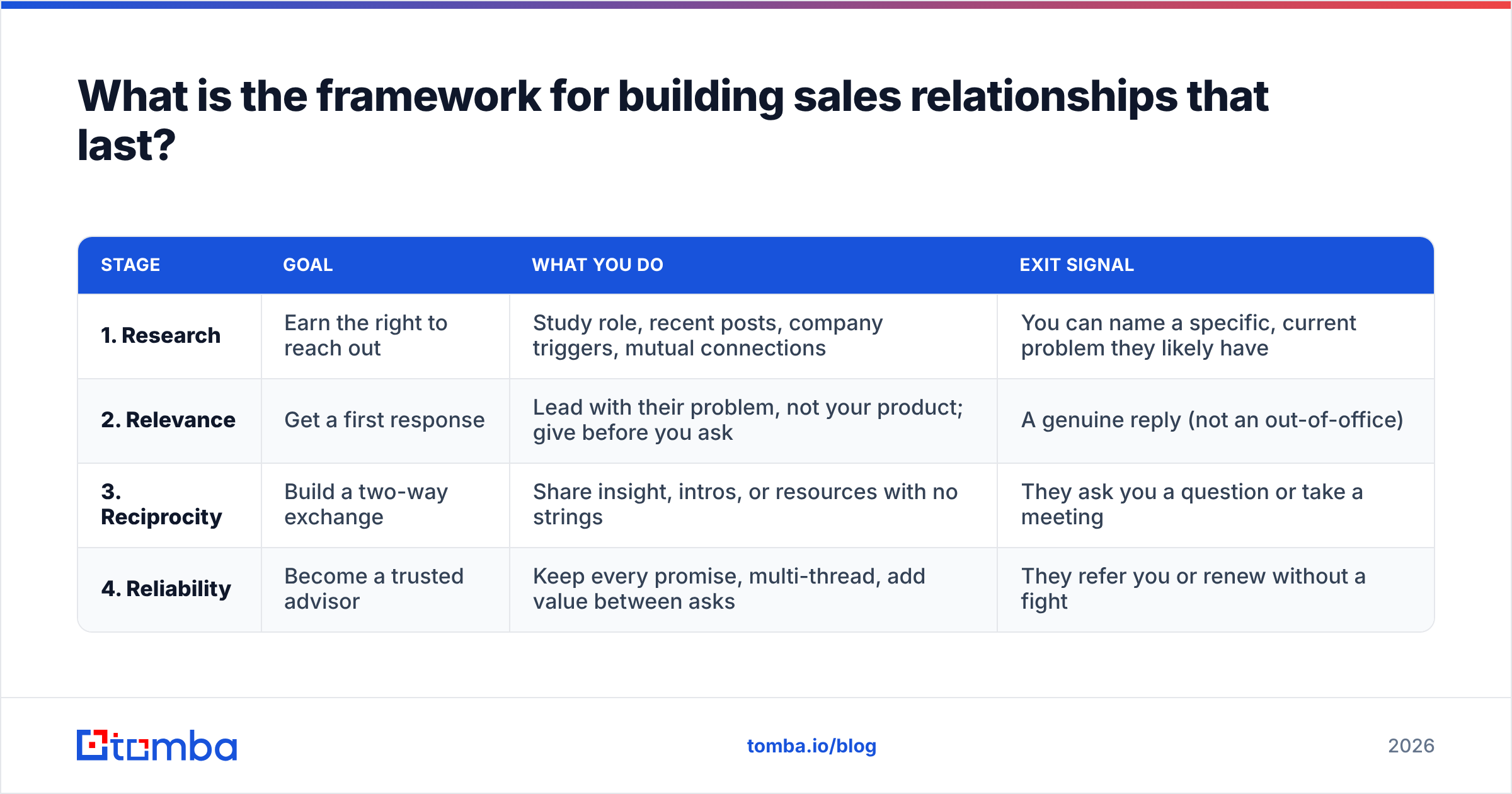
Use a four-stage model. Each stage has an entry condition and an exit signal, so you always know where a relationship actually stands instead of guessing.
| Stage | Goal | What you do | Exit signal |
|---|---|---|---|
| 1. Research | Earn the right to reach out | Study role, recent posts, company triggers, mutual connections | You can name a specific, current problem they likely have |
| 2. Relevance | Get a first response | Lead with their problem, not your product; give before you ask | A genuine reply (not an out-of-office) |
| 3. Reciprocity | Build a two-way exchange | Share insight, intros, or resources with no strings | They ask you a question or take a meeting |
| 4. Reliability | Become a trusted advisor | Keep every promise, multi-thread, add value between asks | They refer you or renew without a fight |
The reason this works is that it forces patience in the exact place reps lose deals. Most jump from Research straight to asking for the meeting, skipping Relevance and Reciprocity entirely. The framework makes those middle stages non-optional.
A few principles that hold across all four stages:
- Give three times before you ask once. Insight, an introduction, a relevant article, a tag in a useful post — deposits before withdrawals.
- Be specific or be silent. If your "personalization" could be copy-pasted to another prospect, it isn't personalization.
- Make the buyer the hero. Your job is to make them look good internally, not to make yourself look impressive.
- Keep every micro-promise. "I'll send that Tuesday" sent Tuesday builds more trust than any pitch deck.
How do you research a prospect without spending all day?#
Spend ten focused minutes, not an hour. The goal of research is one specific, current hook — not a dossier. Over-researching is procrastination dressed up as diligence.
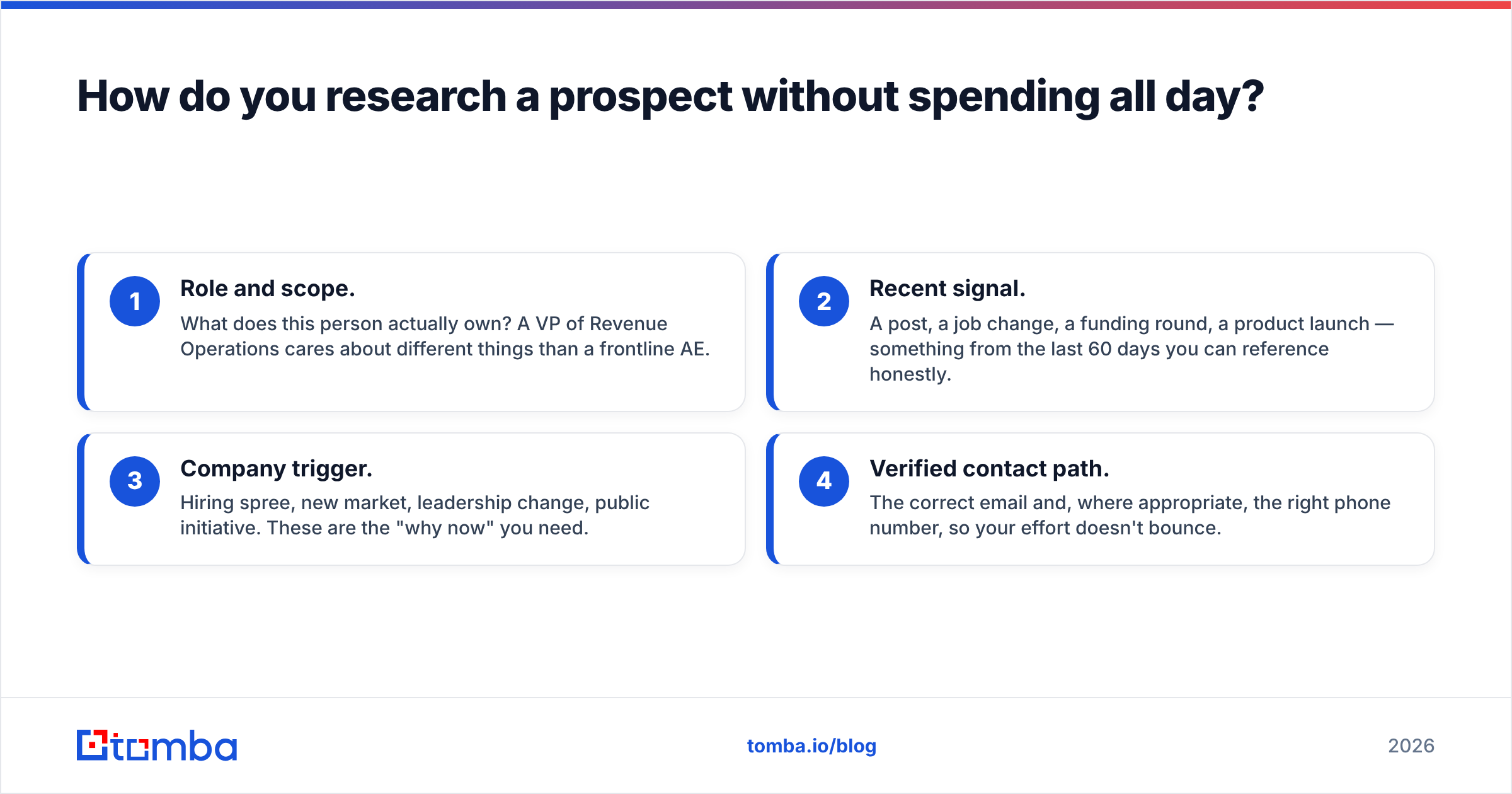
Here is a tight pre-outreach checklist:
- Role and scope. What does this person actually own? A VP of Revenue Operations cares about different things than a frontline AE.
- Recent signal. A post, a job change, a funding round, a product launch — something from the last 60 days you can reference honestly.
- Company trigger. Hiring spree, new market, leadership change, public initiative. These are the "why now" you need.
- Verified contact path. The correct email and, where appropriate, the right phone number, so your effort doesn't bounce.
That last step is where tooling earns its keep. Finding the right person and a deliverable address by domain takes seconds with a good email finder, and pairing it with data enrichment fills in the title, seniority, and company context that make your opener specific instead of generic. The research is only as good as the contact it's attached to.
A useful gut check: if you can't write one sentence that starts with "I noticed you specifically..." and means it, you haven't done enough research. If you can, you're ready to reach out.
Is multi-threading worth the extra effort?#
Yes — multi-threading is the highest-leverage relationship habit in B2B, full stop. A single-threaded deal is one reorg away from dead. When your only champion takes a new job, the deal you forecasted at 80% evaporates, and you never even get the courtesy of a no.
Multi-threading means building real relationships with three to five people per account: the champion, the economic buyer, one or two influencers, and ideally a coach who tells you what's happening behind the scenes. According to research summarized by sales-methodology firms and echoed across Gartner buying-group studies, the typical B2B purchase now involves six to ten decision-makers. Selling to one of them and hoping is not a strategy.
The practical move: every time you book a meeting, ask "who else is affected by this decision, and would it help to bring them in?" Then find and verify those additional contacts so you can reach them directly instead of waiting for a forwarded email that never comes. A domain search surfaces the full org around your champion in one pass, which turns "I should multi-thread someday" into something you can actually do this afternoon.
How does data quality affect trust?#
Data quality is trust at the top of the funnel. Before a buyer knows anything about your product, they judge you on whether you got the small things right. Wrong name, wrong company, dead email — each one whispers "low effort." Get them right, and you've cleared the bar most of your competitors trip over.
Here's the chain reaction bad data sets off:
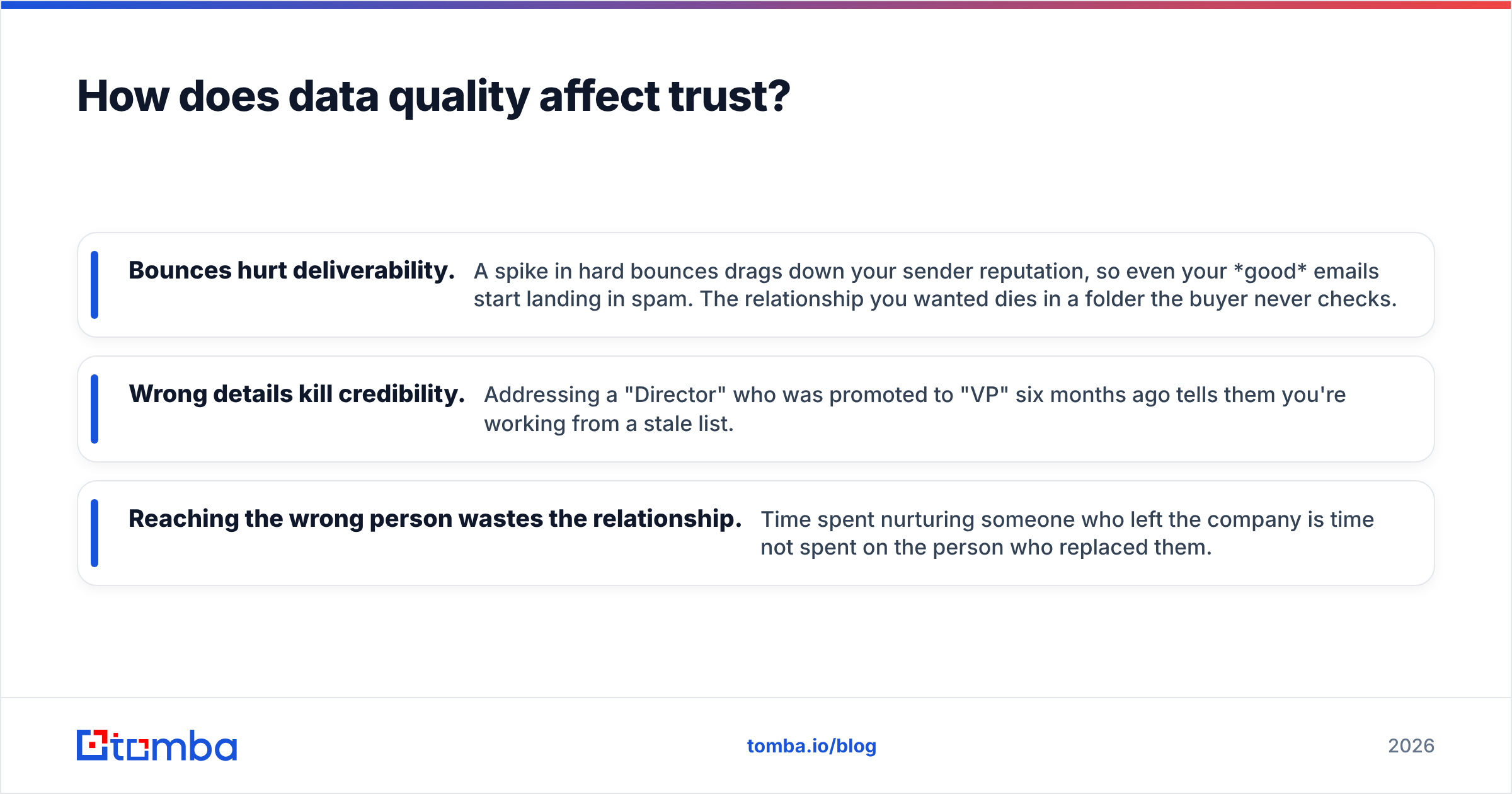
- Bounces hurt deliverability. A spike in hard bounces drags down your sender reputation, so even your good emails start landing in spam. The relationship you wanted dies in a folder the buyer never checks.
- Wrong details kill credibility. Addressing a "Director" who was promoted to "VP" six months ago tells them you're working from a stale list.
- Reaching the wrong person wastes the relationship. Time spent nurturing someone who left the company is time not spent on the person who replaced them.
This is why relationship-building and data hygiene are the same discipline, not separate ones. Run new contacts through verification before the first send, re-verify your active pipeline quarterly, and treat a bounce as a signal to refresh — not just to delete. Tools like a bulk email finder make it realistic to keep an entire account list current instead of fixing records one painful row at a time.
What tools and cadence support relationship-building?#
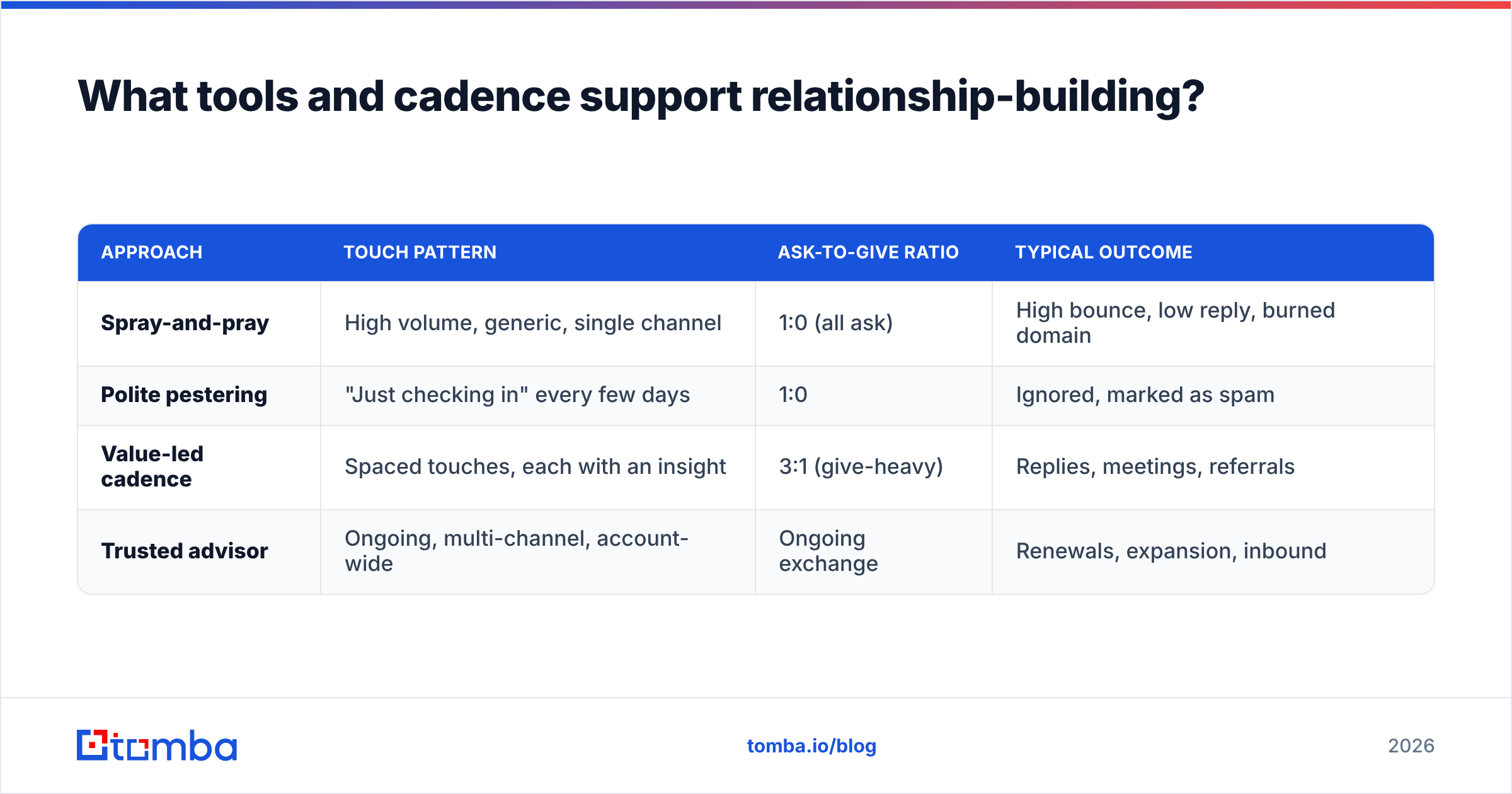
Relationships scale through rhythm, not heroics. The reps who stay top-of-mind aren't sending more — they're sending reliably, across channels, with value attached. Here's a comparison of cadence styles so you can see why the value-led approach wins.
| Approach | Touch pattern | Ask-to-give ratio | Typical outcome |
|---|---|---|---|
| Spray-and-pray | High volume, generic, single channel | 1:0 (all ask) | High bounce, low reply, burned domain |
| Polite pestering | "Just checking in" every few days | 1:0 | Ignored, marked as spam |
| Value-led cadence | Spaced touches, each with an insight | 3:1 (give-heavy) | Replies, meetings, referrals |
| Trusted advisor | Ongoing, multi-channel, account-wide | Ongoing exchange | Renewals, expansion, inbound |
A workable value-led cadence over three weeks looks like: a researched email, a relevant LinkedIn engagement, a second email sharing an insight or resource, a soft check on whether the problem is a priority, and then a direct meeting ask. Mix channels — email plus LinkedIn outreach plus the occasional call — because different buyers live in different places.
On the stack itself: keep it lean. You need a way to find and verify contacts, a CRM to remember every promise, and one outreach tool to sequence touches. The connective tissue matters more than any single app, so make sure your finder and verifier push clean records straight into your CRM — Tomba's HubSpot integration and Salesforce integration exist so the right data lands where you work without copy-paste. If you want to benchmark options, independent reviews on G2 are a more honest signal than any vendor's own page, including ours.
Which metrics tell you if relationships are improving?#
Track leading indicators, because closed-won tells you about relationships you built months ago — too late to coach. The metrics below tell you whether this week's relationships are healthy.
- Response rate. The cleanest measure of whether your relevance is landing. Rising means your research and messaging are working.
- Meeting-held rate. Booked-but-no-show signals weak trust; held meetings mean the relationship is real enough to honor.
- Multi-thread count per account. Average contacts engaged per open deal. Push this from one toward three-plus.
- Reply sentiment and referrals. Are buyers introducing you to colleagues? That's the highest-trust signal there is.
- Data freshness. Percentage of your active pipeline verified in the last 90 days. Stale data is a leading indicator of future bounces and dead deals.
Review these monthly. If response rate is flat, fix relevance. If multi-thread count is stuck at one, your deals are fragile regardless of how warm they feel. Numbers keep you honest in a discipline where it's easy to mistake friendliness for progress.
Start building relationships that actually close#
Trust compounds, but only if the foundation is real: the right person, a deliverable email, a specific reason to care, and a promise kept. Get those right and the cadences, demos, and proposals do their job. Get them wrong and no amount of charm saves the deal.
Start where most relationships break — at first contact. The Tomba Email Finder gives you the verified, accurately-spelled, role-correct contact details that let your outreach say "I know exactly who you are" instead of bouncing into a spam folder. Pair it with verification and enrichment, and you turn cold lists into the kind of pipeline that renews. Check the Tomba pricing plans — including a free tier with 25 searches a month — and build your next relationship on data you can trust.
// get started
Find, verify and enrich your first contacts today
Start on the free plan with 25 searches a month, then scale when your team is ready.
Free plan · No credit card required · GDPR & CCPA
// about the author