Bulk Lead Generation in 2026: Tools, Tactics & Pitfalls
Bulk lead generation done right fills your pipeline fast without torching deliverability. Here's the 2026 workflow, tools, and the mistakes that waste credits.
TL;DR
- Bulk lead generation means building and enriching contact lists at scale — hundreds or thousands at a time — instead of researching prospects one by one.
- The volume is worthless if the data is dirty. Bounce rates above 3-5% drag down sender reputation and can blacklist your domain.
- The modern workflow is a four-step loop: source by domain, enrich, verify in batch, then export to your sequencer or CRM.
- Tooling matters more than effort. A bulk email finder with native verification beats stitching together five disconnected apps.
- Quality gates — catch-all detection, de-duplication, and role-account filtering — are what separate a list that converts from one that gets you flagged as spam.
What is bulk lead generation?#
Bulk lead generation is the process of building large, structured lists of qualified contacts in batches rather than hunting for prospects individually. Think of it like fishing with a net instead of a single rod: you still want the right fish, but you're pulling them in by the school.
In practice, you start with a defined target — a list of company domains, a job-title filter, an industry segment — and run it through tools that return names, verified email addresses, phone numbers, and firmographic data for everyone who matches. A rep doing manual research might find 20-30 contacts a day. A bulk workflow returns thousands in an afternoon.
The catch is that scale amplifies both good and bad decisions. If your targeting is sharp and your data is clean, bulk generation fills your pipeline fast. If your targeting is loose or your list is full of stale and guessed addresses, you've just built a machine for burning your domain reputation at industrial speed.

Why does bulk lead generation matter in 2026?#
Three forces make batch sourcing more important — and more dangerous — than it was a few years ago.
- Inbox providers got stricter. Google and Yahoo now enforce authentication and bounce thresholds that punish sloppy senders. A dirty bulk list will tank your email deliverability before your offer ever gets read.
- Buying committees grew. The average B2B deal now involves multiple stakeholders, so you need more verified contacts per account, not fewer. Bulk sourcing by domain is the only efficient way to map a full buying group.
- AI raised the floor on personalization. When everyone can generate a decent first line, the differentiator is reaching the right person with a valid address. Volume without accuracy just means more personalized bounces.
The takeaway: bulk lead generation in 2026 is less about raw quantity and more about clean, verified quantity. The teams winning are the ones who treat list hygiene as a first-class step, not an afterthought.
How does the bulk lead generation workflow actually work?#
The reliable workflow is a repeatable four-stage loop. Skipping any stage is where most lists go wrong.
- Stage 1 — Source. Start from company domains or a search filter. Use domain search to pull every public email pattern and contact at a target company, or upload a domain list to a bulk tool to fan out across hundreds of accounts at once.
- Stage 2 — Enrich. Layer on the data you actually need to segment and personalize: job title, seniority, department, company size, location, and phone. Data enrichment turns a bare email into a usable lead record.
- Stage 3 — Verify. Run the whole batch through an email verifier before anyone touches a send button. This is the non-negotiable step. Verification removes invalid, deactivated, and high-risk addresses so your bounce rate stays under provider limits.
- Stage 4 — Export. Push the cleaned, enriched list into your sequencer or CRM. De-duplicate against existing records first so you don't re-contact open deals or annoy current customers.
Run this loop on a cadence — weekly or per campaign — and your pipeline becomes a system instead of a scramble.
What should you look for in a bulk lead generation tool?#
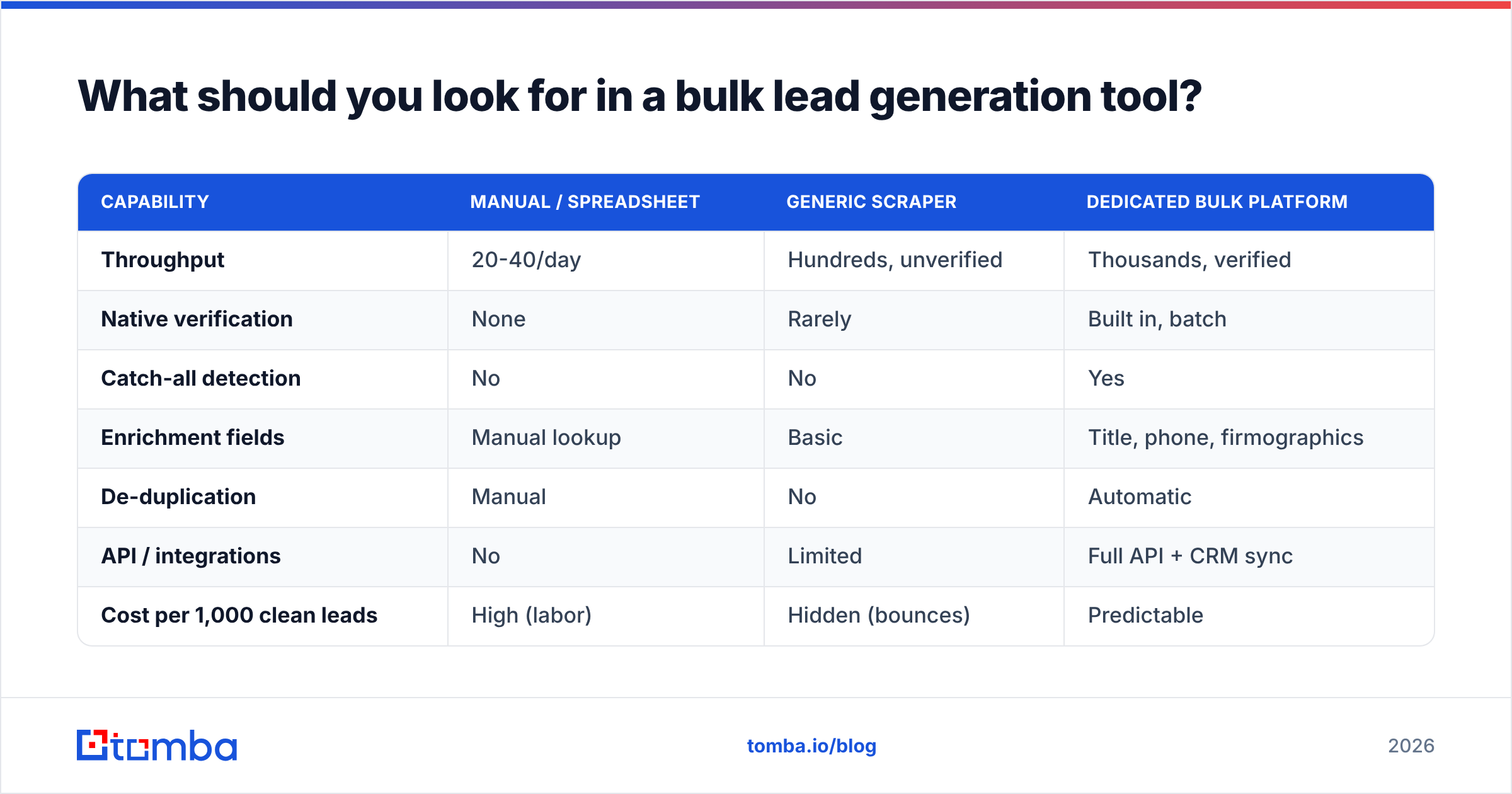
Not all "bulk" features are equal. Some tools dump raw, unverified guesses and call it a list. Here's the comparison that matters when you evaluate options against a dedicated platform like Tomba.
| Capability | Manual / spreadsheet | Generic scraper | Dedicated bulk platform |
|---|---|---|---|
| Throughput | 20-40/day | Hundreds, unverified | Thousands, verified |
| Native verification | None | Rarely | Built in, batch |
| Catch-all detection | No | No | Yes |
| Enrichment fields | Manual lookup | Basic | Title, phone, firmographics |
| De-duplication | Manual | No | Automatic |
| API / integrations | No | Limited | Full API + CRM sync |
| Cost per 1,000 clean leads | High (labor) | Hidden (bounces) | Predictable |
The column that wins is the one where verification, enrichment, and de-duplication live under one roof. Every handoff between disconnected tools is a place where data gets stale or lost. A platform that combines sourcing with a built-in email verifier and a documented Tomba API removes those seams.
For a broader market view, independent review sites like G2 catalog dozens of lead-intelligence vendors with verified user ratings — useful when you want to cross-check accuracy claims against real buyers.
How do you keep a bulk list clean?#
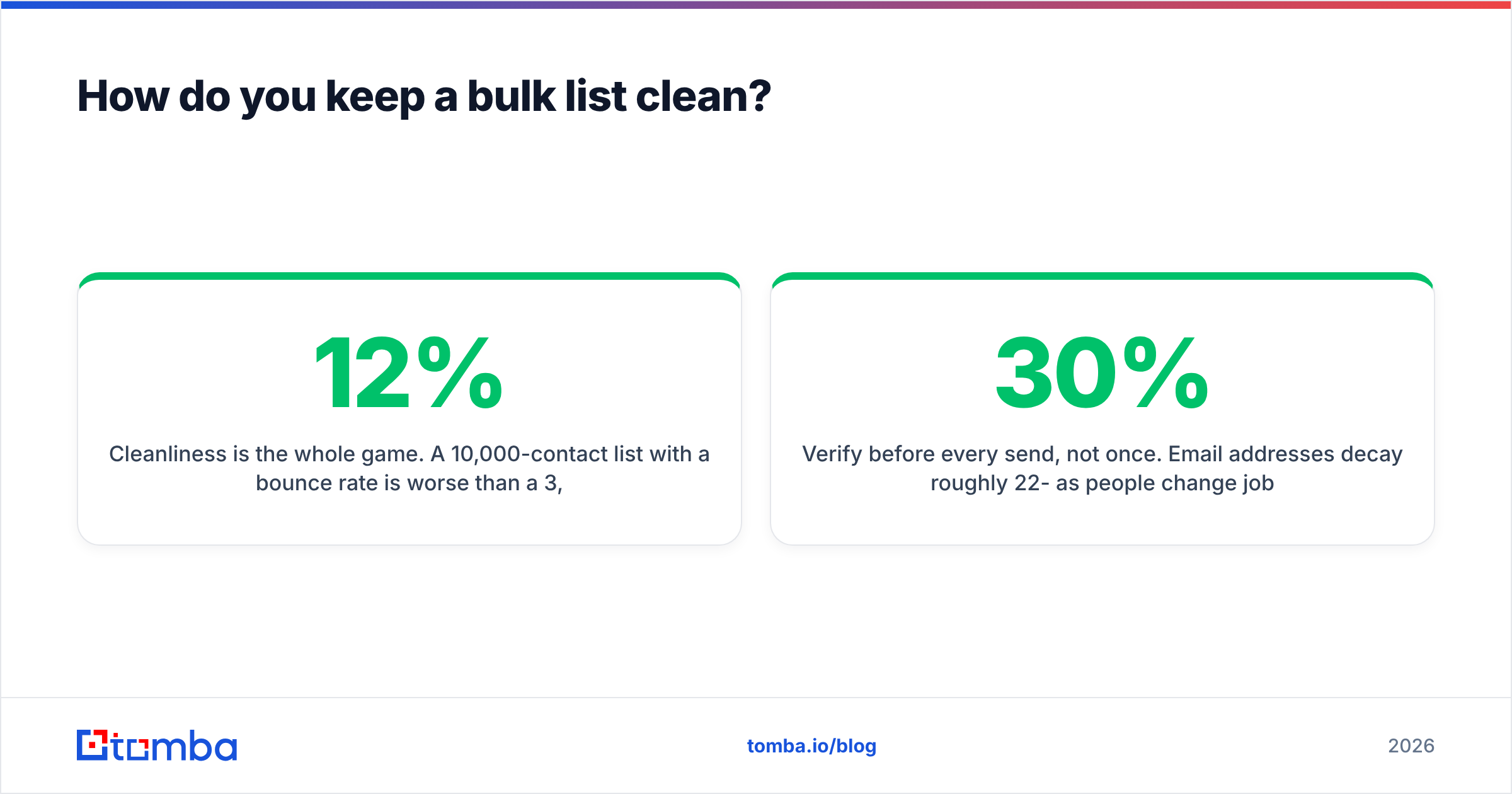
Cleanliness is the whole game. A 10,000-contact list with a 12% bounce rate is worse than a 3,000-contact list with a 1% bounce rate, because the dirty list damages the reputation that delivers all your future mail. Here are the quality gates that keep bulk lists healthy.
- Verify before every send, not once. Email addresses decay roughly 22-30% per year as people change jobs. A list verified six months ago is already partly invalid. Re-verify before each campaign.
- Detect catch-all domains. Catch-all servers accept every address, so a standard verification can't confirm a real inbox. Use a dedicated catch-all verifier to score these separately instead of trusting or blindly trashing them.
- Strip role accounts. Addresses like info@, sales@, and admin@ inflate your count but rarely belong to a buyer. Filter them unless the role is your actual target.
- De-duplicate across sources. When you pull from multiple lists, the same contact appears more than once. Dedupe on email and on company+name to catch alias variations.
- Segment by confidence score. Good tools return a confidence or quality score per address. Send to high-confidence contacts first; route uncertain ones to a slower, lower-risk warmup sequence.
Treat these as a checklist that runs on every batch. Automating them is the difference between a list that compounds your reputation and one that quietly erodes it.

What are the biggest bulk lead generation mistakes?#
Most failures trace back to prioritizing volume over hygiene. Watch for these.
Buying static databases and blasting them. Pre-packaged lists are sold to everyone, are often months stale, and frequently violate consent rules. If you do use a B2B database, treat it as a source to verify and enrich, never as a ready-to-send list.
Ignoring authentication. No amount of list quality saves you if your domain lacks SPF, DKIM, and DMARC. Set up your records before scaling volume — providers check them on every message. HubSpot's research on email deliverability is a solid primer on the sender-reputation fundamentals that bulk senders break most often.
Sending from your primary domain at full volume on day one. Ramp gradually. A new sending domain that suddenly pushes 5,000 emails looks exactly like a spammer to filtering systems.
Skipping verification to save credits. This is the most expensive "savings" in outbound. Every bounce costs you reputation that's far more valuable than the verification credit you skipped.
Treating phone as an afterthought. Multi-channel sequences convert better. Pulling B2B phone numbers with a phone finder during the same enrichment pass means you're not rebuilding the list later for cold calling.
How much should bulk lead generation cost?#
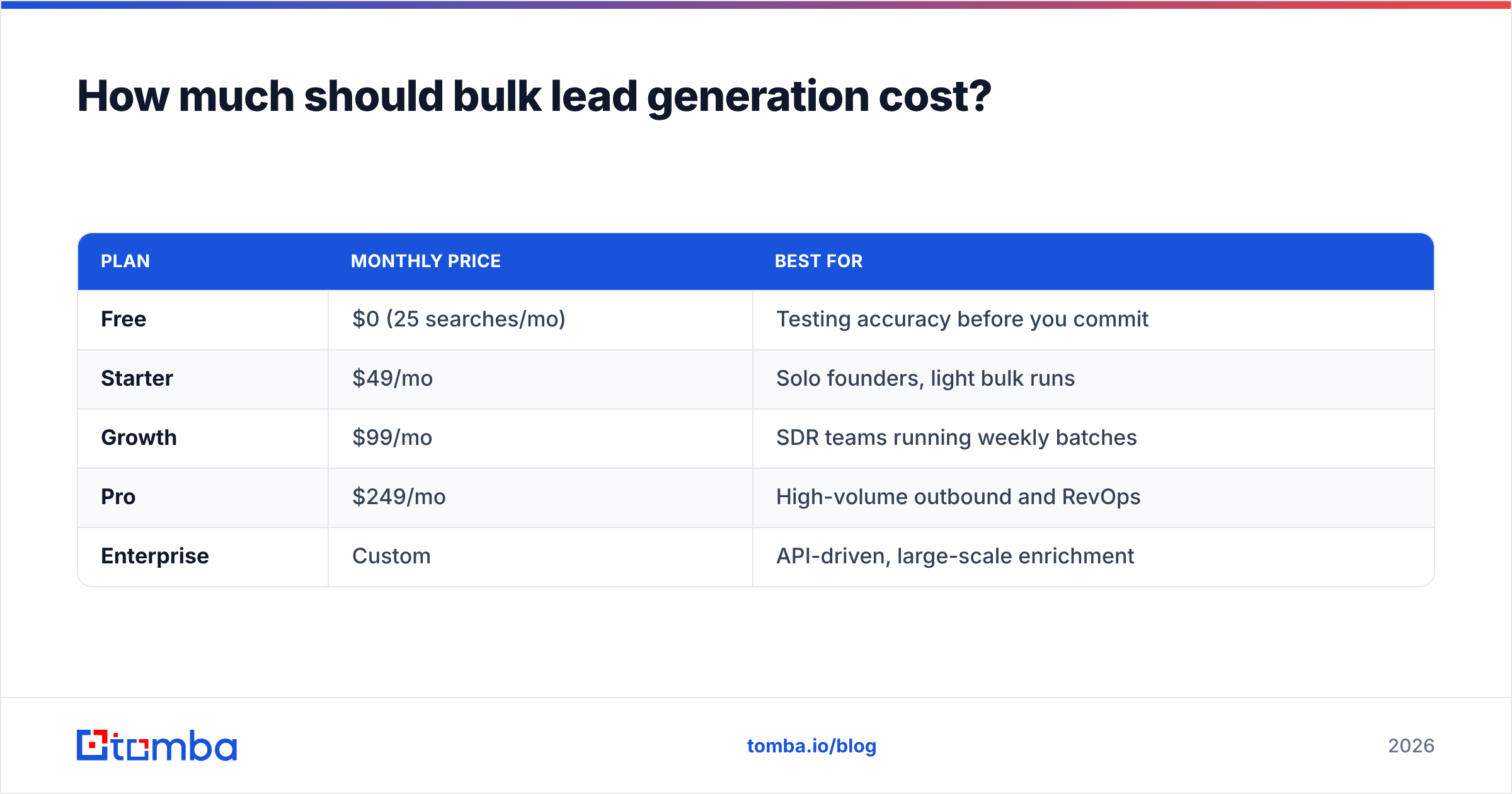
Pricing should be predictable and tied to verified output, not raw guesses. The trap is paying for volume that bounces. Here's how transparent, credit-based pricing typically scales — using Tomba pricing as the reference point.
| Plan | Monthly price | Best for |
|---|---|---|
| Free | $0 (25 searches/mo) | Testing accuracy before you commit |
| Starter | $49/mo | Solo founders, light bulk runs |
| Growth | $99/mo | SDR teams running weekly batches |
| Pro | $249/mo | High-volume outbound and RevOps |
| Enterprise | Custom | API-driven, large-scale enrichment |
The number to watch isn't the headline price — it's the cost per thousand verified, deliverable leads. A cheap tool that returns 40% invalid addresses is more expensive than a mid-tier platform that returns 95% deliverable ones, because you pay the difference in burned reputation and wasted sequencer slots. Start on the free tier, measure real bounce rates on a sample, then scale the plan to your verified throughput.
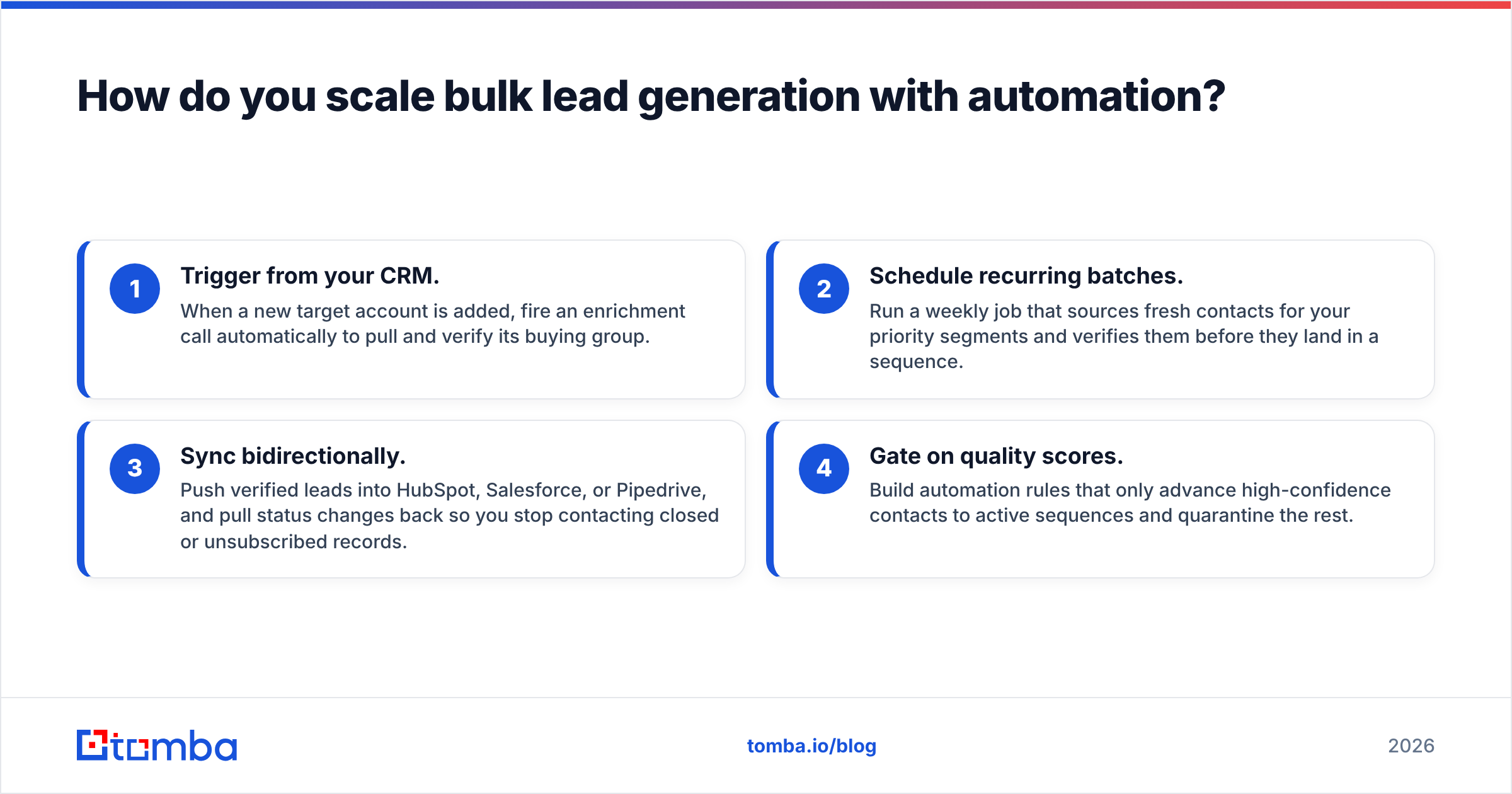
How do you scale bulk lead generation with automation?#
Once the manual loop works, automate it so list-building runs without a human in the loop for every batch.
- Trigger from your CRM. When a new target account is added, fire an enrichment call automatically to pull and verify its buying group.
- Schedule recurring batches. Run a weekly job that sources fresh contacts for your priority segments and verifies them before they land in a sequence.
- Sync bidirectionally. Push verified leads into HubSpot, Salesforce, or Pipedrive, and pull status changes back so you stop contacting closed or unsubscribed records.
- Gate on quality scores. Build automation rules that only advance high-confidence contacts to active sequences and quarantine the rest.
The Tomba API handles each of these as programmatic calls, so your bulk workflow becomes infrastructure rather than a manual chore. For teams without engineering bandwidth, native integrations and no-code connectors cover the same ground.
The underlying principle is simple: automate the mechanics of sourcing and verifying, but keep human judgment on targeting. The machine should never decide who your ideal customer is — only execute the search and hygiene once you've defined it.
Is bulk lead generation right for your team?#
Bulk lead generation pays off when you have a clearly defined ideal customer profile and a repeatable outbound motion. If your targeting is still fuzzy, scaling volume just scales the noise — tighten your ICP first, then turn on the net.
The honest summary: bulk sourcing is a force multiplier, not a strategy. It makes a good outbound system faster and a bad one fail faster. The teams that win in 2026 pair high-volume sourcing with ruthless list hygiene — verify before every send, detect catch-alls, dedupe, and ramp sending volume gradually.
Get those fundamentals right and a bulk workflow becomes the most reliable, lowest-cost channel for filling your pipeline. Get them wrong and you'll spend more rebuilding your sender reputation than you ever saved on speed.
Start building cleaner lists today#
If you want bulk volume without the bounce risk, start with the Tomba Email Finder. Upload a domain list, fan out across every target account, enrich with titles and phone numbers, and run the whole batch through built-in verification before a single message goes out. The free tier gives you 25 searches to test accuracy on your own segments — measure the deliverable rate yourself, then scale to the plan that matches your verified throughput. Build the list once, build it clean, and let your pipeline compound.
Ready to find emails that actually work?
Join 150,000+ professionals who stopped guessing and started sending. Free credits on signup — no credit card required.
Get the Tomba newsletter
Practical outbound tactics and product updates — once every two weeks.
About the author