Bump Email: How to Write Follow-Ups That Get Replies (2026)
A bump email is the short follow-up that revives a dead thread. Learn when to send one, what to write, and templates that actually get replies in 2026.
(title rendered separately)
You sent a great email. Then nothing. No reply, no rejection, just silence. A bump email is the short, low-friction follow-up that drops back into that quiet thread and gives the prospect an easy reason to respond. Done right, it's the cheapest reply you'll ever earn. Done wrong, it's the fastest way to get muted.
TL;DR#
- A bump email is a brief reply to your own previous message that "bumps" the thread back to the top of the inbox without restating your whole pitch.
- The best bumps are 1–3 sentences, sent 2–4 business days after the prior email, and add a reason to reply rather than just saying "just following up."
- Most replies come from follow-ups, not the first send — sequences of 4–6 touches consistently outperform single sends.
- Reply in the same thread (so context carries) and change one variable each time: angle, proof, or ask.
- None of it works if the address is wrong. Verified contact data is the prerequisite for any bump email to land.
What is a bump email?#
A bump email is a follow-up that replies to your original message in the same thread, nudging it back to the top of the recipient's inbox. The name comes from forum culture, where users would post "bump" to push a thread back to page one. In sales and outreach, the mechanics are identical: you re-surface a conversation that got buried, without forcing the reader to scroll back and re-read everything.
The key difference between a bump and a generic follow-up is intent and length. A follow-up can be a fresh, long message. A bump is deliberately short and casual — it assumes the prospect is busy, not uninterested, and it lowers the cost of replying to near zero.
Here's the everyday analogy: a bump email is like tapping a coworker on the shoulder after you left a sticky note on their desk yesterday. You're not re-explaining the note. You're just saying "hey, did you see this?" in a way that's quick to answer.
Why do bump emails work so well?#
Three reasons, all backed by how inboxes actually behave:
- Recency wins attention. Inboxes are reverse-chronological. A two-day-old email is functionally invisible. A bump physically moves it back into view.
- Most buyers ignore the first touch. Plenty of interested prospects never reply to email #1 because of timing, workload, or a missed notification — not disinterest. Follow-ups catch them on a better day.
- Persistence signals seriousness. A tasteful, well-spaced bump shows you're organized and confident, not desperate. That subtly raises the perceived value of what you're offering.
The data agrees. HubSpot's research on sales outreach consistently shows that a majority of positive replies arrive after the first email, and that reps who stop at one or two touches leave most of their pipeline on the table. You can read more in HubSpot's sales follow-up guidance. The takeaway is blunt: if you send one email and quit, you're choosing to lose deals that were winnable.
When should you send a bump email?#
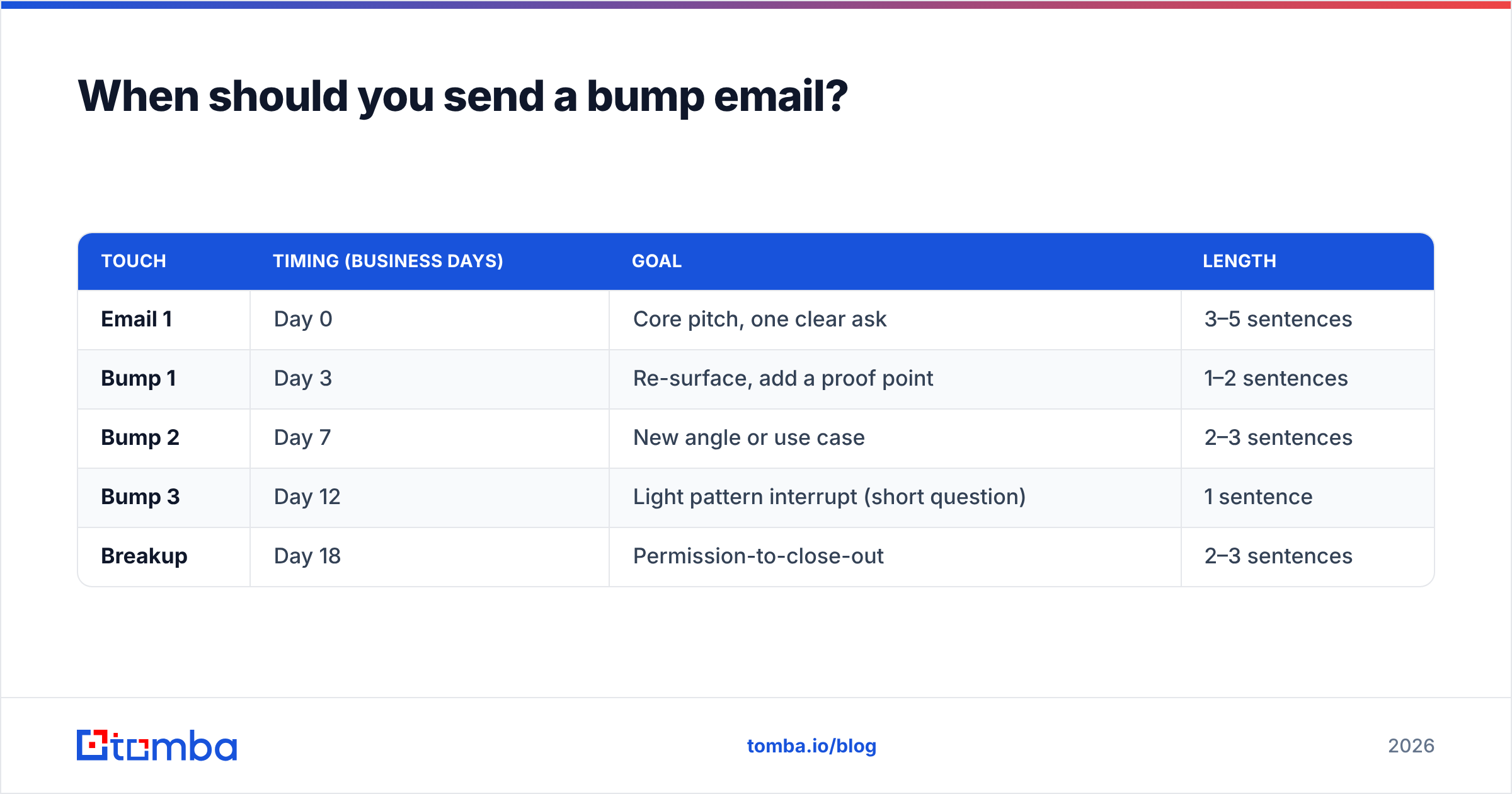
Timing is the lever most people get wrong. Send too soon and you look needy; wait too long and the context is cold. Here's a sane default cadence for a B2B sequence:
| Touch | Timing (business days) | Goal | Length |
|---|---|---|---|
| Email 1 | Day 0 | Core pitch, one clear ask | 3–5 sentences |
| Bump 1 | Day 3 | Re-surface, add a proof point | 1–2 sentences |
| Bump 2 | Day 7 | New angle or use case | 2–3 sentences |
| Bump 3 | Day 12 | Light pattern interrupt (short question) | 1 sentence |
| Breakup | Day 18 | Permission-to-close-out | 2–3 sentences |
A few rules that travel well across industries:
- Wait 2–4 business days between the first email and the first bump. Same-day or next-day bumps read as automated and pushy.
- Send mid-morning, mid-week in the recipient's timezone. Tuesday–Thursday between 8–11 a.m. local tends to beat Monday floods and Friday checkout.
- Stop at a "no" or an explicit "not now." A bump is for silence, not for overriding a clear answer.
- Cap the sequence. Four to six total touches is the sweet spot. Beyond that, reply rates fall and spam complaints climb.
What should a bump email actually say?#
The cardinal sin is the empty bump: "Just following up!" or "Bumping this to the top of your inbox." Those add zero new information and put the entire burden of remembering and deciding back on the reader.
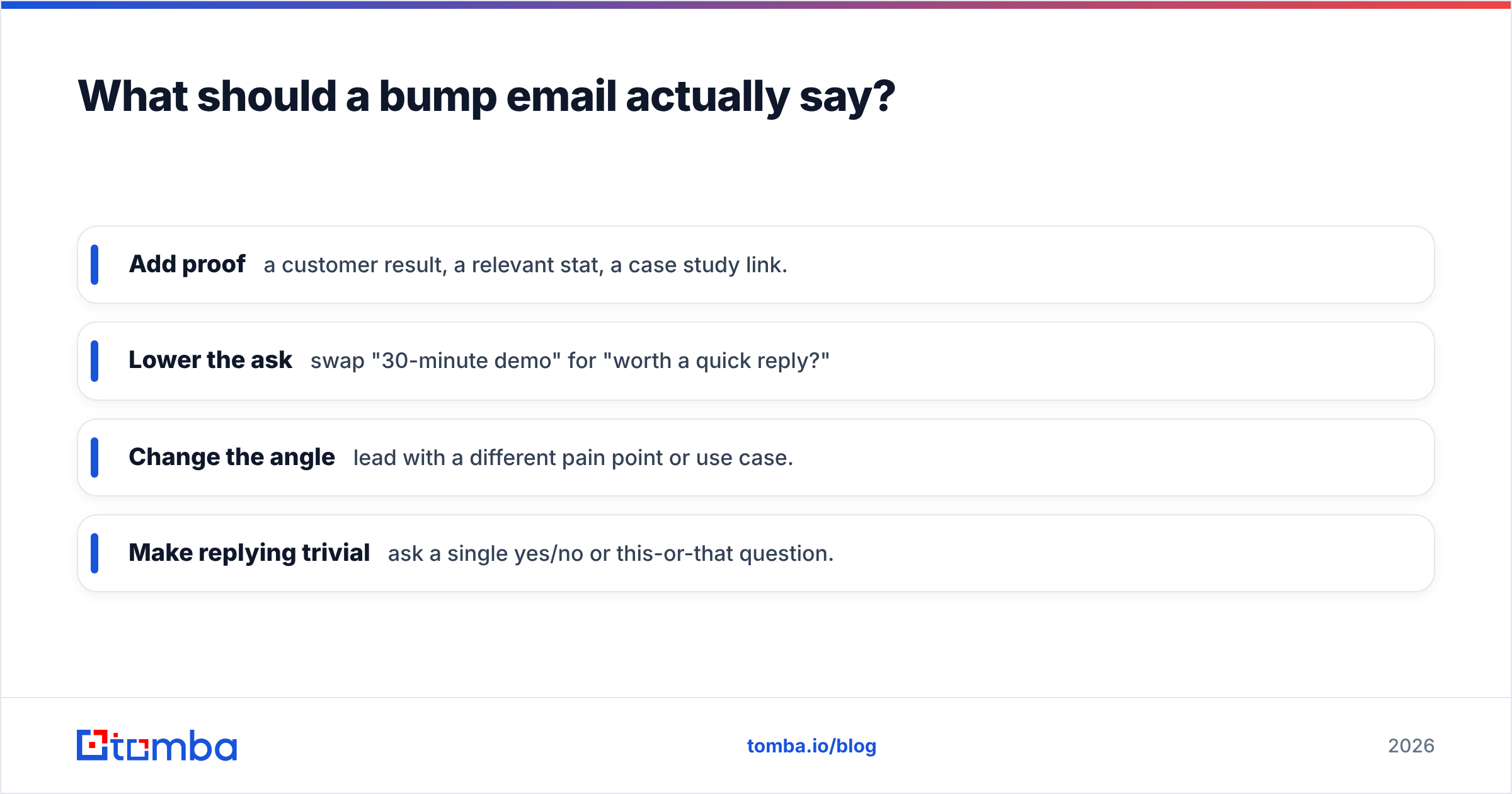
Every good bump should do at least one of the following:
- Add proof — a customer result, a relevant stat, a case study link.
- Lower the ask — swap "30-minute demo" for "worth a quick reply?"
- Change the angle — lead with a different pain point or use case.
- Make replying trivial — ask a single yes/no or this-or-that question.
Keep the writing concrete and in second person. Cut adjectives. If you wouldn't say it out loud to the person at their desk, don't type it. For sharper opening lines, a subject line generator can help you test variants without staring at a blank screen, and a library of cold email templates gives you proven skeletons to adapt.
Bump email templates that get replies#
1. The proof bump (Day 3)
Subject: (reply in same thread, no new subject)
Quick add to my last note — [similar company] used this to cut [metric] by [X%] in [timeframe]. Happy to share how. Worth a reply?
2. The angle-shift bump (Day 7)
Realized I led with [feature] last time. The thing most [role]s actually care about is [different outcome]. Is that on your radar this quarter?
3. The one-question bump (Day 12)
Is reducing [pain] a priority right now, or should I circle back next quarter?
4. The breakup bump (Day 18)
I don't want to clutter your inbox, so I'll close this out on my end. If [outcome] becomes a priority later, just reply here and I'll pick it right back up.
The breakup email is the secret weapon. Loss aversion is real: telling someone you're about to stop often prompts the reply that four polite nudges couldn't. It also protects your sender reputation by giving you a clean reason to stop emailing non-responders.

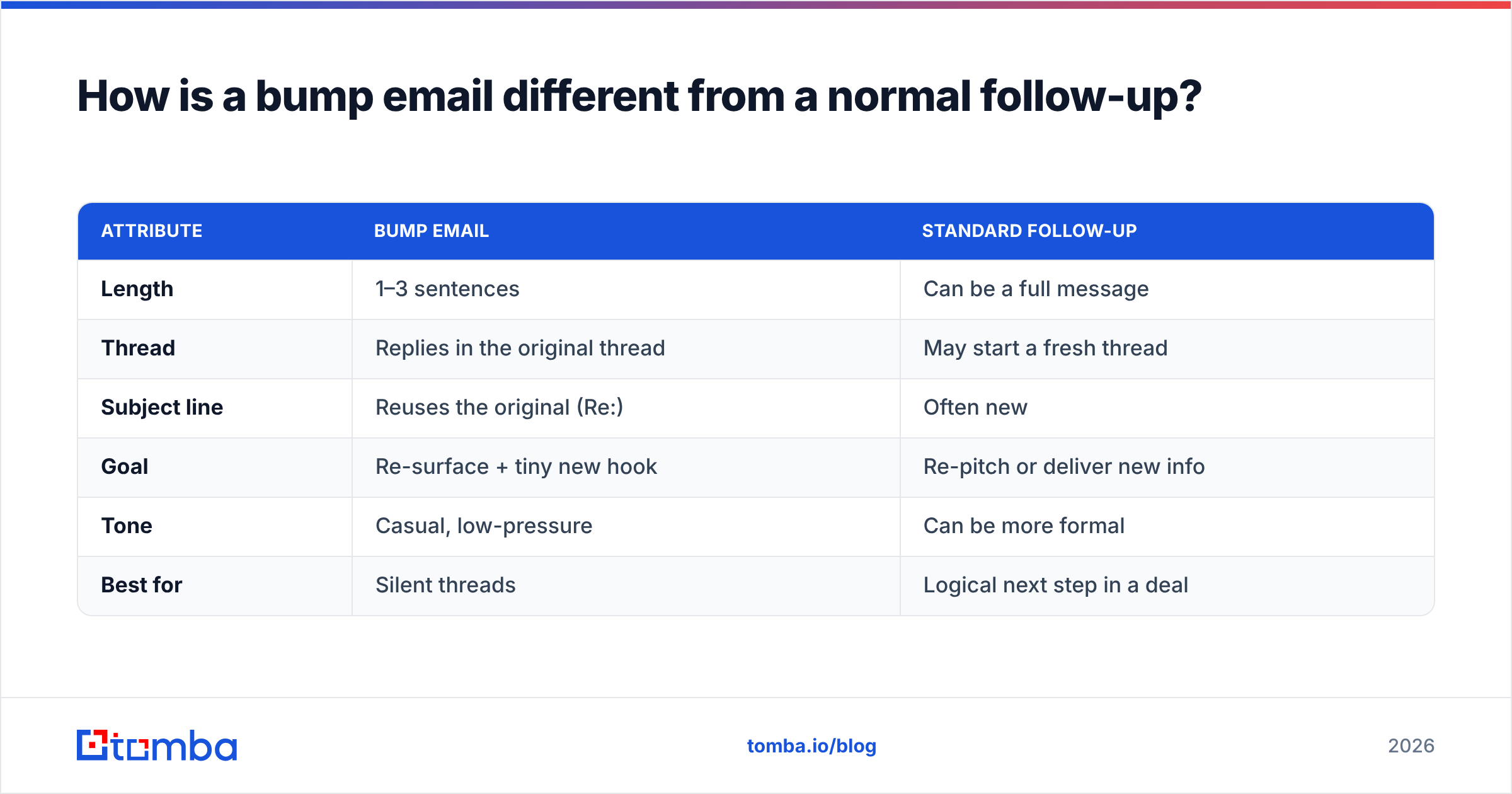
How is a bump email different from a normal follow-up?#
They overlap, but the distinction matters when you're building a sequence:
| Attribute | Bump email | Standard follow-up |
|---|---|---|
| Length | 1–3 sentences | Can be a full message |
| Thread | Replies in the original thread | May start a fresh thread |
| Subject line | Reuses the original (Re:) | Often new |
| Goal | Re-surface + tiny new hook | Re-pitch or deliver new info |
| Tone | Casual, low-pressure | Can be more formal |
| Best for | Silent threads | Logical next step in a deal |
In practice, your sequence will mix both. The early touches after a silent first email are bumps. Later, once someone engages, you switch to substantive follow-ups with proposals, decks, or scheduling links. Treat the bump as the tool for reviving attention and the follow-up as the tool for advancing a live conversation.
What mistakes kill bump emails?#
Most failed bumps share the same handful of errors:
- The guilt trip. "I've reached out three times now…" makes the reader the villain. Drop it.
- Breaking the thread. Starting a new email loses all context and forces a cold re-read. Always reply in place.
- Bumping after a clear no. Respect the answer. Persistence after rejection is harassment, not hustle.
- Identical bumps. Sending the same "just checking in" three times trains the reader to ignore you. Change one variable each time.
- No verification. This is the silent killer. If the address bounces, every bump compounds the damage to your domain's email deliverability.
That last point deserves emphasis. A bump sequence multiplies your send volume against the same contact list. If 15% of those addresses are invalid, you're sending bounce after bounce, and mailbox providers notice. High bounce rates throttle your inbox placement for the good addresses too. Before you load a sequence, run the list through an email verifier so your bumps reach real people. G2's category overviews of sales engagement software are a useful reference if you're choosing tools to manage sequences at scale.
How do you scale bump emails without sounding robotic?#
The tension in outreach is volume versus authenticity. You want hundreds of conversations, but every one should feel one-to-one. Three habits keep it human:
- Personalize the first line, templatize the rest. A single specific opener — referencing their role, a recent post, or a company event — does most of the heavy lifting. The body can be a reused skeleton.
- Segment your cadence. A bump that works for a VP of Sales won't land for a developer. Group prospects by persona and write one short bump set per persona.
- Track replies, not opens. Open tracking is increasingly unreliable thanks to privacy features. Optimize against actual response rate, which is the only metric that pays.
And the foundation under all of it: accurate contact data. You can't bump someone you can't reach. The faster you build clean, verified lists, the more energy you spend on the writing instead of chasing dead addresses. A bulk email finder lets you source and validate hundreds of contacts at once, so your sequences start from a list that won't sabotage your domain.
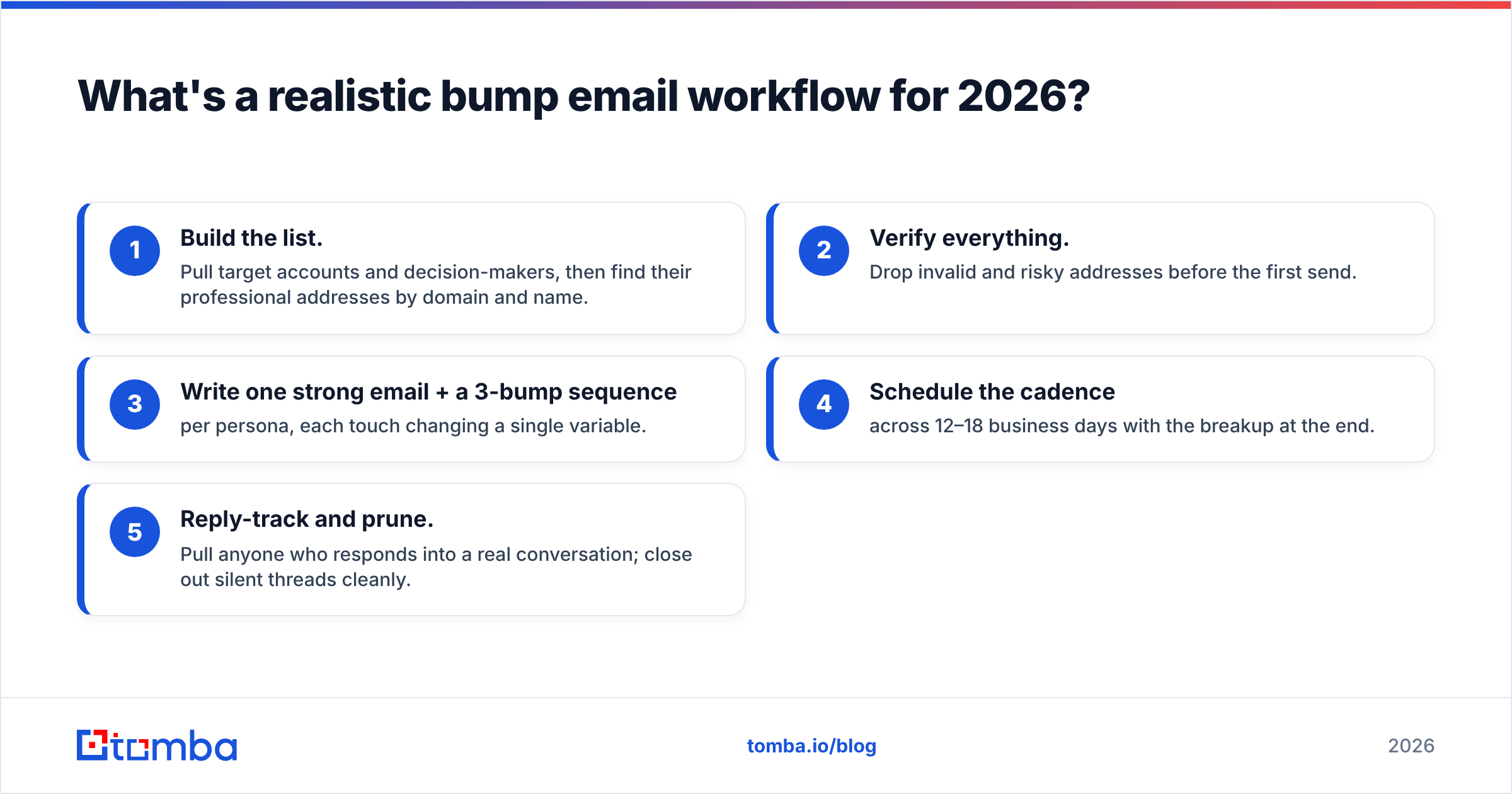
What's a realistic bump email workflow for 2026?#
Put it all together and a repeatable weekly loop looks like this:
- Build the list. Pull target accounts and decision-makers, then find their professional addresses by domain and name.
- Verify everything. Drop invalid and risky addresses before the first send.
- Write one strong email + a 3-bump sequence per persona, each touch changing a single variable.
- Schedule the cadence across 12–18 business days with the breakup at the end.
- Reply-track and prune. Pull anyone who responds into a real conversation; close out silent threads cleanly.
This is boring on purpose. Outreach that works is mostly disciplined repetition: a clean list, a tight sequence, and the patience to let the bumps do their job. The reps who win aren't the ones with the cleverest copy — they're the ones who follow up consistently against verified data.
Start your bump sequence with data that lands#
A bump email is only as good as the inbox it reaches. Before you write a single follow-up, make sure the address is real. The Tomba Email Finder finds verified professional emails by name, domain, or company, so your entire sequence — first send through breakup — actually arrives. Pair it with built-in verification and you'll spend your time perfecting the bump, not cleaning up bounces. Start free with 25 searches a month, and check Tomba pricing when you're ready to scale from a handful of prospects to a full pipeline. Build the list once, verify it, and let your bumps do the rest.
// get started
Find, verify and enrich your first contacts today
Start on the free plan with 25 searches a month, then scale when your team is ready.
Free plan · No credit card required · GDPR & CCPA
// about the author