Bumper Email Template: 9 Examples to Revive Dead Replies (2026)
A bumper email is the one-line follow-up that floats a dead thread back to the top of the inbox. Here are 9 bumper email templates that actually get replies in 2026.
You sent a great email. Then nothing. The thread is sitting somewhere on page three of your prospect's inbox, technically unread, practically dead. A bumper email is the cheapest, fastest tool you have to fix that — and most reps either skip it or write it badly.
This guide breaks down what a bumper email template is, when to fire it, and gives you nine copy-paste examples you can adapt today.
TL;DR#
- A bumper email is a short, low-friction follow-up — often a single line — designed to "bump" a previous message back to the top of the inbox.
- The best bumper emails reply to your own original thread, add zero pressure, and make replying take less than five seconds.
- Send the first bump 2–3 business days after the original, not the same afternoon.
- Bumpers lift reply rates because timing — not eloquence — is usually why people don't answer.
- Templates below cover cold outreach, warm leads, post-demo silence, and "breakup" closers. Steal them.
What is a bumper email?#
A bumper email is a brief follow-up sent in the same thread as your original message, whose only job is to resurface that message at the top of the recipient's inbox.
Think of it like nudging a friend who left you on read. You don't re-explain the entire plan — you send "hey, still on for Friday?" The short nudge does the work because the context already exists one scroll up.
Mechanically, three things define a true bumper:
- It replies to the original thread. Same subject line, threaded conversation. The recipient sees your earlier email directly beneath it, so you don't repeat yourself.
- It is short. One to three sentences. Many effective bumpers are literally one line: "Bumping this up in case it slipped through."
- It removes friction, not adds it. No new asks stacked on old asks. You make saying "yes," "no," or "not now" almost effortless.
The opposite of a bumper is the dreaded "just following up" paragraph that re-pitches everything. That reads as needy and gives the reader more to process, not less.
)
Why do bumper emails work so well?#
Because the problem is rarely your offer — it's attention. Most non-replies are not rejections; they are emails that arrived at a bad moment and got buried. A study-backed reality every rep learns: the majority of replies to a sequence come from follow-ups, not the first touch.
A bumper email works on three levers:
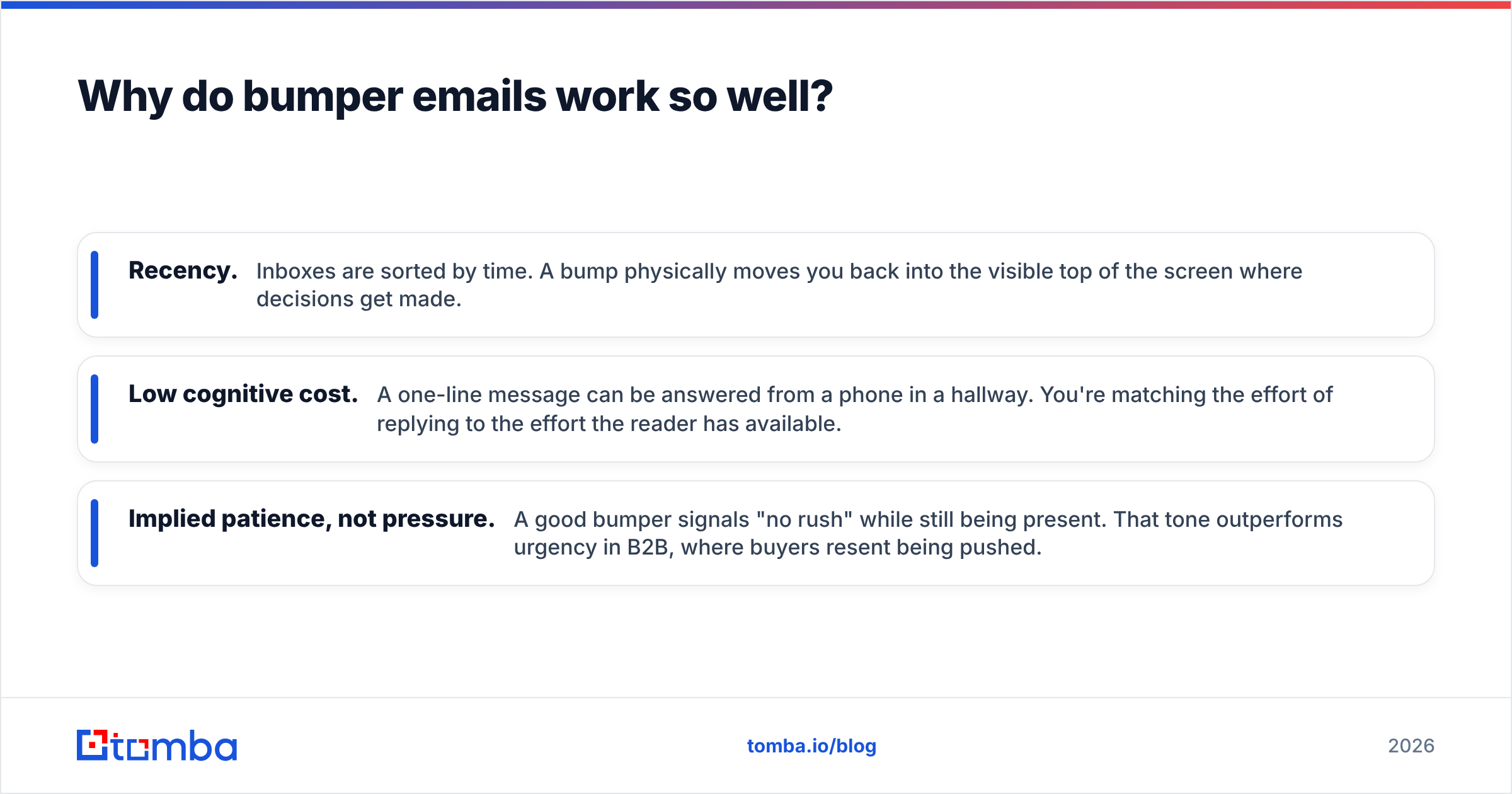
- Recency. Inboxes are sorted by time. A bump physically moves you back into the visible top of the screen where decisions get made.
- Low cognitive cost. A one-line message can be answered from a phone in a hallway. You're matching the effort of replying to the effort the reader has available.
- Implied patience, not pressure. A good bumper signals "no rush" while still being present. That tone outperforms urgency in B2B, where buyers resent being pushed.
For a deeper look at the metric you're trying to move, see how response rate is defined and benchmarked. The point of a bumper is to nudge that number up without burning goodwill.
When should you send a bumper email?#
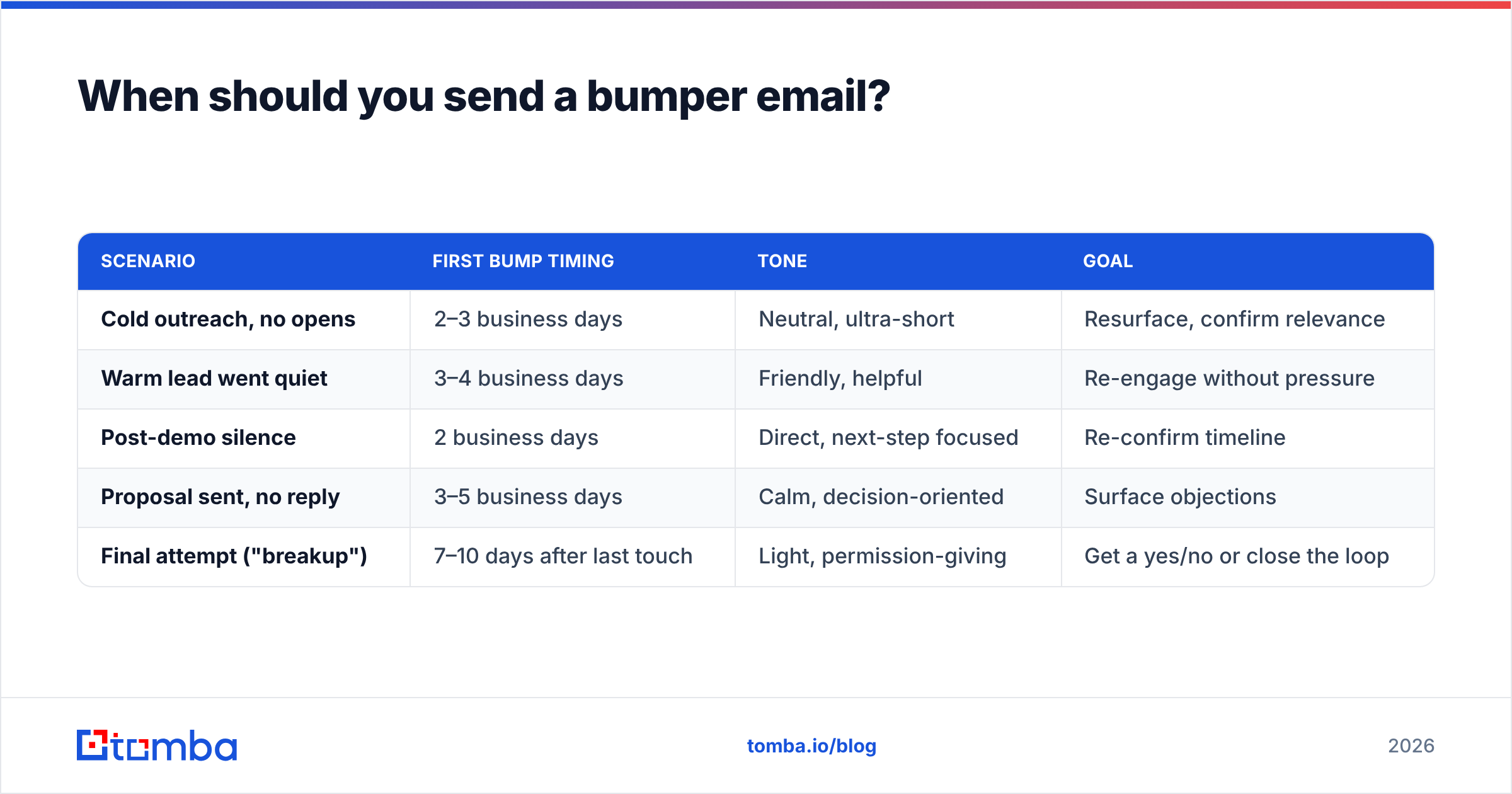
Timing is the entire game. Send too soon and you look anxious; too late and the context is cold.
| Scenario | First bump timing | Tone | Goal |
|---|---|---|---|
| Cold outreach, no opens | 2–3 business days | Neutral, ultra-short | Resurface, confirm relevance |
| Warm lead went quiet | 3–4 business days | Friendly, helpful | Re-engage without pressure |
| Post-demo silence | 2 business days | Direct, next-step focused | Re-confirm timeline |
| Proposal sent, no reply | 3–5 business days | Calm, decision-oriented | Surface objections |
| Final attempt ("breakup") | 7–10 days after last touch | Light, permission-giving | Get a yes/no or close the loop |
A few rules that hold across every row:
- Count business days, not calendar days. A Friday email bumped on Saturday is wasted.
- Vary the send time. If the original went out at 9 a.m., try the bump at 1 p.m. or late afternoon to catch a different inbox moment.
- Cap your sequence. Three to four bumpers is plenty. Beyond that you're training people to ignore you.
What does a good bumper email template look like?#
Here are nine you can use right now. Swap the brackets, keep them short, and resist the urge to add a paragraph.
1. The classic one-liner#
Subject: (reply in original thread)
Hi [First name] — bumping this to the top of your inbox in case it got buried. Worth a quick look?
2. The assume-busy bump#
Totally understand inboxes are brutal this time of year. Should I keep this on your radar, or is now not the right time?
3. The value-add bump#
Quick follow-up — I just put together a [one-page teardown / benchmark] for [Company] that's relevant to what I sent. Want me to send it over?
This one earns the bump by giving instead of asking. Pair it with a useful asset and it stops feeling like a chase.
4. The single-question bump#
One question to make this easy: are you the right person for [topic], or should I be talking to someone else on your team?
Great for cold threads where you're not sure you reached the right contact. If you're not, this is your cue to go find the email address of the right decision-maker.
5. The post-demo bump#
Hi [First name] — following up from [day]'s walkthrough. What did the team think? Happy to answer anything that came up after.
6. The proposal nudge#
Bumping the proposal up. No pressure on timing — just want to make sure it didn't get lost and answer any questions before you decide.
7. The light humor bump#
I promise this is not an automated "just checking in." Real human, genuinely curious if [problem] is still on your plate this quarter.
8. The two-option bump#
To keep this simple — reply "1" if you'd like to talk, or "2" if I should circle back next quarter. Either works for me.
Friction-killers like this convert because the answer is a single keystroke.
9. The breakup bump#
I don't want to keep cluttering your inbox, so this is my last note for now. If [outcome] becomes a priority, you know where to find me — door's open.
Counterintuitively, breakup emails often pull the highest reply rate in a sequence, because they give the reader permission to close the loop.
)
How do you write your own bumper email template?#
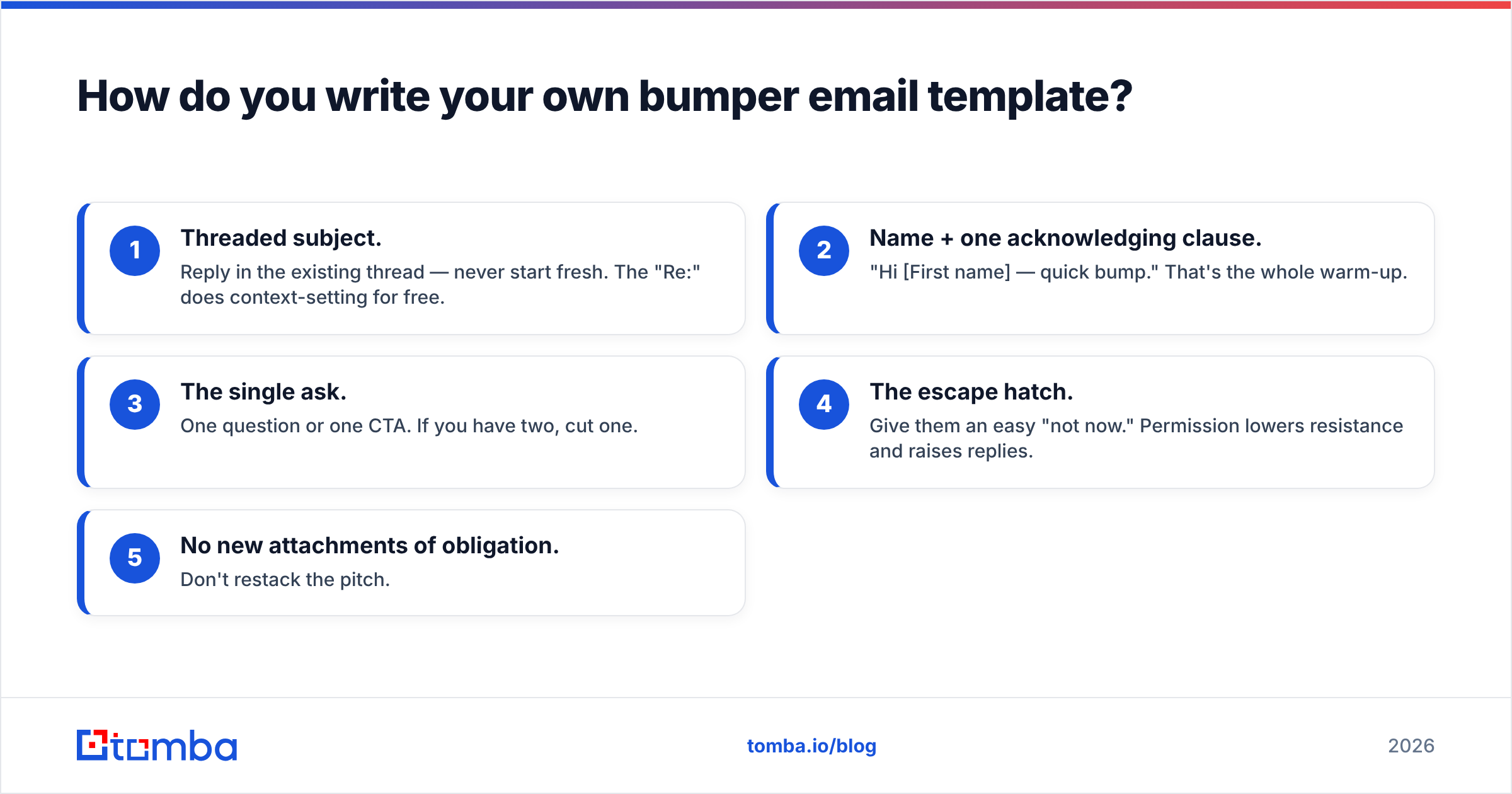
Build a reusable template instead of reinventing the wheel every time. A solid bumper follows a five-part skeleton:
- Threaded subject. Reply in the existing thread — never start fresh. The "Re:" does context-setting for free.
- Name + one acknowledging clause. "Hi [First name] — quick bump." That's the whole warm-up.
- The single ask. One question or one CTA. If you have two, cut one.
- The escape hatch. Give them an easy "not now." Permission lowers resistance and raises replies.
- No new attachments of obligation. Don't restack the pitch.
Keep a small library of these in a shared doc or, better, a tool. Our free cold email templates library is a good starting point, and the subject line generator helps when you do need to break into a new thread instead of bumping an old one.
One more discipline: track which template pulls replies. HubSpot's own research on sales follow-up cadence and the user reviews on G2 both reinforce that consistency and brevity beat clever wording almost every time.
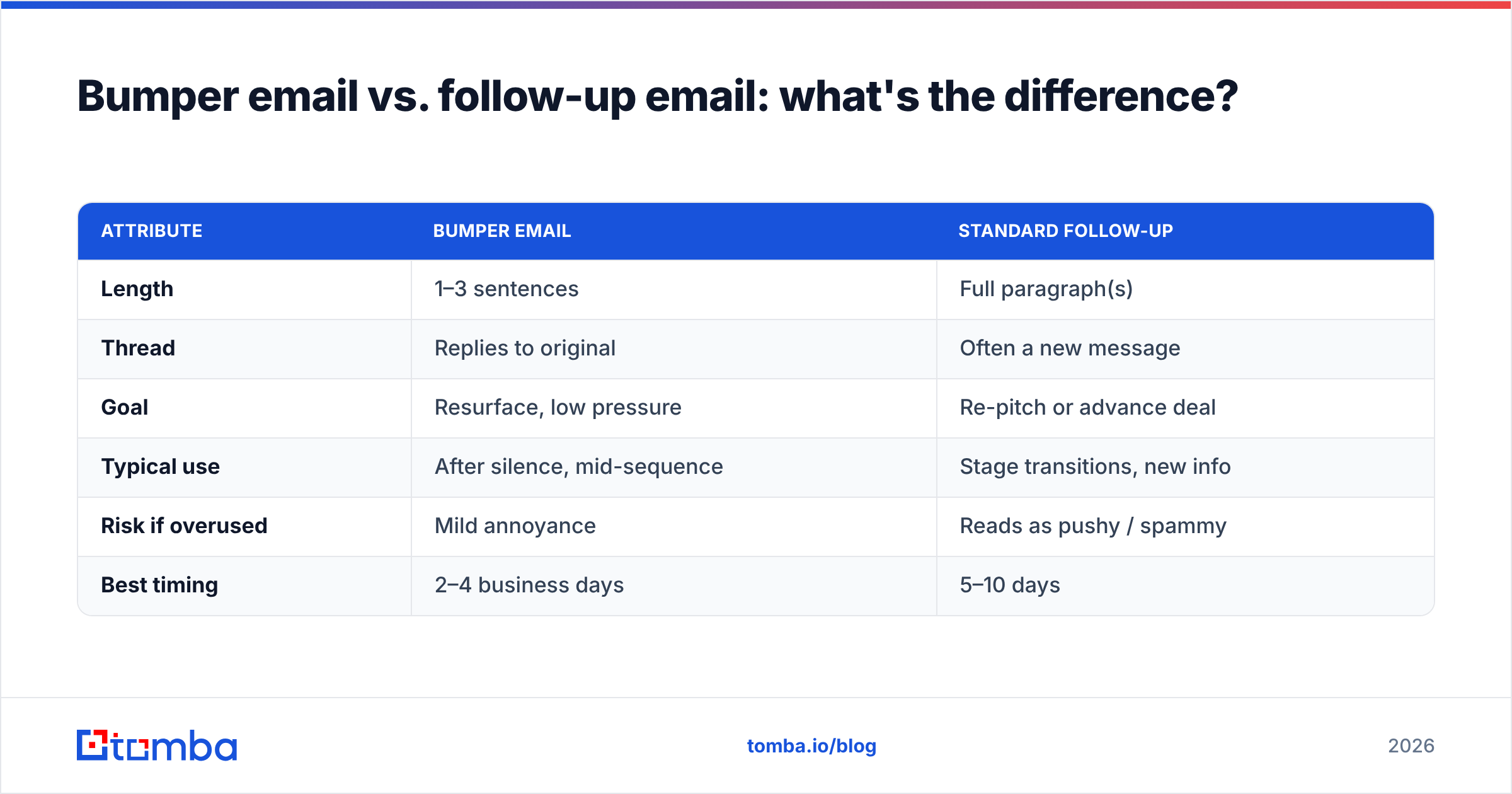
Bumper email vs. follow-up email: what's the difference?#
People use the terms loosely, but they aren't identical. The distinction matters for tone and length.
| Attribute | Bumper email | Standard follow-up |
|---|---|---|
| Length | 1–3 sentences | Full paragraph(s) |
| Thread | Replies to original | Often a new message |
| Goal | Resurface, low pressure | Re-pitch or advance deal |
| Typical use | After silence, mid-sequence | Stage transitions, new info |
| Risk if overused | Mild annoyance | Reads as pushy / spammy |
| Best timing | 2–4 business days | 5–10 days |
A bumper is a type of follow-up — the leanest one. When you have genuinely new information (a case study, a price change, a relevant trigger event), graduate to a fuller follow-up. When you just need to be seen again, bump.
What mistakes kill a bumper email?#
The fastest ways to waste the technique:
- Bumping too fast. A nudge sent four hours later looks frantic. Give it days.
- Re-pitching the whole thing. If your bump is longer than your original, it isn't a bump.
- Guilt-tripping. "I've reached out three times now…" punishes the reader for your cadence. Never do it.
- Bumping a bad address. If your original never landed, no number of bumps will help. Run addresses through an email verifier before you sequence, so you're bumping real, deliverable inboxes — not bouncing into a spam trap and torching your email deliverability.
- Infinite bumping. Stop at three or four. Respect the no-reply as an answer.
That fourth point is where most cold-email programs quietly fail. You can write the nine best bumpers in the world, but if the contact data is wrong, you're nudging a void. Clean data is the foundation the templates sit on.
How does data quality change your bumper strategy?#
Bumpers only pay off when they reach a human who can act. Two data problems sink them:
- Wrong person. You're bumping a junior who can't buy. Solution: confirm the decision-maker and pull their address with an accurate finder.
- Wrong address. The email is dead, catch-all, or role-based. Solution: verify before send.
This is the part teams underrate. According to vendor-neutral roundups on Wikipedia's overview of email marketing, list hygiene is consistently the largest lever on engagement metrics — bigger than copy. A perfect bumper to a bad inbox is a zero. A decent bumper to a verified, correctly-targeted inbox compounds.
If you're building or cleaning a prospect list before you start sequencing, check current Tomba pricing — the free tier gives you 25 searches a month to test the waters, with paid plans starting at $49/mo when you scale.
Start sending bumper emails that land#
A bumper email template is only as good as the inbox it reaches. Before you queue your next follow-up sequence, make sure every address on your list is real and pointed at the right decision-maker. The Tomba Email Finder finds professional emails by name, company, or domain — and pairs with the built-in verifier so your carefully written one-liners actually surface in a live inbox instead of bouncing. Build the list once, bump with confidence, and let timing do the rest.
// get started
Find, verify and enrich your first contacts today
Start on the free plan with 25 searches a month, then scale when your team is ready.
Free plan · No credit card required · GDPR & CCPA
// about the author