How to Build a Business Contacts List That Converts in 2026
A bought list of business contacts decays fast and tanks deliverability. Here's how to build, verify, and enrich a contact list that actually books meetings in 2026.
TL;DR
- A "business contacts" list is only as valuable as it is accurate — and B2B data decays at roughly 22–30% per year, so a list you bought last quarter is already leaking.
- Buying static lists is the worst option for cold outreach: high bounce rates, no consent trail, and shared records that 50 other senders are already hammering.
- The durable approach is to build your list from first-party intent and targeting, then find, verify, and enrich each contact on demand.
- Verify every address before you send. A 3% bounce rate is the line between the inbox and the spam folder.
- Tools like a email finder plus a email verifier turn a target account list into clean, send-ready business contacts in minutes.
If your pipeline depends on reaching the right people at the right companies, the quality of your business contacts list decides your win rate before you write a single subject line. This guide breaks down what a business contact actually is, where to get them in 2026, how to keep them clean, and how to compare the main sourcing methods honestly.
What are business contacts, exactly?#
A business contact is a verified, reachable record tied to a person who can buy from you or influence the purchase. Think of it like a passport, not a name tag: a name tag just says who someone is, but a passport proves identity and gets you through the gate. A real business contact does the same — it pairs a person with a working channel and enough context to make outreach relevant.
A complete business contact record in 2026 usually contains:
- Identity — full name, job title, and seniority. Title alone is noise; seniority tells you whether you're talking to a champion, a user, or the economic buyer.
- Company firmographics — domain, industry, headcount, and revenue band. This is how you score fit before you ever reach out.
- Reachable channels — a verified work email, and ideally a direct dial or LinkedIn profile. A personal Gmail with no company link is not a business contact.
- Context signals — tech stack, recent funding, hiring activity, or content they've published. This is what turns a generic pitch into a relevant one.
- Provenance — where the record came from and when it was last verified. Without this, you can't defend consent or judge freshness.
Miss the last two and you have a mailing list. Include them and you have a prospecting asset.

Why do most business contact lists fail?#
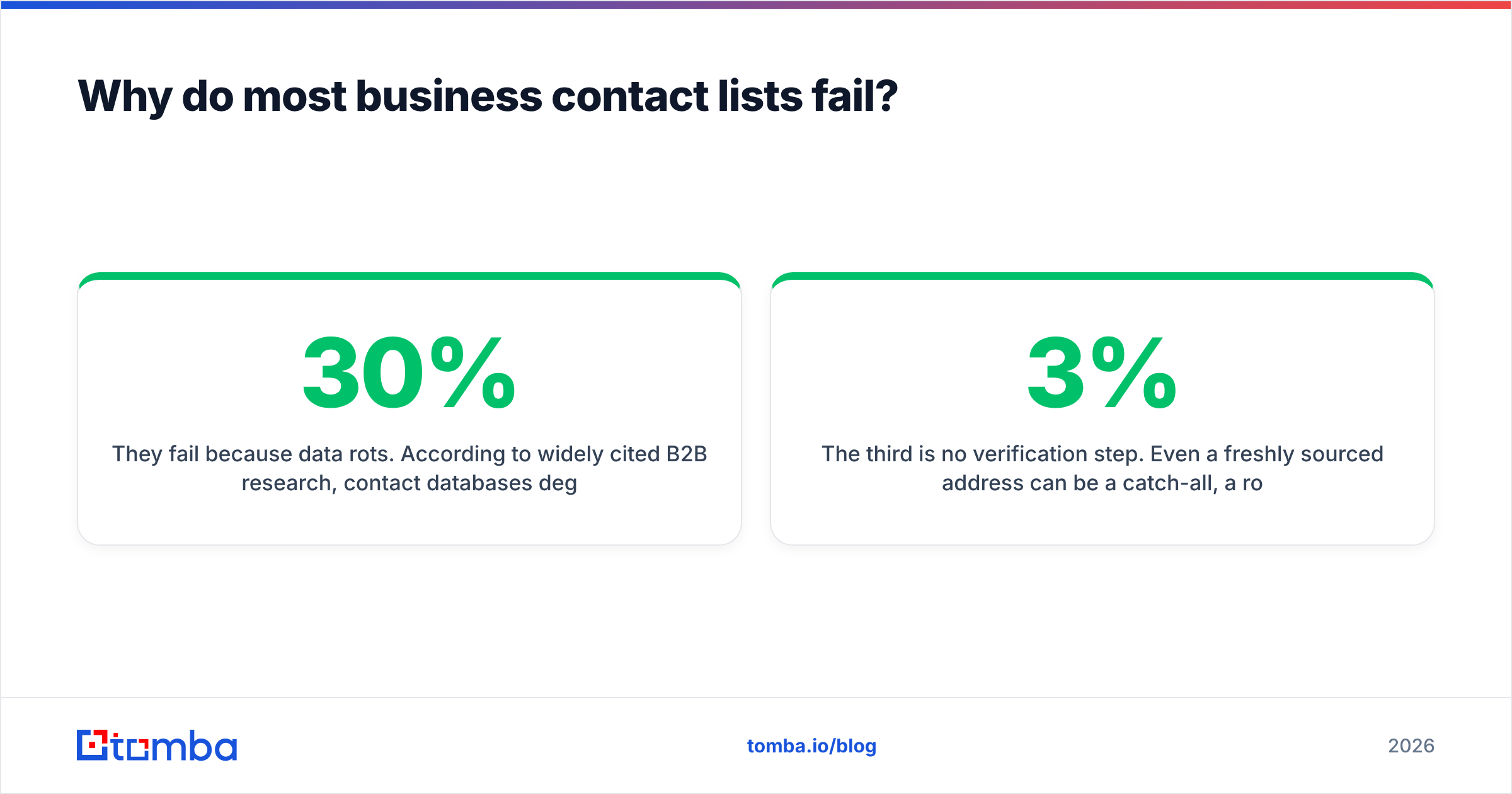
They fail because data rots. According to widely cited B2B research, contact databases degrade by 20–30% every year as people change jobs, companies rebrand, and domains migrate. A list that was 95% accurate in January can be below 70% by year-end without anyone touching it.
The second failure mode is shared, scraped lists. When you buy a static CSV, you're rarely the only buyer. The same 5,000 records get sold repeatedly, so by the time you send, those inboxes are saturated with cold pitches and your domain reputation pays the price. Mailbox providers increasingly judge senders on engagement, and a stale list produces low opens, spam complaints, and hard bounces — the exact signals that trigger filtering. (See HubSpot's research on email deliverability and G2's buyer reviews of data vendors for how widely this is documented.)
The third is no verification step. Even a freshly sourced address can be a catch-all, a role account (info@, sales@), or a typo. Sending without checking means your bounce rate climbs, and once you cross roughly 3%, providers start throttling or junking your mail.
How should you source business contacts in 2026?#
Conclusion first: build, don't buy. Treat sourcing as a repeatable pipeline rather than a one-time purchase. Here's the workflow that holds up:
- Define the ICP and account list. Start from firmographics — industry, size, region, tech stack. Reaching the wrong companies accurately is still failure.
- Find the people. Use a domain search to pull every known email pattern and contact at a target company, or an email finder to resolve a specific name-plus-domain into a deliverable address.
- Verify before you store. Run each address through a verifier to drop invalids, catch-alls, and role accounts before they ever enter your sequence.
- Enrich for relevance. Add title, seniority, and signals via data enrichment so segmentation and personalization are possible.
- Refresh on a cadence. Re-verify quarterly. A contact is a perishable good, not a permanent asset.
This approach keeps your data first-party and current. You only ever hold contacts you sourced for a defined reason, which also makes compliance with consent rules far easier to defend.
Buying vs. building business contacts: which wins?#
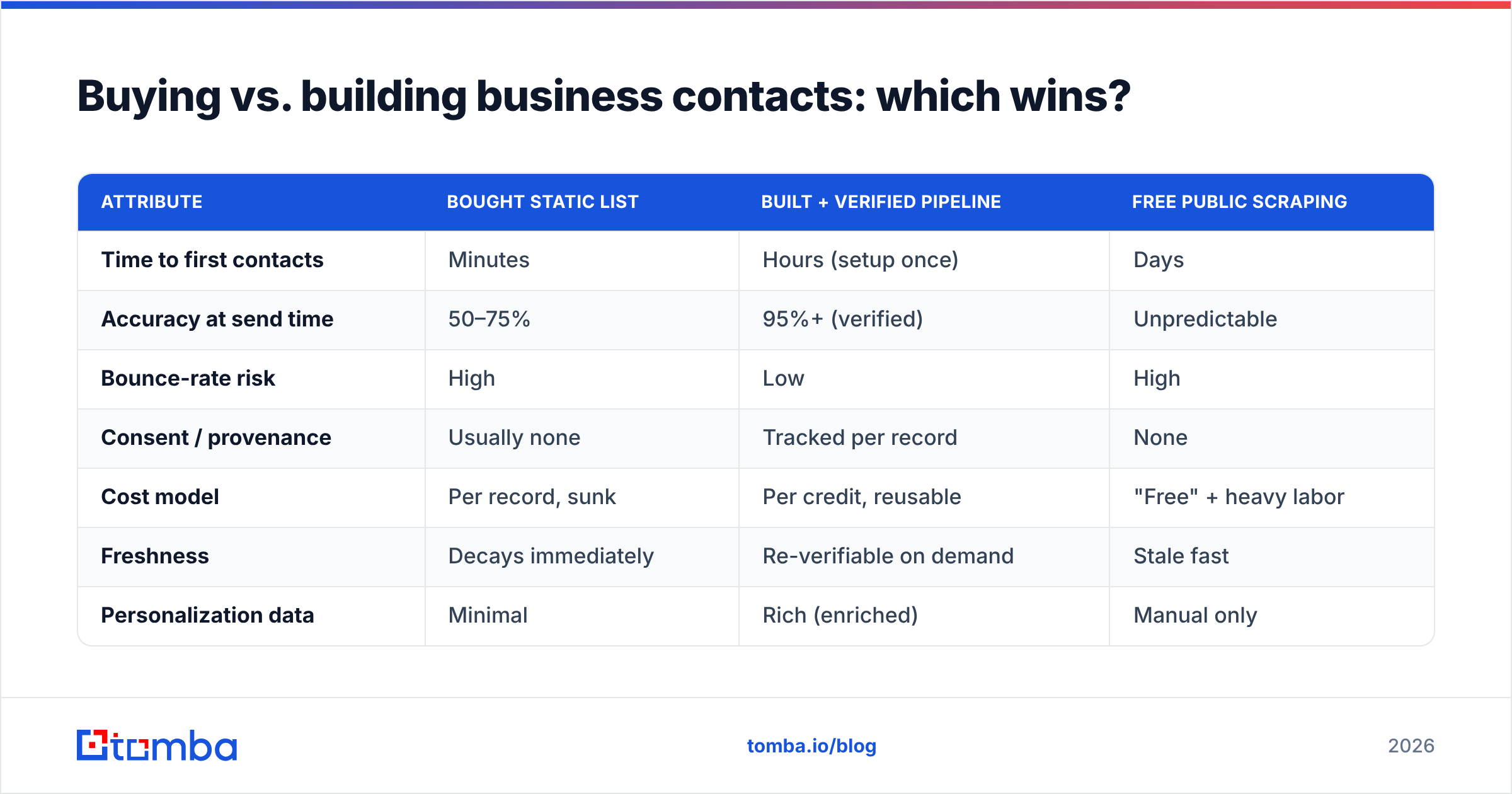
The honest answer depends on speed versus durability. Bought lists feel fast but cost you reputation and rework. Built lists take a workflow but compound in value. Here's the side-by-side.
| Attribute | Bought static list | Built + verified pipeline | Free public scraping |
|---|---|---|---|
| Time to first contacts | Minutes | Hours (setup once) | Days |
| Accuracy at send time | 50–75% | 95%+ (verified) | Unpredictable |
| Bounce-rate risk | High | Low | High |
| Consent / provenance | Usually none | Tracked per record | None |
| Cost model | Per record, sunk | Per credit, reusable | "Free" + heavy labor |
| Freshness | Decays immediately | Re-verifiable on demand | Stale fast |
| Personalization data | Minimal | Rich (enriched) | Manual only |
The pattern is clear: the only column that wins on deliverability and trust is the built-and-verified pipeline. Bought lists win exactly one row — raw speed — and lose everywhere it matters.
How do you keep business contacts clean over time?#
Treat hygiene as a recurring chore, like changing the oil rather than waiting for the engine to seize. A few concrete practices:
- Verify on entry and on a schedule. Every new contact gets verified before storage, and the whole database gets re-checked every 90 days. Pair this with bulk processing so you're not doing it by hand — a bulk email finder and bulk verifier handle thousands of records at once.
- Suppress role and catch-all addresses. info@ and support@ inflate your list and depress your reply rate. Flag them separately so they never enter a 1:1 sequence.
- Track last-verified dates. Sort by oldest-verified first when you re-clean. The records most likely to bounce are the ones you haven't touched in months.
- Watch sender signals. Bounce rate, spam-complaint rate, and open rate are your early-warning system. A sudden bounce spike almost always means a chunk of the list went stale.
Gartner and Forrester both treat data quality as a core revenue-operations discipline rather than an IT afterthought — see Gartner's coverage of data quality for the broader framework. The takeaway for a sales team is simpler: clean data isn't a project you finish, it's a routine you maintain.
What features should a business contact tool have?#
When you evaluate a provider, you're really evaluating five capabilities. Score any tool against this checklist:
- Coverage — Does it find contacts across your target regions and industries, not just US tech? Check this against a sample of your real ICP, not the vendor's demo accounts.
- Accuracy and verification — Does it verify addresses, and does it publish a confidence score per result? A tool that returns guesses without a score is shifting the risk onto you.
- Enrichment depth — Can it append title, seniority, company size, and signals, or does it only return an email string?
- Throughput and integrations — Bulk processing, an API, a Chrome extension, and CRM connectors decide whether the tool fits your actual workflow or becomes a copy-paste tax.
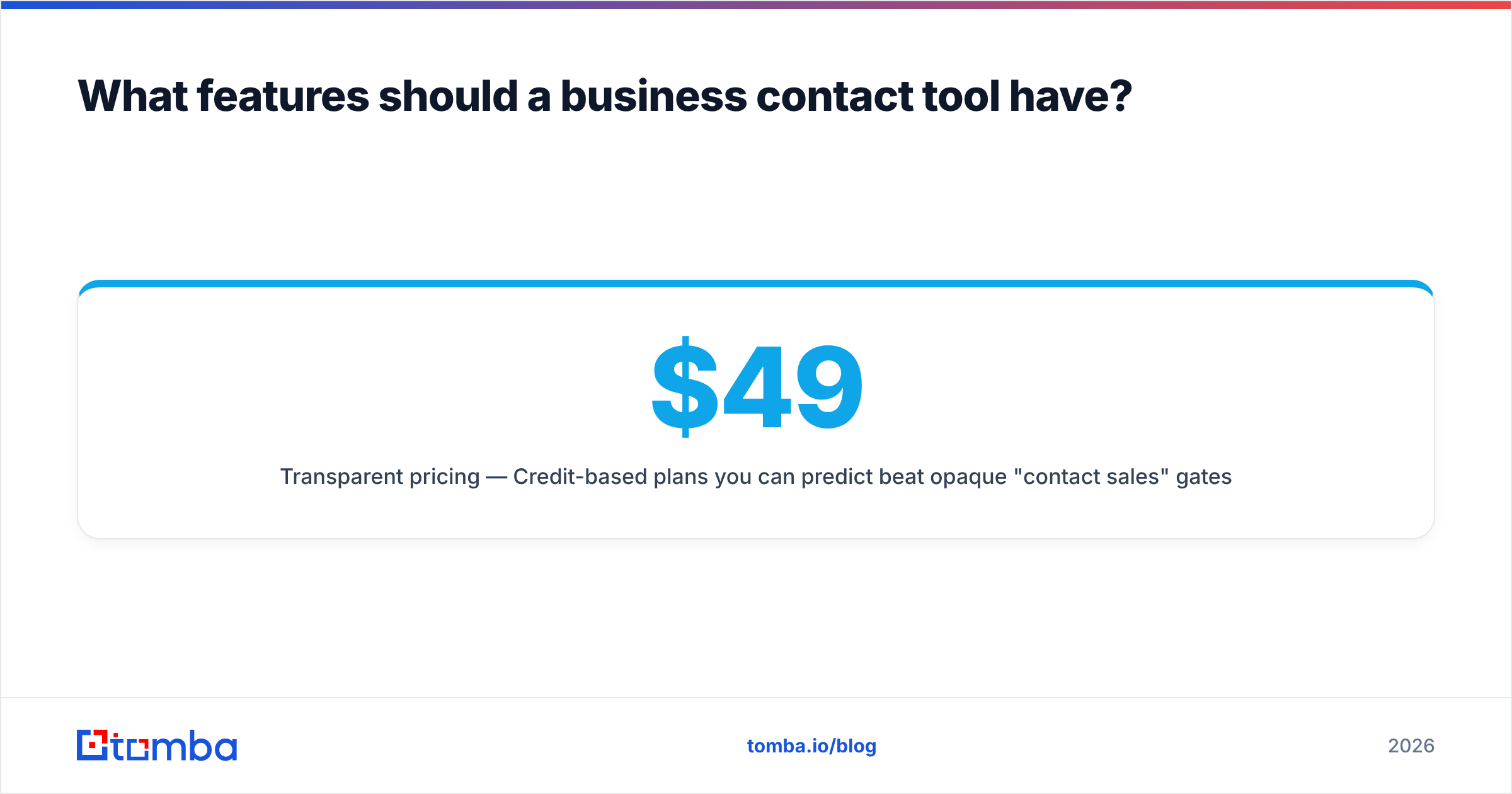
- Transparent pricing — Credit-based plans you can predict beat opaque "contact sales" gates. Tomba, for example, lists a free tier (25 searches/month), Starter at $49/mo, Growth at $99/mo, and Pro at $249/mo on its public Tomba pricing page.
Where does Tomba fit honestly? It's strongest as a sourcing-and-verification engine: email finder, email verifier, domain search, catch-all verification, phone finder, and enrichment in one platform, backed by a sizeable B2B database. If your need is a full multichannel sequencing suite with built-in dialer and warmup, you'll still pair it with a dedicated outreach tool — and that's a reasonable stack, not a gap.
How do business contacts feed the rest of your pipeline?#
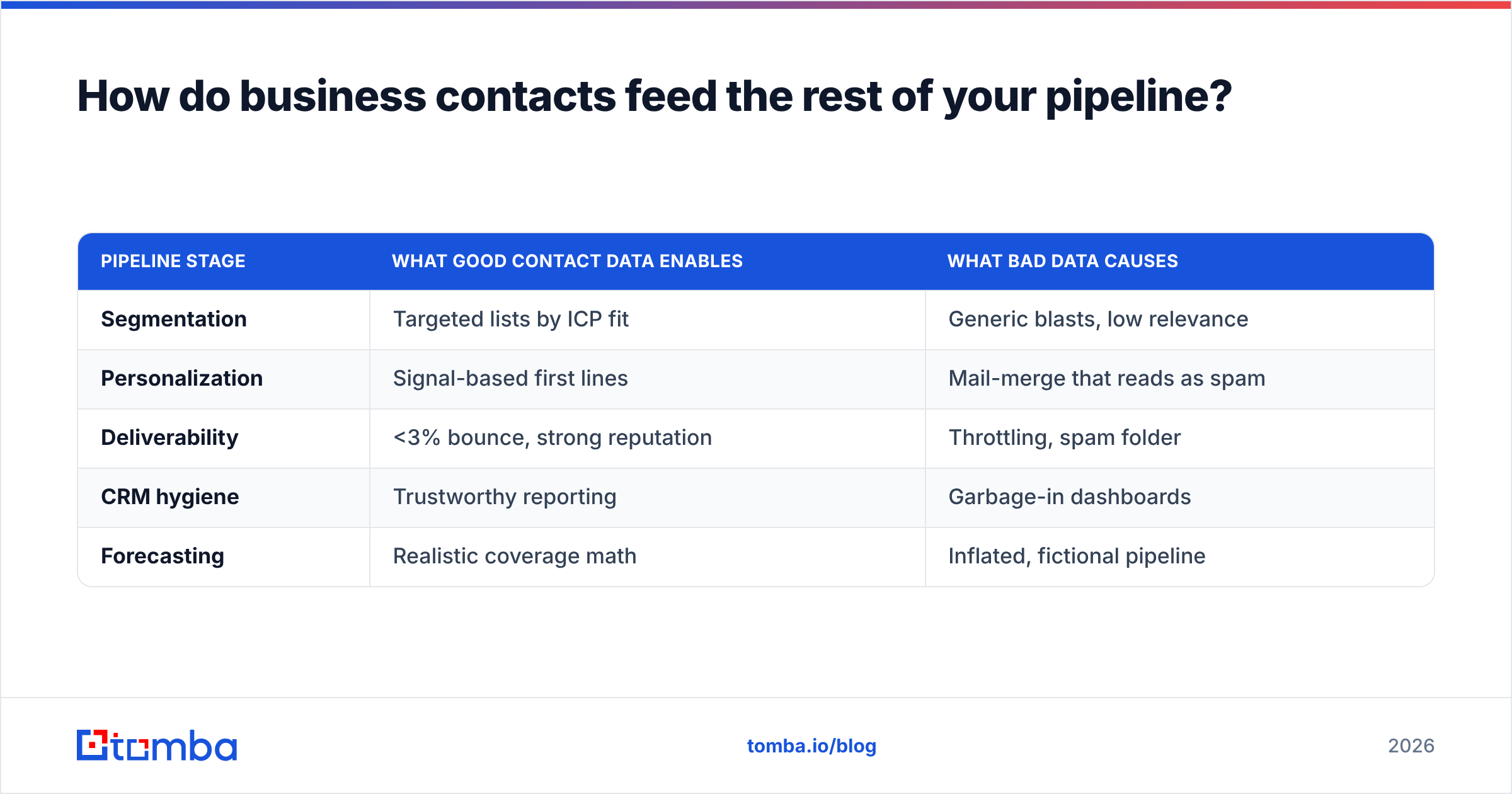
A clean contact list is the input to everything downstream. Bad data multiplies its damage as it flows: a wrong title breaks your segmentation, a dead address burns a sequence slot, a missing company size ruins your scoring. Get the contacts right and each later stage gets easier.
| Pipeline stage | What good contact data enables | What bad data causes |
|---|---|---|
| Segmentation | Targeted lists by ICP fit | Generic blasts, low relevance |
| Personalization | Signal-based first lines | Mail-merge that reads as spam |
| Deliverability | <3% bounce, strong reputation | Throttling, spam folder |
| CRM hygiene | Trustworthy reporting | Garbage-in dashboards |
| Forecasting | Realistic coverage math | Inflated, fictional pipeline |
This is why experienced revenue teams treat the contact layer as foundational. You can fix a weak subject line in an afternoon; you can't out-write a list where a third of the addresses bounce. Salesforce and other CRM leaders make the same point in their data-management guidance (salesforce.com): the system of record is only as good as what you put into it.
A simple framework to start this week#
If you're building a business contacts list from scratch, do this in order and don't skip the verify step:
- Pick 50 target accounts that match your best existing customers.
- Run a domain search on each to surface contacts and email patterns.
- Resolve named decision-makers with the email finder.
- Verify the full batch and discard anything that isn't deliverable.
- Enrich the survivors with title and signal data.
- Load into your CRM with a last-verified date stamped on every record.
You'll end up with a small, accurate, defensible list — and a repeatable process you can scale to 500 accounts once it's working. That beats a 50,000-row bought CSV that bounces on the first send every time.
The bottom line#
Business contacts are a perishable asset, not a permanent purchase. The teams that win in 2026 don't buy bigger lists — they build smaller, cleaner, continuously verified ones and enrich them for relevance. Source on demand, verify before every send, refresh on a cadence, and your deliverability, reply rates, and forecast accuracy all move in the same direction: up.
Ready to build a list that actually reaches people? Start with the Tomba Email Finder to turn your target accounts into verified, send-ready business contacts — find emails by name or domain, confirm they're deliverable, and enrich each record before it touches your sequence. The free tier gives you 25 searches a month to test it on your own ICP before you commit to a plan.
// get started
Find, verify and enrich your first contacts today
Start on the free plan with 25 searches a month, then scale when your team is ready.
Free plan · No credit card required · GDPR & CCPA
// about the author