The Best Business Development Tools to Grow Pipeline in 2026
A no-fluff breakdown of the business development tools that actually move pipeline in 2026 — what each category does, what to pay, and how to build a stack that compounds.
Business development lives or dies on two things: finding the right people and reaching them before a competitor does. The tools you choose decide how fast both happen. This guide cuts through the category noise and shows you exactly which business development tools matter in 2026, what they cost, and how to assemble a stack that compounds instead of bloating your budget.
TL;DR#
- Business development tools fall into seven jobs: data/prospecting, enrichment, outreach, CRM, scheduling, analytics, and AI assistance. You need one strong tool per job, not five overlapping ones.
- Data quality beats feature count. A clean lead list run through a good email finder and verifier outperforms an expensive all-in-one with stale records.
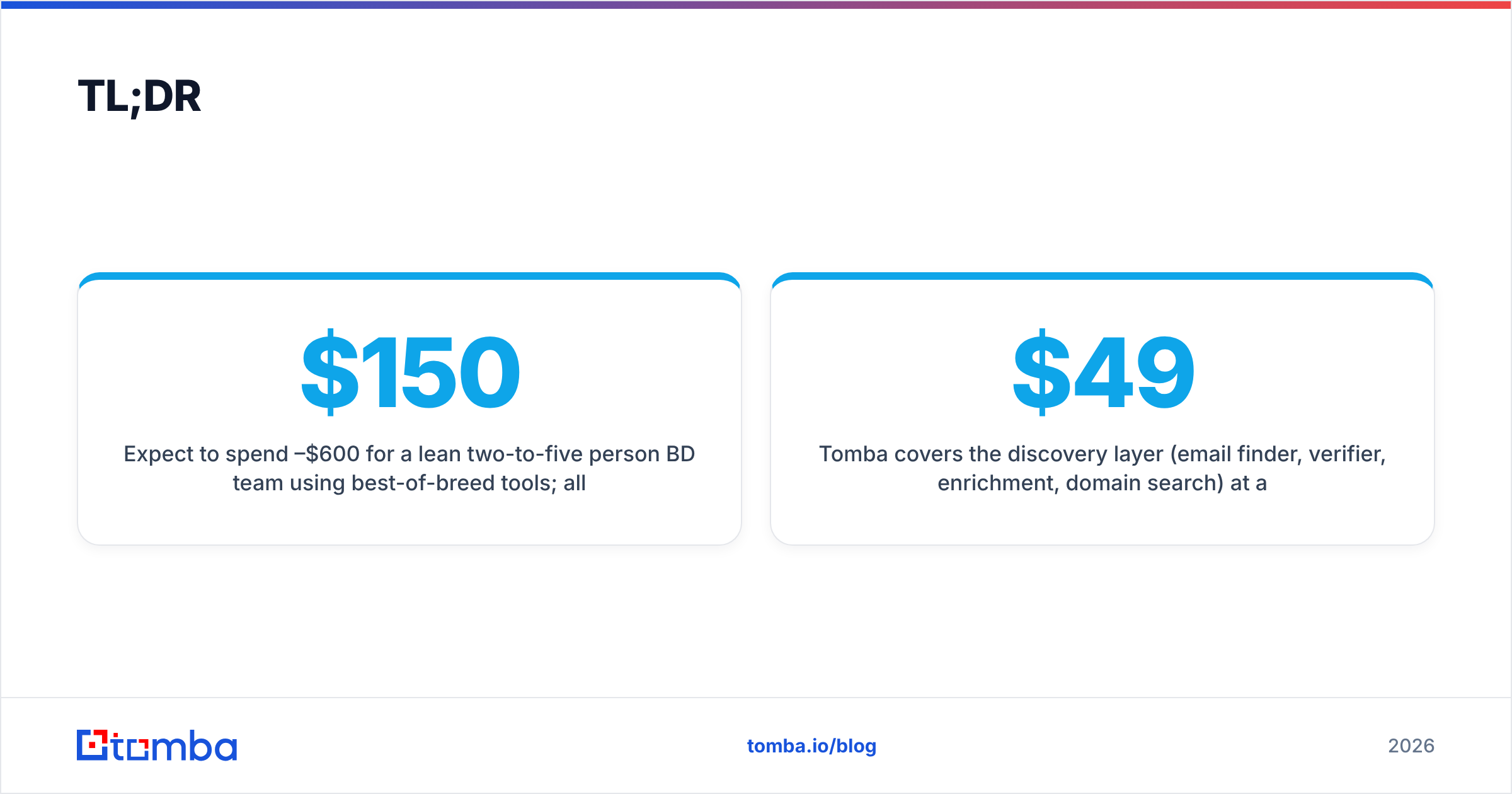
- Expect to spend $150–$600/month for a lean two-to-five person BD team using best-of-breed tools; all-in-one suites run higher and lock you in.
- Start with the top of the funnel. Prospecting and enrichment feed everything downstream — get those right before you buy another sequencer.
- Tomba covers the discovery layer (email finder, verifier, enrichment, domain search) at a starter price of $49/mo, so you can plug clean data into whatever CRM and outreach tools you already run.
What are business development tools?#
Business development tools are the software that helps you identify, reach, and convert new business — accounts, partners, and revenue you do not have yet. Think of them as a relay team: each tool runs one leg of the race and hands off cleanly to the next. The prospecting tool finds the contact, the enrichment tool fills in the details, the outreach tool starts the conversation, and the CRM remembers everything so nothing drops.
The mistake most teams make is buying a single "do-everything" platform and assuming it runs every leg well. In practice, one tool is usually excellent at one job and mediocre at the rest. That is why the strongest BD stacks in 2026 are modular: a specialist for each leg, connected through integrations so data flows automatically.
)
What are the main categories of business development tools?#
Before comparing products, get the categories straight. Each one maps to a distinct job in your pipeline, and skipping a category leaves a gap that quietly kills deals.
- Prospecting and data tools — find net-new contacts and companies that match your ideal customer profile. This is where an email finder and domain search live.
- Data enrichment tools — take a thin record (a name, a domain) and fill in title, company size, location, and verified contact details. Tomba's data enrichment sits here.
- Email verification tools — confirm an address is real and deliverable before you send, protecting your sender reputation. Use a dedicated email verifier for this.
- Outreach and sequencing tools — automate multi-step email and LinkedIn touches at scale.
- CRM and pipeline tools — store every contact, deal, and interaction so the team works from one source of truth.
- Scheduling and meeting tools — remove the back-and-forth of booking calls.
- Analytics and AI assistance — measure what works and let AI draft, summarize, and prioritize.
A complete stack touches all seven. A lean stack uses one tool per category and lets a strong discovery layer feed the rest.
Which business development tools should you actually use in 2026?#
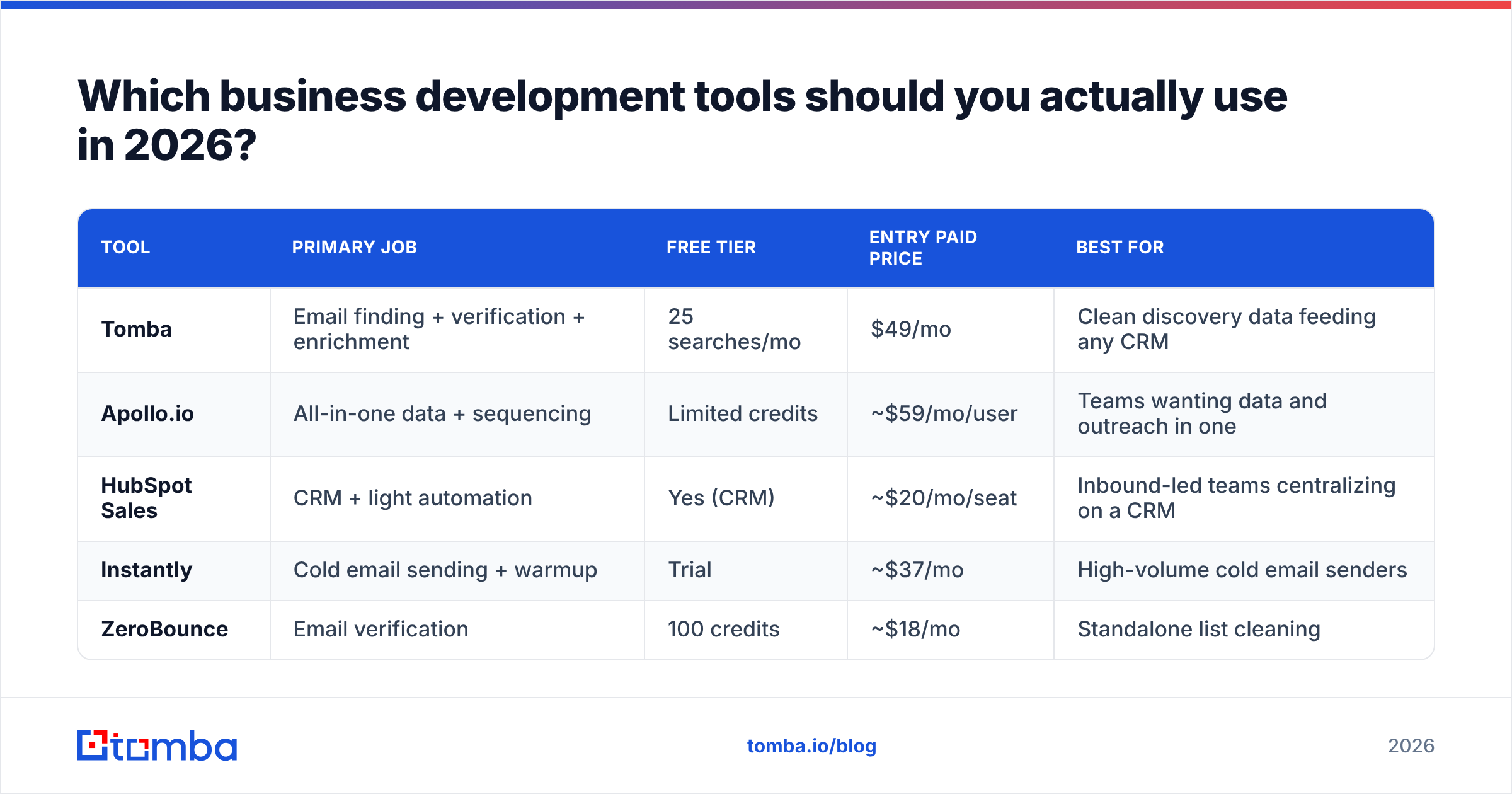
Here is a head-to-head of representative tools across the categories that matter most for top-of-funnel BD. Prices are list rates for entry paid tiers as of 2026 and are rounded for comparison.
| Tool | Primary job | Free tier | Entry paid price | Best for |
|---|---|---|---|---|
| Tomba | Email finding + verification + enrichment | 25 searches/mo | $49/mo | Clean discovery data feeding any CRM |
| Apollo.io | All-in-one data + sequencing | Limited credits | ~$59/mo/user | Teams wanting data and outreach in one |
| HubSpot Sales | CRM + light automation | Yes (CRM) | ~$20/mo/seat | Inbound-led teams centralizing on a CRM |
| Instantly | Cold email sending + warmup | Trial | ~$37/mo | High-volume cold email senders |
| ZeroBounce | Email verification | 100 credits | ~$18/mo | Standalone list cleaning |
Two takeaways. First, the discovery layer (finding and verifying contacts) is the cheapest leg to get right and the one that determines the quality of everything downstream — garbage data makes a $99/seat sequencer useless. Second, the all-in-one platforms look convenient but charge per seat, so a five-person team pays five times over for features half the team never opens.
For a deeper price breakdown of the discovery layer specifically, see the full Tomba pricing tiers, which scale from a free 25-search plan up through Growth at $99/mo and Pro at $249/mo.
How do you build a business development stack without overspending?#
Start at the top of the funnel and only add a tool when the previous one is fully working. The sequence matters because each leg feeds the next.
- Step 1 — Nail your data source. Pick one prospecting tool that returns accurate, verified emails. If 30% of your list bounces, nothing else you buy will save the campaign. Run names and domains through an email finder, then a verifier.
- Step 2 — Enrich before you reach out. A record with a verified title and company size lets you personalize at scale. Enrichment turns a list into segments.
- Step 3 — Centralize in a CRM. Push enriched contacts into HubSpot, Salesforce, or Pipedrive so every touch is logged and nothing gets worked twice.
- Step 4 — Automate outreach. Now — and only now — add a sequencer. Feeding it clean, enriched data is what makes automation produce replies instead of spam complaints.
- Step 5 — Measure and refine. Track reply rate, meeting rate, and pipeline created. Cut the tool that does not move one of those numbers.
This order keeps spend honest. Most teams overspend by buying step 4 first, then wondering why their expensive sequences underperform — the answer is almost always steps 1 through 3.
)
How do you measure ROI on business development tools?#
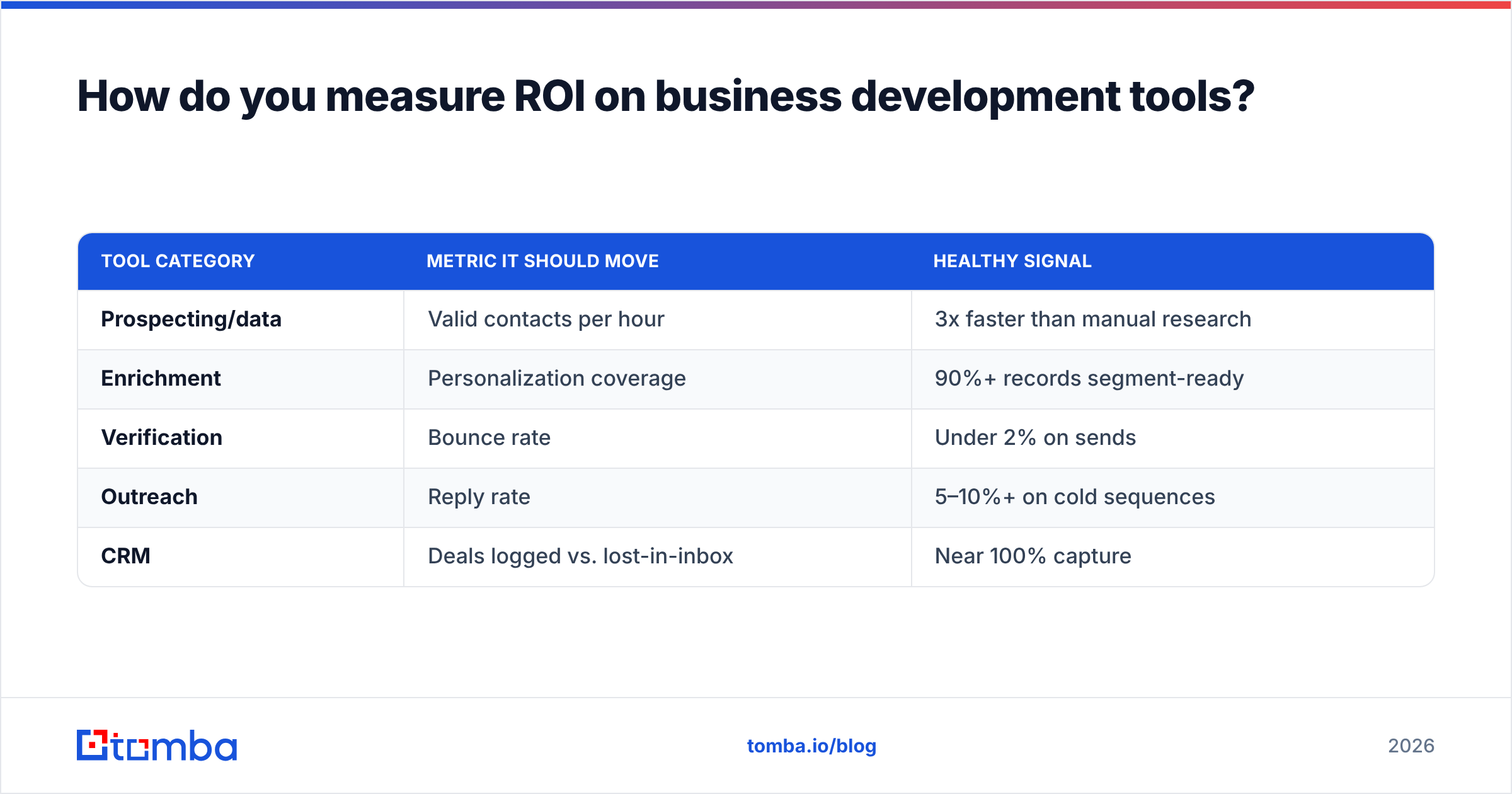
Conclusion first: a BD tool earns its keep only if it lifts a pipeline metric you already track. Everything else is a vanity feature. Tie each tool to one number.
| Tool category | Metric it should move | Healthy signal |
|---|---|---|
| Prospecting/data | Valid contacts per hour | 3x faster than manual research |
| Enrichment | Personalization coverage | 90%+ records segment-ready |
| Verification | Bounce rate | Under 2% on sends |
| Outreach | Reply rate | 5–10%+ on cold sequences |
| CRM | Deals logged vs. lost-in-inbox | Near 100% capture |
A useful rule from analysts at Gartner and peer reviews on G2: if you cannot name the metric a tool improves within two weeks of buying it, you bought the wrong tool. The discovery layer is the easiest place to prove ROI because a lower bounce rate and faster list-building show up immediately — that is why it is the smartest first investment.
What features separate good business development tools from the rest?#
When you evaluate any tool in the stack, weigh these five attributes. They predict long-term value better than the feature list on the pricing page.
- Data accuracy. For discovery tools, verified-email rate is the whole game. Ask for the verification method and the catch-all handling. A catch-all verifier matters more than most buyers realize.
- Integration depth. A tool that exports to CSV is a chore; a tool with native Zapier, CRM, and API hooks is a teammate. Check the Tomba API if you want programmatic access.
- Transparent pricing. Per-credit and per-seat models punish growth. Know your true cost at 3x your current volume.
- Compliance posture. GDPR and CCPA handling is not optional in 2026. Confirm how the vendor sources and stores data.
- Speed to value. If onboarding takes a quarter, the tool will be shelfware. The best tools produce a usable result on day one.
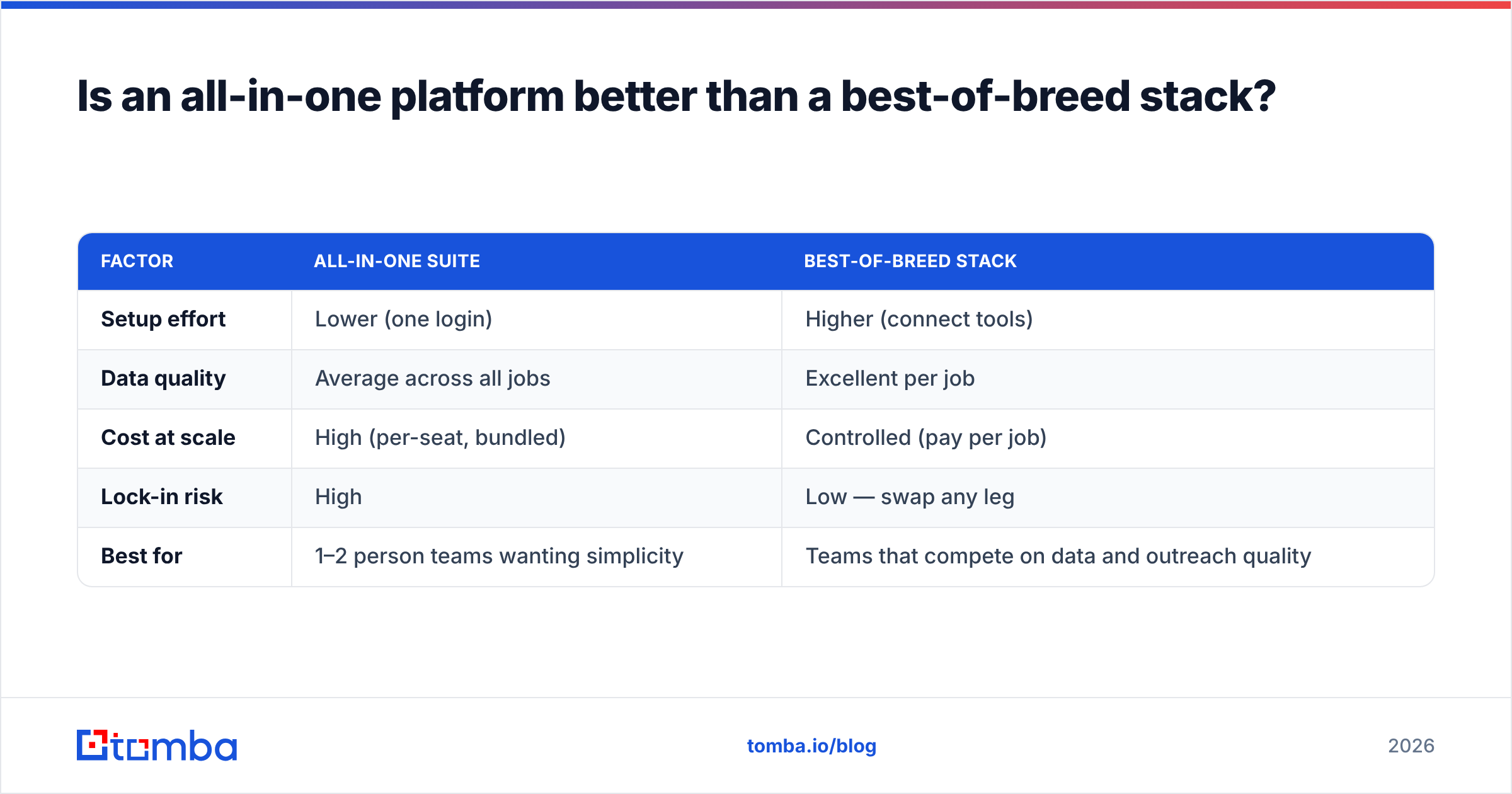
Is an all-in-one platform better than a best-of-breed stack?#
It depends on team size and how much you value data quality versus convenience. Here is the honest trade-off.
| Factor | All-in-one suite | Best-of-breed stack |
|---|---|---|
| Setup effort | Lower (one login) | Higher (connect tools) |
| Data quality | Average across all jobs | Excellent per job |
| Cost at scale | High (per-seat, bundled) | Controlled (pay per job) |
| Lock-in risk | High | Low — swap any leg |
| Best for | 1–2 person teams wanting simplicity | Teams that compete on data and outreach quality |
All-in-one suites such as Apollo or HubSpot win on convenience and are a reasonable starting point for a solo founder. But the moment data quality becomes a competitive edge — which is most B2B markets — a best-of-breed stack with a specialist discovery layer wins. You keep the CRM and sequencer you like and bolt on a dedicated finder and verifier instead of accepting a suite's average-quality data.
What's the fastest way to start improving your pipeline today?#
Fix the top of the funnel first, because it is the cheapest change with the largest downstream effect. You do not need to rip out your CRM or sequencer to get a better pipeline this quarter — you need cleaner, more complete contact data flowing into them.
That is exactly the gap Tomba fills. Use the Tomba Email Finder to turn names and company domains into verified, deliverable email addresses, then enrich and verify them before they ever reach your outreach tool — all starting at $49/mo with a free 25-search tier to test it on your own list first. Plug the results straight into HubSpot, Salesforce, Pipedrive, or your spreadsheet of choice, and let the rest of your stack do its job on data that actually converts. Build the discovery layer right, and every other business development tool you own gets more valuable overnight.
Ready to find emails that actually work?
Join 150,000+ professionals who stopped guessing and started sending. Free credits on signup — no credit card required.
Get the Tomba newsletter
Practical outbound tactics and product updates — once every two weeks.
About the author