Business Development vs Sales: Key Differences in 2026
Business development vs sales confuses even seasoned teams. Here is what each role actually owns, how they hand off, and how to staff both in 2026.
TL;DR
- Business development (BD) builds the conditions for revenue — markets, partnerships, and pipeline — while sales converts qualified opportunities into closed deals.
- They are not interchangeable: BD is long-horizon and relationship-led; sales is quota-led and deal-cycle bound.
- The two roles share one pipeline, so a clean handoff (and shared data) matters more than where you draw the org-chart line.
- Most modern teams split BD into partnership/market BD and sales development (SDR/BDR) — the latter sits inside the sales motion.
- Both functions live or die on accurate contact data. Bad lists waste BD partnerships and sales hours alike.
What is the difference between business development and sales?#
Here is the one-line answer: business development creates opportunity; sales captures it. BD asks "where should revenue come from next, and who do we need to know to get there?" Sales asks "how do I move this specific qualified buyer to a signature this quarter?"
Think of a restaurant. Business development is choosing the neighborhood, signing the lease, partnering with a delivery app, and getting written up in the local food guide. Sales is the host who seats you, the server who upsells the wine, and the close at the end of the meal. Both are "revenue," but they operate on different clocks and different skills.
Technically, business development is a strategic, top-of-funnel function focused on new markets, channels, partnerships, and early-stage pipeline. Sales is an execution function focused on qualified opportunities, deal cycles, negotiation, and quota attainment. When people say a title is "BD" but the job is hitting a monthly closed-won number, that is sales wearing a BD badge — a common and costly mislabel.

What does a business development role actually own?#
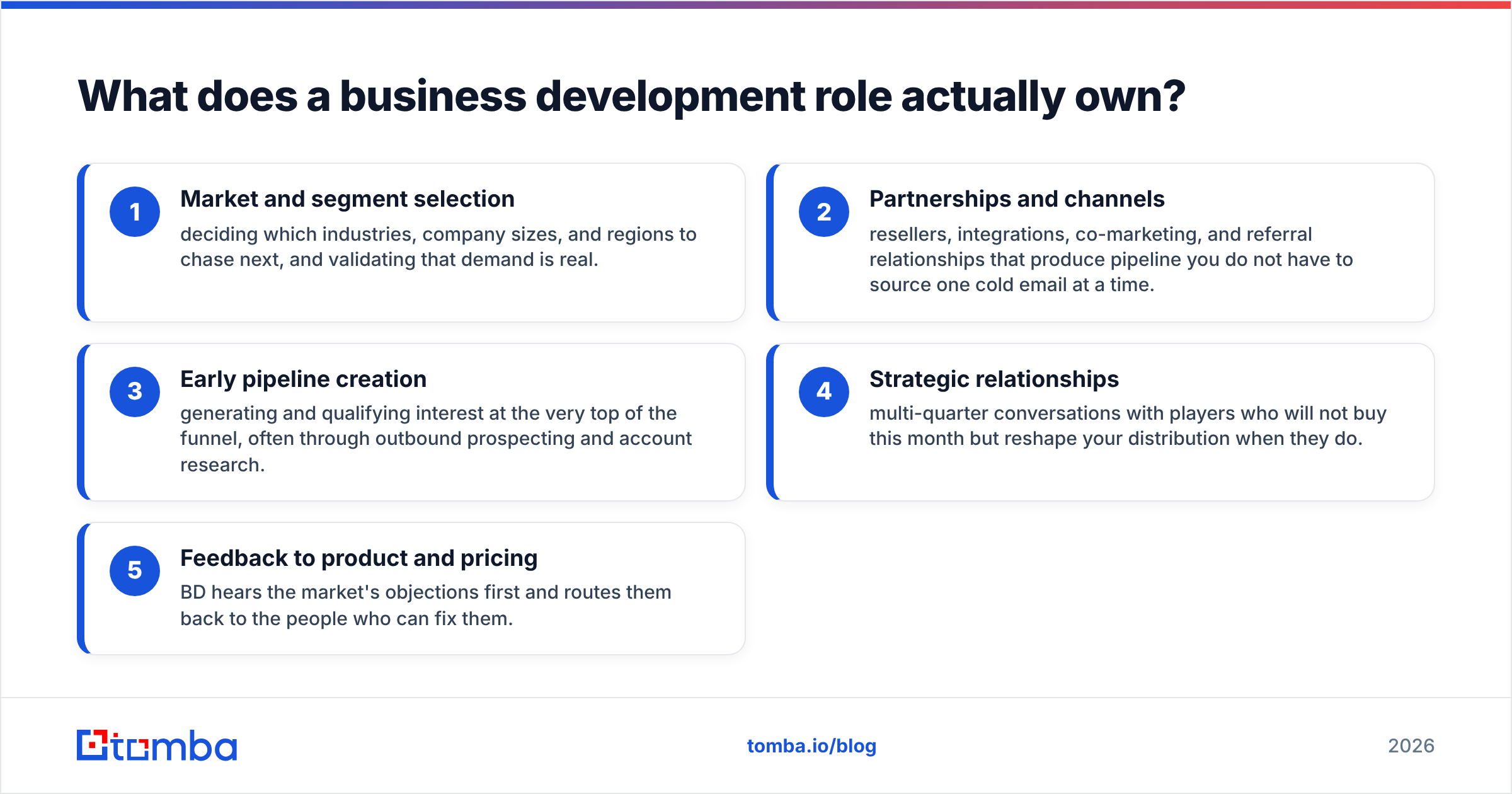
Business development owns the inputs that make a quota possible before any single deal exists. Strip away the buzzwords and the job is concrete:
- Market and segment selection — deciding which industries, company sizes, and regions to chase next, and validating that demand is real.
- Partnerships and channels — resellers, integrations, co-marketing, and referral relationships that produce pipeline you do not have to source one cold email at a time.
- Early pipeline creation — generating and qualifying interest at the very top of the funnel, often through outbound prospecting and account research.
- Strategic relationships — multi-quarter conversations with players who will not buy this month but reshape your distribution when they do.
- Feedback to product and pricing — BD hears the market's objections first and routes them back to the people who can fix them.
A useful split many teams use: partnership BD (deals about deals — channels, alliances) versus sales development (the SDR/BDR layer that books meetings for closers). The second is functionally part of sales even when it carries a "business development representative" title.
What does a sales role own?#
Sales owns the qualified opportunity from the moment it is accepted to the moment it closes — and often the expansion after. The scope is narrower but deeper:
- Discovery and qualification of accepted opportunities (BANT, MEDDICC, or whatever framework you run).
- Solution mapping — connecting your product to a specific buyer's pain, with a tailored demo or proposal.
- Negotiation and closing — pricing, terms, procurement, legal, and the signature.
- Forecasting — a number the company can plan around, tracked against a win rate and a defined sales cycle.
Sales is measured on lagging outcomes: revenue, quota attainment, average deal size, sales-cycle length. BD is measured on leading indicators: partnerships signed, qualified pipeline created, new segments validated. Confusing the two metric sets is how you end up paying a market-builder on a closing quota they cannot control, or a closer on a vanity "meetings booked" number that never converts.
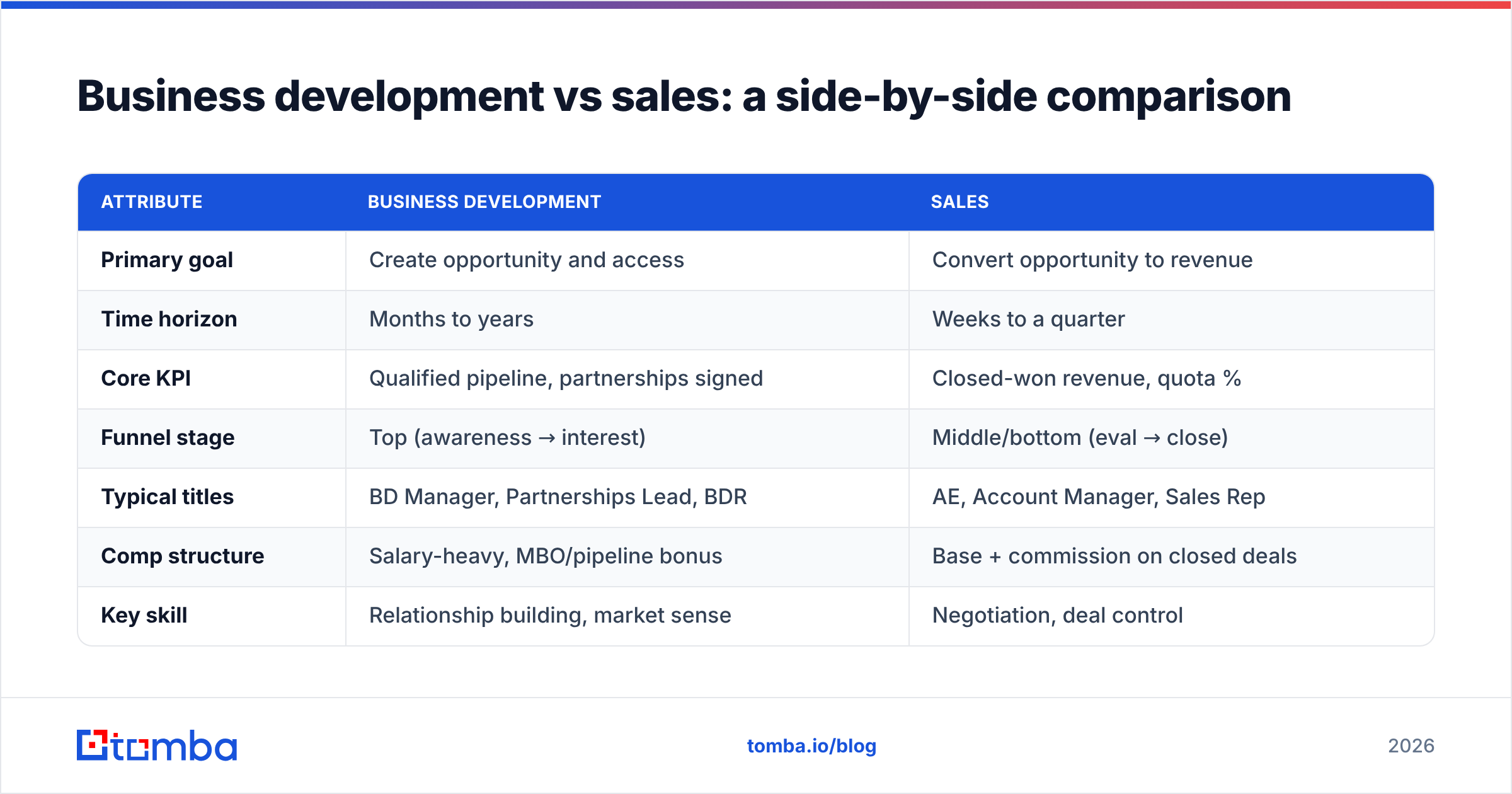
Business development vs sales: a side-by-side comparison#
| Attribute | Business Development | Sales |
|---|---|---|
| Primary goal | Create opportunity and access | Convert opportunity to revenue |
| Time horizon | Months to years | Weeks to a quarter |
| Core KPI | Qualified pipeline, partnerships signed | Closed-won revenue, quota % |
| Funnel stage | Top (awareness → interest) | Middle/bottom (eval → close) |
| Typical titles | BD Manager, Partnerships Lead, BDR | AE, Account Manager, Sales Rep |
| Comp structure | Salary-heavy, MBO/pipeline bonus | Base + commission on closed deals |
| Key skill | Relationship building, market sense | Negotiation, deal control |
| Risk if mis-staffed | No future pipeline | This quarter's number misses |
| Data dependency | Account & contact discovery | Verified contacts, decision-makers |
The row that matters most is the last one. Both functions run on the same fuel: accurate, reachable contact data. BD cannot open a partnership conversation with the wrong VP, and sales cannot close a deal it can never get on the phone. This is why a reliable email finder and data enrichment layer sits underneath both org boxes rather than belonging to one.
How do business development and sales hand off to each other?#
The handoff is where most revenue leaks. BD (or the SDR layer) sources and qualifies; sales accepts and closes. If the definition of "qualified" is fuzzy, BD ships junk and sales rejects everything — and both teams blame the other in the next pipeline review.
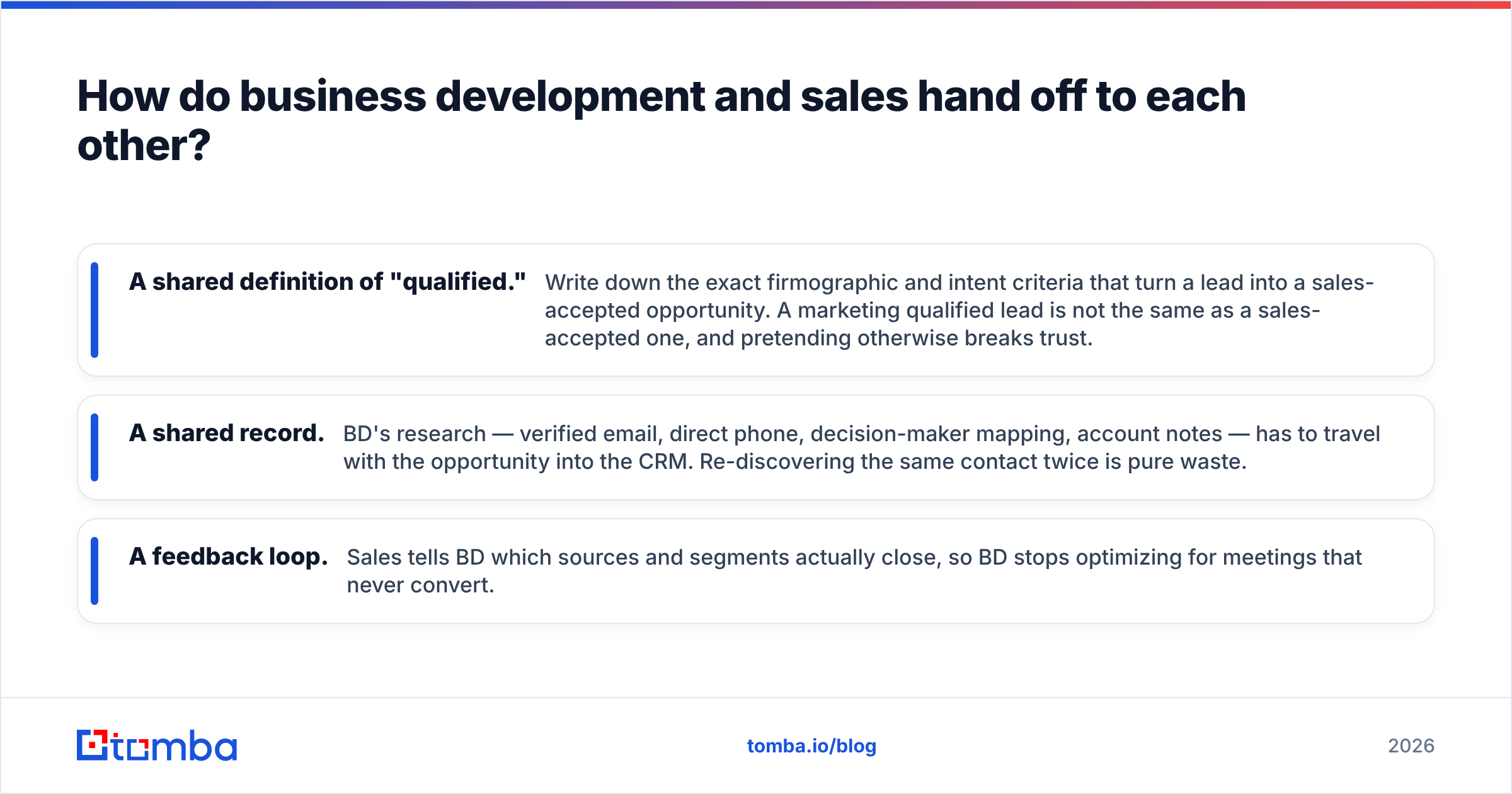
A clean handoff has three parts:
- A shared definition of "qualified." Write down the exact firmographic and intent criteria that turn a lead into a sales-accepted opportunity. A marketing qualified lead is not the same as a sales-accepted one, and pretending otherwise breaks trust.
- A shared record. BD's research — verified email, direct phone, decision-maker mapping, account notes — has to travel with the opportunity into the CRM. Re-discovering the same contact twice is pure waste.
- A feedback loop. Sales tells BD which sources and segments actually close, so BD stops optimizing for meetings that never convert.
Salesforce's own research on revenue teams keeps landing on the same point: alignment between the function that creates pipeline and the function that closes it is the single biggest lever on conversion. You can read their broader take on the state of sales for the macro numbers, and HubSpot's sales vs. business development breakdown for a complementary role-by-role view.

Do you need both, and when do you hire each?#
You need both eventually, but rarely at the same time or in the same ratio. Sequence by stage:
- Pre-product-market fit: founders do both. Do not hire a "BD lead" to find your market for you — that is your job until the motion is repeatable.
- Early traction: hire closers (sales) first. You have demand you cannot personally service; get AEs who turn it into revenue.
- Scaling: add the SDR/BDR layer to feed AEs predictably, then layer in partnership BD once your product is stable enough that channels want to attach to it.
- Expansion stage: invest in strategic BD for new markets and alliances while sales runs the core engine.
A practical staffing tell: if your problem is "we have interest we can't close," hire sales. If your problem is "we've closed everyone we can reach and need new ground," hire business development. Most teams misdiagnose this and over-hire closers into a market that has run dry — then wonder why quotas slip.
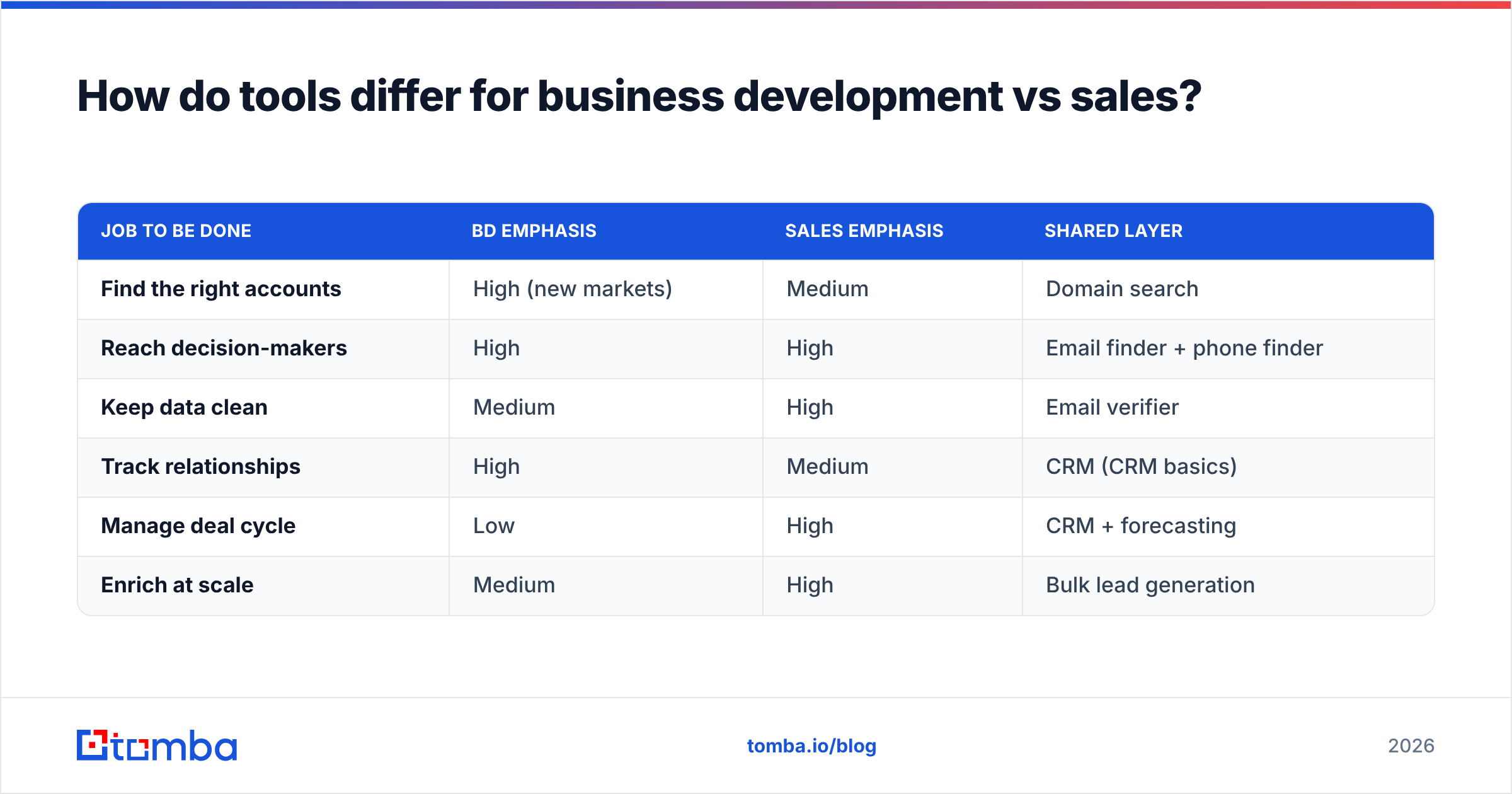
How do tools differ for business development vs sales?#
The stacks overlap but emphasize different jobs. BD leans on discovery, research, and relationship tracking. Sales leans on pipeline management, sequencing, and forecasting. Both need the same clean contact foundation underneath.
| Job to be done | BD emphasis | Sales emphasis | Shared layer |
|---|---|---|---|
| Find the right accounts | High (new markets) | Medium | Domain search |
| Reach decision-makers | High | High | Email finder + phone finder |
| Keep data clean | Medium | High | Email verifier |
| Track relationships | High | Medium | CRM (CRM basics) |
| Manage deal cycle | Low | High | CRM + forecasting |
| Enrich at scale | Medium | High | Bulk lead generation |
Notice the shared column. Whether a contact is going into a three-year partnership conversation or a 30-day close, it still has to be a real, deliverable email tied to the right person. Garbage data taxes both motions equally — a bounced BD intro burns a relationship, and a bounced sales sequence burns sender reputation you spent months building. If you want the full menu of how contact data flows into either motion, the Tomba pricing page lays out where the free tier ends and bulk work begins.
What metrics should you track for each function?#
Match the metric to the time horizon, or you will reward the wrong behavior.
Business development metrics (leading):
- Qualified pipeline created (dollar value, not meeting count)
- Partnerships or channels signed and their sourced revenue
- New-segment validation rate (tested vs. proven)
- Pipeline-to-acceptance ratio (how much BD-sourced pipeline sales actually accepts)
Sales metrics (lagging):
- Closed-won revenue and quota attainment
- Win rate and average deal size
- Sales-cycle length
- Response rate on active opportunities
The connective metric — the one both teams should stare at together — is BD-sourced pipeline that converts to closed-won. It is the only number that proves the handoff works. If BD's pipeline looks huge but converts at a fraction of inbound or AE-sourced deals, your "qualification" is theater.
Common mistakes when separating BD and sales#
A few patterns show up again and again:
- Title inflation. Calling SDRs "business development representatives" is fine, but do not then expect them to do strategic partnership work. Name the job by what it owns.
- Comp misalignment. Paying market-builders on a short-term closing quota pushes them to abandon the long game and chase the nearest deal. Pay BD on pipeline and partnerships; pay sales on revenue.
- Data silos. BD's hard-won research dies in a spreadsheet instead of flowing into the CRM with the opportunity. Standardize on one B2B database and one enrichment path so the record is portable.
- No feedback loop. Sales never tells BD which segments close, so BD keeps feeding the funnel with leads that look good and convert badly.
Avoid these and the BD-vs-sales debate stops being a turf war and becomes what it should be — a relay race with a clean baton pass.
Frequently asked questions#
Is business development the same as sales? No. Business development creates markets, partnerships, and early pipeline; sales converts qualified opportunities into revenue. They share a pipeline but run on different time horizons and metrics.
Is a BDR a sales or business development role? Functionally, the SDR/BDR layer is part of the sales motion — it qualifies and books meetings for closers — even though the title says "business development." True partnership BD is a separate, more strategic role.
Which should I hire first? If you have demand you cannot close, hire sales. If you have closed everyone you can reach and need new ground, hire business development.
Do BD and sales use the same tools? They overlap heavily on the contact-data layer — email finding, verification, and enrichment — but diverge on relationship tracking (BD) versus deal management and forecasting (sales).
Build both motions on data you can trust#
Business development and sales answer different questions, but they fail for the same reason: bad contact data. A partnership intro to the wrong executive and a sales sequence to a dead inbox are the same mistake at two stages of the funnel. Before you argue about org charts, fix the foundation — make sure every contact your team touches is a real, reachable decision-maker.
That is exactly what the Tomba Email Finder is built for: find verified professional emails by name, company, or domain, then enrich and push them straight into your CRM so BD and sales work from the same clean record. Start on the free tier (25 searches a month), and scale into bulk discovery from the $49/mo Starter plan when both motions are humming. Give your market-builders and your closers the same trustworthy fuel, and the handoff finally stops leaking.
// get started
Find, verify and enrich your first contacts today
Start on the free plan with 25 searches a month, then scale when your team is ready.
Free plan · No credit card required · GDPR & CCPA
// about the author