Business Email Opening Lines That Get Replies in 2026
Your business email opening decides whether the rest gets read. Here are the lines, templates, and tests that lift reply rates in 2026.
The first sentence of a business email is the only part most recipients actually decide to read on purpose. Get it wrong and the rest of your carefully written pitch never gets a fair hearing. Get it right and you earn the next ten seconds — which is all you need.
This guide breaks down what a strong business email opening looks like in 2026, why most openers fail, and the exact line formulas you can reuse for cold outreach, warm follow-ups, and internal notes.
TL;DR#
- The job of a business email opening is to earn the second sentence, not to introduce yourself.
- Skip "I hope this email finds you well" — it signals a mass send and wastes your best line.
- Lead with the recipient: a specific trigger, observation, or shared context beats any fact about you.
- Personalized first lines lift reply rates, but they only work if your contact data is accurate — a wrong name or company kills trust instantly.
- Test 2–3 opening variants per campaign and let reply rate, not open rate, pick the winner.
What makes a business email opening actually work?#
A good opening does one thing: it proves, in under two seconds, that the email was written for this person. Think of it like the doorman at a members' club. The recipient's inbox is the door, and your subject line got you a glance. The opening line is the doorman deciding whether you belong inside or get waved off.
Three forces are working against you the moment your email lands:
- Volume — the average professional gets 100+ emails a day and triages most in the preview pane.
- Pattern recognition — readers have learned to spot template language ("I came across your profile…") and delete on sight.
- Skepticism — if your opener feels automated, every claim after it inherits that doubt.
A strong opening neutralizes all three by being specific, recipient-centered, and short. According to HubSpot's sales research, personalization and relevance are the strongest predictors of whether a prospecting email gets a response — and the opening line is where relevance is proven or lost.
The anatomy of a high-performing opener#
Most openers that get replies share the same four-part structure. You rarely need all four, but the best lines hit at least two:
- The hook — a trigger event, observation, or question that's true only for this recipient.
- The relevance bridge — one phrase connecting that hook to why you're reaching out.
- The brevity rule — keep it to one or two sentences before you make your point.
- The forward motion — language that implies a next step, not a dead end.
Compare these two openers for the same prospect:
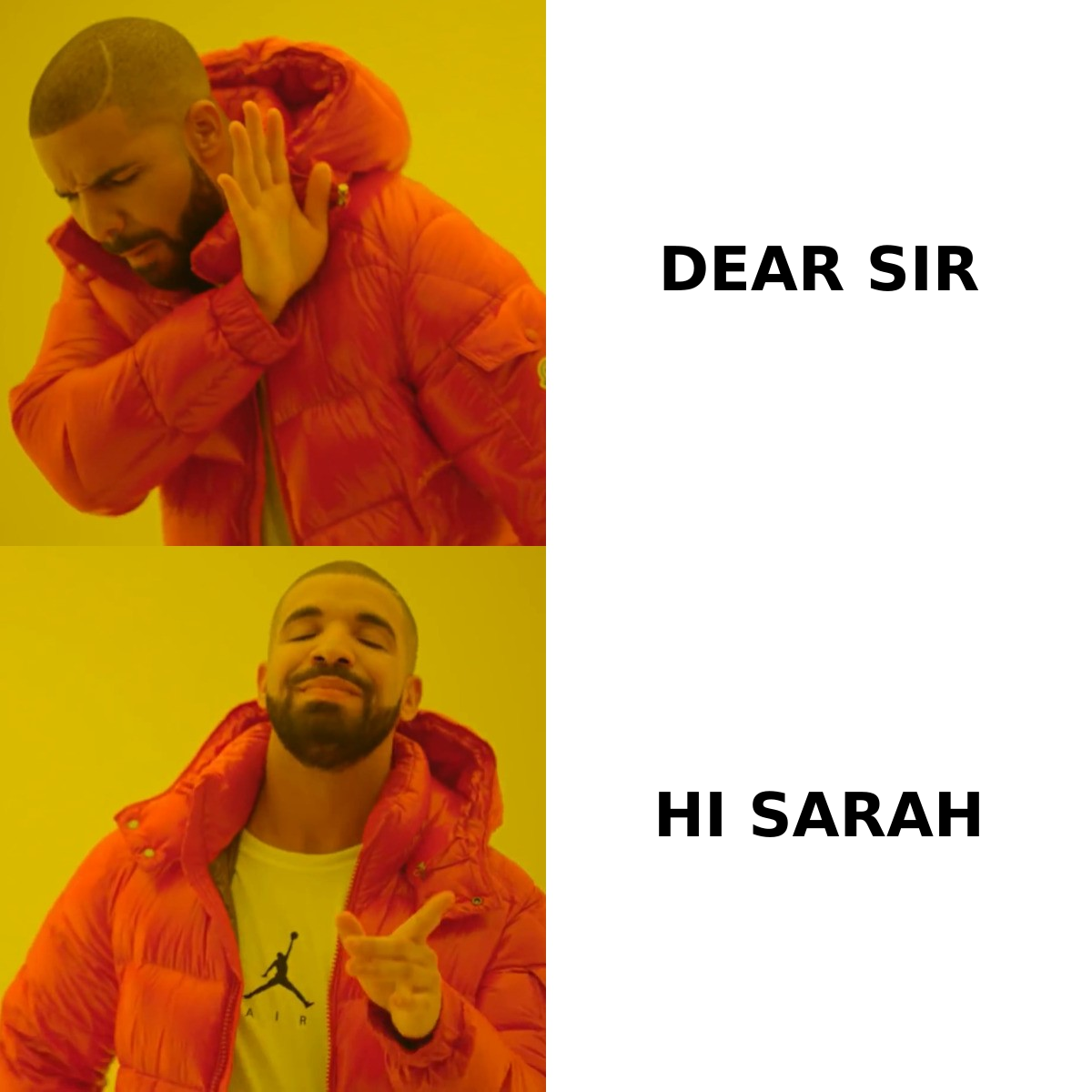
"I hope this email finds you well. My name is Alex and I work at a SaaS company that helps teams like yours."
versus
"Saw your team just opened a second office in Austin — congrats. That kind of growth usually breaks the old way of tracking pipeline."
The second one names a real event, ties it to a pain, and never mentions the sender. That's the entire difference.
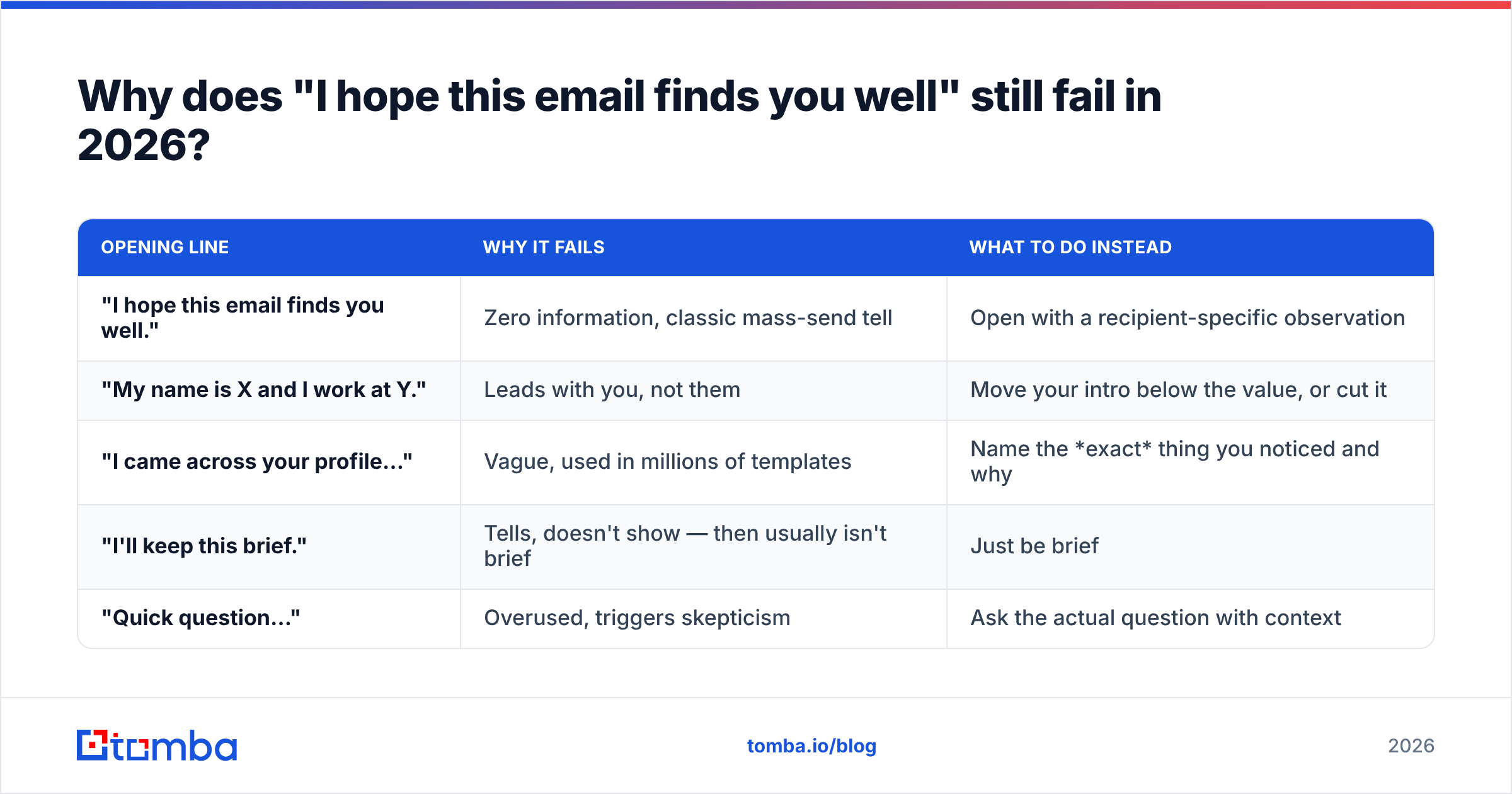
Why does "I hope this email finds you well" still fail in 2026?#
Because it tells the reader nothing and signals everything. The phrase is grammatically polite and strategically empty. It's the email equivalent of clearing your throat — you've used your most valuable line to say "I'm about to talk now."
Worse, it's become a near-perfect spam tell. When a line appears in millions of cold emails, readers stop seeing it as courtesy and start reading it as "this was sent to a list." You're not being rude by skipping it; you're being efficient.
Here's a quick audit of openers that quietly tank your reply rate:
| Opening line | Why it fails | What to do instead |
|---|---|---|
| "I hope this email finds you well." | Zero information, classic mass-send tell | Open with a recipient-specific observation |
| "My name is X and I work at Y." | Leads with you, not them | Move your intro below the value, or cut it |
| "I came across your profile…" | Vague, used in millions of templates | Name the exact thing you noticed and why |
| "I'll keep this brief." | Tells, doesn't show — then usually isn't brief | Just be brief |
| "Quick question…" | Overused, triggers skepticism | Ask the actual question with context |
The pattern across every failure is the same: the line is about the sender or about nothing. The fix is always to make it about the reader.
What are the best business email opening formulas?#
You don't need to invent a new opener every time. You need a small set of reliable formulas you can adapt with real data. Here are six that consistently earn the second sentence.
- The trigger event — "Noticed [company] just [raised funding / launched X / hired a new VP of Sales]…" Timeliness signals you're paying attention, not blasting a list.
- The specific compliment — "Your breakdown of [topic] on [podcast/post] changed how I think about [thing]…" Genuine, specific praise disarms skepticism. Generic flattery does the opposite.
- The shared context — "We both came up through [community / company / role], so you'll get why…" Common ground lowers the reader's guard.
- The pointed question — "How is your team handling [specific problem] now that [recent change]?" A question that assumes relevance pulls a reply.
- The mutual connection — "[Name] suggested I reach out — she mentioned you're rethinking [process]." A referral is the strongest opener that exists; use it when it's true.
- The pattern interrupt — "This is a cold email — I'll be quick about why it might be worth 30 seconds." Honesty stands out precisely because so few senders use it.
Notice that every formula starts with the recipient or a shared reality, and none of them start with your name, your company, or a wish about their wellbeing.
Matching the opener to the email type#
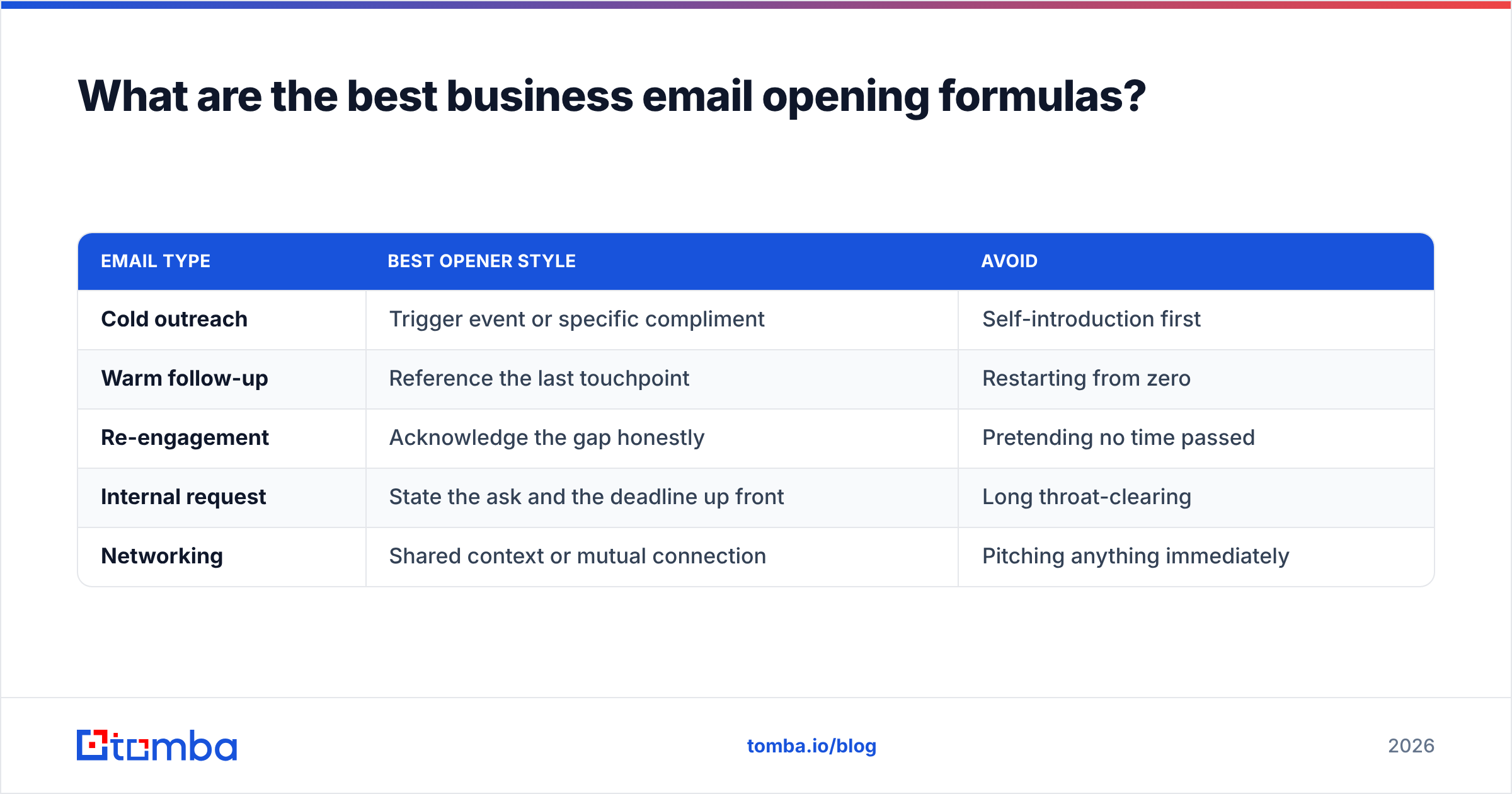
The right opening shifts depending on relationship and intent. Use this as a quick reference:
| Email type | Best opener style | Avoid |
|---|---|---|
| Cold outreach | Trigger event or specific compliment | Self-introduction first |
| Warm follow-up | Reference the last touchpoint | Restarting from zero |
| Re-engagement | Acknowledge the gap honestly | Pretending no time passed |
| Internal request | State the ask and the deadline up front | Long throat-clearing |
| Networking | Shared context or mutual connection | Pitching anything immediately |
The deliverability side matters too: even a perfect opener can't save an email that never reaches the inbox. If your sends are landing in spam, fix email deliverability and sender reputation before you blame the copy.
How do you personalize an opening line at scale?#
Personalization is the multiplier on every formula above, but it's also the place teams quietly break trust. The math is simple: a personalized first line that's wrong — wrong name, wrong company, wrong role — does more damage than no personalization at all. It proves the email is automated and careless.
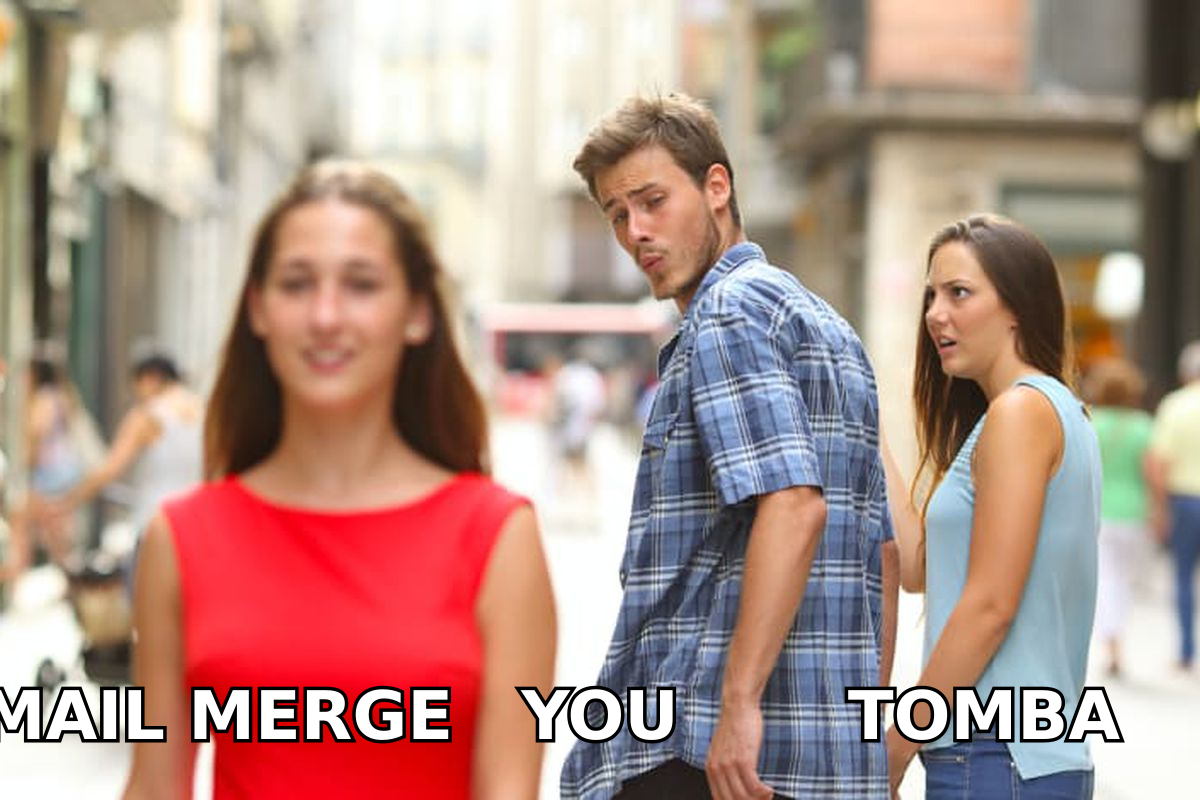
So personalization at scale is really two problems: the line and the data behind the line. The copy is the easy part. The data is where campaigns live or die.
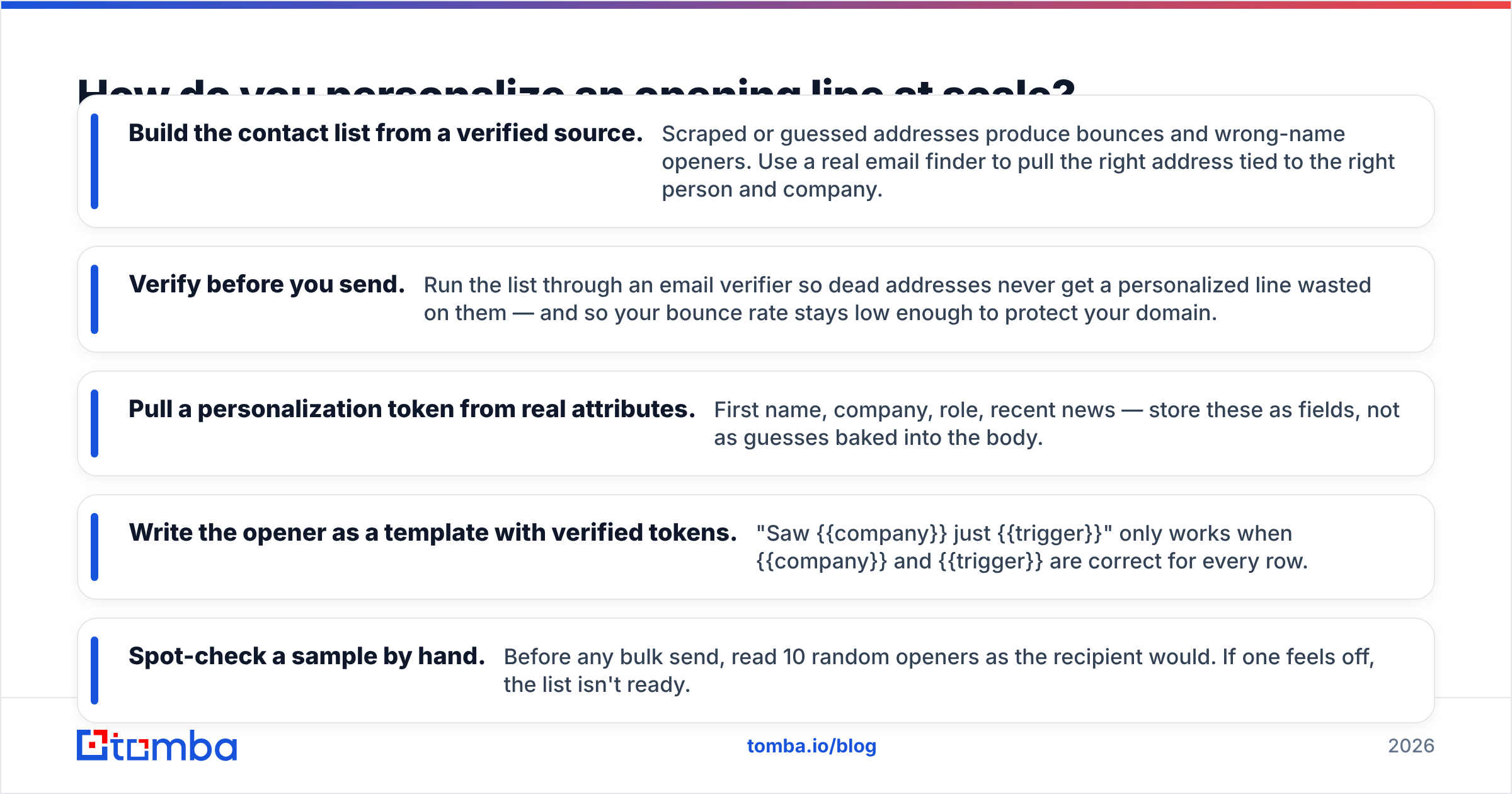
Here's the workflow that keeps personalization accurate without grinding to a halt:
- Build the contact list from a verified source. Scraped or guessed addresses produce bounces and wrong-name openers. Use a real email finder to pull the right address tied to the right person and company.
- Verify before you send. Run the list through an email verifier so dead addresses never get a personalized line wasted on them — and so your bounce rate stays low enough to protect your domain.
- Pull a personalization token from real attributes. First name, company, role, recent news — store these as fields, not as guesses baked into the body.
- Write the opener as a template with verified tokens. "Saw {{company}} just {{trigger}}" only works when {{company}} and {{trigger}} are correct for every row.
- Spot-check a sample by hand. Before any bulk send, read 10 random openers as the recipient would. If one feels off, the list isn't ready.
This is also why data quality and copywriting can't be separated. You can study openers all day, but if your CRM thinks the VP of Sales is named "Mike" when it's "Maya," your best line becomes your worst one. Accurate data is what lets a clever opening formula actually land — which is the entire reason tools like Tomba's domain search and verification layer exist alongside the finder.
A quick word on tone and length#
Length is part of the opener's job. On mobile — where most first reads happen — the preview shows roughly the first 90 characters. That means your opening line is your subject line's backup. Front-load the specific, recipient-facing detail so it survives the preview cut.
On tone, match the reader's world. A founder-to-founder email can be blunt and lowercase. An email to a procurement lead at a regulated enterprise should be cleaner and more formal. The opener is where you signal "I understand your context" before you've said anything else.
What opening mistakes quietly kill your reply rate?#
Beyond the obvious filler lines, a few subtler mistakes do real damage:
- Burying the recipient under your credentials. Awards, funding, and logos belong later, if at all. The opener is not your résumé.
- Faking familiarity. "Long time no talk!" to someone you've never met reads as manipulative the instant they realize it.
- Asking for time before giving a reason. "Do you have 15 minutes?" in line one, before any value, almost always gets ignored.
- Over-personalizing with creepy data. Referencing something too private signals surveillance, not research. Stick to public, professional triggers.
- Copy-pasting a viral template verbatim. If you found the line in a "best cold email openers" post, so did 50,000 other senders. Use the structure, write your own specifics.
The throughline: every mistake either centers the sender or breaks trust. Audit your openers against those two failure modes and you'll catch most problems before you hit send.
How do you test which opening line wins?#
Treat openers like any other variable: isolate them and measure the right metric. The mistake most teams make is optimizing the opener for open rate. But the subject line drives opens — the opening line drives replies. So reply rate is your scoreboard.
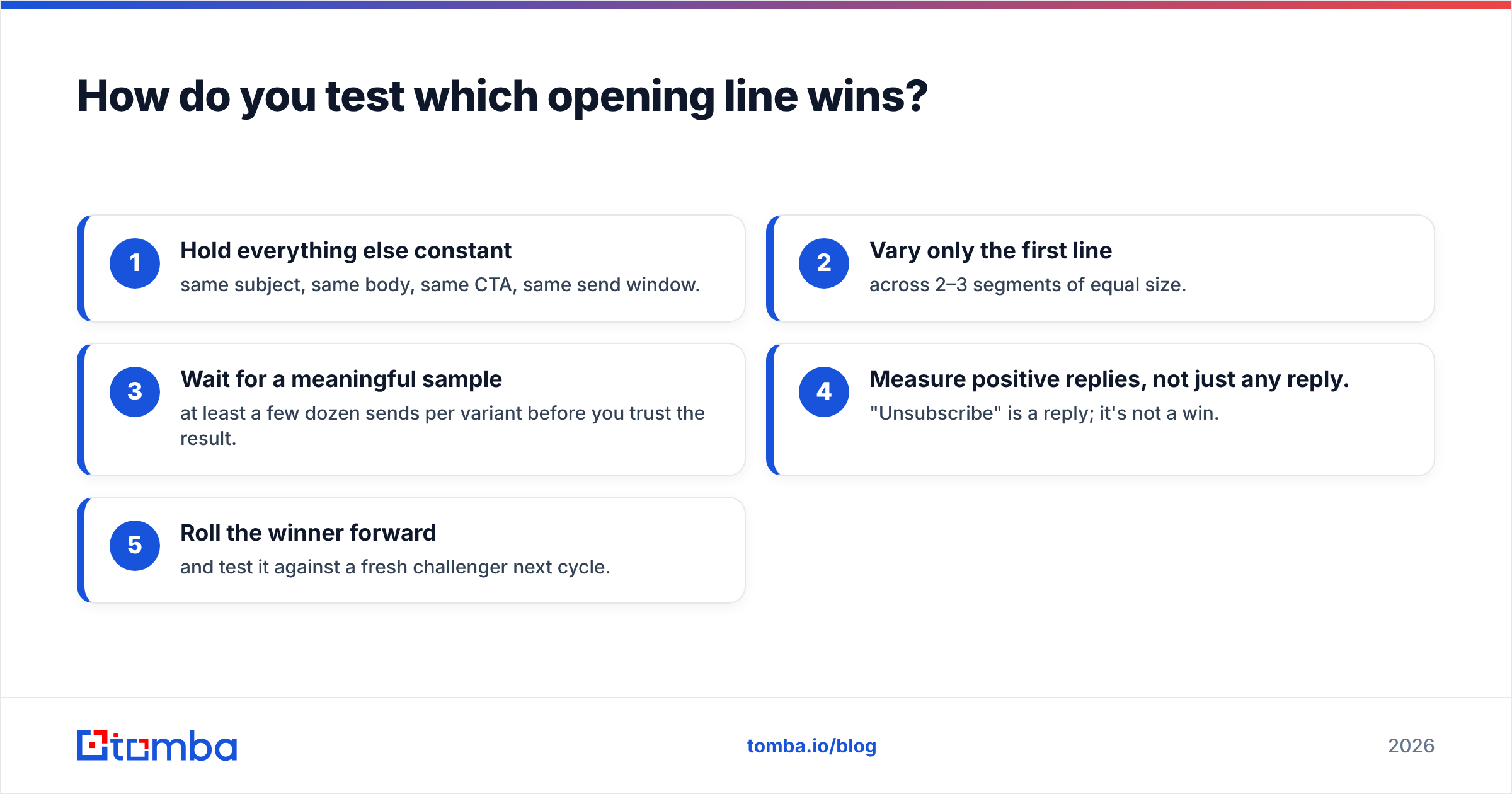
A simple, honest test:
- Hold everything else constant — same subject, same body, same CTA, same send window.
- Vary only the first line across 2–3 segments of equal size.
- Wait for a meaningful sample — at least a few dozen sends per variant before you trust the result.
- Measure positive replies, not just any reply. "Unsubscribe" is a reply; it's not a win.
- Roll the winner forward and test it against a fresh challenger next cycle.
For benchmarks on what "good" looks like, review your own historical response rate before chasing numbers from a blog post. Your audience, offer, and list quality matter more than any industry average. Independent reviews on platforms like G2 can help you compare the tools that run these tests, but your data is the only benchmark that counts.
Quick-reference: openers you can adapt today#
To make this concrete, here are ready-to-edit openers mapped to the formulas above. Replace the brackets with verified, specific detail:
- Trigger: "Saw [company] just [event] — that usually changes how teams handle [problem]."
- Compliment: "Your point about [specific idea] in [source] stuck with me, especially the part about [detail]."
- Question: "How is [team] managing [problem] now that [change] is in play?"
- Referral: "[Name] thought you and I should talk — she mentioned [context]."
- Honest cold: "Cold email, so I'll be direct: [one-line reason this is worth 30 seconds]."
Each of these dies the moment the bracketed data is wrong. That's the recurring lesson of this entire guide — copy and data are one system, not two.
Final takeaway and where to start#
The best business email opening is the one that proves the email was built for the person reading it. That means leading with them, staying short, and — critically — building on contact data that's actually correct. A brilliant opener attached to the wrong name is just a faster way to lose trust.
If your openers are strong but your replies are weak, the problem is usually upstream: bounced sends, wrong names, or addresses that never reached a real person. Start by fixing the data. Use the Tomba Email Finder to pull accurate, verified email addresses tied to the right people and companies, so every personalized first line you write lands on a real human who can actually reply. Pair it with verification, write the opener like you mean it, and let your reply rate climb.
// get started
Find, verify and enrich your first contacts today
Start on the free plan with 25 searches a month, then scale when your team is ready.
Free plan · No credit card required · GDPR & CCPA
// about the author