Business Email Phrases: 60+ Pro Lines That Get Replies in 2026
The exact business email phrases that open, persuade, and close professional emails — plus the tired lines to retire and a copy-paste table for every situation.
Most professional emails fail for a boring reason: the words are vague, hedged, or borrowed from a 2009 corporate template. The fix is not "write better" in the abstract — it is swapping a small set of weak, default business email phrases for sharper ones that tell the reader what happened, what you need, and what to do next.
This guide gives you the phrases, grouped by where they sit in the email: the opener, the request, the follow-up, and the close. You will also see which tired lines to retire and a copy-paste table for the most common situations.
TL;DR#
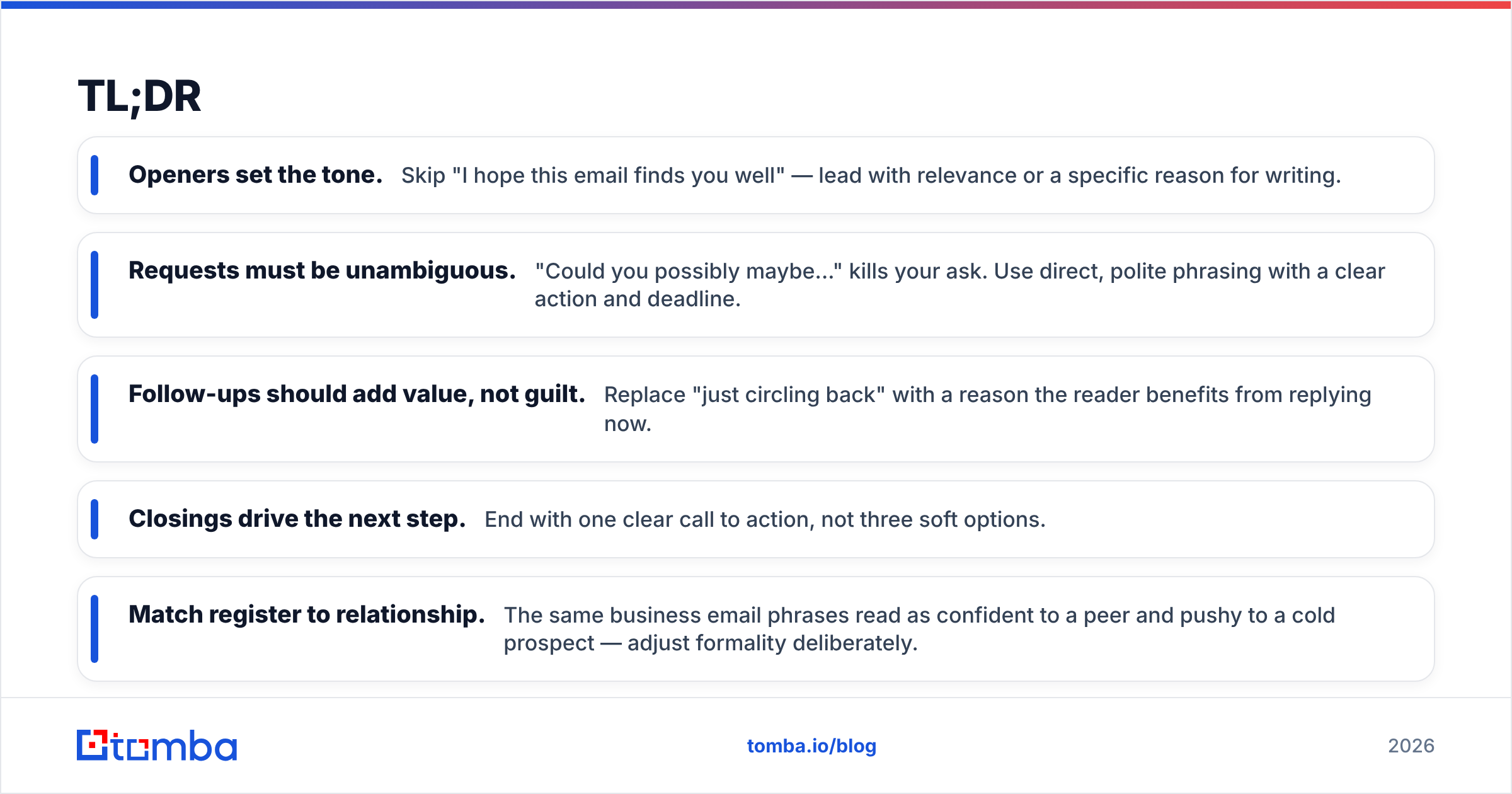
- Openers set the tone. Skip "I hope this email finds you well" — lead with relevance or a specific reason for writing.
- Requests must be unambiguous. "Could you possibly maybe..." kills your ask. Use direct, polite phrasing with a clear action and deadline.
- Follow-ups should add value, not guilt. Replace "just circling back" with a reason the reader benefits from replying now.
- Closings drive the next step. End with one clear call to action, not three soft options.
- Match register to relationship. The same business email phrases read as confident to a peer and pushy to a cold prospect — adjust formality deliberately.
What makes a business email phrase work?#
A good phrase does three jobs at once: it is clear, specific, and low-friction for the reader. Clear means the reader never has to re-read it. Specific means it references the actual situation, not a generic template. Low-friction means replying or acting takes the reader seconds, not minutes.
Think of an email like a doorway. A weak phrase is a door with no handle — the reader can see the room but cannot figure out how to walk in. A strong phrase is a door propped open with a sign that says "this way." The reader does not have to think; they just move.
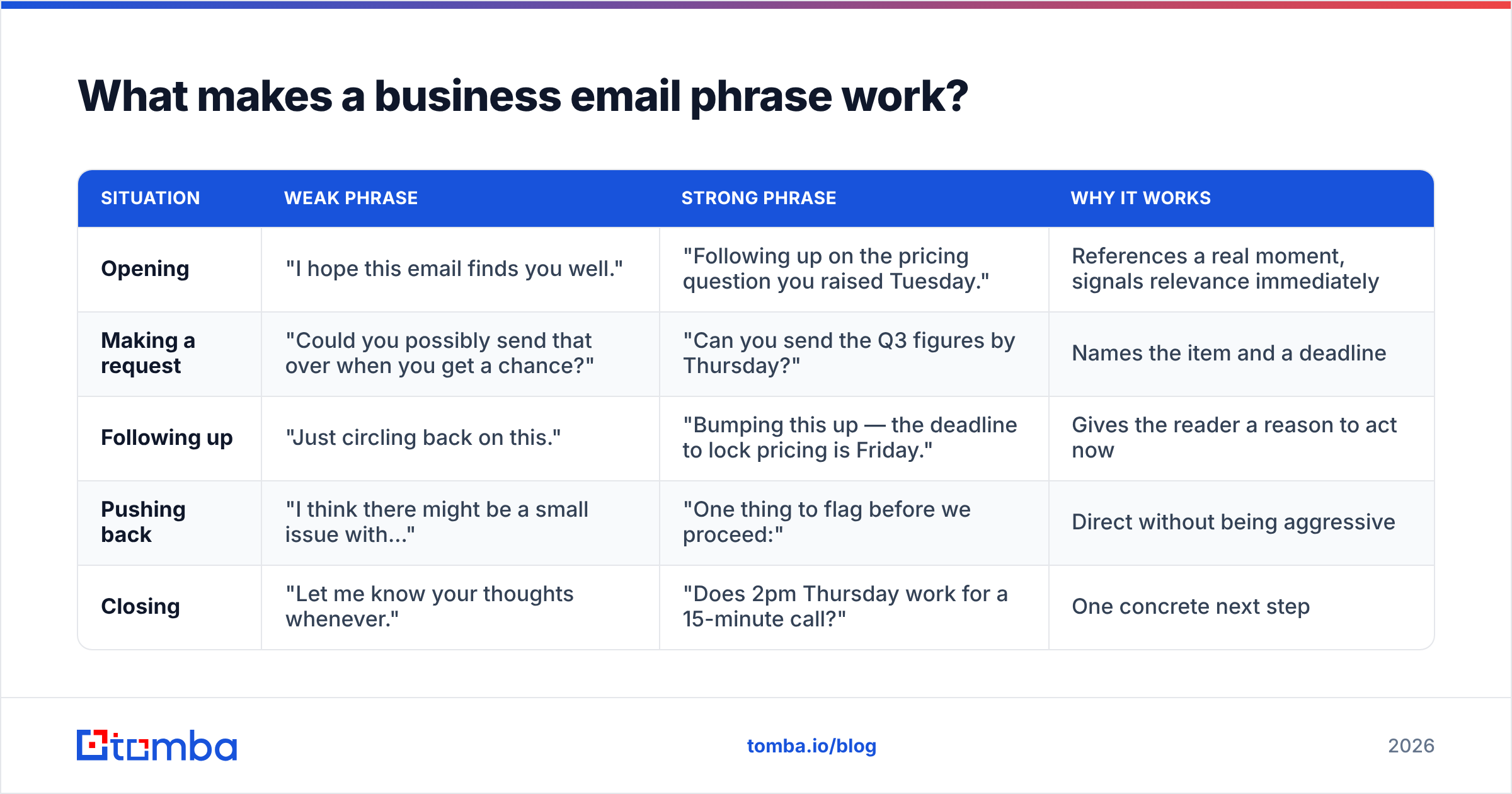
Here is the difference in practice:
| Situation | Weak phrase | Strong phrase | Why it works |
|---|---|---|---|
| Opening | "I hope this email finds you well." | "Following up on the pricing question you raised Tuesday." | References a real moment, signals relevance immediately |
| Making a request | "Could you possibly send that over when you get a chance?" | "Can you send the Q3 figures by Thursday?" | Names the item and a deadline |
| Following up | "Just circling back on this." | "Bumping this up — the deadline to lock pricing is Friday." | Gives the reader a reason to act now |
| Pushing back | "I think there might be a small issue with..." | "One thing to flag before we proceed:" | Direct without being aggressive |
| Closing | "Let me know your thoughts whenever." | "Does 2pm Thursday work for a 15-minute call?" | One concrete next step |
Notice that none of the strong phrases are longer. Clarity is rarely about word count — it is about removing hedges and adding specifics.
Which opening business email phrases actually land?#
Your first line decides whether the rest gets read. Openers fall into three buckets, and the right one depends on how warm the relationship is.
- Cold or first contact — lead with relevance to the reader, not yourself. Try: "I saw your team just shipped [feature] — quick question about how you handle [X]." A strong cold opener earns the next sentence; it does not assume attention.
- Warm follow-up — reference the shared context. Try: "Picking up where we left off on the integration timeline." This anchors the reader instantly.
- Internal or peer — get to the point. Try: "Two quick things on the launch:" Lists signal brevity and respect for time.
Phrases to retire from your openers:
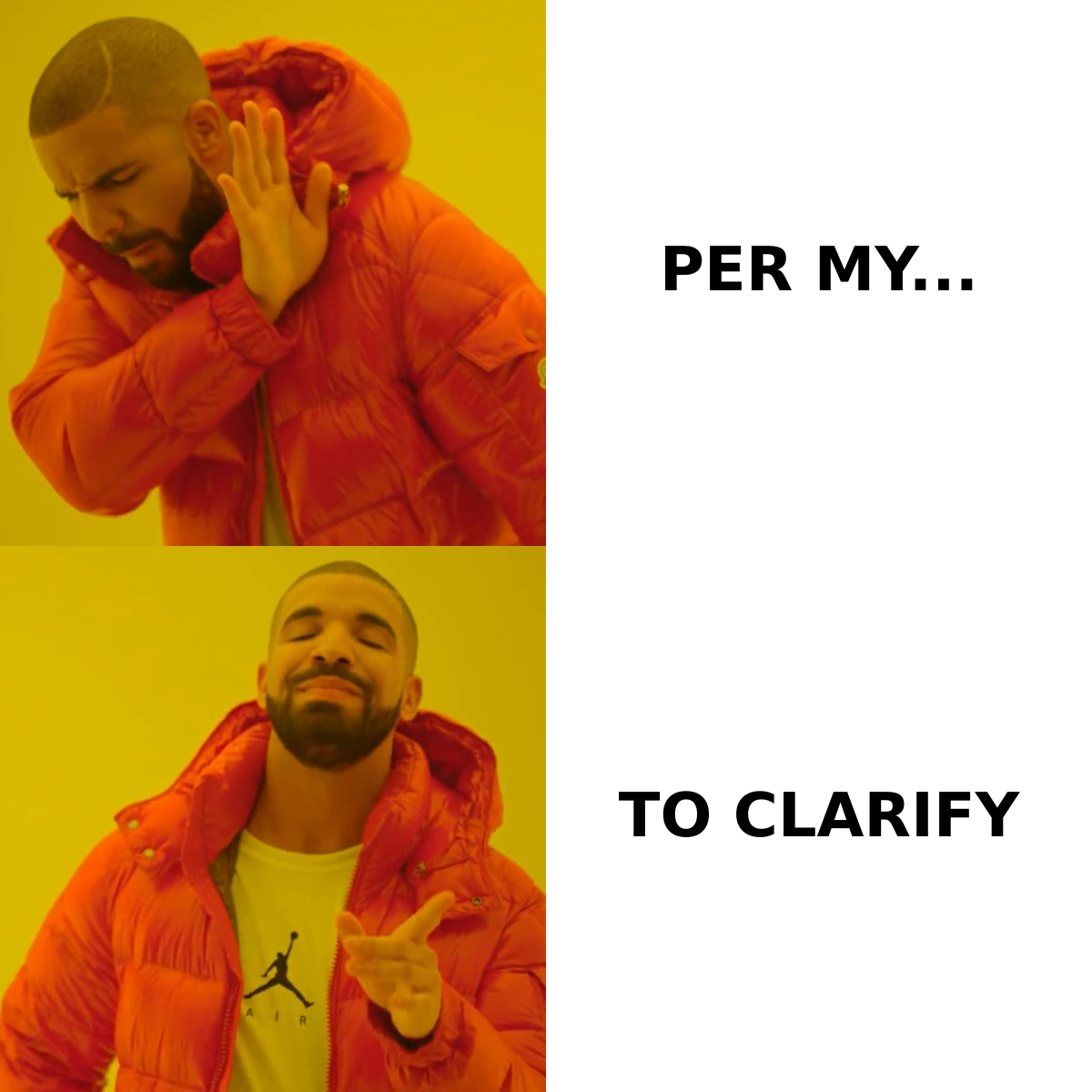
- "I hope this email finds you well." — It says nothing and everyone skims past it.
- "I am reaching out because..." — You are emailing; the reader knows you are reaching out.
- "My name is [X] and I work at [Y]." — Put that in your signature, not your first sentence.
If you write cold emails at scale, the opener only matters once the message lands in the inbox — which is a function of email deliverability and verified contact data, not phrasing alone. A flawless opener sent to a dead address gets nothing.
What are the best request and ask phrases?#
Requests are where most professional emails leak power. Writers soften the ask so much that the reader cannot tell whether action is optional. The cure is to be polite and direct — those are not opposites.
Direct request phrases that stay polite:
- "Can you confirm whether [X] is still on track for Friday?"
- "Would you be able to review the attached draft by end of week?"
- "I need your sign-off on the budget before I can proceed — can you reply by Thursday?"
- "Quick favor: can you forward me the latest contract version?"
Phrases that signal the priority level:
- Low urgency: "No rush, but when you have a moment..."
- Medium: "When you get a chance this week..."
- High: "This is time-sensitive — I need a decision by [time]."
Stating urgency explicitly is a kindness. The reader cannot read your mind, and "ASAP" means different things to different people. According to communication guidance from teams like HubSpot, specificity in the ask is one of the strongest predictors of a reply — vague requests get parked, concrete ones get answered.
A handy framing: every request email should answer "what, by when, and why" in the reader's first pass. Drop any of the three and you invite a clarifying reply, which doubles the cycle time.
How do you write follow-up phrases that don't sound desperate?#
Follow-ups go wrong when they center your anxiety instead of the reader's benefit. "Just checking in" and "circling back" are filler — they add a guilt nudge but no new reason to act.
Replace them with phrases that carry fresh value or a real deadline:
| Tired follow-up | Stronger replacement |
|---|---|
| "Just following up on my last email." | "Adding context that might help: [new detail]." |
| "Circling back on this." | "Quick update — the timeline shifted, so this is now relevant by Friday." |
| "Did you see my email?" | "Want to make sure this didn't get buried — still need your call on [X]." |
| "Bumping this to the top of your inbox." | "If now isn't the right time, who's the best person to ask?" |
That last replacement is underused. Offering an easy "out" or a redirect often gets a faster reply than pressure, because you have lowered the cost of responding.
Sequencing matters too. A good follow-up cadence spaces messages out and changes the angle each time rather than resending the same ask. If you are managing follow-ups across many prospects, your response rate depends as much on timing and list hygiene as on the phrasing — which is why verified contacts and clean sequencing tools earn their keep.
What closing phrases drive the next step?#
The close is your last chance to make action easy. The mistake is offering too many soft options — "let me know your thoughts, or we could hop on a call, or feel free to email back whenever." Three options is zero options; the reader defers.
End with one concrete next step:
- "Does Thursday at 2pm work for a quick call?" (proposes a specific slot)
- "Reply 'yes' and I'll send the contract today." (one-word action)
- "I'll follow up Monday unless I hear otherwise." (sets a default)
- "Who should I loop in to move this forward?" (redirect)
Sign-off phrases by register:
- Formal: "Best regards," / "Kind regards,"
- Neutral professional: "Best," / "Thanks,"
- Warm: "Cheers," / "Talk soon,"
- Avoid: "Sincerely yours," (stiff), "Sent from my iPhone" as an excuse (it isn't one), and "Thanks in advance," which can read as presumptuous when you're asking for a favor.
A reliable structure for any closing: confirm the next step, state who owns it, and give a timeframe. "I'll send the revised deck by Wednesday; let me know if you need it sooner" does all three in one sentence.
How should phrasing change across email types?#
The same phrase can be perfect or wrong depending on context. Below is a quick map of how register shifts across common business email scenarios. For ready-to-send structures, a library of cold email templates saves you from rebuilding the wheel each time.
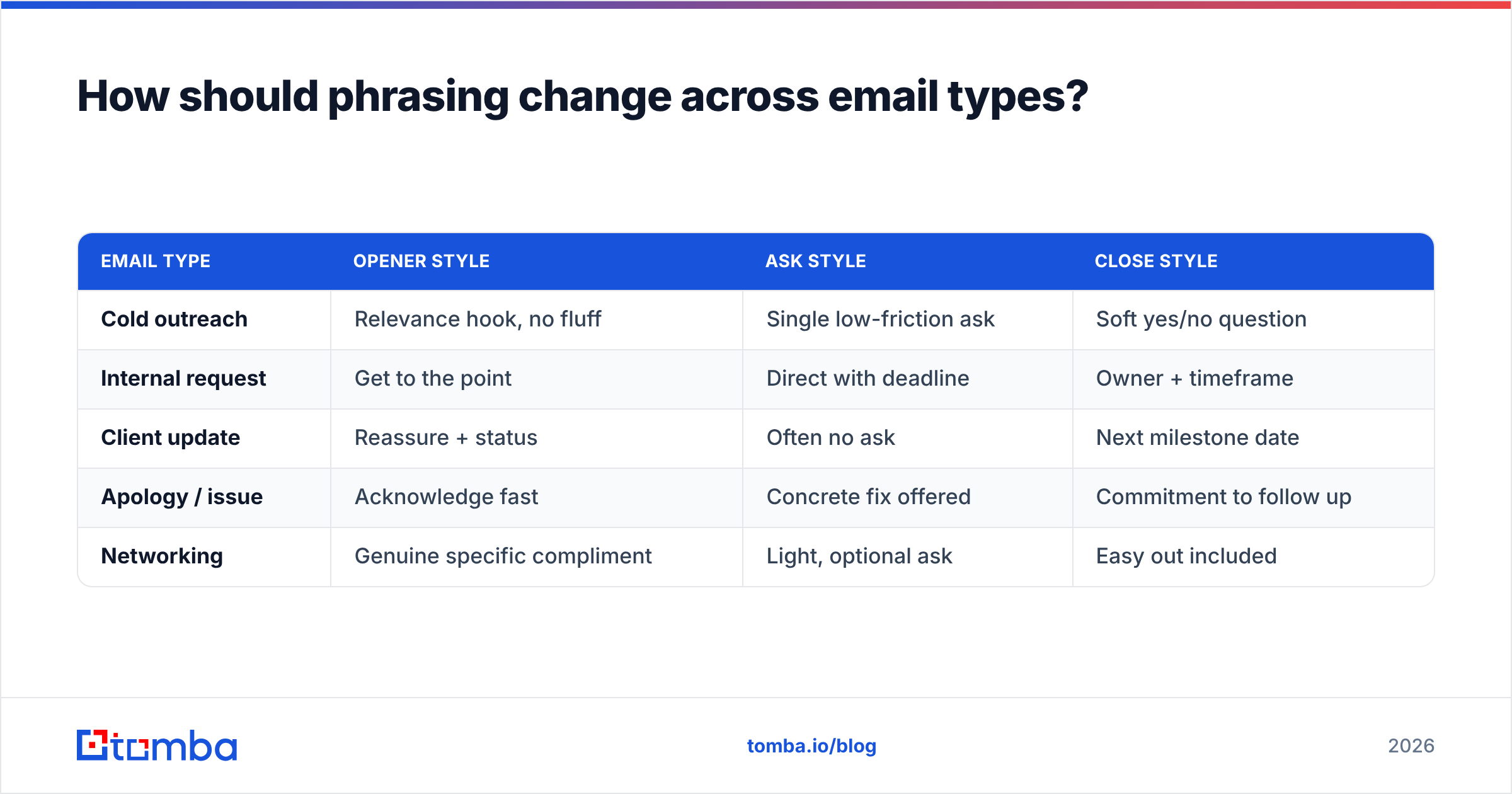
| Email type | Opener style | Ask style | Close style |
|---|---|---|---|
| Cold outreach | Relevance hook, no fluff | Single low-friction ask | Soft yes/no question |
| Internal request | Get to the point | Direct with deadline | Owner + timeframe |
| Client update | Reassure + status | Often no ask | Next milestone date |
| Apology / issue | Acknowledge fast | Concrete fix offered | Commitment to follow up |
| Networking | Genuine specific compliment | Light, optional ask | Easy out included |
The throughline: warmer relationships tolerate more directness, while colder ones need more relevance up front to earn the ask. Calibrate the amount of context, not the clarity — clarity is non-negotiable everywhere.
Which phrases should you retire in 2026?#
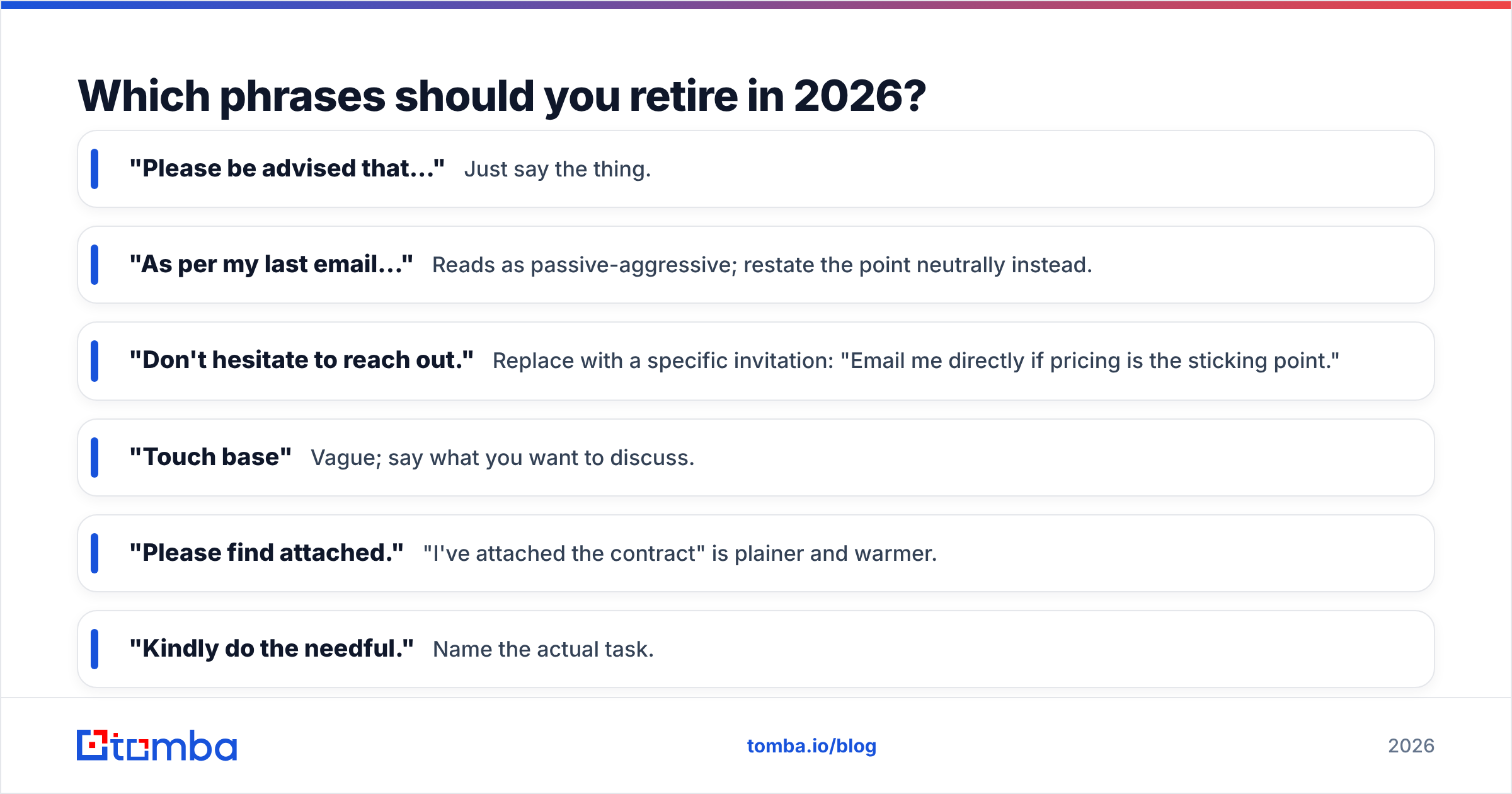
Some business email phrases have aged into pure noise. They are not offensive, just empty — and empty words make you sound like a template. Retire these:
- "Please be advised that..." — Just say the thing.
- "As per my last email..." — Reads as passive-aggressive; restate the point neutrally instead.
- "Don't hesitate to reach out." — Replace with a specific invitation: "Email me directly if pricing is the sticking point."
- "Touch base" — Vague; say what you want to discuss.
- "Please find attached." — "I've attached the contract" is plainer and warmer.
- "Kindly do the needful." — Name the actual task.
- "Hope you're doing well." — Fine in person, filler in email.
You do not need to ban these forever. The point is to notice when you reach for them on autopilot and to ask whether a specific phrase would do more work.
A useful self-edit pass: after drafting, delete your first sentence and your last sentence, then check whether the email still works. Most of the time the opener was throat-clearing and the close was hedging — and the email is stronger without them.
How do phrases fit into the bigger outreach picture?#
Phrasing is the visible 10% of a successful email. The invisible 90% is whether the message reaches a real person and lands in the primary inbox. You can write the cleanest request in the world, but if the address bounces or the domain has a poor sender reputation, no phrase will save it.
That is why high-performing teams pair sharp copy with two upstream basics:
- Accurate contact data — verified, current email addresses so your carefully worded message reaches a human, not a spam trap.
- Clean lists and warm domains — verification and deliverability hygiene so the inbox placement matches the effort you put into the words.
Get those right and your phrasing finally gets a fair test. Skip them and you will keep blaming your copy for a delivery problem.
Frequently asked questions#
What is the safest professional email greeting? "Hi [Name]," works in almost every business context — warm enough to feel human, formal enough for a first contact. Use "Dear [Name]," only for genuinely formal or legal correspondence.
How do I sound polite but firm in a request? Pair a courteous frame with a concrete ask and deadline: "Would you be able to send the figures by Thursday?" The politeness lives in the framing; the firmness lives in the specifics.
How many follow-ups are too many? Three to four spaced follow-ups, each adding a new angle or piece of value, is a reasonable ceiling for most outreach. Beyond that, change the channel or ask for a redirect rather than resending.
Do these phrases work for cold email? Yes, but cold email leans harder on the relevance opener and the low-friction ask. It also depends entirely on reaching a verified address — the best phrasing is wasted on a bounced send.
Put the right phrases in front of the right people#
Sharper business email phrases lift your reply rate — but only when your message actually reaches a living inbox. Start by making sure every address on your list is real: use the Tomba Email Finder to find and confirm professional emails by name, company, or domain, then verify them before you hit send. You can begin on the free tier (25 searches a month) and scale up through Tomba pricing as your outreach grows. Write the clear line, send it to the right person, and let the phrasing do what it was built to do.
// get started
Find, verify and enrich your first contacts today
Start on the free plan with 25 searches a month, then scale when your team is ready.
Free plan · No credit card required · GDPR & CCPA
// about the author