Business Email Salutations: The 2026 Guide That Converts
The right business email salutation sets the tone before your first sentence lands. Here's what to use in 2026, what to avoid, and how to personalize at scale.
The first line a recipient reads is not your subject line — it's your salutation. It decides whether your message feels like a personal note or a blast to 10,000 strangers. Get it wrong and the rest of your perfectly crafted copy never gets read.
TL;DR#
- "Hi [First Name]," is the safe default for most business email in 2026 — professional without sounding stiff.
- "To Whom It May Concern" and "Dear Sir or Madam" are dead. They signal you didn't bother to learn who you're writing to.
- Match formality to context: cold outbound and executives lean formal; warm replies and peers lean casual.
- Personalization beats politeness. A correct first name outperforms a fancy honorific every time.
- You can't personalize what you don't have — accurate contact data is the prerequisite for every greeting on this page.
What Is a Business Email Salutation?#
A business email salutation is the greeting line that opens your message — the "Hi Sarah," or "Dear Dr. Chen," that sits above your first paragraph. Think of it like the handshake before a meeting: it lasts a second, you barely notice a good one, but a bad one colors everything that follows.
Salutations do three jobs at once. They name the recipient (signaling this email is for them, not a list). They set the register — formal, neutral, or friendly. And they buy you the half-second of goodwill you need before the reader decides to keep going or archive.
In 2026, inboxes are more crowded and more defended than ever. Spam filters, AI triage assistants, and skeptical humans all scan the opening for signs of a mass send. A generic or mismatched salutation is one of the loudest of those signals.
Why Do Business Email Salutations Still Matter in 2026?#
Because the greeting is the highest-leverage, lowest-effort variable in your entire email. You can A/B test subject lines for weeks, but if your opener reads "Dear Valued Customer," you've already told the reader you don't know their name.
Three forces make salutations matter more, not less:
- AI inbox triage. Tools like Gmail's priority sorting and Outlook's focused inbox weigh personalization signals. A real first name in the greeting correlates with "this is a 1:1 message," which helps placement.
- Reply rates are tied to opening tone. Data from cold outreach platforms consistently shows personalized openers lifting response rate over generic ones — often by double digits.
- Reputation compounds. Recipients who feel addressed personally are less likely to mark you as spam, which protects your sender reputation and long-term email deliverability.
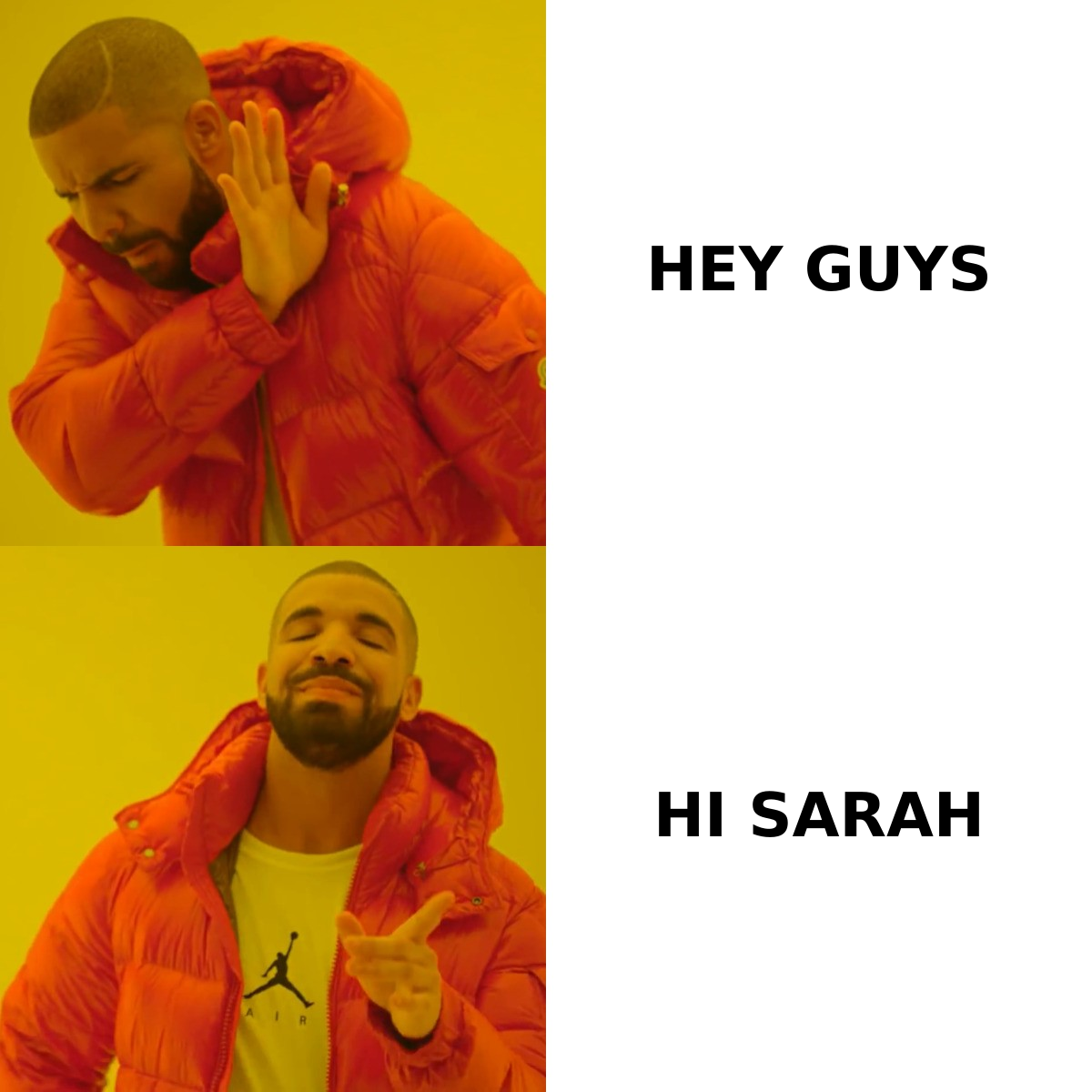
The greeting is small. The downstream effect is not.
What Are the Best Business Email Salutations by Scenario?#
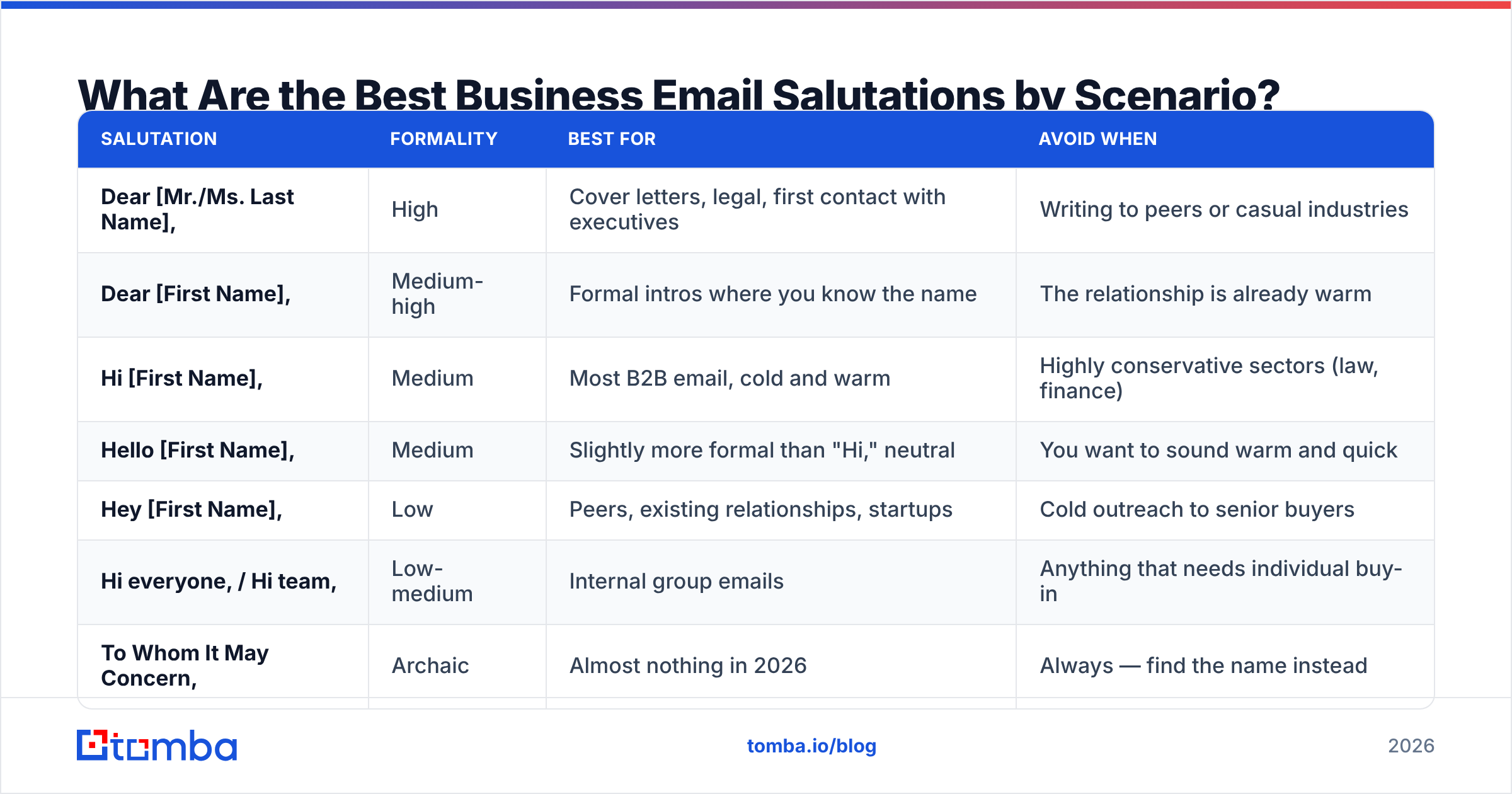
There is no single "correct" salutation — there's the right one for the relationship and the channel. Here's how the common openers map to real situations.
| Salutation | Formality | Best For | Avoid When |
|---|---|---|---|
| Dear [Mr./Ms. Last Name], | High | Cover letters, legal, first contact with executives | Writing to peers or casual industries |
| Dear [First Name], | Medium-high | Formal intros where you know the name | The relationship is already warm |
| Hi [First Name], | Medium | Most B2B email, cold and warm | Highly conservative sectors (law, finance) |
| Hello [First Name], | Medium | Slightly more formal than "Hi," neutral | You want to sound warm and quick |
| Hey [First Name], | Low | Peers, existing relationships, startups | Cold outreach to senior buyers |
| Hi everyone, / Hi team, | Low-medium | Internal group emails | Anything that needs individual buy-in |
| To Whom It May Concern, | Archaic | Almost nothing in 2026 | Always — find the name instead |
A few rules that hold across the table:
- When in doubt, go one notch more formal than you think you need. It's easier to warm up over a thread than to recover from being too familiar with a stranger.
- Mirror the recipient. If they signed their last email "Cheers, Mike," you write "Hi Mike," — not "Dear Mr. Henderson."
- Default to first names in North American and most European B2B. Honorifics can read as distant or even sarcastic among peers.
Formal vs. Casual: How Do You Choose the Right Tone?#
Conclusion first: choose by reading the relationship, not the industry stereotype. A startup founder and a Fortune 500 VP can both warrant "Hi [First Name]," if you've spoken before — and both warrant "Dear [First Name]," if this is your opening shot.
Here's a quick decision frame:
- Formal ("Dear...") when: it's first contact, the recipient is significantly senior, the context is legal/financial/governmental, or the culture you're writing into is conservative.
- Neutral ("Hi..." / "Hello...") when: it's standard B2B, you have light context, or you're unsure. This covers the majority of professional email.
- Casual ("Hey..." / first name only) when: you have an established relationship, you're peers, or the recipient set a casual tone first.
The most common mistake isn't being too formal or too casual — it's being inconsistent. Opening with "Dear Dr. Okafor," and then writing three breezy paragraphs of slang creates a whiplash that undermines your credibility. Pick a register and hold it through the whole message, including your sign-off.
What Business Email Salutations Should You Never Use?#
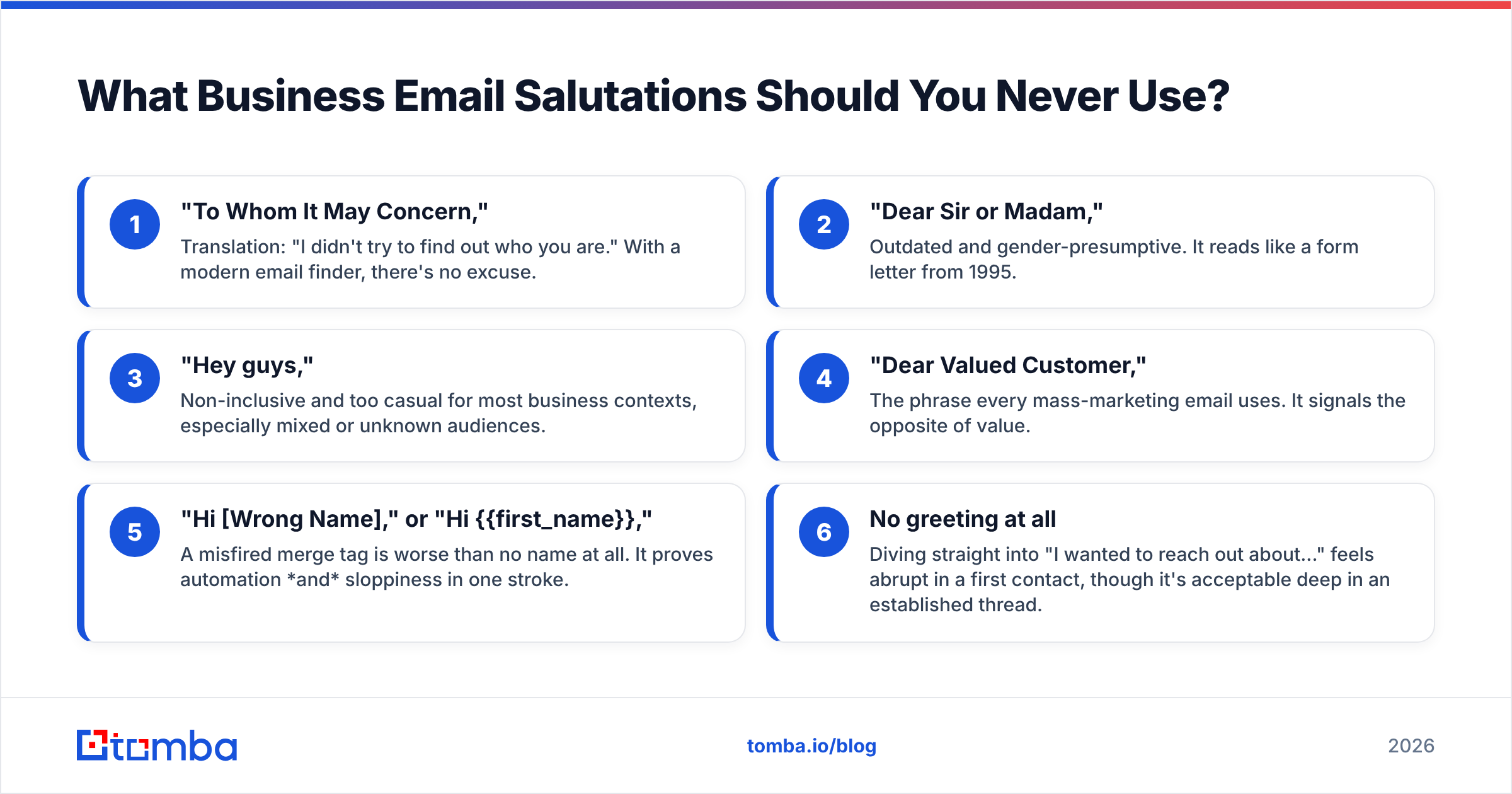
Some openers actively cost you replies. Retire these:
- "To Whom It May Concern," — Translation: "I didn't try to find out who you are." With a modern email finder, there's no excuse.
- "Dear Sir or Madam," — Outdated and gender-presumptive. It reads like a form letter from 1995.
- "Hey guys," — Non-inclusive and too casual for most business contexts, especially mixed or unknown audiences.
- "Dear Valued Customer," — The phrase every mass-marketing email uses. It signals the opposite of value.
- "Hi [Wrong Name]," or "Hi {{first_name}}," — A misfired merge tag is worse than no name at all. It proves automation and sloppiness in one stroke.
- No greeting at all — Diving straight into "I wanted to reach out about..." feels abrupt in a first contact, though it's acceptable deep in an established thread.
That fifth one — the broken merge tag — is the silent reply-killer of automated outreach. It almost always traces back to bad data: a missing first name, a malformed record, or an unverified contact. The fix isn't writing better copy; it's starting with clean inputs.
How Do You Personalize Salutations at Scale Without Getting It Wrong?#
The tension every sales and marketing team feels: personalized greetings convert better, but personalizing 5,000 emails by hand is impossible. The answer is good data plus disciplined merge fields — not abandoning personalization.
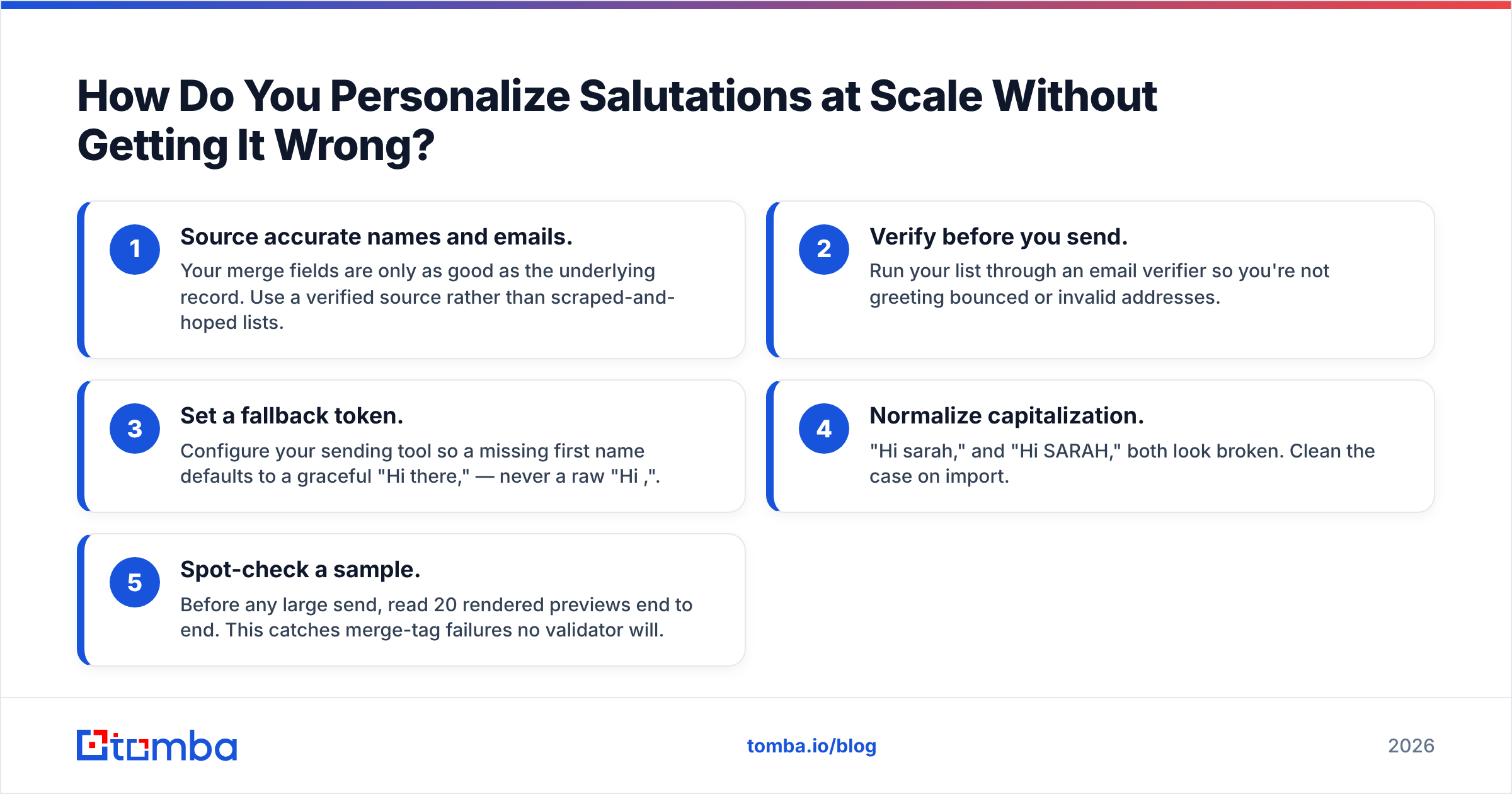
Here's the workflow that keeps your "Hi [First Name]," accurate at volume:
- Source accurate names and emails. Your merge fields are only as good as the underlying record. Use a verified source rather than scraped-and-hoped lists.
- Verify before you send. Run your list through an email verifier so you're not greeting bounced or invalid addresses.
- Set a fallback token. Configure your sending tool so a missing first name defaults to a graceful "Hi there," — never a raw "Hi ,".
- Normalize capitalization. "Hi sarah," and "Hi SARAH," both look broken. Clean the case on import.
- Spot-check a sample. Before any large send, read 20 rendered previews end to end. This catches merge-tag failures no validator will.

The теam that nails personalization at scale isn't writing more — they're feeding their templates better data. When the name is right and the address is real, "Hi [First Name]," does all the work a hand-typed greeting would.
For teams pulling contacts straight into a workflow, data enrichment fills the gaps — adding first names, job titles, and company context so your salutations (and the sentence after them) land as genuinely tailored. If you build campaigns from company websites, domain search returns the named contacts behind a domain so you can greet a person instead of an inbox.
What About Salutations Across Cultures and Languages?#
Tone norms shift hard across borders, and a greeting that reads as friendly in San Francisco can read as presumptuous in Tokyo or Munich.
A few guideposts:
- Germany, Austria, Switzerland: Honorifics and last names persist far longer in business. "Sehr geehrte Frau Schmidt," (the equivalent of a formal "Dear Ms. Schmidt,") is standard well into a relationship.
- Japan: Honorifics like "-san" attach to the name, and formality is the default. Skipping it reads as rude.
- France: "Bonjour Monsieur Dupont," holds formal weight; jumping to first names early can feel overfamiliar.
- US, UK, Australia, Netherlands: First names dominate B2B quickly, though the UK skews a touch more formal than the US.
When you don't know the convention, default formal and let the recipient set the pace. According to HubSpot's research on email engagement, personalization and relevance drive opens and replies — but "relevant" includes respecting the cultural register your reader expects.
How Should the Salutation Connect to the Rest of Your Email?#
Your greeting is a promise the next line has to keep. If you open with a warm, personal "Hi Maria," and immediately pivot to a robotic feature dump, you've broken the contract.
Strong emails carry the salutation's tone straight into the first sentence:
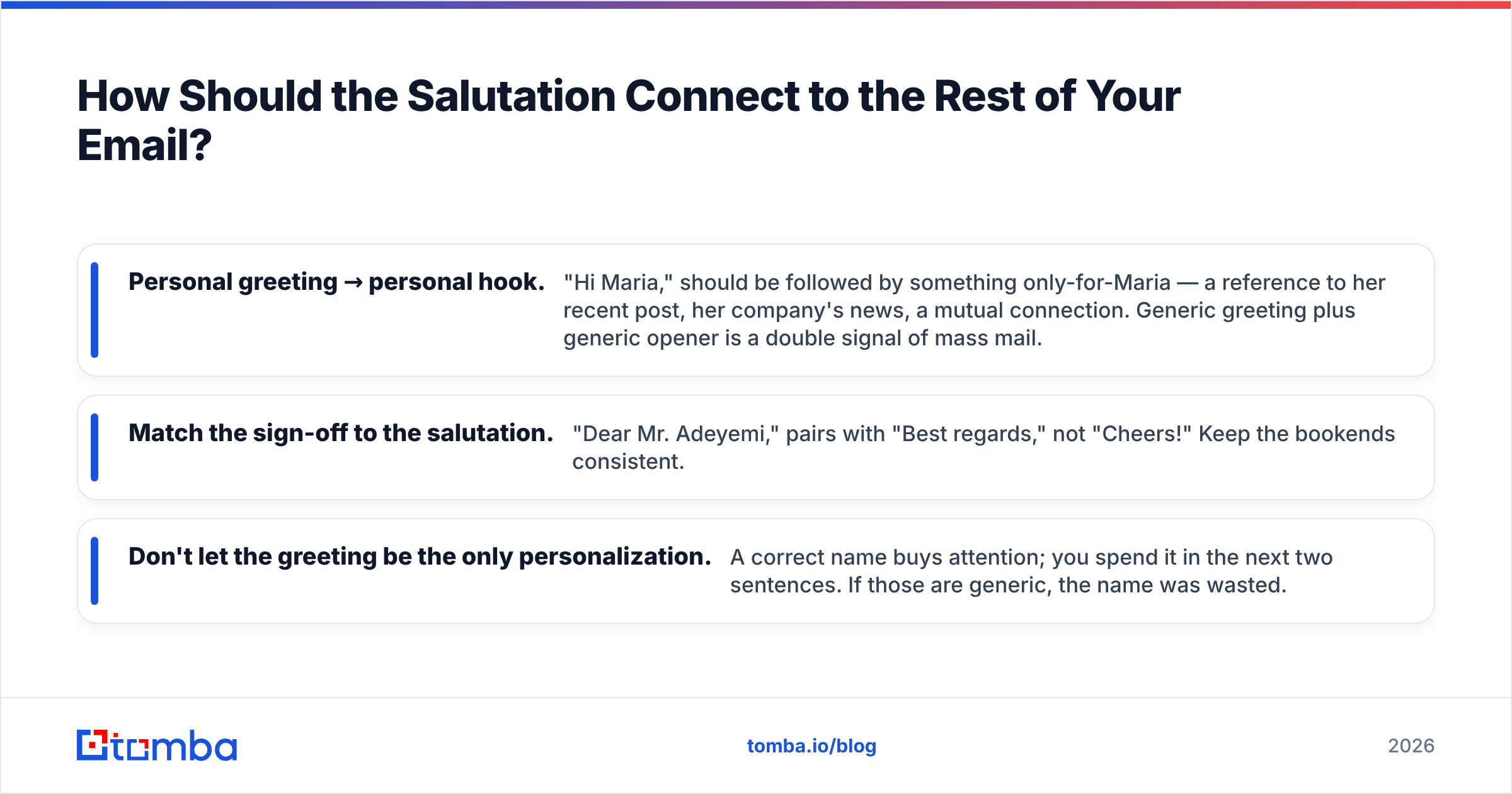
- Personal greeting → personal hook. "Hi Maria," should be followed by something only-for-Maria — a reference to her recent post, her company's news, a mutual connection. Generic greeting plus generic opener is a double signal of mass mail.
- Match the sign-off to the salutation. "Dear Mr. Adeyemi," pairs with "Best regards," not "Cheers!" Keep the bookends consistent.
- Don't let the greeting be the only personalization. A correct name buys attention; you spend it in the next two sentences. If those are generic, the name was wasted.
This is where tooling and copy meet. Resources like Tomba's email templates and subject line generator help you keep the whole message — greeting, hook, ask, and sign-off — in one consistent voice rather than bolting a personalized opener onto a canned body.
Quick Reference: Salutation Cheat Sheet#
When you're moving fast, default to these:
- Cold outreach to a senior buyer: "Hi [First Name]," (or "Dear [First Name]," in conservative sectors)
- Cold outreach to a peer: "Hi [First Name],"
- Warm reply in an active thread: Mirror their last greeting, or drop the greeting after the first exchange
- Internal team email: "Hi team," or "Hi all,"
- Job application / cover letter: "Dear [Hiring Manager Name]," — and find that name, never "To Whom It May Concern,"
- Unknown recipient you couldn't identify: "Hi there," as a last resort — but treat it as a sign you need better data, not a permanent solution
For more reference openers and structures, Grammarly's guide to email greetings is a solid second opinion on phrasing across contexts.
The Bottom Line#
A business email salutation is tiny, but it's the first signal of whether you respect the reader enough to know who they are. In 2026, the winning move isn't a cleverer greeting — it's a correct one, delivered at scale without breaking. "Hi [First Name]," beats "Dear Sir or Madam," every single time, provided that the name is real and the address is valid.
That last condition is everything. Every personalized greeting on this page depends on accurate, verified contact data — a first name that's spelled right and an email that won't bounce. Start there. Use the Tomba Email Finder to source professional emails by name, company, or domain, verify them before you send, and feed your templates the clean inputs that make "Hi [First Name]," land like a note written just for them. The free tier gives you 25 searches a month to test it; paid plans start at $49/mo when you're ready to scale. Check the full Tomba pricing to match a plan to your send volume — and stop letting a broken merge tag undo your best copy.
// get started
Find, verify and enrich your first contacts today
Start on the free plan with 25 searches a month, then scale when your team is ready.
Free plan · No credit card required · GDPR & CCPA
// about the author