Business Follow Up Email After No Response: 2026 Playbook
No reply doesn't mean no. Here's how to write a business follow up email after no response that gets answers — timing, templates, and the data behind it.
Silence is the most common reply in B2B. Most prospects who eventually buy never answer your first email — they answer your third, fourth, or fifth. Writing a strong business follow up email after no response is therefore not a nicety; it is where the majority of your pipeline actually comes from.
This guide gives you the timing, the structure, and six copy-paste templates that consistently pull replies out of quiet inboxes — without sounding desperate or robotic.
TL;DR#
- Most replies come from follow-ups, not the first email. Stopping after one message leaves the bulk of your pipeline on the table.
- Send 4–6 follow-ups spaced over roughly three weeks, each adding new value instead of just "bumping" the thread.
- Timing matters: wait 2–3 business days before the first follow-up, then widen the gaps.
- Every follow-up needs a reason to exist — a resource, a question, an angle — not "just checking in."
- Deliverability beats cleverness. If your emails land in spam or hit dead inboxes, no template will save you. Verify addresses first.
Why do prospects ignore your first email?#
Conclusion first: non-responses are rarely rejections. They are the default state of a busy inbox.
Think of your email like a flyer slipped under an office door. The person wasn't ignoring you on purpose — they walked in carrying coffee, a laptop, and three other problems, and your flyer got swept into a pile. A follow-up is you knocking politely a few days later, when their hands are free.
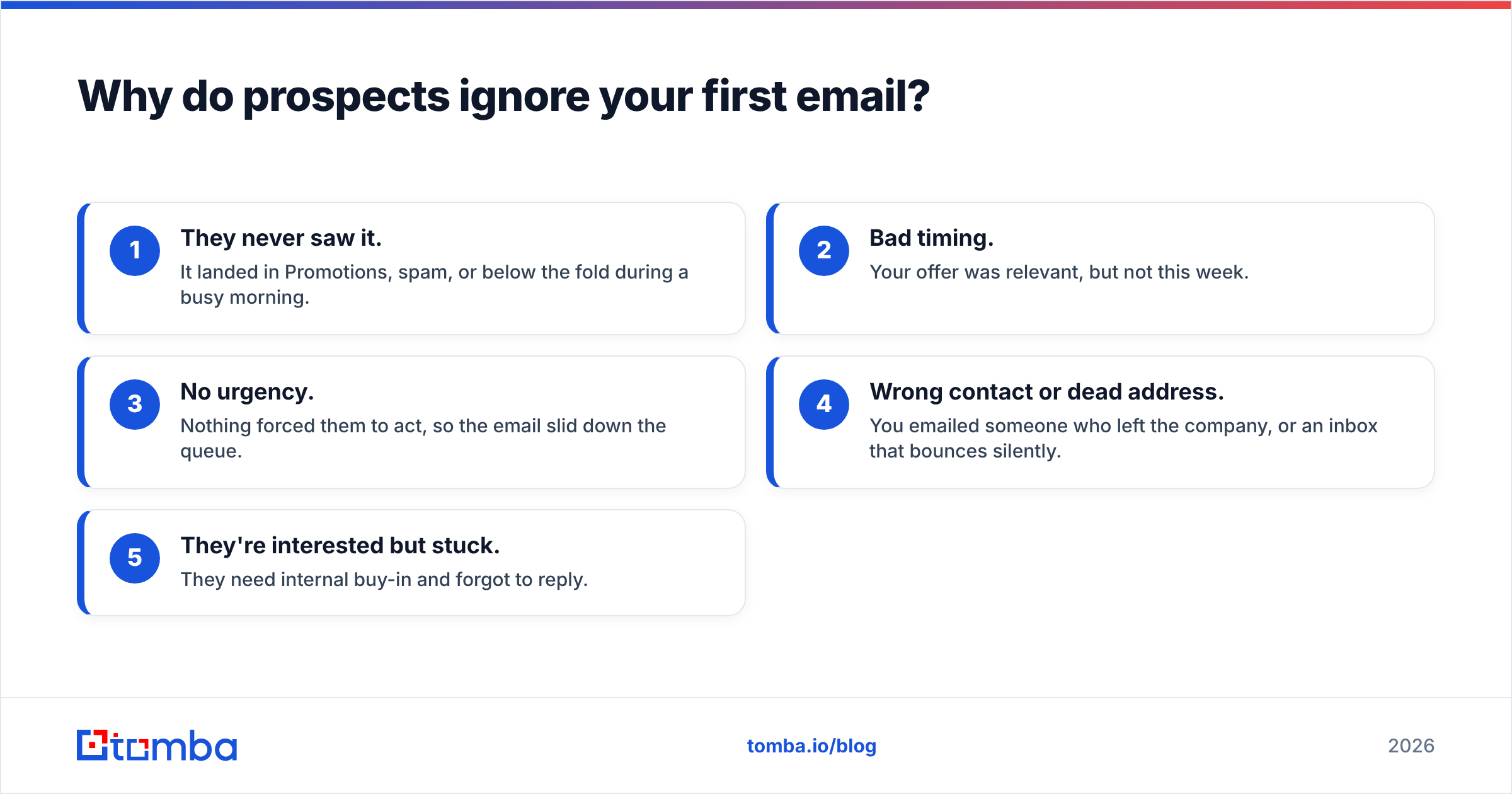
The common reasons for silence:
- They never saw it. It landed in Promotions, spam, or below the fold during a busy morning.
- Bad timing. Your offer was relevant, but not this week.
- No urgency. Nothing forced them to act, so the email slid down the queue.
- Wrong contact or dead address. You emailed someone who left the company, or an inbox that bounces silently.
- They're interested but stuck. They need internal buy-in and forgot to reply.
Only one of those five is an actual "no." That is why following up works: you are catching the four out of five cases that have nothing to do with rejection.
)
How many follow-up emails should you send?#
Send four to six follow-ups before you pause the sequence. One-and-done is the single biggest mistake in outbound — and the data backs that up. Industry analyses from teams like HubSpot consistently show that reply rates climb across multiple touches, with a large share of positive responses arriving after the first message.
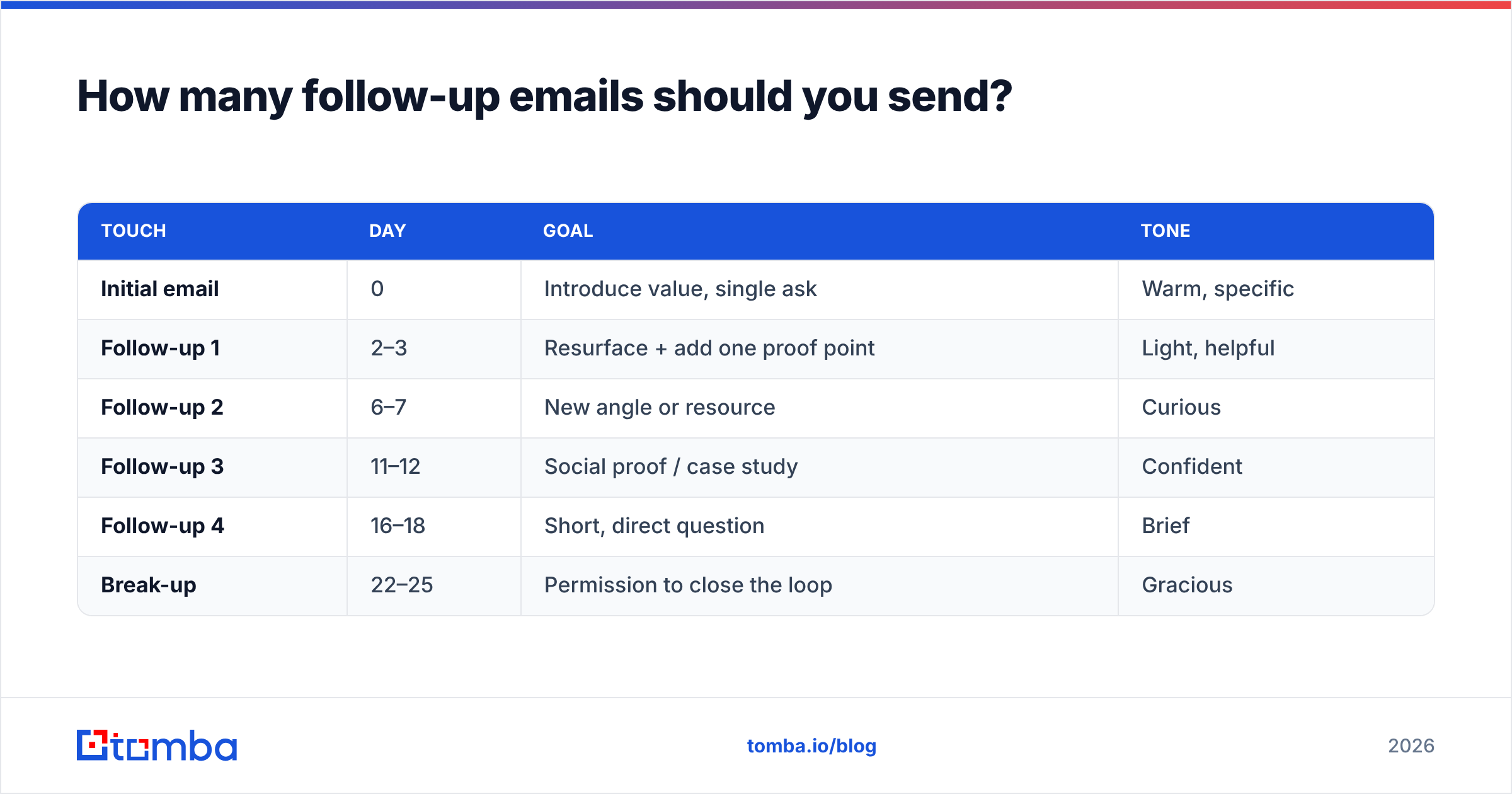
Here is a cadence that balances persistence with respect:
| Touch | Day | Goal | Tone |
|---|---|---|---|
| Initial email | 0 | Introduce value, single ask | Warm, specific |
| Follow-up 1 | 2–3 | Resurface + add one proof point | Light, helpful |
| Follow-up 2 | 6–7 | New angle or resource | Curious |
| Follow-up 3 | 11–12 | Social proof / case study | Confident |
| Follow-up 4 | 16–18 | Short, direct question | Brief |
| Break-up | 22–25 | Permission to close the loop | Gracious |
Notice the gaps widen over time. Hammering someone daily reads as desperation; spacing the touches signals that you respect their time and are not running an aggressive script. Track your own numbers against a baseline — keeping an eye on your email response rate tells you when a cadence is working and when it is fatiguing your list.
What makes a good business follow up email after no response?#
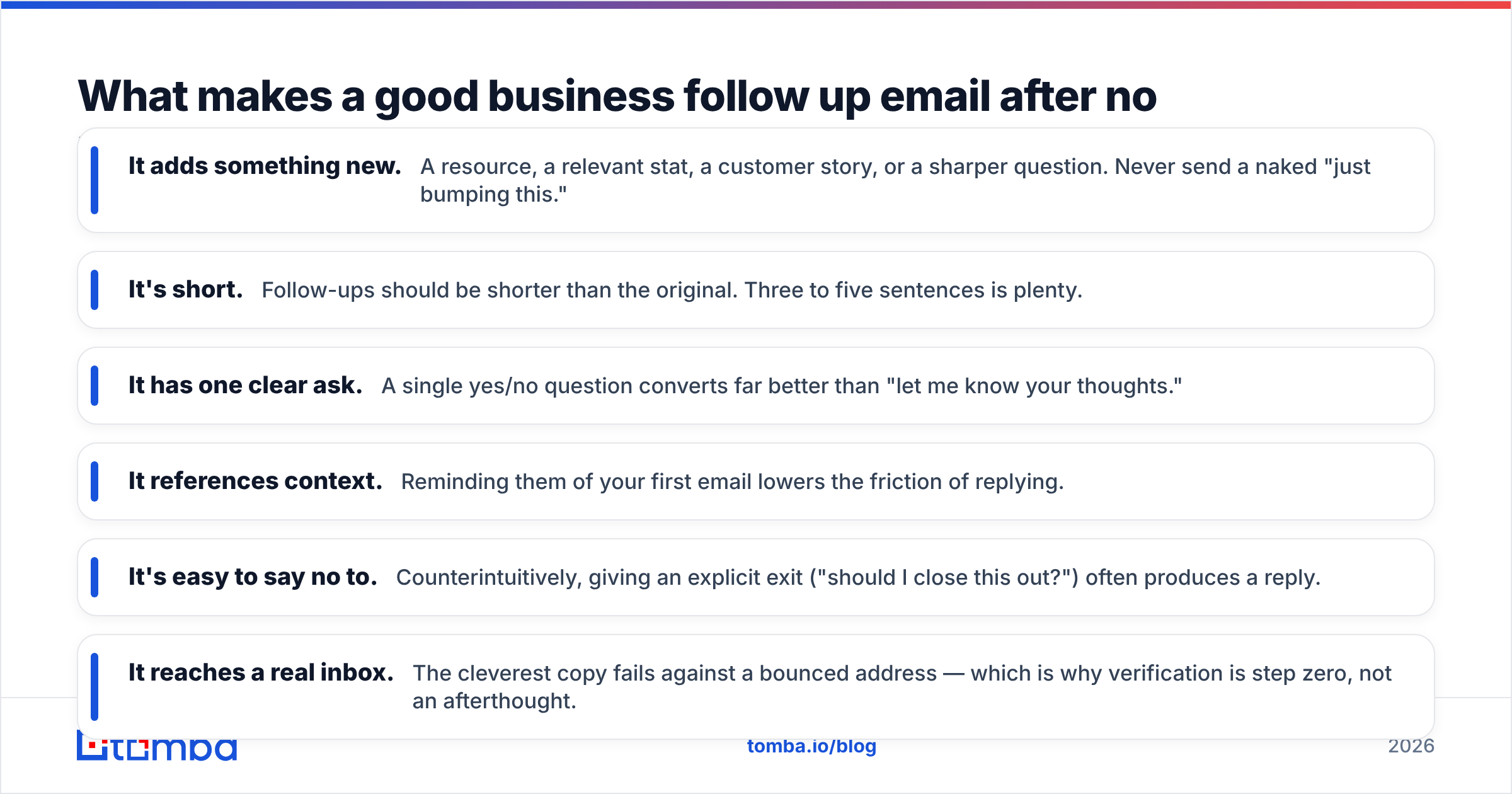
A good follow-up earns its place in the inbox. Every message should pass three tests before you hit send.
- It adds something new. A resource, a relevant stat, a customer story, or a sharper question. Never send a naked "just bumping this."
- It's short. Follow-ups should be shorter than the original. Three to five sentences is plenty.
- It has one clear ask. A single yes/no question converts far better than "let me know your thoughts."
- It references context. Reminding them of your first email lowers the friction of replying.
- It's easy to say no to. Counterintuitively, giving an explicit exit ("should I close this out?") often produces a reply.
- It reaches a real inbox. The cleverest copy fails against a bounced address — which is why verification is step zero, not an afterthought.
That last point deserves emphasis. If you are firing follow-ups at addresses that don't exist, you are not just wasting effort — you are wrecking your sender reputation and pushing your good emails toward spam. Run your list through an email verifier before a sequence so each touch lands where a human can read it.
Six follow-up email templates that get replies#
Copy these, swap the brackets, and adapt the voice to yours. They map to the cadence table above.
1. The gentle resurface (Day 2–3)#
Subject: Re: [original subject]
Hi [First name],
Floating this back to the top of your inbox in case it slipped through. I know [Company] is heads-down on [relevant initiative] right now.
One quick question: is [problem you solve] something on your radar this quarter, or should I check back later in the year?
[Your name]
2. The value-add (Day 6–7)#
Subject: Thought this might help, [First name]
Hi [First name],
Regardless of timing, I put together a short [guide / benchmark / checklist] on how teams like [similar company] handle [problem]. No strings attached — figured it'd be useful either way: [link]
If it sparks any questions, I'm one reply away.
[Your name]
3. The social proof (Day 11–12)#
Subject: How [Similar Company] solved [problem]
Hi [First name],
[Similar Company], also in [industry], was wrestling with [problem]. After [action], they hit [specific result] in [timeframe].
Worth a 15-minute call to see whether the same approach fits [Company]? Here's my calendar: [link]
[Your name]
4. The pattern interrupt (Day 16–18)#
Subject: Quick yes/no
Hi [First name],
I'll keep this to one line: is improving [metric] a priority for your team in the next 90 days — yes or no?
Either answer helps me know whether to keep in touch.
[Your name]
5. The break-up (Day 22–25)#
Subject: Closing the loop
Hi [First name],
I haven't heard back, so I'll assume the timing isn't right and stop reaching out for now. No worries at all.
If [problem] becomes urgent down the line, just reply to this thread and I'll jump back in.
All the best,
[Your name]
6. The re-engage (90 days later)#
Subject: Worth revisiting?
Hi [First name],
It's been a few months since we last connected about [problem]. A few things have changed on our side — [new feature / result] — and I thought of [Company].
Open to a quick look?
[Your name]
Want more starting points? Tomba's free library of cold email templates covers intros, follow-ups, and break-ups you can adapt in seconds. And if your open rates are the real bottleneck, run your lines through a subject line generator before you send.
)
When should you stop following up?#
Stop when you've sent your break-up email and gotten silence — then move the contact to a long-term re-engage list, not the trash.
There is a difference between "no for now" and "no forever." Most non-responders fall into the first bucket. A clean break-up email plus a 90-day re-engage (template six) keeps the relationship warm without burning your reputation. The graceful exit also has a quiet superpower: it frequently triggers the reply your previous five emails couldn't, because people hate to lose an option entirely.
A few hard stops where you should remove a contact immediately:
- They explicitly ask you to stop.
- The email hard-bounces (the address is dead — verify and replace it).
- They've left the company.
For that last case, don't abandon the account — find the replacement. A quick domain search surfaces the new decision-maker at the same company so your pipeline doesn't die with one person's job change.
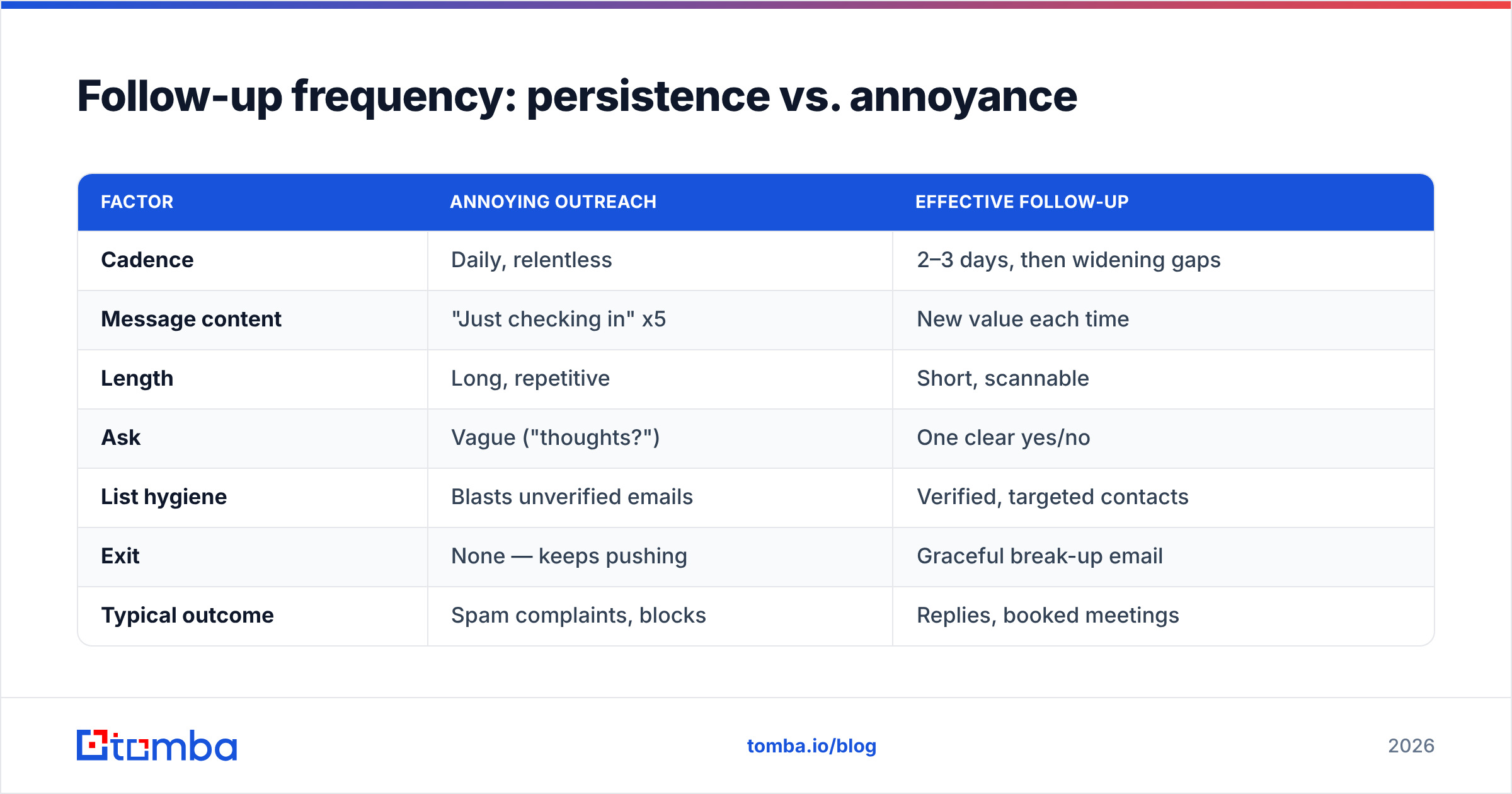
Follow-up frequency: persistence vs. annoyance#
The line between persistent and annoying is about value per touch, not number of touches. Here's how the two approaches compare.
| Factor | Annoying outreach | Effective follow-up |
|---|---|---|
| Cadence | Daily, relentless | 2–3 days, then widening gaps |
| Message content | "Just checking in" x5 | New value each time |
| Length | Long, repetitive | Short, scannable |
| Ask | Vague ("thoughts?") | One clear yes/no |
| List hygiene | Blasts unverified emails | Verified, targeted contacts |
| Exit | None — keeps pushing | Graceful break-up email |
| Typical outcome | Spam complaints, blocks | Replies, booked meetings |
The right column wins not because it's softer, but because it respects the prospect's attention and protects your deliverability. You can read more on how inbox placement is scored in this overview of email deliverability, and you can sanity-check any vendor's reputation claims on a neutral review site like G2 before you trust them with your sending.
How do you scale follow-ups without sounding like a robot?#
Personalize the first line and the value, automate the rest. The goal is leverage, not mass production.
Three rules keep automated sequences human:
- Segment before you send. A follow-up that references the prospect's industry or role beats a generic blast every time. Group your list by persona, then write value props per segment.
- Personalize the variable that matters. You don't need ten custom fields. One genuinely specific opening line — a recent funding round, a job change, a product launch — does more than a dozen merge tags.
- Feed the machine clean data. Automation amplifies whatever you put into it. Garbage contacts in means bounces and spam flags out.
That third rule is where most teams quietly fail. If you're building lists at scale, start with accurate contact data: Tomba's email finder locates professional addresses by name and domain, and you can verify them in the same workflow so your sequence only touches live inboxes. Pair that with your CRM or sending tool through Tomba's integrations, and personalization-at-scale stops being a contradiction.
For more on the mechanics of inbox placement and how reputation compounds over time, the Email marketing overview on Wikipedia is a solid neutral primer.
What metrics tell you a follow-up sequence is working?#
Watch four numbers, in this order: bounce rate, open rate, reply rate, and meetings booked.
- Bounce rate is your canary. Anything above ~2–3% means your list is dirty and your reputation is at risk. Fix this first by verifying before you send.
- Open rate measures subject lines and sender trust. If it's low, your deliverability or your subjects need work — not your body copy.
- Reply rate is the real signal of whether your message and timing resonate. This is the number your templates move.
- Meetings booked is the only metric that pays the bills. A high reply rate with no meetings means your ask is wrong.
Improve them in that sequence. There's no point A/B testing subject lines (open rate) while a third of your emails bounce (deliverability). Clean data first, then copy, then cadence.
Closing: turn silence into pipeline#
The business follow up email after no response is not about pestering people into submission. It's about showing up consistently, adding value each time, and reaching real inboxes so your message has a chance to land. Nail the cadence, write follow-ups that earn their place, and exit gracefully when the answer is truly no.
But all of it rests on one foundation: accurate, verified contact data. The smartest sequence in the world fails against a bounced address. Start your next campaign with the Tomba Email Finder to source professional emails by name or domain, verify them in the same flow, and feed your follow-up engine contacts that actually reply. The free tier gives you 25 searches a month to test it before you scale to Starter at $49/mo. Stop guessing at addresses — and start turning silence into booked meetings.
// get started
Find, verify and enrich your first contacts today
Start on the free plan with 25 searches a month, then scale when your team is ready.
Free plan · No credit card required · GDPR & CCPA
// about the author