What Is a Business Lead? Types, Sources & Scoring (2026)
A business lead is more than a name in a spreadsheet. Learn the types, where to source them, how to qualify and score them, and the cost of each channel in 2026.
What Is a Business Lead and How Do You Turn One Into Revenue?
A business lead is a person or organization that fits your target market and has shown some signal that they might buy from you. That is the whole definition — but the gap between "might buy" and "wired the invoice" is where most pipelines leak. This guide breaks down what actually counts as a business lead, where good ones come from in 2026, and how to qualify, score, and route them without burning your sender reputation or your budget.
TL;DR#
- A business lead is a contact who matches your ideal customer profile (ICP) and has shown intent — not just any email in a list.
- Leads split into marketing-qualified (MQL) and sales-qualified (SQL) tiers; treating them the same wastes rep time.
- The cheapest reliable source is outbound built on verified, first-party data — not bought lists, which decay 25–30% per year.
- Lead scoring (fit + behavior) is what separates a pipeline that converts from a CRM full of dead rows.
- Tools like a business email finder plus an email verifier let you build clean lead lists at a fraction of database-subscription cost.
What Counts as a Business Lead (and What Doesn't)?#
Think of a business lead like a job applicant. A name on a resume pile is not an employee — it's a candidate who matches the role and applied. A business lead is the same: a contact who matches your ICP and raised a hand somehow, whether by downloading a guide, visiting your pricing page, or replying to a cold email.
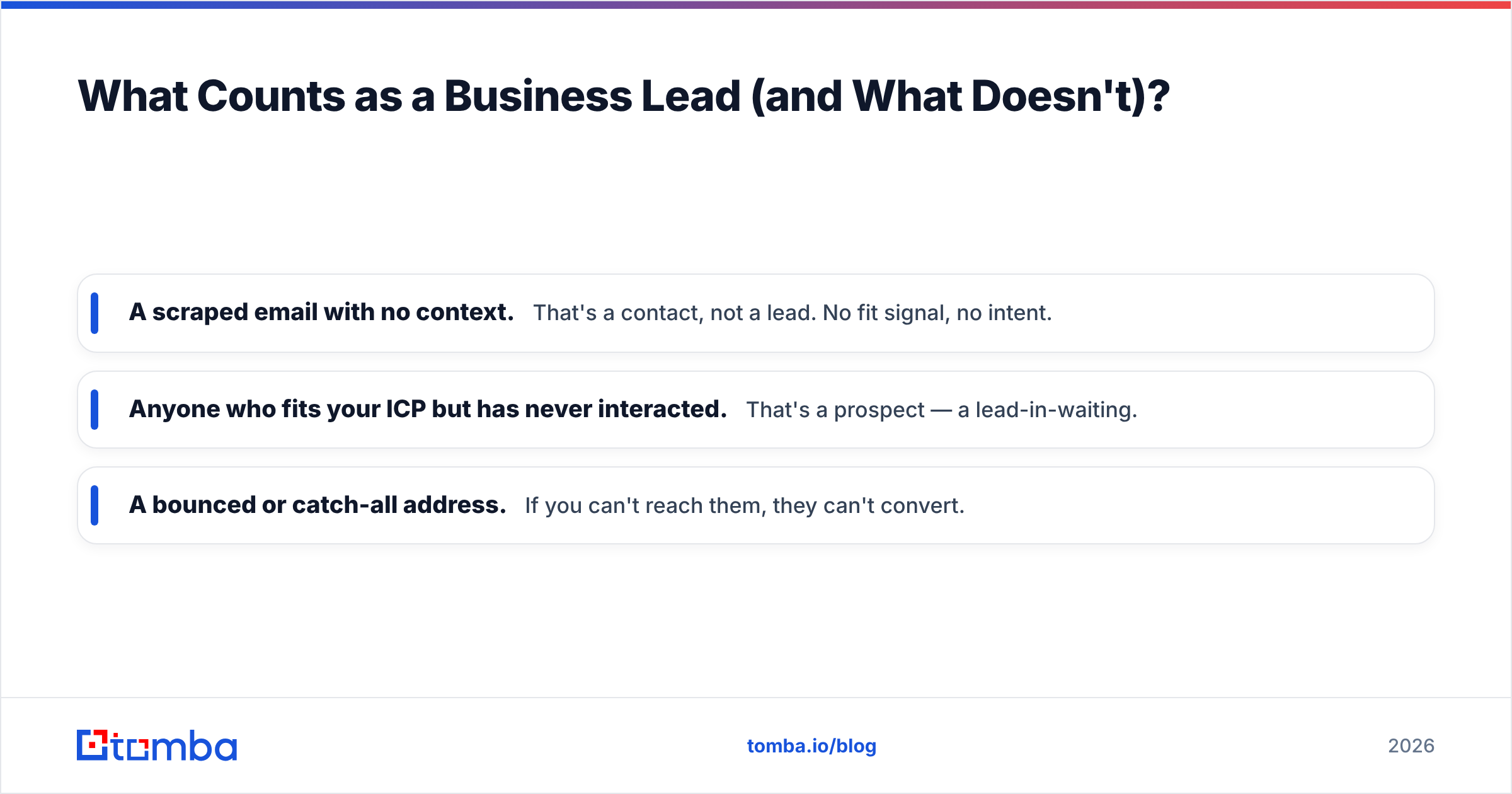
What does not count as a lead:
- A scraped email with no context. That's a contact, not a lead. No fit signal, no intent.
- Anyone who fits your ICP but has never interacted. That's a prospect — a lead-in-waiting.
- A bounced or catch-all address. If you can't reach them, they can't convert.
The distinction matters because your funnel math depends on it. If you count raw contacts as leads, your conversion rate looks broken when it's really just mislabeled. Define the term tightly and every downstream metric — cost per lead, lead-to-SQL rate, win rate — becomes honest.
What Are the Main Types of Business Leads?#
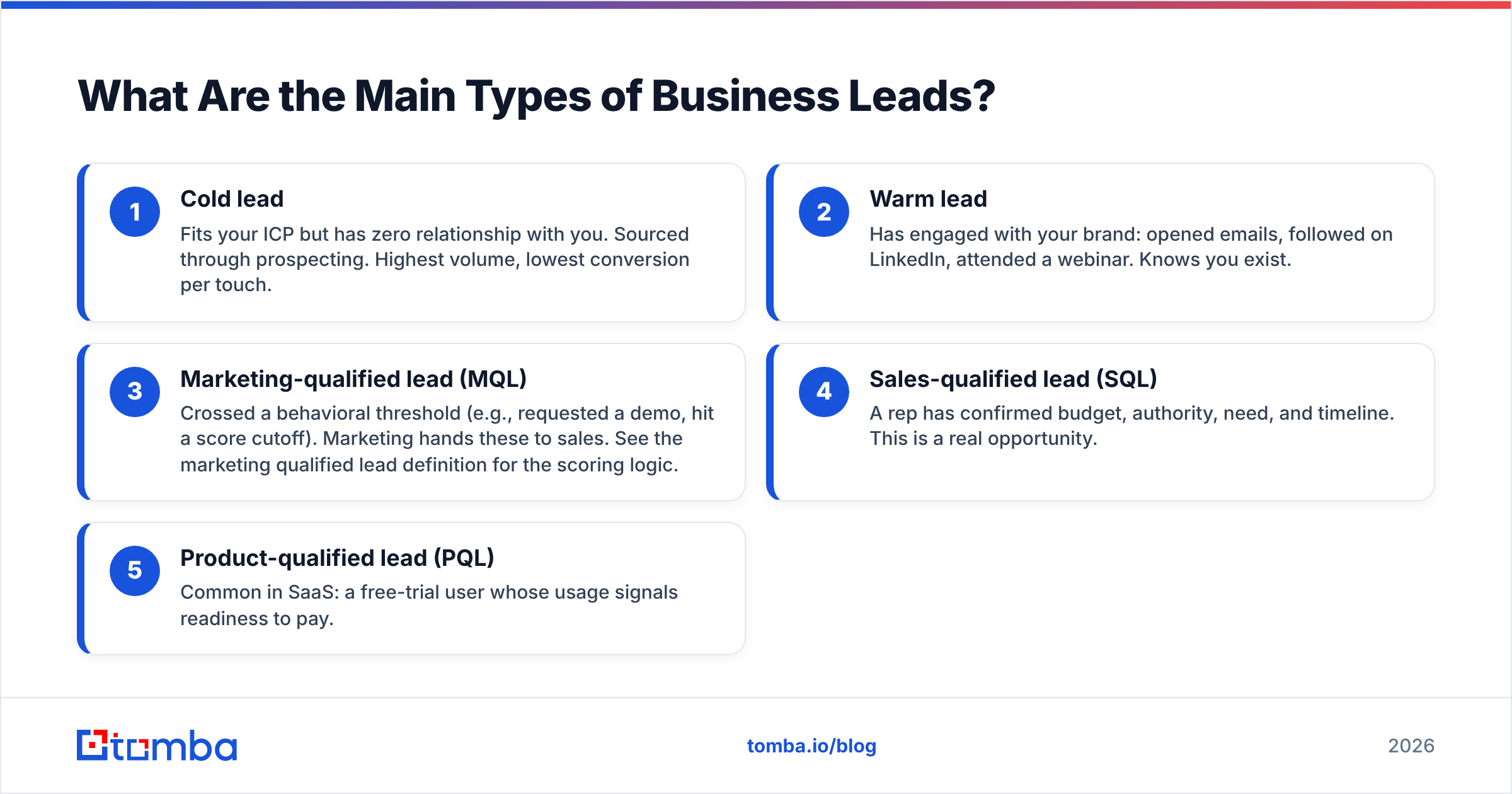
Not all leads deserve the same effort. The standard tiers map to how close someone is to buying:
- Cold lead — Fits your ICP but has zero relationship with you. Sourced through prospecting. Highest volume, lowest conversion per touch.
- Warm lead — Has engaged with your brand: opened emails, followed on LinkedIn, attended a webinar. Knows you exist.
- Marketing-qualified lead (MQL) — Crossed a behavioral threshold (e.g., requested a demo, hit a score cutoff). Marketing hands these to sales. See the marketing qualified lead definition for the scoring logic.
- Sales-qualified lead (SQL) — A rep has confirmed budget, authority, need, and timeline. This is a real opportunity.
- Product-qualified lead (PQL) — Common in SaaS: a free-trial user whose usage signals readiness to pay.
The error most teams make is dumping all five into one queue. A cold lead needs nurture; an SQL needs a call today. Segment by tier and your reps stop wasting their best hours on contacts who aren't ready.
Where Do the Best Business Leads Come From in 2026?#
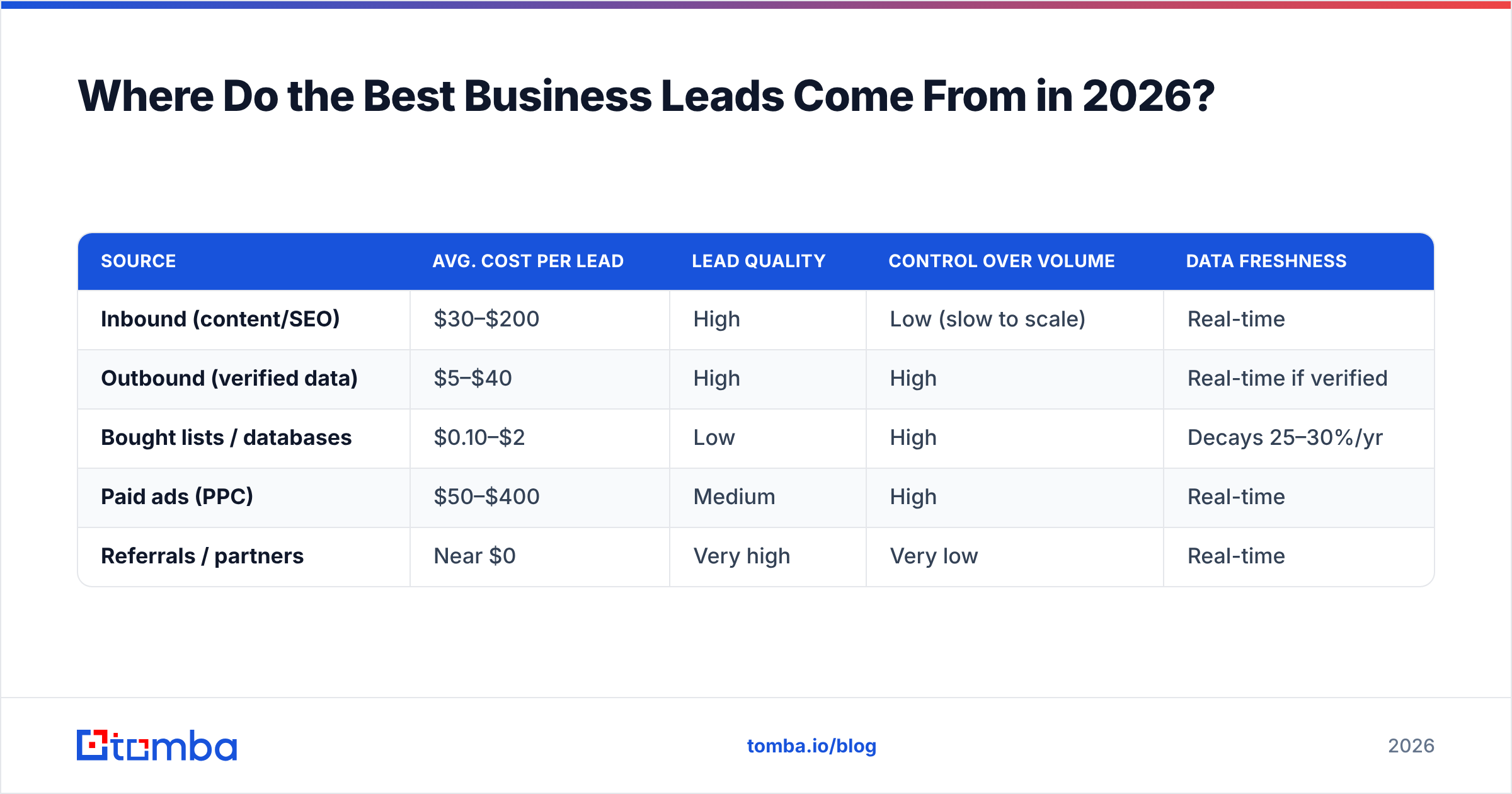
Lead sources fall into three buckets — inbound, outbound, and purchased — and they are not equal on cost, control, or quality. Here's how they stack up:
| Source | Avg. cost per lead | Lead quality | Control over volume | Data freshness |
|---|---|---|---|---|
| Inbound (content/SEO) | $30–$200 | High | Low (slow to scale) | Real-time |
| Outbound (verified data) | $5–$40 | High | High | Real-time if verified |
| Bought lists / databases | $0.10–$2 | Low | High | Decays 25–30%/yr |
| Paid ads (PPC) | $50–$400 | Medium | High | Real-time |
| Referrals / partners | Near $0 | Very high | Very low | Real-time |
Inbound is the highest quality but the slowest lever — you can't will a blog post into ranking next week. Bought lists feel cheap until you factor in bounce rates, spam complaints, and the deliverability hit that follows. According to HubSpot's research on lead generation, buying contact lists is one of the fastest ways to damage sender reputation.
The pragmatic 2026 play is outbound on first-party, verified data: identify accounts that fit your ICP, find the right person, confirm the email is live, then reach out. You control the volume, the quality stays high, and the cost per lead lands far below paid ads. A domain search gives you every reachable contact at a target company, and a bulk email finder scales that across an account list.
How Do You Qualify a Business Lead?#
Qualification is asking two questions in order: Are they a fit? and Are they ready? The classic frameworks formalize this.
BANT — the oldest, still useful for transactional sales:
- Budget — Can they afford it?
- Authority — Are you talking to a decision-maker?
- Need — Do they have the problem you solve?
- Timeline — When will they decide?
CHAMP flips the order to lead with the customer's challenge, which fits modern consultative selling better:
- Challenges — What pain are they trying to fix?
- Authority — Who else weighs in?
- Money — What's the budget reality?
- Prioritization — Where does this sit on their roadmap?
Pick the framework that matches your sales motion, but the underlying move is the same: disqualify fast. A lead you correctly reject in week one is cheaper than one you chase for a quarter. Reps who are afraid to disqualify end up with bloated pipelines and sandbagged forecasts.
What Is Lead Scoring and Why Does It Matter?#
Lead scoring assigns a number to each lead so your team works the hottest ones first. It's like triage in an emergency room — you don't treat patients in the order they walked in, you treat them by severity.
A practical score combines two axes:
- Fit score (who they are): company size, industry, role, tech stack, region. A VP of Sales at a 200-person SaaS company scores higher than an intern at a non-target company.
- Behavior score (what they do): email opens, pricing-page visits, demo requests, content downloads, repeat site visits.
Here's a simple model you can implement in any CRM:
| Signal | Points |
|---|---|
| Matches ICP industry + size | +25 |
| Decision-maker title | +20 |
| Visited pricing page | +15 |
| Replied to outreach | +20 |
| Opened 3+ emails | +10 |
| Free email domain (gmail, etc.) | −15 |
| No activity in 30 days | −10 |
Leads above a threshold (say 50) route straight to a rep; everyone else goes into nurture. The numbers aren't sacred — tune them against your closed-won data quarterly. What matters is that scoring exists at all, because manual "which lead looks good" guessing doesn't scale past a handful of reps.
How Do You Find and Verify Business Leads at Scale?#
Finding leads at scale is a three-step loop: identify the account, find the person, verify the contact.
- Identify accounts. Build a list of companies that match your ICP — by industry, size, funding stage, or tech stack. Tools that map B2B data and intelligence help you assemble this without manual research.
- Find the right person. Once you know the company, you need the human. A name-and-domain lookup returns the most likely professional email; a LinkedIn finder does the same from a profile URL.
- Verify before you send. This is the step teams skip and regret. An unverified list torches your deliverability. Run every address through an email verifier and handle ambiguous catch-all domains with a catch-all verifier.
Skipping verification is the single most expensive shortcut in outbound. A 15% bounce rate doesn't just waste 15% of your sends — it signals mailbox providers that you're a careless sender, and your good emails start landing in spam too. Protecting sender reputation is non-negotiable, and it starts with clean data.
How Much Should a Business Lead Cost?#
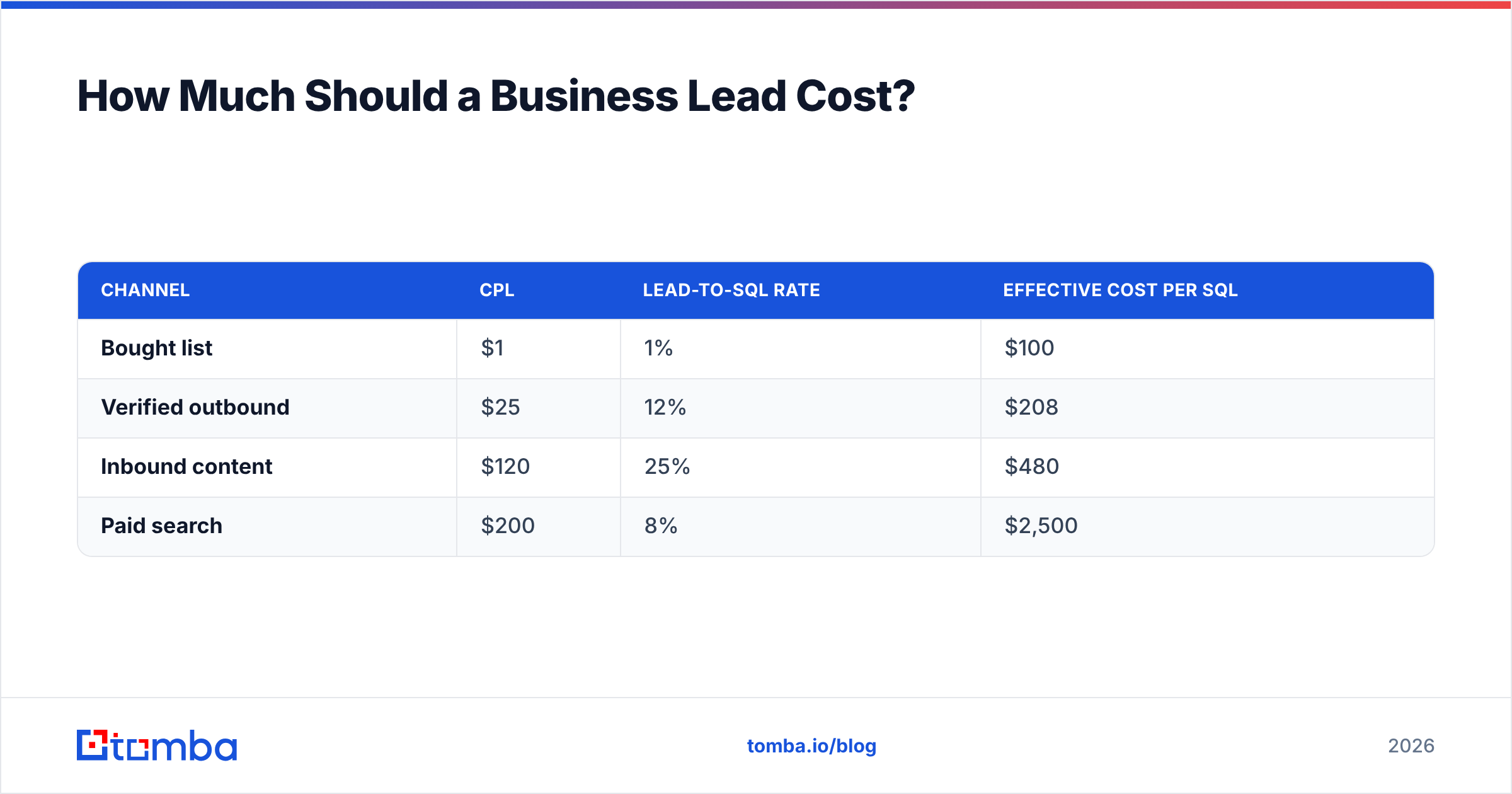
Cost per lead (CPL) varies wildly by industry and channel, but the question that matters is cost per qualified lead and, ultimately, cost per acquired customer. A $2 bought lead that never converts is infinitely more expensive than a $40 verified lead that closes.
Here's how the math typically shakes out for B2B SaaS:
| Channel | CPL | Lead-to-SQL rate | Effective cost per SQL |
|---|---|---|---|
| Bought list | $1 | 1% | $100 |
| Verified outbound | $25 | 12% | $208 |
| Inbound content | $120 | 25% | $480 |
| Paid search | $200 | 8% | $2,500 |
Notice the bought list's "cheap" CPL evaporates once you account for how few convert — and that table ignores the deliverability damage. Verified outbound often wins on effective cost per SQL while staying scalable, which is why it's the backbone of most efficient 2026 go-to-market motions. Compare the Tomba pricing tiers against a per-seat sales-database subscription and the cost gap on lead volume is usually significant.
For benchmarks on what "good" looks like across industries, G2's category data and analyst reports from Gartner are reliable, vendor-neutral references.
How Do You Stop Business Leads From Going Stale?#
Leads decay. A contact who downloaded a guide six months ago and went silent is barely a lead anymore. Three habits keep your database alive:
- Re-verify quarterly. People change jobs constantly. A bulk verify pass every quarter prunes the dead weight before it bounces.
- Enrich on entry. When a lead enters your CRM, enrich leads with firmographics so scoring works from day one instead of waiting for manual research.
- Nurture the not-yet-ready. Most leads aren't ready when you first reach them. A light-touch sequence keeps you top of mind so you're there when their timeline arrives.
The teams with the best pipeline aren't the ones generating the most leads — they're the ones who keep their existing leads clean, scored, and routed. Volume without hygiene is just noise.
Frequently Asked Questions#
What is the difference between a lead and a prospect? A prospect fits your ICP but hasn't engaged. A lead has shown some intent signal. Every lead was once a prospect; not every prospect becomes a lead.
Is buying a business lead list a good idea? Rarely. Bought lists decay fast, often violate data regulations, and damage your sender reputation through high bounce rates. Building verified, first-party lists is slower upfront but far cheaper per closed deal.
What's a good lead-to-customer conversion rate in B2B? It depends on lead quality and deal size, but a healthy verified-outbound motion often sees 1–3% of cold leads become customers, and 15–25% of SQLs close.
How do I verify a business lead's email without sending to it? Use an email verification service that checks the mail server, syntax, and deliverability without sending an actual message. This catches invalid and risky addresses before they bounce.
Turn Verified Contacts Into Real Pipeline#
A business lead is only worth what you can do with it — and that starts with reaching the right person at a live address. The Tomba Email Finder finds professional emails by name, domain, or company, then confirms they're deliverable before you ever hit send. Pair it with verification and enrichment and you build lead lists that convert instead of bounce — without the cost or decay of a bought database. Start on the free tier (25 searches a month), and scale to Starter at $49/mo when your outbound takes off.
// get started
Find, verify and enrich your first contacts today
Start on the free plan with 25 searches a month, then scale when your team is ready.
Free plan · No credit card required · GDPR & CCPA
// about the author