Business Lead Generation in 2026: A Practical Playbook
Most pipelines fail because of bad leads, not too few. Here's how to build a business lead generation engine in 2026 that fills your funnel with buyers who actually convert.
Business lead generation is the system you use to turn strangers into qualified buying conversations. In 2026 the bar is higher: inboxes are crowded, buyers self-educate before they ever talk to sales, and "more leads" is almost never the real problem. The real problem is that most of the leads you generate were never going to buy.
This playbook walks through what business lead generation actually is, which channels still pay off, how to score and route leads, and the tooling that keeps your pipeline full of real people instead of bounces and bots.
TL;DR#
- Business lead generation = quality, not volume. A smaller list of verified, well-targeted contacts beats a giant list of guesses every time.
- Inbound and outbound are not rivals. The teams that win in 2026 run both, and feed each other with shared data.
- Bad data kills more deals than bad copy. Verify every email and enrich every record before a rep ever touches it.
- Score and route fast. Leads decay in hours, not days — speed-to-lead is a top predictor of conversion.
- The right stack is cheap. A solid email finder, verifier, and enrichment layer costs less than one bad sales hire.
What is business lead generation?#
Business lead generation is the process of identifying companies and people who fit your ideal customer profile, capturing their interest or contact details, and moving them toward a buying conversation. Think of it like fishing: you can throw a single hook in a random pond (cold luck), or you can map where the fish actually feed, use the right bait, and bring a net. The net is your system.
A "lead" sits somewhere on a spectrum. At one end is an anonymous website visitor; at the other is a marketing qualified lead who downloaded your pricing guide and matches your target account list. Business lead generation is everything that moves a contact rightward along that line.
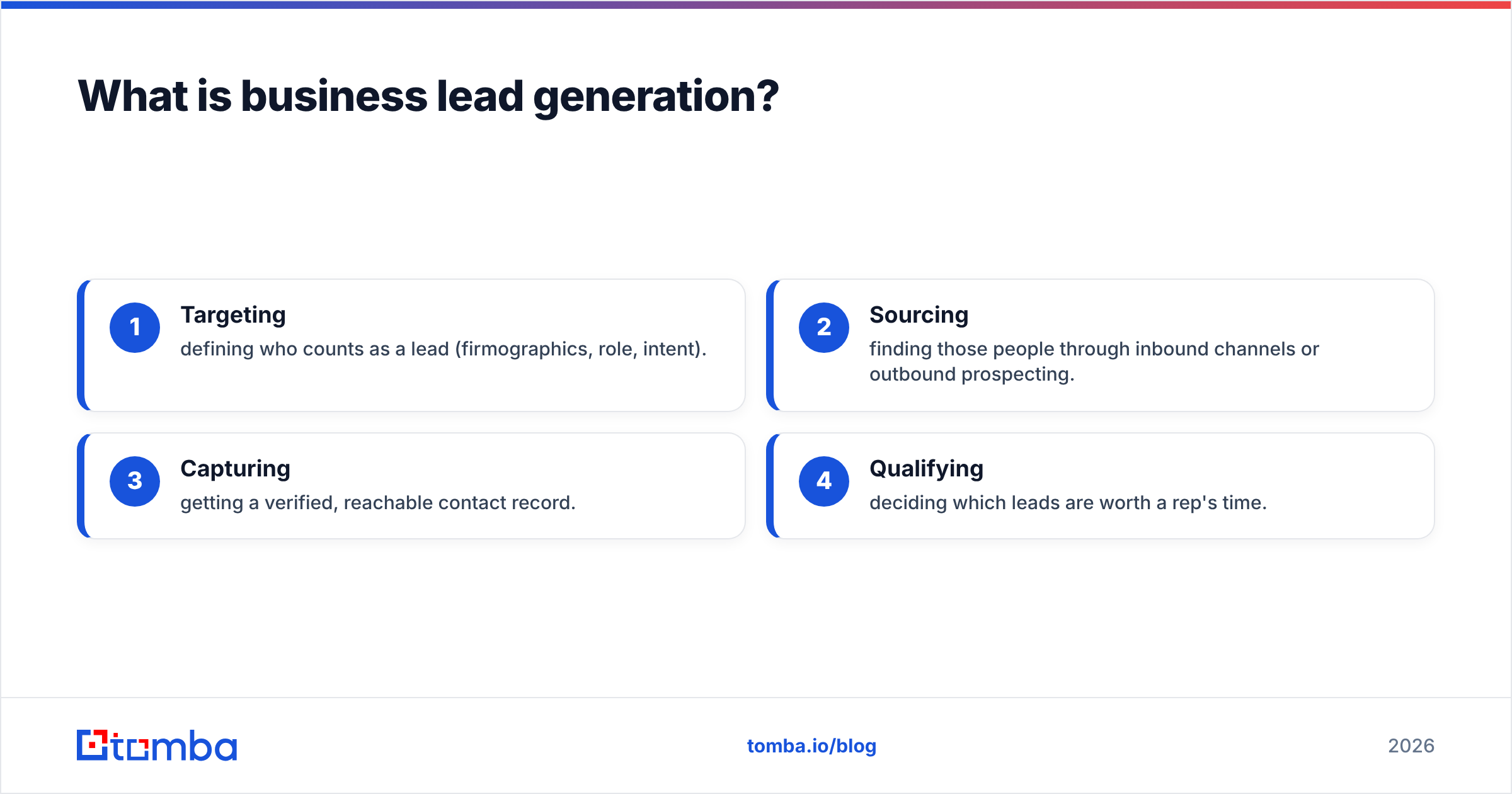
Technically, the work splits into four jobs:
- Targeting — defining who counts as a lead (firmographics, role, intent).
- Sourcing — finding those people through inbound channels or outbound prospecting.
- Capturing — getting a verified, reachable contact record.
- Qualifying — deciding which leads are worth a rep's time.
Skip any one of these and the pipeline leaks. Most teams obsess over sourcing and neglect capturing — which is why so much "lead gen" ends in undeliverable email and dead phone numbers.
Inbound vs outbound: which one should you run?#
Both. The framing of inbound versus outbound is a trap — they solve different parts of the same funnel and the best programs braid them together.
Inbound pulls buyers in with content, SEO, webinars, and product-led signups. It scales slowly, compounds over time, and produces warmer leads who already trust you. Outbound pushes you into accounts you choose, on your timeline. It's faster to start, fully controllable, and essential when you're entering a new market or chasing named accounts.
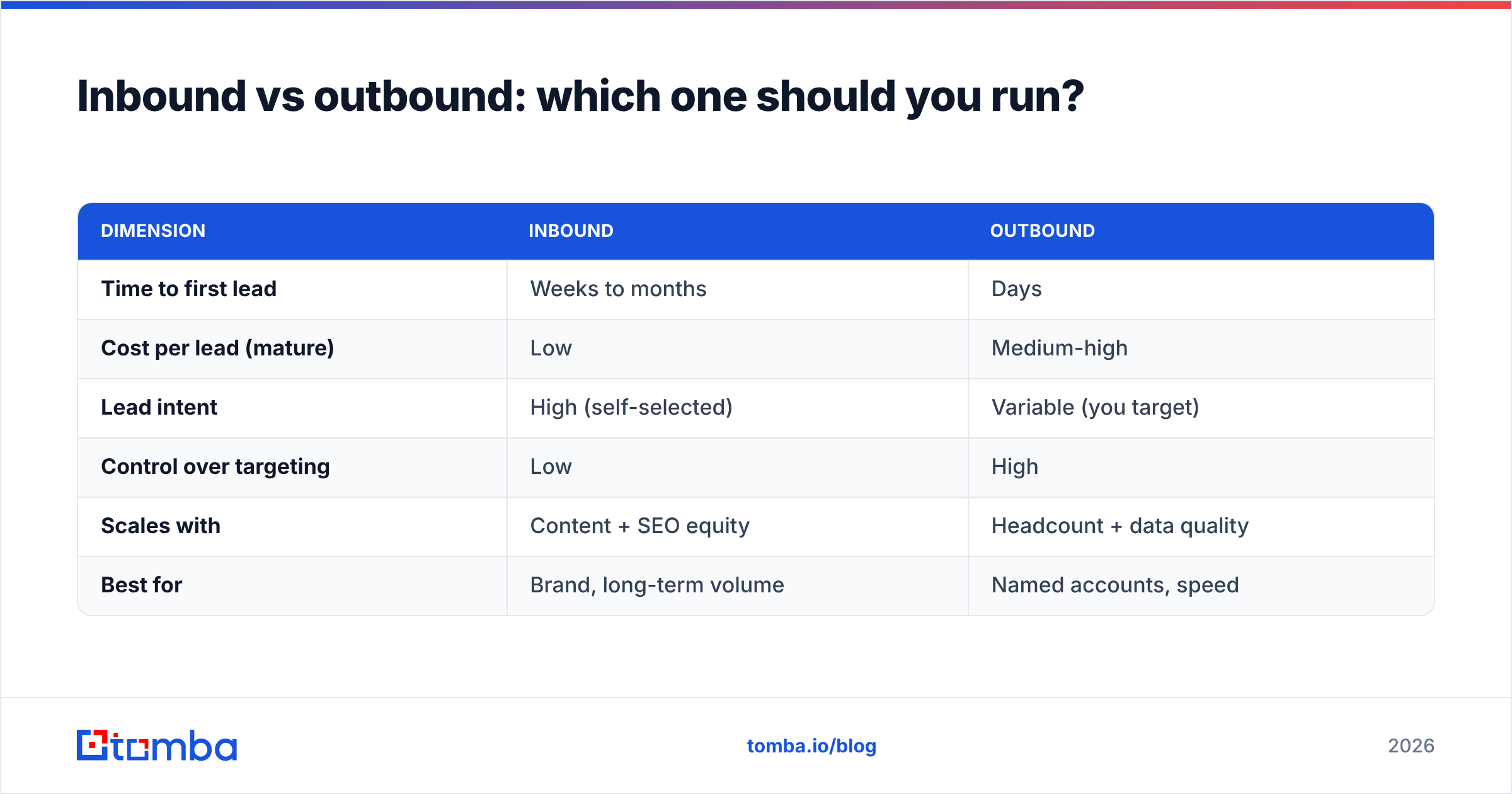
Here's how the two compare on the dimensions that matter for planning a 2026 program:
| Dimension | Inbound | Outbound |
|---|---|---|
| Time to first lead | Weeks to months | Days |
| Cost per lead (mature) | Low | Medium-high |
| Lead intent | High (self-selected) | Variable (you target) |
| Control over targeting | Low | High |
| Scales with | Content + SEO equity | Headcount + data quality |
| Best for | Brand, long-term volume | Named accounts, speed |
The practical move is to let them feed each other. Outbound tells you which messages resonate, which becomes content fuel for inbound. Inbound reveals which accounts are already poking around your site — and tools that handle website visitor reveal turn that anonymous traffic into named outbound targets. A visitor who read your pricing page twice is a far better outbound prospect than a cold name pulled from a list.
Which lead generation channels still work in 2026?#
The channels haven't changed much; what's changed is how saturated each one is and how much data quality decides the winner.
- Cold email — still the highest-ROI outbound channel when your list is clean and your targeting is tight. The catch is deliverability: one batch sent to unverified addresses can wreck your sender reputation for months.
- LinkedIn outreach — strong for senior B2B buyers, but volume limits and connection caps mean you must be selective. Pair it with verified work emails so you can follow up off-platform.
- Content and SEO — the slow compounding engine. Ranking for buyer-intent queries delivers leads while you sleep, but it takes 6–12 months to mature.
- Paid search and social — fast and measurable, but rising costs mean you need airtight follow-up to justify the spend.
- Referrals and partnerships — the highest-converting channel almost nobody systematizes. Build a simple ask into your post-sale flow.
- Events and webinars — back in force for high-ticket deals where trust has to be earned face to face.
Notice that every one of these depends on the same backbone: accurate contact data. A brilliant cold email sent to j.smith@company.com when the real address is john.smith@company.com converts at exactly zero percent.
Why does data quality decide everything?#
Because a lead you can't reach isn't a lead — it's a line in a spreadsheet. According to Gartner, B2B data decays at roughly 20–30% per year as people change jobs, companies rebrand, and domains migrate. That means a list you bought eighteen months ago is now closer to fiction than fact.
Bad data costs you three ways at once: wasted rep hours chasing dead contacts, damaged deliverability from bouncing cold emails, and skewed reporting that hides which campaigns actually work. Industry research collected on review platforms like G2 consistently shows that data accuracy is the number-one differentiator buyers cite when choosing prospecting tools.
The fix is a verification-and-enrichment step between sourcing and outreach. Before any contact enters a sequence:
- Find the correct email using a domain- and name-based email finder rather than guessing the format.
- Verify that the mailbox actually exists with a real-time email verifier, so you don't send to traps or dead inboxes.
- Enrich the record with role, company size, and location so your scoring and personalization have something to work with.
That three-step gate is the single highest-leverage change most teams can make to their business lead generation in a single quarter.
How do you find and capture leads at scale?#
Once you know who you're targeting, capturing them is a tooling problem. The manual version — copying names off LinkedIn, guessing email formats, pasting into a CRM — doesn't survive contact with real volume. You need to systematize.
A repeatable capture workflow looks like this:
- Define the account list from your ICP — industry, size, geography, tech stack.
- Pull contacts by company using domain search to surface every reachable person at a target account, not just the one name you found.
- Run it in bulk with a bulk email finder when you're working hundreds of accounts at once, then verify the whole batch before import.
- Enrich and dedupe with data enrichment so each record carries the fields your scoring model needs and no contact appears twice.
- Push to your CRM through native integrations so reps work from one clean source of truth.
The goal is to compress the gap between "I identified this account" and "a verified, enriched contact is in a sequence" from hours to minutes. That speed is what lets a small team punch far above its weight.
How should you score and route leads?#
Score on fit and intent; route on speed. Those are the two rules that separate teams that convert from teams that collect.
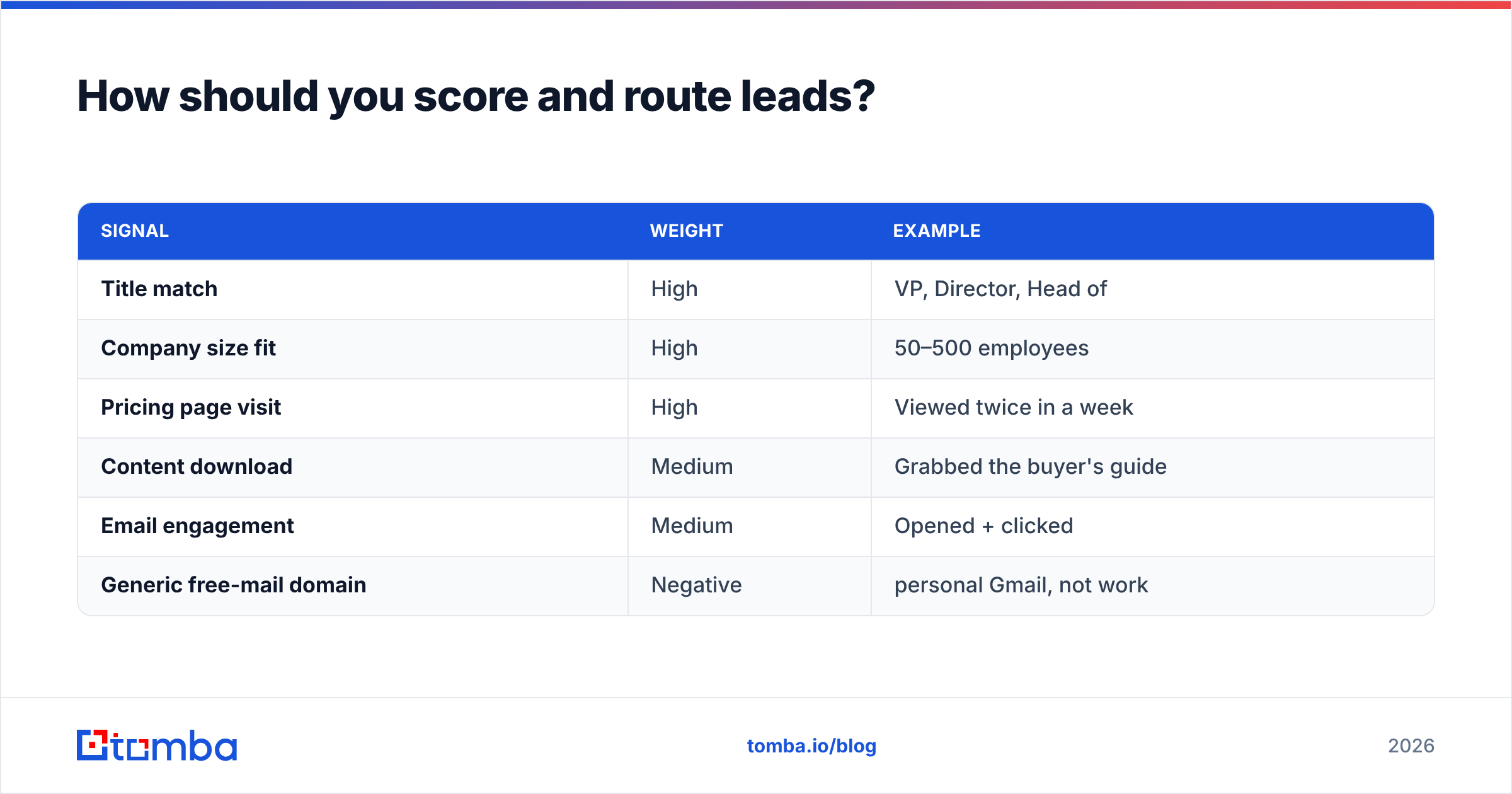
Fit is how closely a lead matches your ICP — the right title, the right company size, the right industry. Intent is behavioral — did they visit your pricing page, open three emails, request a demo? A lead high on both is a hand-raiser; a lead high on fit but low on intent is a nurture candidate; a lead high on intent but low on fit is usually a tire-kicker.
A simple, honest scoring model beats a complex one nobody trusts:
| Signal | Weight | Example |
|---|---|---|
| Title match | High | VP, Director, Head of |
| Company size fit | High | 50–500 employees |
| Pricing page visit | High | Viewed twice in a week |
| Content download | Medium | Grabbed the buyer's guide |
| Email engagement | Medium | Opened + clicked |
| Generic free-mail domain | Negative | personal Gmail, not work |
Then route fast. Speed-to-lead research published by HubSpot has long shown that response within the first few minutes dramatically out-converts a response hours later. Automate the handoff so a qualified lead lands in a rep's queue — with full context — the moment it crosses your threshold.
What does a lean 2026 lead-gen stack look like?#
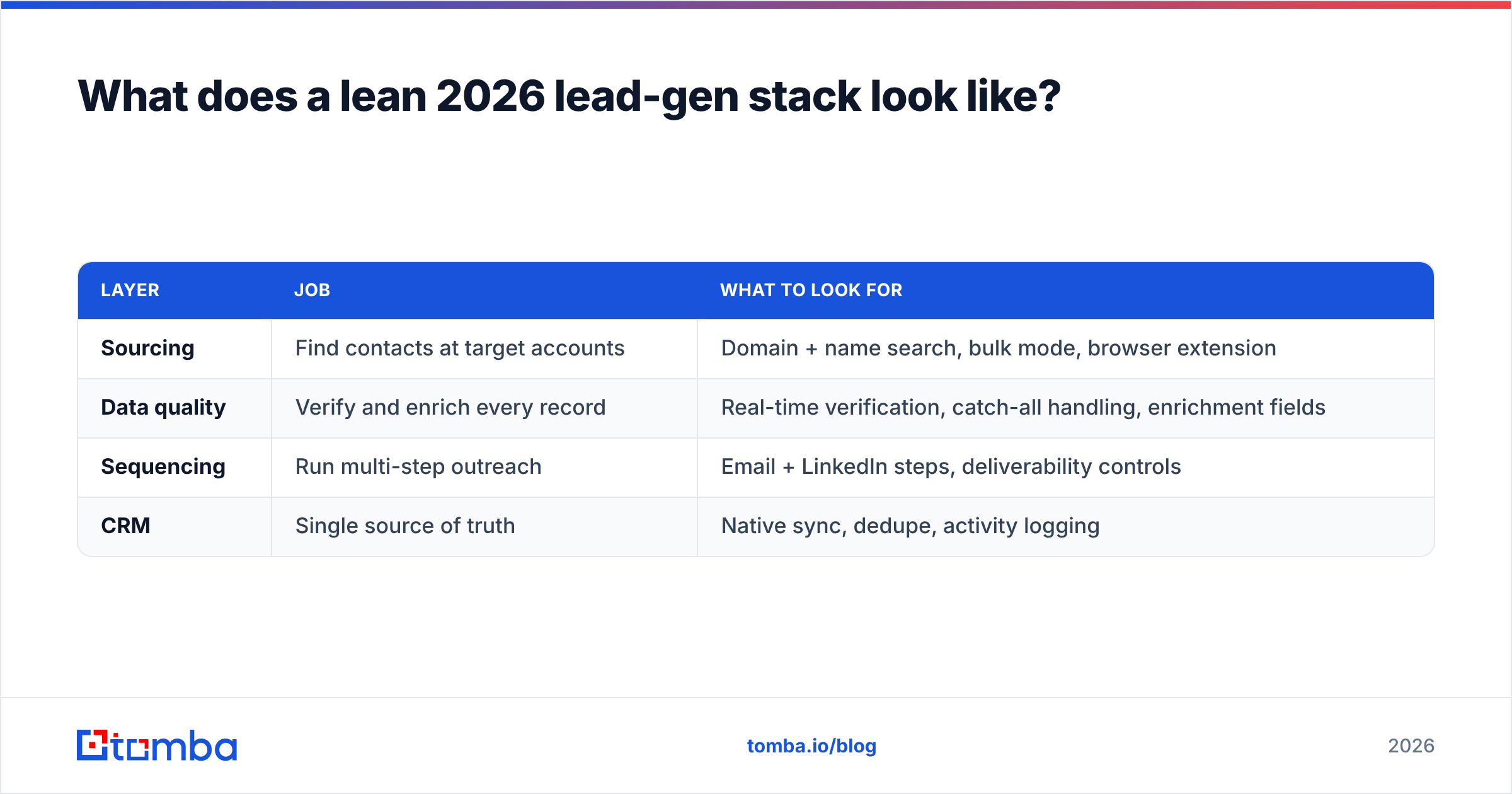
You don't need fifteen tools. You need a sourcing layer, a data-quality layer, a sequencing layer, and a CRM — and they have to talk to each other.
| Layer | Job | What to look for |
|---|---|---|
| Sourcing | Find contacts at target accounts | Domain + name search, bulk mode, browser extension |
| Data quality | Verify and enrich every record | Real-time verification, catch-all handling, enrichment fields |
| Sequencing | Run multi-step outreach | Email + LinkedIn steps, deliverability controls |
| CRM | Single source of truth | Native sync, dedupe, activity logging |
The data-quality layer is the one teams skip and the one that pays for itself fastest. A platform like Tomba covers sourcing and data quality together — email finding, verification, catch-all verification, and enrichment in one place — so you're not stitching three vendors together just to get a clean contact. Compare that against standalone point tools and the math usually favors consolidation; check the Tomba pricing tiers against what you'd pay for separate finder, verifier, and enrichment subscriptions.
How do you measure if it's working?#
Track a small number of metrics that map to revenue, not vanity. Leads generated is meaningless on its own; the question is how many became pipeline and how many became revenue.
Watch these:
- Lead-to-MQL rate — are you sourcing the right people, or just a lot of people?
- MQL-to-opportunity rate — is your scoring honest, or are you passing junk to sales?
- Speed-to-lead — median time from lead created to first touch.
- Bounce rate — over 3% means your data-quality gate is failing.
- Cost per opportunity — the only "cost per" number that ties cleanly to ROI.
If your bounce rate is creeping up, fix data quality before you touch anything else. Every downstream metric is poisoned by leads you can't actually reach.
Common mistakes that quietly drain your pipeline#
- Buying static lists. They decay the moment they're sold and torch your sender reputation. Build lists from live data instead.
- Skipping verification. "It's probably right" is how you bounce into a spam folder. Verify before every send.
- Optimizing volume over fit. Doubling lead count while halving fit just doubles your reps' wasted time.
- Slow follow-up. A hot lead goes cold in hours. If routing takes a day, you've lost the deal.
- One channel only. Single-channel programs are fragile. When that channel saturates, your pipeline stops.
Where Tomba fits in your lead generation engine#
Your business lead generation is only as strong as the contact data underneath it. Tomba's Email Finder gives you accurate, verified professional emails by domain, name, or company — so every lead you source is one you can actually reach. Pair it with built-in verification and enrichment, and you replace the guesswork and bounced sends with a clean, ready-to-sequence pipeline. Start on the free tier with 25 searches a month, then scale into the Starter plan at $49/mo when your outreach picks up. Fill the top of your funnel with buyers, not bounces — and let your reps spend their time selling instead of chasing dead addresses.
// get started
Find, verify and enrich your first contacts today
Start on the free plan with 25 searches a month, then scale when your team is ready.
Free plan · No credit card required · GDPR & CCPA
// about the author