Business Meeting Request Email: Templates That Get Replies in 2026
Stop getting ignored. Learn how to write a business meeting request email that books the call — structure, subject lines, 6 copy-paste templates, and the follow-up cadence that works in 2026.
Business Meeting Request Email: Templates That Get Replies in 2026
You can write the most polished business meeting request email of your career and still hear nothing back — because the email landed in a spam folder, hit the wrong person, or asked for 60 minutes when you'd earned 15. Booking a meeting by email is less about clever phrasing and more about getting five unglamorous things right: the right recipient, a verified address, a specific ask, an easy yes, and a follow-up that doesn't quit.
This guide gives you the structure, the subject lines, six templates you can paste and adapt today, and the follow-up cadence that turns "no reply" into a calendar invite.
TL;DR#
- A business meeting request email is a short, single-purpose message whose only job is to get a yes to a specific time — not to sell, pitch, or explain everything.
- Five components decide whether it works: a relevant subject line, a one-line reason, clear value for them, a concrete time proposal, and an easy reply path.
- Deliverability beats wording. A verified address and a warm sender reputation matter more than your third draft of the opening line.
- Follow up 3–4 times across 10–14 days. Most accepted meetings come from email #2 or #3, not #1.
- Templates below cover cold prospects, warm intros, internal stakeholders, reschedules, and post-event follow-ups.
What is a business meeting request email?#
A business meeting request email is a message that asks a specific person for a specific block of time to talk about a specific topic. That's it. Think of it like asking a busy friend to grab coffee: you don't open with your life story, you say "Are you free Thursday at 3?" The clarity is the courtesy.
The mistake most people make is treating the request like a pitch. They cram in the product, the case studies, the company history — and bury the one question that matters. The recipient skims, sees work, and moves on. A good request email does the opposite: it makes saying "yes" the path of least resistance.
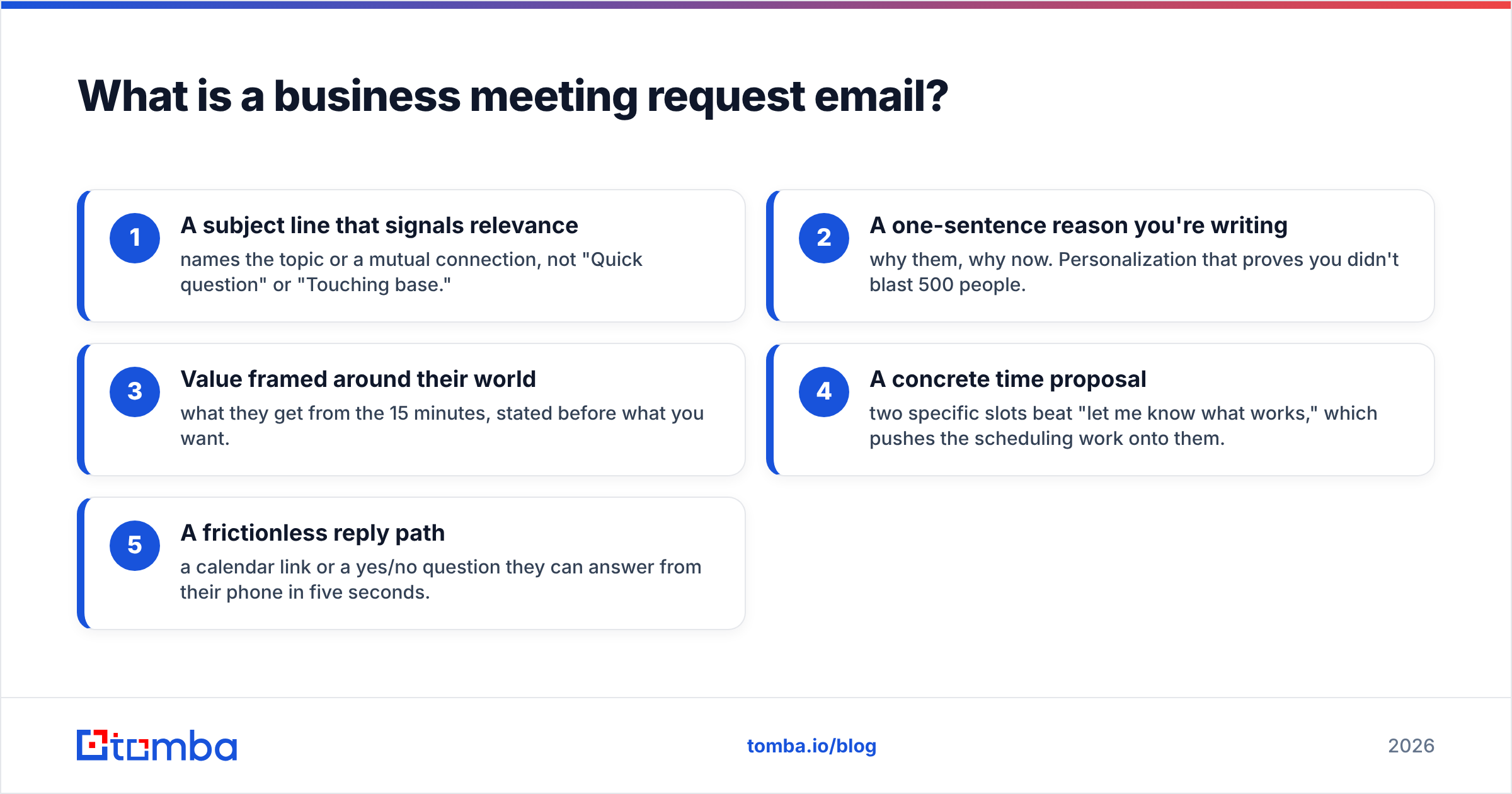
Here are the five components every effective request email shares:
- A subject line that signals relevance — names the topic or a mutual connection, not "Quick question" or "Touching base."
- A one-sentence reason you're writing — why them, why now. Personalization that proves you didn't blast 500 people.
- Value framed around their world — what they get from the 15 minutes, stated before what you want.
- A concrete time proposal — two specific slots beat "let me know what works," which pushes the scheduling work onto them.
- A frictionless reply path — a calendar link or a yes/no question they can answer from their phone in five seconds.
Why do most meeting request emails get ignored?#
Most requests fail before the recipient reads a single word — the email never reached a real inbox, or it reached the wrong person. You can't book a meeting with an address that bounces, and you can't persuade a decision-maker if your message sat in a junk folder.
Three silent killers, in order of impact:
- Bad data. You guessed the address (
firstname@company.com) and it bounced, or you reached a genericinfo@mailbox no human checks. Every bounce also drags down your sender reputation, making your next email more likely to be filtered. - Wrong recipient. You emailed someone with no authority over the decision. Even a perfect message to the wrong title is a dead end.
- Weak deliverability hygiene. No verification step, a cold sending domain, and links or attachments that trip spam filters.
This is the unglamorous truth: the words come last. Before you obsess over your opening line, make sure the email is going to a verified, accurate address for the actual decision-maker. Tools like the Tomba Email Finder and an email verifier exist precisely because a request to a dead inbox has a 0% reply rate no matter how good the copy is. According to HubSpot's sales research, personalized, well-targeted outreach consistently outperforms volume — and targeting starts with reaching the right inbox.
How do you structure a business meeting request email?#
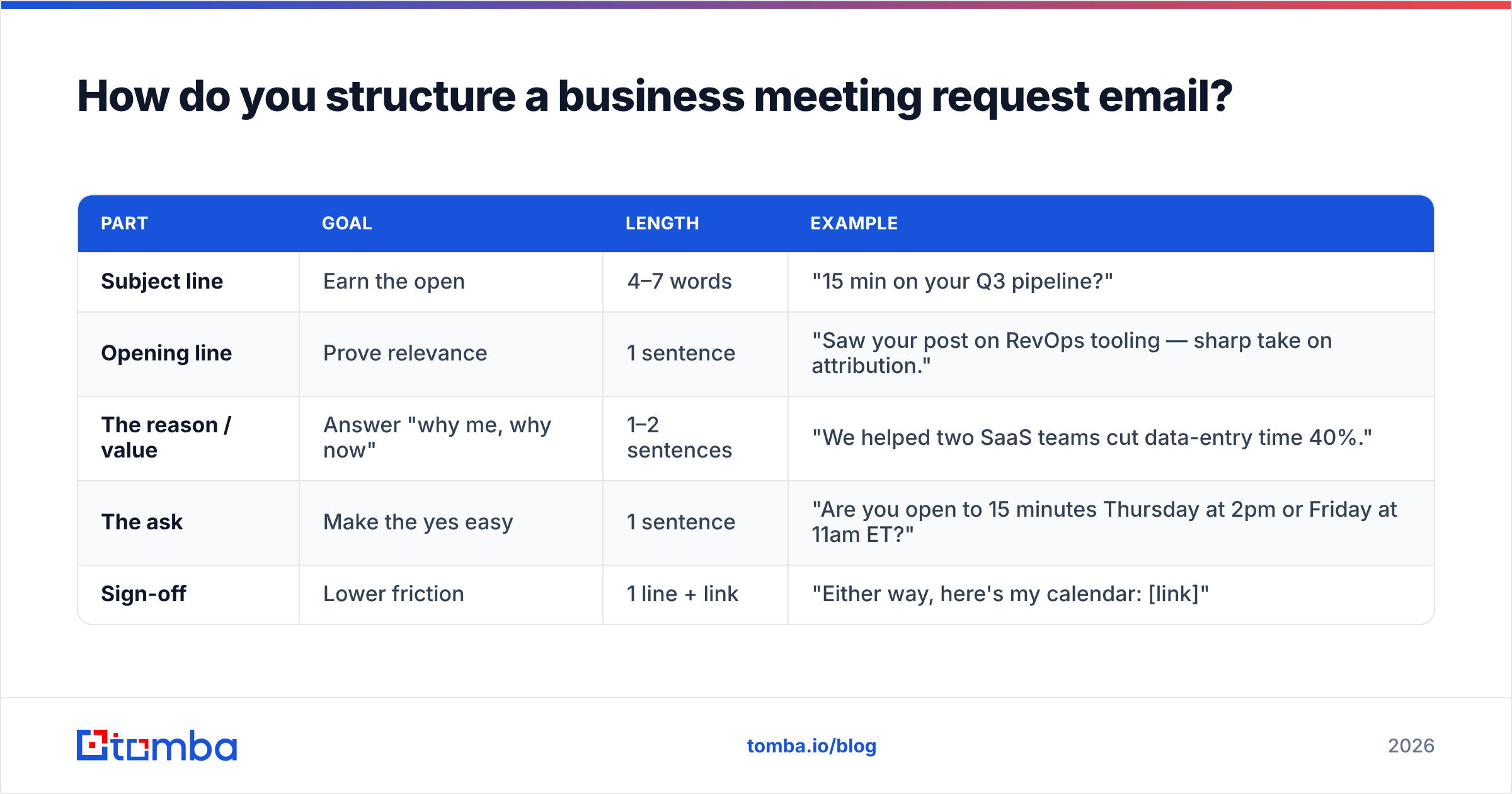
Use a five-line skeleton and resist the urge to add a sixth. The structure below works for cold and warm requests alike; you change the warmth of the language, not the bones.
| Part | Goal | Length | Example |
|---|---|---|---|
| Subject line | Earn the open | 4–7 words | "15 min on your Q3 pipeline?" |
| Opening line | Prove relevance | 1 sentence | "Saw your post on RevOps tooling — sharp take on attribution." |
| The reason / value | Answer "why me, why now" | 1–2 sentences | "We helped two SaaS teams cut data-entry time 40%." |
| The ask | Make the yes easy | 1 sentence | "Are you open to 15 minutes Thursday at 2pm or Friday at 11am ET?" |
| Sign-off | Lower friction | 1 line + link | "Either way, here's my calendar: [link]" |
A few rules that make the skeleton work:
- Keep it under 120 words. If it's longer than a phone screen, it reads as homework.
- Ask for 15 minutes, not an hour. Small asks get small, fast yeses. You can expand the meeting once they're interested.
- Propose times in their timezone. "2pm ET" removes a round of back-and-forth.
- One call to action only. Two asks halve your reply rate. Pick the meeting.
For ready-made starting points, Tomba's free cold email templates library and the subject line generator handle the two parts people overthink most.
What subject lines get meeting requests opened?#
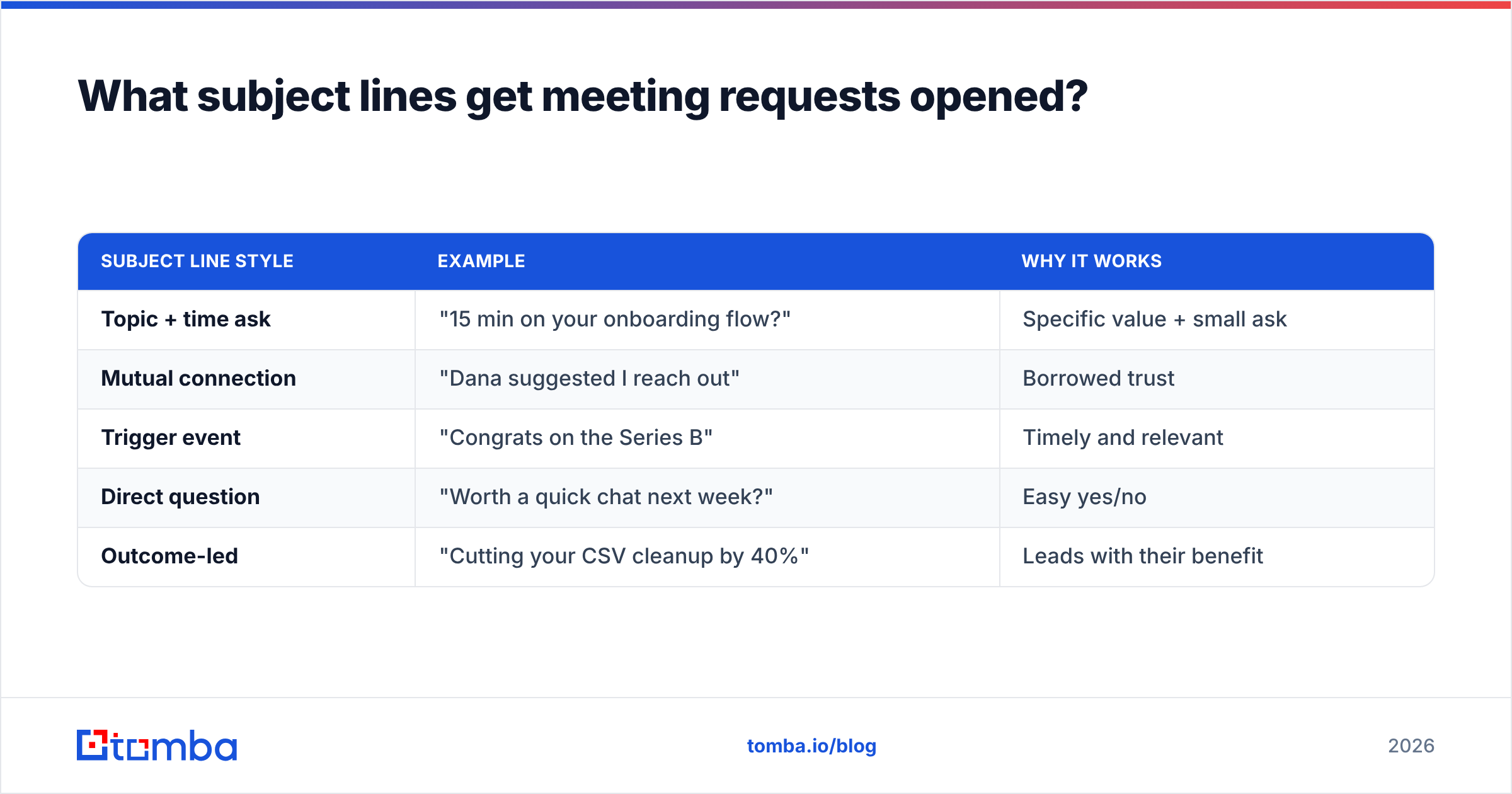
The subject line's only job is the open — so make it specific, short, and human. Vague subject lines ("Touching base," "Following up," "Quick question") read as mass mail and get archived on sight.
| Subject line style | Example | Why it works |
|---|---|---|
| Topic + time ask | "15 min on your onboarding flow?" | Specific value + small ask |
| Mutual connection | "Dana suggested I reach out" | Borrowed trust |
| Trigger event | "Congrats on the Series B" | Timely and relevant |
| Direct question | "Worth a quick chat next week?" | Easy yes/no |
| Outcome-led | "Cutting your CSV cleanup by 40%" | Leads with their benefit |
Two habits raise open rates further: keep subject lines under ~40 characters so they don't truncate on mobile, and never use clickbait you can't pay off in the body. A subject that overpromises tanks your response rate on every future send because recipients learn to distrust your name.
Six business meeting request email templates#
Copy, paste, and swap the brackets. Each is built on the five-line skeleton above.
1. Cold prospect (problem-led)
Subject: 15 min on [specific process]?
Hi [First name],
I noticed [specific signal — recent hire, product launch, post]. Teams in [their role] often lose hours to [problem]; we helped [similar company] cut that by [result].
Worth 15 minutes to see if it maps to your setup? I'm open Thursday 2pm or Friday 11am ET — or grab a slot here: [link].
[Your name]
2. Warm intro (referral)
Subject: [Referrer] suggested we connect
Hi [First name],
[Referrer] mentioned you're rethinking [topic] and thought a quick chat could help. I work with [role] on exactly this.
Are you free for 15 minutes early next week? Tuesday or Wednesday afternoon both work my end.
[Your name]
3. Decision-maker (value-first)
Subject: Cutting [metric] for [their company]
Hi [First name],
Quick one: we've helped [2–3 comparable companies] improve [metric] by [number]. I'd love to show you the one play that drove most of it.
15 minutes Thursday at 10am ET? If easier, here's my calendar: [link].
[Your name]
4. Internal stakeholder
Subject: 20 min to align on [project] timeline
Hi [First name],
Before we lock the [project] scope, I'd like to align on [specific decision] so we don't rework it later.
Does Wednesday 3pm or Thursday 9am suit you? I'll send an agenda ahead.
Thanks, [Your name]
5. Reschedule (keep the relationship warm)
Subject: Rescheduling our chat — same energy, new time
Hi [First name],
Apologies, something urgent landed on [original date]. I still want the conversation — can we move to [new slot 1] or [new slot 2]?
Thanks for the flexibility, [Your name]
6. Post-event follow-up
Subject: Great chatting at [event]
Hi [First name],
Enjoyed our conversation about [topic] at [event]. You mentioned [specific challenge] — I'd love to go deeper.
Free for 15 minutes next week? Monday 1pm or Tuesday 11am ET work for me.
[Your name]
How many times should you follow up?#
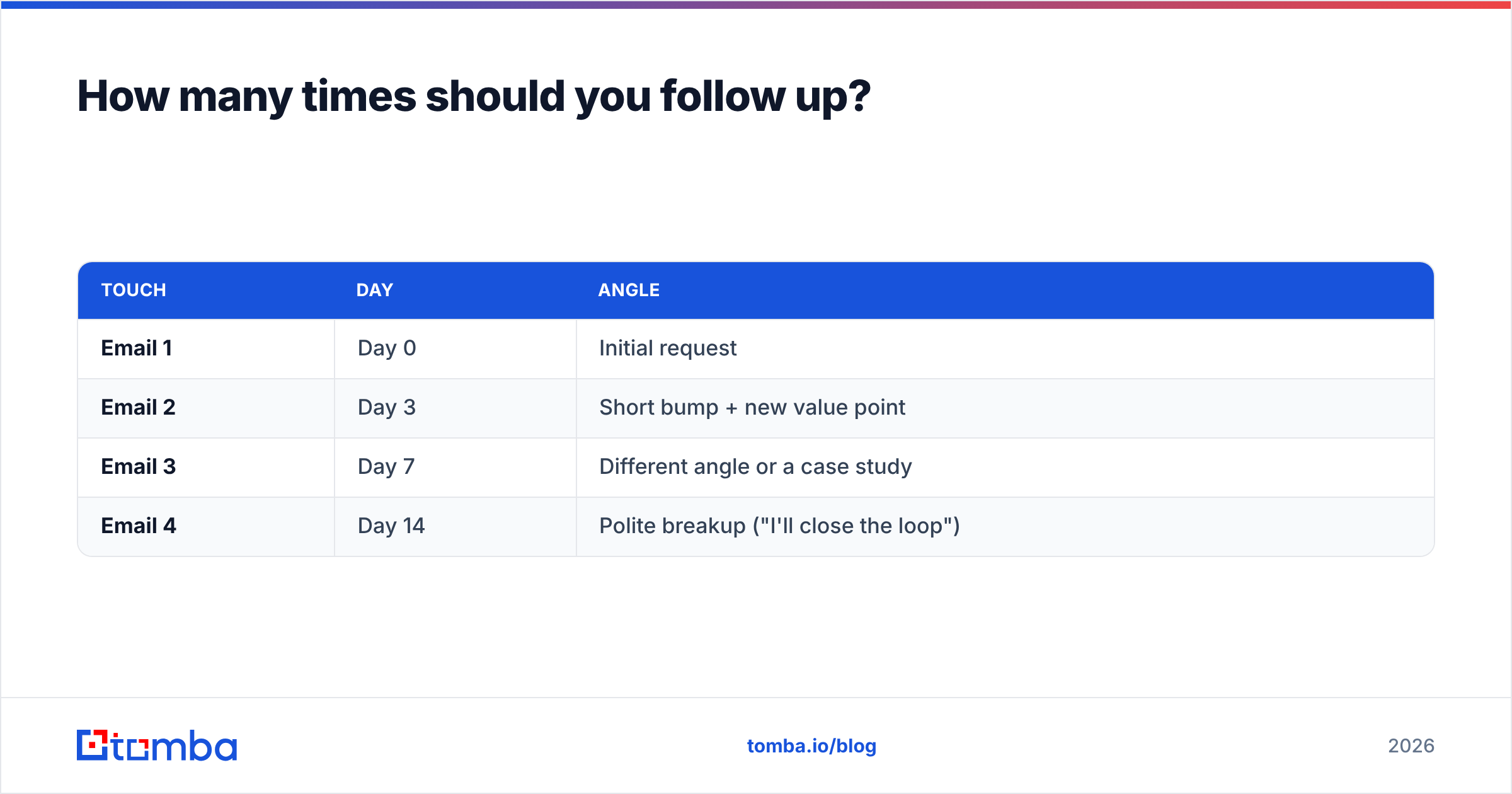
Follow up three to four times over 10–14 days — most accepted meetings come from the second or third email, not the first. People aren't ignoring you out of malice; they're busy, and your first email arrived on a bad day. A patient, polite cadence is the single highest-leverage habit in meeting booking.
| Touch | Day | Angle |
|---|---|---|
| Email 1 | Day 0 | Initial request |
| Email 2 | Day 3 | Short bump + new value point |
| Email 3 | Day 7 | Different angle or a case study |
| Email 4 | Day 14 | Polite breakup ("I'll close the loop") |
Guardrails that keep follow-ups from becoming nagging:
- Add value each time. A new stat, a relevant article, a customer result — never just "bumping this."
- Keep each follow-up shorter than the last. By email 4 you're at two sentences.
- Reply in the same thread. It preserves context and improves deliverability.
- Know when to stop. The breakup email frees you and, surprisingly, often earns the reply. According to peer reviews on G2, persistence paired with personalization is what separates high-booking reps from the rest.
A quick note on volume: if you're running follow-ups across hundreds of contacts, verify the list first with a bulk email finder so you're not burning sender reputation on addresses that were never going to land. One bad list can suppress deliverability for your whole domain.
What mistakes kill a meeting request email?#
The fastest way to improve is to stop doing the things that get you ignored. In order of damage:
- Sending to unverified addresses. Bounces hurt deliverability and waste the rep's time. Verify before you send.
- Asking for too much time. "30–60 minutes" reads as a commitment; "15 minutes" reads as a favor.
- Making them do the scheduling. "Let me know what works" is friction. Propose two slots or share a link.
- Burying the ask. If the meeting request is in paragraph three, it doesn't exist.
- Writing about yourself. Count your "I/we" vs "you/your." If you's losing, rewrite.
- No follow-up. Quitting after one email leaves most of your meetings on the table.
Fix those six and your reply rate climbs before you ever touch the wording of your opening line.
Frequently asked questions#
How long should a business meeting request email be? Under 120 words, or about a phone screen. Long requests read as work and get deferred — which usually means forgotten.
Should I attach a calendar link or propose times? Both work; pick based on warmth. For cold prospects, two specific time proposals feel less presumptuous. For warm contacts, a calendar link removes friction. Never do both in the same email — choose one path.
What's the best time to send a meeting request? Mid-morning on Tuesday through Thursday tends to perform best, but your audience's habits matter more than any rule. Test send times against your own response rate data rather than trusting blanket advice.
How do I find the right person's email to send to? Use a domain or name lookup to find the decision-maker's verified address, then confirm it before sending. Guessing the format and hoping it lands is how you rack up bounces and damage your sender reputation.
Book more meetings by reaching the right inbox first#
The best business meeting request email in the world still needs a real person on the other end. Before you polish another draft, make sure your message is reaching a verified, accurate address for the actual decision-maker — that's the difference between a 0% and a double-digit reply rate.
Tomba's Email Finder finds professional email addresses by name, company, or domain and verifies them before you hit send, so your carefully written request actually lands. Start free with 25 searches a month, and check Tomba pricing when you're ready to scale your outreach. Get the inbox right, keep the ask small, and follow up like you mean it — the meetings will follow.
// get started
Find, verify and enrich your first contacts today
Start on the free plan with 25 searches a month, then scale when your team is ready.
Free plan · No credit card required · GDPR & CCPA
// about the author