How to Write a Business Partnership Email That Wins in 2026
A business partnership email lives or dies in the first two lines. Here are the templates, structure, and outreach tactics that get co-marketing, reseller, and integration deals replied to in 2026.
TL;DR
- A business partnership email is a one-to-one outreach message proposing a mutually beneficial deal — co-marketing, reselling, integration, or referral — not a sales pitch and not a newsletter.
- The winning structure is five parts: a specific subject line, a relevance hook, a value-first proposal, social proof, and a single clear ask.
- Reply rates rise when you reach the right decision-maker at a verified address — guessing the inbox is where most partnership outreach quietly dies.
- Personalization beats volume: a 50-email batch with researched hooks outperforms a 5,000-email blast every time.
- Use the five templates below for cold intros, warm reconnects, co-marketing, reseller, and integration proposals, then follow up three times over 12 days.
When you ask another company to partner with you, you are asking a stranger to bet part of their reputation on you. That is a bigger ask than buying a $49 subscription, which is exactly why most partnership emails get ignored. This guide breaks down how to write a business partnership email that earns a reply, with structure, templates, and the outreach mechanics that actually move the needle in 2026.
What is a business partnership email?#
A business partnership email is a targeted message in which one company proposes a working relationship to another. The relationship is mutual by definition — both sides expect to gain. That makes it fundamentally different from a cold sales email (where you want their money) or a marketing email (where you want their attention).
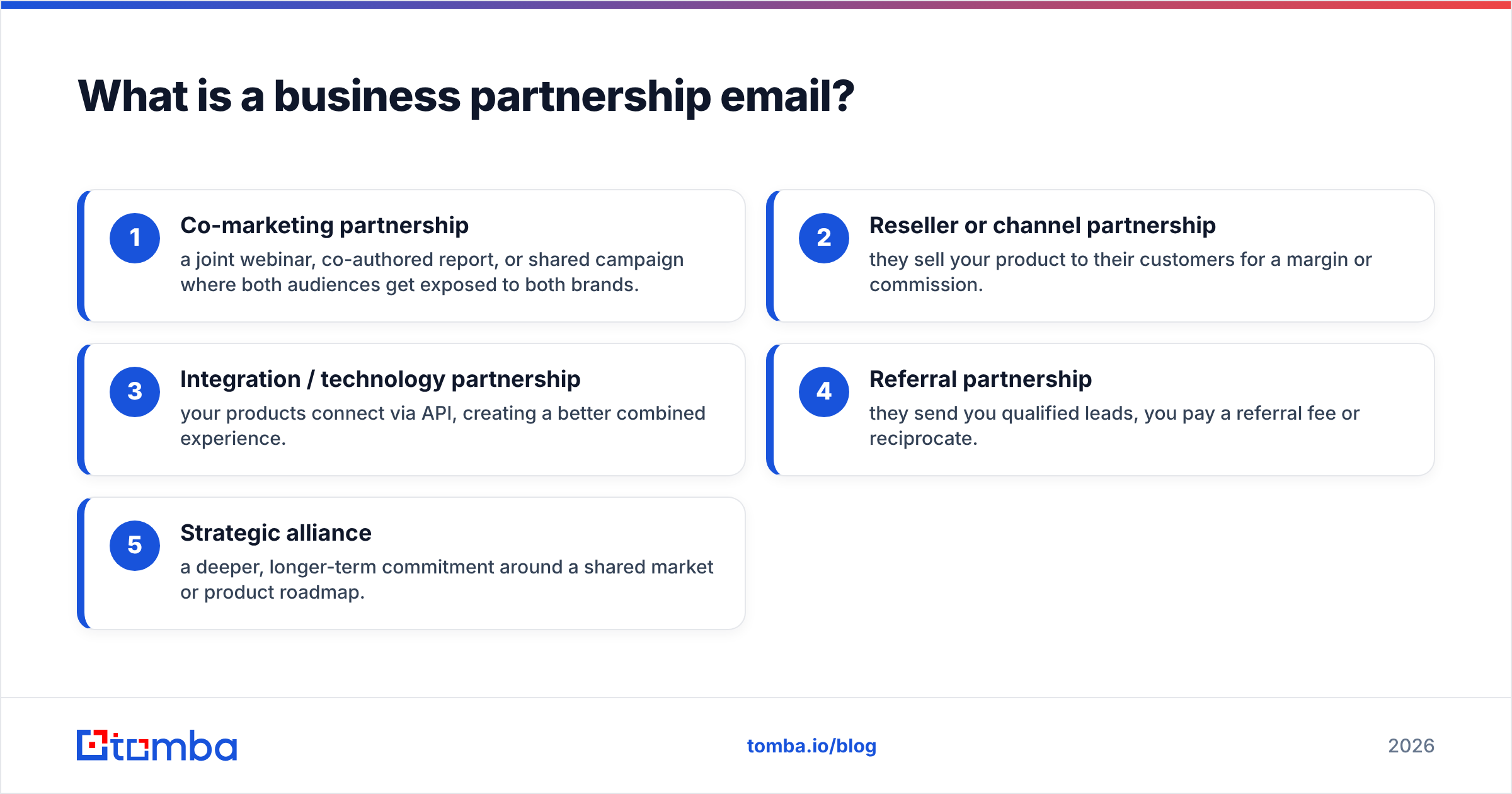
The most common partnership types you will be pitching:
- Co-marketing partnership — a joint webinar, co-authored report, or shared campaign where both audiences get exposed to both brands.
- Reseller or channel partnership — they sell your product to their customers for a margin or commission.
- Integration / technology partnership — your products connect via API, creating a better combined experience.
- Referral partnership — they send you qualified leads, you pay a referral fee or reciprocate.
- Strategic alliance — a deeper, longer-term commitment around a shared market or product roadmap.
Each type changes the ask, but the email anatomy stays the same. Get the anatomy right and you can adapt one framework to all five.

What makes a partnership email get a reply?#
Replies come from relevance, not eloquence. The decision-maker on the other end is scanning, not reading. They decide in roughly three seconds whether your message is worth a fourth. Five elements consistently separate replied-to emails from deleted ones:
- A subject line that names a specific outcome, not "Partnership opportunity." Vague subject lines read as spam.
- A first line about them, not you. Reference their recent launch, content, or customer base — proof you did homework.
- A value-first proposal that leads with what they get, before what you want.
- Credible proof — a recognizable customer, a metric, or a relevant past partnership.
- One ask, one link. Multiple asks split attention and kill conversions.
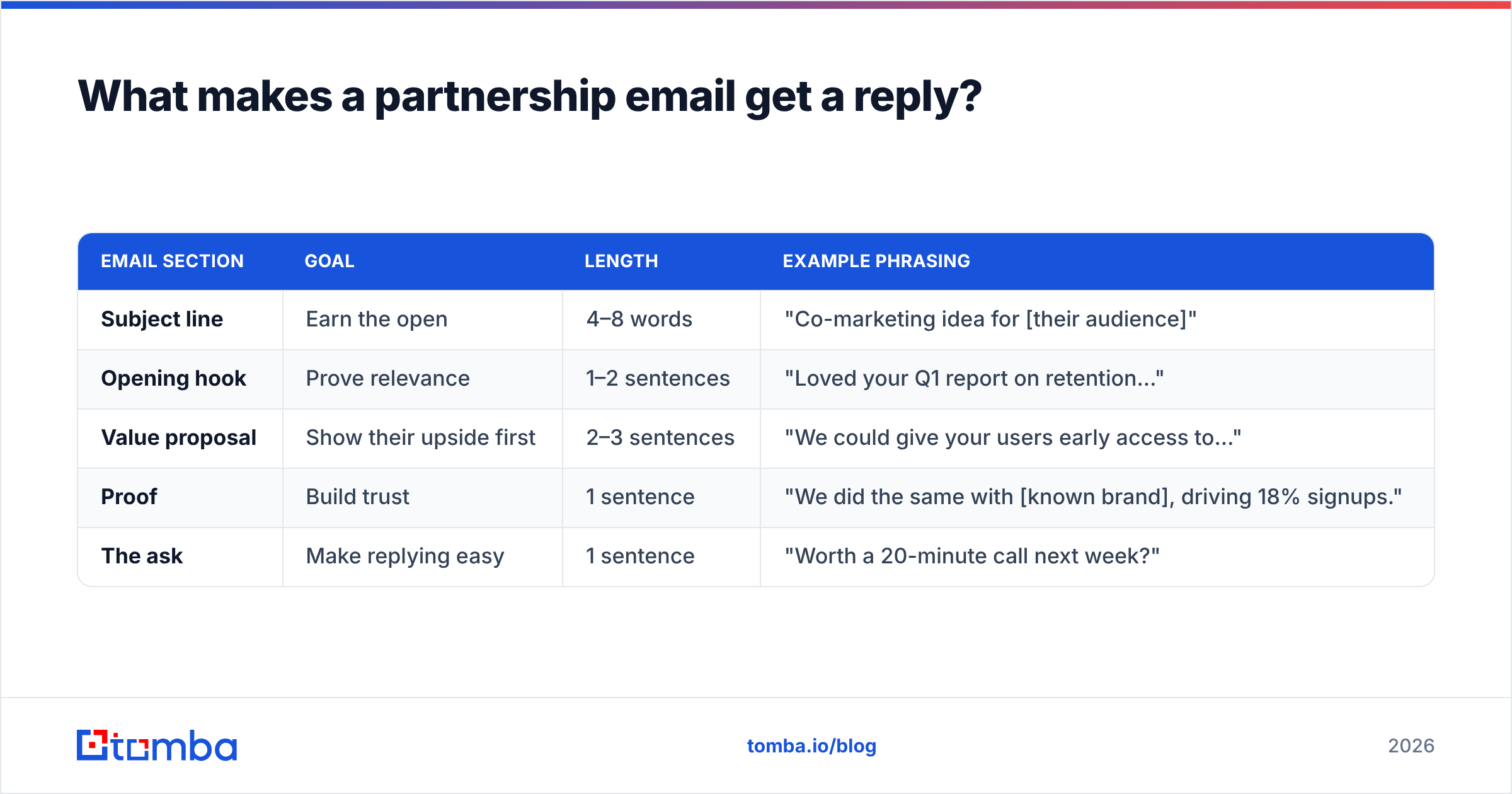
Here is how those five elements map to a real structure you can reuse:
| Email section | Goal | Length | Example phrasing |
|---|---|---|---|
| Subject line | Earn the open | 4–8 words | "Co-marketing idea for [their audience]" |
| Opening hook | Prove relevance | 1–2 sentences | "Loved your Q1 report on retention…" |
| Value proposal | Show their upside first | 2–3 sentences | "We could give your users early access to…" |
| Proof | Build trust | 1 sentence | "We did the same with [known brand], driving 18% signups." |
| The ask | Make replying easy | 1 sentence | "Worth a 20-minute call next week?" |
Notice that your company's name barely appears until the proof line. That restraint is the hardest part to get right and the biggest reason most outreach fails.
How do you structure a business partnership email?#
Lead with the conclusion: open about them, propose value, ask once. Below is the skeleton expanded into a full sequence you can lift directly.
The opening. Skip "I hope this email finds you well." Open with a concrete observation: "Your team's integration with [X] is the cleanest I've seen in the category." Specificity signals you are a peer, not a vendor working a list.
The bridge. Connect their world to your proposal in one sentence. "Our 12,000 SMB users keep asking for exactly what you build." This frames the partnership as obvious, almost inevitable.
The proposal. State the partnership in plain terms and put their benefit first. If it is co-marketing, name the asset. If it is a reseller deal, name the margin. Concreteness converts.
The proof. One credibility line. A named partner, a number, or a logo. Avoid stacking three — it reads as overcompensation.
The ask. Close with a low-friction yes/no question and a single scheduling link. "Open to a quick call?" beats "Let me know your thoughts on the attached 4-page deck."
Good outreach also respects deliverability. If your domain has poor sender reputation, even a perfect email lands in spam. Warm the domain, authenticate it, and keep volume sane — partnership outreach should be a trickle of high-quality messages, not a firehose.
Which partnership email templates actually work?#
Below are five field-tested templates. Replace bracketed variables with researched specifics — the brackets are where the work happens.
1. Cold co-marketing intro
Subject: Joint webinar idea for [their audience]
Hi [First name],
Your guide on [topic] is the resource I keep sending to our customers. We serve [your audience] and have a lot of overlap with yours without competing.
I'd love to co-host a webinar on [shared topic]. You'd reach our [X]-person list; we'd reach yours. We ran the same play with [known brand] and pulled 400+ registrants.
Worth 20 minutes next week to scope it?
2. Warm reconnect
Subject: Picking this back up
Hi [First name], we spoke briefly at [event] about a possible tie-up. Timing wasn't right then. We've since launched [new thing], which makes the fit even cleaner. Open to revisiting?
3. Reseller / channel pitch
Subject: [X]% margin reselling [product] to your clients
Hi [First name], your clients in [vertical] are exactly who buys [product]. Our partner program pays [X]% recurring and includes co-branded materials and dedicated support. [Named partner] added $40k ARR in their first quarter. Can I send the one-page program overview?
4. Integration proposal
Subject: [Your tool] + [their tool] integration
Hi [First name], our mutual users keep asking us to connect with [their product]. A native integration would cut their setup time roughly in half. We'd build and maintain it, and feature you in our marketplace. Interested in a technical scoping call?
5. Referral partnership
Subject: Sending you qualified [vertical] leads
Hi [First name], we regularly get requests for [their service] that we can't fulfill. Rather than drop them, I'd rather send them to you — and you could do the same for [your service]. Want to set up a simple two-way referral?
For more reusable frameworks across the full outreach cycle, the cold email templates library is a useful starting point you can adapt to each partnership type.

How is a partnership email different from a cold sales email?#
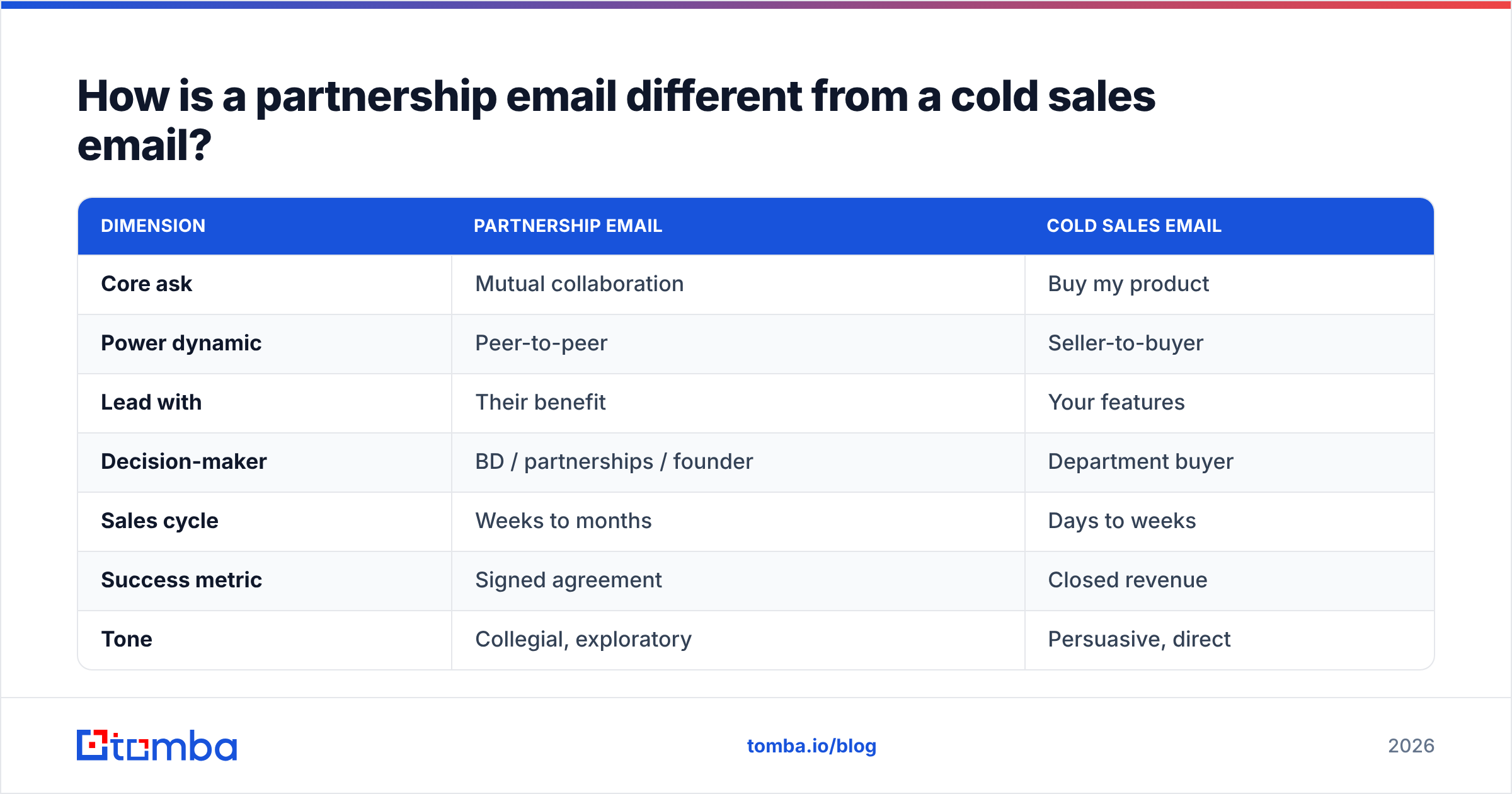
The two look similar on the surface and behave nothing alike. Confusing them is why so many partnership emails read as pushy. Here is the contrast that matters:
| Dimension | Partnership email | Cold sales email |
|---|---|---|
| Core ask | Mutual collaboration | Buy my product |
| Power dynamic | Peer-to-peer | Seller-to-buyer |
| Lead with | Their benefit | Your features |
| Decision-maker | BD / partnerships / founder | Department buyer |
| Sales cycle | Weeks to months | Days to weeks |
| Success metric | Signed agreement | Closed revenue |
| Tone | Collegial, exploratory | Persuasive, direct |
The practical takeaway: address your partnership email to a peer who has the authority to say yes to a collaboration. That is usually a partnerships lead, a head of BD, or at smaller companies, the founder. Sending a partnership pitch to a junior SDR inbox guarantees silence.
How do you find the right person to email?#
Reaching the decision-maker is the unglamorous step that decides everything. A flawless email to the wrong inbox is a wasted send. There are three reliable paths:
- Domain-first search — start from the company URL and pull the people and patterns behind it. A domain search returns the team's verified addresses and the company's email format in one pass, so you can target the head of partnerships directly.
- Name-first lookup — when you already know who you want (say, you found them on LinkedIn), an email finder resolves their professional address from name plus company.
- Pattern inference — if a company uses first.last@, you can construct and then verify the address rather than guess.
Whichever path you use, verify before you send. An email verifier checks that the mailbox exists and accepts mail, which protects your bounce rate and your email deliverability. Bounces above roughly 3% start dragging your domain reputation down, and a damaged domain undermines every future campaign — partnership or otherwise.
Industry data backs the personalization-plus-accuracy approach: HubSpot's research on outreach consistently shows that segmented, personalized sends outperform generic blasts, and review platforms like G2 make it easy to vet which tools partners actually trust before you name-drop them.
How many times should you follow up?#
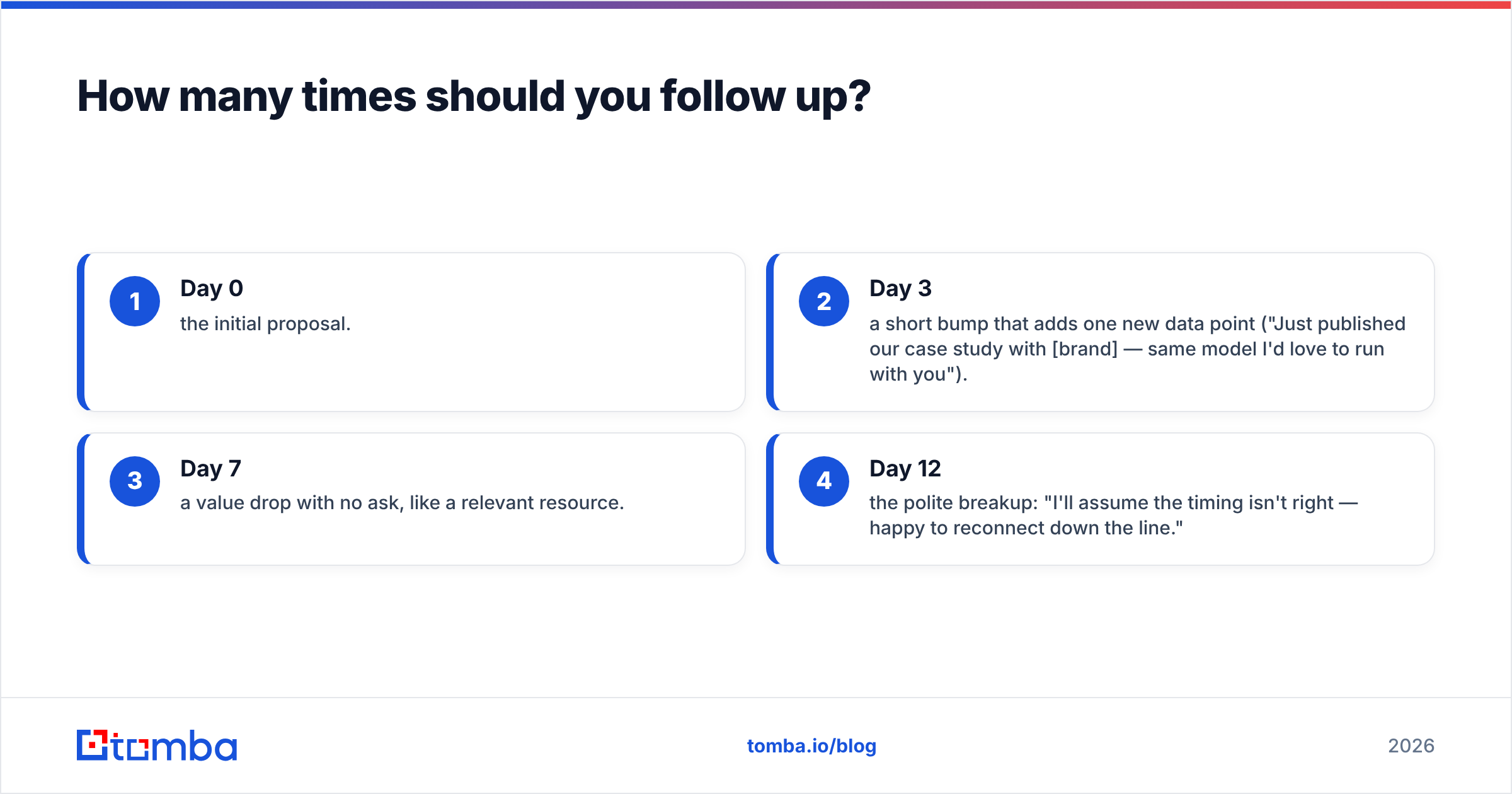
Three follow-ups over about 12 days is the sweet spot for partnership outreach. Most positive replies arrive on the second or third touch, not the first — persistence reads as genuine interest, provided each message adds something new.
A workable cadence:
- Day 0 — the initial proposal.
- Day 3 — a short bump that adds one new data point ("Just published our case study with [brand] — same model I'd love to run with you").
- Day 7 — a value drop with no ask, like a relevant resource.
- Day 12 — the polite breakup: "I'll assume the timing isn't right — happy to reconnect down the line."
Keep each follow-up under four sentences. The breakup email, counterintuitively, often pulls the highest reply rate because it triggers a fear of missing out. Never follow up more than four times for a cold partnership — beyond that you are harming your reputation, not your odds.
What mistakes kill partnership emails?#
The failure patterns are predictable, which means they are avoidable:
- Leading with yourself. "We're an award-winning platform…" Nobody cares yet. Lead with them.
- A vague subject line. "Partnership" or "Quick question" gets archived. Name the outcome.
- Too many asks. A call, a deck review, and a Slack connect in one email splits attention to zero.
- No proof. Claims without evidence read as hype. One concrete number fixes this.
- Wrong recipient. Pitching a collaboration to a generic info@ inbox. Find the actual decision-maker.
- Unverified addresses. High bounce rates tank your domain and your whole sending program.
Fix those six and you are ahead of roughly 90% of the partnership emails landing in any BD leader's inbox this week.
Start your partnership outreach the right way#
A great partnership email is wasted if it never reaches a real, verified decision-maker. Before you write a single word, build a clean list of the right people at the right companies — then personalize each message around what they actually care about.
Tomba's Email Finder lets you go from a company domain to the verified address of its partnerships lead in seconds, with accuracy you can trust and a free tier of 25 searches a month to test it. When you are ready to scale, Tomba pricing starts at $49/mo for Starter and $99/mo for Growth — a small cost against a single closed partnership. Find the right inbox, send the right email, and let the templates above do the rest.
// get started
Find, verify and enrich your first contacts today
Start on the free plan with 25 searches a month, then scale when your team is ready.
Free plan · No credit card required · GDPR & CCPA
// about the author