Business Proposal Email: Templates & Examples for 2026
A business proposal email lives or dies on the first 50 words. Steal the structure, templates, and follow-up cadence that turn cold pitches into signed deals in 2026.
Business Proposal Email: Templates & Examples for 2026
You can have the best offer on the planet and still lose the deal in the inbox. A business proposal email is the moment your pitch meets a busy decision-maker who has 200 unread messages and a meeting in four minutes. Get the first two sentences wrong and your beautifully formatted PDF never gets opened.
This guide breaks down exactly how to write a business proposal email that earns a reply — the structure, the subject lines, the templates you can paste today, and the follow-up cadence that quietly does most of the closing.
TL;DR#
- A business proposal email is a short message that frames a specific offer, ties it to the recipient's problem, and asks for one clear next step — the proposal document is the attachment, not the email itself.
- Lead with the prospect's outcome, not your company history. The first 50 words decide whether the rest gets read.
- Use a four-part structure: relevant hook, value framing, scannable proof, single call to action.
- Personalization beats volume. Sending 30 researched, verified emails outperforms blasting 3,000 generic ones.
- Follow up 3–4 times over two weeks. Roughly half of all positive replies come after the first message.
What is a business proposal email?#
A business proposal email is a written pitch sent to a prospect, partner, or existing client that proposes a specific working arrangement — a service, a project, a partnership, or a price — and invites them to take the next step. Think of it as the trailer, not the movie. The full proposal (scope, deliverables, pricing tiers, timelines) usually lives in an attached document or a link; the email's only job is to get that document opened and a reply sent.
There are two broad situations, and they read very differently:
- Solicited proposals — the prospect asked for it, often after a discovery call or an RFP. Tone is confirmatory: "As discussed, here's how we'd approach X."
- Unsolicited (cold) proposals — you're initiating contact. Tone is earned-attention: you have to justify why this email deserves a reply before you ask for anything.
Most reps blur the two and send a solicited-style email to a cold list. That's why their reply rates sit near zero. The cold version needs more proof of relevance up front and a much lighter ask.

What makes a business proposal email actually get replies?#
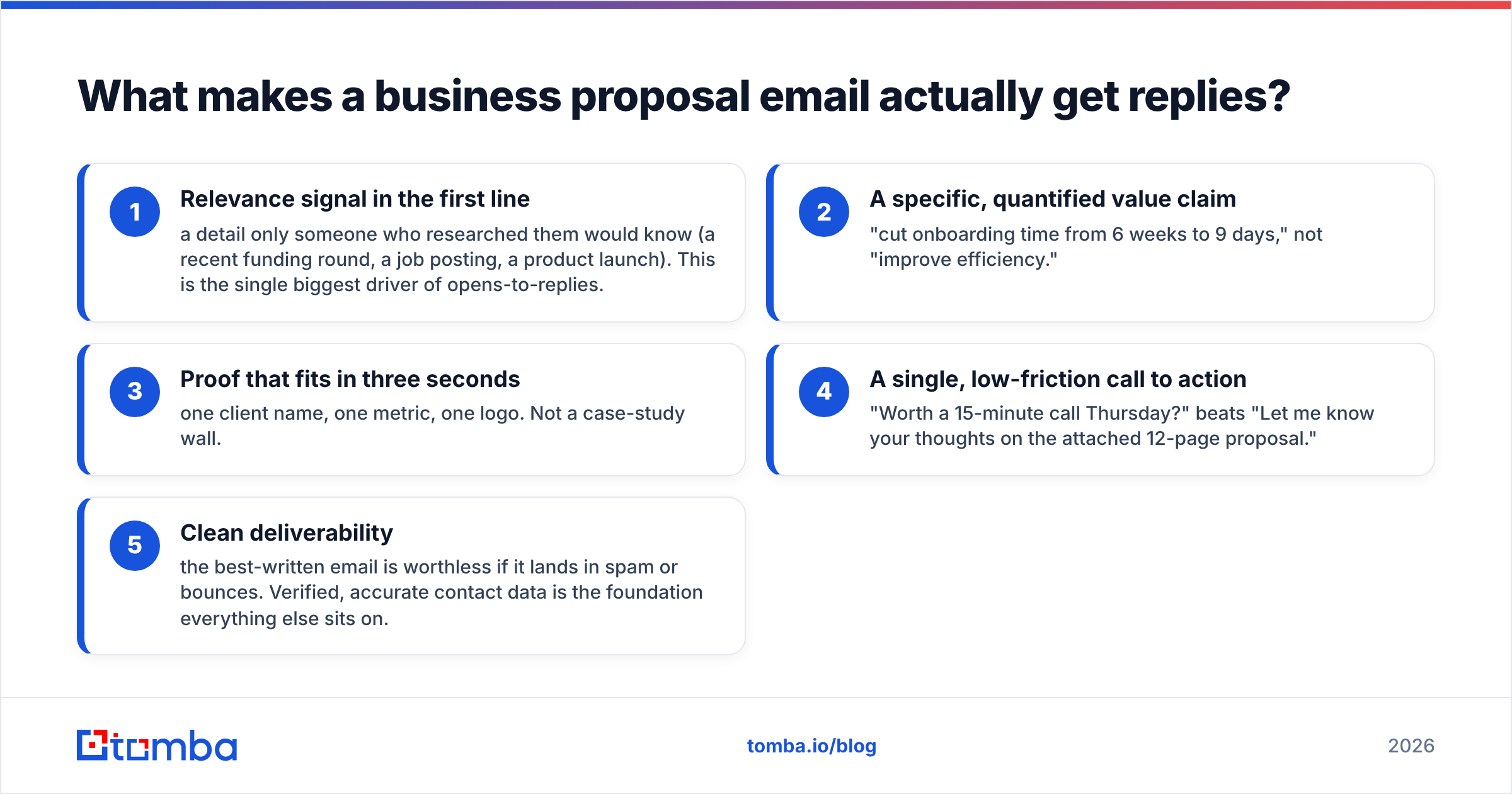
The difference between a 2% and a 20% reply rate is rarely the offer — it's the framing. Decision-makers scan for one thing first: is this about me, or about you? Emails that open with "We are a leading provider of..." get archived. Emails that open with the reader's exact situation get read.
Here are the levers that move the needle, ranked by impact:
- Relevance signal in the first line — a detail only someone who researched them would know (a recent funding round, a job posting, a product launch). This is the single biggest driver of opens-to-replies.
- A specific, quantified value claim — "cut onboarding time from 6 weeks to 9 days," not "improve efficiency."
- Proof that fits in three seconds — one client name, one metric, one logo. Not a case-study wall.
- A single, low-friction call to action — "Worth a 15-minute call Thursday?" beats "Let me know your thoughts on the attached 12-page proposal."
- Clean deliverability — the best-written email is worthless if it lands in spam or bounces. Verified, accurate contact data is the foundation everything else sits on.
That last point is where most outbound quietly breaks. If you're guessing email addresses or pulling them from a stale list, your bounce rate climbs, your sender reputation drops, and even your good emails start skipping the inbox. Running addresses through an email verifier before you send is the unglamorous step that protects every other thing on this list.
How do you structure a business proposal email?#
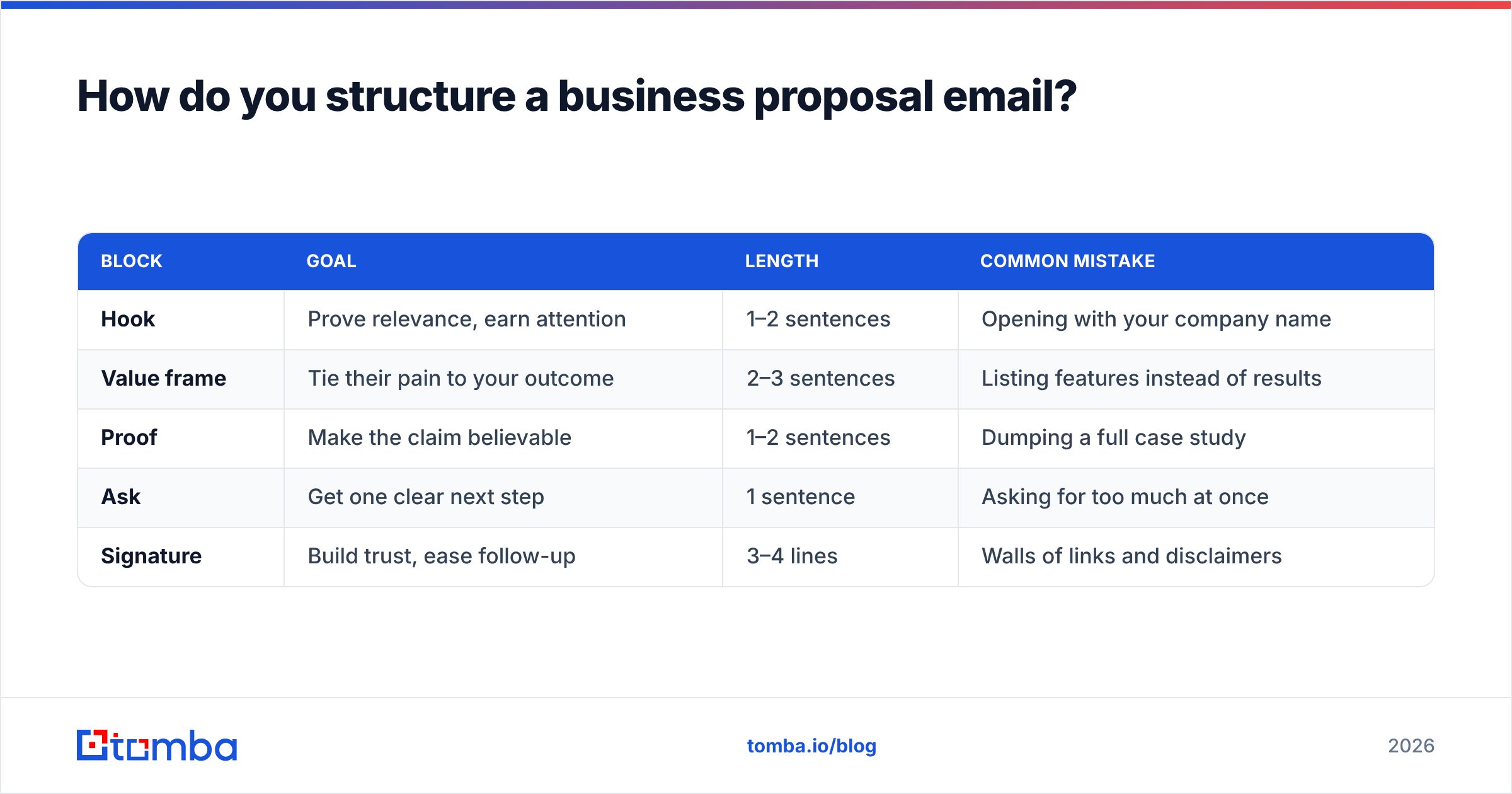
Use a four-block structure. Each block has one job, and none of them is "tell them about your company."
1. The Hook (1–2 sentences). Open with the recipient's world. Reference the trigger event or pain point that makes now the right time. This earns the next paragraph.
2. The Value Frame (2–3 sentences). Connect their problem to your specific outcome. State what changes for them, in numbers if you can. This is where the proposal's core promise lives.
3. The Proof (1–2 sentences or 2–3 bullets). One credible reference point. A comparable client, a result, a relevant credential. Keep it skimmable.
4. The Ask (1 sentence). One next step, one timeframe. Make saying yes take five seconds.
Below the four blocks: a short sign-off, the attachment or link, and a clean signature. That's the whole email — usually 90 to 150 words.
Business proposal email structure at a glance#
| Block | Goal | Length | Common mistake |
|---|---|---|---|
| Hook | Prove relevance, earn attention | 1–2 sentences | Opening with your company name |
| Value frame | Tie their pain to your outcome | 2–3 sentences | Listing features instead of results |
| Proof | Make the claim believable | 1–2 sentences | Dumping a full case study |
| Ask | Get one clear next step | 1 sentence | Asking for too much at once |
| Signature | Build trust, ease follow-up | 3–4 lines | Walls of links and disclaimers |
What does a good business proposal email look like? (Templates)#
Here are three templates you can adapt. Replace the bracketed fields with researched details — the more specific, the better.
Template 1 — Cold proposal (initiating contact)#
Subject: Idea for [Company]'s [specific goal]
Hi [First name],
Saw that [Company] just [trigger event — e.g., "opened a second EU office"]. That usually means [specific challenge] lands on someone's desk fast.
We help [similar companies] [specific outcome with a number]. For [comparable client], we [result] in [timeframe].
I put together a one-page outline of how this could work for [Company] — happy to send it over. Worth a quick 15 minutes on Thursday or Friday?
[Your name]
Template 2 — Solicited proposal (after a call)#
Subject: Your [project] proposal — as discussed
Hi [First name],
Great talking through [their goal] yesterday. As promised, I've attached a proposal covering scope, timeline, and the two pricing options we discussed.
The short version: [one-sentence summary of the recommended option and its outcome].
I've kept it to two pages. Want to walk through it together early next week, or would you rather review first and send questions?
[Your name]
Template 3 — Partnership proposal#
Subject: [Your company] + [Their company] — quick idea
Hi [First name],
Your audience of [their audience] overlaps almost perfectly with the buyers we serve, with no product overlap. That's usually a sign a [co-marketing / referral / integration] partnership could move numbers for both sides.
Rough idea attached. If it's interesting, I'd love 20 minutes to shape it together. If not, no hard feelings — happy to just stay on each other's radar.
[Your name]
If you want more ready-made starting points, our cold email templates library covers proposal, follow-up, and re-engagement variants you can drop straight into your sequence.
What subject lines work for proposal emails?#
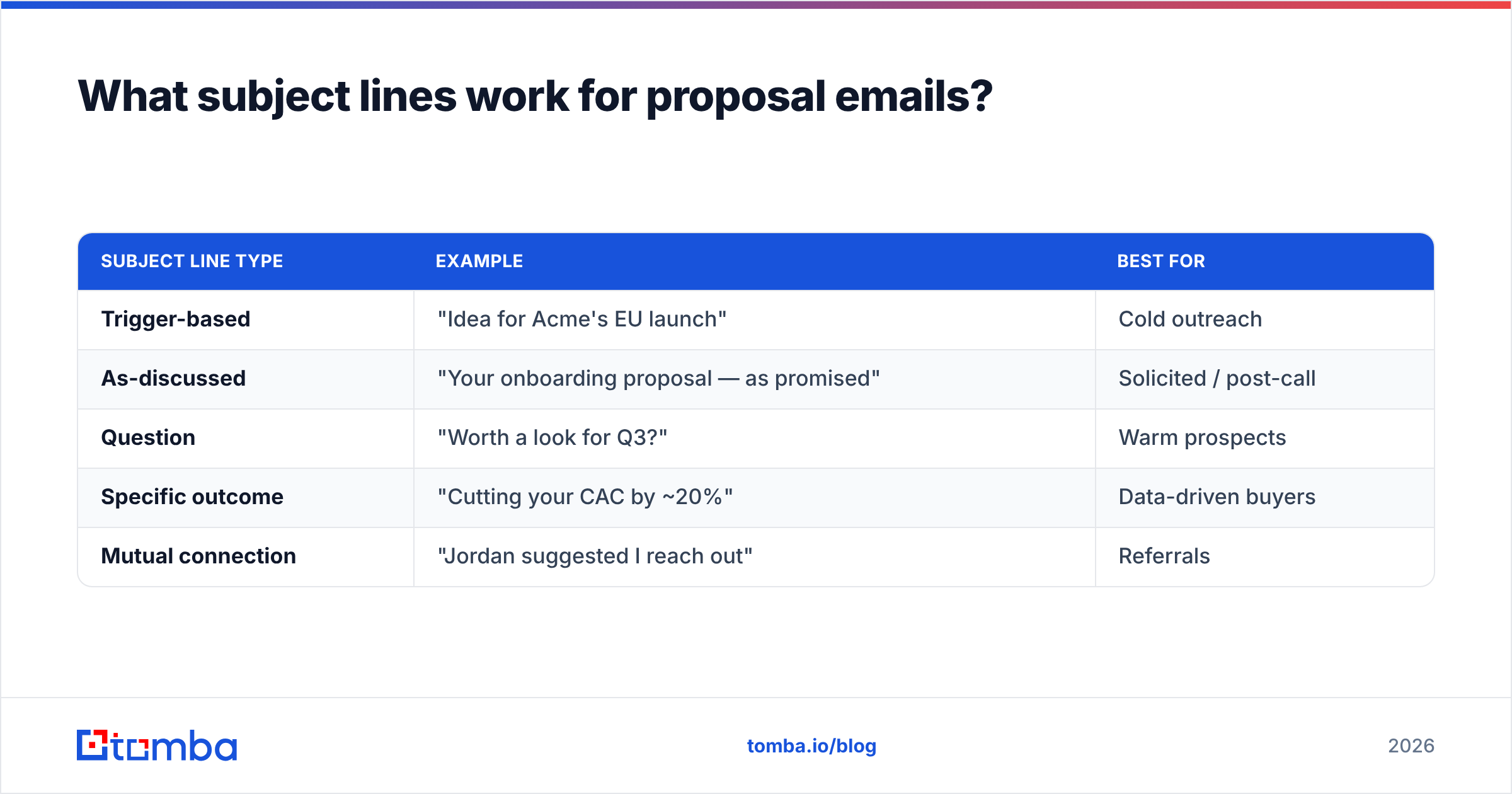
The subject line is a yes/no gate, not a summary. It should signal relevance or curiosity without sounding like a newsletter. Keep it under ~50 characters so it doesn't truncate on mobile.
| Subject line type | Example | Best for |
|---|---|---|
| Trigger-based | "Idea for Acme's EU launch" | Cold outreach |
| As-discussed | "Your onboarding proposal — as promised" | Solicited / post-call |
| Question | "Worth a look for Q3?" | Warm prospects |
| Specific outcome | "Cutting your CAC by ~20%" | Data-driven buyers |
| Mutual connection | "Jordan suggested I reach out" | Referrals |
Avoid all-caps, "RE:" fakery, and the word "proposal" in a cold subject — it signals a sales pitch before you've earned the open. Save "proposal" for solicited emails where it's genuinely expected. If you want to pressure-test variants before sending, a free subject line tester will flag spam triggers and length problems in seconds.
How many times should you follow up?#
Follow up three to four times over roughly two weeks, then stop or move to a long-term nurture. A large share of positive replies arrive on the second or third touch — people are busy, your first email got buried, and a polite nudge often surfaces it at a better moment.
A cadence that works without being annoying:
- Day 0 — the proposal email.
- Day 3 — short bump: "Floating this back to the top of your inbox."
- Day 7 — add value, not pressure: share a relevant resource or a quick new angle.
- Day 12 — the "break-up" email: "Assuming the timing isn't right — should I close this out?"
Each follow-up should be shorter than the last and reply directly in the same thread so context stays attached. According to HubSpot's sales research, persistence across multiple touches consistently outperforms single-send outreach — most reps simply quit after one try.
The trap: chasing dead addresses. If your follow-ups are bouncing or hitting a catch-all that silently drops mail, you're burning days on contacts that were never reachable. Build your list from verified data first, then let the cadence do its work.
How do you find and verify the right recipient?#
A flawless proposal sent to the wrong person — or a bounced address — is wasted effort. Two things have to be true before you hit send: you're emailing the actual decision-maker, and that email address is valid.
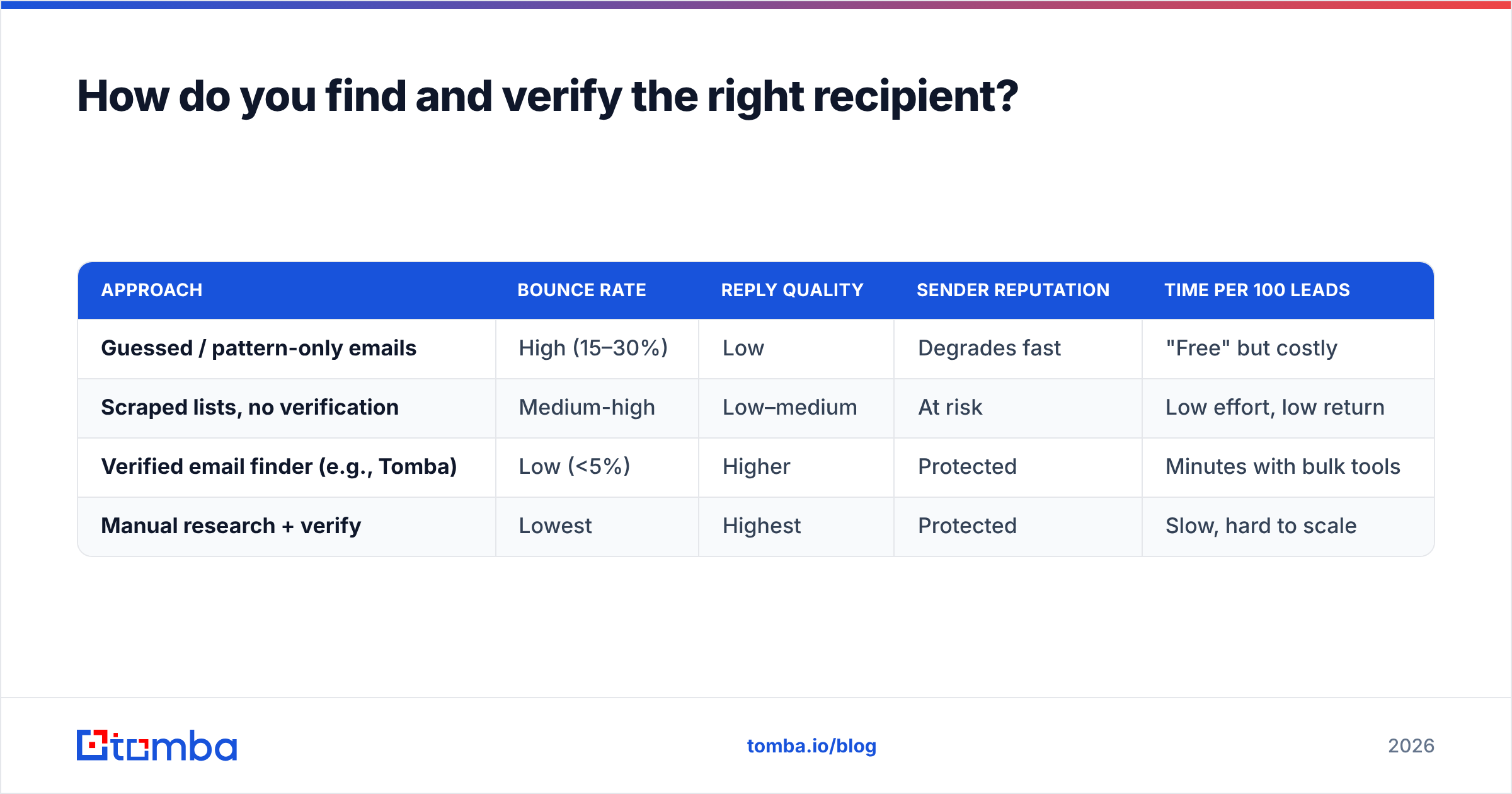
This is where your tooling matters more than your copy. A solid prospecting stack lets you find the right contact at a target company and confirm the address is deliverable in one motion. Here's how a data-quality-first approach compares to the spray-and-pray habit most teams fall into:
| Approach | Bounce rate | Reply quality | Sender reputation | Time per 100 leads |
|---|---|---|---|---|
| Guessed / pattern-only emails | High (15–30%) | Low | Degrades fast | "Free" but costly |
| Scraped lists, no verification | Medium-high | Low–medium | At risk | Low effort, low return |
| Verified email finder (e.g., Tomba) | Low (<5%) | Higher | Protected | Minutes with bulk tools |
| Manual research + verify | Lowest | Highest | Protected | Slow, hard to scale |
The sweet spot for most teams is a verified email finder paired with bulk verification — you get manual-research accuracy at scraped-list speed. Pull contacts by company with domain search, enrich them with role and seniority data so you're targeting the right title, and verify before the proposal ever leaves your outbox.
For pricing context, tools in this category range widely. Tomba's plans start with a free tier (25 searches/month), then Starter at $49/mo, Growth at $99/mo, and Pro at $249/mo — you can see the full breakdown on the Tomba pricing page. Compare that against per-seat platforms like those reviewed on G2 to find your fit.
What are the most common business proposal email mistakes?#
- Burying the ask. If the recipient can't find what you want in three seconds, you don't get it. One CTA, near the bottom, unmissable.
- Writing the proposal in the email. The email sells the click. The document does the detailed selling. A 600-word email is a wall, not a pitch.
- No personalization. "Hi there" and "your company" tell the reader this went to 5,000 people. It did, and they know.
- Attachment-only proposals with no link fallback. Some inboxes strip or quarantine attachments. Include a link as backup.
- Skipping verification. Every bounce chips away at your domain reputation and your sender score. Check addresses first — it's the cheapest insurance in outbound.
- Giving up after one send. The single biggest leak. The deal you wanted was often two follow-ups away.
Frequently asked questions#
How long should a business proposal email be? The email itself: 90–150 words. Long enough to frame value and prove relevance, short enough to read on a phone in one screen. The detailed proposal goes in the attachment or link.
Should I attach the proposal or link to it? Both, when possible. Lead with a link (it survives spam filters and lets you track opens) and attach a PDF as a fallback for recipients who prefer a file.
When is the best time to send a proposal email? Mid-morning on Tuesday through Thursday tends to perform well for B2B, but the trigger event matters more than the clock. Sending right after a relevant company event beats any "optimal hour."
Do I need email verification for a warm, solicited proposal? Yes. Even contacts you spoke with can have typo'd or outdated addresses. A two-second verification check prevents an embarrassing bounce on a deal you've already half-won.
Send proposals that actually land#
The fastest way to lift your proposal reply rate isn't a cleverer subject line — it's making sure every email reaches a real person who's the right buyer. Start with the Tomba Email Finder to find and verify decision-maker addresses by name, company, or domain, then layer in the structure and follow-up cadence above. Clean data plus tight copy is the combination that turns proposals into signed deals. Spin up the free tier, build your first verified list, and send your next proposal with confidence that it'll actually arrive.
// get started
Find, verify and enrich your first contacts today
Start on the free plan with 25 searches a month, then scale when your team is ready.
Free plan · No credit card required · GDPR & CCPA
// about the author