How to Build a Business to Business List That Converts in 2026
A clean business to business list is the difference between a pipeline and a spam folder. Here's how to source, verify, and enrich one in 2026 — without burning your domain.
A business to business list is only as good as the data inside it. You can have 50,000 rows and still book zero meetings if half the emails bounce and the other half target the wrong buyer. This guide walks through how to build a list that actually converts in 2026 — where to source contacts, how to verify them, and how to enrich them so your reps spend time selling instead of cleaning spreadsheets.
TL;DR#
- A business to business list is a structured set of company and contact records (name, role, email, phone, firmographics) used to drive outbound sales and marketing.
- Bought lists decay fast — B2B data goes stale at roughly 22-30% per year as people change jobs. Build and refresh, don't just buy and blast.
- Verification is non-negotiable. Sending to unverified addresses tanks your deliverability and sender reputation within days.
- Enrichment turns a name into a target. Job title, company size, tech stack, and intent signals decide whether a contact is worth your rep's time.
- Tools like Tomba Email Finder plus a verification and enrichment layer let you build a clean list from scratch instead of renting a dirty one.
What is a business to business list?#
A business to business list (B2B list) is a database of decision-makers and the companies they work for, assembled so a sales or marketing team can reach them directly. Think of it like a guest list for a private event: a good one has the right people, correct contact details, and enough context to greet each guest properly. A bad one is a stack of outdated business cards you found in a drawer.
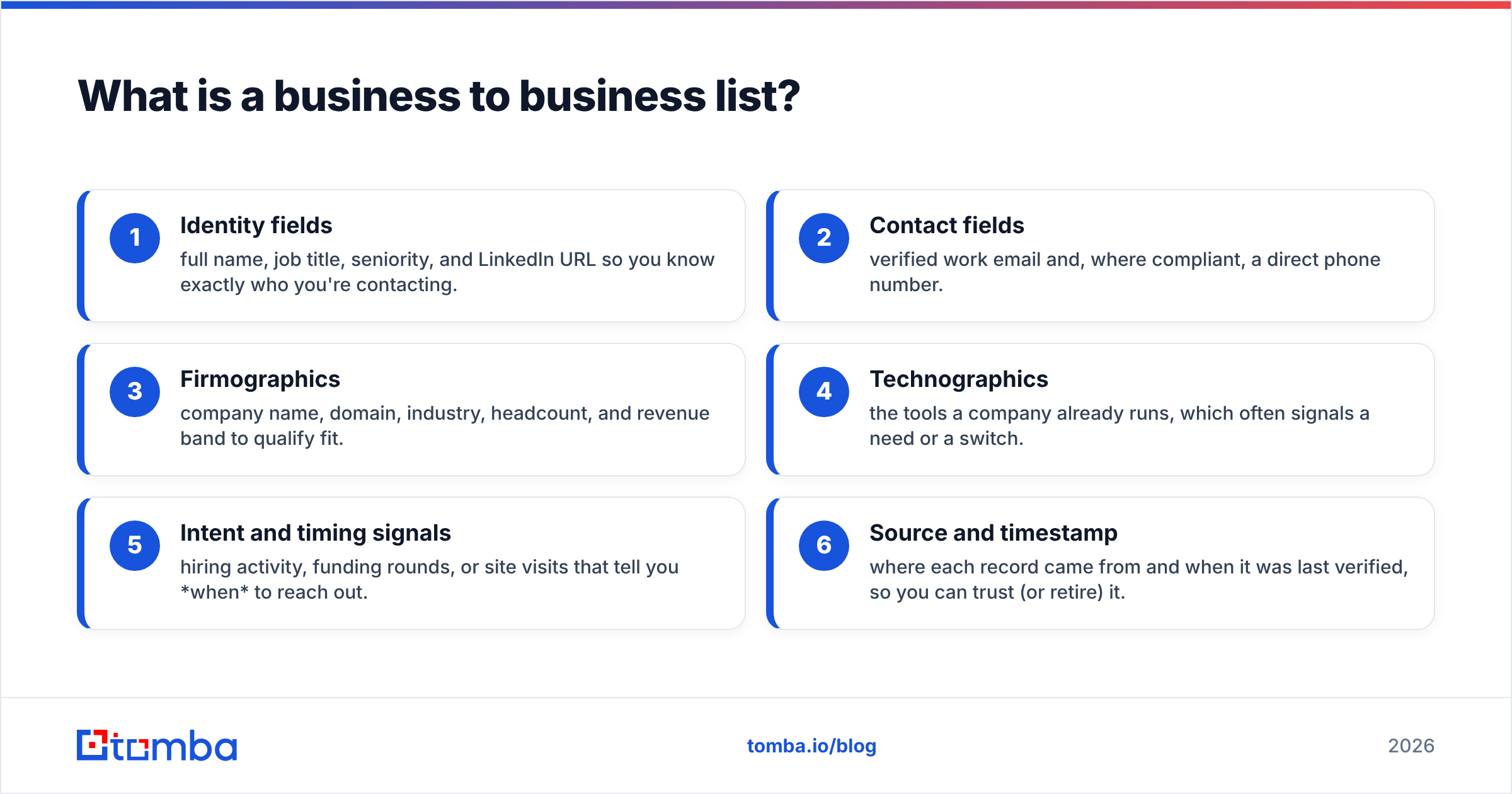
A usable B2B list usually contains:
- Identity fields — full name, job title, seniority, and LinkedIn URL so you know exactly who you're contacting.
- Contact fields — verified work email and, where compliant, a direct phone number.
- Firmographics — company name, domain, industry, headcount, and revenue band to qualify fit.
- Technographics — the tools a company already runs, which often signals a need or a switch.
- Intent and timing signals — hiring activity, funding rounds, or site visits that tell you when to reach out.
- Source and timestamp — where each record came from and when it was last verified, so you can trust (or retire) it.
The first two categories get you in the door. The last four decide whether you're knocking on the right door at the right time.

Why do most business to business lists fail?#
Most lists fail for one boring reason: the data is wrong, and nobody checks. B2B contact data decays continuously because people get promoted, switch companies, and abandon old inboxes. Industry estimates from vendors like HubSpot put B2B database decay around 22-30% per year — meaning a list you bought in January is meaningfully wrong by summer.
Here's what that decay actually costs you:
- Hard bounces wreck deliverability. Mailbox providers read a high bounce rate as a spam signal. A few bad sends and your good emails start landing in spam too. This is why email deliverability lives or dies on list hygiene.
- Spam traps blacklist your domain. Purchased lists frequently contain recycled spam-trap addresses. Hit one and you can land on a blocklist that takes weeks to escape.
- Wrong-target outreach burns trust. Emailing a junior engineer about an enterprise procurement decision doesn't just fail — it trains that whole company to ignore your domain.
Buying a giant pre-made list feels efficient. In practice you're renting someone else's decay and paying for it with your sender reputation.
Should you buy a business to business list or build one?#
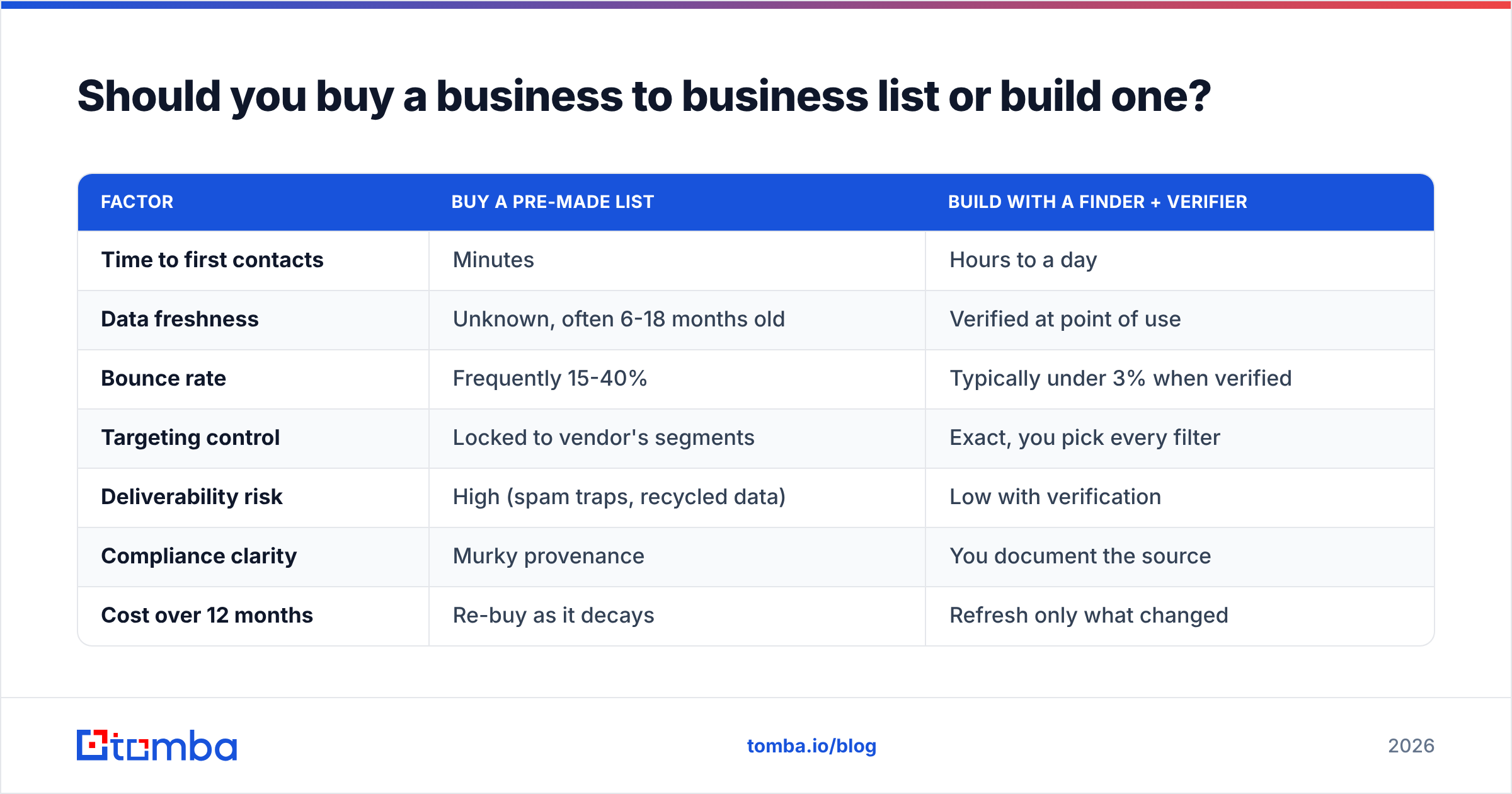
Build it. Buying is faster on day one and slower every day after. A built list — sourced from current public data, verified at the moment of use, and enriched for fit — stays accurate because you control the refresh cycle. Below is the honest tradeoff.
| Factor | Buy a pre-made list | Build with a finder + verifier |
|---|---|---|
| Time to first contacts | Minutes | Hours to a day |
| Data freshness | Unknown, often 6-18 months old | Verified at point of use |
| Bounce rate | Frequently 15-40% | Typically under 3% when verified |
| Targeting control | Locked to vendor's segments | Exact, you pick every filter |
| Deliverability risk | High (spam traps, recycled data) | Low with verification |
| Compliance clarity | Murky provenance | You document the source |
| Cost over 12 months | Re-buy as it decays | Refresh only what changed |
| Who owns the data | Shared with every other buyer | Built for you, not resold |
The pattern that wins in 2026: build a smaller, cleaner list and refresh it on a schedule rather than buying a bloated one and watching it rot. A 2,000-row list at 98% accuracy outperforms a 50,000-row list at 60% accuracy on every metric that matters — reply rate, meetings booked, and domain health.
How do you build a business to business list step by step?#
You build a B2B list in four stages: define, source, verify, enrich. Skip any one and the whole thing leaks.
1. Define your ICP before you pull a single contact#
Your ideal customer profile (ICP) is the filter that keeps your list small and sharp. Write down the firmographics (industry, headcount, region, revenue) and the buying roles (titles, seniority, department) you actually close. Everything downstream inherits from this. A vague ICP produces a vague list, which produces vague results.
2. Source contacts from current, legitimate data#
Once you know who you want, find them. The reliable sources in 2026:
- Company domains — run a domain search to pull every public professional email pattern at a target company, then filter to your buying roles.
- Named prospects — when you already have a name and company, an email finder resolves the most likely work address with a confidence score.
- LinkedIn and account lists — map accounts you're targeting to real contacts and their verified emails.
- Inbound and CRM — enrich the leads already raising their hands before you chase cold ones.
Avoid scraping random web dumps or buying a "100M contacts" CSV. Provenance matters for both compliance and quality.

3. Verify every address before it touches a sequence#
Verification is the step that protects your domain. An email verifier checks syntax, domain records, and mailbox existence so you remove invalid addresses before you send. For high-volume builds, run the whole file through a bulk verify pass and drop anything that comes back invalid or risky. Catch-all domains deserve special handling — a catch-all verifier tells you which accept-everything domains are actually safe to mail.
4. Enrich so every row is a qualified target#
A verified email gets you delivered; enrichment gets you relevant. Use data enrichment to append job title, company size, tech stack, and recent signals to each contact. Now your reps can prioritize the 200 best-fit accounts instead of dialing through 2,000 unknowns. Enrichment is what turns a contact list into a prospecting list.
What makes a high-quality B2B list in 2026?#
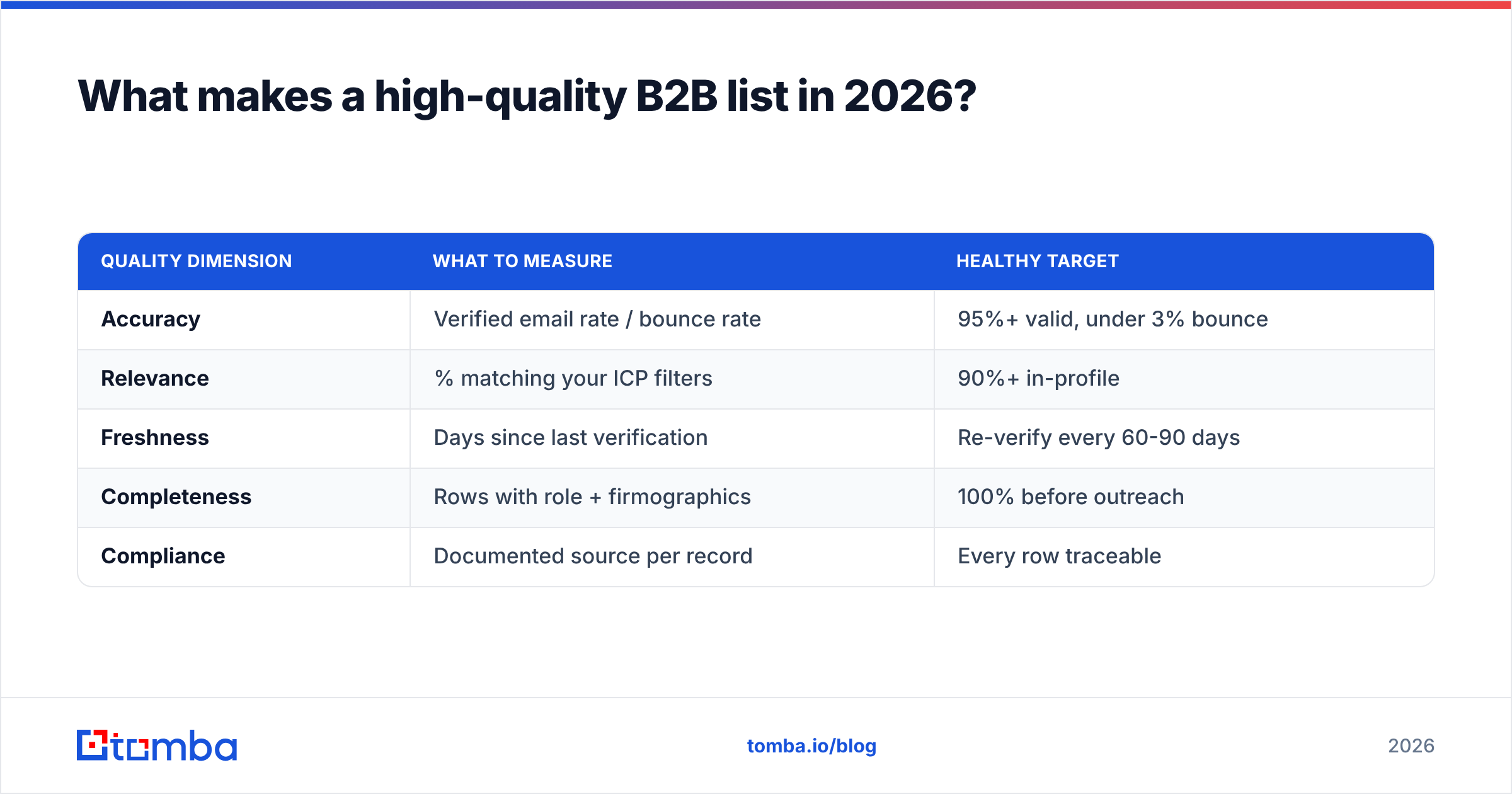
Quality comes down to three measurable things: accuracy, relevance, and freshness. Vendors love to brag about list size; buyers who've been burned care about these instead.
| Quality dimension | What to measure | Healthy target |
|---|---|---|
| Accuracy | Verified email rate / bounce rate | 95%+ valid, under 3% bounce |
| Relevance | % matching your ICP filters | 90%+ in-profile |
| Freshness | Days since last verification | Re-verify every 60-90 days |
| Completeness | Rows with role + firmographics | 100% before outreach |
| Compliance | Documented source per record | Every row traceable |
If you can't report these numbers about your own list, you don't have a list — you have a liability. Treating accuracy as a metric you track (not a promise you assume) is the single biggest mindset shift between teams that scale outbound and teams that get blocklisted.
How do you keep a business to business list clean over time?#
Treat your list like fresh produce, not canned goods — it has a shelf life and needs rotation. Three habits keep it healthy:
- Re-verify on a cadence. Run the active portion of your list back through verification every 60-90 days. People move; their old inboxes become traps. Tools like ZeroBounce and Tomba's verifier exist precisely for this recurring scrub.
- Suppress and segment. Maintain a suppression list of bounced, unsubscribed, and do-not-contact records so they never sneak back into a new pull. Segment the rest by ICP tier so your best contacts get your best sequences.
- Enrich on a trigger, not just once. When a contact changes jobs or their company raises funding, that's a buying signal and a data-refresh event. Re-enrich so the record reflects today, not last year.
Independent review sites like G2 are useful for sanity-checking which verification and enrichment vendors actually deliver the accuracy they advertise — read the negative reviews, not just the badges.
How much should a business to business list cost?#
You should pay for quality and freshness, not for raw row count. The cheapest "list" is usually the most expensive once you factor in bounced sends, a damaged domain, and rep hours wasted on bad data. The smarter spend is a finder-plus-verifier subscription you control, billed by usage rather than by a one-time dump.
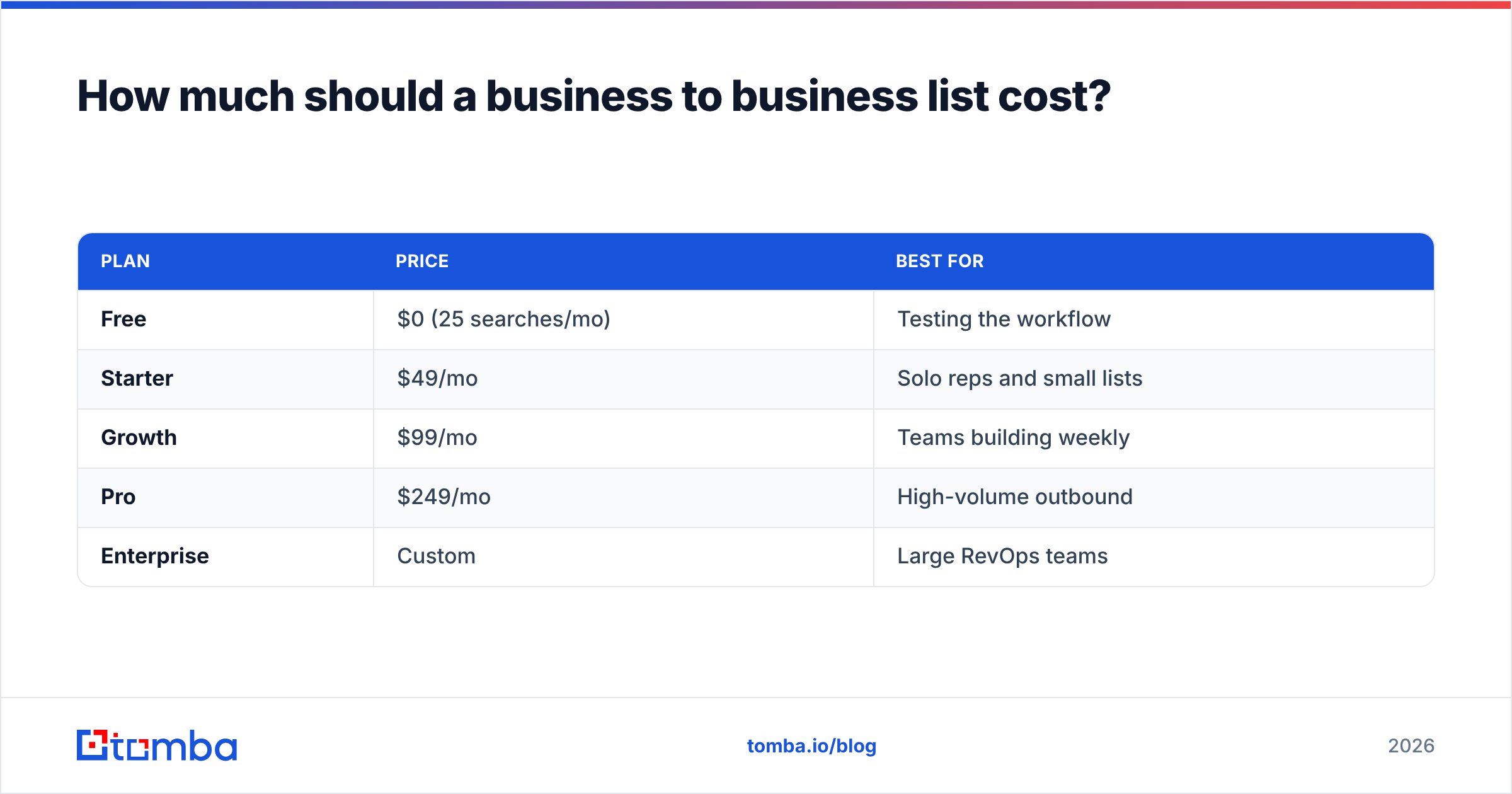
Here's how Tomba's pricing maps to list-building volume:
| Plan | Price | Best for |
|---|---|---|
| Free | $0 (25 searches/mo) | Testing the workflow |
| Starter | $49/mo | Solo reps and small lists |
| Growth | $99/mo | Teams building weekly |
| Pro | $249/mo | High-volume outbound |
| Enterprise | Custom | Large RevOps teams |
Full breakdowns are on the Tomba pricing page. The key idea: a subscription that lets you build and re-verify continuously beats a one-off purchase that's decaying the moment it lands in your inbox.
Frequently asked questions#
Is buying a business to business list legal? Buying contact data isn't automatically illegal, but how you use it is regulated (GDPR, CAN-SPAM, CASL). Lists with unclear provenance create compliance risk and usually have terrible deliverability. Building from documented public sources is both safer and cleaner.
How many contacts should a B2B list have? Fewer than you think. A tightly targeted 1,000-2,000 contact list that matches your ICP will outperform a 50,000-row generic list on reply rate and meetings booked. Optimize for fit and accuracy, not volume.
What's the difference between a B2B list and a CRM? A list is the raw, refreshable contact data; your CRM is where qualified contacts live once they enter your pipeline. The list feeds the CRM — it isn't a replacement for it.
How often should I re-verify my list? Every 60-90 days for actively-mailed segments. Given 22-30% annual decay, quarterly verification is the floor, not the ceiling.
Build a list you can trust#
A great business to business list isn't bought — it's built, verified, and maintained. Start by defining a sharp ICP, then use Tomba Email Finder to source current, professional emails directly from company domains and named prospects. Layer verification and enrichment on top, set a 60-90 day refresh cadence, and you'll have a list that books meetings instead of bounces. Spin up the free tier with 25 searches, prove the workflow on one target account, and scale from there — your domain reputation will thank you.
// get started
Find, verify and enrich your first contacts today
Start on the free plan with 25 searches a month, then scale when your team is ready.
Free plan · No credit card required · GDPR & CCPA
// about the author