Business Voicemail Script Examples That Get Callbacks (2026)
Steal 12 proven business voicemail script examples for sales, support, and after-hours calls — plus the structure, timing, and follow-up that turn voicemails into callbacks.
Business Voicemail Script Examples That Get Callbacks
Most voicemails get deleted in the first three seconds. Not because the offer is bad, but because the rep rambled, buried the reason for calling, and never gave a clear next step. A tight script fixes all three at once.
TL;DR
- A good business voicemail is 20–30 seconds, names a specific reason for calling, and ends with one clear next step.
- The same skeleton — hook, reason, value, next step — works for sales, support, after-hours, and follow-up calls.
- Pair every voicemail with an email and a second touch; voicemails rarely convert alone.
- Personalization beats polish: a relevant first line lifts callbacks more than a smooth voice.
- Use accurate contact data so you reach the right person on the first attempt instead of leaving messages in the void.
What makes a business voicemail script actually work?#
Conclusion first: a voicemail works when the listener knows who you are, why you called, and what to do next — before they decide to delete it. Everything else is decoration.
Think of a voicemail like a movie trailer. You are not telling the whole story. You are giving just enough that the person wants to call back to see the rest. A trailer that explains the entire plot kills curiosity; so does a voicemail that pitches your full feature list.
Three rules separate voicemails that get returned from voicemails that get skipped:
- Lead with relevance, not your résumé. "I saw your team just opened a second location" beats "I'm a senior account executive at..."
- State one reason, not five. Multiple asks create decision paralysis. Pick the single most compelling one.
- Make the next step frictionless. "I'll text you the details" is easier to accept than "call me back at this 11-digit number."
Keep it between 20 and 30 seconds. Past 30 seconds, callback rates fall off a cliff because the listener has already decided you are not worth the time.

What is the basic structure every voicemail script should follow?#
Every script below is built on the same four-part skeleton. Memorize the skeleton and you can improvise any voicemail without sounding scripted.
- Hook (3–5 sec): Your name, company, and a personalized reason you are calling them specifically.
- Reason (5–8 sec): The single problem you solve or the trigger event that prompted the call.
- Value (5–8 sec): One concrete proof point — a result, a number, or a relevant peer.
- Next step (5–8 sec): A clear, low-friction call to action plus your number, said slowly, twice.
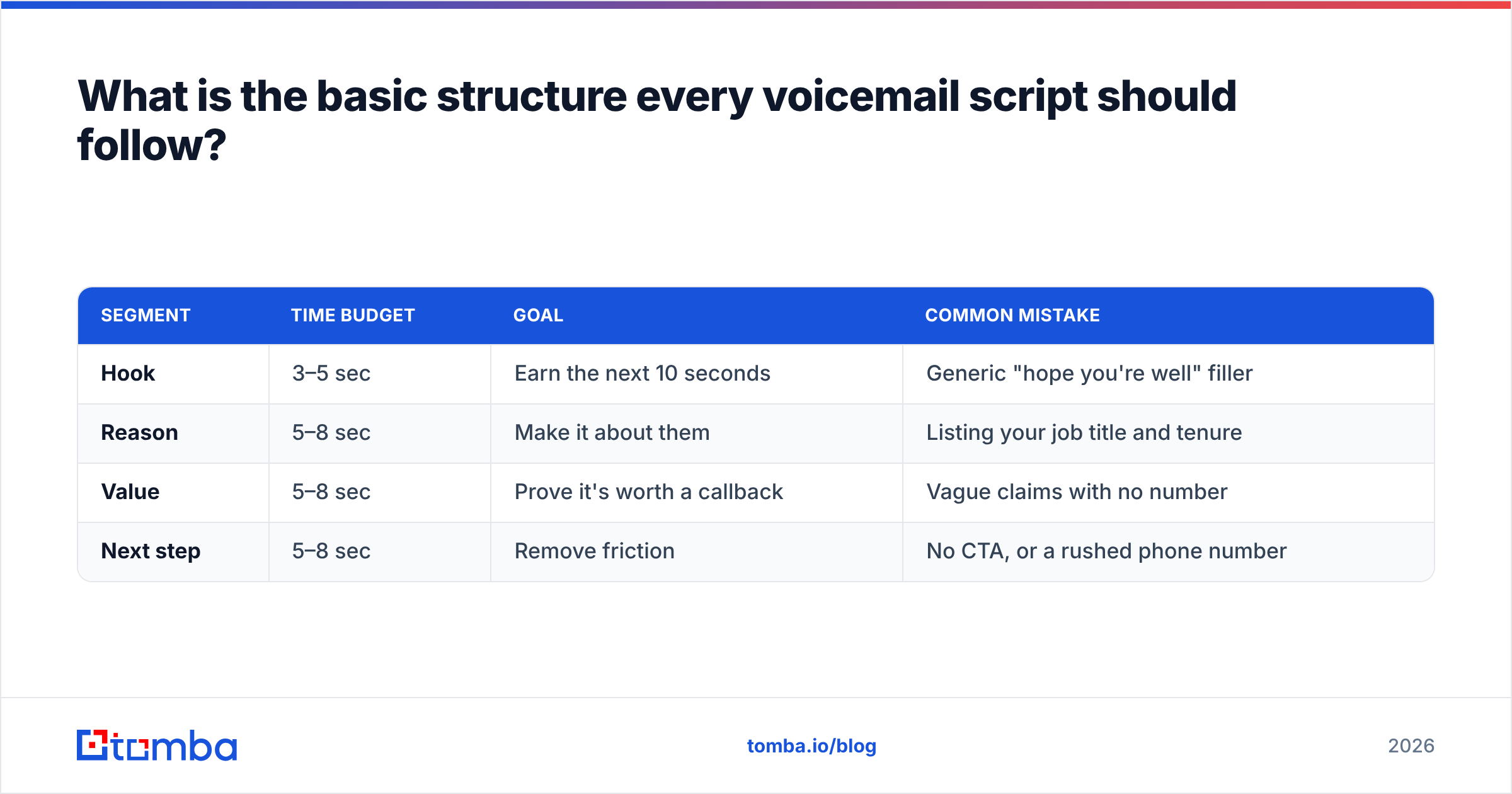
Here is how the skeleton maps to time and intent:
| Segment | Time budget | Goal | Common mistake |
|---|---|---|---|
| Hook | 3–5 sec | Earn the next 10 seconds | Generic "hope you're well" filler |
| Reason | 5–8 sec | Make it about them | Listing your job title and tenure |
| Value | 5–8 sec | Prove it's worth a callback | Vague claims with no number |
| Next step | 5–8 sec | Remove friction | No CTA, or a rushed phone number |
Say your phone number at the very end, slowly, and repeat it. People reach for a pen after they hear the value — not before.
What are the best sales voicemail script examples?#
These are copy-and-adapt templates. Swap the brackets for real details before you dial.
1. The trigger-event opener
"Hi [Name], it's [Your Name] at [Company]. I noticed [trigger event — you're hiring three SDRs / you just raised a Series A]. We help teams in that exact moment [specific outcome]. I have one idea worth 90 seconds — I'll send a short email too. You can reach me at [number]. Again, [number]. Thanks, [Name]."
2. The referred-by
"Hi [Name], [Mutual Contact] suggested I reach out. They mentioned you're tackling [problem]. We helped them [specific result], and I think the same approach fits your team. I'll follow up by email — or call me at [number]. That's [number]."
3. The break-up voicemail
"Hi [Name], it's [Your Name] at [Company]. I've left a couple of messages, so I won't keep calling. If [problem] isn't a priority right now, no worries at all — I'll close your file. If it is, my number's [number]. Either way, I'll send one last email. Thanks, [Name]."
4. The 10-second curiosity hook
"Hi [Name], [Your Name] at [Company]. Quick one — we just helped [peer company] cut [metric] by [number]%. Worth a look for [their company]? Number's [number]."
The break-up voicemail consistently outperforms the polished pitch because it triggers loss aversion. People respond to "I'm closing your file" more than to "I'd love to connect."
What about support, after-hours, and reception voicemail scripts?#
Not every voicemail is outbound sales. The same clarity rules apply to the greetings callers hear from you.
5. After-hours business greeting
"Thanks for calling [Company]. Our office hours are [days, times]. Leave your name, number, and a quick note, and we'll call you back within one business day. For faster help, visit [website]."
6. Customer support callback
"Hi [Name], this is [Your Name] from [Company] support, returning your call about [issue]. I've already looked into it and have a fix. Call me back at [direct line], or reply to my email and I'll handle it from there."
7. Professional out-of-office
"You've reached [Your Name] at [Company]. I'm out until [date] with limited access to messages. For anything urgent, contact [colleague] at [number or email]. Otherwise, I'll respond when I'm back."
8. Reception / main line
"Thank you for calling [Company]. All lines are busy. Leave your name, number, and reason for calling, and the right person will get back to you shortly. You can also reach us at [website]."
For support and after-hours messages, the single most important detail is the response-time promise. "We'll call you back within one business day" sets an expectation and dramatically reduces repeat calls.
How do sales and customer-care voicemails differ?#
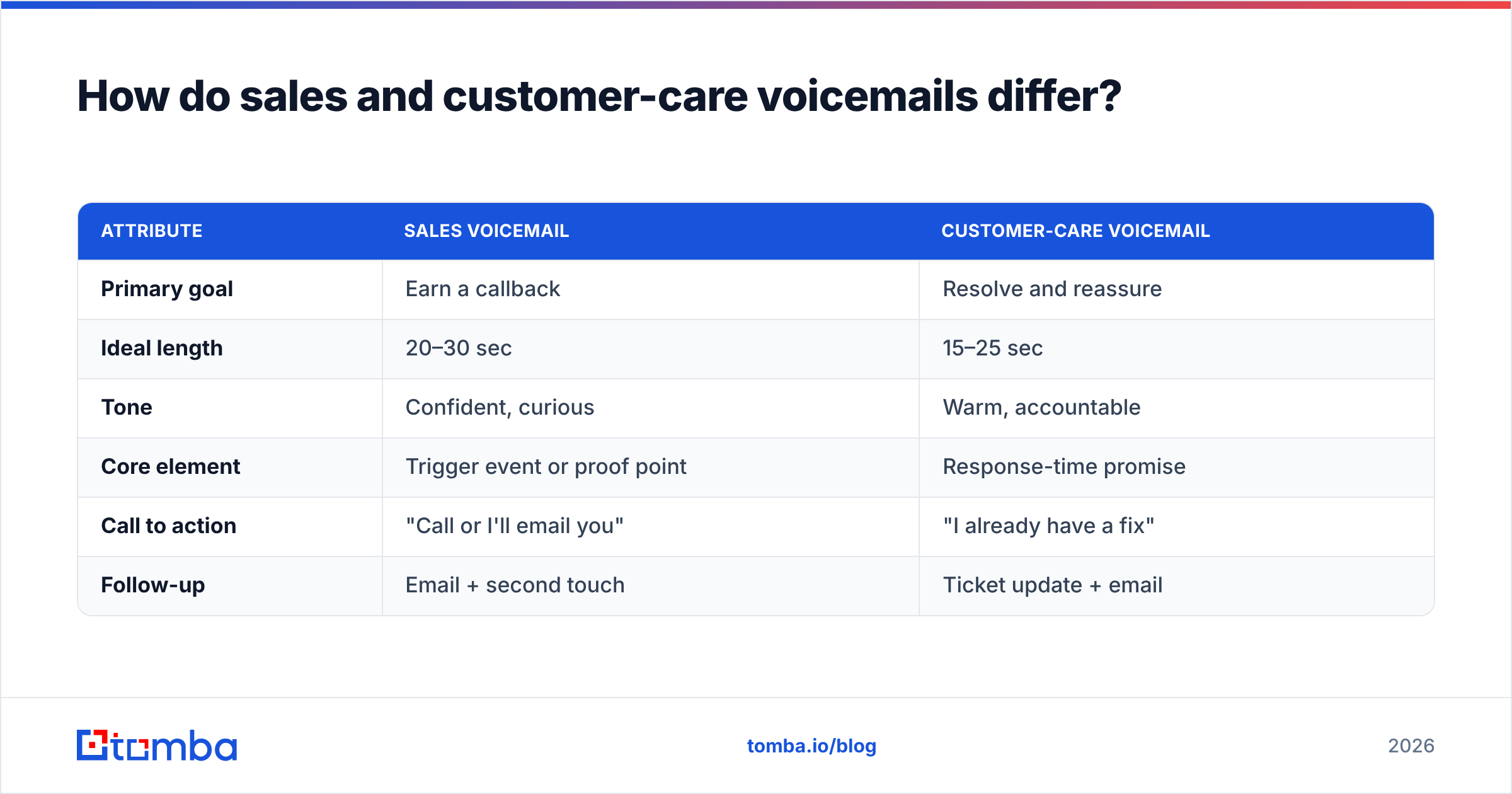
They share the skeleton but optimize for different outcomes. Use this comparison to set the right tone before you record.
| Attribute | Sales voicemail | Customer-care voicemail |
|---|---|---|
| Primary goal | Earn a callback | Resolve and reassure |
| Ideal length | 20–30 sec | 15–25 sec |
| Tone | Confident, curious | Warm, accountable |
| Core element | Trigger event or proof point | Response-time promise |
| Call to action | "Call or I'll email you" | "I already have a fix" |
| Follow-up | Email + second touch | Ticket update + email |
The takeaway: sales voicemails sell the callback, not the product. Care voicemails sell resolution. Mixing the two — pitching an upsell during a support callback — is the fastest way to erode trust.
How long should a business voicemail be?#
Twenty to thirty seconds. That is the conclusion; here is the reasoning.
Voicemail transcription on most phones shows the first line or two as a preview. If your reason for calling is not in those first lines, the listener deletes without playing the audio. So front-load the value, and keep the whole thing short enough that pressing "call back" feels cheaper than pressing "delete."
A practical pacing guide:
- 0–5 sec: Name, company, personalized hook.
- 5–18 sec: Reason plus one proof point.
- 18–30 sec: Clear next step and your number, repeated.
If you cannot say it in 30 seconds, your message is not focused enough yet. Trim until every word earns its place.
How do you boost callback rates after leaving a voicemail?#
A voicemail almost never works alone. Treat it as one touch in a sequence, not a one-shot.
The highest-performing teams pair every voicemail with a same-day email referencing the call ("Just left you a quick voicemail — here's the one idea in writing"). That combination roughly doubles response versus voicemail alone, because some people prefer to reply in writing and never call back by phone.
To run that sequence at scale, you need two things: a reliable phone number and a reliable email address for the same person. That is a data problem before it is a script problem. If you are dialing wrong numbers or guessing at email addresses, the best script in the world reaches no one.
This is where your prospecting stack matters. Use a phone finder to surface verified direct lines instead of switchboards, and pair it with an email finder so your follow-up email lands in the right inbox. Run both through an email verifier before you send to protect your sender reputation. For a full sequence framework, study how teams structure LinkedIn outreach alongside calls.

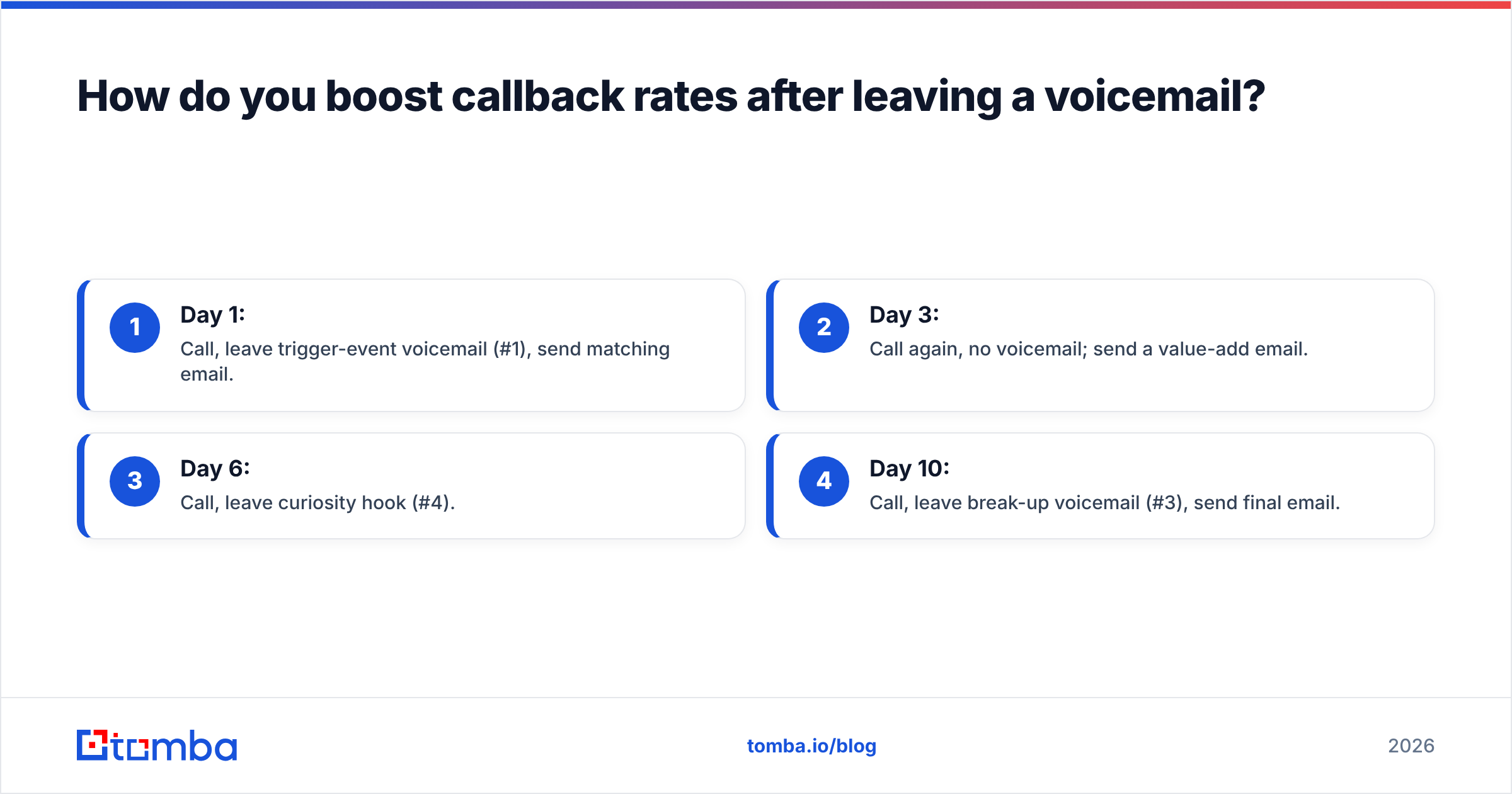
A simple multi-touch cadence that uses these scripts well:
- Day 1: Call, leave trigger-event voicemail (#1), send matching email.
- Day 3: Call again, no voicemail; send a value-add email.
- Day 6: Call, leave curiosity hook (#4).
- Day 10: Call, leave break-up voicemail (#3), send final email.
Track which voicemail variant earns the most callbacks and double down on it. Treat your scripts like ad copy — they are testable, and small wording changes move the numbers.
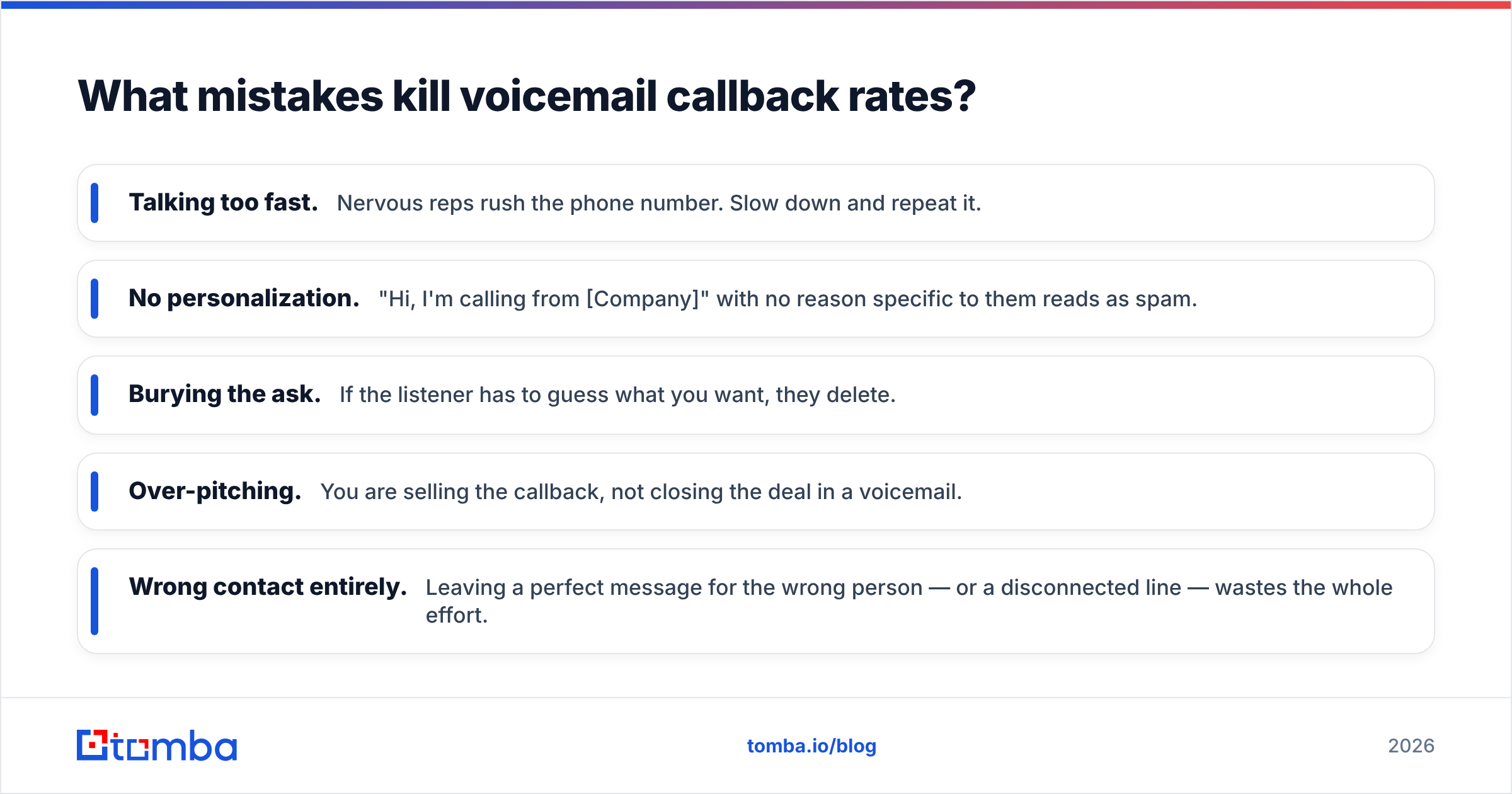
What mistakes kill voicemail callback rates?#
Avoid these and you will already beat most reps:
- Talking too fast. Nervous reps rush the phone number. Slow down and repeat it.
- No personalization. "Hi, I'm calling from [Company]" with no reason specific to them reads as spam.
- Burying the ask. If the listener has to guess what you want, they delete.
- Over-pitching. You are selling the callback, not closing the deal in a voicemail.
- Wrong contact entirely. Leaving a perfect message for the wrong person — or a disconnected line — wastes the whole effort.
That last point is worth repeating: data quality is the silent killer of voicemail campaigns. According to research compiled by HubSpot, persistence and accurate targeting drive far more meetings than message polish alone. And industry reviews on G2 consistently rank contact-data accuracy as the top differentiator between prospecting tools.
Frequently asked questions#
Should you leave a voicemail on the first call? Yes, but make it a strong one. Many people screen unknown numbers, so your first voicemail is often your first real impression. Use the trigger-event opener.
Is it better to call or email? Do both. A voicemail plus a same-day email referencing it consistently outperforms either channel alone, because people reply on the channel they prefer.
How many times should you call before giving up? Three to five touches over about two weeks is a reasonable cadence for B2B. End with a break-up voicemail to trigger a final response.
Do voicemail scripts make you sound robotic? Only if you read them word for word. Memorize the four-part skeleton instead, and improvise the details. The structure keeps you tight; your own voice keeps you human.
Put these scripts to work#
The fastest way to lift callbacks is to combine a tight script with accurate contact data — because a perfect voicemail left for the wrong person still gets you nothing. Start by building a clean list of decision-makers and their direct details with Tomba Email Finder, verify everything before you dial or send, and layer these voicemail templates into a multi-touch cadence. Check the Tomba pricing plans — the free tier gives you 25 searches a month to test the workflow before you scale. Get the data right, keep the scripts tight, and your voicemails will start earning callbacks instead of deletions.
// get started
Find, verify and enrich your first contacts today
Start on the free plan with 25 searches a month, then scale when your team is ready.
Free plan · No credit card required · GDPR & CCPA
// about the author