Buy B2B Database in 2026: The Complete Buyer's Guide
Buying a B2B database can save months of manual prospecting — or burn your sender reputation. Here's how to vet vendors, pricing, and data freshness in 2026.
Buy B2B Database in 2026: The Complete Buyer's Guide
You can buy a B2B database in an afternoon. Whether it's worth the money is a different question — and the answer depends almost entirely on how the data was sourced, how fresh it is, and whether you can verify a single record before you hit send.
This guide breaks down what "buying a B2B database" actually means in 2026, the trade-offs between static lists and on-demand data, and a concrete checklist for vetting any vendor before you pay.
TL;DR#
- Buying a static CSV is the riskiest option. B2B data decays roughly 2–3% per month, so a list sold to 50 other buyers is often half-dead on arrival.
- On-demand access (API or app credits) beats bulk file purchases for accuracy, compliance, and cost control.
- Always verify before you send. Even good data needs a fresh email verification pass to protect deliverability.
- Price per usable record matters more than price per record. A cheap list with 40% bounce risk is more expensive than premium data.
- Compliance is your liability, not the seller's. GDPR and CAN-SPAM obligations follow you, so demand documented sourcing.
What does it mean to "buy a B2B database"?#
"Buying a B2B database" covers three very different products that get marketed with the same words.
- A static list (CSV/Excel). You pay once, download a file of contacts, and own that snapshot. The moment you download it, it starts going stale.
- On-demand credits inside an app. You search and pull contacts as you need them — by company, domain, role, or location — so every record is generated fresh at query time.
- A live API or enrichment feed. Your CRM or workflow calls a provider in real time to find or enrich records, keeping data current automatically.
The distinction is the whole game. A snapshot from six months ago and a record pulled this morning can carry the same job title and email — except one person left the company in March. For most teams, on-demand access through a B2B database you query yourself is dramatically safer than a bulk file someone else assembled and resold.
Static list vs on-demand data: which should you buy?#
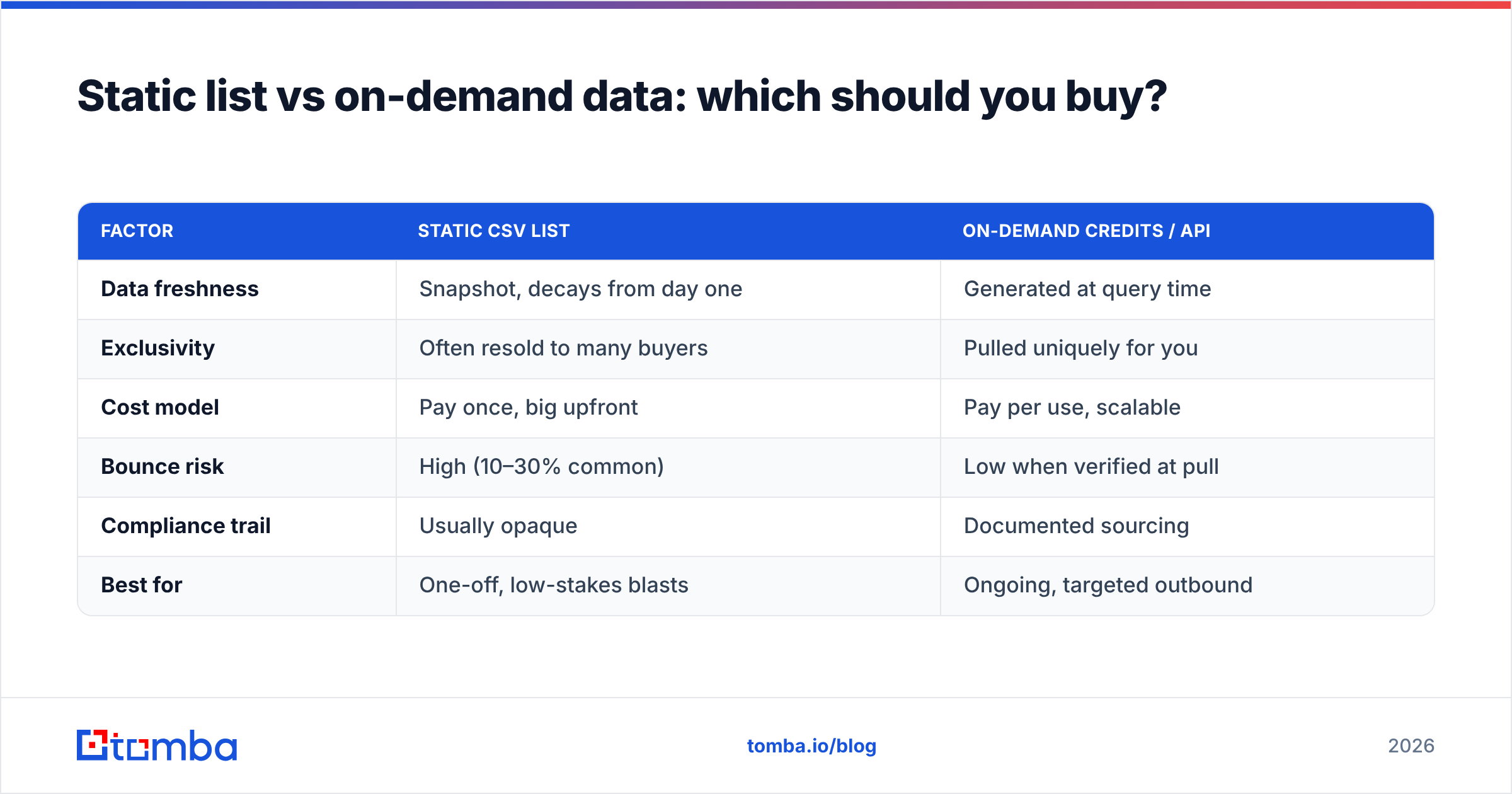
Here's the trade-off in plain terms. Static lists feel cheaper because the sticker price is lower and you "own" the file. On-demand data feels more expensive per month but costs less per usable contact because you never pay to store records that have already rotted.
| Factor | Static CSV list | On-demand credits / API |
|---|---|---|
| Data freshness | Snapshot, decays from day one | Generated at query time |
| Exclusivity | Often resold to many buyers | Pulled uniquely for you |
| Cost model | Pay once, big upfront | Pay per use, scalable |
| Bounce risk | High (10–30% common) | Low when verified at pull |
| Compliance trail | Usually opaque | Documented sourcing |
| Best for | One-off, low-stakes blasts | Ongoing, targeted outbound |
If you only remember one rule: the freshness of a record is worth more than the size of the list. A 5,000-contact file that's 70% accurate gives you 3,500 reachable people and a damaged domain. A 2,000-record on-demand pull at 95% accuracy gives you 1,900 reachable people and a clean sender reputation. The second list outperforms the first on every metric that drives revenue.
How do you judge B2B database quality before buying?#
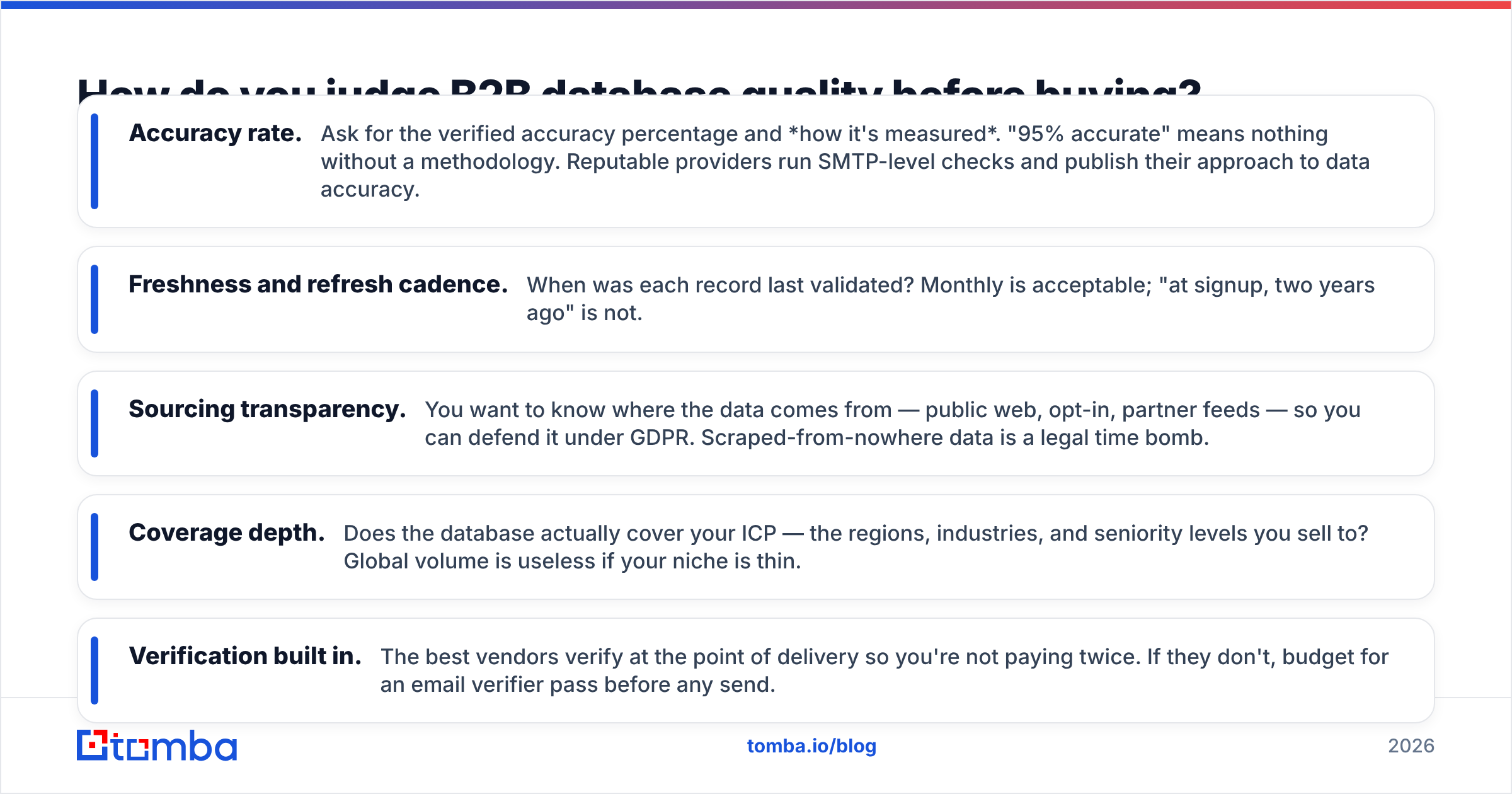
Five attributes separate data worth paying for from data that will quietly wreck your campaigns. Vet every vendor against all five.
- Accuracy rate. Ask for the verified accuracy percentage and how it's measured. "95% accurate" means nothing without a methodology. Reputable providers run SMTP-level checks and publish their approach to data accuracy.
- Freshness and refresh cadence. When was each record last validated? Monthly is acceptable; "at signup, two years ago" is not.
- Sourcing transparency. You want to know where the data comes from — public web, opt-in, partner feeds — so you can defend it under GDPR. Scraped-from-nowhere data is a legal time bomb.
- Coverage depth. Does the database actually cover your ICP — the regions, industries, and seniority levels you sell to? Global volume is useless if your niche is thin.
- Verification built in. The best vendors verify at the point of delivery so you're not paying twice. If they don't, budget for an email verifier pass before any send.
Run a free sample through these five filters first. Any serious provider will let you test 25–50 records before you commit a cent.
What does it cost to buy a B2B database in 2026?#
Pricing splits along the static-vs-on-demand line, and the headline numbers are misleading until you normalize them to cost per usable contact.
Bulk list brokers often quote $0.10–$0.50 per record, which looks cheap until you subtract a 25% bounce rate, dedupe against contacts you already have, and strip out records outside your ICP. Your real cost per usable contact can triple.
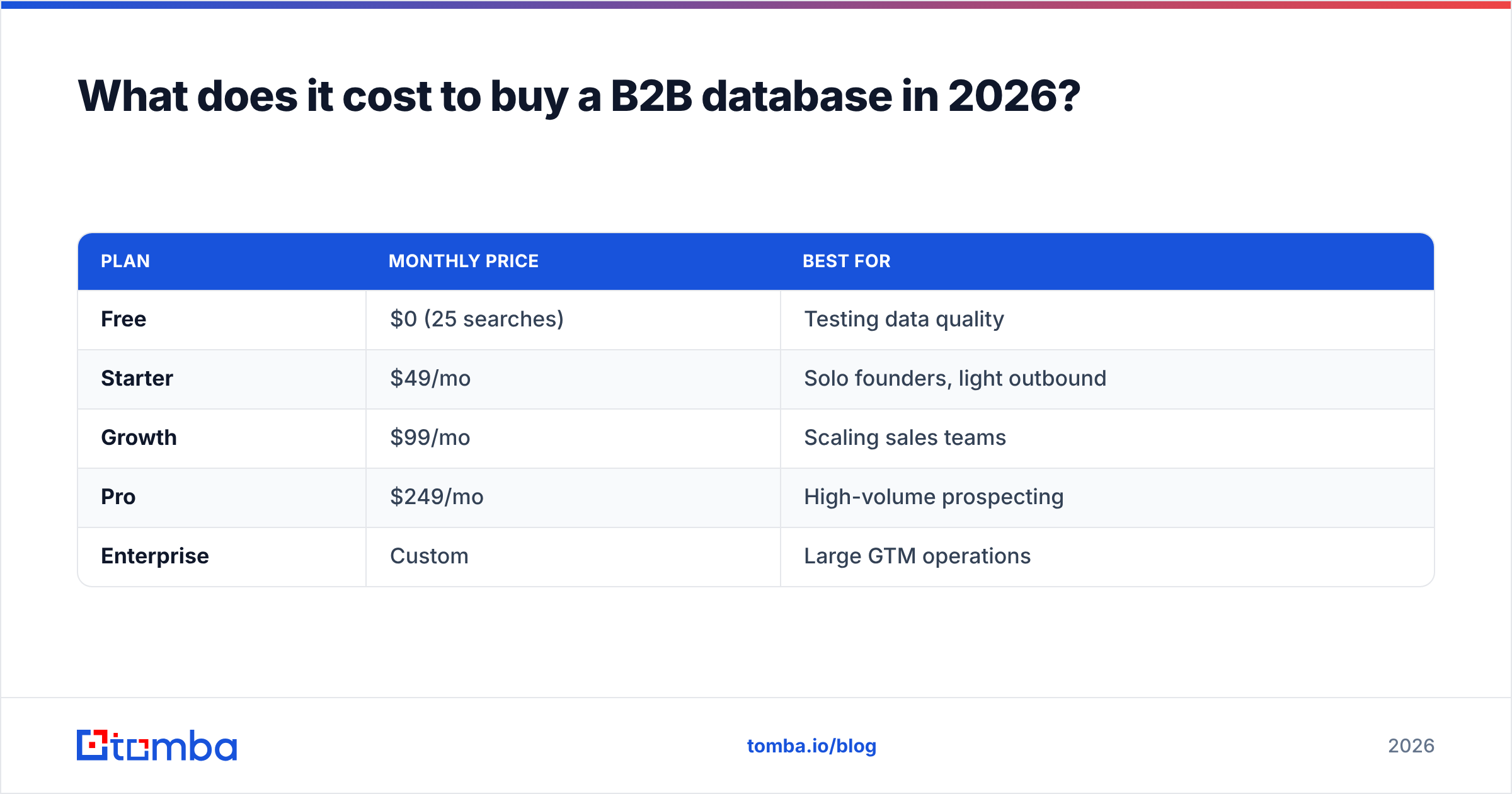
On-demand platforms price by monthly credits, which makes the math honest: you pay for what you pull, and verified records mean almost everything you pull is usable. For reference, here's how transparent, usage-based pricing typically tiers:
| Plan | Monthly price | Best for |
|---|---|---|
| Free | $0 (25 searches) | Testing data quality |
| Starter | $49/mo | Solo founders, light outbound |
| Growth | $99/mo | Scaling sales teams |
| Pro | $249/mo | High-volume prospecting |
| Enterprise | Custom | Large GTM operations |
You can see full Tomba pricing for credit allocations per tier. The point isn't the specific numbers — it's that a credit model lets you start at $49/mo, prove ROI on real campaigns, and scale up only when the pipeline justifies it. There's no five-figure upfront commitment to a file you can't return.
When you compare vendors, don't anchor on price per record. Anchor on price per record that actually converts into a reply. That single reframe will steer you away from cheap lists that cost you the most.
Is it legal to buy a B2B database?#
Buying B2B data is legal in most jurisdictions, but compliance obligations transfer to you the moment you use it — the seller's "it's compliant" assurance won't shield you in an audit.
Under GDPR, B2B outreach to business contacts can rely on legitimate interest, but you must be able to show lawful sourcing, honor opt-outs, and document your basis for processing. The UK ICO and EU regulators expect you to know your data's provenance. For US outreach, CAN-SPAM governs email content and opt-out mechanics rather than consent, but it still carries per-message penalties for violations.
Practical protection: keep records of where every contact came from, suppress anyone who unsubscribes across all campaigns, and prefer vendors who can produce a sourcing trail on request. Gartner's research on data governance and analyst reviews on G2 are useful for sanity-checking a vendor's compliance posture before you sign. If a provider won't explain where their data comes from, treat that as a hard no.

How do you actually use the database after buying it?#
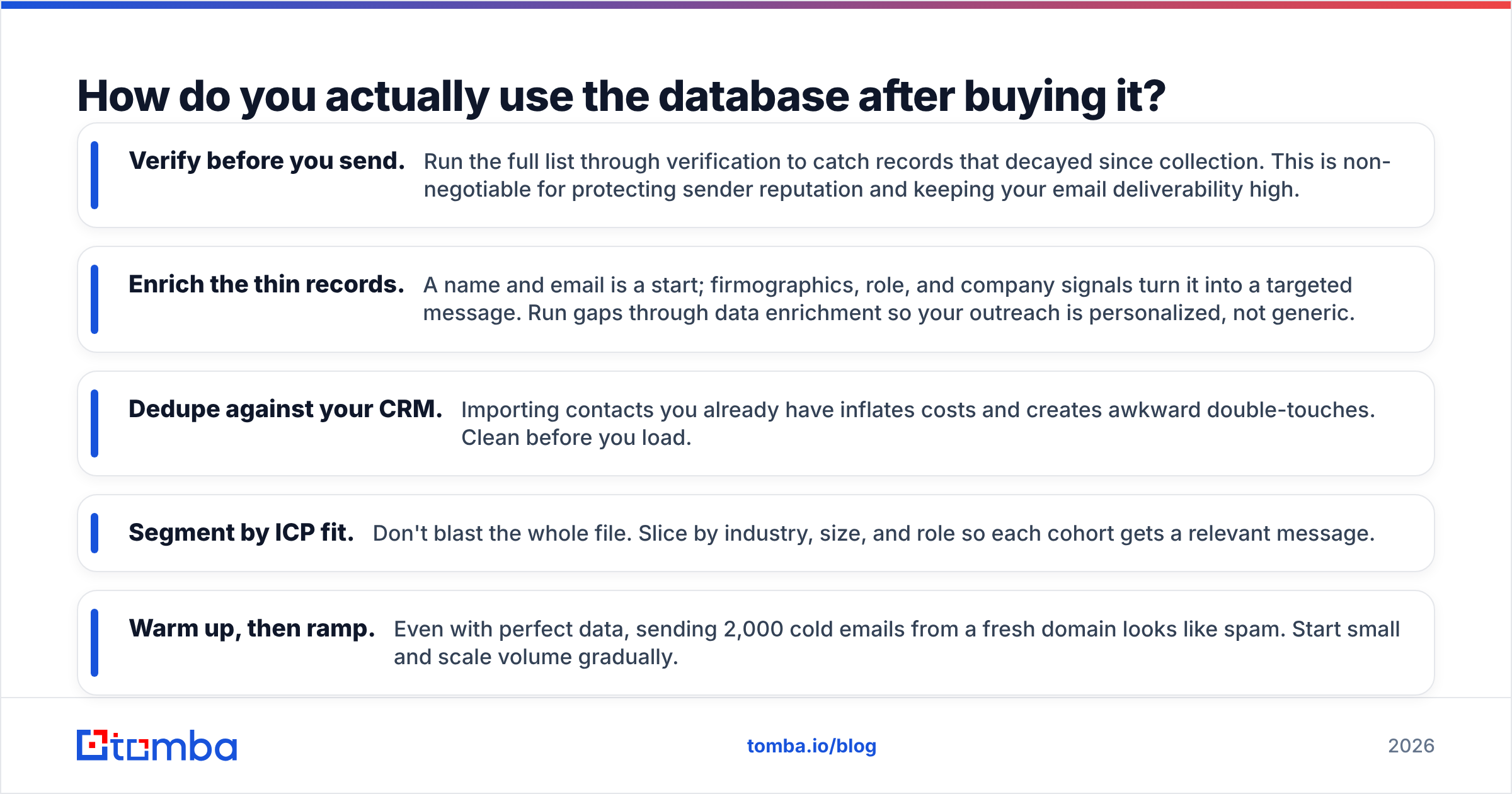
Buying data is step one. The teams that get ROI treat the purchase as the start of a process, not the finish line.
- Verify before you send. Run the full list through verification to catch records that decayed since collection. This is non-negotiable for protecting sender reputation and keeping your email deliverability high.
- Enrich the thin records. A name and email is a start; firmographics, role, and company signals turn it into a targeted message. Run gaps through data enrichment so your outreach is personalized, not generic.
- Dedupe against your CRM. Importing contacts you already have inflates costs and creates awkward double-touches. Clean before you load.
- Segment by ICP fit. Don't blast the whole file. Slice by industry, size, and role so each cohort gets a relevant message.
- Warm up, then ramp. Even with perfect data, sending 2,000 cold emails from a fresh domain looks like spam. Start small and scale volume gradually.
The pattern that wins: buy fresh, verify immediately, enrich the gaps, segment tightly, send gradually. Skip any of those and even premium data underperforms.
Buy a list, or build your own on-demand?#
For most teams in 2026, the smarter move is to stop buying lists and start generating them on demand. You get exclusivity (no one else bought the same file), freshness (records pulled today), and control (you target exactly your ICP instead of accepting whatever the broker bundled).
Here's the decision shortcut:
- Buy a static list only if you need a one-time, low-stakes campaign and you're willing to verify the entire file before sending.
- Use on-demand access if outbound is an ongoing motion, you care about deliverability, or compliance scrutiny is real for your market — which, in B2B, it almost always is.
Static lists made sense when data tools were clunky and APIs were rare. In 2026, on-demand platforms have made the bulk-broker model mostly obsolete for serious sellers. HubSpot's own sales benchmarks consistently show that targeting and personalization beat raw volume — and you can't personalize what you can't trust.
Vendor checklist: 7 questions before you pay#
Copy this and put it in front of any salesperson before you hand over a credit card:
- What's your verified accuracy rate, and how do you measure it?
- How often is each record re-validated?
- Where does the data come from, and can you document it for GDPR?
- Is verification included, or do I pay separately?
- Can I test 25–50 records free before committing?
- Is this list exclusive, or resold to other buyers?
- What's the real cost per usable contact in my ICP?
If a vendor dodges questions 1, 3, or 5, walk away. Those three are where bad data hides.
The bottom line#
Don't buy a stale snapshot — buy access to fresh, verifiable data you control. The cheapest list is almost never the cheapest outcome once bounces, compliance risk, and wasted rep effort are priced in. Vet accuracy, demand sourcing transparency, verify before every send, and treat per-usable-contact cost as your north star.
If you're ready to stop buying questionable CSVs and start pulling fresh, verified contacts on demand, try the Tomba Email Finder. Search by domain, name, or company, verify every result, and start free with 25 searches a month — no upfront list purchase, no resold data, no surprises in your bounce rate. Build the database you need, one accurate record at a time.
// get started
Find, verify and enrich your first contacts today
Start on the free plan with 25 searches a month, then scale when your team is ready.
Free plan · No credit card required · GDPR & CCPA
// about the author