Buy Data Lists in 2026: Smart Move or Money Pit?
Thinking of buying B2B data lists in 2026? Here's what purchased lists really cost you in deliverability, compliance, and wasted reps — and the build-on-demand alternative.
Buying a ready-made contact list looks like the fastest path to pipeline: pay once, download a spreadsheet, start emailing tomorrow. In practice, the decision to buy data lists is one of the most consequential — and most misunderstood — calls a B2B go-to-market team makes. Get it wrong and you torch your sender reputation, trip GDPR, and burn rep hours chasing people who left their job two years ago.
This post is a straight, vendor-neutral look at when buying lists makes sense, when it quietly costs you more than it saves, and what a "build the list on demand" workflow looks like instead.
TL;DR#
- Buying data lists is rarely cheaper than it looks. The sticker price ignores bounce-driven deliverability damage, wasted rep time, and compliance exposure.
- Static lists decay fast — roughly 22–30% of B2B contact data goes stale every year as people change jobs, titles, and email formats.
- Compliance risk is real. Purchased lists rarely carry the lawful basis or consent trail that GDPR, CAN-SPAM, and CASL expect.
- The modern alternative is build-on-demand: generate a fresh, verified list for each campaign using domain search and email verification instead of buying a frozen file.
- If you must buy, demand recency dates, verification proof, and a replacement guarantee for bounces — and verify everything again before you send.
What does it mean to buy data lists?#
To buy data lists means purchasing a pre-compiled file of contacts — names, emails, phone numbers, company details — from a broker or data vendor, usually priced per record or as a bulk package. You're buying a snapshot: someone scraped, aggregated, or licensed that data at some point in the past, and you're paying for a copy of it as it existed on that date.
That snapshot framing is the whole problem. A purchased list is a photograph of a moving target. The moment it's exported, it starts aging — and you have no control over how old it already was when you bought it.
There are three broad flavors of purchased data:
- Brokered lists — aggregated from public records, directories, and third-party sources, sold in bulk. Cheapest, lowest accuracy, highest compliance risk.
- Platform-licensed data — access to a vendor's database (think large sales-intelligence platforms) where you pull records under a subscription. Fresher, but you pay recurring fees and still inherit their coverage gaps.
- Custom-built lists — an agency or vendor compiles a list to your ICP spec. Higher quality, higher cost, slower turnaround.
The distinction matters because people say "I bought a list" and mean wildly different things on the quality spectrum.
Is buying data lists worth it?#
Short answer: usually not as a primary strategy — but it depends on what you're buying and how you treat it. The economics turn on data freshness and what a bad record actually costs you downstream.
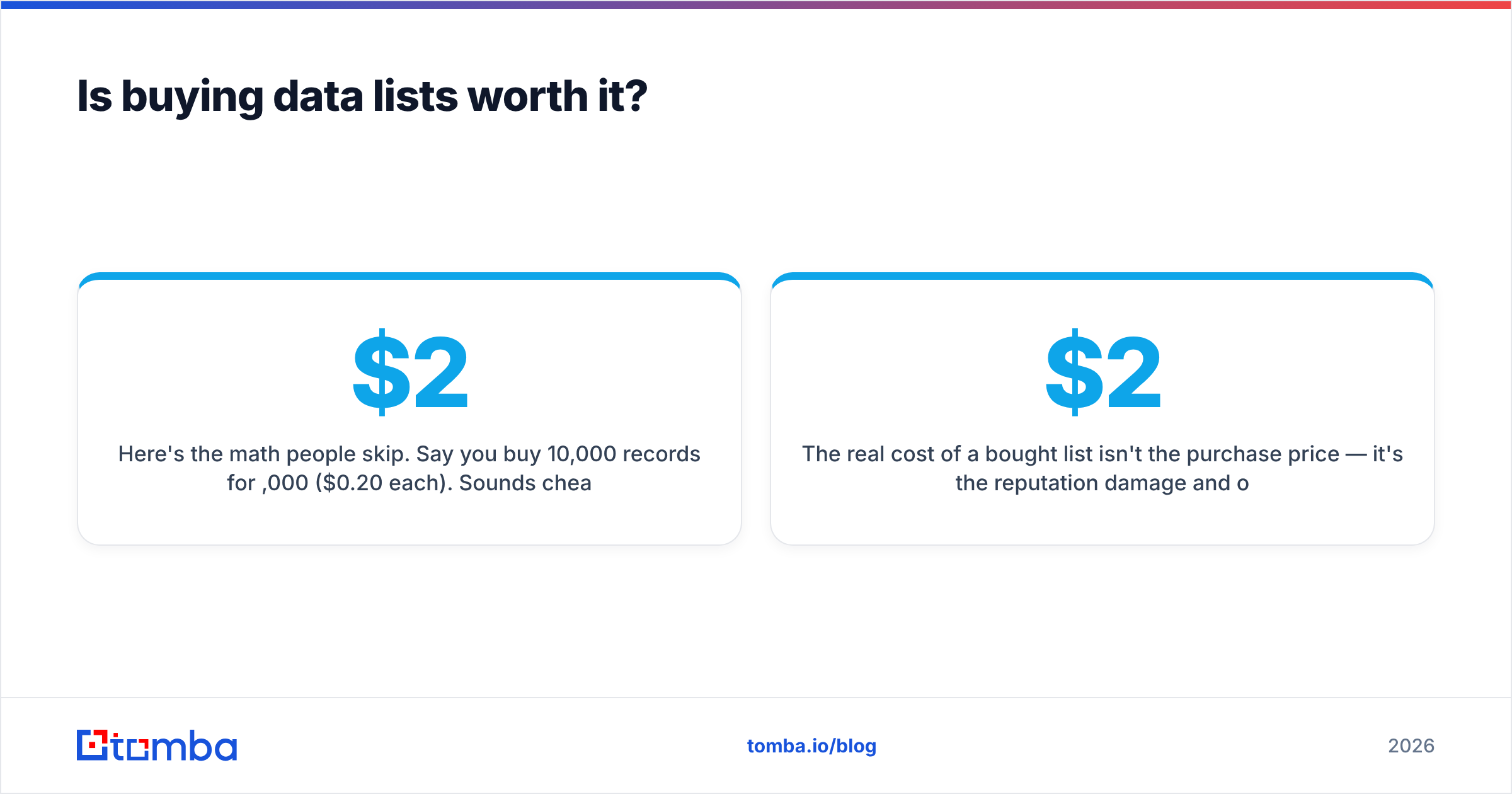
Here's the math people skip. Say you buy 10,000 records for $2,000 ($0.20 each). Sounds cheap. But if 25% are stale:
- 2,500 bad records = wasted spend baked in
- Those bounces spike your bounce rate, and mailbox providers throttle or block your domain
- One bad send can damage email deliverability for every campaign after it, including to your good contacts
- Reps waste hours on dead numbers and disconnected inboxes
The real cost of a bought list isn't the purchase price — it's the reputation damage and opportunity cost. A $2,000 list that tanks your domain reputation can cost you far more than $2,000 in suppressed inbox placement.
Where buying genuinely helps#
To be fair, purchased data has legitimate uses:
- Total addressable market sizing — you need a directional count of accounts, not perfect contacts.
- Account discovery — find which companies exist in a segment, then enrich the contacts yourself.
- Seeding an enrichment pipeline — buy company-level data, then build verified contact-level data on top of it.
The pattern: buy firmographic breadth, build contact-level precision. Don't rely on a frozen file for the email you're actually going to hit send on.
What's the real cost of a purchased list?#
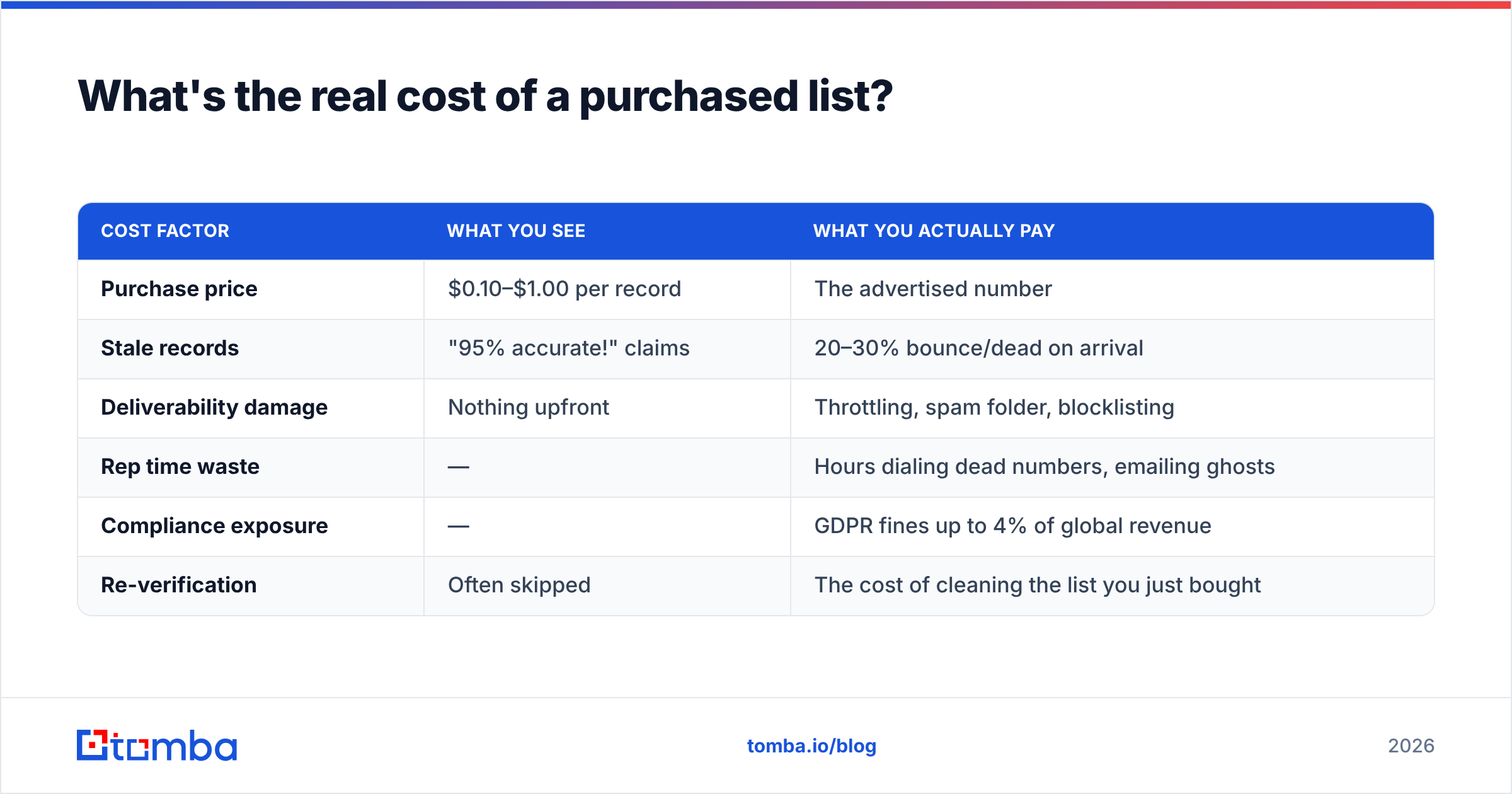
Sticker price is the smallest line item. Here's the fuller picture.
| Cost factor | What you see | What you actually pay |
|---|---|---|
| Purchase price | $0.10–$1.00 per record | The advertised number |
| Stale records | "95% accurate!" claims | 20–30% bounce/dead on arrival |
| Deliverability damage | Nothing upfront | Throttling, spam folder, blocklisting |
| Rep time waste | — | Hours dialing dead numbers, emailing ghosts |
| Compliance exposure | — | GDPR fines up to 4% of global revenue |
| Re-verification | Often skipped | The cost of cleaning the list you just bought |
The takeaway: a "cheap" list usually carries hidden costs that dwarf the purchase price, while a "premium" list still needs re-verification before you trust it. Either way, verification isn't optional — which raises the obvious question of why you're paying for someone else's snapshot at all.
Buy a static list vs. build on demand: which wins?#
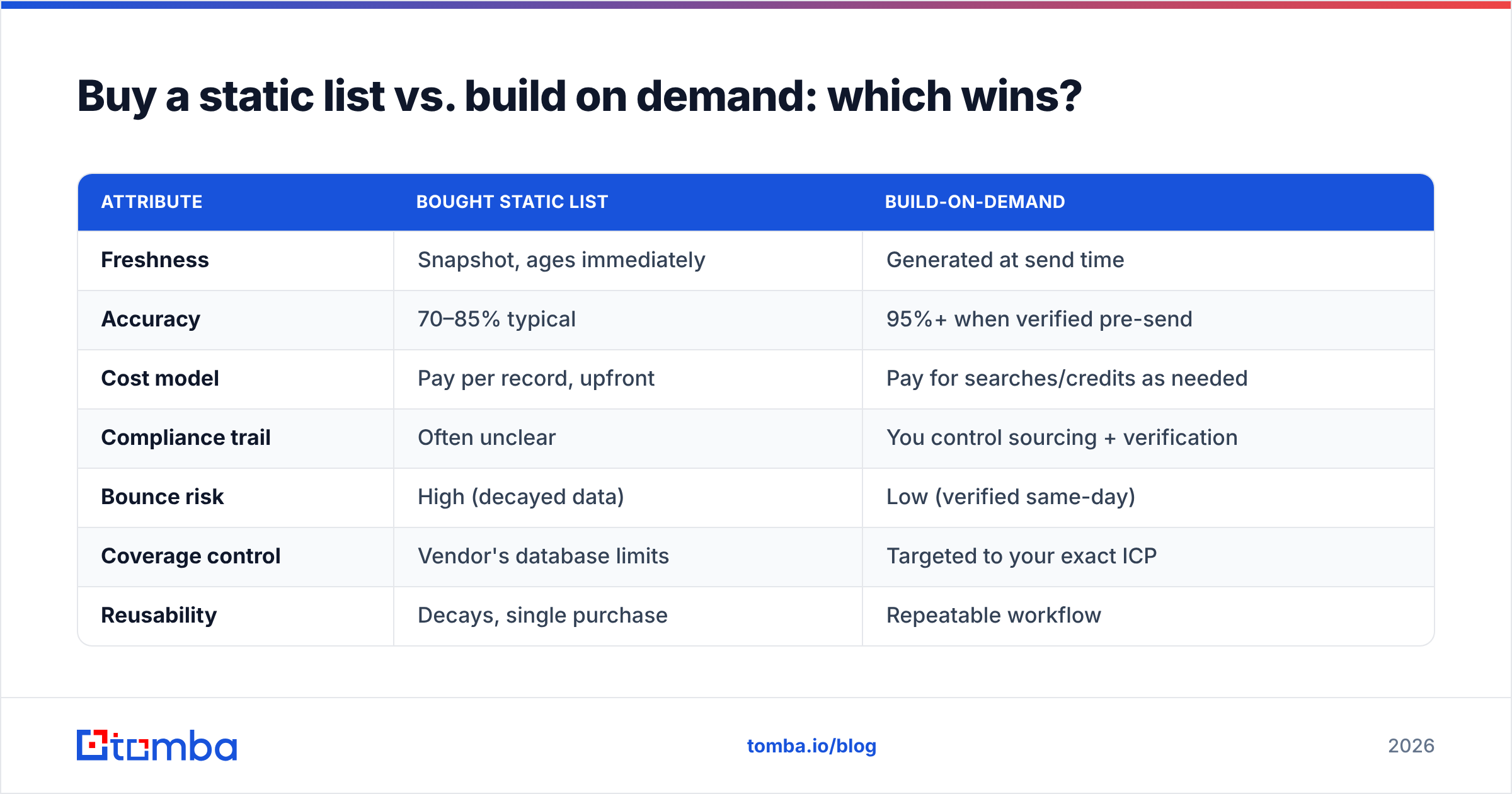
This is the core decision in 2026. Most teams frame it as "buy vs. don't" when the real choice is buy a frozen file vs. generate a fresh list per campaign.
| Attribute | Bought static list | Build-on-demand |
|---|---|---|
| Freshness | Snapshot, ages immediately | Generated at send time |
| Accuracy | 70–85% typical | 95%+ when verified pre-send |
| Cost model | Pay per record, upfront | Pay for searches/credits as needed |
| Compliance trail | Often unclear | You control sourcing + verification |
| Bounce risk | High (decayed data) | Low (verified same-day) |
| Coverage control | Vendor's database limits | Targeted to your exact ICP |
| Reusability | Decays, single purchase | Repeatable workflow |
Build-on-demand is like cooking with fresh ingredients you buy the morning of the meal, versus reheating a frozen dinner someone packaged months ago. Same idea — a list of contacts — but the freshness gap changes the entire outcome.
The build-on-demand workflow in practice:
- Define the ICP — industries, company sizes, roles, geographies.
- Find the companies — pull target domains from a B2B database or your own research.
- Find the contacts — run domain search to pull the right people and email patterns at each company.
- Verify before sending — run every address through an email verifier to strip bounces and catch-alls.
- Enrich — layer on titles, phone numbers, and firmographics with data enrichment.
You end each campaign with a list that was verified hours before you sent to it — not months before someone sold it to you.
How do you stay compliant when sourcing B2B data?#
Compliance is the part most list buyers underestimate — and regulators don't grade on a curve. A purchased list rarely comes with the documentation you'd need to defend it.
The major frameworks each set expectations you inherit the moment you import a file:
- GDPR (EU/UK): you need a lawful basis to process personal data. "I bought it from a broker" is not, on its own, a lawful basis, and brokered consent rarely transfers cleanly. Fines reach up to 4% of global annual revenue. Read the official GDPR text before you assume a vendor handled this for you.
- CAN-SPAM (US): requires accurate headers, a real physical address, and a working unsubscribe. It's more permissive than GDPR but still bites on deceptive sending.
- CASL (Canada): among the strictest — generally requires consent before commercial email, with steep penalties.
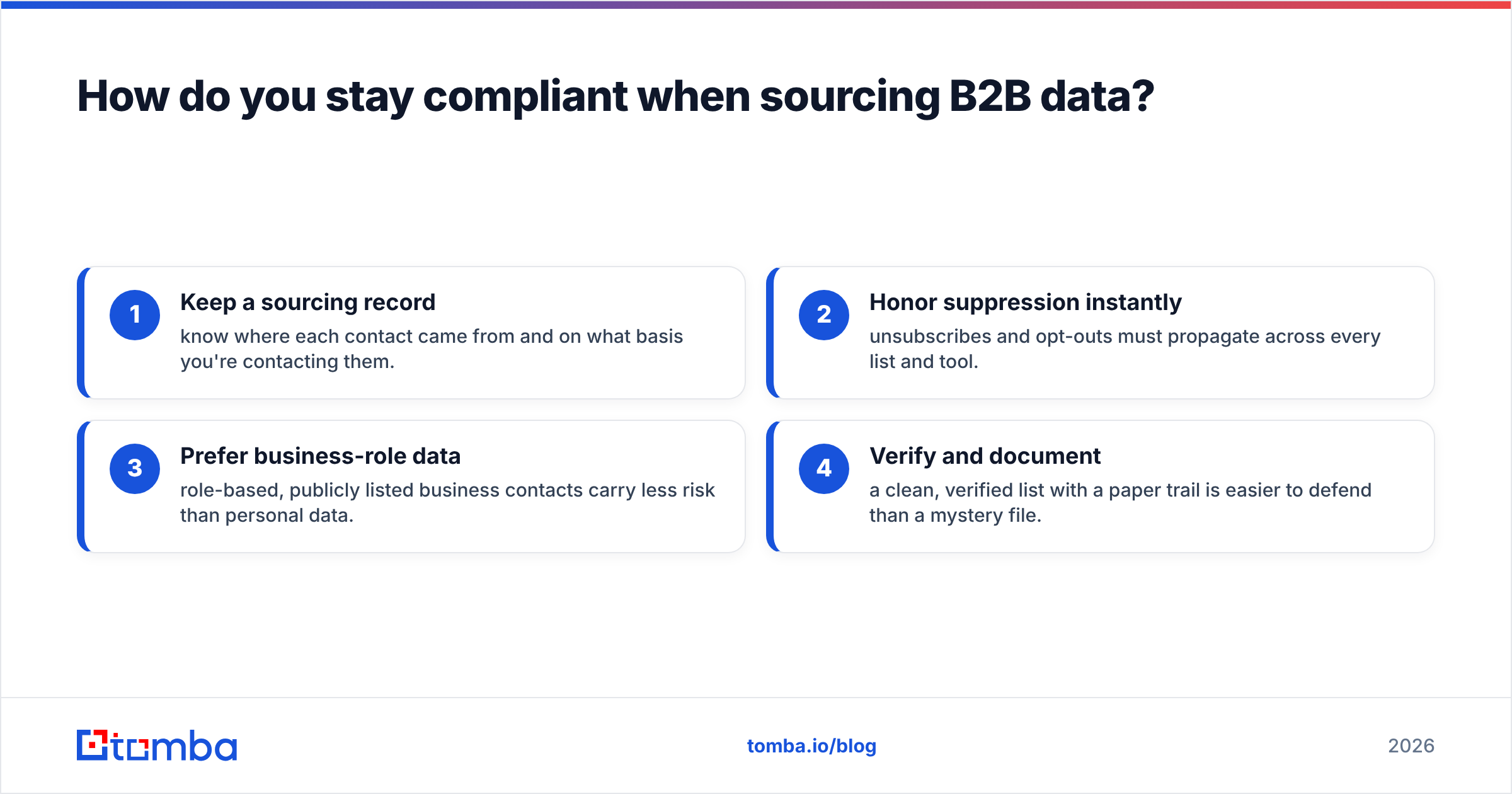
Practical guardrails when you source any B2B data, bought or built:
- Keep a sourcing record — know where each contact came from and on what basis you're contacting them.
- Honor suppression instantly — unsubscribes and opt-outs must propagate across every list and tool.
- Prefer business-role data — role-based, publicly listed business contacts carry less risk than personal data.
- Verify and document — a clean, verified list with a paper trail is easier to defend than a mystery file.
Buying a list doesn't outsource your compliance liability — it inherits it onto you. If a broker can't tell you how the data was collected, that silence is your answer.
If you do buy a list, what should you demand?#
Sometimes buying is the pragmatic call — a new market, a tight deadline, a one-off event. If you go that route, treat the vendor like a skeptical buyer would. Non-negotiables:
| Demand this | Why it matters |
|---|---|
| Record-level recency dates | Tells you how stale the snapshot really is |
| Verification proof | "95% accurate" means nothing without a method |
| Bounce replacement guarantee | Shifts decay risk back to the seller |
| Clear sourcing/consent trail | Your compliance defense |
| A sample before purchase | Test-verify 100 records yourself first |
| No exclusivity locks | Avoid lists resold to every competitor |
Then — and this is the step almost everyone skips — re-verify the entire list yourself before the first send. Run it through a bulk email finder and verifier to catch the decay that happened between when they exported it and when you imported it. The vendor's verification date is not your send date.
Cross-check vendor claims on independent review sites like G2 and Capterra rather than trusting the marketing page. A pattern of "list was full of bounces" reviews is the signal you need.
What does an accurate B2B list actually require?#
Strip away the buy-vs-build debate and every good list comes down to the same three properties:
- Recency — verified close to send time, not licensed months ago.
- Relevance — matched to a real ICP, not a broad scrape.
- Reachability — addresses confirmed deliverable, catch-alls flagged, phone numbers validated.
A purchased static list can occasionally hit one or two of these. It almost never hits all three at once, because the act of selling a frozen file is fundamentally at odds with recency. That's the structural reason build-on-demand keeps winning: it bakes verification into the moment you use the data instead of the moment someone sold it.
If you're weighing tools, check Tomba pricing against the per-record math above — a credit-based model that lets you find and verify fresh contacts often costs less than a bulk list once you factor in the bounces you didn't pay for.
Should you buy data lists in 2026?#
The honest answer: buy firmographic breadth if you must, but build your contact-level data fresh — and never send to anything you haven't verified yourself. The teams that win in 2026 aren't the ones with the biggest purchased database. They're the ones whose lists were accurate the day they sent.
Buying a list is buying a photograph. Building on demand is opening a live window. For anything you'll actually email or call, you want the live window.
If you're ready to stop renting stale snapshots, start with the Tomba Email Finder: find professional email addresses by domain, name, or company, verify them before you send, and build a campaign-ready list that was accurate this week — not whenever a broker last exported it. The free tier gives you 25 searches a month to test it against any list you're tempted to buy. Build the list, verify the list, then hit send with confidence.
Ready to find emails that actually work?
Join 150,000+ professionals who stopped guessing and started sending. Free credits on signup — no credit card required.
Get the Tomba newsletter
Practical outbound tactics and product updates — once every two weeks.
About the author