Should You Buy Lead Lists in 2026? Costs, Risks & ROI
Buying lead lists looks like a shortcut to pipeline — but bounce rates, compliance traps, and dead data often cost more than they save. Here's the honest math for 2026.
TL;DR
- Buying lead lists trades speed for quality: most purchased B2B lists are stale, shared across dozens of buyers, and carry bounce rates of 20–40%.
- The sticker price ($0.10–$1.00 per record) is rarely the real cost — deliverability damage, wasted rep time, and compliance exposure usually dwarf it.
- Under GDPR, CAN-SPAM, and CASL, a purchased list almost never carries valid consent, which puts your sending domain and your company at legal risk.
- A self-built list — verified emails sourced on demand from a current data provider — costs less per usable contact and protects your sender reputation.
- If you only remember one thing: don't email a list you bought; build a targeted, verified one instead.
What does it mean to buy lead lists?#
Buying a lead list means paying a data vendor for a spreadsheet of contacts — names, job titles, company names, emails, sometimes phone numbers — that you did not collect yourself. Think of it like buying a pre-printed phone book versus knocking on doors: it's faster, but everyone else with the same budget bought the same book, and half the numbers were disconnected last year.
These lists come in two broad flavors. Compiled lists are scraped and aggregated from public web sources, old form fills, and recycled databases. Curated or "opt-in" lists claim the contacts agreed to be marketed to — though that claim is usually thin once you read the fine print. Vendors range from marketplaces like data broker resellers to enrichment platforms that will export a slice of their database for a flat fee.
The appeal is obvious: you need pipeline this quarter, and a list of 10,000 "VP of Marketing" contacts in your ICP looks like an instant top-of-funnel. The problem is what happens after you hit send.
Why do marketers buy lead lists in the first place?#
Three pressures push teams toward purchased data, and each one has a catch.
- Speed. A new SDR team needs contacts today, and building a list feels slow. The catch: a list you can't email cleanly isn't faster — it just moves the delay to your deliverability recovery.
- Volume. Leadership sets an activity target (X emails/week), and a big list is the cheapest way to hit it on paper. The catch: volume against bad data trains spam filters to distrust your domain.
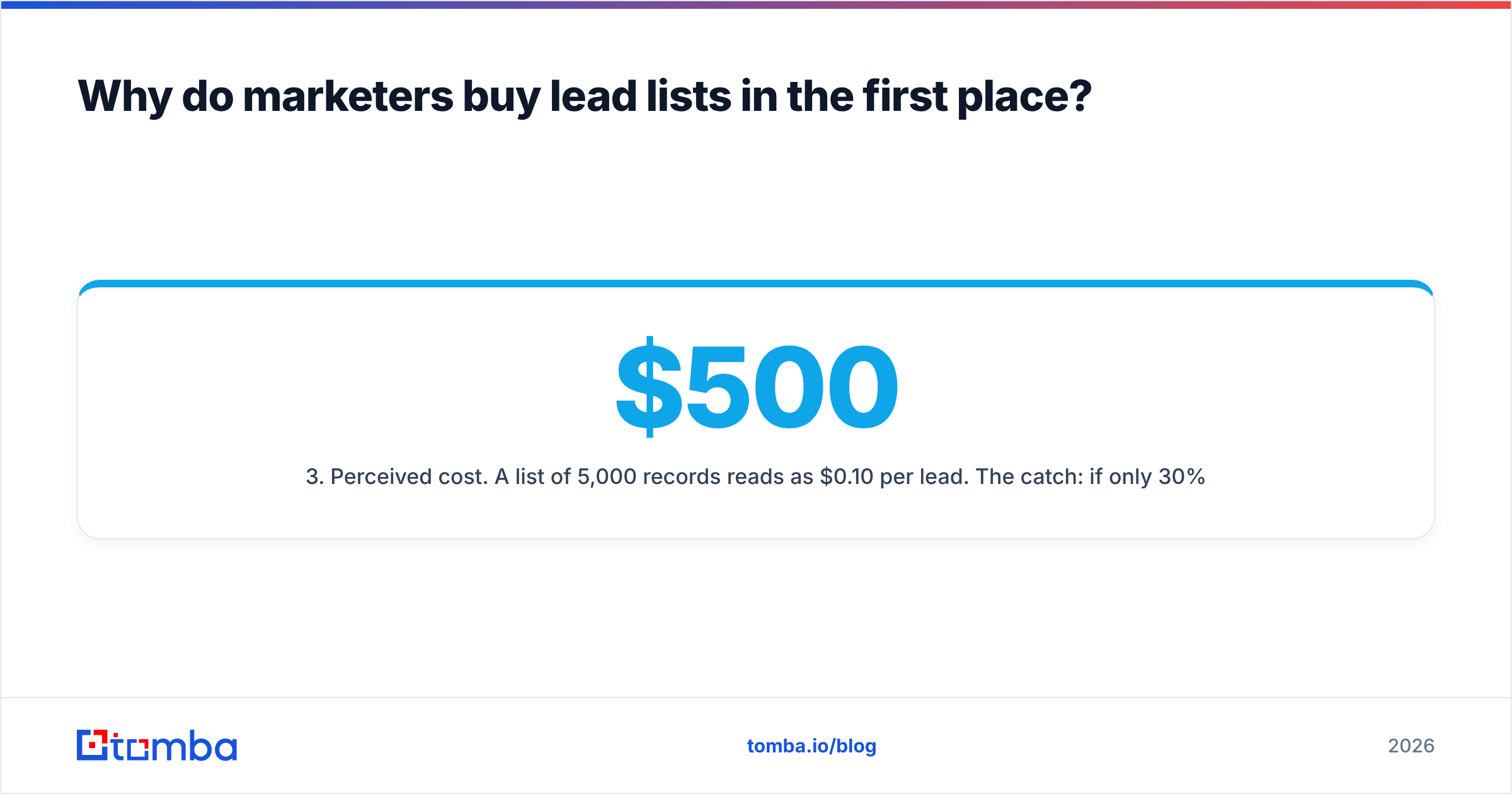
- Perceived cost. A $500 list of 5,000 records reads as $0.10 per lead. The catch: if only 30% are deliverable and 2% are actually in-market, your real cost per usable lead is many times higher.
The instinct isn't irrational — pipeline pressure is real. But the math behind a bought list almost never survives contact with a verification tool.
How much do lead lists actually cost in 2026?#
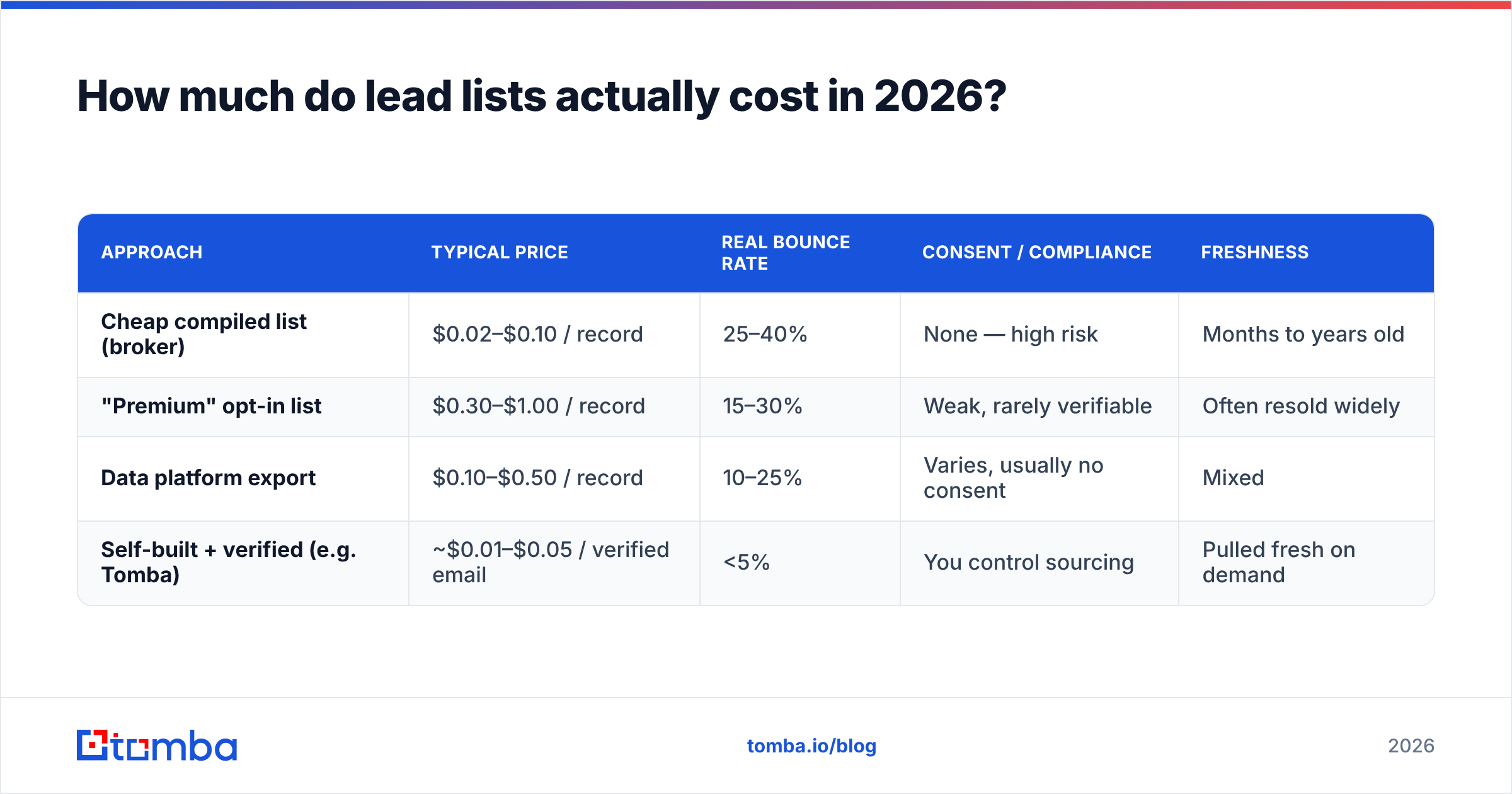
Less than you'd think up front, and far more than you'd think after. Here's a realistic breakdown of common sourcing approaches.
| Approach | Typical price | Real bounce rate | Consent / compliance | Freshness |
|---|---|---|---|---|
| Cheap compiled list (broker) | $0.02–$0.10 / record | 25–40% | None — high risk | Months to years old |
| "Premium" opt-in list | $0.30–$1.00 / record | 15–30% | Weak, rarely verifiable | Often resold widely |
| Data platform export | $0.10–$0.50 / record | 10–25% | Varies, usually no consent | Mixed |
| Self-built + verified (e.g. Tomba) | ~$0.01–$0.05 / verified email | <5% | You control sourcing | Pulled fresh on demand |
The headline number — price per record — is the least useful column in that table. The columns that decide your ROI are bounce rate and freshness, because a 35% bounce rate on a 10,000-record list means 3,500 hard bounces, and a few thousand hard bounces is enough to tank your domain reputation for weeks.
When you model the cost per contact you can safely email and who might actually reply, a $500 bargain list frequently lands above $2–$5 per usable lead, while a verified, self-built list — where you pay only for emails that pass verification — stays low because you're not paying for the dead weight.
Is it legal to buy and email a purchased lead list?#
Short answer: buying is usually legal; emailing the result usually isn't clean. The friction is consent.
- GDPR (EU/UK) requires a lawful basis to process personal data. A list you bought rarely comes with documented, freely given consent tied to your company, and "legitimate interest" is hard to defend for cold bulk email to a purchased file. Fines scale with revenue.
- CAN-SPAM (US) doesn't require prior consent, but it does require accurate headers, a real physical address, and a working unsubscribe. Purchased lists frequently fail the "accurate sender" and suppression-list rules at scale.
- CASL (Canada) is strict: implied or express consent is mandatory, and a purchased list almost never carries it. Penalties run into the millions.
For the underlying concepts, the GDPR overview on Wikipedia and the U.S. FTC's CAN-SPAM compliance guide are the authoritative starting points — read them before you send a single message to bought data.
The practical risk isn't only regulators. Inbox providers treat unsolicited bulk mail as spam regardless of jurisdiction. You can be perfectly "CAN-SPAM compliant" and still get your domain blocklisted because recipients hit "report spam." Compliance is the floor, not the goal.
What's the real damage to deliverability?#
This is the part the list vendor never mentions. Your sender reputation is like a credit score for email: easy to wreck, slow to rebuild, and every mailbox provider keeps its own ledger.
When you blast a stale purchased list, three things happen fast:
- Hard bounces spike. Mailbox providers read a high bounce rate as a signal that you don't know who you're emailing — a classic spammer fingerprint.
- Spam-trap hits. Old compiled lists are riddled with recycled spam traps. One pristine-trap hit can get you onto a blocklist immediately.
- Complaints climb. People who never heard of you mark you as spam, and your complaint rate — anything above ~0.3% is dangerous — pushes you toward the junk folder for everyone, including the prospects you sourced cleanly.
The damage compounds. Once Google and Microsoft distrust your domain, even your warm, double-opt-in newsletter starts landing in spam. Recovering can take weeks of careful warm-up and low-volume sending. That's why protecting email deliverability and sender reputation matters more than any single campaign's volume.
A quick gut check before any send: if you can't verify the list is fresh and the addresses resolve, assume the bounce rate is high and the traps are present. Run it through an email verifier first — and if 20%+ fails, that's your answer about the whole file.
Is buying lead lists ever worth it?#
Rarely, and only in narrow cases. If a vendor provides genuinely opt-in, recently verified, single-buyer data with documented consent for your use case, and you verify it independently before sending, the risk drops. That combination exists, but it's the exception — and it costs far more than the bargain lists most teams actually buy.
For the overwhelming majority of B2B teams, the better question isn't "which list should I buy?" but "how do I build a list that's targeted, fresh, and mine?" That shift is what separates teams whose cold outreach scales from teams who keep replacing burned domains.
What's the better alternative to buying lead lists?#
Build the list yourself, on demand, and verify every address before it enters a sequence. Modern tooling makes this nearly as fast as buying — without the stale data, the shared file, or the compliance landmine.
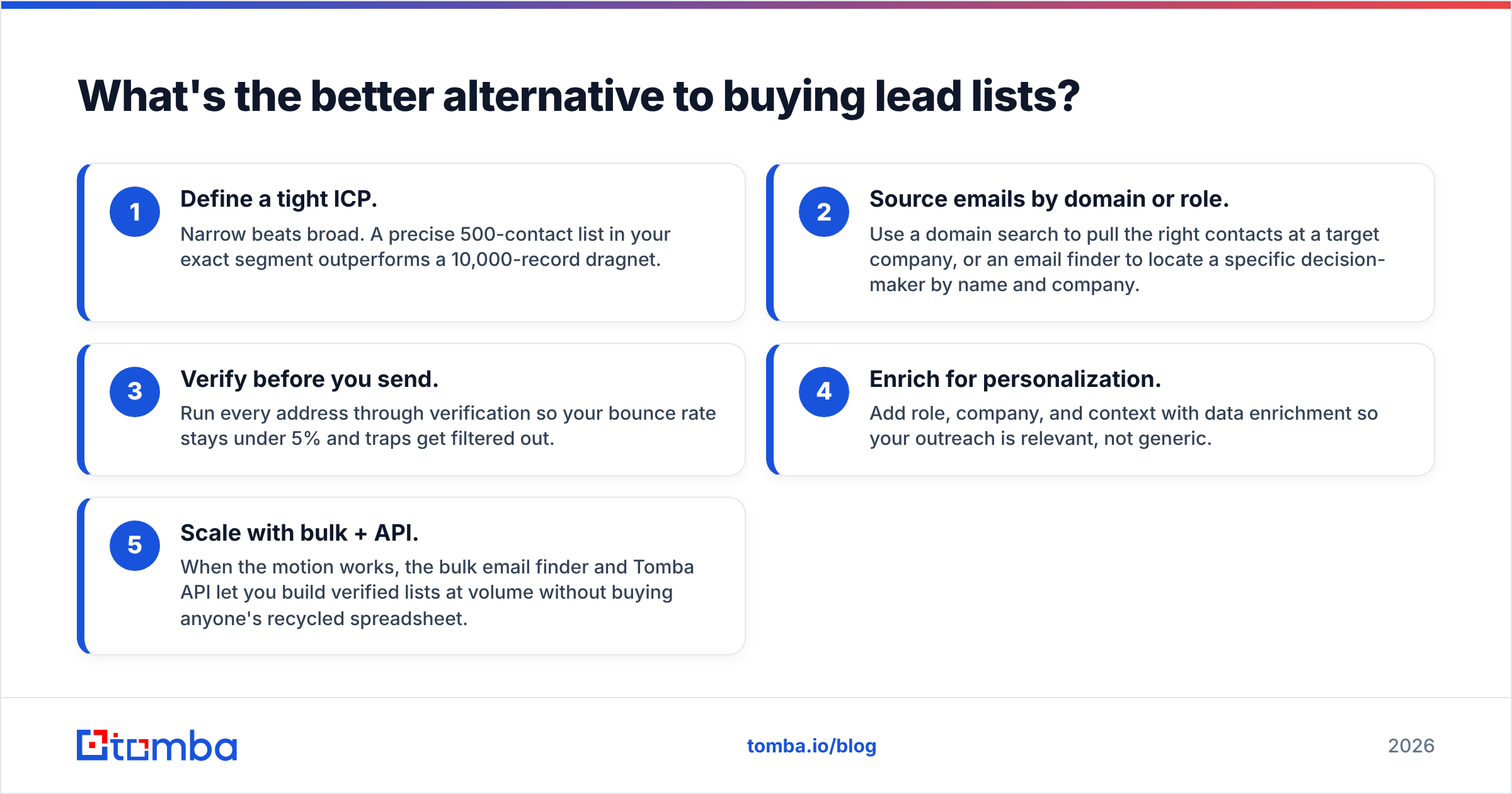
Here's the workflow that beats a purchased list on cost and quality:
- Define a tight ICP. Narrow beats broad. A precise 500-contact list in your exact segment outperforms a 10,000-record dragnet.
- Source emails by domain or role. Use a domain search to pull the right contacts at a target company, or an email finder to locate a specific decision-maker by name and company.
- Verify before you send. Run every address through verification so your bounce rate stays under 5% and traps get filtered out.
- Enrich for personalization. Add role, company, and context with data enrichment so your outreach is relevant, not generic.
- Scale with bulk + API. When the motion works, the bulk email finder and Tomba API let you build verified lists at volume without buying anyone's recycled spreadsheet.
The difference is ownership and freshness. A self-built list reflects today's org charts, runs through your verification standard, and isn't sitting in fifty competitors' CRMs. You pay for usable contacts, not dead records — which is why the per-usable-lead cost typically undercuts even the cheapest broker file.
Bought lists vs. built lists: which wins?#
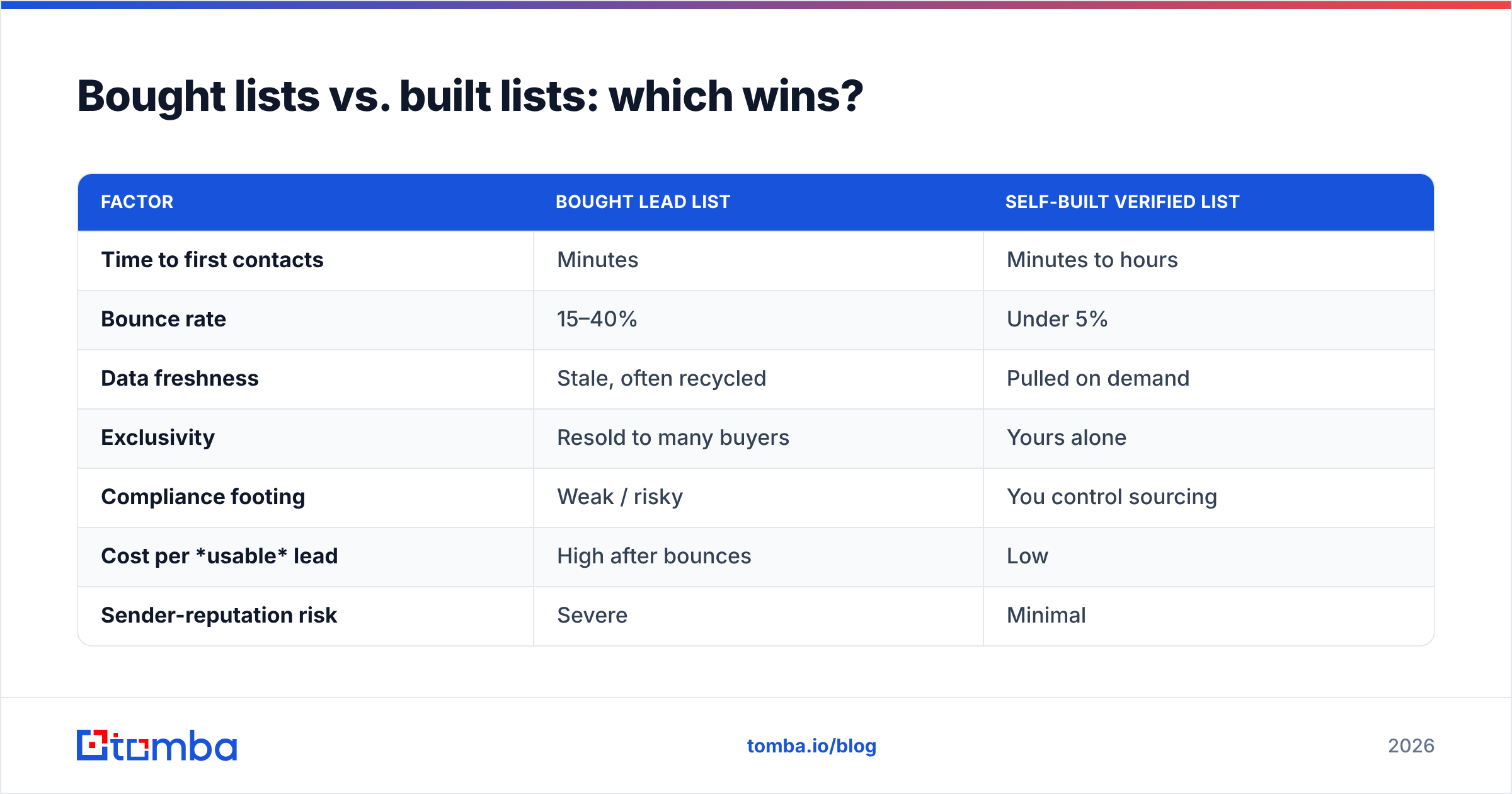
| Factor | Bought lead list | Self-built verified list |
|---|---|---|
| Time to first contacts | Minutes | Minutes to hours |
| Bounce rate | 15–40% | Under 5% |
| Data freshness | Stale, often recycled | Pulled on demand |
| Exclusivity | Resold to many buyers | Yours alone |
| Compliance footing | Weak / risky | You control sourcing |
| Cost per usable lead | High after bounces | Low |
| Sender-reputation risk | Severe | Minimal |
On every column that affects revenue — bounce rate, freshness, exclusivity, reputation — the built list wins. The only category where a bought list looks competitive is raw speed, and even that edge disappears once you factor in the deliverability cleanup a bad list forces on you.
For benchmarking, independent review sites like G2 and Capterra let you compare data-tool accuracy and pricing across vendors before you commit — a faster, safer due-diligence step than trusting a list seller's own numbers.
How do you build a verified lead list without buying one?#
Start small and prove the motion before you scale. Pick ten target accounts, find the right contacts with an email finder, verify them, and run a short sequence. Measure your bounce and reply rates. If the data is clean — and self-sourced, verified data almost always is — you've just validated a repeatable system that doesn't depend on anyone's for-sale spreadsheet.
From there, layer in automation: connect your sourcing to your CRM, use the Tomba Chrome extension to capture contacts as you research, and push verified records straight into your outreach tool. You'll spend less than a typical list purchase and end up with data that's fresher, exclusive, and safe to send. Check the Tomba pricing tiers — the Free plan (25 searches/mo) is enough to test the workflow, and the Starter plan at $49/mo covers most early-stage outbound teams.
The teams that win at cold outreach in 2026 aren't the ones buying the biggest lists. They're the ones who treat their sending domain as the asset it is and only ever email contacts they sourced and verified themselves.
The bottom line#
Don't buy lead lists. The price tag hides the real costs — bounces, blocklists, compliance exposure, and a domain reputation that takes weeks to rebuild after a single bad blast. A targeted, verified, self-built list beats a purchased one on quality, exclusivity, legal footing, and cost per usable lead.
Ready to build instead of buy? Start with the Tomba Email Finder — find professional emails by name, role, or domain, verify them on the spot, and feed your pipeline with clean, fresh data you actually own. Spin up a free account, source your first ten accounts, and see how quickly a built list outperforms anything you could have bought.
// get started
Find, verify and enrich your first contacts today
Start on the free plan with 25 searches a month, then scale when your team is ready.
Free plan · No credit card required · GDPR & CCPA
// about the author