Buy Qualified Leads in 2026: Is It Worth It? Honest Guide
Thinking of buying qualified leads in 2026? Here's what you actually get, what it costs, where bought lists go wrong, and a build-vs-buy framework that protects your domain.
Buy Qualified Leads in 2026: Is It Worth It?
You can buy a list of "qualified leads" in the next ten minutes. Whether that list does anything for your pipeline is a different question entirely. This guide breaks down what you actually get when you pay for leads, what it costs, where bought data quietly destroys your sender reputation, and when building your own list beats buying one.
TL;DR#
- "Buy qualified leads" usually means buying contact records, not sales-ready opportunities. The word "qualified" is doing a lot of unearned work in most vendor pitches.
- Expect to pay $0.10–$5+ per contact depending on freshness, enrichment depth, and whether the leads are exclusive or resold to ten other buyers.
- Bulk-bought lists are the fastest way to wreck deliverability — stale data, spam traps, and catch-all domains tank your bounce rate and sender reputation.
- The reliable play in 2026 is build-then-verify: define your ICP, source contacts on demand, and verify every address before you send.
- A self-serve email finder + verifier gives you exclusive, fresh, validated contacts for less than most "qualified lead" packages — without the shared-list baggage.
What does "buy qualified leads" actually mean?#
It means three very different things depending on who's selling, so pin down the definition before you pay.
- Raw contact lists — name, title, company, email. No intent, no qualification. The cheapest tier and the one most likely to be stale or resold.
- Enriched contact records — the above plus firmographics, technographics, and sometimes a phone number. More useful, more expensive.
- Marketing- or sales-qualified leads (MQL/SQL) — people who showed real intent (downloaded a paper, requested a demo, matched a scoring model). These are the genuinely valuable leads, and almost nobody sells them cheaply because they're hard to produce at scale.
The trap is paying tier-3 prices for tier-1 data. A vendor calls a scraped list "qualified" because the contacts match a job title filter. That's a filter, not qualification. Real qualification means a marketing qualified lead has demonstrated fit and interest — and interest can't be bought in a CSV.
Where do companies buy leads in 2026?#
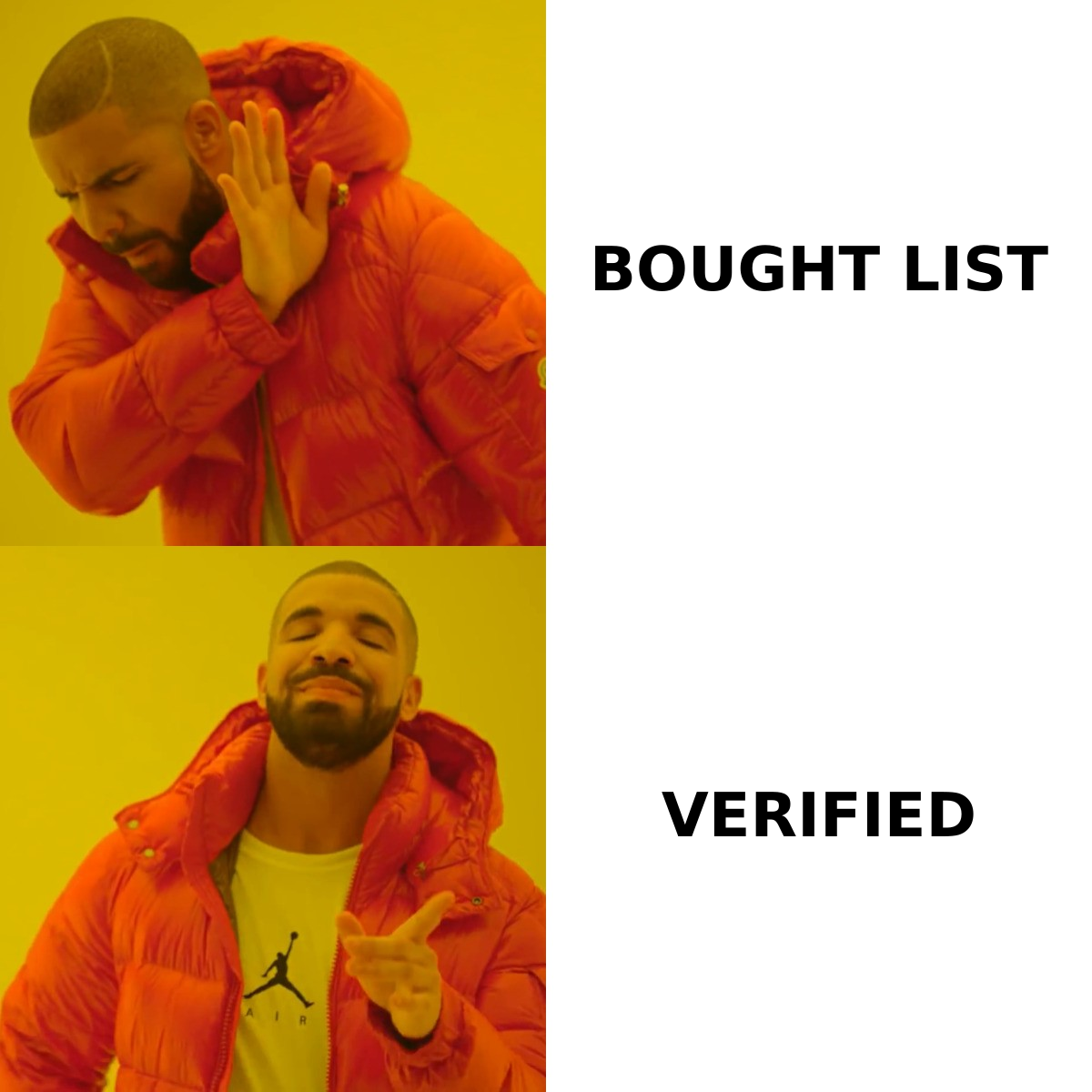
The market splits into four buckets, each with a different risk profile.
| Source type | What you get | Typical price | Exclusivity | Main risk |
|---|---|---|---|---|
| Data marketplaces (ZoomInfo, Apollo, Cognism) | Bulk B2B contacts + firmographics | $0.10–$1 / contact at volume | Shared | Staleness, over-emailing |
| Lead-gen agencies | "Done-for-you" appointment setting | $30–$300 / lead | Often exclusive | Inconsistent quality, attribution disputes |
| Pay-per-lead networks | Form-fill or intent leads | $5–$50 / lead | Resold 3–10x | Same lead sold to competitors |
| Self-serve finders (Tomba, Hunter) | On-demand verified emails by domain/name | ~$0.02–$0.10 / contact | Exclusive to you | You do the targeting |
Marketplaces and self-serve finders give you control and low per-contact cost. Agencies and pay-per-lead networks promise convenience but you inherit their quality problems — and on a resold lead, you're emailing a prospect who already heard from five competitors this week.
The math on exclusivity matters more than people think. A $20 "exclusive" lead sold to eight buyers is really a $160 contact split eight ways, and your reply rate reflects that crowding.
Is buying qualified leads worth it?#
Sometimes — but rarely in the form vendors sell it. Buying data (contacts you then qualify and own) can be efficient. Buying outcomes (pre-qualified appointments) is where most budgets get burned.
Buying makes sense when:
- You need speed over precision — a new market, a launch deadline, a list to test messaging against fast.
- You'll verify and enrich before sending, not blast the raw file.
- The leads are genuinely exclusive and you can prove the source.
Buying backfires when:
- You skip verification. Purchased lists are old the day they ship — people change jobs every ~24 months on average, so a year-old list is roughly 20–30% wrong.
- The list is shared or resold. Your "qualified lead" is everyone's qualified lead.
- You send from your primary domain. One bad bulk send can poison the sender reputation you spent years building.
That last point is the silent killer. Mailbox providers score you on bounce rate, spam complaints, and engagement. A purchased list spikes all three at once.
How do bought leads hurt deliverability?#
Bought lists fail deliverability in four predictable ways, and they compound.
- Spam traps. Recycled or pristine trap addresses sit in old lists specifically to catch buyers. Hit a few and blacklists notice.
- Hard bounces. Stale data means dead mailboxes. A bounce rate above ~2% tells Gmail and Outlook you didn't earn this list.
- Catch-all noise. Many B2B domains accept every address, so a contact can look valid and still bounce. You need a catch-all verifier to separate real mailboxes from accept-all domains.
- Zero engagement history. Recipients never opted in, so opens and replies stay flat — and flat engagement drags your email deliverability down even on the addresses that are technically valid.
The fix isn't to never buy data. It's to treat every purchased or sourced contact as unverified until a verification pass proves otherwise. Run the full list through an email verifier and suppress anything risky before it touches your sending domain.
Build vs. buy: which gets better leads?#
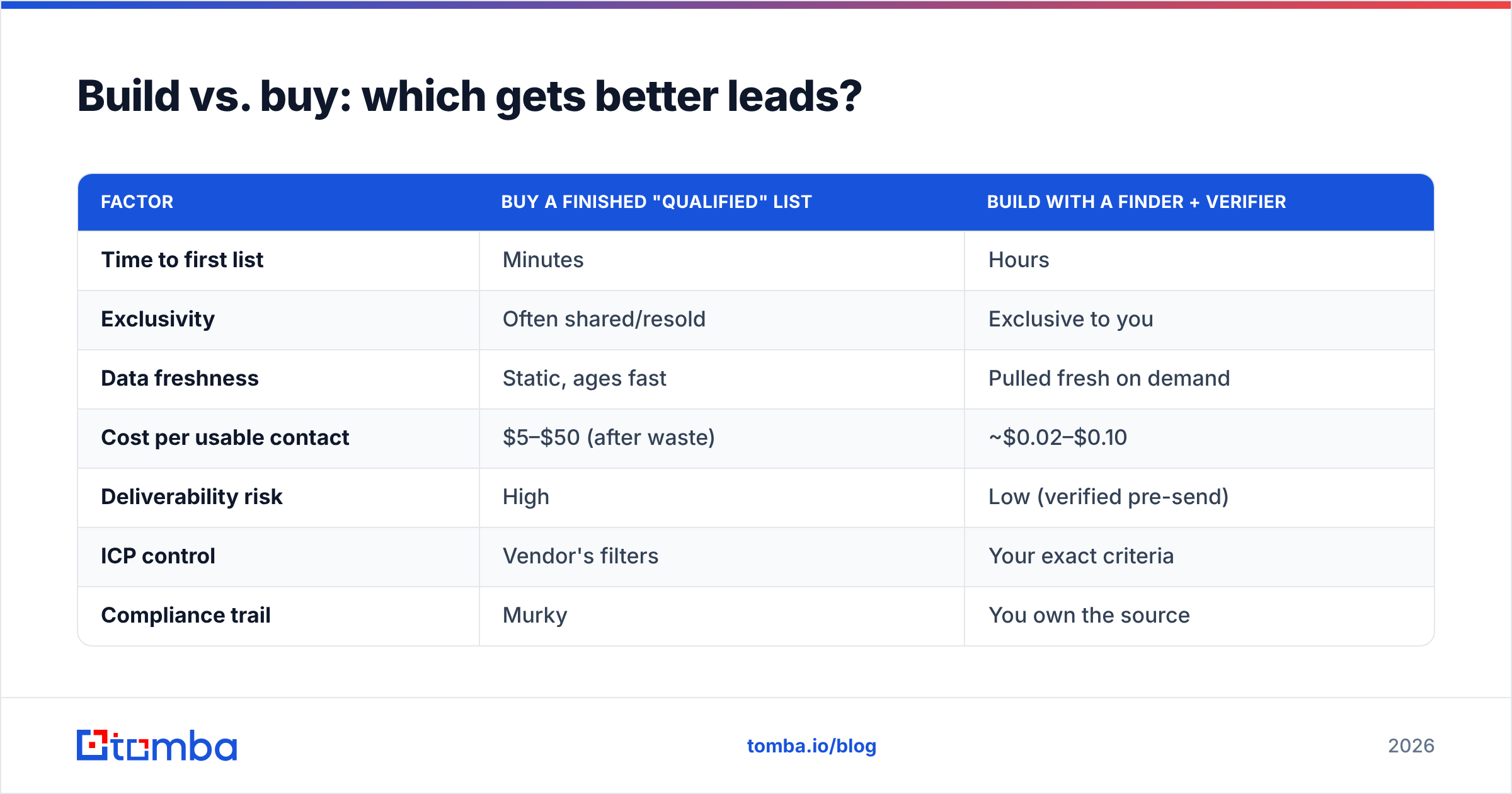
Build-then-verify wins on cost-per-meeting almost every time — because you control targeting, freshness, and exclusivity. Here's the honest comparison.
| Factor | Buy a finished "qualified" list | Build with a finder + verifier |
|---|---|---|
| Time to first list | Minutes | Hours |
| Exclusivity | Often shared/resold | Exclusive to you |
| Data freshness | Static, ages fast | Pulled fresh on demand |
| Cost per usable contact | $5–$50 (after waste) | ~$0.02–$0.10 |
| Deliverability risk | High | Low (verified pre-send) |
| ICP control | Vendor's filters | Your exact criteria |
| Compliance trail | Murky | You own the source |
Building doesn't mean cold-scraping the internet by hand. Modern tooling collapses the work: pick your ICP accounts, pull contacts by company with domain search, find specific decision-makers by name with an email finder, then verify the batch before import. You end up with a smaller, cleaner, exclusively-yours list that outperforms a bought file ten times its size.
For volume, a bulk email finder lets you upload a list of companies or names and get verified contacts back, so "build" scales without becoming a manual slog.
How much should you pay per lead?#
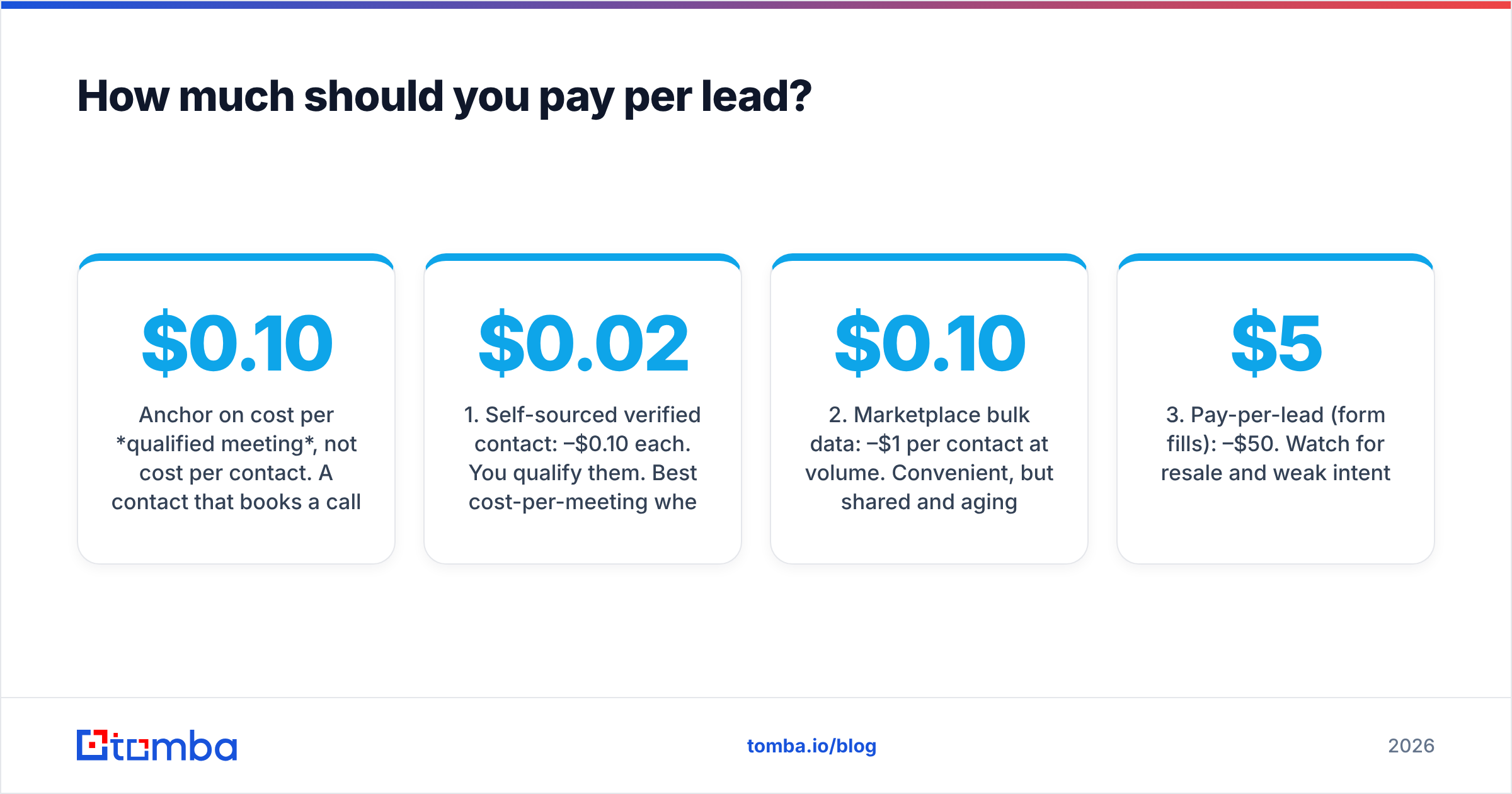
Anchor on cost per qualified meeting, not cost per contact. A $0.10 contact that books a call is cheaper than a $40 "lead" that ghosts.
Rough 2026 benchmarks for B2B:
- Self-sourced verified contact: $0.02–$0.10 each. You qualify them. Best cost-per-meeting when your targeting is sharp.
- Marketplace bulk data: $0.10–$1 per contact at volume. Convenient, but shared and aging.
- Pay-per-lead (form fills): $5–$50. Watch for resale and weak intent.
- Appointment-set leads: $50–$300+. Only worth it if the meetings are genuinely qualified and show up.
Whatever tier you choose, budget for verification on top. A verification pass costs cents per contact and routinely saves you from a deliverability incident that would cost weeks of inbox recovery. Compare that to Tomba pricing, where a Starter plan at $49/mo covers finding and verifying enough contacts to replace most mid-tier "qualified lead" packages outright.
What does a build-then-verify pipeline look like?#
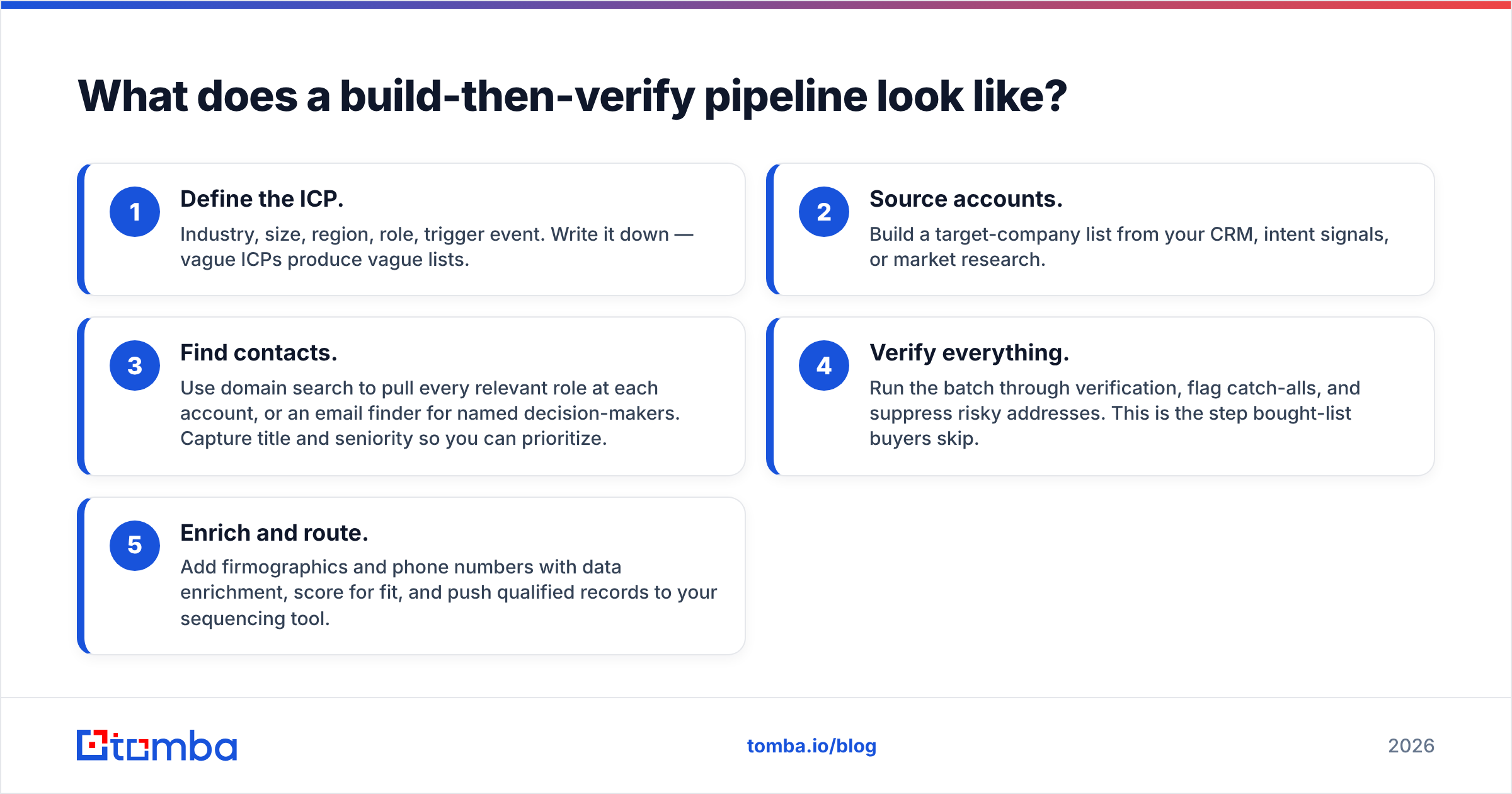
Five steps, repeatable every week:
- Define the ICP. Industry, size, region, role, trigger event. Write it down — vague ICPs produce vague lists.
- Source accounts. Build a target-company list from your CRM, intent signals, or market research.
- Find contacts. Use domain search to pull every relevant role at each account, or an email finder for named decision-makers. Capture title and seniority so you can prioritize.
- Verify everything. Run the batch through verification, flag catch-alls, and suppress risky addresses. This is the step bought-list buyers skip.
- Enrich and route. Add firmographics and phone numbers with data enrichment, score for fit, and push qualified records to your sequencing tool.
The difference between this and buying a list is ownership. You know exactly where every contact came from, how fresh it is, and that it's yours alone — which matters for both performance and compliance under frameworks like GDPR. Vendor directories such as G2 and Capterra are useful for shortlisting tools, and HubSpot's lead generation guide is a solid neutral primer on qualification frameworks.
What are the red flags when buying leads?#
Walk away if a vendor can't answer these:
- "Where did this data come from?" No clear, compliant source = no deal. You'll inherit the liability.
- "Is this list exclusive?" If it's resold, your reply rate is already spent.
- "When was it last verified?" "Recently" isn't a date. Ask for the bounce-rate guarantee in writing.
- "What's your bounce/replacement policy?" Reputable sellers replace bad records. List dumpers don't.
- "Can I get a sample to verify myself?" Always test a sample against your own verifier before buying the full file.
If the answers are vague, you're not buying qualified leads — you're renting a deliverability problem.
The bottom line#
Buying qualified leads is rarely a yes/no decision — it's a how decision. Buying static, shared, unverified lists is a fast path to a damaged domain and a skeptical sales team. Sourcing exclusive contacts on demand and verifying every one before you send gives you cleaner data, lower cost-per-meeting, and a list nobody else is hammering.
If you want the build-then-verify approach without standing up a data team, start with the Tomba Email Finder. Find decision-makers by domain or name, verify each address before it hits your sequence, and enrich the keepers — exclusive leads you actually own, for a fraction of what most "qualified lead" packages cost. Spin up the free tier, test it against any list you were about to buy, and let the bounce rate decide.
// get started
Find, verify and enrich your first contacts today
Start on the free plan with 25 searches a month, then scale when your team is ready.
Free plan · No credit card required · GDPR & CCPA
Get the Tomba newsletter
Product and data updates
// about the author