Buyer Intent Data in 2026: How to Find Ready-to-Buy Leads
Buyer intent data tells you which accounts are researching a purchase right now. Here's how the signals work, where they come from, and how to act on them before competitors do.
TL;DR#
- Buyer intent data is behavioral evidence that a person or account is actively researching a purchase — content consumption, search activity, site visits, and review-site browsing.
- It splits into first-party (your own properties), second-party (review and vendor sites), and third-party (publisher co-ops) signals. Each has different freshness and reliability.
- Intent alone is noise. It only converts when you resolve the signal to a contact, enrich it, and reach out within hours — not weeks.
- Most teams overpay for raw intent feeds and underinvest in the contact data and workflow that make signals actionable.
- The practical 2026 stack: capture signals, identify the account and people, verify contact details, and route to a rep with context attached.
What is buyer intent?#
Buyer intent is the set of behaviors that reveal someone is moving toward a purchase decision. Think of it like a shopper lingering in one aisle, picking up three competing products, and reading the labels — they haven't bought yet, but they're clearly close. Intent data captures that "lingering" digitally: the articles they read, the keywords they search, the comparison pages they open, and the vendor sites they keep returning to.
The reason intent matters is timing. In B2B, roughly 70% of the buying journey happens before a prospect ever talks to sales. By the time someone fills out a "contact us" form, they've usually already built a shortlist. Buyer intent lets you enter the conversation earlier — while the shortlist is still being written — instead of fighting to get added at the end.
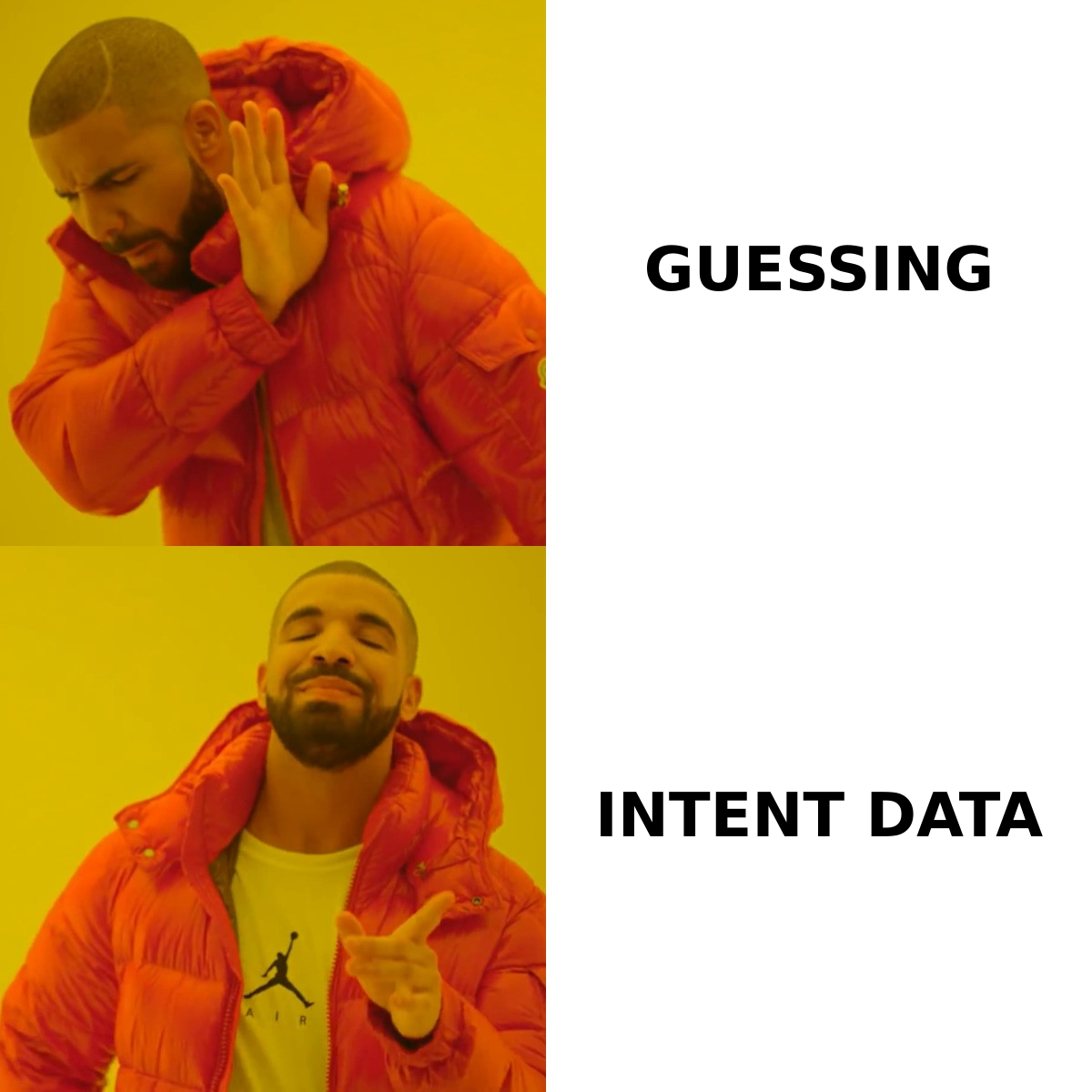
There's an important distinction between fit and intent. Fit is static: company size, industry, tech stack, revenue. Intent is dynamic: it changes week to week as accounts research, pause, and re-engage. A great account with zero intent is a long nurture. A mediocre-fit account with surging intent is a phone call you make today. The accounts where strong fit and rising intent overlap are where your pipeline should come from.
What are the types of buyer intent signals?#
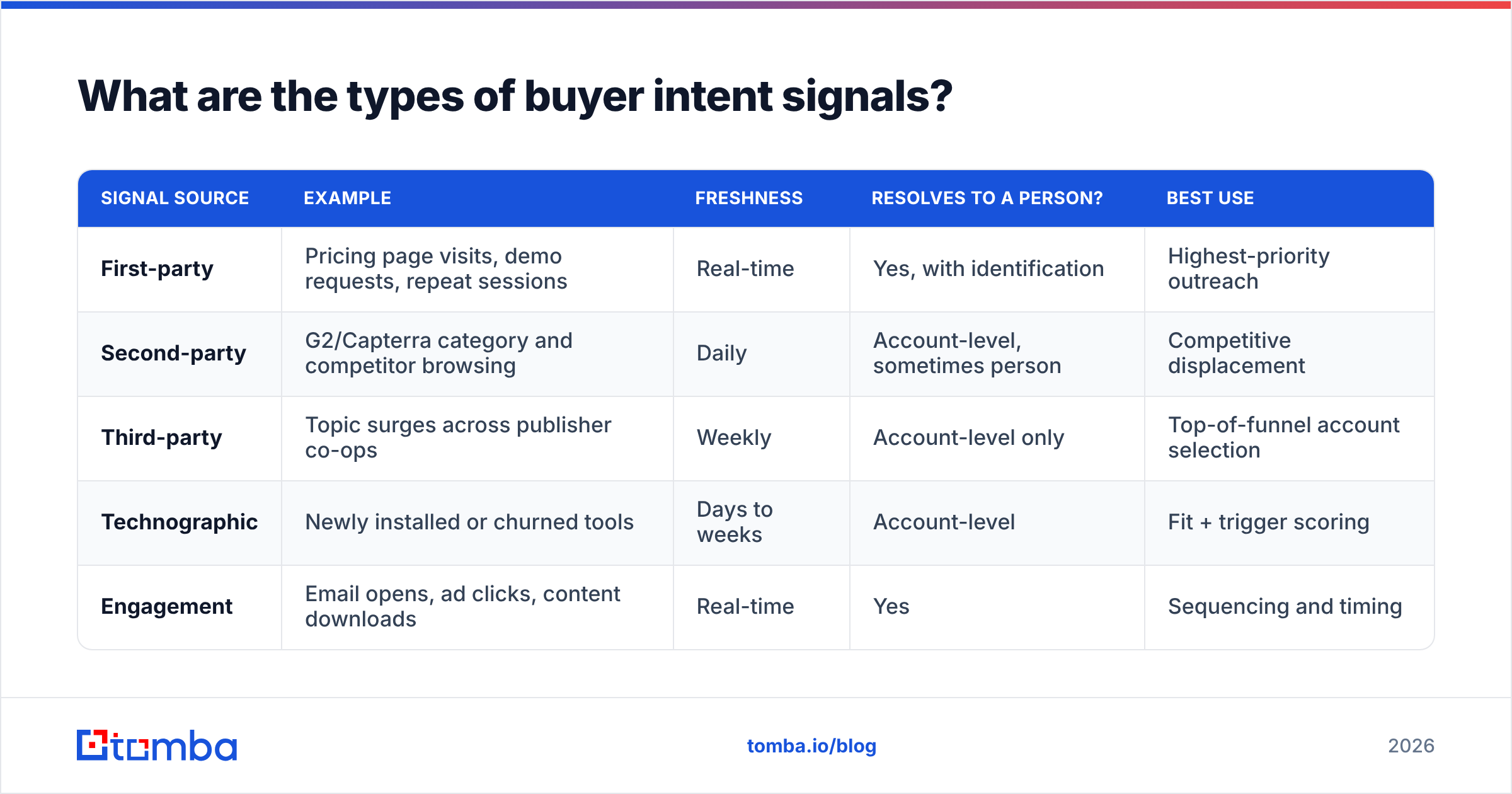
Not all intent is created equal. The signals differ by where they come from, how fresh they are, and how directly they tie to a real person you can contact. Here's how the main categories stack up.
| Signal source | Example | Freshness | Resolves to a person? | Best use |
|---|---|---|---|---|
| First-party | Pricing page visits, demo requests, repeat sessions | Real-time | Yes, with identification | Highest-priority outreach |
| Second-party | G2/Capterra category and competitor browsing | Daily | Account-level, sometimes person | Competitive displacement |
| Third-party | Topic surges across publisher co-ops | Weekly | Account-level only | Top-of-funnel account selection |
| Technographic | Newly installed or churned tools | Days to weeks | Account-level | Fit + trigger scoring |
| Engagement | Email opens, ad clicks, content downloads | Real-time | Yes | Sequencing and timing |
The hierarchy is simple: first-party signals are gold, because they happen on your turf and you can tie them to a specific session, company, and often a named visitor. Third-party "topic surge" data is useful for deciding which accounts to target, but it's account-level and noisy — a spike in "buyer intent" research at a 5,000-person company tells you nothing about who to email.
That gap is exactly where most intent programs fail. Buying a third-party feed feels productive, but a list of company names with an "intent score" is not a pipeline. You still have to figure out which humans are involved and how to reach them.
Where does buyer intent data come from?#
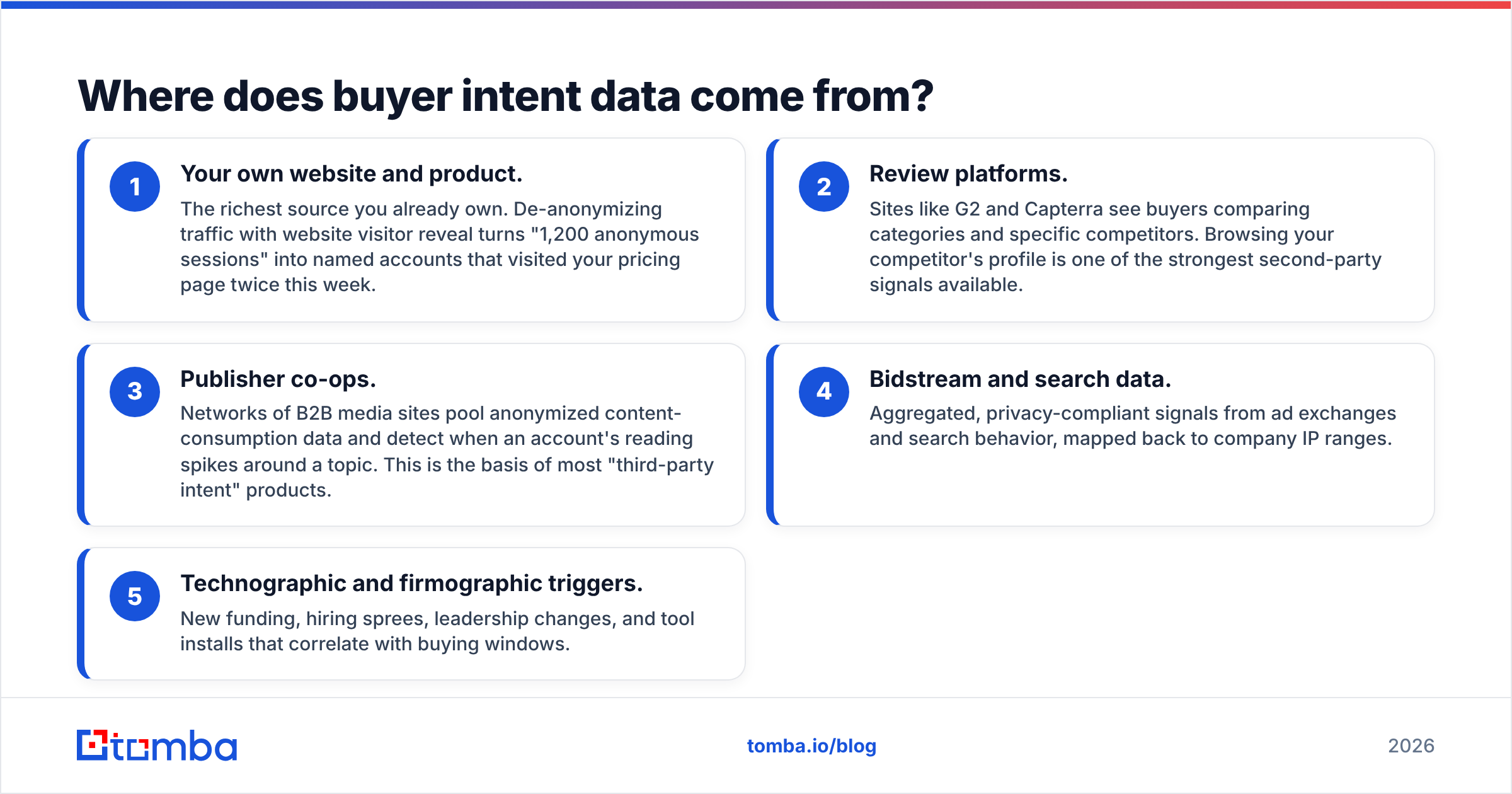
Understanding the plumbing helps you judge what you're actually paying for. Intent data is assembled from a handful of distinct sources, and vendors blend them in different proportions.
- Your own website and product. The richest source you already own. De-anonymizing traffic with website visitor reveal turns "1,200 anonymous sessions" into named accounts that visited your pricing page twice this week.
- Review platforms. Sites like G2 and Capterra see buyers comparing categories and specific competitors. Browsing your competitor's profile is one of the strongest second-party signals available.
- Publisher co-ops. Networks of B2B media sites pool anonymized content-consumption data and detect when an account's reading spikes around a topic. This is the basis of most "third-party intent" products.
- Bidstream and search data. Aggregated, privacy-compliant signals from ad exchanges and search behavior, mapped back to company IP ranges.
- Technographic and firmographic triggers. New funding, hiring sprees, leadership changes, and tool installs that correlate with buying windows.
According to Gartner, the value of intent data depends heavily on how well it's integrated into existing workflows — raw signals that never reach a rep with context are wasted spend. In other words, sourcing is the easy part. Activation is where programs live or die.
Is buyer intent data actually worth it?#
Yes — but only if you close the loop between signal and contact. The dirty secret of the intent market is that a large share of buyers churn off third-party feeds within a year, not because the data is fake, but because they never built the workflow to use it. A weekly CSV of "surging accounts" lands in someone's inbox, gets glanced at, and dies.
Here's the honest cost-benefit. Standalone third-party intent platforms often start at four figures per month and scale into five. For many mid-market teams, that's hard to justify when the output is account-level scores you can't immediately action. The teams who win treat intent as one input in a chain, not a product they "buy."
The chain looks like this:
- Capture the signal (first-party preferred, third-party to widen the net).
- Identify the account and the specific people in the buying committee.
- Enrich those people with verified work emails, phone numbers, and role data.
- Verify the contact details so your outreach actually lands.
- Route the lead to a rep with the signal attached as context.
Skip any link and the value collapses. Capture without identification gives you trends, not leads. Identification without verified contact data gives you bounces. Verified data without routing gives you a database nobody touches.
How do you turn buyer intent into pipeline?#
Conclusion first: act fast, reach the right people, and lead with relevance. Intent decays. A signal that was hot on Monday is lukewarm by Friday, because your prospect is also being researched by — and is researching — your competitors.
Step 1 — Score fit and intent together. Don't chase every spike. Combine firmographic fit with the intent surge so reps work the overlap. A simple model: tier accounts as A/B/C on fit, then layer a rising/flat/falling intent trend on top. A-fit + rising intent goes to the top of the queue.
Step 2 — Resolve the account to people. A company doesn't buy; a buying committee does, and it's grown to 6–10 people for most B2B deals. Once you know the account is in-market, find the actual decision-makers and influencers. Use domain search to map the email patterns and surface the relevant roles at that company, then pull the specific contacts you need.
Step 3 — Enrich and verify. Append verified work emails and direct-dial numbers, and confirm they're deliverable before you send. Even strong intent is wasted if your message bounces or your call hits a dead line. Running contacts through an email verifier protects your sender reputation and keeps surging accounts from being lost to a hard bounce.
Step 4 — Reach out with the signal as context. The signal is your opener. Reference the problem they're clearly researching, not your product. "Noticed teams in your space are wrestling with X" beats "I wanted to introduce our platform." You earned the right to be relevant — use it.
Step 5 — Route and measure. Push enriched, prioritized leads straight into the CRM with the intent reason attached, so reps open the record and immediately know why this account is hot. Then track which signal types actually convert and double down.
For more on how downstream qualification works once a signal lands, the framework around a marketing qualified lead maps cleanly onto intent scoring — intent is often the trigger that promotes a contact from raw lead to MQL.
How does buyer intent compare to traditional prospecting?#
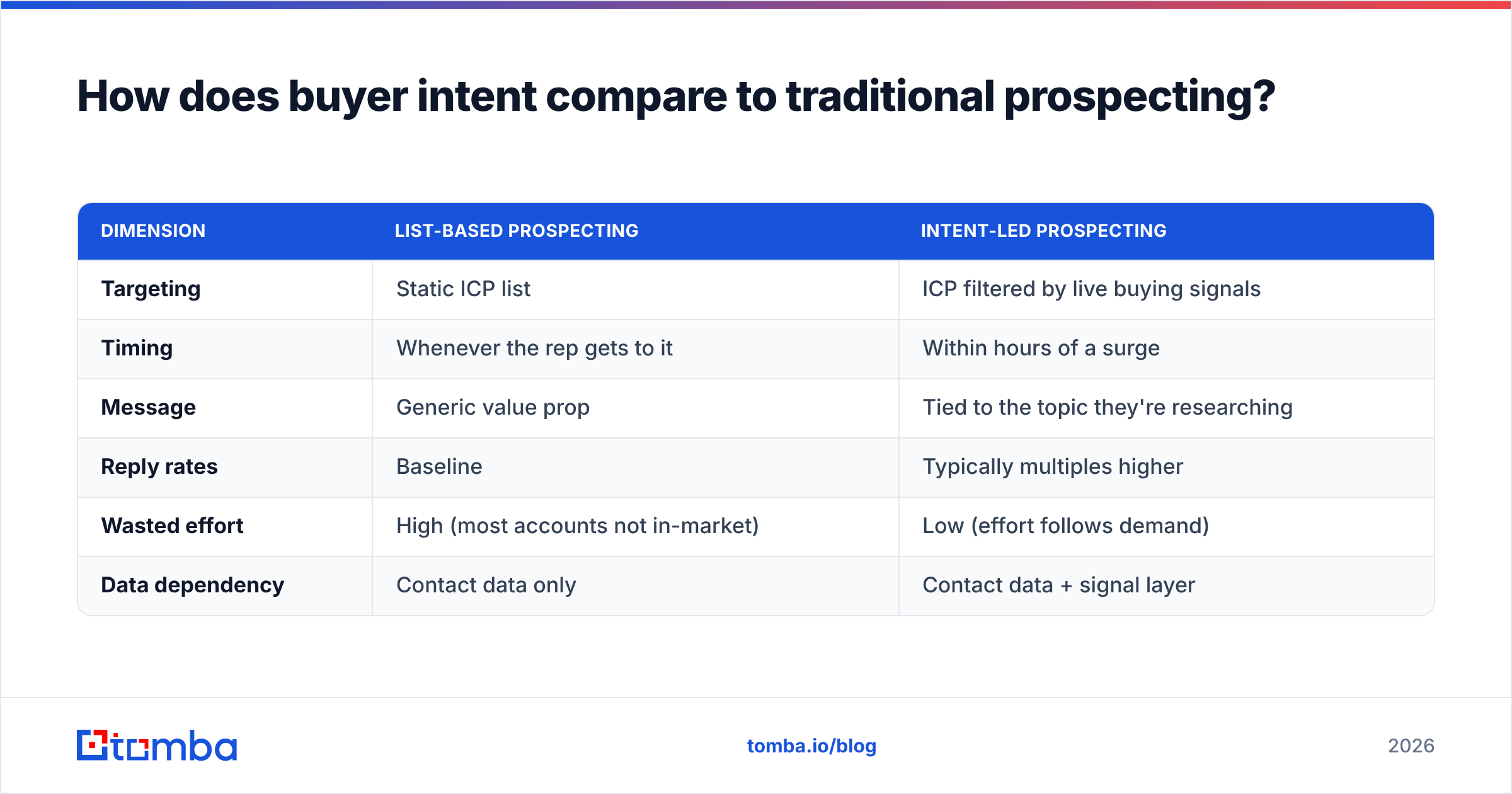
The contrast is stark once you see them side by side. Traditional list-based prospecting treats every fit account the same and sprays the same sequence at all of them. Intent-led prospecting concentrates effort where buying is actually happening.
| Dimension | List-based prospecting | Intent-led prospecting |
|---|---|---|
| Targeting | Static ICP list | ICP filtered by live buying signals |
| Timing | Whenever the rep gets to it | Within hours of a surge |
| Message | Generic value prop | Tied to the topic they're researching |
| Reply rates | Baseline | Typically multiples higher |
| Wasted effort | High (most accounts not in-market) | Low (effort follows demand) |
| Data dependency | Contact data only | Contact data + signal layer |
The catch is in that last row. Intent-led prospecting increases your dependency on accurate contact data, because the whole point is to move fast on a narrow window. A stale or unverified contact database turns a hot signal into a missed deal. This is why the teams getting real ROI from intent invest just as much in clean, verified contact data as they do in the signals themselves.
What tools do you need for a buyer intent workflow?#
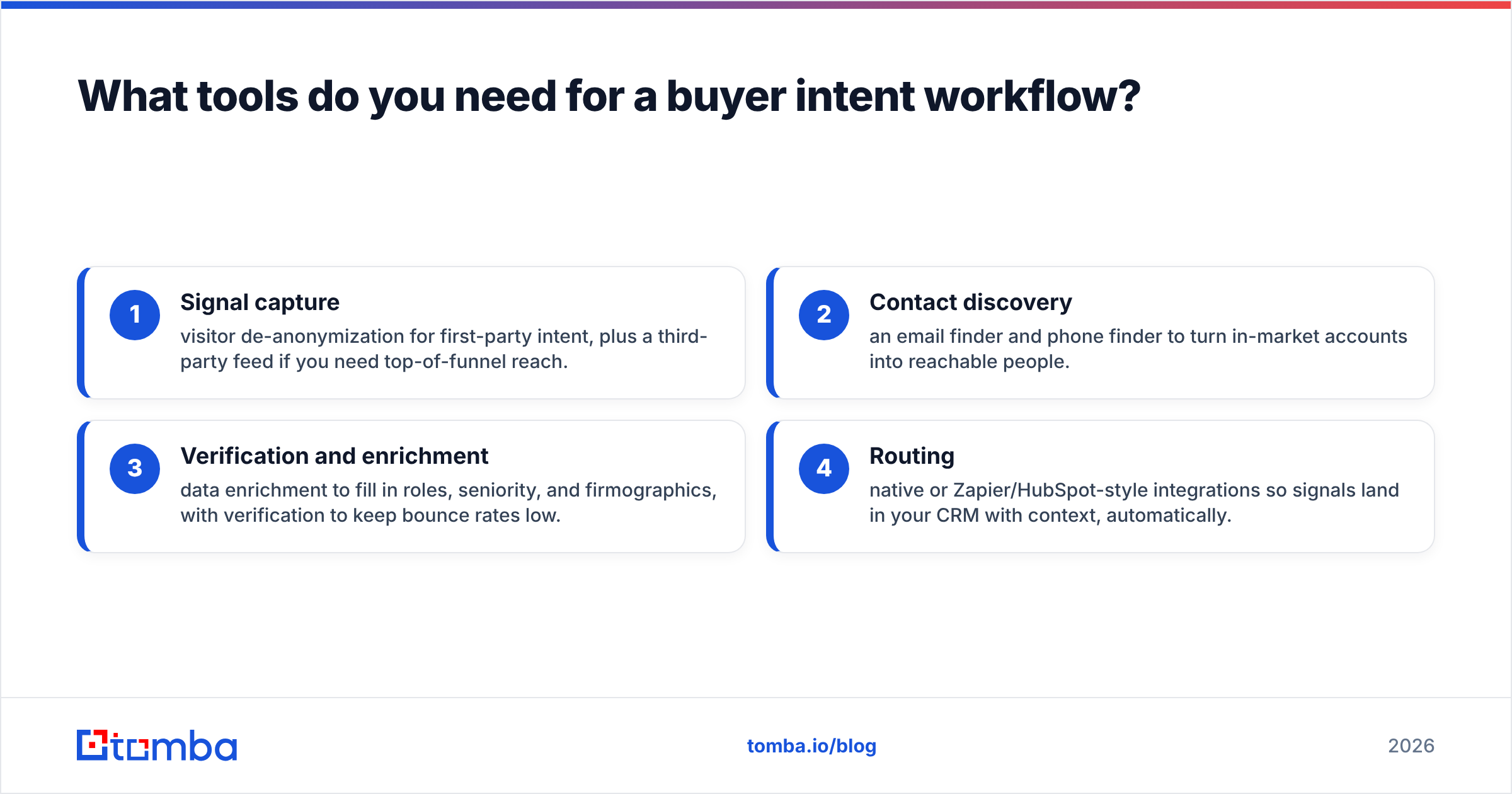
You need four capabilities, and they don't have to come from one mega-platform. In fact, assembling focused tools is usually cheaper and more flexible than a single suite that does everything adequately and nothing well.
- Signal capture — visitor de-anonymization for first-party intent, plus a third-party feed if you need top-of-funnel reach.
- Contact discovery — an email finder and phone finder to turn in-market accounts into reachable people.
- Verification and enrichment — data enrichment to fill in roles, seniority, and firmographics, with verification to keep bounce rates low.
- Routing — native or Zapier/HubSpot-style integrations so signals land in your CRM with context, automatically.
For pricing-conscious teams, this modular approach scales sanely. You can start with first-party signals (which are free to capture) plus accurate contact data, then add a paid third-party feed only once you've proven the workflow converts. Check current Tomba pricing if you want to budget the contact-data layer — the free tier covers 25 searches a month so you can validate the loop before committing.
Common mistakes that kill intent programs#
A few patterns show up again and again when intent spend doesn't pay off:
- Buying signals you can't action. Account-level third-party data with no plan to find the people inside. The signal expires unused.
- Treating intent as a lead source instead of a prioritization layer. Intent tells you who to work first, not who to ignore forever.
- Slow follow-up. A 30-minute response window can be 100x more effective than a 24-hour one. Surges don't wait for your weekly review.
- Dirty contact data. Reaching the right account at the right moment with a bounced email is worse than not reaching out at all — it burns sender reputation too.
- No feedback loop. If you never measure which signals convert, you can't tell intelligence from noise, and you'll keep paying for both.
How do you measure buyer intent ROI?#
Track three things and you'll know within a quarter whether your program works. First, surge-to-meeting rate: of the accounts that showed rising intent and got worked, how many booked? Second, speed-to-touch: median time between a signal firing and a rep reaching out — drive this toward minutes, not days. Third, signal-to-revenue: which signal types (pricing-page visits vs. competitor browsing vs. topic surge) actually produce closed-won deals.
Most teams discover that their first-party signals convert several times better than the third-party feed they're paying the most for. That's not a reason to drop third-party data — it widens your net — but it should rebalance where your budget goes. The signals that come from your own properties and your own enriched contact data are almost always the highest-ROI part of the stack.
For deeper context on building the contact-data foundation, HubSpot's research on response timing consistently shows that speed of follow-up is one of the largest controllable levers on conversion — which is exactly what intent data lets you optimize.
Turn buyer intent into booked meetings#
Buyer intent is only as valuable as your ability to act on it, and acting on it starts with reaching the right human before your competitors do. Once a signal tells you an account is in-market, the Tomba Email Finder turns that account into verified, reachable contacts — find decision-makers by name, company, or domain, confirm their work emails are deliverable, and push them straight into your sequence while the window is still open. Start free with 25 searches a month, prove the loop on your hottest accounts, and scale from there. Intent shows you where the demand is; clean contact data is how you capture it.
// get started
Find, verify and enrich your first contacts today
Start on the free plan with 25 searches a month, then scale when your team is ready.
Free plan · No credit card required · GDPR & CCPA
// about the author