Buyer Intent Keywords in 2026: The B2B Prospecting Playbook
Buyer intent keywords tell you who is ready to buy before your competitors notice. Here is how to map, score, and act on them in 2026.
TL;DR
- Buyer intent keywords are the search terms, content topics, and review-site queries that prospects use right before they buy — they expose who is in-market now, not who fit your profile six months ago.
- They split into three tiers: informational (early), commercial-investigation (mid), and transactional (late). Your outreach should change at each tier.
- Intent data only converts when you pair it with accurate contact data — a hot account is worthless if you can't reach the right person.
- A simple scoring model (keyword tier × recency × account fit) lets a two-person team punch above its weight without a six-figure intent platform.
- Build the workflow once: capture signals, enrich the account, find the decision-maker's email, and reach out within 48 hours.
What are buyer intent keywords?#
Buyer intent keywords are the words and phrases people use when they are actively trying to solve a problem you sell against. Think of them like the smell of smoke before you see the fire — they tell you something is happening before the obvious signal (a demo request) ever arrives.
In practice, a buyer intent keyword is any query that signals commercial motion: "best CRM for field sales teams," "Salesforce vs HubSpot pricing," "email verification API documentation," "Apollo alternative for small teams." Contrast that with a generic informational query like "what is a CRM," which a student, a competitor, or an analyst might type with zero intention of buying.
The distinction matters because most prospecting lists are built on fit — company size, industry, job title — and fit tells you who could buy. Intent tells you who is trying to buy. When you combine the two, you stop interrupting strangers and start joining conversations that are already underway.
How are buyer intent keywords different from regular keywords?#
Regular SEO keywords are graded by search volume and difficulty. Buyer intent keywords are graded by commercial proximity — how close the searcher is to a purchase decision. A keyword with 90 searches a month can be worth ten times more than one with 9,000 if those 90 searches come from people comparing two vendors with a budget approved.
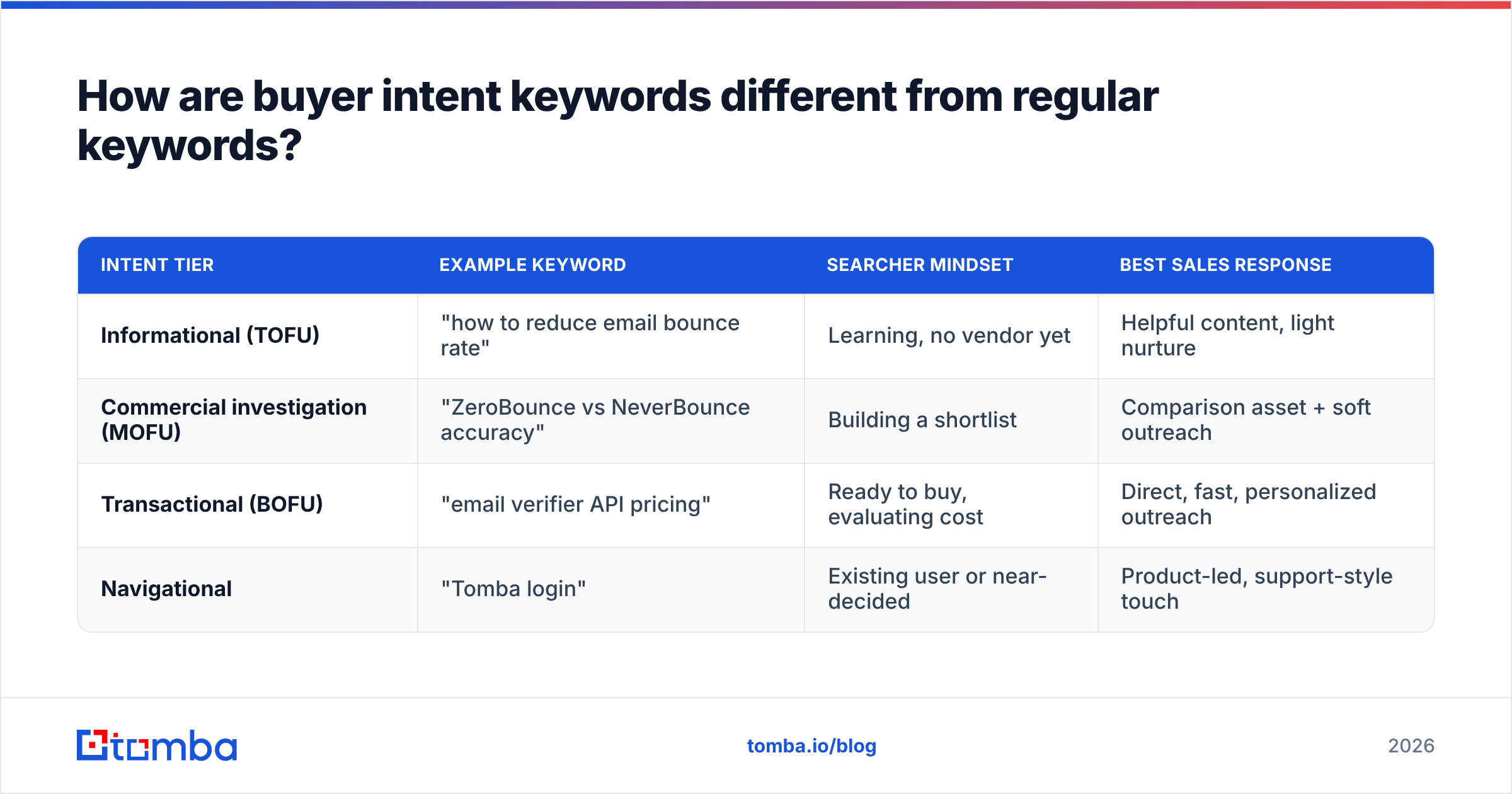
Here is the core difference laid out by funnel stage:
| Intent tier | Example keyword | Searcher mindset | Best sales response |
|---|---|---|---|
| Informational (TOFU) | "how to reduce email bounce rate" | Learning, no vendor yet | Helpful content, light nurture |
| Commercial investigation (MOFU) | "ZeroBounce vs NeverBounce accuracy" | Building a shortlist | Comparison asset + soft outreach |
| Transactional (BOFU) | "email verifier API pricing" | Ready to buy, evaluating cost | Direct, fast, personalized outreach |
| Navigational | "Tomba login" | Existing user or near-decided | Product-led, support-style touch |
The trap most teams fall into is treating every signal the same. A "how-to" reader gets the same aggressive cold email as someone pricing your API, and both convert poorly. Map the keyword to the tier, then map the tier to the response.
Why do buyer intent keywords matter in 2026?#
Three things changed the math. First, buyers now complete most of their research before they ever talk to sales — Gartner has long pegged the typical B2B buying group as spending the majority of its journey self-educating, and that share keeps climbing. Second, AI-assisted search means buyers reach vendor-comparison and pricing queries faster, compressing the window you have to react. Third, intent data has commoditized: review platforms, content syndication networks, and your own analytics all surface signals that used to be invisible.
The result is a timing game. The account that books a meeting is rarely the best-fit account — it's the in-market account that someone reached first. Buyer intent keywords are how you find "first." If you want the formal definition of the downstream outcome, it's simply a faster path to a marketing qualified lead, because the prospect has already self-identified as in-market.
Where do buyer intent signals actually come from?#
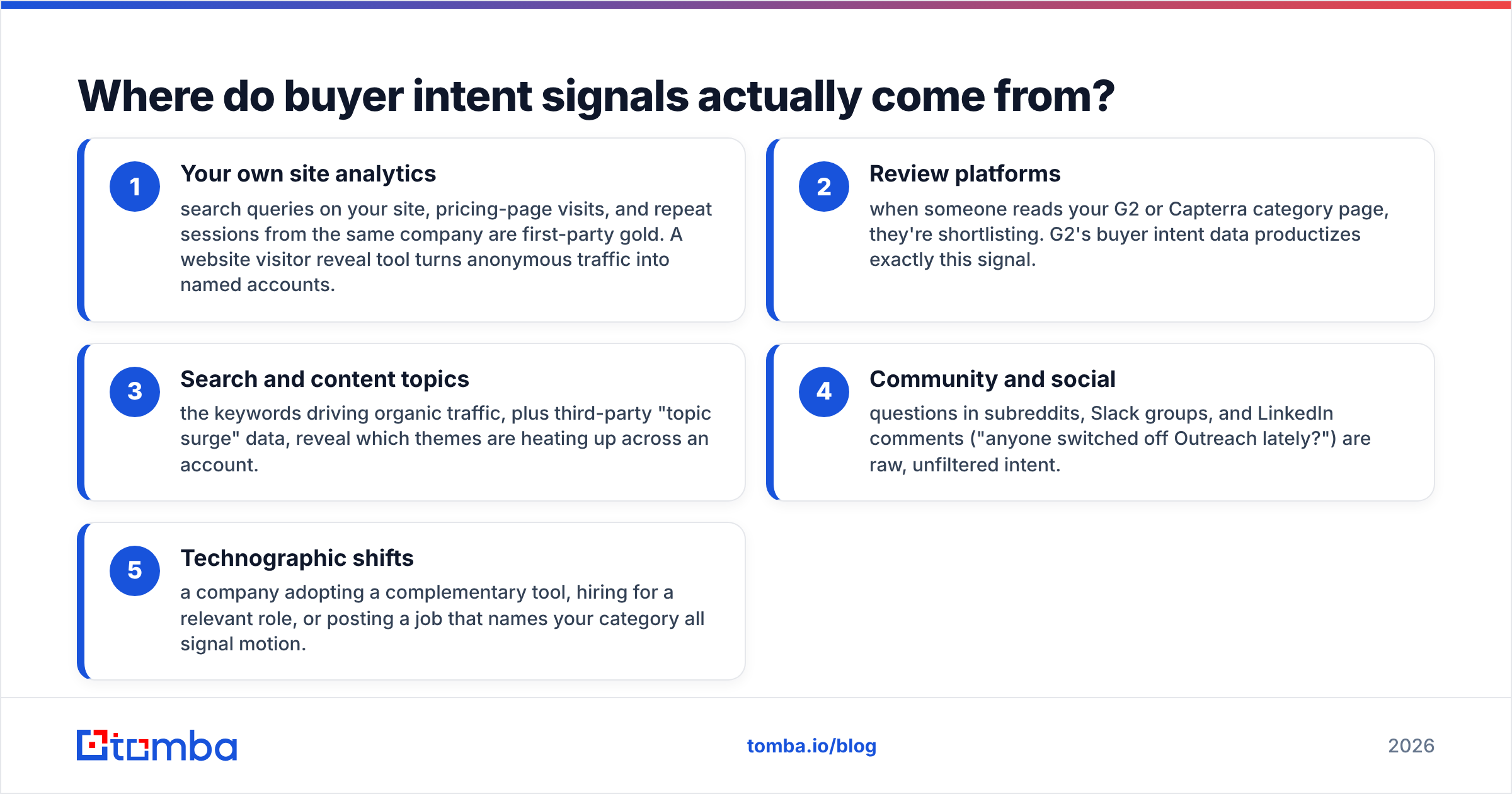
You don't need a $60k platform to start. Intent signals live in five places you can tap today:
- Your own site analytics — search queries on your site, pricing-page visits, and repeat sessions from the same company are first-party gold. A website visitor reveal tool turns anonymous traffic into named accounts.
- Review platforms — when someone reads your G2 or Capterra category page, they're shortlisting. G2's buyer intent data productizes exactly this signal.
- Search and content topics — the keywords driving organic traffic, plus third-party "topic surge" data, reveal which themes are heating up across an account.
- Community and social — questions in subreddits, Slack groups, and LinkedIn comments ("anyone switched off Outreach lately?") are raw, unfiltered intent.
- Technographic shifts — a company adopting a complementary tool, hiring for a relevant role, or posting a job that names your category all signal motion.
The catch is that a signal without a contact is a dead end. You can know that someone at acme.com priced your category this week, but if you can't reach the right buyer, the insight evaporates. That's the bridge most teams miss — and it's where contact data closes the loop.
How do you build a buyer intent keyword list?#
Start narrow and concrete. Don't try to boil the ocean; build a seed list of 30–50 phrases that a real buyer types when they're close to purchasing.
- Mine your won deals. Ask recent customers what they searched before they found you. Those phrases are your highest-converting keywords by definition.
- Steal from comparison queries. Every "[competitor] alternative" and "[competitor] vs [competitor]" is a transactional keyword. If you sell against Apollo, "Apollo alternative" is a buying signal — the people typing it have a budget and a complaint.
- Layer modifiers. Add "pricing," "API," "for [industry]," "review," "demo," and "vs" to your core terms. These modifiers correlate with late-stage intent.
- Watch the negative space. Phrases like "cancel," "too expensive," or "migrate from" against a competitor signal an account in active churn — your warmest possible lead.
Once you have the seed list, group each phrase into the tier table above and assign it a point value. The list is a living document; review it monthly and prune phrases that bring traffic but no pipeline.
How do you score and prioritize intent signals?#
A signal is only useful if you can rank it against a hundred others. Use a transparent formula your whole team understands:
Intent score = (keyword tier weight) × (recency multiplier) × (account-fit multiplier)
- Keyword tier weight — Informational = 1, commercial investigation = 3, transactional = 5.
- Recency multiplier — within 48 hours = 3, within a week = 2, within a month = 1. Intent decays fast; a 30-day-old signal is barely warm.
- Account-fit multiplier — strong ICP match = 2, partial = 1, poor = 0 (drop it entirely).
A transactional keyword from a perfect-fit account this morning scores 5 × 3 × 2 = 30 and goes to the top of the rep's queue. An informational read from a partial-fit account last month scores 1 × 1 × 1 = 1 and waits. This keeps reps working the hottest 10% instead of grinding through a flat list. For a deeper rubric on grading and routing these scores, see the broader discipline of lead generation — intent scoring is the front door to it.
How do you turn buyer intent keywords into booked meetings?#
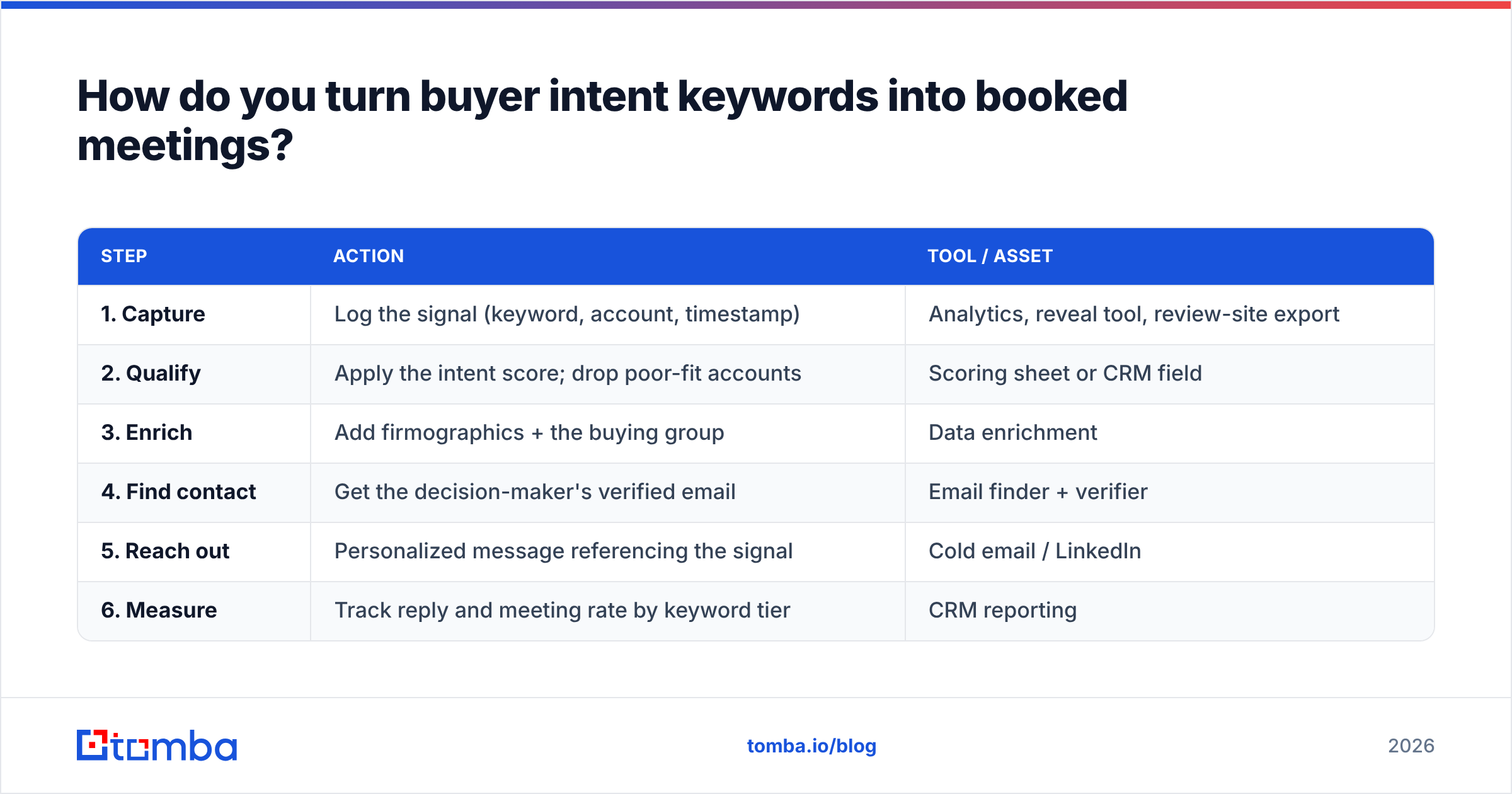
Here is the operational loop that separates teams who collect intent from teams who convert it:
| Step | Action | Tool / asset |
|---|---|---|
| 1. Capture | Log the signal (keyword, account, timestamp) | Analytics, reveal tool, review-site export |
| 2. Qualify | Apply the intent score; drop poor-fit accounts | Scoring sheet or CRM field |
| 3. Enrich | Add firmographics + the buying group | Data enrichment |
| 4. Find contact | Get the decision-maker's verified email | Email finder + verifier |
| 5. Reach out | Personalized message referencing the signal | Cold email / LinkedIn |
| 6. Measure | Track reply and meeting rate by keyword tier | CRM reporting |
Steps 3 and 4 are where intent becomes revenue. Knowing acme.com is in-market is useless until you know that Dana, the VP of RevOps, owns the decision and her email is dana@acme.com. Layer data enrichment onto the account, then use an email verifier so your carefully timed message doesn't bounce and torch your sender reputation.
The outreach itself should reference the signal without being creepy. "Saw your team is evaluating options in the deliverability space" works; "I see you visited our pricing page at 2:47pm" does not. Tie the message to the topic, not the surveillance.
What tools do you need — and what can you skip?#
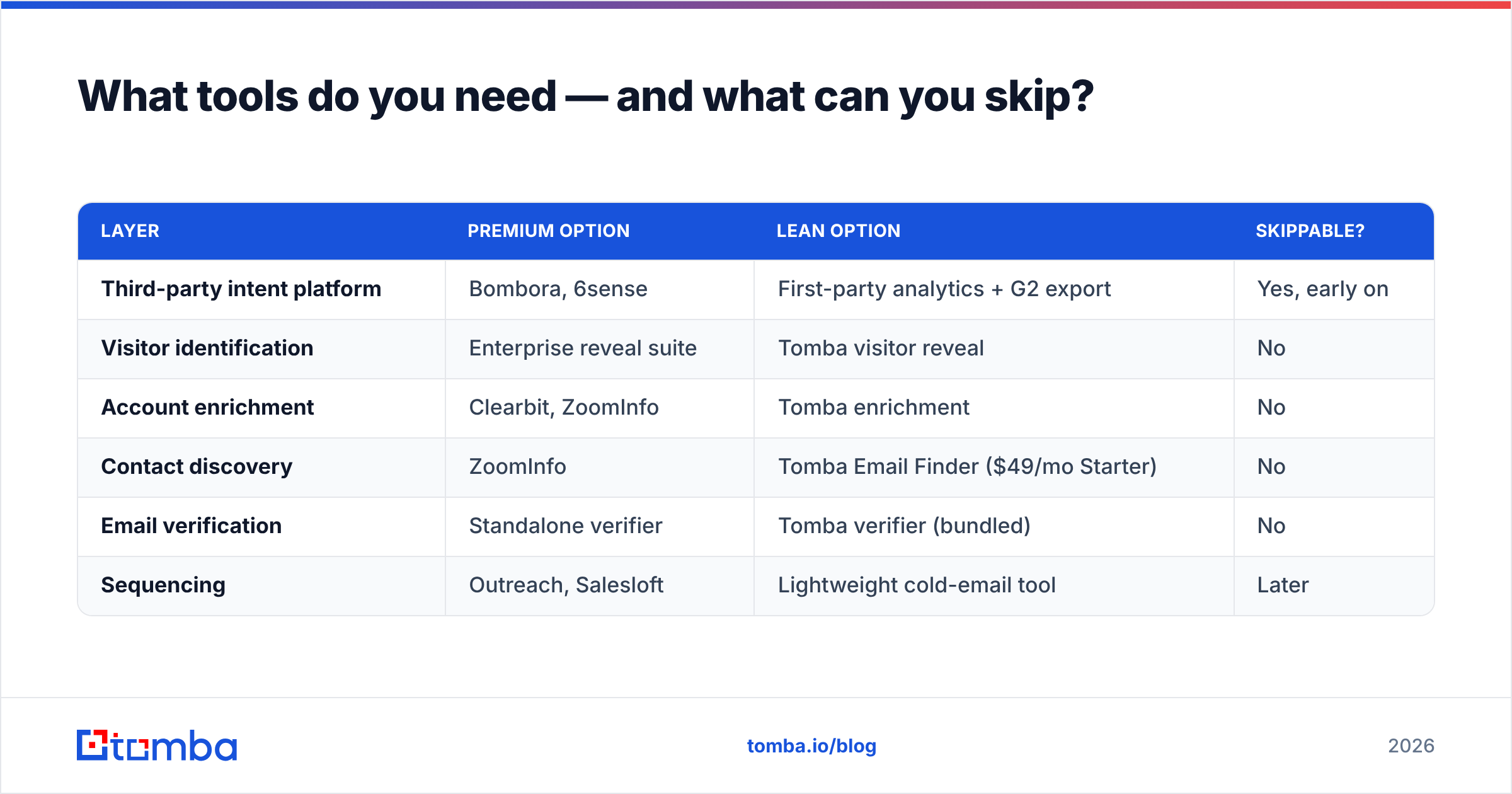
You can assemble a credible intent stack on a startup budget. The expensive part is the platform layer; the indispensable part is the contact-data layer. Here's an honest breakdown:
| Layer | Premium option | Lean option | Skippable? |
|---|---|---|---|
| Third-party intent platform | Bombora, 6sense | First-party analytics + G2 export | Yes, early on |
| Visitor identification | Enterprise reveal suite | Tomba visitor reveal | No |
| Account enrichment | Clearbit, ZoomInfo | Tomba enrichment | No |
| Contact discovery | ZoomInfo | Tomba Email Finder ($49/mo Starter) | No |
| Email verification | Standalone verifier | Tomba verifier (bundled) | No |
| Sequencing | Outreach, Salesloft | Lightweight cold-email tool | Later |
The pattern is clear: skip the big intent platform until you've maxed out free first-party signals, but never skip enrichment, contact discovery, or verification. Those three are the difference between "interesting dashboard" and "booked meeting." You can review the full Tomba pricing to see how the finder, verifier, and enrichment bundle together rather than buying four separate subscriptions. For an outside benchmark on platform costs, HubSpot's research on buyer behavior is a useful sanity check on where to invest.
What are the most common mistakes with buyer intent keywords?#
- Chasing volume over intent. A high-traffic informational keyword feels productive and converts nothing. Optimize for commercial proximity, not impressions.
- Letting signals go stale. Intent has a 48-hour half-life. If your process takes a week to act, you're emailing yesterday's buyer who already signed with a faster competitor.
- Reaching the wrong person. Account-level intent ≠ contact-level access. Without a verified email for the actual decision-maker, you're shouting into a mailbox nobody reads.
- One message for every tier. Blasting a "buy now" CTA at someone in the learning phase burns the relationship. Match the message to the mindset.
- No feedback loop. If you don't track reply rate by keyword tier, you can't kill the phrases that waste reps' time. Measure, prune, repeat.
How does this fit into a 2026 outbound motion?#
Buyer intent keywords are the targeting layer; everything else is execution. The modern motion looks like this: surface in-market accounts from intent signals, enrich and prioritize them with a transparent score, find and verify the right contact, then reach out fast with a message tied to the buyer's actual topic. The teams winning in 2026 aren't the ones with the biggest lists — they're the ones with the shortest gap between a buying signal and a relevant human touch.
That gap is almost always a data problem, not a strategy problem. You know the account is hot. You just need the verified email of the person who can say yes, before your competitor finds it too.
Start closing the loop today#
Intent tells you who and when. The missing piece is how to reach them — and that's a contact-data problem you can solve in minutes. Use the Tomba Email Finder to turn every in-market account into a verified, reachable decision-maker: search by domain, name, or company, confirm the address with the built-in verifier, and hand your reps a list that's hot and deliverable. The free tier gives you 25 searches a month to test the workflow, and the $49/mo Starter plan scales it once you see the meetings land. Stop letting good intent signals die at the inbox — connect the dots and book the meeting first.
// get started
Find, verify and enrich your first contacts today
Start on the free plan with 25 searches a month, then scale when your team is ready.
Free plan · No credit card required · GDPR & CCPA
// about the author