Buyer Intent Keywords List: 60+ Terms That Convert in 2026
A practical buyer intent keywords list for 2026 — sorted by funnel stage, with examples, intent scores, and how to turn high-intent searches into booked meetings.
Most of your traffic is window-shopping. A small slice is reaching for a credit card. The difference between the two is the language they type into a search bar — and a good buyer intent keywords list is how you tell them apart before your competitors do.
This guide gives you that list, organized so you can act on it. You will get 60+ real terms sorted by funnel stage, an intent score for each category, and a workflow for turning a high-intent search into a booked meeting instead of a bounce.
TL;DR#
- Buyer intent keywords are search phrases that reveal where someone sits in the buying journey — from "what is" curiosity to "buy now" readiness.
- They split into three buckets: informational (low intent), commercial investigation (medium-high), and transactional (high intent).
- The highest-converting terms contain modifiers like best, pricing, vs, alternative, for [industry], and near me.
- A keyword list is only half the job — the revenue comes from identifying and contacting the companies behind those searches fast.
- Pair your list with website visitor identification and an email finder so high-intent traffic becomes named contacts, not anonymous sessions.
What are buyer intent keywords?#
Buyer intent keywords are the search terms that signal how ready a person is to buy. Think of them like a restaurant host reading body language: someone glancing at the menu taped to the window is browsing; someone asking "do you have a table for two right now?" is ready to be seated. Same building, very different intent.
Technically, intent is inferred from the words and modifiers in a query. "Email verification" is vague. "ZeroBounce vs Tomba pricing" is a buyer with a shortlist, a budget question, and a decision to make this quarter. Search engines already classify queries this way, and so should your demand-gen team.
The payoff is efficiency. When you target high-intent terms, you spend ad budget and sales time on people who are close to a purchase decision instead of broad audiences who will never convert. That is the entire premise behind lead generation that actually fills pipeline.
What are the three types of buyer intent keywords?#
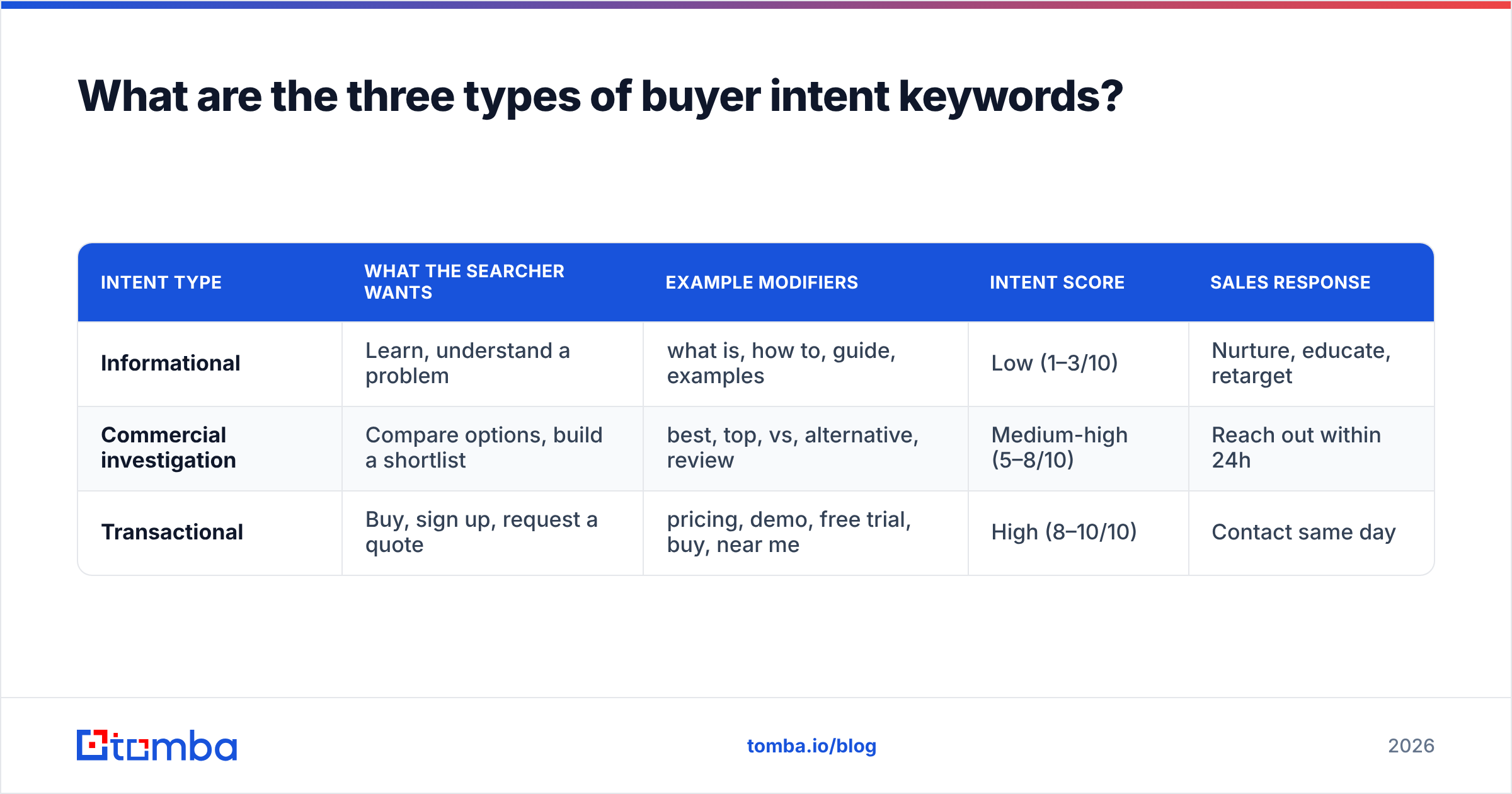
Every search maps to one of three intent levels. Here is how they compare on intent strength, typical volume, and how aggressively you should respond.
| Intent type | What the searcher wants | Example modifiers | Intent score | Sales response |
|---|---|---|---|---|
| Informational | Learn, understand a problem | what is, how to, guide, examples | Low (1–3/10) | Nurture, educate, retarget |
| Commercial investigation | Compare options, build a shortlist | best, top, vs, alternative, review | Medium-high (5–8/10) | Reach out within 24h |
| Transactional | Buy, sign up, request a quote | pricing, demo, free trial, buy, near me | High (8–10/10) | Contact same day |
The mistake most teams make is treating all three the same. You do not pitch a demo to someone reading a "what is email deliverability" article, and you do not send a 2,000-word explainer to someone searching "Tomba pricing." Match the message to the intent score.
The buyer intent keywords list (sorted by stage)#
Here is the working list. Swap the bracketed placeholders for your category, product, or competitor names.
Informational intent (top of funnel, score 1–3)#
These terms attract future buyers. Capture the email, do not push the sale.
- what is [category] — e.g., "what is data enrichment"
- how to [achieve outcome] — "how to find anyone's email address"
- [problem] examples
- [category] guide / tutorial / checklist
- why is [problem] happening
- [category] benchmarks / statistics 2026
- [category] best practices
- types of [category]
Commercial investigation (middle of funnel, score 5–8)#
This is the highest-leverage bucket. The searcher has a problem and a budget — they are just choosing a vendor.
- best [category] tools — "best email finders"
- top [category] software 2026
- [competitor] alternative — "Apollo alternative", "RocketReach alternative"
- [competitor A] vs [competitor B] — "Hunter vs Tomba"
- [category] reviews
- [category] for [industry/role] — "email finder for recruiters"
- is [product] worth it
- [product] case study / results
- cheapest / most accurate [category]
- [category] comparison
Transactional intent (bottom of funnel, score 8–10)#
These people are ready. Get a human in front of them today.
- [product] pricing / cost / plans
- [product] free trial / free plan
- [product] demo / book a demo
- buy [product]
- [product] discount / coupon / deal
- [product] sign up / get started
- [category] near me (for local/services)
- [product] API / integration with [tool]
- [product] vs [product] pricing
- switch from [competitor]
Notice how the transactional terms cluster around money, speed, and switching. A search like "switch from RocketReach" is a competitor's unhappy customer raising their hand. If you sell a RocketReach alternative, that single keyword is worth more than a thousand "what is" impressions.
How do you find buyer intent keywords for your own market?#
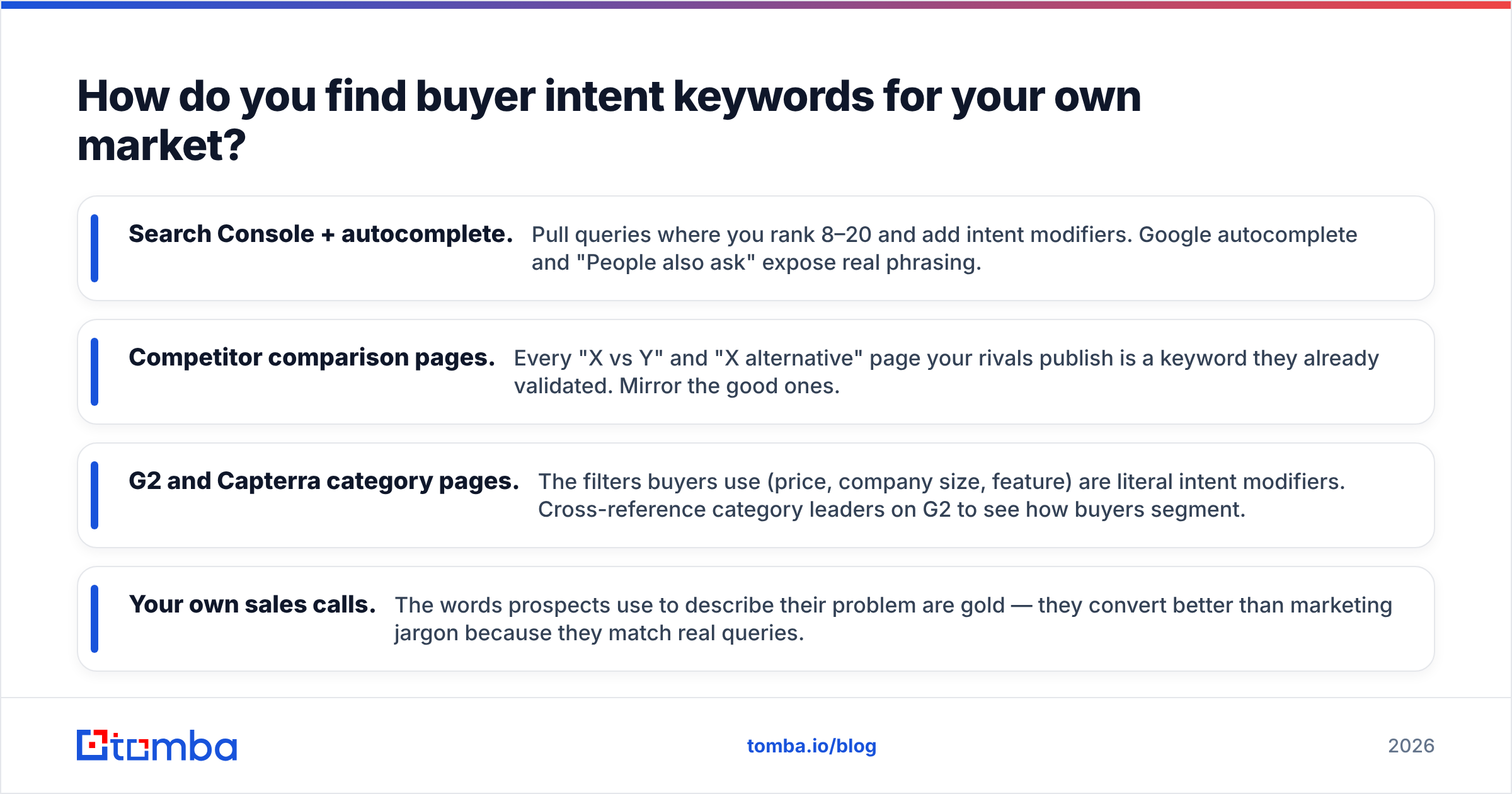
You do not have to guess. Combine four sources and you will surface nearly every commercial term in your niche.
- Search Console + autocomplete. Pull queries where you rank 8–20 and add intent modifiers. Google autocomplete and "People also ask" expose real phrasing.
- Competitor comparison pages. Every "X vs Y" and "X alternative" page your rivals publish is a keyword they already validated. Mirror the good ones.
- G2 and Capterra category pages. The filters buyers use (price, company size, feature) are literal intent modifiers. Cross-reference category leaders on G2 to see how buyers segment.
- Your own sales calls. The words prospects use to describe their problem are gold — they convert better than marketing jargon because they match real queries.
Run each candidate through a simple test: would someone typing this be ready to talk to sales in the next 30 days? If yes, it belongs in your commercial or transactional bucket.
How do you turn intent keywords into actual pipeline?#
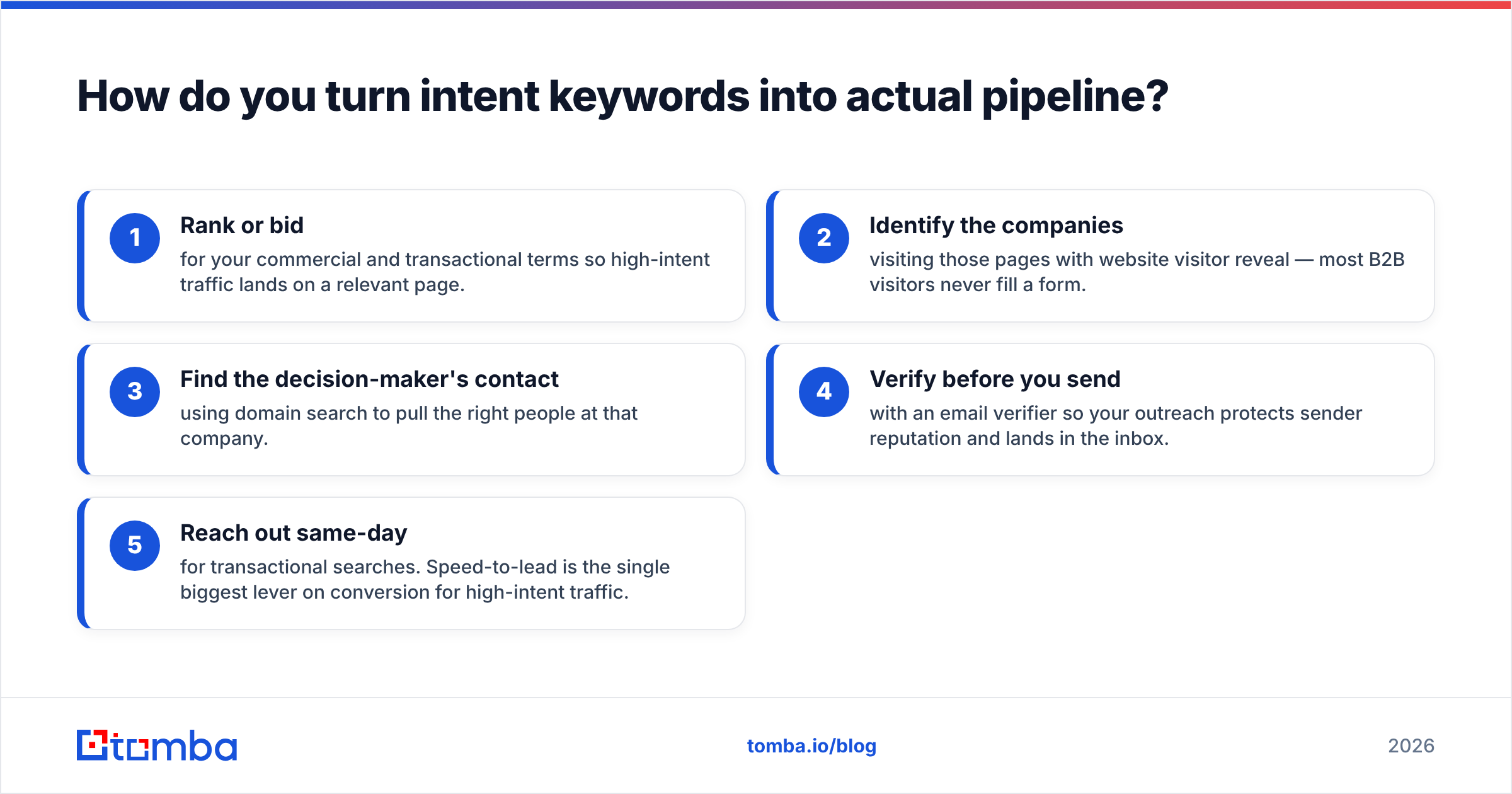
A keyword list ranks pages. It does not, by itself, book meetings. The revenue step is connecting an anonymous high-intent visitor to a real, contactable human. Here is the loop that works.

- Rank or bid for your commercial and transactional terms so high-intent traffic lands on a relevant page.
- Identify the companies visiting those pages with website visitor reveal — most B2B visitors never fill a form.
- Find the decision-maker's contact using domain search to pull the right people at that company.
- Verify before you send with an email verifier so your outreach protects sender reputation and lands in the inbox.
- Reach out same-day for transactional searches. Speed-to-lead is the single biggest lever on conversion for high-intent traffic.
This is where intent data and contact data meet. The keyword tells you who is in-market; the data enrichment tells you exactly who to call. Skip step two through four and you are just generating traffic for the competitor who does follow up.
Which intent keywords have the highest ROI?#
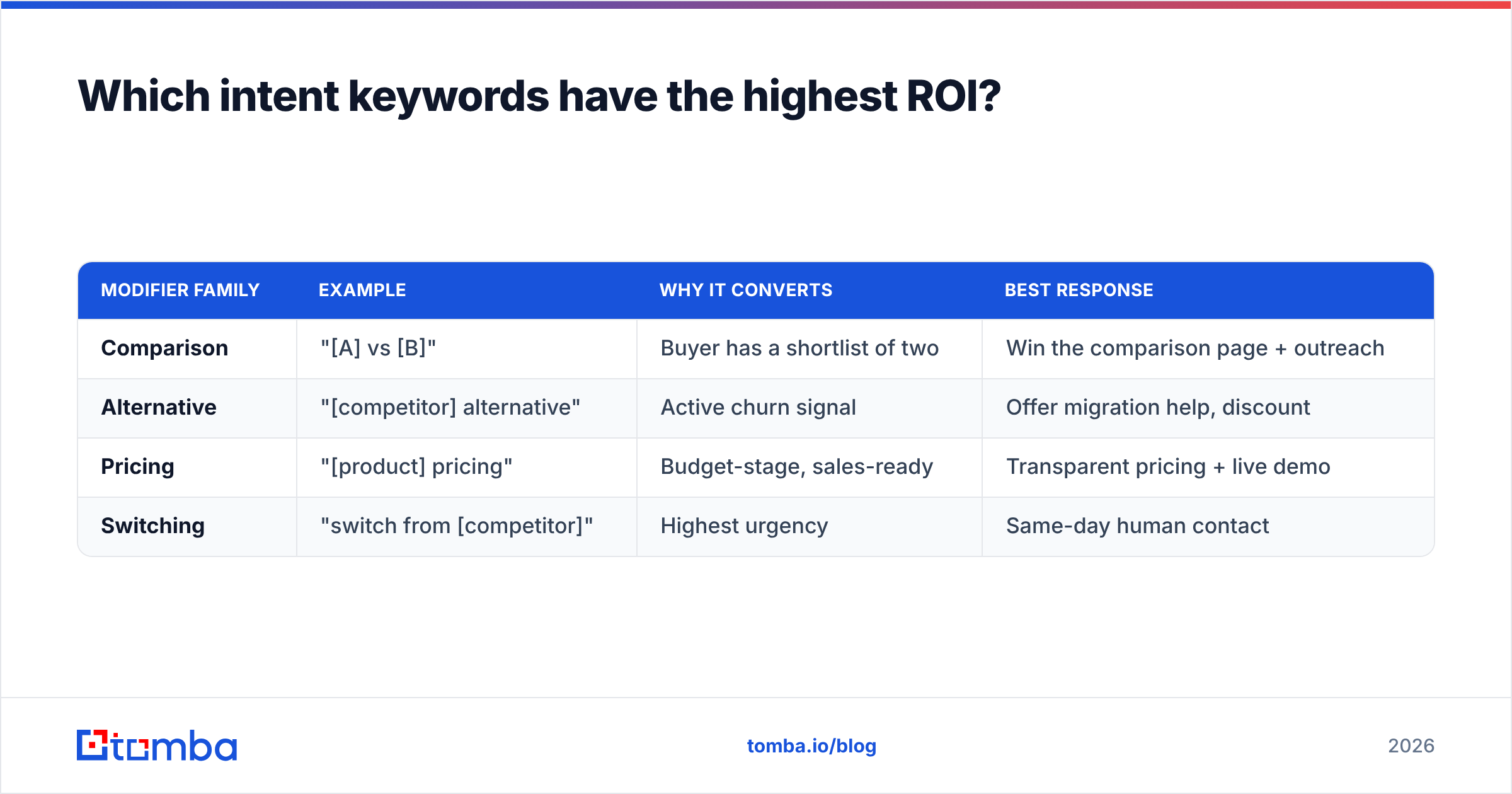
Three modifier families consistently punch above their search volume.
| Modifier family | Example | Why it converts | Best response |
|---|---|---|---|
| Comparison | "[A] vs [B]" | Buyer has a shortlist of two | Win the comparison page + outreach |
| Alternative | "[competitor] alternative" | Active churn signal | Offer migration help, discount |
| Pricing | "[product] pricing" | Budget-stage, sales-ready | Transparent pricing + live demo |
| Switching | "switch from [competitor]" | Highest urgency | Same-day human contact |
If you only had budget for one bucket, choose comparison and alternative terms. They have lower volume than "best [category]," but the searcher is deeper in the funnel and far cheaper to convert. Build a clean comparison page, link it to transparent Tomba pricing, and route every visitor through the identification loop above.
How do you score and prioritize a buyer intent keywords list?#
Assign each term two numbers: an intent score (1–10, from the tables above) and an effort score (how hard it is to rank or how expensive to bid). Then prioritize by intent-to-effort ratio.
- High intent, low effort → do first. Usually long-tail comparison and "for [niche]" terms.
- High intent, high effort → invest steadily. Head terms like "best [category]."
- Low intent, low effort → batch for top-of-funnel content and retargeting.
- Low intent, high effort → skip unless brand-building.
Re-score quarterly. Intent shifts: a term that was informational in 2024 can become transactional once your category matures and buyers know what they want. For deeper definitions of the funnel stages, the B2B glossary is a useful reference, and so is HubSpot's primer on buyer intent data.
Common mistakes with buyer intent keywords#
- Chasing volume over intent. A 50-search "switch from [competitor]" term beats a 50,000-search "what is" term for pipeline.
- No follow-up system. Ranking without an identification-and-outreach loop means you warm up leads for someone else.
- Sending to unverified emails. High-intent outreach to a stale list torches your sender reputation. Verify first.
- One message for all intents. Pitching a demo to a top-of-funnel reader feels like a stranger proposing on a first date. Match the ask to the score.
- Set-and-forget lists. Markets move. Refresh modifiers, competitors, and scores every quarter.
Turn high-intent searches into named contacts#
A buyer intent keywords list gets the right people onto your pages — but pages do not close deals, conversations do. The fastest path from an in-market search to a sales call is to identify the company behind the visit, find the decision-maker, and reach out before the intent cools.
That is exactly what the Tomba Email Finder is built for: turn a domain or a name into a verified, contactable email in seconds, then push it straight into your outreach. Start free with 25 searches a month, scale on the Starter plan at $49/mo, and stop letting high-intent traffic leave anonymous. Pair your keyword list with Tomba and every ready buyer becomes a real conversation.
// get started
Find, verify and enrich your first contacts today
Start on the free plan with 25 searches a month, then scale when your team is ready.
Free plan · No credit card required · GDPR & CCPA
// about the author