Buyer Intent Marketing in 2026: The Complete B2B Playbook
Buyer intent marketing turns anonymous research signals into pipeline. Here is how intent data works in 2026, which signals matter, and how to act on them fast.
Most of your future buyers are already researching a solution like yours right now — and you have no idea who they are. Buyer intent marketing is the discipline of finding those people while they are still in the research phase, instead of waiting for them to fill out a form. Done well, it is the difference between chasing cold lists and reaching accounts that already want to talk.
TL;DR#
- Buyer intent marketing uses behavioral signals (content consumption, search, site visits, review activity) to identify accounts actively researching a purchase, then targets them before competitors do.
- There are three signal layers: first-party (your own site/CRM), second-party (review and community platforms), and third-party (publisher co-ops and the wider web).
- Intent without contact data is useless — you need to resolve anonymous accounts into named, reachable people to act on a signal.
- The winning play in 2026 is speed: route a hot signal to sales or a tailored campaign within hours, not weeks.
- Start narrow. Pick one high-value topic, one signal source, and one play before you buy an enterprise intent platform.
What is buyer intent marketing?#
Buyer intent marketing is a go-to-market approach that prioritizes prospects based on observable buying signals rather than static firmographics alone. Instead of treating every company in your ICP equally, you weight your outreach toward the accounts showing measurable research activity right now.
Think of it like a bookstore that notices the same customer keeps returning to the personal-finance shelf. The customer hasn't bought anything yet, but the staff would be foolish to pitch them cookbooks. Intent data is that observation, applied at scale across thousands of accounts.
Technically, intent signals are aggregated from many sources — content downloads, keyword searches, competitor comparison pages, software review sites, and ad engagement — then scored against topics that map to your product. A spike above an account's normal baseline is what marketers call a "surge."
The category has matured fast. According to Gartner, B2B buyers spend the majority of their journey researching independently before ever contacting a vendor. Buyer intent marketing exists to shrink that blind spot.
Why does intent data matter more in 2026?#
Three shifts made intent the center of modern GTM:
- Self-serve research is the default. Buyers complete most of their evaluation before a sales conversation. If you wait for the form fill, the shortlist is already set.
- Form fills are drying up. Privacy changes, AI-summarized search, and gated-content fatigue mean fewer people raise their hands. Intent fills the gap with passive signals.
- Budgets reward efficiency. When every dollar is scrutinized, spraying the whole ICP looks wasteful. Targeting only surging accounts lifts conversion rates and lowers cost per opportunity.
The result: intent data moved from a "nice enrichment field" to the layer that decides who gets your attention each week. Pair it with solid data enrichment and you can move from "this account is interested" to "here are the three people to contact and how to reach them."
What are the types of buyer intent signals?#
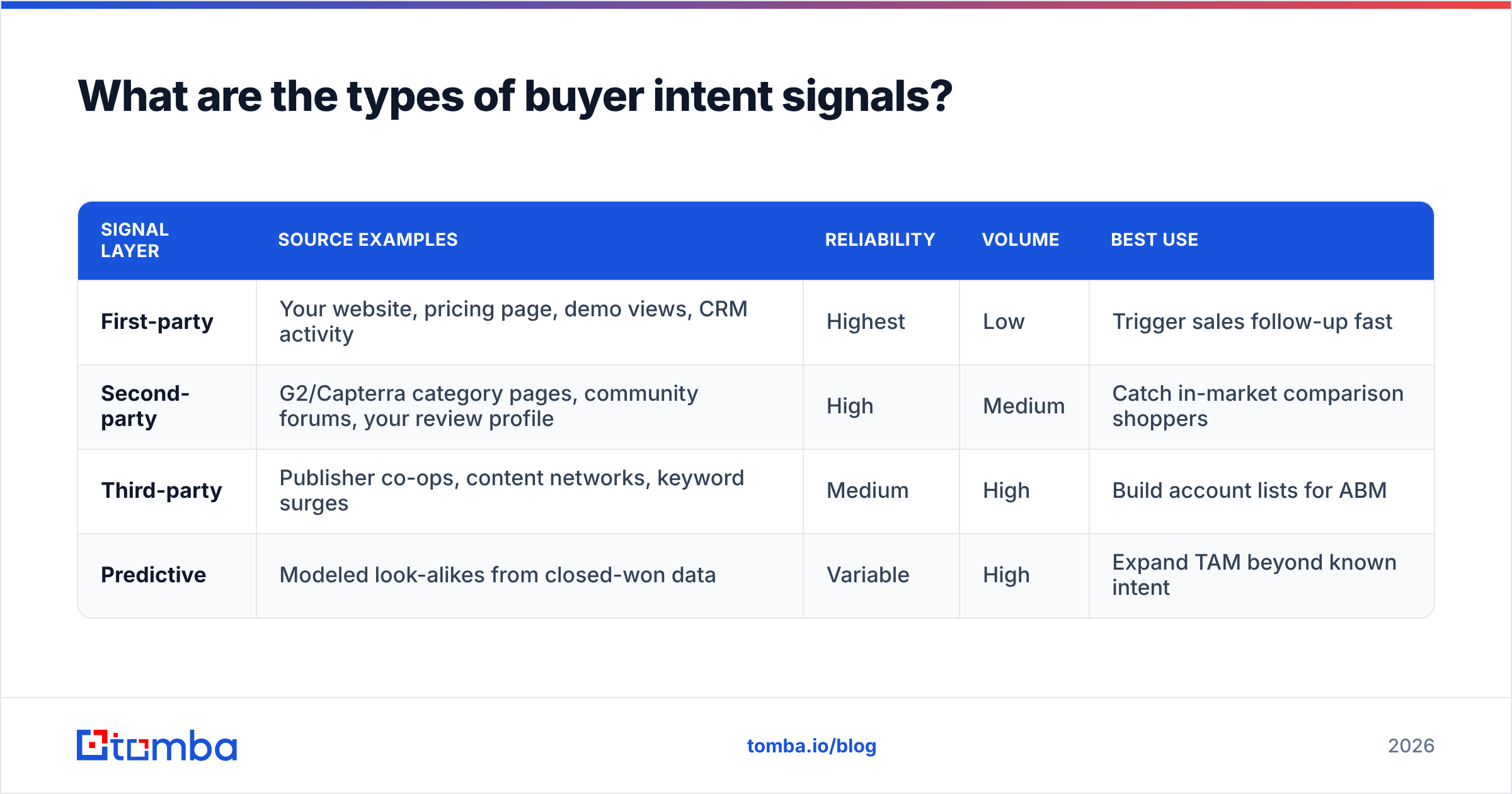
Not all signals are equal. The closer a signal is to your own property, the more reliable it is — but the rarer it is. The table below breaks down the three layers.
| Signal layer | Source examples | Reliability | Volume | Best use |
|---|---|---|---|---|
| First-party | Your website, pricing page, demo views, CRM activity | Highest | Low | Trigger sales follow-up fast |
| Second-party | G2/Capterra category pages, community forums, your review profile | High | Medium | Catch in-market comparison shoppers |
| Third-party | Publisher co-ops, content networks, keyword surges | Medium | High | Build account lists for ABM |
| Predictive | Modeled look-alikes from closed-won data | Variable | High | Expand TAM beyond known intent |
A practical hierarchy: first-party signals are gold because the prospect touched your brand. Second-party signals — like someone reading your G2 profile against a competitor — are nearly as strong because they reveal active comparison. Third-party intent is broad and noisier, but it is how you discover accounts you've never heard of.
The mistake teams make is buying third-party intent first because it promises the biggest list. Start with the signals closest to you. They convert better and cost nothing.
How do you turn an intent signal into pipeline?#
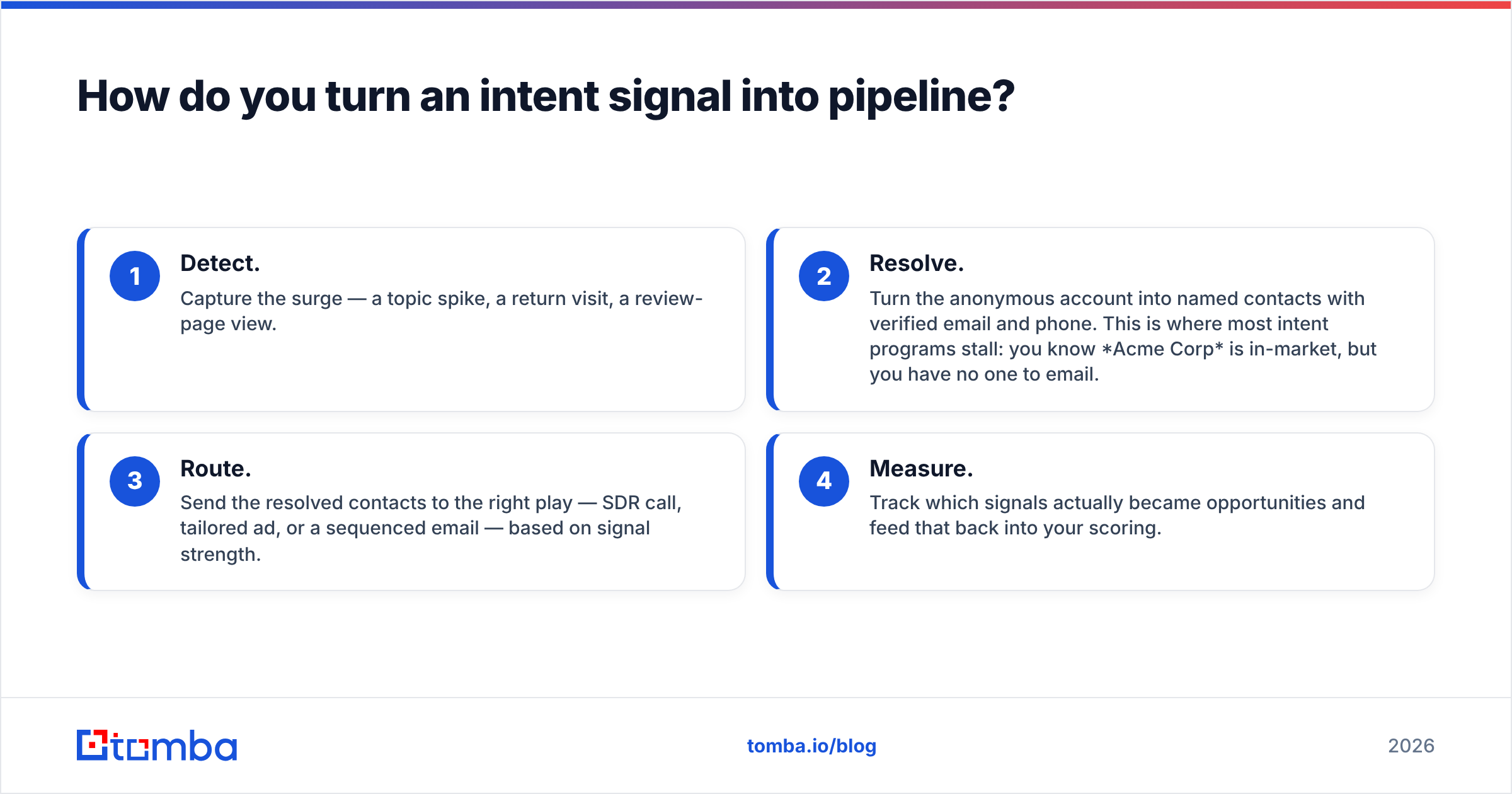
A signal is a lead only after you can act on it. The workflow has four steps, and the gap most teams fall into is between steps two and three.
- Detect. Capture the surge — a topic spike, a return visit, a review-page view.
- Resolve. Turn the anonymous account into named contacts with verified email and phone. This is where most intent programs stall: you know Acme Corp is in-market, but you have no one to email.
- Route. Send the resolved contacts to the right play — SDR call, tailored ad, or a sequenced email — based on signal strength.
- Measure. Track which signals actually became opportunities and feed that back into your scoring.
Step two is the make-or-break. Intent platforms surface account names; they rarely hand you reliable, deliverable contact details for the specific decision-makers. That is exactly the job of an email finder: take the surging company domain and return the people who match your buyer persona, with addresses you can actually send to. Layer in a B2B database and you can enrich the whole account team in one pass.
For first-party web intent specifically, deanonymizing your own traffic is the fastest win. Tools that handle website visitor reveal turn the 97% of visitors who never fill out a form into named accounts you can pursue while their interest is fresh.

Buyer intent marketing vs. traditional lead generation#
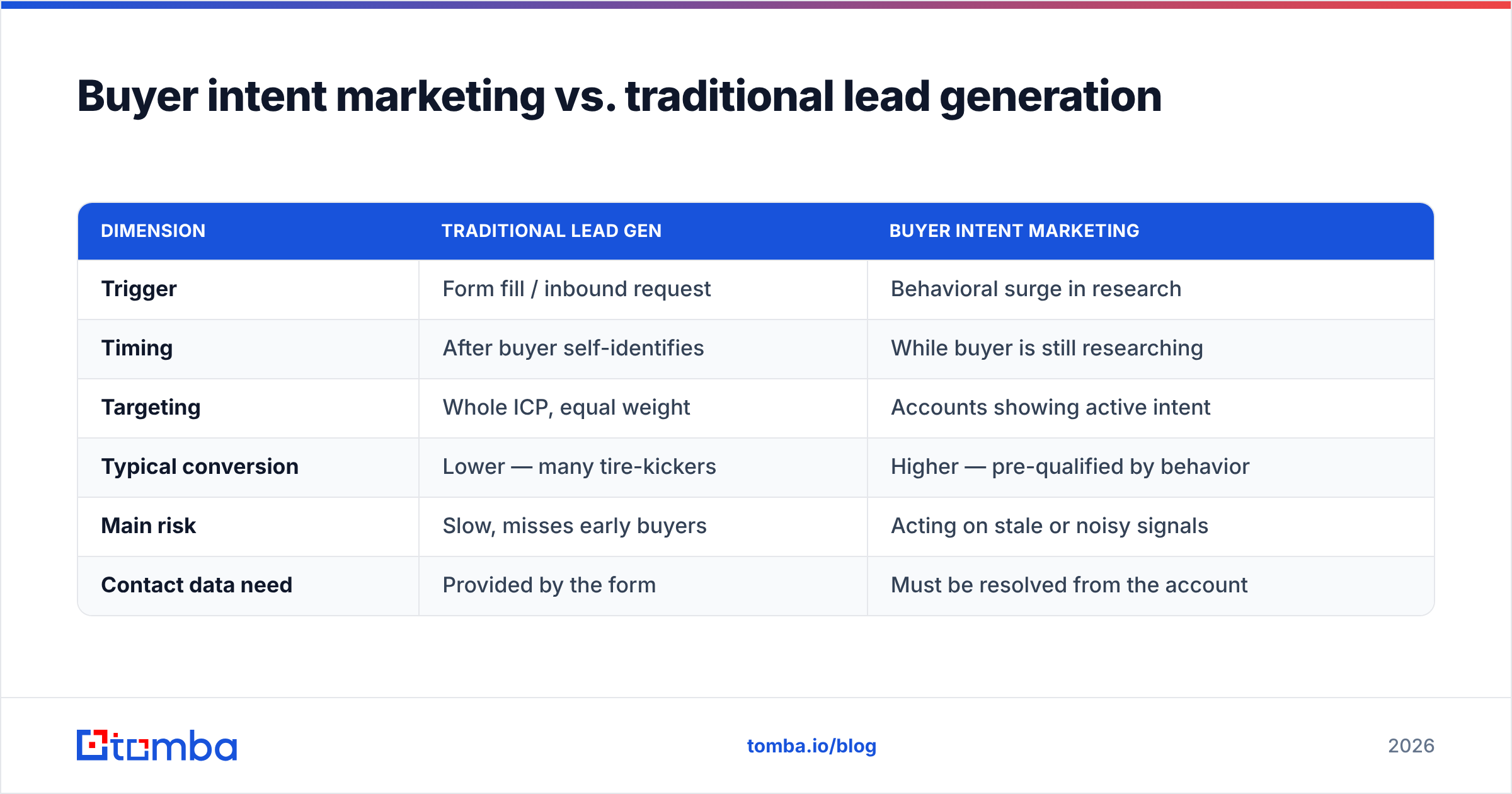
It helps to see the contrast directly. Traditional lead gen waits for a hand-raise; intent marketing acts on behavior before the hand goes up.
| Dimension | Traditional lead gen | Buyer intent marketing |
|---|---|---|
| Trigger | Form fill / inbound request | Behavioral surge in research |
| Timing | After buyer self-identifies | While buyer is still researching |
| Targeting | Whole ICP, equal weight | Accounts showing active intent |
| Typical conversion | Lower — many tire-kickers | Higher — pre-qualified by behavior |
| Main risk | Slow, misses early buyers | Acting on stale or noisy signals |
| Contact data need | Provided by the form | Must be resolved from the account |
The two are not enemies. Inbound forms still capture your hottest hand-raisers. Buyer intent marketing simply adds a second engine that finds the buyers who never fill out the form — which, in 2026, is most of them.
How do you build an intent-led campaign step by step?#
You do not need a six-figure platform to start. Here is a lean build that any B2B team can run this quarter.
- Pick one topic cluster. Choose the three to five keywords that signal genuine purchase intent for your category — comparison terms, "alternative to" queries, and bottom-of-funnel feature searches. Vanity topics waste budget.
- Choose one signal source. Begin with first-party: instrument your pricing and comparison pages, and reveal anonymous visitors. Add a second-party source (your review-site profile) before touching third-party.
- Define the surge threshold. Decide what counts as "in-market." A single page view is noise; three relevant touches in a week is a signal. Document it so scoring is consistent.
- Resolve contacts automatically. When an account crosses the threshold, pull the matching personas and verified contact details so a rep has someone to reach within the hour.
- Match the play to the heat. Strong first-party signal → SDR call same day. Third-party surge with no site visit → a tailored ad or a soft, value-first email.
- Close the loop. Tag every opportunity with the signal that sourced it. After 90 days you will know which topics actually predict revenue and can cut the rest.
Notice the pattern: narrow inputs, fast resolution, measured outputs. Teams that try to boil the ocean — every topic, every source, every account — drown in noise and conclude "intent data doesn't work." It works; breadth without discipline does not.
What mistakes kill intent programs?#
A few failure modes show up again and again. Avoid these and you are ahead of most of the market.
- Buying volume over signal quality. A 50,000-account third-party list feels productive and converts like a cold list. Prioritize the smaller, hotter set.
- No contact resolution. Surfacing account names without reachable people is a dead end. Budget for resolution and verification, not just the intent feed. Reaching the wrong inbox also burns your sender reputation, so verification is not optional.
- Slow routing. Intent decays in days. A signal that sits in a weekly report has already cooled. Automate the hand-off.
- One generic message. If your "intent-based" outreach reads like every other cold email, the signal advantage is wasted. Reference the specific problem the buyer is researching.
- Never measuring back. Without attribution from signal to closed-won, you cannot tell good topics from noise. Most platforms over-credit their own data; verify with your CRM.
For more on aligning these motions across marketing and sales, HubSpot's research on the B2B buyer's journey is a useful, vendor-neutral reference point.
How much does buyer intent marketing cost to start?#
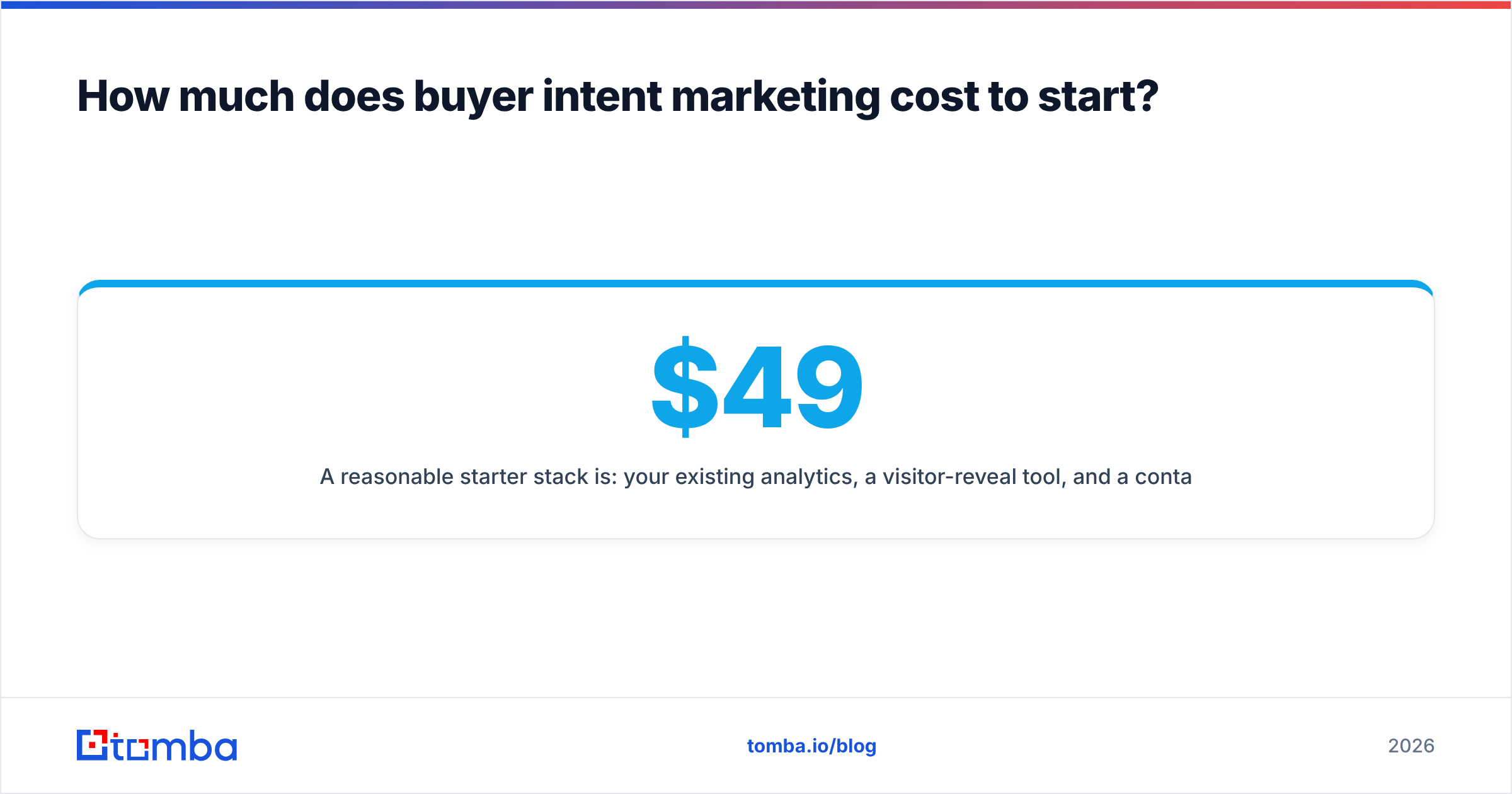
Less than the enterprise pricing pages suggest. The expensive part is third-party intent subscriptions; the high-ROI part — first-party reveal plus contact resolution — is affordable.
A reasonable starter stack is: your existing analytics, a visitor-reveal tool, and a contact-resolution tool with a verification layer. As a concrete anchor, Tomba pricing starts free with 25 searches per month, then $49/mo (Starter), $99/mo (Growth), and $249/mo (Pro) — enough to resolve and verify the accounts a focused first-party program surfaces without committing to a six-figure intent platform on day one.
Spend the saved budget proving the motion on one topic. Once you can show signal-sourced pipeline, the case for adding paid third-party intent makes itself.
The takeaway#
Buyer intent marketing is not a magic list — it is a discipline: detect the surge, resolve the account into real people, route fast, and measure what actually converts. The teams winning in 2026 are not the ones with the biggest intent subscription. They are the ones that turn a signal into a verified, personalized conversation before the competition even knows the buyer exists.
Start with the signals closest to you, and make sure every surging account becomes a reachable human — not a row in a dashboard. The Tomba Email Finder is built for exactly that step: take a surging company domain and return the verified, persona-matched contacts your reps can email today. Pair it with visitor reveal and enrichment, and your intent signals stop being interesting and start being pipeline. Spin up the free tier, point it at this week's hottest accounts, and see how fast "in-market" becomes "in conversation."
// get started
Find, verify and enrich your first contacts today
Start on the free plan with 25 searches a month, then scale when your team is ready.
Free plan · No credit card required · GDPR & CCPA
// about the author